Current switching behavior mediated via hinge modes in higher-order topological phases using altermagnets
Pith reviewed 2026-05-21 18:30 UTC · model grok-4.3
The pith
Coupling d-wave altermagnets to three-dimensional topological insulators produces controllable hinge modes that enable tunable current switching.
A machine-rendered reading of the paper's core claim, the machinery that carries it, and where it could break.
Core claim
Incorporation of the d_{x^2-z^2}-type AM drives the system into two second-order topological insulator phases hosting distinct types of hinge modes whose localization and propagation direction are controllable by tuning the relative strengths of the altermagnetic exchange orders, enabling a tunable current-switching behavior.
What carries the argument
The low-energy surface Hamiltonian derived from the bulk three-dimensional topological insulator coupled to d-wave altermagnets, together with the dipolar and quadrupolar winding numbers that classify the second-order topology and determine the hinge-mode spectrum.
Load-bearing premise
The low-energy surface theory and the topological invariants remain valid when the altermagnetic exchange terms are added to the bulk Hamiltonian of the three-dimensional topological insulator.
What would settle it
A reversal in the sign or spatial location of the quantized differential conductance along a chosen hinge when the ratio of the two altermagnetic exchange strengths is inverted would directly test the predicted controllability of propagation direction.
Figures
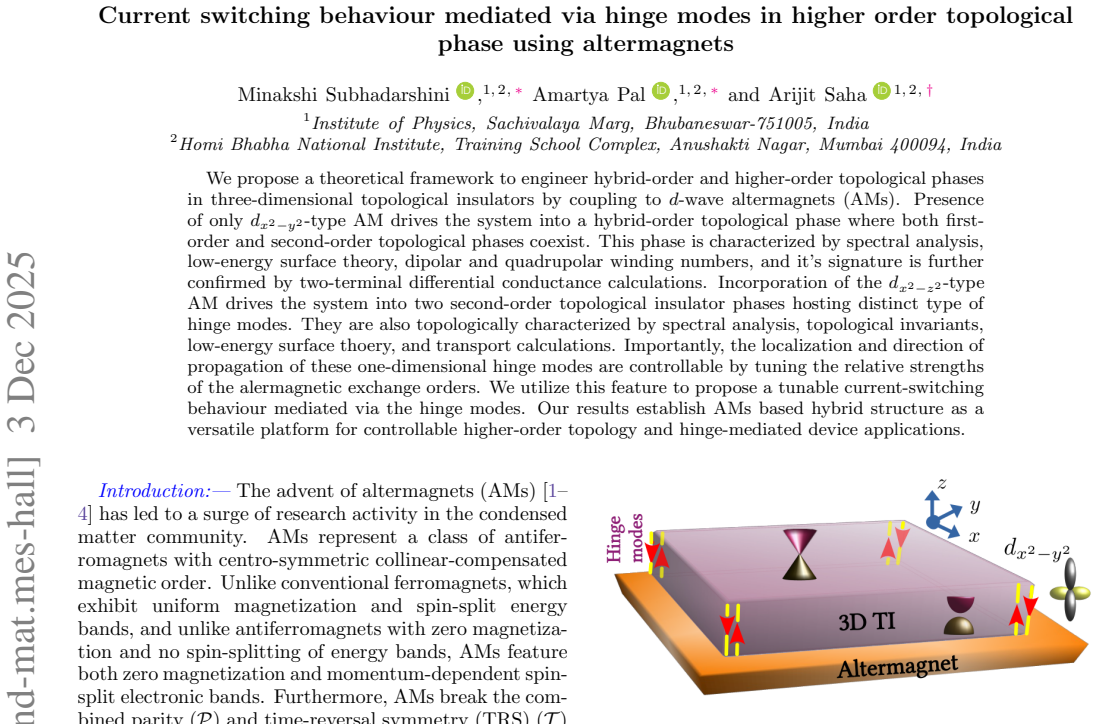


read the original abstract
We propose a theoretical framework to engineer hybrid-order and higher-order topological phases in three-dimensional topological insulators by coupling to $d$-wave altermagnets (AMs). Presence of only $d_{x^2-y^2}$-type AM drives the system into a hybrid-order topological phase where both first-order and second-order topological phases coexist. This phase is characterized by spectral analysis, low-energy surface theory, dipolar and quadrupolar winding numbers, and it's signature is further confirmed by two-terminal differential conductance calculations. Incorporation of the $d_{x^2-z^2}$-type AM drives the system into two second-order topological insulator phases hosting distinct type of hinge modes. These two variants of second-order topological phases are also topologically characterized by spectral analysis, topological invariants, low-energy surface thoery, and transport calculations. Importantly, the localization and direction of propagation of these one-dimensional hinge modes are controllable by tuning the relative strengths of the alermagnetic exchange orders. We utilize this feature to propose a tunable current-switching behaviour mediated via the hinge modes. Our results establish AMs based hybrid structure as a versatile platform for controllable higher-order topology and hinge-mediated device applications.
Editorial analysis
A structured set of objections, weighed in public.
Referee Report
Summary. The manuscript proposes coupling a three-dimensional topological insulator to d-wave altermagnets to realize hybrid-order and higher-order topological phases. With only d_{x^2-y^2}-type altermagnetic exchange the system enters a phase hosting both first- and second-order topology, diagnosed by spectral analysis, low-energy surface theory, dipolar/quadrupolar winding numbers, and two-terminal conductance. Adding a d_{x^2-z^2} component drives the system into two distinct second-order topological insulator phases whose hinge modes have tunable localization and propagation direction controlled by the relative strength of the two altermagnetic orders; this tunability is used to propose a current-switching device.
Significance. If the low-energy surface theory and winding-number diagnostics remain valid under the momentum-dependent altermagnetic perturbations, the work would provide a concrete route to electrically tunable hinge-mode transport in higher-order topological insulators, with direct implications for mesoscopic device design. The combination of bulk-boundary correspondence, transport calculations, and explicit parameter tuning constitutes a strength of the approach.
major comments (2)
- [low-energy surface theory] Section on low-energy surface theory (following the bulk Hamiltonian with added altermagnetic terms): the standard surface-state construction for a pure 3D TI does not automatically carry over when momentum-dependent, spin-selective exchange terms are introduced. Additional surface mixing or gap-opening contributions linear in k may appear that are not captured by the original low-energy expansion; these would alter the dipolar and quadrupolar winding numbers and therefore the claimed controllability of hinge-mode localization and direction. A explicit re-derivation of the effective surface Hamiltonian including all symmetry-allowed terms up to linear order in k is required to confirm the invariants remain well-defined across the full tuning range of the relative exchange strengths.
- [transport calculations] Transport section (two-terminal differential conductance): the conductance signatures attributed to the hinge modes assume perfect transmission along the hinges without backscattering from the altermagnetic perturbations. If the surface theory is incomplete, the calculated conductance plateaus may not correspond to the claimed hinge-mode propagation directions; explicit comparison of conductance for the two second-order phases at several values of the relative exchange ratio is needed to substantiate the switching behavior.
minor comments (2)
- [abstract] Abstract: 'alermagnetic' should read 'altermagnetic' and 'thoery' should read 'theory'.
- Notation for the two altermagnetic exchange strengths should be introduced once and used consistently in all figures and equations rather than switching between symbols.
Simulated Author's Rebuttal
We thank the referee for their thorough review and valuable suggestions. We address the major comments point by point below and have made revisions to strengthen the manuscript.
read point-by-point responses
-
Referee: Section on low-energy surface theory (following the bulk Hamiltonian with added altermagnetic terms): the standard surface-state construction for a pure 3D TI does not automatically carry over when momentum-dependent, spin-selective exchange terms are introduced. Additional surface mixing or gap-opening contributions linear in k may appear that are not captured by the original low-energy expansion; these would alter the dipolar and quadrupolar winding numbers and therefore the claimed controllability of hinge-mode localization and direction. A explicit re-derivation of the effective surface Hamiltonian including all symmetry-allowed terms up to linear order in k is required to confirm the invariants remain well-defined across the full tuning range of the relative exchange strengths.
Authors: We appreciate the referee's concern about the applicability of the low-energy surface theory in the presence of momentum-dependent altermagnetic perturbations. In our derivation, we projected the full bulk Hamiltonian, including the altermagnetic exchange terms, onto the surface Dirac states. Due to the symmetry properties of the d-wave altermagnets, no additional linear-in-k gap-opening terms are introduced that would invalidate the topological invariants. To address this explicitly, we have now included a detailed re-derivation of the effective surface Hamiltonian with all symmetry-allowed terms up to linear order in k in the revised manuscript. This confirms that the dipolar and quadrupolar winding numbers remain well-defined and support the tunable hinge-mode properties across the parameter range. revision: yes
-
Referee: Transport section (two-terminal differential conductance): the conductance signatures attributed to the hinge modes assume perfect transmission along the hinges without backscattering from the altermagnetic perturbations. If the surface theory is incomplete, the calculated conductance plateaus may not correspond to the claimed hinge-mode propagation directions; explicit comparison of conductance for the two second-order phases at several values of the relative exchange ratio is needed to substantiate the switching behavior.
Authors: We thank the referee for this suggestion to strengthen the transport analysis. While our original calculations already demonstrate the conductance signatures consistent with the hinge modes, we agree that explicit comparisons at multiple exchange ratios would be beneficial. In the revised manuscript, we have added conductance plots for several values of the relative strength between the d_{x^2-y^2} and d_{x^2-z^2} components. These show clear differences in the plateau values and transmission directions corresponding to the two distinct second-order phases. Regarding potential backscattering, the topological protection from the bulk-boundary correspondence ensures robust hinge-mode propagation without backscattering in the ideal case considered; we have clarified this in the text. revision: yes
Circularity Check
No significant circularity; topological invariants computed independently from bulk model and confirmed by transport
full rationale
The paper starts from a 3D TI bulk Hamiltonian, augments it with explicit d-wave altermagnetic exchange terms, derives the low-energy surface theory, evaluates dipolar and quadrupolar winding numbers directly on that surface Hamiltonian, and then performs separate spectral and two-terminal conductance calculations to exhibit hinge-mode localization and current switching. These steps are linked by explicit model construction and numerical evaluation rather than by re-using a fitted parameter as a prediction or by reducing the central claim to a self-citation. The relative altermagnetic strengths function as external tuning knobs whose effects are computed, not presupposed. No load-bearing self-citation, self-definitional loop, or ansatz smuggling appears in the derivation chain.
Axiom & Free-Parameter Ledger
free parameters (1)
- relative strength of altermagnetic exchange orders
axioms (1)
- domain assumption The low-energy surface theory derived from the bulk Hamiltonian remains topologically valid after addition of the altermagnetic terms.
Reference graph
Works this paper leans on
-
[1]
Emerging Re- search Landscape of Altermagnetism,
L. ˇSmejkal, J. Sinova, and T. Jungwirth,“Emerging Re- search Landscape of Altermagnetism,”Phys. Rev. X12, 040501 (2022)
work page 2022
-
[2]
L. ˇSmejkal, J. Sinova, and T. Jungwirth,“Beyond Con- ventional Ferromagnetism and Antiferromagnetism: A Phase with Nonrelativistic Spin and Crystal Rotation Symmetry,”Phys. Rev. X12, 031042 (2022)
work page 2022
-
[3]
Altermagnetism in MnTe: Origin, predicted manifestations, and routes to detwinning,
I. I. Mazin,“Altermagnetism in MnTe: Origin, predicted manifestations, and routes to detwinning,”Phys. Rev. B 107, L100418 (2023)
work page 2023
-
[4]
Ferroically Ordered Mag- netic Octupoles ind-Wave Altermagnets,
S. Bhowal and N. A. Spaldin,“Ferroically Ordered Mag- netic Octupoles ind-Wave Altermagnets,”Phys. Rev. X 14, 011019 (2024)
work page 2024
-
[5]
Altermagnetic Anomalous Hall Ef- fect Emerging from Electronic Correlations,
T. Sato, S. Haddad, I. C. Fulga, F. F. Assaad, and J. van den Brink,“Altermagnetic Anomalous Hall Ef- fect Emerging from Electronic Correlations,”Phys. Rev. Lett.133, 086503 (2024)
work page 2024
-
[6]
Metallic collinear antiferromagnets with mirror-symmetric and asymmetric spin splittings,
V. A. Zyuzin,“Metallic collinear antiferromagnets with mirror-symmetric and asymmetric spin splittings,”Phys. Rev. B112, 165104 (2025)
work page 2025
-
[7]
Activation of anomalous Hall effect and orbital magnetization by domain walls in altermagnets,
S. Sorn and Y. Mokrousov,“Activation of anomalous Hall effect and orbital magnetization by domain walls in altermagnets,”Phys. Rev. B , (2025)
work page 2025
-
[8]
Intrinsic anomalous Hall effect in altermagnets,
L. Attias, A. Levchenko, and M. Khodas,“Intrinsic anomalous Hall effect in altermagnets,”Phys. Rev. B 110, 094425 (2024)
work page 2024
-
[9]
Anisotropic spin- polarized conductivity in collinear altermagnets,
M. Dou, X. Wang, and L. L. Tao,“Anisotropic spin- polarized conductivity in collinear altermagnets,”Phys. Rev. B111, 224423 (2025)
work page 2025
-
[10]
Anisotropic magnetoresistance in altermagnetic MnTe,
R. D. G. Betancourt, J. Zub´ aˇ c, K. Geishendorf, P. Ritzinger, B. R˚ uˇ ziˇ ckov´ a, T. Kotte, J. ˇZelezn´ y, K. Olejn´ ık, G. Springholz, B. B¨ uchner, A. Thomas, K. V´ yborn´ y, T. Jungwirth, H. Reichlov´ a, and D. Krieg- ner,“Anisotropic magnetoresistance in altermagnetic MnTe,”npj Spintronics2, 45 (2024)
work page 2024
-
[11]
Anisotropy of the anomalous Hall effect in thin films of the altermagnet candidateMn 5Si3,
M. Leivisk¨ a, J. Rial, A. Bad’ura, R. L. Seeger, I. Kounta, S. Beckert, D. Kriegner, I. Joumard, E. Schmoranzerov´ a, J. Sinova, O. Gomonay, A. Thomas, S. T. B. Goennen- wein, H. Reichlov´ a, L.ˇSmejkal, L. Michez, T. c. v. Jung- wirth, and V. Baltz,“Anisotropy of the anomalous Hall effect in thin films of the altermagnet candidateMn 5Si3,” Phys. Rev. B1...
work page 2024
-
[12]
H. Bai, Y. C. Zhang, Y. J. Zhou, P. Chen, C. H. Wan, L. Han, W. X. Zhu, S. X. Liang, Y. C. Su, X. F. Han, F. Pan, and C. Song,“Efficient Spin-to-Charge Conver- sion via Altermagnetic Spin Splitting Effect in Antiferro- magnetRuO 2,”Phys. Rev. Lett.130, 216701 (2023)
work page 2023
-
[13]
Alter- magnetic Routes to Majorana Modes in Zero Net Mag- netization,
S. A. A. Ghorashi, T. L. Hughes, and J. Cano,“Alter- magnetic Routes to Majorana Modes in Zero Net Mag- netization,”Phys. Rev. Lett.133, 106601 (2024)
work page 2024
-
[14]
Realizing tunable higher-order topological su- perconductors with altermagnets,
Y.-X. Li,“Realizing tunable higher-order topological su- perconductors with altermagnets,”Phys. Rev. B109, 224502 (2024)
work page 2024
-
[15]
Topolog- ical superconductivity in two-dimensional altermagnetic metals,
D. Zhu, Z.-Y. Zhuang, Z. Wu, and Z. Yan,“Topolog- ical superconductivity in two-dimensional altermagnetic metals,”Phys. Rev. B108, 184505 (2023)
work page 2023
-
[16]
Classification of pair symmetries in supercon- ductors with unconventional magnetism,
K. Maeda, Y. Fukaya, K. Yada, B. Lu, Y. Tanaka, and J. Cayao,“Classification of pair symmetries in supercon- ductors with unconventional magnetism,”Phys. Rev. B 111, 144508 (2025)
work page 2025
-
[17]
D. Mondal, A. Pal, A. Saha, and T. Nag,“Distinguish- ing between topological Majorana and trivial zero modes via transport and shot noise study in an altermagnet het- erostructure,”Phys. Rev. B111, L121401 (2025)
work page 2025
-
[18]
O. Alam, A. Pal, P. Dutta, and A. Saha, “Proximity-induced superconductivity and emerging topological phases in altermagnet-based heterostruc- tures,” arXiv:2510.26894 [cond-mat.supr-con]
work page internal anchor Pith review Pith/arXiv arXiv
-
[19]
dc Josephson Effect in Altermagnets,
J. A. Ouassou, A. Brataas, and J. Linder,“dc Josephson Effect in Altermagnets,”Phys. Rev. Lett.131, 076003 (2023)
work page 2023
-
[20]
φ Josephson Junction Induced by Altermagnetism,
B. Lu, K. Maeda, H. Ito, K. Yada, and Y. Tanaka,“φ Josephson Junction Induced by Altermagnetism,”Phys. Rev. Lett.133, 226002 (2024)
work page 2024
-
[21]
L. Sharma and M. Thakurathi,“Tunable Josephson diode effect in singlet superconductor-altermagnet-triplet super- conductor junctions,”Phys. Rev. B112, 104506 (2025)
work page 2025
-
[22]
A. Pal, D. Mondal, T. Nag, and A. Saha,“Josephson current signature of Floquet Majorana and topological accidental zero modes in altermagnet heterostructures,” Phys. Rev. B112, L201408 (2025)
work page 2025
-
[23]
D. T. Plouff, L. Scheuer, S. Shrestha, W. Wu, N. J. Parvez, S. Bhatt, X. Wang, L. Gundlach, M. B. Jungfleisch, and J. Q. Xiao,“Revisiting altermagnetism in RuO2: a study of laser-pulse induced charge dynamics by time-domain terahertz spectroscopy,”npj Spintronics 3, 17 (2025)
work page 2025
-
[24]
Topological Insula- tors in Three Dimensions,
L. Fu, C. L. Kane, and E. J. Mele,“Topological Insula- tors in Three Dimensions,”Phys. Rev. Lett.98, 106803 (2007)
work page 2007
-
[26]
W. A. Benalcazar, B. A. Bernevig, and T. L. Hughes, “Electric multipole moments, topological multipole mo- ment pumping, and chiral hinge states in crystalline in- sulators,”Phys. Rev. B96, 245115 (2017)
work page 2017
-
[27]
Higher-order topological insulators,
F. Schindler, A. M. Cook, M. G. Vergniory, Z. Wang, S. S. P. Parkin, B. A. Bernevig, and T. Neupert, “Higher-order topological insulators,”Science Advances 7 4, eaat0346 (2018)
work page 2018
-
[28]
M. Ezawa,“Higher-order topological insulators and semimetals on the breathing kagome and pyrochlore lat- tices,”Phys. Rev. Lett.120, 026801 (2018)
work page 2018
-
[29]
An anoma- lous higher-order topological insulator,
S. Franca, J. van den Brink, and I. C. Fulga,“An anoma- lous higher-order topological insulator,”Phys. Rev. B98, 201114 (2018)
work page 2018
-
[30]
Higher-order topological phases: A general principle of construction,
D. C˘ alug˘ aru, V. Juriˇ ci´ c, and B. Roy,“Higher-order topological phases: A general principle of construction,” Phys. Rev. B99, 041301 (2019)
work page 2019
-
[31]
Higher-Order Bulk- Boundary Correspondence for Topological Crystalline Phases,
L. Trifunovic and P. W. Brouwer,“Higher-Order Bulk- Boundary Correspondence for Topological Crystalline Phases,”Phys. Rev. X9, 011012 (2019)
work page 2019
-
[32]
Second-order topological superconductor via noncollinear magnetic texture,
P. Chatterjee, A. K. Ghosh, A. K. Nandy, and A. Saha,“Second-order topological superconductor via noncollinear magnetic texture,”Phys. Rev. B109, L041409 (2024)
work page 2024
-
[33]
Reflection-Symmetric Second-Order Topological Insulators and Superconductors,
J. Langbehn, Y. Peng, L. Trifunovic, F. von Oppen, and P. W. Brouwer,“Reflection-Symmetric Second-Order Topological Insulators and Superconductors,”Phys. Rev. Lett.119, 246401 (2017)
work page 2017
-
[34]
(d−2)-Dimensional Edge States of Rotation Symmetry Protected Topological States,
Z. Song, Z. Fang, and C. Fang,“(d−2)-Dimensional Edge States of Rotation Symmetry Protected Topological States,”Phys. Rev. Lett.119, 246402 (2017)
work page 2017
-
[35]
Higher-order topological insulators and su- perconductors protected by inversion symmetry,
E. Khalaf,“Higher-order topological insulators and su- perconductors protected by inversion symmetry,”Phys. Rev. B97, 205136 (2018)
work page 2018
-
[36]
X. Ni, M. Weiner, A. Al` u, and A. B. Khanikaev,“Ob- servation of higher-order topological acoustic states pro- tected by generalized chiral symmetry,”Nature Materials 18, 113 (2019)
work page 2019
-
[37]
Obser- vation of a phononic quadrupole topological insulator,
M. Serra-Garcia, V. Peri, R. S¨ usstrunk, O. R. Bilal, T. Larsen, L. G. Villanueva, and S. D. Huber,“Obser- vation of a phononic quadrupole topological insulator,” Nature555, 342 (2018)
work page 2018
-
[38]
Higher-order topology in bismuth,
F. Schindler, Z. Wang, M. G. Vergniory, A. M. Cook, A. Murani, S. Sengupta, A. Y. Kasumov, R. Deblock, S. Jeon, I. Drozdov, H. Bouchiat, S. Gu´ eron, A. Yazdani, B. A. Bernevig, and T. Neupert,“Higher-order topology in bismuth,”Nature Physics14, 918 (2018)
work page 2018
-
[40]
M¨ obius insula- tor and higher-order topology in MnBi 2nTe3n+1,
R.-X. Zhang, F. Wu, and S. Das Sarma,“M¨ obius insula- tor and higher-order topology in MnBi 2nTe3n+1,”Phys. Rev. Lett.124, 136407 (2020)
work page 2020
-
[41]
M. Ezawa,“Detecting the N´ eel vector of altermagnets in heterostructures with a topological insulator and a crys- talline valley-edge insulator,”Phys. Rev. B109, 245306 (2024)
work page 2024
-
[43]
Creation and manipu- lation of higher-order topological states by altermagnets,
Y.-X. Li, Y. Liu, and C.-C. Liu,“Creation and manipu- lation of higher-order topological states by altermagnets,” Phys. Rev. B109, L201109 (2024)
work page 2024
-
[44]
Majorana corner modes and tun- able patterns in an altermagnet heterostructure,
Y.-X. Li and C.-C. Liu,“Majorana corner modes and tun- able patterns in an altermagnet heterostructure,”Phys. Rev. B108, 205410 (2023)
work page 2023
-
[45]
N.-J. Yang, Z. Huang, and J.-M. Zhang,“Spin- Selective Second-Order Topological Insulators Enabling Cornertronics in Two-Dimensional Altermagnets,”Nano Letters25, 15495 (2025)
work page 2025
-
[46]
Higher- Order Weyl Semimetals,
S. A. A. Ghorashi, T. Li, and T. L. Hughes,“Higher- Order Weyl Semimetals,”Phys. Rev. Lett.125, 266804 (2020)
work page 2020
-
[47]
H.-X. Wang, Z.-K. Lin, B. Jiang, G.-Y. Guo, and J.- H. Jiang,“Higher-Order Weyl Semimetals,”Phys. Rev. Lett.125, 146401 (2020)
work page 2020
-
[48]
Z. Wang, B. J. Wieder, J. Li, B. Yan, and B. A. Bernevig, “Higher-Order Topology, Monopole Nodal Lines, and the Origin of Large Fermi Arcs in Transition Metal Dichalco- genidesXTe 2 (X= Mo,W),”Phys. Rev. Lett.123, 186401 (2019)
work page 2019
-
[49]
Boundary Criticality ofPT-Invariant Topology and Second-Order Nodal-Line Semimetals,
K. Wang, J.-X. Dai, L. B. Shao, S. A. Yang, and Y. X. Zhao,“Boundary Criticality ofPT-Invariant Topology and Second-Order Nodal-Line Semimetals,”Phys. Rev. Lett.125, 126403 (2020)
work page 2020
-
[50]
Discovery of Higher-Order Nodal Surface Semimetals,
H. Qiu, Y. Li, Q. Zhang, and C. Qiu,“Discovery of Higher-Order Nodal Surface Semimetals,”Phys. Rev. Lett.132, 186601 (2024)
work page 2024
-
[51]
Multi-higher-order Dirac and nodal line semimetals,
A. Pal and A. K. Ghosh,“Multi-higher-order Dirac and nodal line semimetals,”Phys. Rev. B111, 195429 (2025)
work page 2025
-
[52]
Hierarchy of higher- order topological superconductors in three dimensions,
A. K. Ghosh, T. Nag, and A. Saha,“Hierarchy of higher- order topological superconductors in three dimensions,” Phys. Rev. B104, 134508 (2021)
work page 2021
-
[53]
Topological insulators in Bi2Se3, Bi2Te3 and Sb2Te3 with a single Dirac cone on the surface,
H. Zhang, C.-X. Liu, X.-L. Qi, X. Dai, Z. Fang, and S.- C. Zhang,“Topological insulators in Bi2Se3, Bi2Te3 and Sb2Te3 with a single Dirac cone on the surface,”Nature Physics5, 438 (2009)
work page 2009
-
[54]
Quantized electric multipole insulators,
W. A. Benalcazar, B. A. Bernevig, and T. L. Hughes, “Quantized electric multipole insulators,”Science357, 61 (2017)
work page 2017
-
[55]
See the Supplemental Material (SM) at XXXXXXXXXXX for detailed discussions on Un- derstanding of the Altermagnet Hamiltonian, Band structure in different topological phases, Topological In- variant, Surface theory, Details of transport calculation, Third-order TI
-
[56]
Classification of topological quantum matter with sym- metries,
C.-K. Chiu, J. C. Y. Teo, A. P. Schnyder, and S. Ryu, “Classification of topological quantum matter with sym- metries,”Rev. Mod. Phys.88, 035005 (2016)
work page 2016
-
[57]
Chiral-Symmetric Higher-Order Topological Phases of Matter,
W. A. Benalcazar and A. Cerjan,“Chiral-Symmetric Higher-Order Topological Phases of Matter,”Phys. Rev. Lett.128, 127601 (2022)
work page 2022
-
[58]
M. Subhadarshini, A. Mishra, and A. Saha,“Engineering a second-order topological superconductor hosting tun- able Majorana corner modes in a magnet/d-wave super- conductor hybrid platform,”Phys. Rev. B112, 125426 (2025)
work page 2025
-
[59]
Solitons with fermion number ½,
R. Jackiw and C. Rebbi,“Solitons with fermion number ½,”Phys. Rev. D13, 3398 (1976)
work page 1976
-
[60]
S. Datta,Electronic Transport in Mesoscopic Systems, Cambridge Studies in Semiconductor Physics and Mi- croelectronic Engineering (Cambridge University Press, 1995)
work page 1995
-
[61]
Kwant: a software package for quantum transport,
C. W. Groth, M. Wimmer, A. R. Akhmerov, and X. Waintal,“Kwant: a software package for quantum transport,”New Journal of Physics16, 063065 (2014)
work page 2014
-
[62]
A. Pal, P. Dutta, and A. Saha,“Fermi arc medi- ated transport in an inversion symmetry broken Weyl semimetal nanowire and its hybrid junctions,”Phys. Rev. B109, 235419 (2024). 1 Supplementary Material for “Current switching behaviour mediated via hinge modes in higher order topological phase using altermagnets” Minakshi Subhadarshini ID ,1,2,∗Amartya Pal ...
work page 2024
discussion (0)
Sign in with ORCID, Apple, or X to comment. Anyone can read and Pith papers without signing in.