REVIEW 3 major objections 4 minor 105 references
A Quantum Algorithm with Polylogarithmic Depth per Trotter Step for the Extended Hubbard Model
T0 review · 3 major / 4 minor · reviewed 2026-08-03 · deepseek-v4-flash
Pith's one-line read Q2FMM simulates the extended Hubbard model's long-range Coulomb term in polylogarithmic depth per Trotter step.
desk verdict A genuinely novel FMM-based Trotter circuit for the 2D extended Hubbard model, but the polylog-depth headline rests on an idealized O(1) shuttling primitive and an error estimate that looks like it misses N-dependent accumulation. read the letter →
The pith
A machine-rendered reading of the paper's core claim, the machinery that carries it, and where it could break.
The reading
What carries the argument
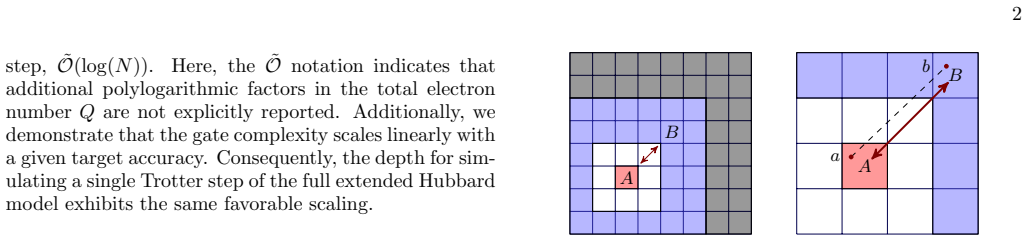
The central object is the hierarchical multipole expansion of the Coulomb kernel, expressed through the solid harmonic addition theorem; the algorithm's workhorse is a reversible 'coarse-graining' circuit that computes box occupation numbers/multipole moments from finer levels, evaluates box–box phase factors, and uncomputes in reverse order. Supporting primitives are quantum adders and multipliers, the COPY operation (transversal CNOT) for parallelism, unbounded fan-out gates, and atom shuttling on 2D neutral-atom hardware.
What would settle it
Measure shuttling latency versus distance on a 2D neutral-atom array: if time grows with distance, or if simultaneous long-range shuttling causes collisions that serialize operations, the O(1) routing premise fails, and the per-Trotter-step depth becomes O(√N) or worse.
Extended reading notes
Core claim
Q2FMM treats the Coulomb kernel 1/|r_a − r_b| using the fast multipole method: instead of summing pairwise site–site interactions, it organizes sites into a quadtree of boxes and, at each level, replaces the interaction between well-separated boxes by a single interaction between their centers (0th order) or by truncated multipole expansions (higher order). Each box's occupation number (or multipole coefficients) is computed from its children with quantum adders, stored in ancilla registers, used to generate phase rotations via quantum multipliers and single-qubit Z-rotations, and then uncomputed so the phase transfers back to the system qubits. Because parent boxes reuse child multipole exp
Load-bearing premise
The polylogarithmic depth claim rests on shuttling (or an equivalent non-local routing primitive) moving qubits across arbitrary distances in O(1) depth with no congestion; the paper's own analysis shows that under nearest-neighbor connectivity alone, depth degrades to O(√N).
Editorial extensions
If this is right
- Per Trotter step, the full extended Hubbard model (hopping, on-site, and Coulomb terms) runs in O~(log N) depth on 2D neutral-atom hardware with shuttling.
- Gate complexity scales linearly with N for a fixed target accuracy, with a prefactor p^5.3 where p ~ log(1/ε) is fixed.
- The same machinery applies to other FMM-compatible kernels (Yukawa, Helmholtz, etc.) and to the Pariser–Parr–Pople model on grids.
- If the interaction is truncated at a distance ξ, Q2FMM needs only O(log ξ) levels, further reducing depth.
- Under nearest-neighbor connectivity only, the depth is O(√N), still better than O(N) but not polylogarithmic.
Reading between the lines
- The O(1) shuttling assumption is the load-bearing card; if parallel shuttling has distance-dependent latency or routing congestion, the polylog claim reverts to O(√N) unless long-range gates are used.
- The paper's resource tables omit the COPY operation's ancilla count, so the 'linear ancilla' statement is a lower bound in practice; a complete accounting must include those temporary qubits.
- The linear gate-complexity claim with a high prefactor p^5.3 means the asymptotic advantage may only be realized for large N; for small systems, block-encoding or interaction-picture methods with lower prefactors may compete.
- A direct testable extension is to implement the 1D version of Q2FMM (shown in Appendix B) on current devices and measure empirical depth versus N; deviations from O(log N) would expose shuttling overhead.
Editorial analysis
A structured set of objections, weighed in public.
Referee Report
Summary. The paper introduces Q2FMM, a Trotter-based quantum algorithm for simulating the extended Hubbard model on a two-dimensional lattice. The long-range Coulomb term is replaced by a hierarchical fast-multipole decomposition: box occupation numbers (0th order) or multipole moments (pth order) are computed with reversible quantum adders/multipliers, phase gates encode the resulting pair energies, and uncomputing transfers the accumulated phase back to the physical qubits. The authors claim that, on a neutral-atom platform supporting shuttling and/or unbounded fan-out, the circuit depth for one Trotter step is polylogarithmic in the number of sites N, with gate complexity linear in N for a fixed target accuracy, and they provide resource tables and a 1D example circuit.
Significance. If the polylogarithmic-depth claim were fully established, it would be a meaningful asymptotic improvement over O(N) fermionic swap networks and O(√N) nearest-neighbor routing for long-range Coulomb interactions, with direct relevance to extended Hubbard and Pariser-Parr-Pople models. The coherent hierarchical FMM construction is a useful and original contribution, and the paper is honest in comparing with earlier block-encoding approaches. However, the headline scaling currently rests on two unproven assumptions: a distance-independent, congestion-free shuttling primitive, and an N-independent FMM error bound. Both are load-bearing for the central claim and require substantial additional analysis before the paper's main conclusion can be accepted.
major comments (3)
- [Sec. II C2 and II D1; Table I] The O(log N) depth claim treats atom shuttling as a depth-O(1) primitive: a SWAP chain of depth O(r_AB) is replaced by “only two shuttling operations” with “high parallelism.” No model is given for transport time versus distance or for routing congestion. At the coarsest level, interacting boxes are separated by Θ(√N) sites; finite-speed physical transport therefore costs Ω(√N) time unless the primitive is defined to be instantaneous. The cited neutral-atom demonstrations (Refs. 41–45) show parallel entangling gates and array rearrangement, but not concurrent long-range routing of all interaction-list pairs in the Q2FMM interaction graph. Since Table I and the abstract's Õ(log N) claim rely on this primitive, the hardware-model gap is load-bearing; under nearest-neighbor connectivity the paper's own Eq. (15) gives O(√N) depth.
- [Sec. III D, Eqs. (26)–(27) and (32)] The FMM error bound in Eq. (26), ε_F,t ∼ O(t(r/R)^{p+1}), has no N dependence. From Eqs. (24)–(25), ε_i^F is the error in the total Coulomb energy of basis state i, which is a sum over O(N) box-pair contributions. The per-pair FMM truncation error alone does not imply an N-independent total error; without a global bound, the total error may grow with N (or with total charge Q). Consequently Eq. (27), p=O(log(1/ε_F,t)), and Eq. (32), N_G=p^{5.3}O(N) with p constant for fixed target error, are not established. If the correct scaling is p=O(log(N/ε)), the gate complexity acquires a polylogarithmic factor in N and the statement “p is constant” must be revised. The bound in Eq. (28) addresses only the magnitude of the multipole coefficients, not the truncation error of the expansion.
- [Table II caption and Sec. II D2] The O(N) ancilla count for Q2FMM + fan-out excludes the COPY operation, which Sec. II C1 states is needed to parallelize phase evaluation and whose ancilla overhead is linear in the number of copies (|I(A)| ≤ 27 per box). Moreover, the algorithm defers uncomputing until all levels have been processed (Sec. II B), so adder ancillas from finer levels are retained while coarser levels are computed; the claim that arithmetic ancillas can be “recycled across coarser levels” (Sec. II D2) is not obviously compatible with that deferral. Thus the resource tables do not establish the advertised O(N) ancilla scaling for the full algorithm. This does not by itself invalidate the depth claim, but it weakens the Q2FMM + fan-out trade-off presented in Table I.
minor comments (4)
- [Sec. III B and Fig. 9] The encoding of R_lm(r_aA) q_a via CNOTs assumes q_a ∈ {0,1}. For negative or non-integer R_lm values, a signed fixed-point representation and signed arithmetic are needed; the paper mentions fixed-point scaling but does not specify sign handling. This should be clarified.
- [Appendix A] For the spinful case, the total occupation q_a at a site can be 2. The text says the method of Fig. 9 is applied to the two qubits representing a site; please state explicitly that the multipole contribution is accumulated per spin, so that each control qubit remains 0 or 1.
- [Eq. (20b)] The definition of M^B_jk uses R_lm in the text; it should read R_jk(r_bB). This is likely a typo but should be corrected.
- [Sec. II A] The hierarchy assumes N is a power of 4. For general N, the treatment of non-square or incomplete quadtree levels should be discussed, or the asymptotic statement should specify the padding convention.
Circularity Check
No significant circularity: the FMM expansion and arithmetic-circuit bounds are independent inputs; the polylog-depth claim is an explicit conditional on stated O(1)-depth shuttling/fan-out primitives, not a fitted or self-referential result.
full rationale
It is not circular. The derivation chain is: the Hamiltonian (1) is decomposed using the solid-harmonic addition theorem (Eq. 4) into hierarchical box-box terms (Eqs. 6-7). Each term is a product of occupation-number operators, so exp(-iδt V_L) is implemented by out-of-place quantum adders/multipliers and phase gates followed by uncomputation (Sec. II B, Figs. 3-5). The FMM identity Eq. (4) is an external mathematical result from standard references (Refs. 26, 59), not an input fitted to the target evolution; no parameter is fitted to a subset of data and then renamed as a prediction. The depth analysis is explicitly conditional on stated hardware primitives: 'we allow the shuttling operation and assume it admits depth O(1)' (Table I discussion, Sec. II C) and the unbounded fan-out treated as a constant-depth primitive. Under nearest-neighbor connectivity the paper honestly reports O(√N) in Eq. (15), so the polylog claim is not forced by the equations themselves. The only potentially self-citing reference, Ref. [70] for 'Element-wise CNOT', is terminological and not load-bearing; the same COPY operation is also cited to standard transversal CNOT references [67-69]. The Table II caption explicitly excludes COPY from the resource tables, and shuttling-parallelism without congestion analysis is a hardware-model/correctness limitation, not a circular step. No quoted passage reduces the derived claim to its own input, so no circular step can be exhibited.
Assumptions & free parameters
free parameters (3)
- FMM truncation order p =
claimed O(log(1/epsilon_F,t)); possibly O(log(N/epsilon_F,t)) in 2D
- Fixed-point precision epsilon_b =
chosen equal to epsilon_F,t
- Interaction-list well-separatedness parameter (implicit) =
unspecified; <=27 neighbor boxes in 2D
assumptions (6)
- standard math Multipole expansion of the Coulomb kernel via solid harmonic addition theorem (Eq. 4)
- domain assumption FMM truncation error scales as O((r/R)^{p+1}) for well-separated boxes (Eq. 26)
- standard math Trotter-Suzuki product formula (Eq. 8)
- domain assumption Atom shuttling moves qubits across arbitrary distances in O(1) depth (Sec. II C 2, II D 1)
- domain assumption Unbounded fan-out gates are constant-depth primitives and enable O(log* n) arithmetic (Sec. II C 3)
- domain assumption Quantum multiplier depths from Ref. [66] (O(n) or O(log* n) with fan-out) are directly applicable to fixed-point arithmetic with the stated bit lengths
Cite this review
Pith. "Pith review of A Quantum Algorithm with Polylogarithmic Depth per Trotter Step for the Extended Hubbard Model." pith.science (2026). https://pith.science/paper/4FE24VBM
@misc{pith2026251203898,
  author       = {Pith},
  title        = {Pith review of: A Quantum Algorithm with Polylogarithmic Depth per Trotter Step for the Extended Hubbard Model},
  year         = {2026},
  howpublished = {\url{https://pith.science/paper/4FE24VBM}},
  note         = {Machine review of arXiv:2512.03898}
}
read the original abstract
The extended Hubbard model on a two-dimensional lattice captures key physical phenomena, but its simulation remains challenging because long-range interactions give rise to a large number of interaction terms. Here we present Q2FMM, an efficient quantum algorithm for simulating this model within the Trotter product formula. Inspired by the fast multipole method, Q2FMM replaces site-site interactions with interactions between hierarchical coarse-grained boxes across multiple length scales. In addition, the multipole expansions of boxes are reused for their parent boxes, further enhancing the efficiency. To enable this hierarchical reuse coherently, we design a reversible quantum circuit that removes garbage information through uncomputing. The resulting circuit depth for a single Trotter step scales polylogarithmically with system size.
Figures


Figures from the paper (10 more)


Reference graph
Works this paper leans on
-
[1]
4 n n n+1 |a⟩ Quantum Adder |a⟩ |b⟩ |b⟩ |0⟩ |a+b⟩ (a) An out-of-place quantum adder, in which the output |a+b⟩is recorded in ancilla qubits
Calculate the occupation numbersN A andN B for boxesAandBseparately. 4 n n n+1 |a⟩ Quantum Adder |a⟩ |b⟩ |b⟩ |0⟩ |a+b⟩ (a) An out-of-place quantum adder, in which the output |a+b⟩is recorded in ancilla qubits. n n 2n |a⟩ Quantum Multiplier |a⟩ |b⟩ |b⟩ |0⟩ |a·b⟩ (b) Ann-bit quantum multiplication gate. The binary representation of the result|a·b⟩is stored ...
-
[2]
Compute the productN ANB
-
[3]
At the finest level of the hierarchy,L=L max = log4(N), the boxes coincide with the physical two- dimensional lattice
Compute the evolving phasee −it′ AB NANB . At the finest level of the hierarchy,L=L max = log4(N), the boxes coincide with the physical two- dimensional lattice. At this resolution, each lattice site corresponds to a single qubit, where|1⟩denotes an occu- pied site and|0⟩an empty one. Proceeding to the next level, the occupation number of each box is obta...
-
[4]
We first obtain the occupation number of each box at the current level by summing the values of its four children using quantum adders
-
[5]
(10) with these occupation numbers by means of the quantum multiplier
Subsequently, we implement the evolution in Eq. (10) with these occupation numbers by means of the quantum multiplier. This procedure is recursively repeated to transverse the entire hierarchy. Note that after the summation, every four child boxes are efficiently merged into their corre- sponding parent box, as illustrated in Fig. 3. 5 Since the quantum a...
-
[6]
(10) commute, the correspond- ing phases can be evaluated simultaneously for each in- teraction term within a given level
TheCOPYoperation Since the terms in Eq. (10) commute, the correspond- ing phases can be evaluated simultaneously for each in- teraction term within a given level. Intuitively, this fol- lows from the fact that the time evolution governed by the Coulomb operator leaves the occupation numbers un- changed, as discussed earlier. Thus, an efficient strategy fo...
-
[7]
Bringing box information together: the shuttling operation The qubits encoding the occupation information of each box (and also their copies whenCOPYis utilized) are typically located at its corresponding geometric lo- cation. To evaluate the long-range interaction between two spatially separated boxes, either (i) the hardware must support long-range quan...
-
[8]
unbounded
The unbounded fan-out gate The unbounded fan-out gate [37], where a single qubit simultaneously controls multiple targets as illustrated in Fig. 7, can also provide significant advantages. Here, “unbounded” means we treat the fan-out operation as a constant-depth primitive, independent of the number of targets. Recent experimental progress demonstrated th...
Show all 105 references
-
[9]
Depth with shuttling Here, we take a 2D neutral-atom quantum com- puter [38–45] as a representative example and analyze the resulting circuit depth. In such platforms,atom shuttling can be implemented using optical tweezers, enabling the rearranging of the position of the atom...
-
[10]
As discussed in Sec
Depth with the unbounded fan-out gate As a further improvement, the fan-out gate can be em- ployed to efficiently implement the quantum arithmetic circuits in Q2FMM. As discussed in Sec. II C 3, the depth of both the quantum adder and multiplier is reduced to O(log⋆ n). Consid...
-
[11]
When constrained to the near- est connectivity, the dominant contribution to the cir- cuit depth arises from using SW AP gates to “move” the ancilla qubits of two boxes together
Depth when constrained to nearest connectivity Our algorithm remains efficient even without the shut- tling or fan-out gate. When constrained to the near- est connectivity, the dominant contribution to the cir- cuit depth arises from using SW AP gates to “move” the ancilla qub...
-
[12]
Error analysis In the context of error analysis, the total error orig- inates from two main sources: Trotterization and the FMM approximation. Although the 0 th-order FMM is relatively inaccurate [26], its accuracy can be improved by tightening the acceptance criterion, i.e., ...
-
[13]
R. P. Feynman, Simulating physics with computers, International Journal of Theoretical Physics21, 467 (1982)
1982
-
[14]
Lloyd, Universal quantum simulators, Science273, 1073 (1996)
S. Lloyd, Universal quantum simulators, Science273, 1073 (1996)
1996
-
[15]
McArdle, S
S. McArdle, S. Endo, A. Aspuru-Guzik, S. C. Benjamin, and X. Yuan, Quantum computational chemistry, Re- views of Modern Physics92, 015003 (2020)
2020
-
[16]
I. M. Georgescu, S. Ashhab, and F. Nori, Quantum sim- ulation, Reviews of Modern Physics86, 153 (2014)
2014
-
[17]
Reiher, N
M. Reiher, N. Wiebe, K. M. Svore, D. Wecker, and M. Troyer, Elucidating reaction mechanisms on quan- tum computers, Proc. Natl. Acad. Sci. U.S.A.114, 7555 (2017)
2017
-
[18]
Arute, K
F. Arute, K. Arya, R. Babbush, D. Bacon, J. C. Bardin, R. Barends, S. Boixo, M. Broughton, B. B. Buckley, D. A. Buell, and et al., Hartree-fock on a superconducting qubit quantum computer, Science369, 1084 (2020)
2020
-
[19]
Preskill, Quantum computing in the nisq era and be- yond, Quantum2, 79 (2018)
J. Preskill, Quantum computing in the nisq era and be- yond, Quantum2, 79 (2018)
2018
-
[20]
Lin and Y
L. Lin and Y. Tong, Heisenberg-limited ground-state en- ergy estimation for early fault-tolerant quantum comput- ers, PRX Quantum3, 010318 (2022)
2022
-
[21]
Monroe, W
C. Monroe, W. C. Campbell, L.-M. Duan, Z.-X. Gong, A. V. Gorshkov, P. W. Hess, R. Islam, K. Kim, N. M. Linke, G. Pagano, and et al., Programmable quantum simulations of spin systems with trapped ions, Rev. Mod. Phys.93, 025001 (2021)
2021
-
[22]
Hubbard, Electron correlations in narrow energy bands, Proceedings of the Royal Society of London
J. Hubbard, Electron correlations in narrow energy bands, Proceedings of the Royal Society of London. Series A. Mathematical and Physical Sciences276, 238 (1963)
1963
-
[23]
D. P. Arovas, E. Berg, S. A. Kivelson, and S. Raghu, The Hubbard model, Annu. Rev. Condens. Matter Phys.13, 239 (2022)
2022
-
[24]
D. J. Scalapino, A common thread: The pairing inter- action for unconventional superconductors, Reviews of Modern Physics84, 1383 (2012)
2012
-
[25]
Imada, A
M. Imada, A. Fujimori, and Y. Tokura, Metal-insulator transitions, Reviews of Modern Physics70, 1039 (1998)
1998
-
[26]
P. A. Lee, N. Nagaosa, and X.-G. Wen, Doping a mott in- sulator: Physics of high-temperature superconductivity, Reviews of Modern Physics78, 17 (2006)
2006
-
[27]
Pariser and R
R. Pariser and R. G. Parr, A semi-empirical theory of the electronic spectra and electronic structure of complex un- saturated molecules. ii, The Journal of Chemical Physics 21, 767 (1953)
1953
-
[28]
J. A. Pople, Electron interaction in unsaturated hydro- carbons, Transactions of the Faraday Society49, 1375 (1953)
1953
-
[29]
A. J. Heeger, S. Kivelson, J. R. Schrieffer, and W.-P. Su, Solitons in conducting polymers, Reviews of Modern Physics60, 781 (1988)
1988
-
[30]
Verstraete and J
F. Verstraete and J. I. Cirac, Mapping local hamiltonians of fermions to local hamiltonians of spins, J. Stat. Mech.: Theory Exp.2005(09), P09012
2005
-
[31]
S. B. Bravyi and A. Y. Kitaev, Fermionic quantum com- putation, Ann. Phys.298, 210 (2002)
2002
-
[32]
Derby, J
C. Derby, J. Klassen, J. Bausch, and T. Cubitt, Compact fermion to qubit mappings, Phys. Rev. B104, 035118 (2021)
2021
-
[33]
Clinton, J
L. Clinton, J. Bausch, and T. Cubitt, Hamiltonian simu- lation algorithms for near-term quantum hardware, Nat. Commun.12, 4989 (2021)
2021
-
[34]
I. D. Kivlichan, J. R. McClean, N. Wiebe, C. Gid- ney, A. Aspuru-Guzik, G. K.-L. Chan, and R. Babbush, Quantum simulation of electronic structure with linear depth and connectivity, Phys. Rev. Lett.120, 110501 (2018)
2018
-
[35]
M. C. Tran, A. Y. Guo, Y. Su, J. R. Garrison, Z. El- dredge, M. Foss-Feig, A. M. Childs, and A. V. Gorshkov, Locality and digital quantum simulation of power-law in- teractions, Phys. Rev. X9, 031006 (2019)
2019
-
[36]
A. M. Childs, Y. Su, M. C. Tran, N. Wiebe, and S. Zhu, Theory of trotter error with commutator scaling, Physi- cal Review X11, 011020 (2021)
2021
-
[37]
Barnes and P
J. Barnes and P. Hut, A hierarchicalO(nlogn) force- calculation algorithm, Nature324, 446 (1986)
1986
-
[38]
Ying, A pedestrian introduction to fast multipole methods, Sci
L. Ying, A pedestrian introduction to fast multipole methods, Sci. China Math.55, 1043 (2012)
2012
-
[39]
Greengard and V
L. Greengard and V. Rokhlin, A fast algorithm for par- ticle simulations, J. Comput. Phys.73, 325 (1987)
1987
-
[40]
Darve, The fast multipole method: Numerical imple- mentation, J
E. Darve, The fast multipole method: Numerical imple- mentation, J. Comput. Phys.160, 195 (2000)
2000
-
[41]
S. Wang, X. Li, W. J. B. Lee, S. Deb, E. Lim, and A. Chattopadhyay, A comprehensive study of quantum arithmetic circuits, Philosophical Transactions A383, 20230392 (2025)
2025
-
[42]
T. G. Draper, S. A. Kutin, E. M. Rains, and K. M. Svore, A logarithmic-depth quantum carry-lookahead adder, Quantum Inf. Comput.6, 351 (2006)
2006
-
[43]
Takahashi, S
Y. Takahashi, S. Tani, and N. Kunihiro, Quantum addi- tion circuits and unbounded fan-out, Quantum Inf. Com- put.10, 872 (2010)
2010
- [44]
-
[45]
Remaud and V
M. Remaud and V. Vandaele, Ancilla-free quantum adder with sublinear depth, inInternational Conference on Re- versible Computation(Springer, 2025) pp. 137–154
2025
-
[46]
Dutta, D
S. Dutta, D. Bhattacharjee, and A. Chattopadhyay, Quantum circuits for toom–cook multiplication, Phys. Rev. A98, 012311 (2018)
2018
-
[47]
Kepley and R
S. Kepley and R. Steinwandt, Quantum circuits forF 2n - multiplication with subquadratic gate count, Quantum Information Processing14, 2373 (2015)
2015
-
[48]
F. Orts, E. Filatovas, G. Ortega, J. SanJuan-Estrada, and E. Garz´ on, Improving the number of t gates and their spread in integer multipliers on quantum comput- ing, Phys. Rev. A107, 042621 (2023)
2023
-
[49]
Høyer and R
P. Høyer and R. ˇSpalek, Quantum fan-out is powerful, Theory of Computing1, 81 (2005)
2005
-
[50]
Hollerith, K
S. Hollerith, K. Srakaew, D. Wei, A. Rubio-Abadal, D. Adler, P. Weckesser, A. Kruckenhauser, V. Walther, R. van Bijnen, J. Rui, and et al., Realizing distance- selective interactions in a rydberg-dressed atom array, Phys. Rev. Lett.128, 113602 (2022)
2022
-
[51]
R. Tao, M. Ammenwerth, F. Gyger, I. Bloch, and J. Zei- her, High-fidelity detection of large-scale atom arrays in an optical lattice, Phys. Rev. Lett.133, 013401 (2024)
2024
-
[52]
D. Wei, D. Adler, K. Srakaew, S. Agrawal, P. Weckesser, I. Bloch, and J. Zeiher, Observation of brane parity or- der in programmable optical lattices, Phys. Rev. X13, 15 021042 (2023)
2023
-
[53]
T. M. Graham, Y. Song, J. Scott, C. Poole, L. Phutti- tarn, K. Jooya, P. Eichler, X. Jiang, A. Marra, B. Grinke- meyer, and et al., Multi-qubit entanglement and algo- rithms on a neutral-atom quantum computer, Nature 604, 457 (2022)
2022
-
[54]
S. J. Evered, D. Bluvstein, M. Kalinowski, S. Ebadi, T. Manovitz, H. Zhou, S. H. Li, A. A. Geim, T. T. Wang, N. Maskara, and et al., High-fidelity parallel entangling gates on a neutral-atom quantum computer, Nature622, 268 (2023)
2023
-
[55]
Bluvstein, H
D. Bluvstein, H. Levine, G. Semeghini, T. T. Wang, S. Ebadi, M. Kalinowski, A. Keesling, N. Maskara, H. Pichler, M. Greiner, and et al., A quantum processor based on coherent transport of entangled atom arrays, Nature604, 451 (2022)
2022
-
[56]
Schmid, D
L. Schmid, D. F. Locher, M. Rispler, S. Blatt, J. Zei- her, M. M¨ uller, and R. Wille, Computational capabili- ties and compiler development for neutral atom quan- tum processors–connecting tool developers and hardware experts, Quantum Science and Technology9, 033001 (2024)
2024
-
[57]
Bluvstein, S
D. Bluvstein, S. J. Evered, A. A. Geim, S. H. Li, H. Zhou, T. Manovitz, S. Ebadi, M. Cain, M. Kali- nowski, D. Hangleiter, and et al., Logical quantum pro- cessor based on reconfigurable atom arrays, Nature626, 58 (2024)
2024
-
[58]
S. J. Evered, M. Kalinowski, A. A. Geim, T. Manovitz, D. Bluvstein, S. H. Li, N. Maskara, H. Zhou, S. Ebadi, M. Xu, and et al., Probing the kitaev honeycomb model on a neutral-atom quantum computer, Nature645, 341 (2025)
2025
-
[59]
H. J. Manetsch, G. Nomura, E. Bataille, X. Lv, K. H. Leung, and M. Endres, A tweezer array with 6100 highly coherent atomic qubits, Nature647, 60 (2025)
2025
-
[60]
N.-C. Chiu, E. C. Trapp, J. Guo, M. H. Abobeih, L. M. Stewart, S. Hollerith, P. L. Stroganov, M. Kalinowski, A. A. Geim, S. J. Evered, and et al., Continuous opera- tion of a coherent 3,000-qubit system, Nature646, 1075 (2025)
2025
-
[61]
M. Xu, L. H. Kendrick, A. Kale, Y. Gang, C. Feng, S. Zhang, A. W. Young, M. Lebrat, and M. Greiner, A neutral-atom hubbard quantum simulator in the cryo- genic regime, Nature642, 909 (2025)
2025
-
[62]
Greengard and J
L. Greengard and J. Huang, A new version of the fast multipole method for screened coulomb interactions in three dimensions, Journal of Computational Physics180, 642 (2002)
2002
-
[63]
Cheng, W
H. Cheng, W. Y. Crutchfield, Z. Gimbutas, L. Green- gard, J. Ethridge, J. Huang, and V. Rokhlin, A wide- band fast multipole method for the helmholtz equation in three dimensions, Journal of Computational Physics 216, 300 (2006)
2006
-
[64]
Engquist and L
B. Engquist and L. Ying, Fast directional multilevel algo- rithms for oscillatory kernels, SIAM Journal on Scientific Computing29, 1710 (2007)
2007
-
[65]
W. C. Chew, J.-M. Jin, E. Michielssen, and J. Song, eds., Fast and Efficient Algorithms in Computational Electro- magnetics(Artech House, Boston and London, 2001)
2001
-
[66]
Tornberg and L
A.-K. Tornberg and L. Greengard, A fast multipole method for the three-dimensional stokes equations, Jour- nal of Computational Physics227, 1613 (2008)
2008
-
[67]
Liu,Fast Multipole Boundary Element Method: The- ory and Applications in Engineering(Cambridge Univer- sity Press, 2009)
Y. Liu,Fast Multipole Boundary Element Method: The- ory and Applications in Engineering(Cambridge Univer- sity Press, 2009)
2009
-
[68]
Gimbutas and L
Z. Gimbutas and L. Greengard, A fast multipole method for the evaluation of elastostatic fields in a half-space with zero normal stress, Advances in Computational Mathe- matics42, 1293 (2016)
2016
-
[69]
N. A. Gumerov and R. Duraiswami, Fast multipole method for the biharmonic equation in three dimensions, Journal of Computational Physics215, 363 (2006)
2006
-
[70]
L. Ying, G. Biros, and D. Zorin, A kernel-independent adaptive fast multipole algorithm in two and three di- mensions, Journal of Computational Physics196, 591 (2004)
2004
-
[71]
Helgaker, P
T. Helgaker, P. Jørgensen, and J. Olsen,Molecular Electronic-Structure Theory(Wiley, Chichester, 2000)
2000
-
[72]
A. J. Stone,The Theory of Intermolecular Forces, 2nd ed. (Oxford University Press, Oxford, 2013)
2013
-
[73]
D. M. Brink and G. R. Satchler,Angular Momentum, 2nd ed. (Clarendon Press, Oxford, 1968)
1968
-
[74]
H. F. Trotter, On the product of semi-groups of opera- tors, Proceedings of the American Mathematical Society 10, 545 (1959)
1959
-
[75]
M. Suzuki, Generalized trotter’s formula and systematic approximants of exponential operators and inner deriva- tions with applications to many-body problems, Commu- nications in Mathematical Physics51, 183 (1976)
1976
-
[76]
D. W. Berry, G. Ahokas, R. Cleve, and B. C. Sanders, Ef- ficient quantum algorithms for simulating sparse hamil- tonians, Communications in Mathematical Physics270, 359 (2007)
2007
-
[77]
A. M. Childs and Y. Su, Nearly optimal lattice simula- tion by product formulas, Physical Review Letters123, 050503 (2019)
2019
- [78]
-
[79]
M. A. Nielsen and I. L. Chuang,Quantum Computation and Quantum Information: 10th Anniversary Edition (Cambridge University Press, 2011)
2011
-
[80]
Gottesman, An introduction to quantum error cor- rection and fault-tolerant quantum computation (2009), arXiv:0904.2557
D. Gottesman, An introduction to quantum error cor- rection and fault-tolerant quantum computation (2009), arXiv:0904.2557
2009 arXiv
-
[81]
Sahay, Y
K. Sahay, Y. Lin, S. Huang, K. R. Brown, and S. Puri, Error correction of transversal cnot gates for scalable surface-code computation, PRX Quantum6, 020326 (2025)
2025
-
[82]
F. D. Chiara, M. Nibbi, Y. Shen, and R. V. Beeumen, Efficient lcu block encodings through dicke states prepa- ration (2025), arXiv:2507.20887
2025 arXiv
-
[83]
Kielpinski, C
D. Kielpinski, C. Monroe, and D. J. Wineland, Architec- ture for a large-scale ion-trap quantum computer, Nature 417, 709 (2002)
2002
-
[84]
R. B. Blakestad, C. Ospelkaus, A. P. VanDevender, J. M. Amini, J. Britton, D. Leibfried, and D. J. Wineland, High-fidelity transport of trapped-ion qubits through an x-junction trap array, Phys. Rev. Lett.102, 153002 (2009)
2009
-
[85]
Schoenberger, S
D. Schoenberger, S. Hillmich, M. Brandl, and R. Wille, Shuttling for scalable trapped-ion quantum computers, IEEE Trans. Comput.-Aided Des. Integr. Circuits Syst. 44, 2144 (2025)
2025
-
[86]
J. M. Pino, J. M. Dreiling, C. Figgatt, J. P. Gaebler, S. A. Moses, M. S. Allman, C. H. Baldwin, M. Foss-Feig, D. Hayes, K. Mayer, and et al., Demonstration of the trapped-ion quantum ccd computer architecture, Nature 16 592, 209 (2021)
2021
-
[87]
S. A. Moses, C. H. Baldwin, M. S. Allman, R. Ancona, L. Ascarrunz, C. Barnes, J. P. Bartolotta, B. Bjork, P. Blanchard, M. Bohn, and et al., A race-track trapped- ion quantum processor, Phys. Rev. X13, 041052 (2023)
2023
-
[88]
Guo, Y.-K
S.-A. Guo, Y.-K. Wu, J. Ye, L. Zhang, W.-Q. Lian, R. Yao, Y. Wang, R.-Y. Yan, Y.-J. Yi, Y.-L. Xu, and et al., A site-resolved two-dimensional quantum simu- lator with hundreds of trapped ions, Nature630, 613 (2024)
2024
-
[89]
Li, Y.-K
B.-W. Li, Y.-K. Wu, Q.-X. Mei, R. Yao, W.-Q. Lian, M.- L. Cai, Y. Wang, B.-X. Qi, L. Yao, L. He, and et al., Probing critical behavior of long-range transverse-field ising model through quantum kibble-zurek mechanism, PRX Quantum4, 010302 (2023)
2023
-
[90]
Khazali and K
M. Khazali and K. Mølmer, Fast multiqubit gates by adiabatic evolution in interacting excited-state manifolds of rydberg atoms and superconducting circuits, Physical Review X10, 021054 (2020)
2020
-
[91]
J. T. Young, P. Bienias, R. Belyansky, A. M. Kaufman, and A. V. Gorshkov, Asymmetric blockade and multi- qubit gates via dipole-dipole interactions, Physical Re- view Letters127, 120501 (2021)
2021
-
[92]
Y. Song, L. Beltr´ an, I. Besedin, M. Kerschbaum, M. Pechal, F. Swiadek, C. Hellings, D. C. Zanuz, A. Flasby, J.-C. Besse, and A. Wallraff, Constant-depth fan-out with real-time feedforward on a superconduct- ing quantum processor, Phys. Rev. Applied24, 024068 (2025)
2025
-
[93]
B¨ aumer and S
E. B¨ aumer and S. Woerner, Measurement-based long- range entangling gates in constant depth, Phys. Rev. Res. 7, 023120 (2025)
2025
-
[94]
Maslov, Linear depth stabilizer and quantum fourier transformation circuits with no auxiliary qubits in finite- neighbor quantum architectures, Phys
D. Maslov, Linear depth stabilizer and quantum fourier transformation circuits with no auxiliary qubits in finite- neighbor quantum architectures, Phys. Rev. A76, 052310 (2007)
2007
- [95]
-
[96]
Cleve and J
R. Cleve and J. Watrous, Fast parallel circuits for the quantum fourier transform, inProceedings of the 41st Annual Symposium on Foundations of Computer Science (FOCS 2000)(2000) pp. 526–536
2000
-
[97]
Barenco, A
A. Barenco, A. Ekert, K.-A. Suominen, and P. T¨ orm¨ a, Approximate quantum fourier transform and decoher- ence, Phys. Rev. A54, 139 (1996)
1996
-
[98]
Ruiz-Perez and J
L. Ruiz-Perez and J. C. Garcia-Escartin, Quantum arith- metic with the quantum fourier transform, Quantum Inf. Process.16, 152 (2017)
2017
- [99]
-
[100]
D. W. Berry, K. Wan, A. D. Baczewski, E. C. Ek- lund, A. Tikku, and R. Babbush, Quantum simulation of chemistry via quantum fast multipole method (2025), arXiv:2510.07380
2025 arXiv
-
[101]
Kay, Tutorial on the quantikz package (2018), arXiv:1809.03842
A. Kay, Tutorial on the quantikz package (2018), arXiv:1809.03842
2018
-
[102]
Desef, Yquant: Typesetting quantum circuits in a human-readable language (2020), arXiv:2007.12931
B. Desef, Yquant: Typesetting quantum circuits in a human-readable language (2020), arXiv:2007.12931
2020 arXiv
-
[103]
S. R. White, Hybrid grid/basis set discretizations of the schr¨ odinger equation, J. Chem. Phys.147, 244102 (2017)
2017
-
[104]
E. M. Stoudenmire and S. R. White, Sliced basis den- sity matrix renormalization group for electronic struc- ture, Phys. Rev. Lett.119, 046401 (2017)
2017
-
[105]
S. R. White and E. M. Stoudenmire, Multisliced gaus- slet basis sets for electronic structure, Phys. Rev. B99, 081110(R) (2019)
2019
Reviewed August 3, 2026 · model on record in the stance chip above.
Discussion (0). Continue with ORCID to comment.