Recognition: 1 theorem link
· Lean TheoremThermalization from quenching in coupled oscillators
Pith reviewed 2026-05-17 02:05 UTC · model grok-4.3
The pith
Sudden quenches in coupled oscillators thermalize a quantum harmonic oscillator to any target temperature without a macroscopic bath.
A machine-rendered reading of the paper's core claim, the machinery that carries it, and where it could break.
Core claim
By coupling the target oscillator to a second one and applying sudden changes to their frequencies and coupling strength, the first oscillator reaches a thermal state. The Gaussian property means that matching the thermal covariance matrix requires solving only three equations for the quench parameters, which have analytic forms at certain temperatures.
What carries the argument
Reduction of thermalization conditions to three solvable equations from the Gaussian evolution under sudden quenches in coupled oscillators.
If this is right
- Exact analytic solutions for quench parameters exist for a dense discrete set of temperatures.
- Numerical solutions cover all other temperatures.
- Any target temperature can be approximated arbitrarily closely.
- The protocol is suitable for rapid thermalization in quantum thermodynamics experiments.
Where Pith is reading between the lines
- This method could be adapted for preparing non-thermal states in similar finite-time settings.
- It might offer insights into how small environments can mimic thermal baths in quantum systems.
- Experimental tests in optomechanical or circuit QED systems could validate the precision limits.
- The approach may connect to work on shortcuts to thermalization in open quantum systems.
Load-bearing premise
The second oscillator acts as a sufficient effective environment and its post-quench state does not prevent the first oscillator from reaching the target thermal covariance.
What would settle it
Perform the quench protocol and measure the final position-momentum covariance matrix of the first oscillator to check if it equals the thermal covariance at the intended temperature.
Figures




read the original abstract
We introduce a finite-time protocol that thermalizes a quantum harmonic oscillator, initially in its ground state, without requiring a macroscopic bath. The method uses a second oscillator as an effective environment and implements sudden quenches of the oscillator frequencies and coupling. Owing to the Gaussian nature of the dynamics, the thermalization condition reduces to three solvable equations, yielding exact analytic solutions for a dense discrete set of temperatures and numerical solutions in all other cases. Any target temperature can be approximated with arbitrary precision, with a trade-off between speed and accuracy. The simplicity of the protocol makes it a promising tool for rapid, controlled thermalization in quantum thermodynamics experiments and state preparation.
Editorial analysis
A structured set of objections, weighed in public.
Referee Report
Summary. The manuscript introduces a finite-time protocol to thermalize a quantum harmonic oscillator, initially in its ground state, by using a second oscillator as an effective environment and performing sudden quenches on the frequencies and coupling strength. Owing to the Gaussian nature of the harmonic-oscillator dynamics, the condition for reaching a target thermal covariance reduces to three equations that admit exact analytic solutions for a dense discrete set of temperatures and numerical solutions otherwise, allowing arbitrary-precision approximation of any target temperature with a speed-accuracy trade-off.
Significance. If the protocol achieves a stable thermal state, the approach offers a simple, controllable method for thermalization in quantum thermodynamics without macroscopic baths, with potential utility for experiments and state preparation. The reduction to three solvable equations via Gaussian covariance evolution is a clear strength, yielding exact results in special cases without fitted parameters.
major comments (1)
- [Protocol description] Protocol description (abstract and main text on quench sequence): the description of the quenches on frequencies and coupling does not explicitly confirm that the final coupling strength is quenched to g=0. Without final decoupling, the coupled equations of motion will drive ongoing energy exchange, causing the covariance of the first oscillator to deviate from the target thermal value. This is load-bearing for the claim of stable thermalization after the protocol ends.
minor comments (2)
- The abstract states that analytic solutions exist for a dense discrete set of temperatures, but the explicit equations are not shown; adding them in the main text would improve clarity.
- Notation for the covariance matrix and thermal target should be defined consistently in the first appearance to aid readability.
Simulated Author's Rebuttal
We thank the referee for their careful reading of the manuscript and for highlighting the importance of an unambiguous protocol description. We address the single major comment below and have revised the manuscript to improve clarity on this point.
read point-by-point responses
-
Referee: Protocol description (abstract and main text on quench sequence): the description of the quenches on frequencies and coupling does not explicitly confirm that the final coupling strength is quenched to g=0. Without final decoupling, the coupled equations of motion will drive ongoing energy exchange, causing the covariance of the first oscillator to deviate from the target thermal value. This is load-bearing for the claim of stable thermalization after the protocol ends.
Authors: We agree that an explicit statement of the final decoupling step strengthens the presentation. The protocol in the manuscript consists of three successive sudden quenches: (i) a frequency quench on the target oscillator, (ii) a quench of the coupling strength to a finite value g>0 that initiates energy exchange, and (iii) a final quench that simultaneously returns the frequencies to their initial values and sets the coupling to g=0. The third step is performed once the Gaussian covariance matrix of the first oscillator has reached the target thermal form; with g=0 the oscillators are decoupled and the covariance of the first oscillator remains frozen at the desired thermal value. Because the referee correctly notes that this final step is load-bearing for stability, we have added an explicit sentence in the abstract and a dedicated paragraph in Section II describing the full three-step sequence, including the explicit final quench to g=0. The revised text now states that the protocol ends with the oscillators decoupled. revision: yes
Circularity Check
No significant circularity; derivation self-contained
full rationale
The protocol solves for quench parameters by setting the evolved Gaussian covariance equal to a target thermal covariance using the standard equations of motion for coupled oscillators. The target temperature enters as an independent external parameter rather than being defined by the protocol. No steps reduce by construction to fitted outputs, self-citations, or ansatzes imported from prior work by the same authors. The central claim rests on solvable linear equations from the dynamics and remains independent of the result itself.
Axiom & Free-Parameter Ledger
free parameters (1)
- quench frequencies and coupling strengths
axioms (2)
- standard math The joint state remains Gaussian under sudden frequency and coupling quenches.
- domain assumption Thermalization is achieved when the reduced covariance matrix of the first oscillator matches that of a thermal state at the target temperature.
Reference graph
Works this paper leans on
-
[1]
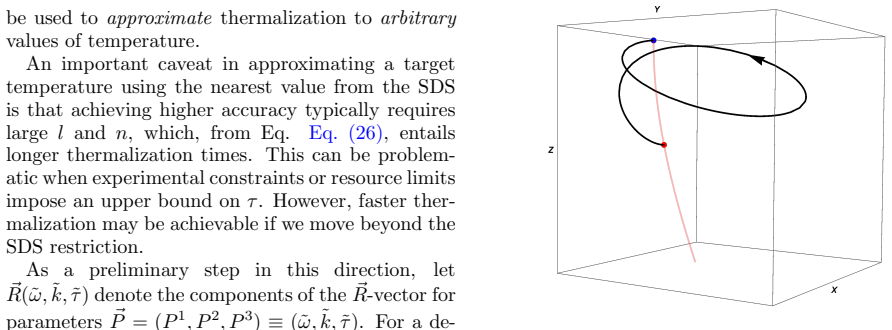
cothβω−2x 1x′ 1csch(βω)] , (7) FIG. 1:The family of thermal density matrices is repre- sented by the curve ⃗Rβ = (coth(βω),0,−cosech(βω)). The curve lies entirely in theX–Zplane, shown as the shaded region, where it is described by part of the hyper- bolaZ=− √ X 2 −1. The blue dot indicates the ground state, and the arrow shows the direction of increasing...
-
[2]
Particle Theory at the Higgs Cen- tre
Evolution to the thermal state To visualize the time evolution of the density ma- trix as the system thermalizes under our protocol, we once again invoke the ⃗R-space defined in Sec- tion II. As a first example, we revisitβ= kB Eg log 2, corresponding to the quickest case in the SDS. The evolution ofoscillator-1 from the ground state to the thermal state ...
-
[3]
The role of quantum information in thermodynamics – a topical review,
J. Goold, A. Riera, L. del Rio, M. Huber, and P. Skrzypczyk, “The role of quantum information in thermodynamics – a topical review,”Journal of Physics A: Mathematical and Theoretical49 no. 14, (Feb., 2016) 143001
work page 2016
-
[4]
Quantum thermodynamics: An introduction to the thermodynamics of quantum information,
S. Deffner and S. Campbell, “Quantum thermodynamics: An introduction to the thermodynamics of quantum information,” 2019. https://arxiv.org/abs/1907.01596
-
[5]
Perspective on quantum thermodynamics,
J. Millen and A. Xuereb, “Perspective on quantum thermodynamics,”New Journal of Physics18 no. 1, (2016) 011002
work page 2016
-
[6]
Introduction to black hole thermodynamics,
E. Witten, “Introduction to black hole thermodynamics,”Eur. Phys. J. Plus140no. 5, (2025) 430,arXiv:2412.16795 [hep-th]
-
[7]
Jerusalem Lectures on Black Holes and Quantum Information,
D. Harlow, “Jerusalem Lectures on Black Holes and Quantum Information,”Rev. Mod. Phys.88 (2016) 015002,arXiv:1409.1231 [hep-th]
-
[8]
S. Vinjanampathy and J. Anders, “Quantum thermodynamics,”Contemporary Physics57no. 4, (July, 2016) 545–579.http: //dx.doi.org/10.1080/00107514.2016.1201896
-
[9]
Quantum thermodynamic devices: From theoretical proposals to experimental reality,
N. M. Myers, O. Abah, and S. Deffner, “Quantum thermodynamic devices: From theoretical proposals to experimental reality,”A VS Quantum Sci.4no. 2, (2022) 027101,arXiv:2201.01740 [quant-ph]
-
[10]
Artificial brownian motors: Controlling transport on the nanoscale,
P. H¨ anggi and F. Marchesoni, “Artificial brownian motors: Controlling transport on the nanoscale,” Reviews of Modern Physics81no. 1, (Mar., 2009) 387–442. http://dx.doi.org/10.1103/RevModPhys.81.387
-
[11]
Fundamental limitations for quantum and nanoscale thermodynamics,
M. Horodecki and J. Oppenheim, “Fundamental limitations for quantum and nanoscale thermodynamics,”Nature Communications4 no. 1, (June, 2013) . http://dx.doi.org/10.1038/ncomms3059
-
[12]
I. M. Georgescu, S. Ashhab, and F. Nori, “Quantum Simulation,”Rev. Mod. Phys.86 (2014) 153,arXiv:1308.6253 [quant-ph]
work page internal anchor Pith review Pith/arXiv arXiv 2014
-
[13]
Quantum Thermal State Preparation,
C.-F. Chen, M. J. Kastoryano, F. G. S. L. Brand˜ ao, and A. Gily´ en, “Quantum Thermal State Preparation,”arXiv:2303.18224 [quant-ph]
-
[14]
End-to-end efficient quantum thermal and ground state preparation made simple,
Z. Ding, Y. Zhan, J. Preskill, and L. Lin, “End-to-end efficient quantum thermal and ground state preparation made simple,” 2025. https://arxiv.org/abs/2508.05703
-
[15]
Experimental issues in coherent quantum-state manipulation of trapped atomic ions
D. J. Wineland, C. Monroe, W. M. Itano, D. Leibfried, B. E. King, and D. M. Meekhof, “Experimental issues in coherent quantum-state manipulation of trapped atomic ions,”J. Res. Natl. Inst. Stand. Tech.103no. 3, (1998) 259, arXiv:quant-ph/9710025
work page internal anchor Pith review Pith/arXiv arXiv 1998
-
[16]
Strong coupling of a single photon to a superconducting qubit using circuit quantum electrodynamics,
A. Wallraff, D. I. Schuster, A. Blais, L. Frunzio, R.-S. Huang, J. Majer, S. Kumar, S. M. Girvin, and R. J. Schoelkopf, “Strong coupling of a single photon to a superconducting qubit using circuit quantum electrodynamics,”Nature431no. 7005, (2004) 162–167. https://www.nature.com/articles/nature02851
work page 2004
-
[17]
M. Aspelmeyer, T. J. Kippenberg, and F. Marquardt, “Cavity Optomechanics,”Rev. Mod. Phys.86(2014) 1391,arXiv:1303.0733 [cond-mat.mes-hall]
work page internal anchor Pith review Pith/arXiv arXiv 2014
-
[18]
Mesoscopic physics of nanomechanical systems,
A. Bachtold, J. Moser, and M. I. Dykman, “Mesoscopic physics of nanomechanical systems,” Rev. Mod. Phys.94no. 4, (2022) 045005, arXiv:2202.01819 [cond-mat.mes-hall]
-
[19]
The quantum harmonic otto cycle,
R. Kosloff and Y. Rezek, “The quantum harmonic otto cycle,”Entropy19no. 4, (Mar., 2017) 136. http://dx.doi.org/10.3390/e19040136
-
[20]
Efficiency of harmonic quantum otto engines at maximal power,
S. Deffner, “Efficiency of harmonic quantum otto engines at maximal power,”Entropy20no. 11, (Nov., 2018) 875. http://dx.doi.org/10.3390/e20110875
-
[21]
Gaussian thermal operations and the limits of algorithmic cooling,
A. Serafini, M. Lostaglio, S. Longden, U. Shackerley-Bennett, C.-Y. Hsieh, and G. Adesso, “Gaussian thermal operations and the limits of algorithmic cooling,”Physical Review Letters124no. 1, (Jan., 2020) .http: //dx.doi.org/10.1103/PhysRevLett.124.010602
-
[22]
V. Singh and ¨O. E. M¨ ustecaplıo˘ glu, “Performance bounds of nonadiabatic quantum harmonic otto engine and refrigerator under a squeezed thermal reservoir,”Physical Review E102no. 6, (Dec.,
-
[23]
http: //dx.doi.org/10.1103/PhysRevE.102.062123
-
[24]
Dynamical casimir effect and minimal temperature in quantum thermodynamics,
G. Benenti and G. Strini, “Dynamical casimir effect and minimal temperature in quantum thermodynamics,”Phys. Rev. A91(Feb, 2015) 020502.https://link.aps.org/doi/10.1103/ PhysRevA.91.020502
work page 2015
-
[25]
Quantum jump model for a system with a 11 finite-size environment,
S. Suomela, A. Kutvonen, and T. Ala-Nissila, “Quantum jump model for a system with a 11 finite-size environment,”Phys. Rev. E93(Jun,
- [26]
-
[27]
A self-contained quantum harmonic engine,
B. Reid, S. Pigeon, M. Antezza, and G. De Chiara, “A self-contained quantum harmonic engine,”EPL (Europhysics Letters)120no. 6, (Dec., 2017) 60006.http: //dx.doi.org/10.1209/0295-5075/120/60006
-
[28]
Thermodynamics as a consequence of information conservation,
M. N. Bera, A. Riera, M. Lewenstein, Z. B. Khanian, and A. Winter, “Thermodynamics as a consequence of information conservation,” Quantum3(Feb., 2019) 121.http: //dx.doi.org/10.22331/q-2019-02-14-121
-
[29]
E. Torrontegui, S. Ib´ a˜ nez, S. Mart´ ınez-Garaot, M. Modugno, A. del Campo, D. Gu´ ery-Odelin, A. Ruschhaupt, X. Chen, and J. G. Muga, “Shortcuts to Adiabaticity,”Adv. At. Mol. Opt. Phys.62(2013) 117–169,arXiv:1212.6343 [quant-ph]
work page internal anchor Pith review Pith/arXiv arXiv 2013
-
[30]
Focus on shortcuts to adiabaticity,
A. del Campo and K. Kim, “Focus on shortcuts to adiabaticity,”New Journal of Physics21no. 5, (May, 2019) 050201. http://dx.doi.org/10.1088/1367-2630/ab1437
-
[31]
Second order differential equations: conditions of complete integrability,
V. P. Ermakov, “Second order differential equations: conditions of complete integrability,” Univ. Izv. Kiev20no. 9, (1880) 1
-
[32]
Classical and quantum systems with time-dependent harmonic-oscillator-type hamiltonians,
H. R. Lewis Jr, “Classical and quantum systems with time-dependent harmonic-oscillator-type hamiltonians,”Physical Review Letters18no. 13, (1967) 510
work page 1967
-
[33]
Class of exact invariants for classical and quantum time-dependent harmonic oscillators,
H. R. Lewis Jr, “Class of exact invariants for classical and quantum time-dependent harmonic oscillators,”Journal of Mathematical Physics9 no. 11, (1968) 1976–1986
work page 1968
-
[34]
Resolved-sideband raman cooling of a bound atom to the 3d zero-point energy,
C. Monroe, D. Meekhof, B. King, S. R. Jefferts, W. M. Itano, D. J. Wineland, and P. Gould, “Resolved-sideband raman cooling of a bound atom to the 3d zero-point energy,”Physical review letters75no. 22, (1995) 4011
work page 1995
-
[35]
Generation of nonclassical motional states of a trapped atom,
D. Meekhof, C. Monroe, B. King, W. M. Itano, and D. J. Wineland, “Generation of nonclassical motional states of a trapped atom,”Physical review letters76no. 11, (1996) 1796
work page 1996
-
[36]
Nonequilibrium work distribution of a quantum harmonic oscillator,
S. Deffner and E. Lutz, “Nonequilibrium work distribution of a quantum harmonic oscillator,” Physical Review E—Statistical, Nonlinear, and Soft Matter Physics77no. 2, (2008) 021128
work page 2008
-
[37]
Thermal control across a chain of electronic nanocavities,
E. Jussiau, S. K. Manikandan, B. Bhandari, and A. N. Jordan, “Thermal control across a chain of electronic nanocavities,”Physical Review B104 no. 4, (July, 2021) .http: //dx.doi.org/10.1103/PhysRevB.104.045414
-
[38]
D. E. Kirk,Optimal Control Theory: An Introduction. Courier Corporation, Mineola, NY, 2004.https://books.google.com/books/about/ Optimal_Control_Theory.html?id=fCh2SAtWIdwC
work page 2004
-
[39]
Microwave quantum logic gates for trapped ions,
C. Ospelkaus, U. Warring, Y. Colombe, K. R. Brown, J. M. Amini, D. Leibfried, and D. J. Wineland, “Microwave quantum logic gates for trapped ions,”Nature476no. 7359, (Aug., 2011) 181–184. http://dx.doi.org/10.1038/nature10290
-
[40]
N. Freitas and J. P. Paz, “Cooling a quantum oscillator: A useful analogy to understand laser cooling as a thermodynamical process,”Phys. Rev. A97(Mar, 2018) 032104.https://link.aps.org/ doi/10.1103/PhysRevA.97.032104
-
[41]
Quantum harmonic oscillator state synthesis by reservoir engineering,
D. Kienzler, H.-Y. Lo, B. Keitch, L. de Clercq, F. Leupold, F. Lindenfelser, M. Marinelli, V. Negnevitsky, and J. P. Home, “Quantum harmonic oscillator state synthesis by reservoir engineering,”Science347no. 6217, (Jan., 2015) 53–56. http://dx.doi.org/10.1126/science.1261033
-
[42]
Nanoscale heat engine beyond the carnot limit,
J. Roßnagel, O. Abah, F. Schmidt-Kaler, K. Singer, and E. Lutz, “Nanoscale heat engine beyond the carnot limit,”Physical Review Letters 112no. 3, (Jan., 2014) .http: //dx.doi.org/10.1103/PhysRevLett.112.030602
-
[43]
J. Roßnagel, S. T. Dawkins, K. N. Tolazzi, O. Abah, E. Lutz, F. Schmidt-Kaler, and K. Singer, “A single-atom heat engine,”Science 352no. 6283, (Apr., 2016) 325–329. http://dx.doi.org/10.1126/science.aad6320
-
[44]
Quantum work statistics of linear and nonlinear parametric oscillators,
S. Deffner, O. Abah, and E. Lutz, “Quantum work statistics of linear and nonlinear parametric oscillators,”Chemical Physics375no. 2-3, (2010) 200–208
work page 2010
-
[45]
Work and efficiency of quantum otto cycles in power-law trapping potentials,
Y. Zheng and D. Poletti, “Work and efficiency of quantum otto cycles in power-law trapping potentials,”Physical Review E90no. 1, (2014) 012145
work page 2014
-
[46]
Quantum marginal problem and n-representability,
A. A. Klyachko, “Quantum marginal problem and n-representability,”Journal of Physics: Conference Series36(Apr., 2006) 72–86.http: //dx.doi.org/10.1088/1742-6596/36/1/014
-
[47]
Random Pure Gaussian States and Hawking Radiation,
E. Aurell, L. Hackl, P. Horodecki, R. H. Jonsson, and M. Kieburg, “Random Pure Gaussian States and Hawking Radiation,”Phys. Rev. Lett.133 no. 6, (2024) 060202,arXiv:2311.10562 [gr-qc]
-
[48]
Average entanglement entropy of a small subsystem in a constrained pure Gaussian state ensemble,
E. Aurell, L. Hackl, and M. Kieburg, “Average entanglement entropy of a small subsystem in a constrained pure Gaussian state ensemble,” arXiv:2505.03696 [quant-ph]. 12
discussion (0)
Sign in with ORCID, Apple, or X to comment. Anyone can read and Pith papers without signing in.