Recognition: 2 theorem links
· Lean TheoremBayesian Inference of Heavy-Quark Dissipation and Jet Transport Parameters from D-Meson observables in heavy-ion collisions at the LHC energies
Pith reviewed 2026-05-17 01:32 UTC · model grok-4.3
The pith
Bayesian inference simultaneously extracts temperature-dependent heavy-quark diffusion and jet transport coefficients from D-meson observables.
A machine-rendered reading of the paper's core claim, the machinery that carries it, and where it could break.
Core claim
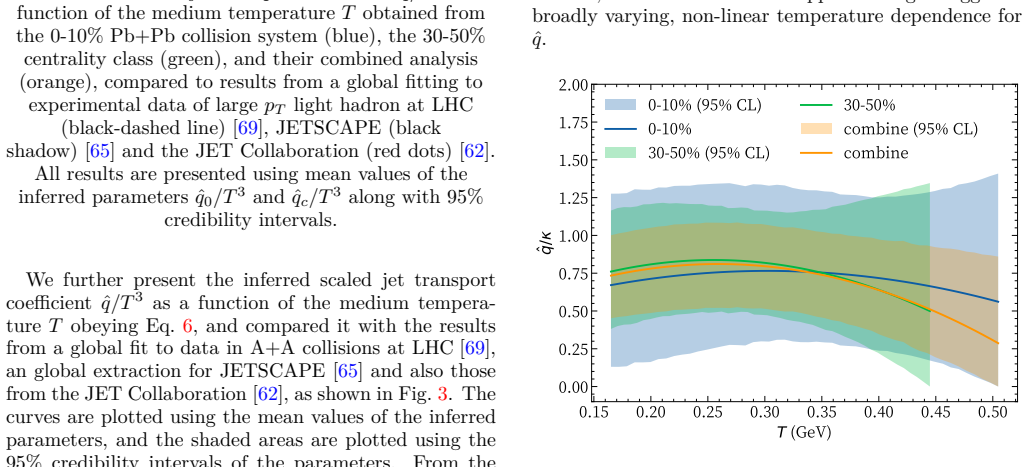
Using Bayesian inference on D-meson nuclear modification factor and elliptic flow data from Pb-Pb collisions at 5.02 TeV, the temperature-dependent forms of 2πT D_s and q-hat/T^3 are inferred simultaneously within an improved Langevin model. The posterior distributions are constrained, and the ratio q-hat/kappa exhibits non-monotonic temperature dependence with values between 0.25 and 0.8 for the mean parameters, deviating from the expected value of 2. This establishes a data-driven quantitative relationship between heavy-quark dissipation and jet transport properties in the strongly coupled quark-gluon plasma.
What carries the argument
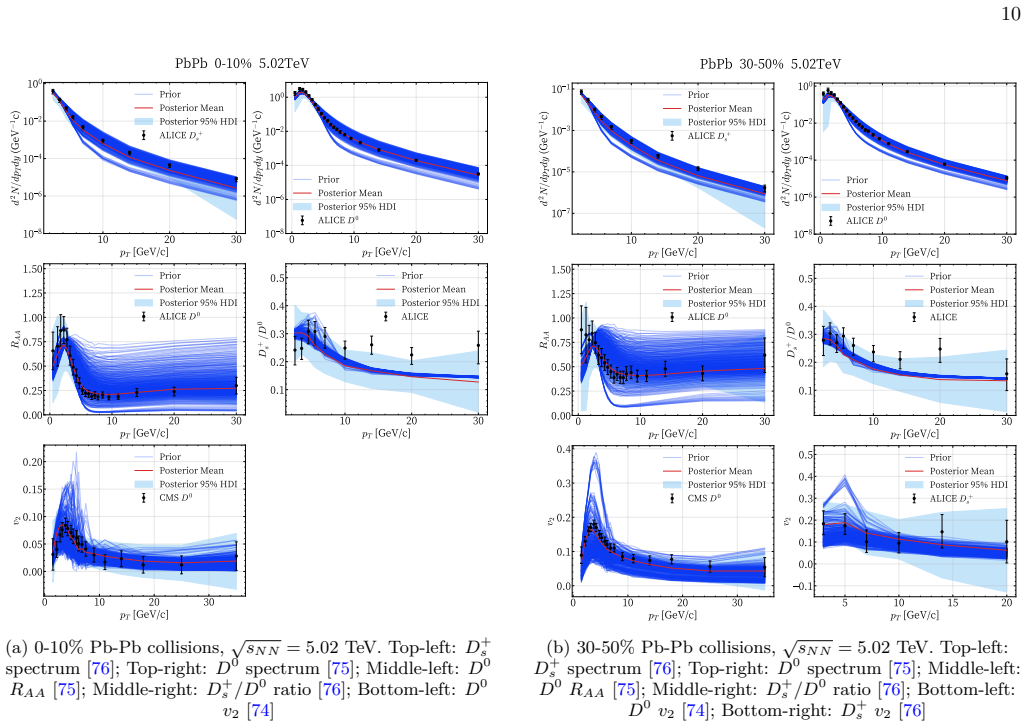
The unified improved Langevin transport model that incorporates both collisional and radiative energy loss with coalescence plus fragmentation hadronization, serving as the framework for Bayesian parameter inference from R_AA and v2 observables.
If this is right
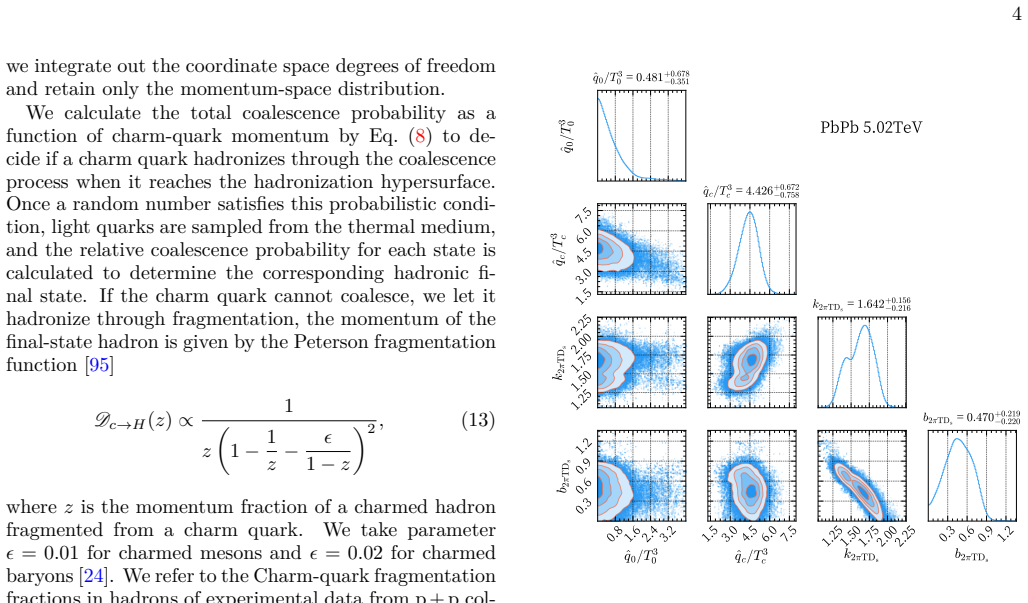
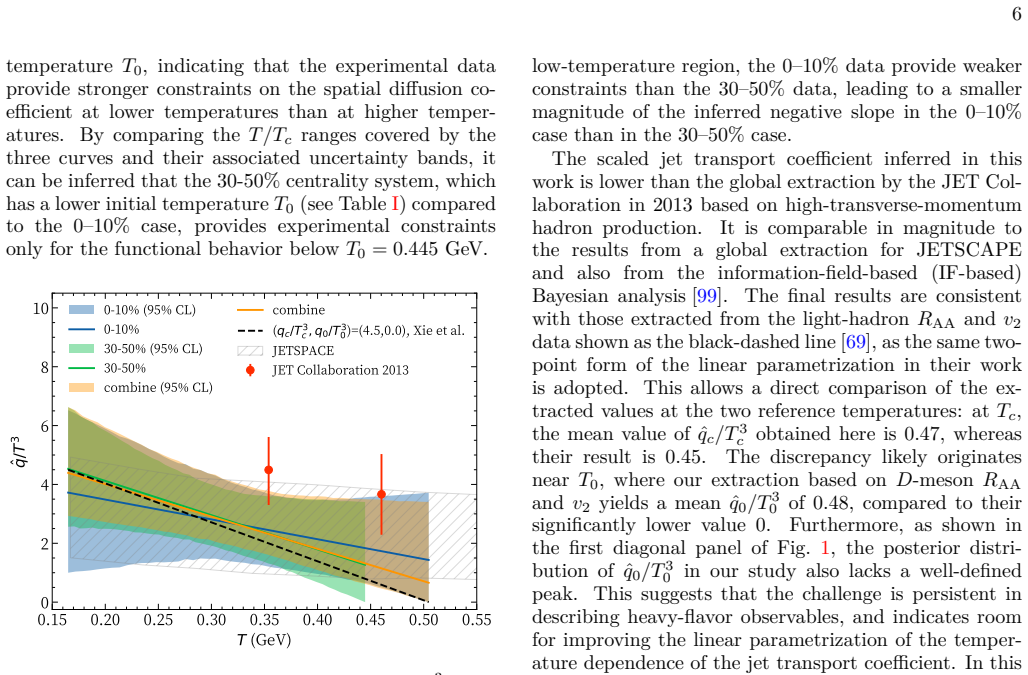
- The posterior distributions of the parameters of q-hat/T^3 and 2πT D_s are well constrained and comparable to results from theoretical models or other experimental data extraction.
- The 30-50% centrality data provide significantly stronger constraints than the 0-10% data.
- The extracted ratio q-hat/kappa between the quark jet transport and heavy-quark diffusion coefficients exhibits a non-monotonic temperature dependence deviating from 2.
- This work establishes a data-driven quantitative relationship between these two fundamental transport properties in the same observables.
Where Pith is reading between the lines
- If the non-monotonic temperature dependence of the ratio holds, it could indicate distinct temperature regimes where the medium couples differently to heavy quarks versus light partons.
- Similar Bayesian analyses applied to other heavy-flavor particles or lower collision energies could test whether the observed interval of 0.25-0.8 is a universal feature of the quark-gluon plasma.
- Incorporating additional observables such as higher flow harmonics or jet suppression patterns in future work might further narrow the allowed temperature dependence of the parameters.
Load-bearing premise
The unified improved Langevin transport model that incorporates both collisional and radiative energy loss, followed by coalescence plus fragmentation hadronization, accurately reproduces the D-meson R_AA and v2 observables without large unaccounted systematic biases from the model choice or the functional form chosen for the temperature dependence.
What would settle it
Repeating the Bayesian analysis with an alternative transport model or data from different collision energies or centralities that produces a constant ratio of exactly 2 across all temperatures would challenge the reported non-monotonic deviation.
Figures

read the original abstract
We perform the first simultaneous Bayesian inference of the temperature-dependent heavy-quark spatial diffusion coefficient $2\pi T\mathcal{D}_s$ and the scaled jet transport coefficient $\hat{q}/T^3$ in the quark-gluon plasma, utilizing $D$-meson nuclear modification factor $R_\text{AA}$ and elliptic flow $v_2$ data from Pb-Pb collisions at $\sqrt{s_\text{NN}} = 5.02\ \text{TeV}$. The analysis employs a unified improved Langevin transport model that incorporates both collisional and radiative energy loss, followed by coalescence plus fragmentation hadronization. The posterior distributions of the parameters of $\hat{q}/T^3$ and those of $2\pi T\mathcal{D}_s$ are well constrained, and compared with the results of theoretical models or other experimental data extraction, respectively. The $30-50\%$ centrality data provide significantly stronger constraints than the $0-10\%$ data. The extracted ratio $\hat{q}/\kappa$ between the quark jet transport and heavy-quark diffusion coefficients exhibits a non-monotonic temperature dependence, deviating from the value $2$ estimated from the definition, with a value interval spanning 0.25--0.8 corresponding to the mean values of the inferred parameters. This work establishes a data-driven quantitative relationship between these two fundamental transport properties in the same observables, offering crucial insight into their interplay in the strongly coupled medium.
Editorial analysis
A structured set of objections, weighed in public.
Referee Report
Summary. The manuscript performs the first simultaneous Bayesian inference of the temperature-dependent heavy-quark spatial diffusion coefficient 2πT D_s and the scaled jet transport coefficient q-hat/T^3 from D-meson R_AA and v2 data in Pb-Pb collisions at 5.02 TeV. It employs a unified improved Langevin transport model with both collisional and radiative energy loss, followed by coalescence plus fragmentation hadronization. The posteriors of the parameters are reported as well constrained, with 30-50% centrality data providing stronger constraints than 0-10% data. The extracted ratio q-hat/kappa exhibits non-monotonic temperature dependence, deviating from the value 2 estimated from the definition, with values spanning 0.25-0.8 based on the mean values of the inferred parameters.
Significance. If the results hold after addressing robustness concerns, the work provides a data-driven quantitative relationship between jet transport and heavy-quark diffusion coefficients extracted from the same observables. The simultaneous Bayesian inference is a clear strength, as is the use of centrality-dependent constraints and comparison to theoretical models. This could offer insight into the interplay of these transport properties in the QGP. The manuscript ships a data-driven extraction with explicit posterior constraints, which adds to its value if the functional-form dependence is clarified.
major comments (2)
- [Abstract and results section on parameter inference] The central claim of non-monotonic temperature dependence in the q-hat/kappa ratio (deviating from 2) is load-bearing for the paper's main result. The abstract states that posteriors are well constrained, yet the manuscript provides no indication of tests with alternative functional forms (constant, linear, or higher-order) for the temperature dependence of 2πT D_s and q-hat/T^3. If the chosen parametrization introduces artificial variation or correlates the coefficients in a model-specific way, the reported deviation and non-monotonicity could be driven by the functional choice rather than the data. This requires explicit robustness checks in the results section.
- [Model description and likelihood construction] The unified improved Langevin model is assumed to accurately reproduce the D-meson R_AA and v2 without large unaccounted systematic biases from the model choice or the functional form of temperature dependence. However, the abstract and summary do not detail cross-validation or alternative hadronization implementations, which is critical given that the ratio q-hat/kappa is computed from the mean values of the jointly inferred parameters.
minor comments (2)
- [Methods] Clarify the exact number of coefficients parametrizing the temperature dependence and how priors are chosen for each set.
- [Figures] Add uncertainty bands from the full posterior (not just mean values) when plotting the q-hat/kappa ratio versus temperature.
Simulated Author's Rebuttal
We thank the referee for the careful and constructive review of our manuscript. We address each major comment in detail below and have revised the manuscript to incorporate additional robustness checks and clarifications where feasible.
read point-by-point responses
-
Referee: [Abstract and results section on parameter inference] The central claim of non-monotonic temperature dependence in the q-hat/kappa ratio (deviating from 2) is load-bearing for the paper's main result. The abstract states that posteriors are well constrained, yet the manuscript provides no indication of tests with alternative functional forms (constant, linear, or higher-order) for the temperature dependence of 2πT D_s and q-hat/T^3. If the chosen parametrization introduces artificial variation or correlates the coefficients in a model-specific way, the reported deviation and non-monotonicity could be driven by the functional choice rather than the data. This requires explicit robustness checks in the results section.
Authors: We agree that explicit tests of alternative functional forms are necessary to confirm that the reported non-monotonicity and deviation from 2 in the q-hat/kappa ratio are not artifacts of the chosen parametrization. The functional form adopted in the manuscript was motivated by the need for sufficient flexibility to accommodate possible temperature variations suggested by both theoretical calculations and earlier extractions. To address the referee's concern directly, we have performed supplementary Bayesian analyses employing constant and linear temperature dependencies for the transport coefficients. These additional inferences show that the key features of the ratio persist across the tested forms, supporting that the behavior is driven by the constraining power of the D-meson data. A new subsection detailing these robustness tests, including posterior comparisons and the resulting ratio values, will be added to the results section of the revised manuscript. revision: yes
-
Referee: [Model description and likelihood construction] The unified improved Langevin model is assumed to accurately reproduce the D-meson R_AA and v2 without large unaccounted systematic biases from the model choice or the functional form of temperature dependence. However, the abstract and summary do not detail cross-validation or alternative hadronization implementations, which is critical given that the ratio q-hat/kappa is computed from the mean values of the jointly inferred parameters.
Authors: The unified improved Langevin framework used in this work has been validated against heavy-flavor observables in our earlier publications, where it successfully reproduces R_AA and v2 trends across different collision energies and systems. We recognize that a more explicit discussion of cross-validation procedures and the sensitivity to hadronization modeling would strengthen the presentation, particularly since the extracted ratio relies on the joint posterior means. In the revised manuscript we will expand the model description and likelihood sections to include a dedicated paragraph on potential systematic uncertainties arising from the coalescence-plus-fragmentation hadronization scheme, together with references to related cross-validation studies in the literature. While a full re-analysis with multiple alternative hadronization implementations lies beyond the scope of the current computational resources, we will quantify the expected impact on the ratio through a limited sensitivity study. revision: partial
Circularity Check
No significant circularity detected in the Bayesian inference chain
full rationale
The paper's core derivation consists of simultaneous Bayesian inference of the parameters governing the temperature dependence of 2πT D_s and q-hat/T^3, using D-meson R_AA and v2 data from LHC Pb-Pb collisions inside a unified improved Langevin model with coalescence plus fragmentation. The extracted ratio q-hat/kappa is computed after the fact from the posterior means of these independently constrained parameters and compared against an external theoretical expectation of 2 from the definition. No step reduces the output ratio or its non-monotonicity to the input data or model assumptions by algebraic construction, self-definition, or load-bearing self-citation; the posteriors remain data-driven and the functional forms are stated modeling choices rather than tautologies. The chain is therefore self-contained against external benchmarks.
Axiom & Free-Parameter Ledger
free parameters (2)
- coefficients parametrizing temperature dependence of 2πT D_s
- coefficients parametrizing temperature dependence of q-hat/T^3
axioms (2)
- domain assumption The improved Langevin model with both collisional and radiative energy loss correctly describes heavy-quark propagation through the quark-gluon plasma.
- domain assumption Coalescence plus fragmentation hadronization accurately converts heavy quarks into observed D mesons.
Lean theorems connected to this paper
-
IndisputableMonolith/Cost/FunctionalEquation.leanwashburn_uniqueness_aczel unclear?
unclearRelation between the paper passage and the cited Recognition theorem.
unified improved Langevin transport model that incorporates both collisional and radiative energy loss... 2πT Ds = k · T/Tc + b ... q-hat/T^3 linear interpolation
-
IndisputableMonolith/Foundation/AlphaCoordinateFixation.leanJ_uniquely_calibrated_via_higher_derivative unclear?
unclearRelation between the paper passage and the cited Recognition theorem.
extracted ratio q-hat/κ ... non-monotonic temperature dependence, deviating from the value 2
What do these tags mean?
- matches
- The paper's claim is directly supported by a theorem in the formal canon.
- supports
- The theorem supports part of the paper's argument, but the paper may add assumptions or extra steps.
- extends
- The paper goes beyond the formal theorem; the theorem is a base layer rather than the whole result.
- uses
- The paper appears to rely on the theorem as machinery.
- contradicts
- The paper's claim conflicts with a theorem or certificate in the canon.
- unclear
- Pith found a possible connection, but the passage is too broad, indirect, or ambiguous to say the theorem truly supports the claim.
Reference graph
Works this paper leans on
- [1]
-
[2]
C. Wu, in 31st International Conference on Ultra-relativistic Nucleus-Nucleus Collisions (2025) arXiv:2509.02502 [nucl-ex]
-
[3]
B. Zhang, L.-W. Chen, and C.-M. Ko, Phys. Rev. C 72, 024906 (2005) , arXiv:nucl-th/0502056
work page internal anchor Pith review Pith/arXiv arXiv 2005
- [4]
-
[5]
Elliptic flow and energy loss of heavy quarks in ultra-relativistic heavy ion collisions
J. Uphoff, O. Fochler, Z. Xu, and C. Greiner, Phys. Rev. C 84, 024908 (2011) , arXiv:1104.2295 [hep-ph]
work page internal anchor Pith review Pith/arXiv arXiv 2011
-
[6]
Open heavy flavor in Pb+Pb collisions at sqrt(s)=2.76 TeV within a transport model
J. Uphoff, O. Fochler, Z. Xu, and C. Greiner, Phys. Lett. B 717, 430 (2012) , arXiv:1205.4945 [hep-ph]
work page internal anchor Pith review Pith/arXiv arXiv 2012
-
[7]
P. B. Gossiaux, J. Aichelin, T. Gousset, and V. Guiho, J. Phys. G 37, 094019 (2010) , arXiv:1001.4166 [hep-ph]
work page internal anchor Pith review Pith/arXiv arXiv 2010
-
[8]
Azimuthal correlations of heavy quarks in Pb+Pb collisions at LHC ($\sqrt{s}=2.76$ TeV)
M. Nahrgang, J. Aichelin, P. B. Gossiaux, and K. Werner, Phys. Rev. C 90, 024907 (2014) , arXiv:1305.3823 [hep- ph]
work page internal anchor Pith review Pith/arXiv arXiv 2014
-
[9]
S. K. Das, F. Scardina, S. Plumari, and V. Greco, Phys. Rev. C 90, 044901 (2014) , arXiv:1312.6857 [nucl-th]
work page internal anchor Pith review Pith/arXiv arXiv 2014
-
[10]
S. Cao, T. Luo, G.-Y. Qin, and X.-N. Wang, Phys. Rev. C 94, 014909 (2016) , arXiv:1605.06447 [nucl-th]
work page internal anchor Pith review Pith/arXiv arXiv 2016
-
[11]
S. Cao, T. Luo, G.-Y. Qin, and X.-N. Wang, Phys. Lett. B 777, 255 (2018) , arXiv:1703.00822 [nucl-th]
work page internal anchor Pith review Pith/arXiv arXiv 2018
-
[12]
Extraction of Heavy-Flavor Transport Coefficients in QCD Matter
A. Beraudo et al. , Nucl. Phys. A 979, 21 (2018) , arXiv:1803.03824 [nucl-th]
work page internal anchor Pith review Pith/arXiv arXiv 2018
- [13]
- [14]
-
[15]
G. D. Moore and D. Teaney, Phys. Rev. C 71, 064904 (2005), arXiv:hep-ph/0412346
work page internal anchor Pith review Pith/arXiv arXiv 2005
-
[16]
M. G. Mustafa, Phys. Rev. C 72, 014905 (2005) , arXiv:hep-ph/0412402
work page internal anchor Pith review Pith/arXiv arXiv 2005
-
[17]
Thermalization of Heavy Quarks in the Quark-Gluon Plasma
H. van Hees and R. Rapp, Phys. Rev. C 71, 034907 (2005), arXiv:nucl-th/0412015
work page internal anchor Pith review Pith/arXiv arXiv 2005
-
[18]
Heavy-Quark Probes of the Quark-Gluon Plasma at RHIC
H. van Hees, V. Greco, and R. Rapp, Phys. Rev. C 73, 034913 (2006) , arXiv:nucl-th/0508055
work page internal anchor Pith review Pith/arXiv arXiv 2006
-
[19]
Thermalization of charm quarks in infinite and finite QGP matter
S. Cao and S. A. Bass, Phys. Rev. C 84, 064902 (2011) , arXiv:1108.5101 [nucl-th]
work page internal anchor Pith review Pith/arXiv arXiv 2011
-
[20]
T. Lang, H. van Hees, J. Steinheimer, G. Inghirami, and M. Bleicher, Phys. Rev. C 93, 014901 (2016) , arXiv:1211.6912 [hep-ph]
work page internal anchor Pith review Pith/arXiv arXiv 2016
-
[21]
S. Cao, G.-Y. Qin, and S. A. Bass, Phys. Rev. C 88, 044907 (2013) , arXiv:1308.0617 [nucl-th]
work page internal anchor Pith review Pith/arXiv arXiv 2013
-
[22]
M. He, H. van Hees, P. B. Gossiaux, R. J. Fries, and R. Rapp, Phys. Rev. E 88, 032138 (2013) , arXiv:1305.1425 [nucl-th]
work page internal anchor Pith review Pith/arXiv arXiv 2013
-
[23]
Heavy flavours in heavy-ion collisions: quenching, flow and correlations
A. Beraudo, A. De Pace, M. Monteno, M. Nardi, and 8 F. Prino, Eur. Phys. J. C 75, 121 (2015), arXiv:1410.6082 [hep-ph]
work page internal anchor Pith review Pith/arXiv arXiv 2015
-
[24]
S. K. Das, J. M. Torres-Rincon, L. Tolos, V. Minissale, F. Scardina, and V. Greco, Phys. Rev. D 94, 114039 (2016), arXiv:1604.05666 [nucl-th]
work page internal anchor Pith review Pith/arXiv arXiv 2016
-
[25]
F. Scardina, S. K. Das, V. Minissale, S. Plumari, and V. Greco, Phys. Rev. C 96, 044905 (2017) , arXiv:1707.05452 [nucl-th]
work page internal anchor Pith review Pith/arXiv arXiv 2017
- [26]
- [27]
- [28]
- [29]
- [30]
-
[31]
Heavy Quark Momentum Diffusion Coefficient from Lattice QCD
D. Banerjee, S. Datta, R. Gavai, and P. Majumdar, Phys. Rev. D 85, 014510 (2012) , arXiv:1109.5738 [hep-lat]
work page internal anchor Pith review Pith/arXiv arXiv 2012
-
[32]
A non-perturbative estimate of the heavy quark momentum diffusion coefficient
A. Francis, O. Kaczmarek, M. Laine, T. Neuhaus, and H. Ohno, Phys. Rev. D 92, 116003 (2015) , arXiv:1508.04543 [hep-lat]
work page internal anchor Pith review Pith/arXiv arXiv 2015
-
[33]
N. Brambilla, V. Leino, P. Petreczky, and A. Vairo, Phys. Rev. D 102, 074503 (2020) , arXiv:2007.10078 [hep-lat]
-
[34]
L. Altenkort, A. M. Eller, O. Kaczmarek, L. Mazur, G. D. Moore, and H.-T. Shu, Phys. Rev. D 103, 014511 (2021) , arXiv:2009.13553 [hep-lat]
-
[35]
N. Brambilla, V. Leino, J. Mayer-Steudte, and P. Pe- treczky (TUMQCD), Phys. Rev. D 107, 054508 (2023) , arXiv:2206.02861 [hep-lat]
-
[36]
D. Banerjee, S. Datta, R. V. Gavai, and P. Majumdar, Nucl. Phys. A 1038, 122721 (2023) , arXiv:2206.15471 [hep-ph]
-
[37]
L. Altenkort, O. Kaczmarek, R. Larsen, S. Mukherjee, P. Petreczky, H.-T. Shu, and S. Stendebach (HotQCD), Phys. Rev. Lett. 130, 231902 (2023) , arXiv:2302.08501 [hep-lat]
-
[38]
L. Altenkort, D. de la Cruz, O. Kaczmarek, R. Larsen, G. D. Moore, S. Mukherjee, P. Petreczky, H.-T. Shu, and S. Stendebach (HotQCD), Phys. Rev. Lett. 132, 051902 (2024), arXiv:2311.01525 [hep-lat]
-
[39]
D. Bollweg, J. L. Dasilva Golán, O. Kaczmarek, R. N. Larsen, G. D. Moore, S. Mukherjee, P. Petreczky, H.-T. Shu, S. Stendebach, and J. H. Weber (HotQCD), JHEP 09, 180 , arXiv:2506.11958 [hep-lat]
-
[40]
From AdS/CFT correspondence to hydrodynamics
G. Policastro, D. T. Son, and A. O. Starinets, JHEP 09, 043, arXiv:hep-th/0205052
work page internal anchor Pith review Pith/arXiv arXiv
-
[41]
Heavy Quark Diffusion in Strongly Coupled $\N=4$ Yang Mills
J. Casalderrey-Solana and D. Teaney, Phys. Rev. D 74, 085012 (2006) , arXiv:hep-ph/0605199
work page internal anchor Pith review Pith/arXiv arXiv 2006
- [42]
-
[43]
W. A. Horowitz, Phys. Rev. D 91, 085019 (2015) , arXiv:1501.04693 [hep-ph]
work page internal anchor Pith review Pith/arXiv arXiv 2015
-
[44]
Drag Force on Heavy Quarks and Spatial String Tension
O. Andreev, Mod. Phys. Lett. A 33, 1850041 (2018) , arXiv:1707.05045 [hep-ph]
work page internal anchor Pith review Pith/arXiv arXiv 2018
- [45]
- [46]
-
[47]
W.-C. Dai, O.-Y. Luo, B. Chen, X. Chen, X.-Y. Zhu, and X.-H. Li, (2025), arXiv:2503.10213 [hep-ph]
work page internal anchor Pith review Pith/arXiv arXiv 2025
-
[48]
Hadronic Modes and Quark Properties in the Quark-Gluon Plasma
M. Mannarelli and R. Rapp, Phys. Rev. C 72, 064905 (2005), arXiv:hep-ph/0505080
work page internal anchor Pith review Pith/arXiv arXiv 2005
-
[49]
Quarkonia and Heavy-Quark Relaxation Times in the Quark-Gluon Plasma
F. Riek and R. Rapp, Phys. Rev. C 82, 035201 (2010) , arXiv:1005.0769 [hep-ph]
work page internal anchor Pith review Pith/arXiv arXiv 2010
- [50]
-
[51]
S. Y. F. Liu and R. Rapp, Phys. Rev. C 97, 034918 (2018), arXiv:1711.03282 [nucl-th]
work page internal anchor Pith review Pith/arXiv arXiv 2018
- [52]
-
[53]
From Kadanoff-Baym dynamics to off-shell parton transport
W. Cassing, Eur. Phys. J. ST 168, 3 (2009) , arXiv:0808.0715 [nucl-th]
work page internal anchor Pith review Pith/arXiv arXiv 2009
-
[54]
T. Song, H. Berrehrah, D. Cabrera, J. M. Torres-Rincon, L. Tolos, W. Cassing, and E. Bratkovskaya, Phys. Rev. C 92, 014910 (2015) , arXiv:1503.03039 [nucl-th]
work page internal anchor Pith review Pith/arXiv arXiv 2015
-
[55]
A dynamical quasiparticle approach for the Quark-Gluon-Plasma bulk and transport properties
H. Berrehrah, E. Bratkovskaya, T. Steinert, and W. Cassing, Int. J. Mod. Phys. E 25, 1642003 (2016) , arXiv:1605.02371 [hep-ph]
work page internal anchor Pith review Pith/arXiv arXiv 2016
-
[56]
Recent thermodynamic results from lattice QCD analyzed within a quasi-particle model
S. Plumari, W. M. Alberico, V. Greco, and C. Ratti, Phys. Rev. D 84, 094004 (2011) , arXiv:1103.5611 [hep- ph]
work page internal anchor Pith review Pith/arXiv arXiv 2011
-
[57]
S. K. Das, F. Scardina, S. Plumari, and V. Greco, Phys. Lett. B 747, 260 (2015) , arXiv:1502.03757 [nucl-th]
work page internal anchor Pith review Pith/arXiv arXiv 2015
- [58]
-
[59]
Y. Xu, J. E. Bernhard, S. A. Bass, M. Nahrgang, and S. Cao, Phys. Rev. C 97, 014907 (2018) , arXiv:1710.00807 [nucl-th]
work page internal anchor Pith review Pith/arXiv arXiv 2018
-
[60]
X.-F. Chen, C. Greiner, E. Wang, X.-N. Wang, and Z. Xu, Phys. Rev. C 81, 064908 (2010) , arXiv:1002.1165 [nucl-th]
work page internal anchor Pith review Pith/arXiv arXiv 2010
-
[61]
X.-F. Chen, T. Hirano, E. Wang, X.-N. Wang, and H. Zhang, Phys. Rev. C 84, 034902 (2011) , arXiv:1102.5614 [nucl-th]
work page internal anchor Pith review Pith/arXiv arXiv 2011
-
[62]
K. M. Burke et al. (JET), Phys. Rev. C 90, 014909 (2014), arXiv:1312.5003 [nucl-th]
work page internal anchor Pith review Pith/arXiv arXiv 2014
-
[63]
Z.-Q. Liu, H. Zhang, B.-W. Zhang, and E. Wang, Eur. Phys. J. C 76, 20 (2016) , arXiv:1506.02840 [nucl-th]
work page internal anchor Pith review Pith/arXiv arXiv 2016
-
[64]
Soltz (Jetscape), PoS HardProbes2018, 048 (2019)
R. Soltz (Jetscape), PoS HardProbes2018, 048 (2019)
work page 2019
- [65]
-
[66]
J. Mulligan et al. (JETSCAPE), in 55th Rencontres de Moriond on QCD and High Energy Interactions (2021) arXiv:2106.11348 [nucl-th]
-
[67]
R. Ehlers et al. (JETSCAPE), Phys. Rev. C 111, 054913 (2025), arXiv:2408.08247 [hep-ph]
- [68]
- [69]
- [70]
- [71]
-
[72]
H. Liu, K. Rajagopal, and U. A. Wiedemann, Phys. Rev. Lett. 97, 182301 (2006) , arXiv:hep-ph/0605178
work page internal anchor Pith review Pith/arXiv arXiv 2006
- [73]
- [74]
-
[75]
S. Acharya et al. (ALICE), JHEP 01, 174 , 9 arXiv:2110.09420 [nucl-ex]
-
[76]
S. Acharya et al. (ALICE), Phys. Lett. B 827, 136986 (2022), arXiv:2110.10006 [nucl-ex]
- [77]
-
[78]
Theoretical predictions for charm and bottom production at the LHC
M. Cacciari, S. Frixione, N. Houdeau, M. L. Mangano, P. Nason, and G. Ridolfi, JHEP 10, 137, arXiv:1205.6344 [hep-ph]
work page internal anchor Pith review Pith/arXiv arXiv
- [79]
- [80]
discussion (0)
Sign in with ORCID, Apple, or X to comment. Anyone can read and Pith papers without signing in.