REVIEW 4 major objections 5 minor 1 cited by
Reconstructing Objects along Hand Interaction Timelines in Egocentric Video
T0 review · 4 major / 5 minor · reviewed 2026-08-03 · deepseek-v4-flash
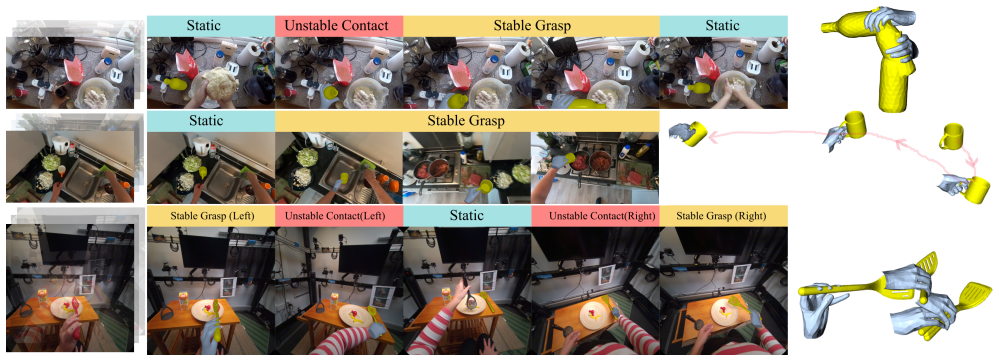
Pith's one-line read The paper claims that enforcing stable-grasp contact invariance across frames and propagating poses across interaction segments reconstructs object pose in egocentric video better than per-frame fitting, improving accuracy by up to 24.5%.
desk verdict Solid task-definition and dataset paper; the GT-based ADD gains on HOT3D are real, but the EPIC SCA metrics are partly circular and the stable-grasp loss is stronger than the paper's own definition. read the letter →
The pith
A machine-rendered reading of the paper's core claim, the machinery that carries it, and where it could break.
The reading
What carries the argument
The load-bearing mechanism is the Hand Interaction Timeline decomposition into Static, Unstable Contact, and Stable Grasp segments, paired with the stable-grasp loss E_SG—a differentiable term that penalizes, for all pairs of frames in a segment, the variation of the distance between each object vertex and each fingertip vertex. E_SG carries the stable-grasp assumption into a numerical objective, and the propagation step—using the object-to-world pose at the segment boundary to initialize the next segment—is what links the timeline together. The push/pull losses and mask rendering loss handle physical contact and 2D supervision.
What would settle it
A direct check: take stable-grasp clips where the object is known to rotate slightly in the hand (rolling or sliding) and where ground-truth poses are available. If COP's ADD on those clips is no better than the Dynamic per-frame baseline, or if the E_SG loss is lower for an incorrect pose than for the ground-truth pose, the contact-invariance constraint is not selecting the right pose. More practically, an experiment with deliberately perturbed hand poses (e.g., adding noise to the estimated fingers) should show COP degrading to chance levels, confirming that the frame-to-frame vertex-distanc
Extended reading notes
Core claim
The central claim is that a rigid object's pose during a hand interaction can be recovered from egocentric video by explicitly modeling the three temporal regimes the object passes through. In a stable grasp, the contact area on the object remains the same even though finger articulations and object pose vary, so the paper introduces the stable-grasp loss E_SG: for every object vertex and every fingertip vertex, the distance between them must be equal in every pair of frames of the segment. Because the object is rigid, minimizing E_SG by adjusting its pose relative to the hand aligns the contact region over time without freezing the object's motion. Each segment is then optimized under its o
Load-bearing premise
The central assumption is that during a stable grasp the distance between every object vertex and every fingertip vertex is exactly the same in every frame—stronger than just 'the contact area overlaps,' and violated when the grasp rolls or slides slightly or when the hand pose is estimated incorrectly.
Editorial extensions
If this is right
- Stable-grasp reconstruction improves by 6.2–11.3% over dynamic per-frame fitting, and full-HIT unstable-contact segments, the hardest part of an interaction, improve by up to 24.5% when poses are propagated.
- On HOT3D-HIT, full-timeline ADD reaches 70.3% for stable grasps, 79.2% for static segments, and 67.1% for unstable contact, so the benefit is not limited to the in-hand portion.
- Accuracy degrades gracefully under noisy segment boundaries: adding 10–30 frames of noise to boundaries lowers ADD from 70.0 to 60.0, still far above the 15.0 of the smoothing baseline, so the method does not require perfect annotations.
- Because the optimization is training-free and only needs a category CAD model and 2D masks, it transfers to in-the-wild footage where 3D ground truth does not exist, and it also improves stable grasps in the ARCTIC dataset (ADD 56.0 to 65.1).
- The proposed SCA-ADD and SCA-IOU metrics, which measure whether the reconstructed pose keeps a stable contact area, provide a way to evaluate contact consistency rather than only final pose.
Reading between the lines
- A natural extension is to make the hand pose itself part of the optimization under E_SG; the paper's stated failure mode—incorrect hand poses—might then be mitigated, since the same contact-invariance objective would also constrain the hand.
- The timeline decomposition suggests a benchmark protocol for in-the-wild egocentric reconstruction: evaluate contact-area consistency (SCA) alongside 2D mask IoU, so methods that overfit to masks but break contact physics are penalized.
- The propagation scheme implies that errors can accumulate across long timelines; combining COP with an automatic segment localizer (e.g., a vision-language model) would be a direct next step, and the boundary-noise ablation indicates where such a model would help most.
- One could test the stable-grasp assumption more directly by measuring whether E_SG is minimized near ground-truth poses on clips with deliberate micro-rolling; if not, the loss would need to be softened to tolerate slow contact drift.
Editorial analysis
A structured set of objections, weighed in public.
Referee Report
Summary. The paper proposes ROHIT, a task for reconstructing rigid object 6-DoF poses over a Hand Interaction Timeline (HIT) in egocentric video, and COP, an optimization framework with segment-specific constraints: Static segments fix the object in the world, Stable Grasp segments use a novel stable-grasp loss E_SG that penalizes variation of hand-object vertex distances across frames, and Unstable Contact segments use mask and physical-contact losses. COP also propagates optimized object-to-world poses across segment boundaries to initialize subsequent segments. The authors curate HOT3D-HIT (1,239 stable grasps, 113 HITs with 3D GT) and EPIC-HIT (2,431 stable grasps, 96 HITs with 2D masks), and report ADD improvements on stable grasps from 51.9% to 58.1% (HOT3D) and 56.0% to 65.1% (ARCTIC), with further gains from propagation, e.g., stable-grasp ADD 70.3% and Static ADD 79.2% on HOT3D-HIT.
Significance. If the reported gains are robust, the paper makes a useful contribution: it defines a new temporal task with explicit segment types, introduces two datasets, and shows that enforcing stable-contact constraints and propagating poses across segments improves object pose estimation. The strongest evidence is the GT-based ADD evaluation: the HOT3D-HIT and ARCTIC results are not built from the SCA metrics that E_SG targets, and the supplementary ARCTIC evaluation plus the boundary-noise ablation provide useful supporting analyses. However, the EPIC-HIT quantitative claims rely on SCA metrics that are closely aligned with the optimized loss, and the paper's own definition of stable grasp is weaker than the constraint imposed by E_SG; these issues need additional analysis before the central claims can be fully accepted.
major comments (4)
- [Sec. 4.2, Eq. (6)] E_SG enforces a much stronger condition than the paper's own stable-grasp definition. Eq. (1) only requires the IoU of the in-contact object area to exceed tau, permitting gradual rolling/sliding or changes in non-contact distances. Eq. (6) instead minimizes, for every object vertex and every fingertip vertex, the variation of d_oh over all frame pairs, i.e. it requires the full distance field to be time-invariant. Grasps that satisfy Eq. (1) but include slight rolling/sliding or soft-tissue deformation can then be optimized to a wrong pose. The GT ADD results on HOT3D/ARCTIC are not affected by this concern, but the paper does not measure how often the stronger condition actually holds in its own stable-grasp data. Please report the distribution of contact-area IoU vs. Eq. (6) distance variation under GT poses, and consider a relaxed loss that constrains only the nearest-contact vertice
- [Sec. 5.3, Table 3] The SCA@0.8/0.6 and SCA-IOU metrics measure exactly the quantity that E_SG is designed to optimize: consistency of in-contact areas across frame pairs. The paper's own explanation in Sec. 4.2 that aligned distance fields imply aligned contact area makes the EPIC-HIT gains on SCA metrics partly circular. Since EPIC-HIT has no 3D GT, the only independent support comes from HOT3D-HIT and ARCTIC ADD. The abstract and Sec. 1 should not present EPIC-HIT SCA gains as direct evidence of pose accuracy. Please report the relationship between IOU and ADD, or add a no-GT proxy that is not the loss objective.
- [Table 7] The hyperparameters lambda1 and lambda2 are selected by measuring ADD/SCA-ADD on HOT3D-HIT, which is the same set used to report the headline results in Tables 2 and 4. No validation split is described. This selection on the evaluation set can inflate reported improvements; the table shows, for instance, lambda1=10 improves SCA-ADD but hurts ADD relative to lambda1=1, so the choice is consequential. Please use a held-out validation split or report sensitivity to lambda over a range.
- [Table 4 and Supplement Sec. E] The Unstable Contact improvement from 17.3 to 67.1 ADD is the largest component of the claimed up-to-24.5% HIT gain, but COP without propagation uses random initialization for Unstable Contact while COP with propagation initializes from the optimized previous segment, which in HOT3D is itself initialized from GT-derived poses. This comparison primarily measures the value of a good initialization rather than a temporal constraint. COP's propagation is a warm start, not a joint temporal optimization (Sec. 4.4). Please add an ablation that initializes both variants with the same initialization protocol, or add a temporal consistency term, to separate initialization effects from constrained propagation.
minor comments (5)
- [Table 2] The 'whiteboardmarker' row reports COP with SCA-IOU 0.0 but SCA-ADD 35.4; since both are averages over the same category, this inconsistency needs an explanation or correction.
- [Sec. 3.1, Eq. (1)] The definition of Unstable Contact uses IOU(Si,Sj)<=tau, but if Si or Sj is empty the IoU is undefined. Please clarify how empty contact sets are handled.
- [Abstract] The range '6.2-11.3%' is not tied to specific datasets or tables in the abstract; it appears to refer to HOT3D and ARCTIC ADD gains. Please state the source of each number.
- [Table 1] The EPIC-HIT row lists 79,736 frames for 96 HITs, while Supp. B.2 reports 319,661 segmentation masks for stable-grasp clips. Please clarify whether the table counts only HIT frames or includes stable-grasp clips.
- [Sec. 5.2] The scaling lambda_f = f * render_size needs units and a precise definition of f, since Eq. (5) is in pixels and Eq. (6) is in meters; this is needed for reproducibility.
Circularity Check
Core HOT3D-ADD claim is independent, but the EPIC-HIT SCA evaluation is partly self-referential: the metric measures contact-area stability, the same quantity E_SG is constructed to enforce.
-
self definitional
[Sec. 4.2, Eq. (6) and Sec. 5.3 (SCA-IOU/SCA-ADD definitions); EPIC-HIT evaluation in Table 3]
"ESG = Σ_{vo∈Vo} Σ_{vh∈VF} Σ_n Σ_m |d^n_oh − d^m_oh|_1 ... Optimising for this distance is the same as aligning the contact area – i.e. if two frames have the same hand-object vertex distance, then the contact area will undoubtedly be aligned. ... we measure the stable contact area across the sequence, defined as the average IOU of in contact area between all pairs of frames (Sec. 3.1)."
The EPIC-HIT subset has no 3D ground truth, so its main evidence for 'stable grasp reconstruction' is SCA-IOU/SCA@0.6. That metric is the average IOU of the in-contact object area, which is exactly the property E_SG is designed to maximize: E_SG minimizes frame-to-frame variation of hand-fingertip-to-object-vertex distances, and the paper asserts this 'is the same as aligning the contact area.' Thus the SCA gains of COP over Dynamic (e.g. SCA@0.6 25.2→36.5 in Table 3) are mostly a check that the optimizer achieved its own stable-contact objective, not an independent reconstruction-accuracy measurement. The HOT3D ADD/SCA-ADD results remain genuinely independent, so the circularity is partial.
full rationale
The central HOT3D claim is grounded in GT ADD, which is external to the optimization and not built from the SCA objective; the propagation contribution is also evaluated against GT poses, so those derivations are self-contained. No load-bearing self-citation chain or imported uniqueness theorem appears. The only concrete circular step is the EPIC-HIT SCA evaluation: without 3D GT, the paper relies on SCA-IOU/SCA@0.6 as evidence, while the stable-grasp loss and these metrics share the same definition of stable contact. The paper itself connects Eq. (6) to contact-area alignment, making the EPIC SCA gains partially tautological. Because COP is also validated on HOT3D with ADD and on ARCTIC with ADD, the overall score is moderate rather than high. This is not an accusation of intent; it identifies a metric-loss overlap that limits the in-the-wild conclusions to the extent they rest on SCA numbers.
Assumptions & free parameters
free parameters (3)
- λ1, λ2 loss weights =
λ1 = λ_f, λ2 = 0.1·λ_f
- stable-grasp IoU threshold τ =
0.5
- object pose initialization set =
10 rotations + 1 translation per segment; ~4.1 manual common poses per (category, hand) on EPIC-HIT
assumptions (6)
- domain assumption Stable Grasp is characterized by an invariant set of contacting object vertices over the segment, operationalized as invariance of distances from all object vertices to five fingertip vertices.
- domain assumption Hand pose T_h2c and MANO articulations θ_n are available or estimated reliably (HaMeR in the wild).
- domain assumption HIT segment boundaries (Static/Unstable/Stable) are given as input.
- domain assumption Object is rigid and a category-level CAD model is known for each instance.
- domain assumption Object-to-world pose is constant during Static segments.
- domain assumption World-to-camera poses are available from dataset annotations or SfM.
Cite this review
Pith. "Pith review of Reconstructing Objects along Hand Interaction Timelines in Egocentric Video." pith.science (2026). https://pith.science/paper/ZOYP4BNA
@misc{pith2026251207394,
  author       = {Pith},
  title        = {Pith review of: Reconstructing Objects along Hand Interaction Timelines in Egocentric Video},
  year         = {2026},
  howpublished = {\url{https://pith.science/paper/ZOYP4BNA}},
  note         = {Machine review of arXiv:2512.07394}
}
read the original abstract
We introduce the task of Reconstructing Objects along Hand Interaction Timelines (ROHIT). We first define the Hand Interaction Timeline (HIT) from a rigid object's perspective. In a HIT, an object is first static relative to the scene, then is held in hand following contact, where its pose changes. This is usually followed by a firm grip during use, before it is released to be static again w.r.t. to the scene. We model these pose constraints over the HIT, and propose to propagate the object's pose along the HIT enabling superior reconstruction using our proposed Constrained Optimisation and Propagation (COP) framework. Importantly, we focus on timelines with stable grasps - i.e. where the hand is stably holding an object, effectively maintaining constant contact during use. This allows us to efficiently annotate, study, and evaluate object reconstruction in videos without 3D ground truth. We evaluate our proposed task, ROHIT, over two egocentric datasets, HOT3D and in-the-wild EPIC-Kitchens. In HOT3D, we curate 1.2K clips of stable grasps. In EPIC-Kitchens, we annotate 2.4K clips of stable grasps including 390 object instances across 9 categories from videos of daily interactions in 141 environments. Without 3D ground truth, we utilise 2D projection error to assess the reconstruction. Quantitatively, COP improves stable grasp reconstruction by 6.2-11.3% and HIT reconstruction by up to 24.5% with constrained pose propagation.
Figures


Figures from the paper (9 more)


Forward citations
Cited by 1 Pith paper
-
WARPED: Wrist-Aligned Rendering for Robot Policy Learning from Egocentric Human Demonstrations
WARPED synthesizes realistic wrist-view observations from monocular egocentric human videos via foundation models, hand-object tracking, retargeting, and Gaussian Splatting to train visuomotor policies that match tele...
Reference graph
Works this paper leans on
-
[1]
Thor-net: End-to-end graformer-based realistic two hands and object reconstruc- tion with self-supervision
Ahmed Tawfik Aboukhadra, Jameel Malik, Ahmed Elhayek, Nadia Robertini, and Didier Stricker. Thor-net: End-to-end graformer-based realistic two hands and object reconstruc- tion with self-supervision. InProceedings of the IEEE/CVF Winter Conference on Applications of Computer Vision, pages 1001–1010, 2023. 2
2023
-
[2]
Ayce Idil Aytekin, Helge Rhodin, Rishabh Dabral, and Chris- tian Theobalt. Follow my hold: Hand-object interaction reconstruction through geometric guidance.arXiv preprint arXiv:2508.18213, 2025. 3
arXiv 2025
-
[3]
Hot3d: Hand and object tracking in 3d from egocentric multi-view videos
Prithviraj Banerjee, Sindi Shkodrani, Pierre Moulon, Shreyas Hampali, Shangchen Han, Fan Zhang, Linguang Zhang, Jade Fountain, Edward Miller, Selen Basol, et al. Hot3d: Hand and object tracking in 3d from egocentric multi-view videos. InProceedings of the IEEE Conference on Computer Vision and Pattern Recognition, pages 7061– 7071, 2025. 1, 4, 5, 6, 13, 14, 15
2025
-
[4]
Contactpose: A dataset of grasps with object contact and hand pose
Samarth Brahmbhatt, Chengcheng Tang, Christopher D Twigg, Charles C Kemp, and James Hays. Contactpose: A dataset of grasps with object contact and hand pose. InPro- ceedings of the European Conference on Computer Vision, pages 361–378, 2020. 1, 13, 15
2020
-
[5]
Bullock, Raymond R
Ian M. Bullock, Raymond R. Ma, and Aaron M. Dollar. A hand-centric classification of human and robot dexterous ma- nipulation.IEEE Transactions on Haptics, 6(2):129–144,
-
[6]
Reconstructing hand-object interactions in the wild
Zhe Cao, Ilija Radosavovic, Angjoo Kanazawa, and Jiten- dra Malik. Reconstructing hand-object interactions in the wild. InProceedings of the IEEE International Conference on Computer Vision, pages 12417–12426, 2021. 1, 2, 3, 5, 6, 15
2021
-
[7]
Dexycb: A benchmark for capturing hand grasping of objects
Yu-Wei Chao, Wei Yang, Yu Xiang, Pavlo Molchanov, Ankur Handa, Jonathan Tremblay, Yashraj S Narang, Karl Van Wyk, Umar Iqbal, Stan Birchfield, et al. Dexycb: A benchmark for capturing hand grasping of objects. InPro- ceedings of the IEEE Conference on Computer Vision and Pattern Recognition, pages 9044–9053, 2021. 13, 15
2021
-
[8]
MonoRUn: Monocular 3D object detection by reconstruction and uncertainty propagation
Hansheng Chen, Yuyao Huang, Wei Tian, Zhong Gao, and Lu Xiong. MonoRUn: Monocular 3D object detection by reconstruction and uncertainty propagation. InProceedings of the IEEE Conference on Computer Vision and Pattern Recognition, pages 10379–10388, 2021. 2
2021
Show all 82 references
-
[9]
Alignsdf: Pose-aligned signed distance fields for hand-object reconstruction
Zerui Chen, Yana Hasson, Cordelia Schmid, and Ivan Laptev. Alignsdf: Pose-aligned signed distance fields for hand-object reconstruction. InProceedings of the European Conference on Computer Vision, pages 231–248, 2022. 1, 2
2022
-
[10]
HORT: Monocular hand-held objects reconstruction with transformers
Zerui Chen, Rolandos Alexandros Potamias, Shizhe Chen, and Cordelia Schmid. HORT: Monocular hand-held objects reconstruction with transformers. InProceedings of the IEEE International Conference on Computer Vision, 2025. 2
2025
-
[11]
Transformer- based unified recognition of two hands manipulating objects
Hoseong Cho, Chanwoo Kim, Jihyeon Kim, Seongyeong Lee, Elkhan Ismayilzada, and Seungryul Baek. Transformer- based unified recognition of two hands manipulating objects. InProceedings of the IEEE Conference on Computer Vision and Pattern Recognition, pages 4769–4778, 2023. 2
2023
-
[12]
Dense hand- object(ho) graspnet with full grasping taxonomy and dynam- ics
Woojin Cho, Jihyun Lee, Minjae Yi, Minje Kim, Taeyun Woo, Donghwan Kim, Taewook Ha, Hyokeun Lee, Je-Hwan Ryu, Woontack Woo, and Tae-Kyun Kim. Dense hand- object(ho) graspnet with full grasping taxonomy and dynam- ics. InProceedings of the European Conference on Com- puter Visi...
2024
-
[13]
Blender Foundation, Stichting Blender Foundation, Amsterdam, 2018
Blender Online Community.Blender - a 3D modelling and rendering package. Blender Foundation, Stichting Blender Foundation, Amsterdam, 2018. 13
2018
-
[14]
Cutkosky
M.R. Cutkosky. On grasp choice, grasp models, and the de- sign of hands for manufacturing tasks.IEEE Transactions on Robotics and Automation, 5(3):269–279, 1989. 3
1989
-
[15]
Scaling egocentric vision: The epic-kitchens dataset
Dima Damen, Hazel Doughty, Giovanni Maria Farinella, Sanja Fidler, Antonino Furnari, Evangelos Kazakos, Davide Moltisanti, Jonathan Munro, Toby Perrett, Will Price, et al. Scaling egocentric vision: The epic-kitchens dataset. InPro- ceedings of the European Conference on Compu...
2018
-
[16]
Rescaling egocentric vision: Collection, pipeline and challenges for epic-kitchens-100.International Journal of Computer Vision (IJCV), 130:33–55, 2022
Dima Damen, Hazel Doughty, Giovanni Maria Farinella, , Antonino Furnari, Jian Ma, Evangelos Kazakos, Davide Moltisanti, Jonathan Munro, Toby Perrett, Will Price, and Michael Wray. Rescaling egocentric vision: Collection, pipeline and challenges for epic-kitchens-100.Internatio...
2022
-
[17]
Epic-kitchens visor benchmark: Video segmenta- tions and object relations
Ahmad Darkhalil, Dandan Shan, Bin Zhu, Jian Ma, Amlan Kar, Richard Higgins, Sanja Fidler, David Fouhey, and Dima Damen. Epic-kitchens visor benchmark: Video segmenta- tions and object relations. InAdvances in Neural Information Processing Systems, 2022. 6, 14
2022
-
[18]
Hamba: Single- view 3d hand reconstruction with graph-guided bi-scanning mamba
Haoye Dong, Aviral Chharia, Wenbo Gou, Francisco Vi- cente Carrasco, and Fernando D De la Torre. Hamba: Single- view 3d hand reconstruction with graph-guided bi-scanning mamba. InAdvances in Neural Information Processing Sys- tems, pages 2127–2160, 2024. 2
2024
-
[19]
Black, and Otmar Hilliges
Zicong Fan, Omid Taheri, Dimitrios Tzionas, Muhammed Kocabas, Manuel Kaufmann, Michael J. Black, and Otmar Hilliges. ARCTIC: A dataset for dexterous bimanual hand- object manipulation. InProceedings of the IEEE Conference 9 on Computer Vision and Pattern Recognition, 2023. 6, ...
2023
-
[20]
HOLD: Category-agnostic 3d reconstruction of in- teracting hands and objects from video
Zicong Fan, Maria Parelli, Maria Eleni Kadoglou, Muhammed Kocabas, Xu Chen, Michael J Black, and Otmar Hilliges. HOLD: Category-agnostic 3d reconstruction of in- teracting hands and objects from video. InProceedings of the IEEE Conference on Computer Vision and Pattern Recogni...
2024
-
[21]
Dollar, and Danica Kragic
Thomas Feix, Javier Romero, Heinz Bodo Schmiedmayer, Aaron M. Dollar, and Danica Kragic. The GRASP Taxon- omy of Human Grasp Types.IEEE Transactions on Human- Machine Systems, 46(1):66–77, 2016. 3
2016
-
[22]
First-person hand action bench- mark with RGB-D videos and 3d hand pose annotations
Guillermo Garcia-Hernando, Shanxin Yuan, Seungryul Baek, and Tae-Kyun Kim. First-person hand action bench- mark with RGB-D videos and 3d hand pose annotations. In Proceedings of the IEEE Conference on Computer Vision and Pattern Recognition, pages 409–419, 2018. 15
2018
-
[23]
Mesh R-CNN
Georgia Gkioxari, Jitendra Malik, and Justin Johnson. Mesh R-CNN. InProceedings of the IEEE International Confer- ence on Computer Vision, pages 9784–9794, 2019. 2
2019
-
[24]
Zero-shot category-level object pose estimation
Walter Goodwin, Sagar Vaze, Ioannis Havoutis, and Ingmar Posner. Zero-shot category-level object pose estimation. In Proceedings of the European Conference on Computer Vi- sion, pages 516–532, 2022. 2
2022
-
[25]
Honnotate: A method for 3d annotation of hand and object poses
Shreyas Hampali, Mahdi Rad, Markus Oberweger, and Vin- cent Lepetit. Honnotate: A method for 3d annotation of hand and object poses. InProceedings of the IEEE Conference on Computer Vision and Pattern Recognition, pages 3193– 3203, 2020. 13, 15
2020
-
[26]
In-hand 3d object scan- ning from an rgb sequence
Shreyas Hampali, Tomas Hodan, Luan Tran, Lingni Ma, Cem Keskin, and Vincent Lepetit. In-hand 3d object scan- ning from an rgb sequence. InProceedings of the IEEE Con- ference on Computer Vision and Pattern Recognition, 2023. 3
2023
-
[27]
Black, Ivan Laptev, and Cordelia Schmid
Yana Hasson, G ¨ul Varol, Dimitrios Tzionas, Igor Kale- vatykh, Michael J. Black, Ivan Laptev, and Cordelia Schmid. Learning joint reconstruction of hands and manipulated ob- jects. InProceedings of the IEEE Conference on Computer Vision and Pattern Recognition, pages 11807–11...
2019
-
[28]
Towards unconstrained joint hand-object reconstruc- tion from rgb videos
Yana Hasson, G ¨ul Varol, Cordelia Schmid, and Ivan Laptev. Towards unconstrained joint hand-object reconstruc- tion from rgb videos. InInternational Conference on 3D Vi- sion (3DV), pages 659–668, 2021. 1, 2, 3, 4, 5, 6, 7, 13, 14, 16
2021
-
[29]
EPOS: Es- timating 6d pose of objects with symmetries
Tomas Hodan, Daniel Barath, and Jiri Matas. EPOS: Es- timating 6d pose of objects with symmetries. InProceed- ings of the IEEE Conference on Computer Vision and Pattern Recognition, pages 11703–11712, 2020. 6
2020
-
[30]
BOP challenge 2020 on 6D object localization
Tom ´aˇs Hoda ˇn, Martin Sundermeyer, Bertram Drost, Yann Labb´e, Eric Brachmann, Frank Michel, Carsten Rother, and Jiˇr´ı Matas. BOP challenge 2020 on 6D object localization. InProceedings of the European Conference on Computer Vi- sion Workshops, pages 577–594. Springer, 2020. 6
2020
-
[31]
Reconstruct- ing Hand-Held Objects from Monocular Video
Di Huang, Xiaopeng Ji, Xingyi He, Jiaming Sun, Tong He, Qing Shuai, Wanli Ouyang, and Xiaowei Zhou. Reconstruct- ing Hand-Held Objects from Monocular Video. InProceed- ings of SIGGRAPH Asia 2022 Conference Papers, 2022. 3, 13
2022
-
[32]
Qort- former: Query-optimized real-time transformer for under- standing two hands manipulating objects
Elkhan Ismayilzada, MD Khalequzzaman Chowdhury Sayem, Yihalem Yimolal Tiruneh, Mubarrat Tajoar Chowd- hury, Muhammadjon Boboev, and Seungryul Baek. Qort- former: Query-optimized real-time transformer for under- standing two hands manipulating objects. InProceedings of the AAAI...
2025
-
[33]
Hand-held object reconstruction from rgb video with dynamic interaction
Shijian Jiang, Qi Ye, Rengan Xie, Yuchi Huo, and Jiming Chen. Hand-held object reconstruction from rgb video with dynamic interaction. InProceedings of the Computer Vision and Pattern Recognition Conference, pages 12220–12230,
-
[34]
Grasp- ing field: Learning implicit representations for human grasps
Korrawe Karunratanakul, Jinlong Yang, Yan Zhang, Michael J Black, Krikamol Muandet, and Siyu Tang. Grasp- ing field: Learning implicit representations for human grasps. InInternational Conference on 3D Vision (3DV), pages 333–344, 2020. 1, 2
2020
-
[35]
Neu- ral 3d mesh renderer
Hiroharu Kato, Yoshitaka Ushiku, and Tatsuya Harada. Neu- ral 3d mesh renderer. InProceedings of the IEEE Conference on Computer Vision and Pattern Recognition, pages 3907– 3916, 2018. 4
2018
-
[36]
Learning analysis-by-synthesis for 6d pose estimation in rgb-d images
Alexander Krull, Eric Brachmann, Frank Michel, Michael Ying Yang, Stefan Gumhold, and Carsten Rother. Learning analysis-by-synthesis for 6d pose estimation in rgb-d images. InProceedings of the IEEE international conference on computer vision, pages 954–962, 2015. 6
2015
-
[37]
H2o: Two hands manipulating objects for first person interaction recognition
Taein Kwon, Bugra Tekin, Jan St ¨uhmer, Federica Bogo, and Marc Pollefeys. H2o: Two hands manipulating objects for first person interaction recognition. InProceedings of the IEEE International Conference on Computer Vision, pages 10138–10148, 2021. 2, 13, 15
2021
-
[38]
HHMR: Holistic Hand Mesh Recovery by Enhancing the Multimodal Controllability of Graph Diffusion Models
Mengcheng Li, Hongwen Zhang, Yuxiang Zhang, Ruizhi Shao, Tao Yu, and Yebin Liu. HHMR: Holistic Hand Mesh Recovery by Enhancing the Multimodal Controllability of Graph Diffusion Models. InProceedings of the IEEE Con- ference on Computer Vision and Pattern Recognition, pages 645...
2024
-
[39]
End-to-end hu- man pose and mesh reconstruction with transformers
Kevin Lin, Lijuan Wang, and Zicheng Liu. End-to-end hu- man pose and mesh reconstruction with transformers. InPro- ceedings of the IEEE Conference on Computer Vision and Pattern Recognition, 2021. 2
2021
-
[40]
Harmonious feature learning for in- teractive hand-object pose estimation
Zhifeng Lin, Changxing Ding, Huan Yao, Zengsheng Kuang, and Shaoli Huang. Harmonious feature learning for in- teractive hand-object pose estimation. InProceedings of the IEEE/CVF Conference on Computer Vision and Pattern Recognition, pages 12989–12998, 2023. 2, 6
2023
-
[41]
Semi-supervised 3d hand-object poses es- timation with interactions in time
Shaowei Liu, Hanwen Jiang, Jiarui Xu, Sifei Liu, and Xi- aolong Wang. Semi-supervised 3d hand-object poses es- timation with interactions in time. InProceedings of the IEEE/CVF Conference on Computer Vision and Pattern Recognition, pages 14687–14697, 2021. 2
2021
-
[42]
HOI4D: A 4D Egocentric Dataset for Category-Level Human-Object Interaction
Yunze Liu, Yun Liu, Che Jiang, Kangbo Lyu, Weikang Wan, Hao Shen, Boqiang Liang, Zhoujie Fu, He Wang, and Li Yi. HOI4D: A 4D Egocentric Dataset for Category-Level Human-Object Interaction. InProceedings of the IEEE Con- 10 ference on Computer Vision and Pattern Recognition, pa...
2022
-
[43]
Easyhoi: Unleashing the power of large models for reconstructing hand-object interactions in the wild
Yumeng Liu, Xiaoxiao Long, Zemin Yang, Yuan Liu, Marc Habermann, Christian Theobalt, Yuexin Ma, and Wenping Wang. Easyhoi: Unleashing the power of large models for reconstructing hand-object interactions in the wild. InPro- ceedings of the IEEE Conference on Computer Vision an...
2025
-
[44]
AutoShape: Real-time shape-aware monocular 3D object detection
Zongdai Liu, Dingfu Zhou, Feixiang Lu, Jin Fang, and Liangjun Zhang. AutoShape: Real-time shape-aware monocular 3D object detection. InProceedings of the IEEE International Conference on Computer Vision, pages 15621– 15630, 2021. 2
2021
-
[45]
Core50: a new dataset and benchmark for continuous object recognition
Vincenzo Lomonaco and Davide Maltoni. Core50: a new dataset and benchmark for continuous object recognition. In Conference on Robot Learning, pages 17–26, 2017. 15
2017
-
[46]
Maxime Oquab, Timoth ´ee Darcet, Th´eo Moutakanni, Huy V . V o, Marc Szafraniec, Vasil Khalidov, Pierre Fernandez, Daniel HAZIZA, Francisco Massa, Alaaeldin El-Nouby, Mido Assran, Nicolas Ballas, Wojciech Galuba, Russell Howes, Po-Yao Huang, Shang-Wen Li, Ishan Misra, Michael ...
2024
-
[47]
Found- pose: Unseen object pose estimation with foundation fea- tures
Evin Pınar ¨Ornek, Yann Labb ´e, Bugra Tekin, Lingni Ma, Cem Keskin, Christian Forster, and Tom ´aˇs Hoda ˇn. Found- pose: Unseen object pose estimation with foundation fea- tures. InProceedings of the European Conference on Com- puter Vision, 2024. 2, 16
2024
-
[48]
Learning to imitate object interactions from internet videos.arXiv preprint arXiv:2211.13225, 2022
Austin Patel, Andrew Wang, Ilija Radosavovic, and Jitendra Malik. Learning to imitate object interactions from internet videos.arXiv preprint arXiv:2211.13225, 2022. 1, 2, 3, 4, 5, 6, 15
2022 arXiv
-
[49]
Reconstruct- ing hands in 3d with transformers
Georgios Pavlakos, Dandan Shan, Ilija Radosavovic, Angjoo Kanazawa, David Fouhey, and Jitendra Malik. Reconstruct- ing hands in 3d with transformers. InProceedings of the IEEE Conference on Computer Vision and Pattern Recogni- tion, pages 9826–9836, 2024. 2, 3, 4
2024
-
[50]
Spatial cognition from egocentric video: Out of sight, not out of mind
Chiara Plizzari, Shubham Goel, Toby Perrett, Jacob Chalk, Angjoo Kanazawa, and Dima Damen. Spatial cognition from egocentric video: Out of sight, not out of mind. In2025 International Conference on 3D Vision (3DV), 2025. 14
2025
-
[51]
Wilor: End-to-end 3d hand localization and reconstruction in-the-wild
Rolandos Alexandros Potamias, Jinglei Zhang, Jiankang Deng, and Stefanos Zafeiriou. Wilor: End-to-end 3d hand localization and reconstruction in-the-wild. InProceedings of the IEEE Conference on Computer Vision and Pattern Recognition, pages 12242–12254, 2025. 2
2025
-
[52]
3d reconstruction of objects in hands without real world 3d supervision
Aditya Prakash, Matthew Chang, Matthew Jin, Ruisen Tu, and Saurabh Gupta. 3d reconstruction of objects in hands without real world 3d supervision. InProceedings of the European Conference on Computer Vision, 2024. 2, 6
2024
-
[53]
3d hand pose estimation in everyday egocentric im- ages
Aditya Prakash, Ruisen Tu, Matthew Chang, and Saurabh Gupta. 3d hand pose estimation in everyday egocentric im- ages. InProceedings of the European Conference on Com- puter Vision, 2024. 2
2024
-
[54]
Em- bodied Hands: Modeling and Capturing Hands and Bodies Together.ACM Trans
Javier Romero, Dimitrios Tzionas, and Michael J Black. Em- bodied Hands: Modeling and Capturing Hands and Bodies Together.ACM Trans. Graph, 36:17, 2017. 3
2017
-
[55]
Frankmocap: A monocular 3d whole-body pose estimation system via re- gression and integration
Yu Rong, Takaaki Shiratori, and Hanbyul Joo. Frankmocap: A monocular 3d whole-body pose estimation system via re- gression and integration. InProceedings of the IEEE Inter- national Conference on Computer Vision Workshops, pages 1749–1759, 2021. 2
2021
-
[56]
Sch ¨onberger and Jan-Michael Frahm
Johannes L. Sch ¨onberger and Jan-Michael Frahm. Structure- from-motion revisited. InProceedings of the IEEE Con- ference on Computer Vision and Pattern Recognition, pages 4104–4113. IEEE Computer Society, 2016. 4
2016
-
[57]
As- sembly101: A large-scale multi-view video dataset for un- derstanding procedural activities
Fadime Sener, Dibyadip Chatterjee, Daniel Shelepov, Kun He, Dipika Singhania, Robert Wang, and Angela Yao. As- sembly101: A large-scale multi-view video dataset for un- derstanding procedural activities. InProceedings of the IEEE/CVF Conference on Computer Vision and Pattern R...
2022
-
[58]
NodeSLAM: Neural Object Descriptors for Multi-View Shape Reconstruction
Edgar Sucar, Kentaro Wada, and Andrew Davison. NodeSLAM: Neural Object Descriptors for Multi-View Shape Reconstruction. InProceedings of the International Conference on 3D Vision (3DV), 2020. 13
2020
-
[59]
Showme: Benchmarking object-agnostic hand-object 3d re- construction
Anilkumar Swamy, Vincent Leroy, Philippe Weinzaepfel, Fabien Baradel, Salma Galaaoui, Romain Br ´egier, Matthieu Armando, Jean-Sebastien Franco, and Gr ´egory Rogez. Showme: Benchmarking object-agnostic hand-object 3d re- construction. InProceedings of the IEEE International C...
1935
-
[60]
Grab: A dataset of whole-body human grasp- ing of objects
Omid Taheri, Nima Ghorbani, Michael J Black, and Dim- itrios Tzionas. Grab: A dataset of whole-body human grasp- ing of objects. InProceedings of the European Conference on Computer Vision, pages 581–600, 2020. 1, 13, 15
2020
-
[61]
EPIC Fields: Marrying 3D Geometry and Video Understanding
Vadim Tschernezki, Ahmad Darkhalil, Zhifan Zhu, David Fouhey, Iro Larina, Diane Larlus, Dima Damen, and Andrea Vedaldi. EPIC Fields: Marrying 3D Geometry and Video Understanding. InAdvances in Neural Information Process- ing Systems, 2023. 4, 14
2023
-
[62]
Collaborative learning for hand and ob- ject reconstruction with attention-guided graph convolution
Tze Ho Elden Tse, Kwang In Kim, Ales Leonardis, and Hyung Jin Chang. Collaborative learning for hand and ob- ject reconstruction with attention-guided graph convolution. InProceedings of the IEEE Conference on Computer Vision and Pattern Recognition, pages 1664–1674, 2022. 2
2022
-
[63]
He Wang, Srinath Sridhar, Jingwei Huang, Julien P. C. Valentin, Shuran Song, and L. Guibas. Normalized ob- ject coordinate space for category-level 6D object pose and size estimation. InProceedings of the IEEE Conference on Computer Vision and Pattern Recognition, pages 2642– ...
2019
-
[64]
Ho-cap: A capture system and dataset for 3d reconstruction and pose tracking of hand- object interaction, 2024
Jikai Wang, Qifan Zhang, Yu-Wei Chao, Bowen Wen, Xi- aohu Guo, and Yu Xiang. Ho-cap: A capture system and dataset for 3d reconstruction and pose tracking of hand- object interaction, 2024. 15
2024
-
[65]
Interacting hand- object pose estimation via dense mutual attention
Rong Wang, Wei Mao, and Hongdong Li. Interacting hand- object pose estimation via dense mutual attention. InPro- ceedings of the IEEE/CVF Winter Conference on Applica- tions of Computer Vision, pages 5735–5745, 2023. 2 11
2023
-
[66]
Magichoi: Leveraging 3d priors for accurate hand-object reconstruction from short monoc- ular video clips
Shibo Wang, Haonan He, Maria Parelli, Christoph Gebhardt, Zicong Fan, and Jie Song. Magichoi: Leveraging 3d priors for accurate hand-object reconstruction from short monoc- ular video clips. InProceedings of the IEEE International Conference on Computer Vision, pages 5957–5968...
2025
-
[67]
Reconstructing hand-held objects in 3d.arXiv preprint arXiv:2404.06507, 2024
Jane Wu, Georgios Pavlakos, Georgia Gkioxari, and Jiten- dra Malik. Reconstructing hand-held objects in 3d.arXiv preprint arXiv:2404.06507, 2024. 6
2024
-
[68]
PoseCNN: A convolutional neural network for 6D object pose estimation in cluttered scenes
Yu Xiang, Tanner Schmidt, Venkatraman Narayanan, and Dieter Fox. PoseCNN: A convolutional neural network for 6D object pose estimation in cluttered scenes. InProceed- ings of Robotics: Science and Systems, 2018. 2, 6
2018
-
[69]
CPF: Learning a contact potential field to model the hand-object interaction
Lixin Yang, Xinyu Zhan, Kailin Li, Wenqiang Xu, Jiefeng Li, and Cewu Lu. CPF: Learning a contact potential field to model the hand-object interaction. InProceedings of the IEEE International Conference on Computer Vision, pages 11097–11106, 2021. 1, 2, 5, 6
2021
-
[70]
ArtiBoost: Boosting articulated 3d hand-object pose estimation via online exploration and syn- thesis
Lixin Yang, Kailin Li, Xinyu Zhan, Jun Lv, Wenqiang Xu, Jiefeng Li, and Cewu Lu. ArtiBoost: Boosting articulated 3d hand-object pose estimation via online exploration and syn- thesis. InProceedings of the IEEE Conference on Computer Vision and Pattern Recognition, pages 2750–2...
2022
-
[71]
Oakink: A large-scale knowledge repos- itory for understanding hand-object interaction
Lixin Yang, Kailin Li, Xinyu Zhan, Fei Wu, Anran Xu, Liu Liu, and Cewu Lu. Oakink: A large-scale knowledge repos- itory for understanding hand-object interaction. InProceed- ings of the IEEE/CVF Conference on Computer Vision and Pattern Recognition, pages 20953–20962, 2022. 15
2022
-
[72]
What’s in your hands? 3d reconstruction of generic objects in hands
Yufei Ye, Abhinav Gupta, and Shubham Tulsiani. What’s in your hands? 3d reconstruction of generic objects in hands. InProceedings of the IEEE Conference on Computer Vision and Pattern Recognition, pages 3895–3905, 2022. 1, 2, 6
2022
-
[73]
Diffusion-guided reconstruction of everyday hand- object interaction clips
Yufei Ye, Poorvi Hebbar, Abhinav Gupta, and Shubham Tul- siani. Diffusion-guided reconstruction of everyday hand- object interaction clips. InProceedings of the IEEE Interna- tional Conference on Computer Vision, pages 19717–19728,
-
[74]
G-hop: Generative hand-object prior for interaction reconstruction and grasp synthesis
Yufei Ye, Abhinav Gupta, Kris Kitani, and Shubham Tul- siani. G-hop: Generative hand-object prior for interaction reconstruction and grasp synthesis. InProceedings of the IEEE Conference on Computer Vision and Pattern Recogni- tion, 2024. 2, 6, 16, 17
2024
-
[75]
Estimating body and hand motion in an ego- sensed world
Brent Yi, Vickie Ye, Maya Zheng, Yunqi Li, Lea M ¨uller, Georgios Pavlakos, Yi Ma, Jitendra Malik, and Angjoo Kanazawa. Estimating body and hand motion in an ego- sensed world. InProceedings of the Computer Vision and Pattern Recognition Conference, pages 7072–7084, 2025. 2
2025
-
[76]
Dynamic recon- struction of hand-object interaction with distributed force- aware contact representation
Zhenjun Yu, Wenqiang Xu, Pengfei Xie, Yutong Li, Brian W Anthony, Zhuorui Zhang, and Cewu Lu. Dynamic recon- struction of hand-object interaction with distributed force- aware contact representation. InProceedings of the IEEE International Conference on Computer Vision, pages ...
2025
-
[77]
ManipNet: Neural Manipulation Synthesis with a Hand- Object Spatial Representation.ACM Transactions on Graph- ics, 40(4), 2021
He Zhang, Yuting Ye, Takaaki Shiratori, and Taku Komura. ManipNet: Neural Manipulation Synthesis with a Hand- Object Spatial Representation.ACM Transactions on Graph- ics, 40(4), 2021. 1, 13
2021
-
[78]
Perceiving 3d human-object spatial arrangements from a single image in the wild
Jason Y Zhang, Sam Pepose, Hanbyul Joo, Deva Ramanan, Jitendra Malik, and Angjoo Kanazawa. Perceiving 3d human-object spatial arrangements from a single image in the wild. InProceedings of the European Conference on Computer Vision, pages 34–51, 2020. 4
2020
-
[79]
A simple baseline for efficient hand mesh reconstruction
Zhishan Zhou, Shihao Zhou, Zhi Lv, Minqiang Zou, Yao Tang, and Jiajun Liang. A simple baseline for efficient hand mesh reconstruction. InProceedings of the IEEE Conference on Computer Vision and Pattern Recognition, pages 1367– 1376, 2024. 2 12 Reconstructing Objects along Han...
2024
-
[80]
However, as we show later in Sec
Identifying candidate clips.The ultimate goal of hand- object reconstruction is to generalize to any rigid or dy- namic objects, including those belonging to novel classes. However, as we show later in Sec. F, current approaches for reconstruction of unknown objects [20, 31, 5...
-
[81]
13 Figure 11
Annotating Stable Grasp.Two annotators were asked to label the start-and-end frames following the Stable Grasp 1Forobject mesh, we made per-category CAD model in Blender [13]. 13 Figure 11. Eight contact regions: five fingertipsV F + three palm areas. The contact regions serve...
-
[82]
capsule machine
Annotating HIT segments.Once we have the stable grasps annotated, we extend them to HIT. We select42 videos that have verified camera pose estimates from [61] with metric scale and gravity available from [50]. Manual annotations for temporal segments are then added to form con...
2018
Reviewed August 3, 2026 · model on record in the stance chip above.
Discussion (0). Sign in to comment.