Recognition: 2 theorem links
· Lean TheoremHorizon brightened acceleration radiation from massive vector fields
Pith reviewed 2026-05-17 00:14 UTC · model grok-4.3
The pith
The thermal detailed-balance factor for acceleration radiation stays universal for massive vector fields and depends only on the near-horizon Rindler transformation.
A machine-rendered reading of the paper's core claim, the machinery that carries it, and where it could break.
Core claim
A near-horizon stationary-phase analysis shows that the thermal detailed-balance factor governing excitation versus absorption is universal and depends only on the near-horizon Rindler coordinate transformation, while the absolute spectra acquire distinctive Proca signatures: a hard mass threshold, polarization-dependent prefactors, and axial/polar graybody transmissions. Promoting single-pass probabilities to escaping rates yields a master equation whose steady state is geometric and whose entropy flux obeys a horizon-brightened acceleration radiation-style area-entropy relation identical in form to the scalar case, with all vector-field specifics entering through the radiative area change.
What carries the argument
The universal near-horizon kernel extracted via stationary-phase analysis from the Rindler coordinate transformation, which factors out of the Proca transmission coefficients and graybody factors.
If this is right
- The detailed-balance factor remains identical to the scalar case and independent of mass or polarization.
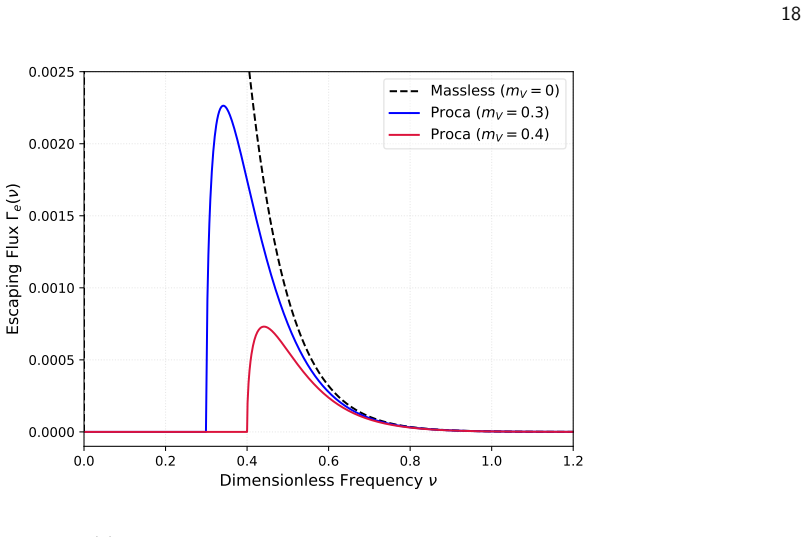
- Spectra exhibit a sharp mass threshold below which radiation is forbidden.
- Polarization-resolved graybody factors split the transmission into axial and polar channels.
- The entropy flux still satisfies the same area-entropy relation as in the scalar HBAR case.
- Vector specifics appear only through the radiative area change that enters the master equation.
Where Pith is reading between the lines
- The same separation between universal kernel and field-specific transmission should hold for other massive fields of arbitrary spin.
- Detector engineering that resolves polarization or frequency near the mass threshold could directly map the graybody profiles.
- Extending the cavity analysis to Kerr backgrounds would test whether the universal factor survives rotation-induced frame dragging.
- Quantitative predictions for observable signals now require only the missing numerical graybody data.
Load-bearing premise
The analysis assumes a cavity that isolates a single outgoing Schwarzschild mode prepared in the Boulware state and relies on the validity of the near-horizon stationary-phase approximation for deriving the universal kernel and the master equation.
What would settle it
A direct numerical computation of the axial and polar graybody transmission profiles for a Proca field around a Schwarzschild black hole, or an observation of whether the excitation-absorption ratio remains strictly independent of field mass and polarization in the low-frequency limit.
Figures


read the original abstract
In this paper, we develop a quantum-optical treatment of acceleration radiation for atoms freely falling into a Schwarzschild black hole when the ambient field is a massive spin-1 (Proca) field. Building on the HBAR framework of Scully and collaborators, we analyze two detector realizations: a charged-monopole current coupling and a physical electric-dipole coupling, both within a cavity that isolates a single outgoing Schwarzschild mode prepared in the Boulware state. Using a near-horizon stationary-phase analysis, we show that the thermal detailed-balance factor governing excitation versus absorption is universal and depends only on the near-horizon Rindler coordinate transformation. At the same time, the absolute spectra acquire distinctive Proca signatures: a hard mass threshold, polarization-dependent prefactors, and axial/polar graybody transmissions. Promoting single-pass probabilities to escaping rates yields a master equation whose steady state is geometric and whose entropy flux obeys an horizon brightened acceleration radiation-style area-entropy relation identical in form to the scalar case, with all vector-field specifics entering through the radiative area change. Our results provide a controlled pathway to probe longitudinal versus transverse responses, mass thresholds, and the role of polarization-resolved graybody transmission in acceleration radiation. More precisely, we derive the universal near-horizon kernel and show how the Proca transmission data enter the escaping probabilities, rates, and entropy flux; a dedicated numerical computation of the axial/polar graybody profiles is left for future work. This sets the stage for extensions to rotating backgrounds, alternative exterior states, and detector-engineering strategies.
Editorial analysis
A structured set of objections, weighed in public.
Referee Report
Summary. The paper extends the HBAR framework to massive spin-1 Proca fields in Schwarzschild spacetime. Using a cavity-isolated single outgoing mode in the Boulware state and a near-horizon stationary-phase analysis, it claims that the thermal detailed-balance factor for detector excitation versus absorption is universal and determined solely by the Rindler coordinate transformation, while the absolute spectra exhibit Proca-specific features including a hard mass threshold, polarization-dependent prefactors, and axial/polar graybody factors. These are promoted to a master equation whose steady state is geometric and whose entropy flux satisfies an area-entropy relation identical in form to the scalar case, with vector specifics entering only through radiative area change.
Significance. If the separation between the universal kernel and the Proca-specific spectra holds, the work provides a controlled extension of acceleration radiation to massive vector fields, enabling future probes of longitudinal versus transverse responses and mass thresholds near black-hole horizons. The explicit pathway from near-horizon kernel through graybody transmission to entropy flux is a constructive contribution, though its robustness depends on the stationary-phase justification.
major comments (2)
- [near-horizon stationary-phase analysis] Abstract and the near-horizon stationary-phase analysis: the claim that the thermal detailed-balance factor is universal and depends only on the Rindler coordinate transformation is load-bearing for the central result, yet the Proca mass term and the distinct wave equations for the three polarizations can generate corrections to the phase that enter at the same order as the boost factor when frequencies approach the mass threshold; an explicit demonstration that these corrections vanish in the stationary-point integral is required.
- [cavity and mode preparation] The assumption that the cavity isolates a single outgoing Schwarzschild mode prepared in the Boulware state and that the near-horizon stationary-phase approximation remains valid for deriving both the universal kernel and the master equation needs quantitative error estimates, particularly for the polarization-dependent graybody transmissions that are stated to enter the escaping probabilities.
minor comments (2)
- [abstract] The manuscript notes that a dedicated numerical computation of the axial/polar graybody profiles is left for future work; including at least one illustrative plot or reference to existing Proca graybody literature would strengthen the presentation of the spectra.
- [detector realizations] Notation for the two detector realizations (charged-monopole current versus physical electric-dipole coupling) should be introduced with explicit interaction Hamiltonians to clarify how each couples to the Proca field.
Simulated Author's Rebuttal
We thank the referee for the careful reading and constructive comments, which help strengthen the presentation of our results on HBAR for massive vector fields. We address the major comments point by point below, with planned revisions indicated.
read point-by-point responses
-
Referee: Abstract and the near-horizon stationary-phase analysis: the claim that the thermal detailed-balance factor is universal and depends only on the Rindler coordinate transformation is load-bearing for the central result, yet the Proca mass term and the distinct wave equations for the three polarizations can generate corrections to the phase that enter at the same order as the boost factor when frequencies approach the mass threshold; an explicit demonstration that these corrections vanish in the stationary-point integral is required.
Authors: We agree that an explicit demonstration is needed near the mass threshold. In the revised manuscript we will expand the phase in the stationary-point integral to include the Proca mass term and polarization-dependent dispersion relations. The leading saddle-point contribution remains the universal Rindler boost factor e^{-2πω/κ}, while mass corrections enter only at subleading orders in the large-boost expansion and do not modify the detailed-balance ratio. This calculation will be added as an appendix. revision: yes
-
Referee: The assumption that the cavity isolates a single outgoing Schwarzschild mode prepared in the Boulware state and that the near-horizon stationary-phase approximation remains valid for deriving both the universal kernel and the master equation needs quantitative error estimates, particularly for the polarization-dependent graybody transmissions that are stated to enter the escaping probabilities.
Authors: We acknowledge the need for quantitative error bounds. In revision we will supply order-of-magnitude estimates showing that, for cavity bandwidth Δω ≪ ω and frequencies ω ≫ m, the relative error in the stationary-phase kernel is O(κ/ω). The graybody factors enter the escaping rates multiplicatively and cancel from the universal kernel; we will clarify this separation and note that the area-entropy relation holds independently of their precise values. A full numerical graybody computation is left for future work as stated in the manuscript. revision: partial
Circularity Check
Near-horizon stationary-phase derivation of universal kernel is independent of Proca details
full rationale
The paper performs a near-horizon stationary-phase analysis on the Rindler coordinate transformation to obtain the thermal detailed-balance factor and states that this factor depends only on the coordinate map while Proca mass thresholds, polarization prefactors, and graybody transmissions enter solely through the absolute spectra and radiative area change. The entropy-flux relation is presented as identical in form to the scalar HBAR case precisely because the kernel is extracted from the same coordinate transformation; the vector-field specifics are inserted afterward via transmission data rather than being fitted or redefined into the kernel. No equation is shown to reduce to a prior result by construction, no parameter is fitted to a subset and then relabeled as a prediction, and the central claim rests on the stationary-phase integral rather than a self-citation chain or imported uniqueness theorem. The derivation is therefore self-contained against the stated assumptions.
Axiom & Free-Parameter Ledger
free parameters (1)
- Proca field mass
axioms (2)
- domain assumption Ambient field prepared in the Boulware state for the isolated outgoing mode
- domain assumption Near-horizon Rindler coordinate transformation governs the stationary-phase analysis
Lean theorems connected to this paper
-
IndisputableMonolith/Foundation/RealityFromDistinction.leanreality_from_one_distinction unclear?
unclearRelation between the paper passage and the cited Recognition theorem.
Using a near-horizon stationary-phase analysis, we show that the thermal detailed-balance factor governing excitation versus absorption is universal and depends only on the near-horizon Rindler coordinate transformation. ... the absolute spectra acquire distinctive Proca signatures: a hard mass threshold, polarization-dependent prefactors, and axial/polar greybody transmissions.
-
IndisputableMonolith/Cost/FunctionalEquation.leanwashburn_uniqueness_aczel echoes?
echoesECHOES: this paper passage has the same mathematical shape or conceptual pattern as the Recognition theorem, but is not a direct formal dependency.
the Planckian detailed-balance factor ... is independent of the detector model ... the field’s spin, the Proca mass, and greybody details. The reason is structural: after isolating a single outgoing Schwarzschild mode, every first-order counter-rotating amplitude reduces to an integral ... where G is a smooth, slowly varying function ... None of these ingredients alters the phase driver t−r∗.
What do these tags mean?
- matches
- The paper's claim is directly supported by a theorem in the formal canon.
- supports
- The theorem supports part of the paper's argument, but the paper may add assumptions or extra steps.
- extends
- The paper goes beyond the formal theorem; the theorem is a base layer rather than the whole result.
- uses
- The paper appears to rely on the theorem as machinery.
- contradicts
- The paper's claim conflicts with a theorem or certificate in the canon.
- unclear
- Pith found a possible connection, but the passage is too broad, indirect, or ambiguous to say the theorem truly supports the claim.
Reference graph
Works this paper leans on
-
[1]
Initial |g; 0B⟩ forbids the rotating ∝a νℓmλσeg channel; only the counter-rotating ∝a † νℓmλσeg contributes to excitation. This singles out the terms displayed in (57)-(58) and underlies the emission-before-absorption picture adopted in the master-equation treatment
-
[2]
Asymptotically, propagation requires ν≥m V , k ∞(ν) = q ν2 −m 2 V ,(59) so modes below threshold do not contribute to the escaping flux. In the stationary-phase evaluation, the rapidly varying piece depends only on ν > 0, thus preserving the same detailed-balance structure as in Eqs. (B13)-(B15) of [6]
-
[3]
For a narrow, axially aligned, radially infalling beam (as in the pencil-like cloud of Fig
The coupling to a given( ℓ, m)is weighted by Yℓm(θ(τ), ϕ(τ)). For a narrow, axially aligned, radially infalling beam (as in the pencil-like cloud of Fig. 1), the trajectory satisfies ϕ =const and θ≈ 0, which selects predominantly m = 0 and suppresses |m| ≥ 1through the small-angle behavior of Yℓm. The cavity’s mode selector then isolates a single (ℓ, m)ch...
-
[4]
For the monopole coupling, the polarization sum produces X λ u·ε(λ) 2 =−1 + Ω2(τ, ν) m2 V ,(60) whereΩ = −k·u grows without bound near the horizon; this enhances the longitudinal contribution of the massive vector relative to the massless limit and feeds only a smooth prefactor in the final probability. For the dipole coupling the contraction ˆdµ ˆdνΠµν p...
-
[5]
Since all master fields reduce to plane waves ∼e −iν(t−r∗) as r→r + g , the same stationary-phase structure that yielded Eq. (B14) in [ 6] in the scalar case recurs here, while the mass and polarization affect only the prefactor (and the ν≥m V threshold). These rules ensure that, after summing over( m, λ)and implementing the single-mode cavity filter, the...
-
[6]
Jacob D. Bekenstein, “Black holes and entropy,” Phys. Rev. D7, 2333–2346 (1973)
work page 1973
-
[7]
S. W. Hawking, “Black hole explosions,” Nature248, 30–31 (1974)
work page 1974
-
[8]
Particle Creation by Black Holes,
S. W. Hawking, “Particle Creation by Black Holes,” Commun. Math. Phys.43, 199–220 (1975), [Erratum: Commun.Math.Phys. 46, 206 (1976)]
work page 1975
-
[9]
Notes on black hole evaporation,
W. G. Unruh, “Notes on black hole evaporation,” Phys. Rev. D14, 870 (1976)
work page 1976
-
[10]
Quantum Field Theory in Schwarzschild and Rindler Spaces,
David G. Boulware, “Quantum Field Theory in Schwarzschild and Rindler Spaces,” Phys. Rev. D11, 1404 (1975)
work page 1975
-
[11]
Radiation from Atoms Falling into a Black Hole
Marlan O. Scully, Stephen Fulling, David Lee, Don N. Page, Wolfgang Schleich, and Anatoly Svidzinsky, “Quantum optics approach to radiation from atoms falling into a black hole,” Proc. Nat. Acad. Sci.115, 8131–8136 (2018), arXiv:1709.00481 [quant-ph]
work page internal anchor Pith review Pith/arXiv arXiv 2018
-
[12]
A. Azizi, H. E. Camblong, A. Chakraborty, C. R. Ordonez, and M. O. Scully, “Quantum optics meets black hole ther- modynamics via conformal quantum mechanics: I. Master equation for acceleration radiation,” Phys. Rev. D104(2021), 10.1103/PhysRevD.104.084086, arXiv:2108.07570 [gr-qc]
-
[13]
A. Azizi, H. E. Camblong, A. Chakraborty, C. R. Ordonez, and M. O. Scully, “Quantum optics meets black hole ther- modynamics via conformal quantum mechanics: II. Thermodynamics of acceleration radiation,” Phys. Rev. D104(2021), 10.1103/PhysRevD.104.084085, arXiv:2108.07572 [gr-qc]
-
[14]
Excitation of an Atom by a Uniformly Accelerated Mirror through Virtual Transitions,
Anatoly A. Svidzinsky, Jonathan S. Ben-Benjamin, Stephen A. Fulling, and Don N. Page, “Excitation of an Atom by a Uniformly Accelerated Mirror through Virtual Transitions,” Phys. Rev. Lett.121, 071301 (2018)
work page 2018
-
[15]
Unruh Acceleration Radiation Revisited,
J. S. Ben-Benjaminet al., “Unruh Acceleration Radiation Revisited,” Int. J. Mod. Phys. A34, 1941005 (2019), arXiv:1906.01729 [quant-ph]
-
[16]
A. Azizi, H. E. Camblong, A. Chakraborty, C. R. Ordonez, and M. O. Scully, “Acceleration radiation of an atom freely falling into a Kerr black hole and near-horizon conformal quantum mechanics,” Phys. Rev. D104, 065006 (2021), arXiv:2011.08368 [gr-qc]
-
[17]
Near-horizon aspects of acceleration radiation by free fall of an atom into a black hole,
H. E. Camblong, A. Chakraborty, and C. R. Ordonez, “Near-horizon aspects of acceleration radiation by free fall of an atom into a black hole,” Phys. Rev. D102, 085010 (2020), arXiv:2009.06580 [gr-qc]
-
[18]
Soham Sen, Rituparna Mandal, and Sunandan Gangopadhyay, “Near horizon aspects of acceleration radiation of an atom falling into a class of static spherically symmetric black hole geometries,” Phys. Rev. D106, 025004 (2022), arXiv:2205.11260 [gr-qc]
-
[19]
Equivalence principle and HBAR entropy of an atom falling into a quantum corrected black hole,
Soham Sen, Rituparna Mandal, and Sunandan Gangopadhyay, “Equivalence principle and HBAR entropy of an atom falling into a quantum corrected black hole,” Phys. Rev. D105, 085007 (2022), arXiv:2202.00671 [hep-th]
-
[20]
Horizon brightened accelerated radiation in the background of braneworld black holes,
Ashmita Das, Soham Sen, and Sunandan Gangopadhyay, “Horizon brightened accelerated radiation in the background of braneworld black holes,” Phys. Rev. D109, 064087 (2024), arXiv:2311.13557 [gr-qc]
-
[21]
Derivative coupling in horizon brightened acceleration radiation: a quantum optics approach
Ashmita Das, Anjana Krishnan, Soham Sen, and Sunandan Gangopadhyay, “Derivative coupling in horizon brightened acceleration radiation: A quantum optics approach,” Phys. Rev. D112, 065006 (2025), arXiv:2505.16897 [gr-qc]
work page internal anchor Pith review Pith/arXiv arXiv 2025
-
[22]
Atom falling into a quantum corrected charged black hole and HBAR entropy,
Arpita Jana, Soham Sen, and Sunandan Gangopadhyay, “Atom falling into a quantum corrected charged black hole and HBAR entropy,” Phys. Rev. D110, 026029 (2024), arXiv:2405.13087 [gr-qc]
-
[23]
Arpita Jana, Soham Sen, and Sunandan Gangopadhyay, “Inverse logarithmic correction in the horizon brightened acceleration radiation entropy of an atom falling into a renormalization group improved charged black hole,” Phys. Rev. D111, 085017 (2025), arXiv:2501.17579 [gr-qc]
-
[24]
Nonthermal acceleration radiation of atoms near a black hole in presence of dark energy,
Syed Masood A. S. Bukhari, Imtiyaz Ahmad Bhat, Chenni Xu, and Li-Gang Wang, “Nonthermal acceleration radiation of atoms near a black hole in presence of dark energy,” Phys. Rev. D107, 105017 (2023), arXiv:2211.08793 [gr-qc]
-
[25]
Seeing dark matter via acceleration radiation,
Syed Masood A. S. Bukhari and Li-Gang Wang, “Seeing dark matter via acceleration radiation,” Phys. Rev. D109, 045009 (2024), arXiv:2309.11958 [gr-qc]
-
[26]
Ali ¨Ovg¨ un and Reggie C. Pantig, “HBAR entropy of Infalling Atoms into a GUP-corrected Schwarzschild Black Hole and equivalence principle,” Physics Letters A568, 131201 (2026)
work page 2026
-
[27]
Acceleration radiation from derivative-coupled atoms falling in modified gravity black holes,
Reggie C. Pantig and Ali ¨Ovg¨ un, “Acceleration radiation from derivative-coupled atoms falling in modified gravity black holes,” Eur. Phys. J. C85, 1183 (2025), arXiv:2508.11734 [gr-qc]
-
[28]
Reggie C. Pantig, Ali ¨Ovg¨ un, Syed Masood, and Li-Gang Wang, “Floquet resonances and redshift-enhanced acceleration radiation from vibrating atoms in Schwarzschild spacetime,” (2025), arXiv:2510.11761 [gr-qc]
-
[29]
Near horizon local instability and quantum thermality,
Surojit Dalui and Bibhas Ranjan Majhi, “Near horizon local instability and quantum thermality,” Phys. Rev. D102, 124047 (2020), arXiv:2007.14312 [gr-qc]
-
[30]
Influence through mixing: hotspots as benchmarks for basic black-hole behaviour,
G. Kaplanek, C. P. Burgess, and R. Holman, “Influence through mixing: hotspots as benchmarks for basic black-hole behaviour,” JHEP09, 006 (2021), arXiv:2106.09854 [hep-th]
-
[31]
What Hawking radiation looks like as you fall into a black hole,
Christopher J. Shallue and Sean M. Carroll, “What Hawking radiation looks like as you fall into a black hole,” Phys. Rev. D112, 085013 (2025), arXiv:2501.06609 [gr-qc]
-
[32]
Toward a self-consistent framework for measuring black hole ringdowns,
Teagan A. Clarkeet al., “Toward a self-consistent framework for measuring black hole ringdowns,” Phys. Rev. D109, 124030 (2024), arXiv:2402.02819 [gr-qc]
-
[33]
Black hole spectroscopy: status report,
Gregorio Carullo, “Black hole spectroscopy: status report,” Gen. Rel. Grav.57, 76 (2025)
work page 2025
-
[34]
R. A. Konoplya, “Massive vector field perturbations in the Schwarzschild background: Stability and unusual quasinormal spectrum,” Phys. Rev. D73, 024009 (2006), arXiv:gr-qc/0509026. 23
work page internal anchor Pith review Pith/arXiv arXiv 2006
-
[35]
Massive vector fields on the Schwarzschild spacetime: quasinormal modes and bound states
Joao G. Rosa and Sam R. Dolan, “Massive vector fields on the Schwarzschild spacetime: quasi-normal modes and bound states,” Phys. Rev. D85, 044043 (2012), arXiv:1110.4494 [hep-th]
work page internal anchor Pith review Pith/arXiv arXiv 2012
-
[36]
Quasinormal modes of Proca fields in a Schwarzschild- AdS spacetime,
Tiago V. Fernandes, David Hilditch, Jos´ e P. S. Lemos, and Vitor Cardoso, “Quasinormal modes of Proca fields in a Schwarzschild- AdS spacetime,” Phys. Rev. D105, 044017 (2022), arXiv:2112.03282 [gr-qc]
-
[37]
Superradiance -- the 2020 Edition
Richard Brito, Vitor Cardoso, and Paolo Pani, “Superradiance: New Frontiers in Black Hole Physics,” Lect. Notes Phys.906, pp.1–237 (2015), arXiv:1501.06570 [gr-qc]
work page internal anchor Pith review Pith/arXiv arXiv 2015
-
[38]
Black Hole Superradiance Signatures of Ultralight Vectors
Masha Baryakhtar, Robert Lasenby, and Mae Teo, “Black Hole Superradiance Signatures of Ultralight Vectors,” Phys. Rev. D 96, 035019 (2017), arXiv:1704.05081 [hep-ph]
work page internal anchor Pith review Pith/arXiv arXiv 2017
-
[39]
Cavities in curved spacetimes: the response of particle detectors
Aida Ahmadzadegan, Eduardo Martin-Martinez, and Robert B. Mann, “Cavities in curved spacetimes: the response of particle detectors,” Phys. Rev. D89, 024013 (2014), arXiv:1310.5097 [quant-ph]
work page internal anchor Pith review Pith/arXiv arXiv 2014
-
[40]
On the gravitational field of a mass point according to Einstein's theory
Karl Schwarzschild, “On the gravitational field of a mass point according to Einstein’s theory,” Sitzungsber. Preuss. Akad. Wiss. Berlin (Math. Phys. )1916, 189–196 (1916), arXiv:physics/9905030
work page internal anchor Pith review Pith/arXiv arXiv 1916
-
[41]
Subrahmanyan Chandrasekhar,The mathematical theory of black holes(Oxford University Press, 1985)
work page 1985
-
[42]
Stability of a Schwarzschild singularity,
Tullio Regge and John A. Wheeler, “Stability of a Schwarzschild singularity,” Phys. Rev.108, 1063–1069 (1957)
work page 1957
-
[43]
Exact Solutions of Regge-Wheeler Equation
Plamen P. Fiziev, “Exact solutions of Regge-Wheeler equation,” J. Phys. Conf. Ser.66, 012016 (2007), arXiv:gr-qc/0702014
work page internal anchor Pith review Pith/arXiv arXiv 2007
-
[44]
N. D. Birrell and P. C. W. Davies,Quantum Fields in Curved Space, Cambridge Monographs on Mathematical Physics (Cambridge University Press, Cambridge, UK, 1982)
work page 1982
-
[45]
Vacuum Polarization in Schwarzschild Space-Time,
P. Candelas, “Vacuum Polarization in Schwarzschild Space-Time,” Phys. Rev. D21, 2185–2202 (1980)
work page 1980
-
[46]
Sean M. Carroll,Spacetime and Geometry: An Introduction to General Relativity(Cambridge University Press, 2019)
work page 2019
-
[47]
M.O. Scully and M.S. Zubairy,Quantum Optics, Quantum Optics (Cambridge University Press, 1997)
work page 1997
-
[48]
C. Cohen-Tannoudji, J. Dupont-Roc, and G. Grynberg,Atom-Photon Interactions: Basic Processes and Applications(Wiley, 1998)
work page 1998
-
[49]
Ryogo Kubo, “Statistical mechanical theory of irreversible processes. 1. General theory and simple applications in magnetic and conduction problems,” J. Phys. Soc. Jap.12, 570–586 (1957)
work page 1957
-
[50]
Theory of many particle systems. 1
Paul C. Martin and Julian S. Schwinger, “Theory of many particle systems. 1.” Phys. Rev.115, 1342–1373 (1959)
work page 1959
-
[51]
H.P. Breuer and F. Petruccione,The Theory of Open Quantum Systems(Oxford University Press, 2002)
work page 2002
-
[52]
On the Generators of Quantum Dynamical Semigroups,
Goran Lindblad, “On the Generators of Quantum Dynamical Semigroups,” Commun. Math. Phys.48, 119 (1976)
work page 1976
-
[53]
Tong,Quantum Field Theory(CreateSpace Independent Publishing Platform, 2014)
D. Tong,Quantum Field Theory(CreateSpace Independent Publishing Platform, 2014)
work page 2014
-
[54]
Path Integral Derivation of Black Hole Radiance,
J. B. Hartle and S. W. Hawking, “Path Integral Derivation of Black Hole Radiance,” Phys. Rev. D13, 2188–2203 (1976)
work page 1976
-
[55]
Harvesting correlations in Schwarzschild and collapsing shell spacetimes,
Erickson Tjoa and Robert B. Mann, “Harvesting correlations in Schwarzschild and collapsing shell spacetimes,” JHEP08, 155 (2020), arXiv:2007.02955 [quant-ph]
-
[56]
The Four laws of black hole mechanics,
James M. Bardeen, B. Carter, and S. W. Hawking, “The Four laws of black hole mechanics,” Commun. Math. Phys.31, 161–170 (1973)
work page 1973
discussion (0)
Sign in with ORCID, Apple, or X to comment. Anyone can read and Pith papers without signing in.