REVIEW 3 major objections 3 minor 43 references
ReMoSPLAT shows that a Gaussian Splat scene representation can replace an analytic signed-distance field in reactive collision avoidance for mobile manipulation, matching baseline performance in cluttered reaching tasks.
Reviewed by Pith at T0; open to challenge. T0 means a machine referee read the full paper against a public rubric. the ladder, T0–T4 →
T0 review · deepseek-v4-flash
2026-08-03 17:23 UTC pith:XSXK4QHM
load-bearing objection First reactive mobile-manipulation controller that uses Gaussian-Splat distances directly, with a solid synthetic benchmark, but the safety gradient in Eq. (19) is inconsistent with the text as written and needs fixing or a code release. the 3 major comments →
ReMoSPLAT: Reactive Mobile Manipulation Control on a Gaussian Splat
The pith
A machine-rendered reading of the paper's core claim, the machinery that carries it, and where it could break.
Core claim
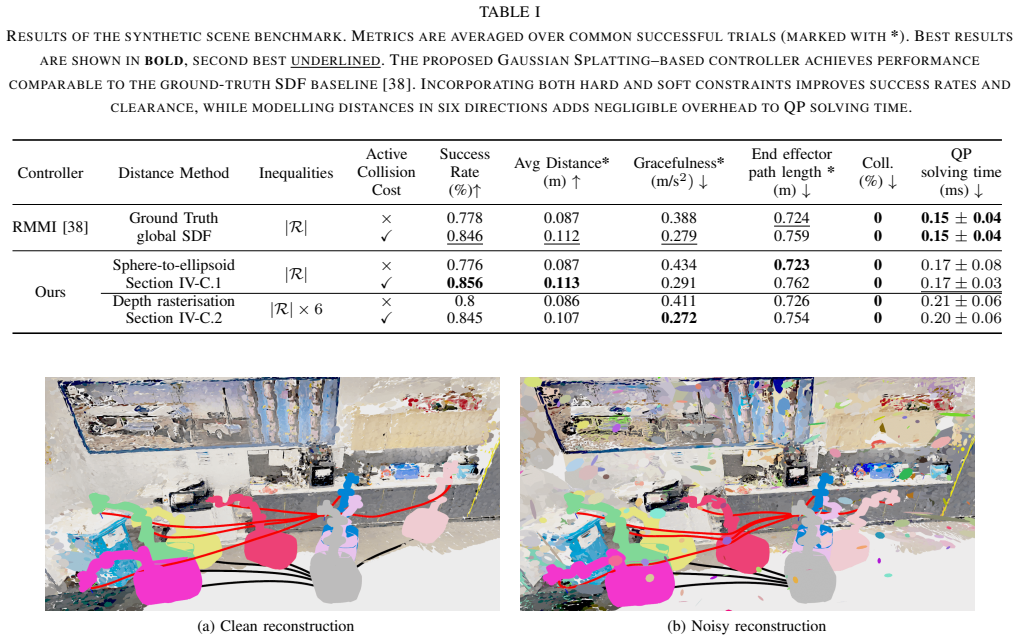
ReMoSPLAT's central claim is that collision avoidance for reactive mobile manipulation can be performed directly on a Gaussian Splat map by computing robot-to-surface distances and feeding them into a QP as inequality constraints plus a distance-weighted collision cost. The paper demonstrates that this learned representation performs comparably to a controller with perfect distance information from an analytical SDF: over common successful trials, success rates, average clearance, and collision counts are statistically similar, with the splat-based controller even improving success rate by up to 8% when hard and soft constraints are combined. It further claims that accounting for opacity thr
What carries the argument
The load-bearing object is the distance query on the Gaussian Splat. The robot is covered by 77 spheres; distances are computed either by solving the point-to-ellipsoid problem as a convex root-finding via bisection, or by mounting six virtual cameras per sphere with 90° fields of view, rasterising median depth from 2D Gaussian Splats, and backprojecting the closest pixel. These distances become linear inequality constraints through a velocity damper and a weighted collision cost, so the existing QP controller sees only standard Jacobian-distance rows. The median-depth rule is what lets the rasterisation query respect opacity, which is the property that saves it in noisy scenes.
Load-bearing premise
The load-bearing premise is that the six fixed camera orientations per robot sphere see every obstacle that could collide; if an obstacle lies between those frustums, no distance constraint is generated and the collision-free guarantee lapses.
What would settle it
Run the controller with the depth-rasterisation distance query in a scene containing a thin pole placed along a direction outside the six camera axes — e.g., the diagonal between two adjacent 90° frustums — within the influence distance of a sphere. The query returns no obstacle distance, the constraint set is empty for that sphere, and the robot drives into the pole; equivalently, compute the union of the six frustums per sphere and show it does not cover the sphere's full solid angle.
If this is right
- If the claim holds, a mobile manipulator can navigate cluttered, offline-mapped scenes with a reactive QP and no global planner, at control rates above 20 Hz.
- The Gaussian Splat can substitute for a signed-distance field in optimisation-based reactive control, matching ground-truth performance on success rate and clearance.
- Combining hard velocity-damper constraints with a soft collision cost yields measurable gains: up to 8% higher success rate and larger average obstacle clearance, at the price of about 4% longer end-effector paths.
- Opacity-aware depth rasterisation is the robust distance primitive: the geometric sphere-to-ellipsoid query collapses under noisy reconstructions, while rasterisation still completes 4 of 7 tasks with no collisions.
- The controller is representation-agnostic: any geometry-accurate Gaussian Splatting variant can be swapped in, so advances in splat reconstruction directly improve control.
Where Pith is reading between the lines
- The six fixed camera directions per sphere are a discretisation; a diagonal obstacle can fall between frustums and produce no constraint. An analytic angular-coverage check or adaptive view selection would close that gap, and the real-world 6/7 success may partly reflect scenes whose surfaces align with the camera axes.
- The opacity-weighted median depth behaves like a probabilistic occupancy filter; the same mechanism could weight constraint confidence by transmittance, making the controller degrade gracefully when reconstruction quality drops.
- Since the distance query is the only splat-dependent piece, hooking the controller to incremental or dynamic Gaussian Splatting would lift the static fully-mapped assumption, a step the paper names as future work.
- The collision cost is built from the already-computed constraint matrix and distances, so similar QP-based controllers can add safety costs without extra scene queries.
Editorial analysis
A structured set of objections, weighed in public.
Referee Report
Summary. The manuscript introduces ReMoSPLAT, a reactive quadratic-programming (QP) controller for a mobile manipulator that uses a Gaussian Splatting (GS) scene representation for collision avoidance. The robot's body is approximated by 77 spheres. Two distance-query methods are developed: a sphere-to-ellipsoid geometric computation and a depth-rasterisation method that places six virtual cameras on each sphere and renders depth maps from the GS. These distances enter the QP as velocity-damper hard constraints (Eq. (21)) and an active collision-avoidance cost (Eq. (23)). The method is evaluated on 1000 synthetic scenes against the RMMI controller with a ground-truth SDF, on one real-world office scan, and on a noisy-reconstruction ablation. The paper reports success rates of 77.6-85.6% versus 77.8-84.6% for the SDF baseline, zero collisions, and control rates of 17-24 Hz, concluding comparable performance to a perfect-distance baseline.
Significance. If correct, the work demonstrates that a GS representation can support reactive collision avoidance for mobile manipulation without global planning or an explicit SDF, at control rates sufficient for real-time operation. The experimental design has notable strengths: the synthetic benchmark is large (1000 scenes), the baseline uses ground-truth analytical distances, and the noisy-reconstruction ablation isolates the opacity-handling advantage of the rasterisation approach. The real-world scan adds credibility. However, the central safety-constraint equations are not self-consistent as written: the depth-rasterisation gradient in Eq. (19) is neither unit-normalised nor expressed in the world frame, and the sign of the velocity-damper constraint in Eq. (21) is inconsistent with the gradient defined in Eq. (14). The six-view sampling in Eq. (16) is not a blind-spot issue (the six 90° frustums form a cube map covering all directions), but the gradient inconsistency is load-bearing because every reported collision-free result depends on it. Because no code is provided, the reader cannot determine whether the evaluated controller matches the described one.
major comments (3)
- [§IV-C.2 and §IV-D, Eq. (19)-(21)] The gradient in Eq. (19) is not a unit vector and is expressed in the virtual camera frame. Its Euclidean norm is sqrt(((u-cx)/f)^2 + ((v-cy)/f)^2 + 1), which ranges from 1 to about sqrt(3) for a 90° FOV. Section IV-D nevertheless states that every method yields 'a corresponding unit vector ∇dj' in the world frame, and Eq. (20) multiplies it by the world-frame Jacobian J_v. The paper omits the necessary normalisation and the rotation R_c from camera to world frame. If the implementation follows the text literally, the left-hand side of Eq. (21) is not the time derivative of the measured distance; it is a scaled, frame-mismatched quantity. Since the safety constraints and the active-collision cost (Eq. (23)) are built from this quantity, the collision-free claim rests on an unspecified implementation detail. Please provide the exact transformation or correct the equations.
- [§IV-D, Eq. (20)-(21)] The sign of the velocity-damper constraint is inconsistent with the gradient definition. For the sphere-to-ellipsoid method, Eq. (14) defines ∇d_j as the gradient of d_j with respect to the sphere-centre position, which points away from the obstacle (from p_e to p_j). With this choice, \dot d_j in Eq. (20) is the rate of increase of clearance, and a safety constraint should limit -\dot d_j, not \dot d_j. As written, Eq. (21) restricts only how fast the robot moves away from an obstacle; the approach speed is unconstrained. If instead ∇d_j is intended to point toward the obstacle as stated in Section IV-D, then Eq. (14) has the wrong sign. This is a load-bearing inconsistency because both the hard constraints and the cost in Eq. (23) use J_d.
- [§V-B.4, Table I] The metrics marked '*' in Table I are averaged only over trials in which all methods succeeded. This selection bias can make a method that fails on hard scenes appear comparable to the baseline by removing its failures from the clearance, gracefulness, and path-length averages. Success rate is reported over all trials, but the other metrics are not. In addition, only QP solving time is reported with a standard deviation; no confidence intervals or statistical tests are given for success rate, distance, or collision outcomes. Please report the unselected metrics (or per-method success sets) and include variability estimates.
minor comments (3)
- [§IV-C.2, Eq. (15)] In the definition of the virtual sensor set D, the tuple (T_Dj, r_j, K) does not include p_j, although the text says a sensor is placed on each sphere and Eq. (18) uses the sphere-centre distance. Clarify how T_Dj relates to the sphere position p_j.
- [§V-B.4] The reported control frequencies (17.2 Hz and 24.2 Hz) are far below what the sub-millisecond QP solving times in Table I would allow; the bottleneck is the distance query. This is worth stating explicitly, since one of the paper's contributions is the efficiency trade-off.
- [§IV-E] The 'dynamic gain of [38]' is not defined; please give the value or the relevant equation from [38] so that the cost magnitude is reproducible.
Circularity Check
No significant circularity: GS-based distances feed a QP whose claims are evaluated against an independent analytical SDF baseline.
full rationale
The paper's derivation chain is self-contained in the relevant sense. The controller QP is inherited from an external formulation [1] and from the same group's RMMI [38], but the novel component — obtaining robot-obstacle distances from a Gaussian Splat — is computed by two concrete algorithms (bisection-based sphere-to-ellipsoid distance, and median-depth rasterisation from six virtual cameras), neither of which is fit to the reported success metrics. The central comparison is against a baseline that uses an analytical signed distance function, i.e. ground-truth geometry, so the claim of comparable performance is not forced by construction. The reused 'dynamic gain of [38]' is a parameter transfer, not a fitted prediction. The paper also explicitly acknowledges its main limitation (the environment must be fully mapped), which is a scope condition, not a circular step. The reviewer-flagged issue of the Eq. (19) gradient not being a unit vector and not being explicitly rotated into the world frame is a correctness/soundness concern about the implementation as written, not a circularity: it does not make any output equal to an input by definition. No equation in the paper reduces to another by construction, and no fitted parameter is renamed as a prediction. Therefore the circularity score is 0.
Axiom & Free-Parameter Ledger
free parameters (4)
- influence distance d_i and stopping distance d_s =
not reported (inherited from RMMI [38])
- 77-sphere robot approximation =
not provided
- virtual camera intrinsics K and six-view orientation set C_R =
90° FOV; Rx(0), Rx(±π/2), Ry(π/2), Ry(π), Ry(3π/2)
- active collision cost gain =
not reported (dynamic gain of [38])
axioms (6)
- domain assumption The trained Gaussian Splat / 2DGS reconstruction is a geometrically accurate metric-scale proxy for the scene's occupied surfaces.
- domain assumption Median-depth rasterisation (Eqs. 7–8) returns a meaningful surface distance per pixel, and opacity-weighted transmittance separates real surfaces from floaters.
- domain assumption The six fixed virtual-camera directions C_R cover all relevant obstacle directions for each sphere at every control step.
- domain assumption The base/arm kinematic QP controller from [1]/[38] remains stable when the distance constraints and collision cost are appended.
- domain assumption The environment is static and fully mapped before execution.
- standard math The closest point on an ellipsoid can be obtained robustly via the convex root-finding/bisection method of [37].
invented entities (1)
-
Virtual camera distance sensor (six virtual cameras per robot sphere)
no independent evidence
read the original abstract
Reactive control can gracefully coordinate the motion of the base and the arm of a mobile manipulator. However, incorporating an accurate representation of the environment to avoid obstacles without involving costly planning remains a challenge. In this work, we present ReMoSPLAT, a reactive controller based on a quadratic program formulation for mobile manipulation that leverages a Gaussian Splat representation for collision avoidance. By integrating additional constraints and costs into the optimisation formulation, a mobile manipulator platform can reach its intended end effector pose while avoiding obstacles, even in cluttered scenes. We investigate the trade-offs of two methods for efficiently calculating robot-obstacle distances, comparing a purely geometric approach with a rasterisation-based approach. Our simulation experiments on both synthetic and real-world scans demonstrate the feasibility of the proposed method, achieving performance comparable to controllers that rely on perfect ground-truth information. We further validate the approach on a real robot platform more details: https://remosplat.github.io
Figures


Reference graph
Works this paper leans on
-
[1]
A Holistic Approach to Reactive Mobile Manipulation,
J. Haviland, N. Sunderhauf, and P. Corke, “A Holistic Approach to Reactive Mobile Manipulation,”IEEE Robotics and Automation Letters, vol. 7, no. 2, pp. 3122–3129, 2022
2022
-
[2]
Mobile Manipulation in Unknown Environments with Differential Inverse Kinematics Control,
A. Heins, M. Jakob, and A. P. Schoellig, “Mobile Manipulation in Unknown Environments with Differential Inverse Kinematics Control,” Conference on Robots and Vision, pp. 64–71, 2021
2021
-
[3]
Local reactive control for mobile manipulators with whole-body safety in complex environments,
C. Zhenget al., “Local reactive control for mobile manipulators with whole-body safety in complex environments,”IEEE Robotics and Automation Letters, vol. 10, no. 5, pp. 4556–4563, 2025
2025
-
[4]
A review of the challenges in mobile manipulation: systems design and robocup challenges,
M. Sereinig, W. Werth, and L.-M. Faller, “A review of the challenges in mobile manipulation: systems design and robocup challenges,” Elektrotechnik und Informationstechnik, vol. 137, pp. 297–308, 10 2020
2020
-
[5]
Decentralized planning and control for UA V–UGV cooperative teams,
B. Arbanaset al., “Decentralized planning and control for UA V–UGV cooperative teams,”Autonomous Robots, vol. 42, no. 8, pp. 1601–1618, 2018
2018
-
[6]
Rgb-only reconstruction of tabletop scenes for collision-free manipulator control,
Z. Tanget al., “Rgb-only reconstruction of tabletop scenes for collision-free manipulator control,” inIEEE International Conference on Robotics and Automation, 2023, pp. 1778–1785
2023
-
[7]
Closing the loop: Real-time perception and control for robust collision avoidance with occluded obstacles,
A. Tulbure and O. Khatib, “Closing the loop: Real-time perception and control for robust collision avoidance with occluded obstacles,” in IEEE/RSJ International Conference on Intelligent Robots and Systems, 2020, pp. 5700–5707
2020
-
[8]
3D Gaussian Splatting for Real-Time Radiance Field Rendering,
B. Kerblet al., “3D Gaussian Splatting for Real-Time Radiance Field Rendering,”ACM Transactions on Graphics, vol. 42, no. 4, pp. 1–14, 2023
2023
-
[9]
3D Gaussian Splatting in Robotics: A Survey,
S. Zhuet al., “3D Gaussian Splatting in Robotics: A Survey,”arXiv preprint arXiv:2410.12262, 2024
Pith/arXiv arXiv 2024
-
[10]
Splat-nav: Safe real-time robot navigation in gaussian splatting maps,
T. Chenet al., “Splat-nav: Safe real-time robot navigation in gaussian splatting maps,”IEEE Transactions on Robotics, vol. 41, pp. 2765– 2784, 2025
2025
-
[11]
FOCI: Trajectory Optimization on Gaussian Splats,
M. G. Andreuet al., “FOCI: Trajectory Optimization on Gaussian Splats,”arXiv preprint arXiv:2505.08510, 2025
Pith/arXiv arXiv 2025
-
[12]
SAFER-Splat: A Control Barrier Function for Safe Navigation with Online Gaussian Splatting Maps,
T. Chenet al., “SAFER-Splat: A Control Barrier Function for Safe Navigation with Online Gaussian Splatting Maps,”arXiv preprint arXiv:2409.09868, 2024
Pith/arXiv arXiv 2024
-
[13]
Motion planning with sequential convex opti- mization and convex collision checking,
J. Schulmanet al., “Motion planning with sequential convex opti- mization and convex collision checking,”The International Journal of Robotics Research, vol. 33, no. 9, pp. 1251–1270, 8 2014
2014
-
[14]
CHOMP: Covariant Hamiltonian optimization for motion planning,
M. Zuckeret al., “CHOMP: Covariant Hamiltonian optimization for motion planning,”International Journal of Robotics Research, vol. 32, no. 9-10, pp. 1164–1193, 2013
2013
-
[15]
Differentiable Collision Detection for a Set of Convex Primitives,
K. Tracy, T. A. Howell, and Z. Manchester, “Differentiable Collision Detection for a Set of Convex Primitives,” inIEEE International Conference on Robotics and Automation, 2023, pp. 3663–3670
2023
-
[16]
OctoMap: An efficient probabilistic 3D mapping framework based on octrees,
A. Hornunget al., “OctoMap: An efficient probabilistic 3D mapping framework based on octrees,”Autonomous Robots, vol. 34, no. 3, pp. 189–206, 2013
2013
-
[17]
V oxfield: Non-Projective Signed Distance Fields for Online Planning and 3D Reconstruction,
Y . Panet al., “V oxfield: Non-Projective Signed Distance Fields for Online Planning and 3D Reconstruction,” inIEEE International Conference on Intelligent Robots and Systems, 2022, pp. 5331–5338
2022
-
[18]
Perceptive model predictive control for continuous mobile manipulation,
J. Pankert and M. Hutter, “Perceptive model predictive control for continuous mobile manipulation,”IEEE Robotics and Automation Letters, vol. 5, no. 4, pp. 6177–6184, 2020
2020
-
[19]
NeRF: Representing Scenes as Neural Radiance Fields for View Synthesis,
B. Mildenhallet al., “NeRF: Representing Scenes as Neural Radiance Fields for View Synthesis,”https://dl.acm.org/doi/10.1145/3503250, 2020
doi:10.1145/3503250 2020
-
[20]
Splatam: Splat, track & map 3d gaussians for dense rgb-d slam,
N. Keethaet al., “Splatam: Splat, track & map 3d gaussians for dense rgb-d slam,” inIEEE/CVF Conference on Computer Vision and Pattern Recognition, 2024, pp. 21 357–21 366
2024
-
[21]
Gaussian Splatting SLAM,
H. Matsukiet al., “Gaussian Splatting SLAM,” inProceedings of the IEEE/CVF Conference on Computer Vision and Pattern Recognition, 2024, pp. 18 039–18 048
2024
-
[22]
Splat-slam: Globally optimized rgb-only slam with 3d gaussians,
E. Sandstr ¨omet al., “Splat-slam: Globally optimized rgb-only slam with 3d gaussians,”arXiv preprint arXiv:2405.16544, 2024
Pith/arXiv arXiv 2024
-
[23]
GraspSplats: Efficient Manipulation with 3D Feature Splatting,
M. Jiet al., “GraspSplats: Efficient Manipulation with 3D Feature Splatting,”arXiv preprint arXiv:2409.02084, 9 2024
Pith/arXiv arXiv 2024
-
[24]
Gaussiangrasper: 3d language gaussian splatting for open-vocabulary robotic grasping,
Y . Zhenget al., “Gaussiangrasper: 3d language gaussian splatting for open-vocabulary robotic grasping,”IEEE Robotics and Automation Letters, vol. 9, no. 9, pp. 7827–7834, 2024
2024
-
[25]
Physgaussian: Physics-integrated 3d gaussians for generative dynamics,
T. Xieet al., “Physgaussian: Physics-integrated 3d gaussians for generative dynamics,” inProceedings of the IEEE/CVF Conference on Computer Vision and Pattern Recognition, 2024, pp. 4389–4398
2024
-
[26]
A Purely-Reactive Manipulability- Maximising Motion Controller,
J. Haviland and P. Corke, “A Purely-Reactive Manipulability- Maximising Motion Controller,”arXiv preprint arXiv:2002.11901, 2020
Pith/arXiv arXiv 2002
-
[27]
Manipulability of Robotic Mechanisms,
T. Yoshikawa, “Manipulability of Robotic Mechanisms,”The Interna- tional Journal of Robotics Research, vol. 4, no. 2, pp. 3–9, 1985
1985
-
[28]
Structure-from-Motion Revisited,
J. L. Sch ¨onberger and J.-M. Frahm, “Structure-from-Motion Revisited,” inIEEE/CVF Conference on Computer Vision and Pattern Recognition, 2016, pp. 4104–4113
2016
-
[29]
2D Gaussian Splatting for Geometrically Accurate Radiance Fields,
B. Huanget al., “2D Gaussian Splatting for Geometrically Accurate Radiance Fields,”SIGGRAPH 2024 Conference Papers, vol. 1, no. 1, pp. 1–13, 2024
2024
-
[30]
RaDe-GS: Rasterizing Depth in Gaussian Splatting,
B. Zhanget al., “RaDe-GS: Rasterizing Depth in Gaussian Splatting,” arXiv preprint arXiv:2406.01467, 2024
Pith/arXiv arXiv 2024
-
[31]
SuGaR: Surface-Aligned Gaussian Splat- ting for Efficient 3D Mesh Reconstruction and High-Quality Mesh Rendering,
A. Gu ´edon and V . Lepetit, “SuGaR: Surface-Aligned Gaussian Splat- ting for Efficient 3D Mesh Reconstruction and High-Quality Mesh Rendering,” inIEEE/CVF Conference on Computer Vision and Pattern Recognition, 6 2024, pp. 5354–5363
2024
-
[32]
GSFusion: Online RGB-D Mapping Where Gaussian Splatting Meets TSDF Fusion,
J. Wei and S. Leutenegger, “GSFusion: Online RGB-D Mapping Where Gaussian Splatting Meets TSDF Fusion,”IEEE Robotics and Automation Letters, vol. 9, no. 12, pp. 11 865–11 872, 12 2024
2024
-
[33]
GSDF: 3DGS Meets SDF for Improved Rendering and Reconstruction,
M. Yuet al., “GSDF: 3DGS Meets SDF for Improved Rendering and Reconstruction,”arXiv preprint arXiv:2403.16964, 2024
Pith/arXiv arXiv 2024
-
[34]
CuRobo: Parallelized Collision-Free Robot Motion Generation,
B. Sundaralingamet al., “CuRobo: Parallelized Collision-Free Robot Motion Generation,”IEEE International Conference on Robotics and Automation, pp. 8112–8119, 2023
2023
-
[35]
Foam: A tool for spherical approximation of robot geometry,
S. Coumaret al., “Foam: A tool for spherical approximation of robot geometry,”arXiv preprint arXiv:2503.13704, 2025
Pith/arXiv arXiv 2025
-
[36]
Point-to-ellipse and point-to- ellipsoid distance equation analysis,
A. Y . Uteshev and M. V . Goncharova, “Point-to-ellipse and point-to- ellipsoid distance equation analysis,”Journal of Computational and Applied Mathematics, vol. 328, pp. 232–251, 2018
2018
-
[37]
Distance from a point to an ellipse, an ellipsoid, or a hyperellipsoid,
D. Eberly, “Distance from a point to an ellipse, an ellipsoid, or a hyperellipsoid,” 2013, accessed: 2025-02-19. [Online]. Available: https://www.geometrictools.com/Documentation/ DistancePointEllipseEllipsoid.pdf
2013
-
[38]
RMMI: Reactive Mobile Manipulation using an Implicit Neural Map,
N. Marticorenaet al., “RMMI: Reactive Mobile Manipulation using an Implicit Neural Map,” inIEEE/RSJ International Conference on Intelligent Robots and Systems, 2025
2025
-
[39]
Not your grandmother’s toolbox - the Robotics Toolbox reinvented for Python,
P. Corke and J. Haviland, “Not your grandmother’s toolbox - the Robotics Toolbox reinvented for Python,”IEEE International Confer- ence on Robotics and Automation, pp. 11 357–11 363, 2021
2021
-
[40]
NeRFCapture,
J. Abou-Chakra, “NeRFCapture,” 3 2023. [Online]. Available: https://github.com/jc211/NeRFCapture
2023
-
[41]
Physically embodied gaussian splatting: A realtime correctable world model for robotics,
J. Abou-Chakraet al., “Physically embodied gaussian splatting: A realtime correctable world model for robotics,” inConference on Robot Learning, 2024
2024
-
[42]
Dynamic 3d gaussians: Tracking by persistent dynamic view synthesis,
J. Luitenet al., “Dynamic 3d gaussians: Tracking by persistent dynamic view synthesis,” in3DV, 2024
2024
-
[43]
LangSplat: 3D Language Gaussian Splatting,
M. Qinet al., “LangSplat: 3D Language Gaussian Splatting,” in IEEE/CVF Conference on Computer Vision and Pattern Recognition, 2024, pp. 20 051–20 060
2024
discussion (0)
Sign in with ORCID, Apple, or X to comment. Anyone can read and Pith papers without signing in.