Recognition: 2 theorem links
· Lean TheoremCosmological and lunar laser ranging constraints on evolving dark energy in a nonminimally coupled curvature-matter gravity model
Pith reviewed 2026-05-16 23:25 UTC · model grok-4.3
The pith
Nonminimally coupled curvature-matter gravity allows dynamical dark energy consistent with DESI results and lunar ranging limits.
A machine-rendered reading of the paper's core claim, the machinery that carries it, and where it could break.
Core claim
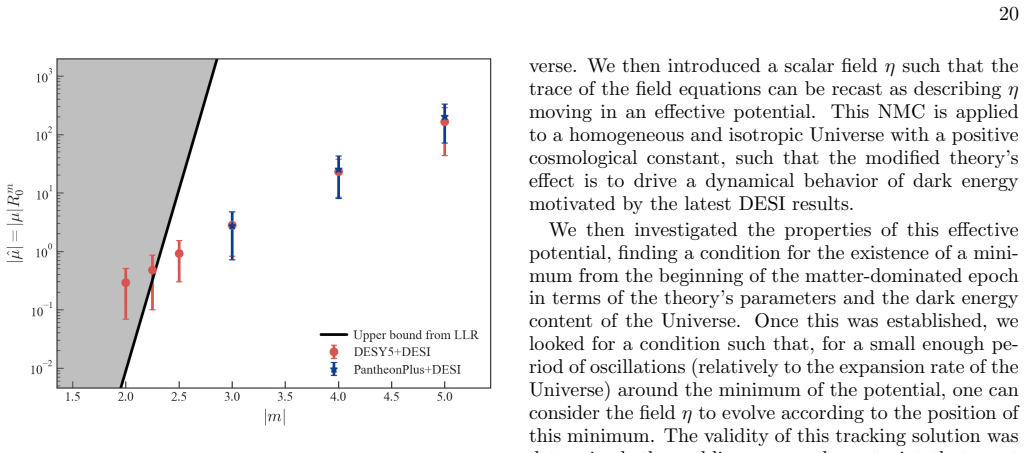
In this nonminimally coupled gravity model the current accelerated expansion is driven by a cosmological constant while the impact of the nonminimal coupling on the expansion history is recast as an effective equation of state for evolving dark energy. The model is analyzed under a tracking solution that follows the minimum of the effective potential for a scalar field that captures the modified theory's effects. Cosmological constraints from recent DESI outcomes in combination with Pantheon+ and Dark Energy Survey supernovae compilations point to dynamical dark energy. Intersecting these with limits from lunar laser ranging tests of the equivalence principle violation shows that a variety 0
What carries the argument
Tracking solution that follows the minimum of the effective potential for the scalar field capturing the modified theory's effects
If this is right
- The nonminimal coupling produces an effective equation of state for evolving dark energy.
- Recent DESI data combined with supernova compilations constrain the model parameters toward dynamical behavior.
- The model generates a fifth force that violates the equivalence principle, tested in the Earth-Moon system.
- Lunar laser ranging limits intersect with cosmological constraints to leave a range of viable parameters.
- The resulting dark energy evolution shows similarities to that indicated by recent DESI results.
Where Pith is reading between the lines
- Future higher-precision lunar ranging could further restrict the allowed parameter space.
- The same coupling mechanism could be checked against other datasets such as galaxy clustering or weak lensing.
- Next-generation cosmological surveys may distinguish the model's evolving dark energy from a pure cosmological constant.
Load-bearing premise
The validity of the tracking solution that follows the minimum of the effective potential for the scalar field capturing the modified theory's effects, together with the conditions for its existence.
What would settle it
A lunar laser ranging measurement showing a differential acceleration of Earth and Moon toward the Sun outside the range permitted by the model's consistent parameters, or cosmological data that rules out any dynamical evolution in the effective dark energy equation of state.
Figures




read the original abstract
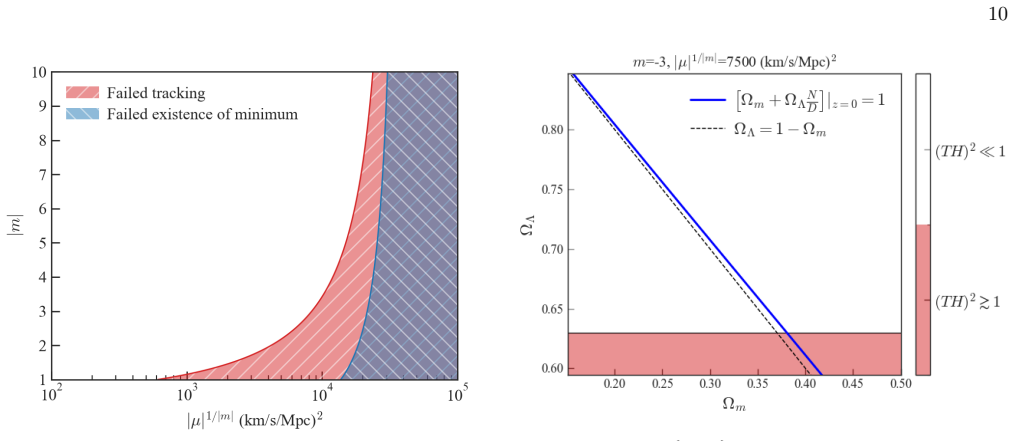
We analyze a cosmological solution to the field equations of a modified gravity model where curvature and matter are nonminimally coupled. The current Universe's accelerated expansion is driven by a cosmological constant while the impact of the nonminimal coupling on the expansion history is recast as an effective equation of state for evolving dark energy. The model is analyzed under a tracking solution that follows the minimum of the effective potential for a scalar field that captures the modified theory's effects. We determine the conditions for the existence of this minimum and for the validity of the tracking solution. Cosmological constraints on the parameters of the model are obtained by resorting to recent outcomes of data from the DESI collaboration in combination with the Pantheon+ and Dark Energy Survey supernovae compilations, which give compatible results that point to the presence of a dynamical behavior for dark energy. The gravity model violates the equivalence principle since it gives rise to a fifth force that implies the Earth and Moon fall differently towards the Sun. The cosmological constraints are intersected with limits resulting from a test of the equivalence principle in the Earth-Moon system based on lunar laser ranging data. We find that a variety of model parameters are consistent with both of these constraints, all while producing a dynamical evolution of dark energy with similarities to that found in recent DESI results.
Editorial analysis
A structured set of objections, weighed in public.
Referee Report
Summary. The paper analyzes a nonminimally coupled curvature-matter gravity model in which the nonminimal term is recast as an effective evolving dark energy equation of state. Under a tracking solution that follows the minimum of an effective scalar-field potential, the authors derive conditions for the minimum's existence and tracking validity, obtain cosmological constraints from DESI, Pantheon+, and DES data, intersect them with lunar laser ranging limits on the equivalence-principle violation, and report that a range of parameters remains viable while producing DESI-like dynamical dark energy.
Significance. If the tracking solution is shown to hold for the jointly constrained parameters, the work supplies a concrete modified-gravity mechanism that simultaneously accommodates recent indications of dynamical dark energy and passes local fifth-force tests, thereby offering an independent theoretical interpretation of the DESI results.
major comments (2)
- [§3] §3 (tracking solution and effective potential): the conditions for the existence of the minimum and the validity of the tracking solution are stated, yet the manuscript does not verify that these conditions remain satisfied for the specific parameter values that survive the intersection of the cosmological (DESI+Pantheon+DES) and lunar-laser-ranging constraints performed in §5. Without this check the claimed effective equation of state and the reported dynamical evolution do not necessarily apply to the viable models.
- [§4] §4 (cosmological constraints): the fitting procedure, likelihood construction, error propagation, and any post-hoc selections used to obtain the cosmological bounds are not described quantitatively, so the robustness of the claimed compatibility with DESI-like evolution cannot be assessed from the text.
minor comments (2)
- [Abstract] The abstract states that 'a variety of model parameters' are consistent but does not report the numerical ranges or example points that survive both datasets.
- Notation for the nonminimal coupling function and the scalar-field potential should be defined explicitly at first use rather than only in an appendix.
Simulated Author's Rebuttal
We thank the referee for the constructive comments, which help clarify the presentation of our results. We address each major point below and will revise the manuscript to incorporate the requested verifications and details.
read point-by-point responses
-
Referee: §3 (tracking solution and effective potential): the conditions for the existence of the minimum and the validity of the tracking solution are stated, yet the manuscript does not verify that these conditions remain satisfied for the specific parameter values that survive the intersection of the cosmological (DESI+Pantheon+DES) and lunar-laser-ranging constraints performed in §5. Without this check the claimed effective equation of state and the reported dynamical evolution do not necessarily apply to the viable models.
Authors: We agree that an explicit check is required. In the revised manuscript we will add a dedicated paragraph (or short subsection) at the end of §5 that substitutes the best-fit values and the 1σ/2σ ranges obtained from the joint cosmological plus lunar-laser-ranging constraints into the analytic conditions derived in §3. We will report the numerical values of the relevant inequalities and confirm that the minimum exists and the tracking regime remains valid throughout the allowed parameter volume. This verification will be performed for both the DESI+Pantheon+ and DESI+DES combinations. revision: yes
-
Referee: §4 (cosmological constraints): the fitting procedure, likelihood construction, error propagation, and any post-hoc selections used to obtain the cosmological bounds are not described quantitatively, so the robustness of the claimed compatibility with DESI-like evolution cannot be assessed from the text.
Authors: We acknowledge that §4 currently presents the final bounds without a fully quantitative description of the statistical pipeline. In the revision we will expand §4 to include: (i) the explicit form of the likelihood (χ² for each dataset and the total χ²), (ii) the sampling method (MCMC settings or grid resolution), (iii) how parameter uncertainties are propagated from the posterior, and (iv) any post-hoc cuts applied to ensure physical viability. These additions will make the robustness of the reported compatibility with DESI-like evolution directly verifiable from the text. revision: yes
Circularity Check
Effective dark energy EoS defined by recasting nonminimal coupling; tracking solution parameters fitted to DESI-motivated data
specific steps
-
self definitional
[Abstract]
"the impact of the nonminimal coupling on the expansion history is recast as an effective equation of state for evolving dark energy"
The effective EoS is obtained directly by algebraic recasting of the coupling term, so any dynamical evolution it exhibits is a definitional consequence of the model rather than an independent derivation from first principles or external data.
-
fitted input called prediction
[Abstract]
"We determine the conditions for the existence of this minimum and for the validity of the tracking solution. Cosmological constraints on the parameters of the model are obtained by resorting to recent outcomes of data from the DESI collaboration in combination with the Pantheon+ and Dark Energy Survey supernovae compilations, which give compatible results that point to the presence of a dynamical behavior for dark energy."
Parameters of the tracking solution are constrained by fitting to the same DESI+Pantheon+ data that already favor dynamical dark energy; the resulting 'dynamical evolution with similarities to DESI' is therefore statistically encouraged by the input data choice rather than predicted from the model alone.
full rationale
The paper derives an effective equation of state by recasting the nonminimal coupling term and assumes a tracking solution whose validity conditions are stated but not re-verified at the specific parameter values that survive the joint DESI+LLR fit. This introduces partial circularity because the claimed dynamical dark energy behavior is built into the model's definition and the data selection already encodes a preference for evolving dark energy, yet the central claim of consistency across datasets still rests on independent LLR bounds and explicit (if not fully cross-checked) existence conditions for the minimum. No self-citation chain or uniqueness theorem is load-bearing, and the derivation does not reduce to a pure renaming or tautology.
Axiom & Free-Parameter Ledger
free parameters (1)
- nonminimal coupling strength and potential parameters
axioms (1)
- domain assumption Existence and stability of the tracking solution minimum for the effective scalar field
Lean theorems connected to this paper
-
IndisputableMonolith/Cost/FunctionalEquation.leanwashburn_uniqueness_aczel unclear?
unclearRelation between the paper passage and the cited Recognition theorem.
We analyze a cosmological solution ... under a tracking solution that follows the minimum of the effective potential for a scalar field ... f2(R)=μ R^m ... |μ|<1/|2m−1|(4Λ)^|m|
-
IndisputableMonolith/Foundation/AbsoluteFloorClosure.leanabsolute_floor_iff_bare_distinguishability unclear?
unclearRelation between the paper passage and the cited Recognition theorem.
existence of the minimum ... tracking condition (T H/2π)^2 ≪1 ... ξ≪1
What do these tags mean?
- matches
- The paper's claim is directly supported by a theorem in the formal canon.
- supports
- The theorem supports part of the paper's argument, but the paper may add assumptions or extra steps.
- extends
- The paper goes beyond the formal theorem; the theorem is a base layer rather than the whole result.
- uses
- The paper appears to rely on the theorem as machinery.
- contradicts
- The paper's claim conflicts with a theorem or certificate in the canon.
- unclear
- Pith found a possible connection, but the passage is too broad, indirect, or ambiguous to say the theorem truly supports the claim.
Reference graph
Works this paper leans on
-
[1]
Coefficients of effective dark energy equation of state a. First order coefficients First we give the coefficients that are involved in the leading-order approximation of the fractionN wX /DwX 22 with respect toξ: V0,1(m) = 9m(2−3m+m 2), V1,1(m) = 3m(−10 + 9m+m 2), V2,1(m) = 2m(2 + 5m), V3,1(m) = 2(2m−1), W0,0(m) = 0, W1,0(m) = 0, W2,0(m) =m, W3,0(m) =−m....
-
[2]
Coefficients of effective dark energy density The coefficients of the numerator are the following: Y (N) 0,0 (m) = 0, Y (N) 1,0 (m) = 4m 2, Y (N) 2,0 (m) =−4m 2, Y (N) 0,1 (m) = 48m 2(m−1), Y (N) 1,1 (m) = 2m(2m 2 + 17m−1), Y (N) 2,1 (m) =−2m(2m 2 −3m+ 3), Y (N) 0,2 (m) = 48m(m−1)(2m−1), Y (N) 1,2 (m) =m(2m−1)(39−6m), Y (N) 2,2 (m) =m(2m−1)(2m−3), Y (N) 0...
-
[3]
P. Agrawal, F.-Y. Cyr-Racine, D. Pinner, and L. Ran- dall, Rock ‘n’ roll solutions to the Hubble tension, Phys. Dark Univ.42, 101347 (2023), arXiv:1904.01016 [astro- ph.CO]
-
[4]
In the Realm of the Hubble tension $-$ a Review of Solutions
E. Di Valentino, O. Mena, S. Pan, L. Visinelli, W. Yang, A. Melchiorri, D. F. Mota, A. G. Riess, and J. Silk, In the realm of the Hubble tension—a review of solutions, Class. Quant. Grav.38, 153001 (2021), arXiv:2103.01183 [astro-ph.CO]
work page internal anchor Pith review Pith/arXiv arXiv 2021
-
[5]
A. G. Adameet al.(DESI), DESI 2024 VI: cosmologi- cal constraints from the measurements of baryon acous- tic oscillations, JCAP02, 021, arXiv:2404.03002 [astro- ph.CO]
work page internal anchor Pith review Pith/arXiv arXiv 2024
-
[6]
DESI DR2 Results II: Measurements of Baryon Acoustic Oscillations and Cosmological Constraints
M. Abdul Karimet al.(DESI), DESI DR2 Results. II. Measurements of baryon acoustic oscillations and cos- mological constraints, Phys. Rev. D112, 083515 (2025), arXiv:2503.14738 [astro-ph.CO]
work page internal anchor Pith review Pith/arXiv arXiv 2025
-
[7]
I. Zlatev, L.-M. Wang, and P. J. Steinhardt, Quintessence, cosmic coincidence, and the cosmological constant, Phys. Rev. Lett.82, 896 (1999), arXiv:astro- ph/9807002
-
[8]
A. Y. Kamenshchik, U. Moschella, and V. Pasquier, An Alternative to quintessence, Phys. Lett. B511, 265 (2001), arXiv:gr-qc/0103004
work page internal anchor Pith review Pith/arXiv arXiv 2001
- [9]
- [10]
-
[11]
Can the Chaplygin gas be a plausible model for dark energy?
V. Gorini, A. Kamenshchik, and U. Moschella, Can the Chaplygin gas be a plausible model for dark energy?, Phys. Rev. D67, 063509 (2003), arXiv:astro-ph/0209395
work page internal anchor Pith review Pith/arXiv arXiv 2003
-
[12]
M. C. Bento, O. Bertolami, and A. A. Sen, General- ized Chaplygin gas, accelerated expansion and dark en- ergy matter unification, Phys. Rev. D66, 043507 (2002), arXiv:gr-qc/0202064
work page internal anchor Pith review Pith/arXiv arXiv 2002
- [13]
-
[14]
W. Giar` e, M. A. Sabogal, R. C. Nunes, and E. Di Valentino, Interacting Dark Energy after DESI Baryon Acoustic Oscillation Measurements, Phys. Rev. Lett.133, 251003 (2024), arXiv:2404.15232 [astro- ph.CO]
-
[15]
T. P. Sotiriou and V. Faraoni, f(R) Theories Of Gravity, Rev. Mod. Phys.82, 451 (2010), arXiv:0805.1726 [gr-qc]
work page internal anchor Pith review Pith/arXiv arXiv 2010
-
[16]
A. De Felice and S. Tsujikawa, f(R) theories, Living Rev. Rel.13, 3 (2010), arXiv:1002.4928 [gr-qc]
work page internal anchor Pith review Pith/arXiv arXiv 2010
-
[17]
A. A. Starobinsky, Disappearing cosmological constant in f(R) gravity, JETP Lett.86, 157 (2007), arXiv:0706.2041 [astro-ph]
work page internal anchor Pith review Pith/arXiv arXiv 2007
-
[18]
Models of f(R) Cosmic Acceleration that Evade Solar-System Tests
W. Hu and I. Sawicki, Models off(r) cosmic acceleration that evade solar-system tests, Phys. Rev. D76, 064004 (2007), arXiv:0705.1158 [astro-ph]
work page internal anchor Pith review Pith/arXiv arXiv 2007
-
[19]
Extra force in $f(R)$ modified theories of gravity
O. Bertolami, C. G. B¨ ohmer, T. Harko, and F. S. N. Lobo, Extra force inf(r) modified theories of gravity, Phys. Rev. D75, 104016 (2007), arXiv:0704.1733 [gr-qc]
work page internal anchor Pith review Pith/arXiv arXiv 2007
-
[20]
Mimicking dark matter through a non-minimal gravitational coupling with matter
O. Bertolami and J. P´ aramos, Mimicking dark mat- ter through a non-minimal gravitational coupling with matter, JCAP2010(03), 009, arXiv:0906.4757 [astro- ph.GA]
work page internal anchor Pith review Pith/arXiv arXiv
-
[21]
Mimicking dark matter in galaxy clusters through a non-minimal gravitational coupling with matter
O. Bertolami, P. Frazao, and J. Paramos, Mimicking dark matter in galaxy clusters through a non-minimal gravi- tational coupling with matter, Phys. Rev. D86, 044034 (2012), arXiv:1111.3167 [gr-qc]
work page internal anchor Pith review Pith/arXiv arXiv 2012
-
[22]
Information Flow of quantum states interacting with closed timelike curves
O. Bertolami, P. Fraz˜ ao, and J. P´ aramos, Accelerated expansion from a nonminimal gravitational coupling to matter, Phys. Rev. D81, 104046 (2010), arXiv:1003.1987 [gr-qc]
work page internal anchor Pith review Pith/arXiv arXiv 2010
-
[23]
Planck 2018 results. VI. Cosmological parameters
N. Aghanimet al.(Planck), Planck 2018 results. VI. Cosmological parameters, Astron. Astrophys.641, A6 (2020), [Erratum: Astron.Astrophys. 652, C4 (2021)], arXiv:1807.06209 [astro-ph.CO]
work page internal anchor Pith review Pith/arXiv arXiv 2018
-
[24]
M. Barroso Varela and O. Bertolami, Hubble tension in a nonminimally coupled curvature-matter gravity model, JCAP06, 025, arXiv:2403.11683 [gr-qc]
-
[25]
Gravitational waves in theories with a non-minimal curvature-matter coupling
O. Bertolami, C. Gomes, and F. S. N. Lobo, Gravita- tional waves in theories with a non-minimal curvature- matter coupling, Eur. Phys. J. C78, 303 (2018), arXiv:1706.06826 [gr-qc]
work page internal anchor Pith review Pith/arXiv arXiv 2018
-
[26]
M. Barroso Varela and O. Bertolami, Gravitational wave polarizations in nonminimally coupled gravity, Phys. Rev. D111, 024014 (2025), arXiv:2409.07625 [gr-qc]
-
[27]
Cosmological perturbations in theories with non-minimal coupling between curvature and matter
O. Bertolami, P. Fraz˜ ao, and J. P´ aramos, Cosmolog- ical perturbations in theories with non-minimal cou- pling between curvature and matter, JCAP05, 029, arXiv:1303.3215 [gr-qc]
work page internal anchor Pith review Pith/arXiv arXiv
-
[28]
M. Barroso Varela and O. Bertolami, Density pertur- bations in nonminimally coupled gravity: symptoms of Lagrangian density ambiguity, arXiv:2505.10291 [gr-qc] (2025)
-
[29]
Inflation in non-minimal matter-curvature coupling theories
C. Gomes, J. G. Rosa, and O. Bertolami, Inflation in non-minimal matter-curvature coupling theories, JCAP 06, 021, arXiv:1611.02124 [gr-qc]
work page internal anchor Pith review Pith/arXiv arXiv
-
[30]
O. Bertolami, M. M. Lima, and F. C. Mena, Primordial magnetic fields in theories of gravity with non-minimal coupling between curvature and matter, Gen. Rel. Grav. 54, 82 (2022), arXiv:2204.06883 [gr-qc]
-
[31]
M. Barroso Varela, O. Bertolami, and A. Mantziris, Infla- tionary dynamics of non-minimally coupledf(R) matter- curvature theories, arXiv:2509.01532 [gr-qc] (2025)
- [32]
- [33]
-
[34]
M. Barroso Varela and O. Bertolami, Is cosmological data suggesting a nonminimal coupling between mat- ter and gravity?, Phys. Dark Univ.48, 101861 (2025), arXiv:2412.09348 [astro-ph.CO]
-
[35]
On the non-minimal gravitational coupling to matter
O. Bertolami and J. P´ aramos, On the non-minimal grav- itational coupling to matter, Class. Quantum Grav.25, 245017 (2008), arXiv:0805.1241 [gr-qc]
work page internal anchor Pith review Pith/arXiv arXiv 2008
-
[36]
T. P. Sotiriou and V. Faraoni, Modified gravity with r–matter couplings and (non-)geodesic motion, Class. Quantum Grav.25, 205002 (2008), arXiv:0805.1249 [gr- qc]
work page internal anchor Pith review Pith/arXiv arXiv 2008
-
[37]
Nonminimal coupling of perfect fluids to curvature
O. Bertolami, F. S. N. Lobo, and J. P´ aramos, Nonmini- mal coupling of perfect fluids to curvature, Phys. Rev. D 78, 064036 (2008), arXiv:0806.4434 [gr-qc]
work page internal anchor Pith review Pith/arXiv arXiv 2008
-
[38]
P. Brax, C. van de Bruck, A.-C. Davis, J. Khoury, and A. Weltman, Detecting dark energy in orbit: The cos- mological chameleon, Phys. Rev. D70, 123518 (2004), arXiv:astro-ph/0408415 [astro-ph]
work page internal anchor Pith review Pith/arXiv arXiv 2004
-
[39]
Constraining f(R) Gravity as a Scalar Tensor Theory
T. Faulkner, M. Tegmark, E. F. Bunn, and Y. Mao, Constrainingf(r) gravity as a scalar-tensor theory, Phys. Rev. D76, 063505 (2007), arXiv:astro-ph/0612569 [astro-ph]
work page internal anchor Pith review Pith/arXiv arXiv 2007
-
[40]
Dark energy two decades after: Observables, probes, consistency tests
D. Huterer and D. L. Shafer, Dark energy two decades after: Observables, probes, consistency tests, Rep. Prog. Phys.81, 016901 (2018), arXiv:1709.01091 [astro- ph.CO]
work page internal anchor Pith review Pith/arXiv arXiv 2018
-
[41]
D. L. Turcotte and G. Schubert,Geodynamics, 2nd ed. (Cambridge University Press, Cambridge, 2002)
work page 2002
-
[42]
C. M. Will,Theory and Experiment in Gravitational Physics, revised ed. (Cambridge University Press, Cam- bridge, 1993)
work page 1993
-
[43]
J. Khoury and A. Weltman, Chameleon cosmology, Phys. Rev. D69, 044026 (2004), arXiv:astro-ph/0309411 [astro-ph]
work page internal anchor Pith review Pith/arXiv arXiv 2004
-
[44]
A viability criterion for modified gravity with an extra force
V. Faraoni, A viability criterion for modified gravity with an extra force, Phys. Rev. D76, 127501 (2007), arXiv:0710.1291 [gr-qc]
work page internal anchor Pith review Pith/arXiv arXiv 2007
-
[45]
Energy Conditions and Stability in $f(R)$ theories of gravity with non-minimal coupling to matter
O. Bertolami and M. C. Sequeira, Energy conditions and stability inf(r) theories of gravity with nonmini- mal coupling to matter, Phys. Rev. D79, 104010 (2009), arXiv:0903.4540 [gr-qc]
work page internal anchor Pith review Pith/arXiv arXiv 2009
-
[46]
Equivalence Principle in Chameleon Models
L. Kraiselburd, S. J. Landau, M. Salgado, D. Su- darsky, and H. Vucetich, Equivalence principle in chameleon models, Phys. Rev. D97, 104044 (2018), arXiv:1511.06307 [gr-qc]. 24
work page internal anchor Pith review Pith/arXiv arXiv 2018
-
[47]
Revisiting chameleon gravity - thin-shells and no-shells with appropriate boundary conditions
T. Tamaki and S. Tsujikawa, Revisiting chameleon grav- ity: Thin-shell and no-shell fields with appropriate boundary conditions, Phys. Rev. D78, 084028 (2008), arXiv:0808.2284 [gr-qc]
work page internal anchor Pith review Pith/arXiv arXiv 2008
-
[48]
P. T. Metzger and J. E. Lane, Electric potential due to a system of conducting spheres, The Open Applied Physics Journal2, 32 (2009)
work page 2009
-
[49]
Solar system and equivalence principle constraints on f(R) gravity by chameleon approach
S. Capozziello and S. Tsujikawa, Solar system and equivalence principle constraints onf(r) gravity by chameleon approach, Phys. Rev. D77, 107501 (2008), arXiv:0712.2268 [gr-qc]
work page internal anchor Pith review Pith/arXiv arXiv 2008
-
[50]
C. Burrage and J. Sakstein, Tests of chameleon grav- ity, Living Rev. Relativ.21, 1 (2018), arXiv:1709.09071 [astro-ph.CO]
work page internal anchor Pith review Pith/arXiv arXiv 2018
-
[51]
V. Viswanathan, A. Fienga, O. Minazzoli, L. Bernus, J. Laskar, and M. Gastineau, The new lunar ephemeris inpop17a and its application to fundamental physics, Mon. Not. R. Astron. Soc.476, 1877 (2018)
work page 2018
-
[52]
Cobaya: Code for Bayesian Analysis of hierarchical physical models
J. Torrado and A. Lewis, Cobaya: Code for Bayesian Analysis of hierarchical physical models, JCAP05, 057, arXiv:2005.05290 [astro-ph.IM]
work page internal anchor Pith review Pith/arXiv arXiv 2005
-
[53]
GetDist: a Python package for analysing Monte Carlo samples
A. Lewis, GetDist: a Python package for analysing Monte Carlo samples, arXiv:1910.13970 [astro-ph.IM] (2019)
work page internal anchor Pith review Pith/arXiv arXiv 1910
-
[54]
The Pantheon+ Analysis: The Full Dataset and Light-Curve Release
D. Scolnicet al., The Pantheon+ Analysis: The Full Data Set and Light-curve Release, Astrophys. J.938, 113 (2022), arXiv:2112.03863 [astro-ph.CO]
work page internal anchor Pith review Pith/arXiv arXiv 2022
-
[55]
Camilleriet al.(DES), The dark energy survey super- nova program: investigating beyond-ΛCDM, Mon
R. Camilleriet al.(DES), The dark energy survey super- nova program: investigating beyond-ΛCDM, Mon. Not. Roy. Astron. Soc.533, 2615 (2024), arXiv:2406.05048 [astro-ph.CO]
-
[56]
M. Goliath, R. Amanullah, P. Astier, A. Goobar, and R. Pain, Supernovae and the nature of the dark en- ergy, Astron. Astrophys.380, 6 (2001), arXiv:astro- ph/0104009
-
[57]
A. G. Riesset al., A Comprehensive Measurement of the Local Value of the Hubble Constant with 1 km s −1 Mpc−1 Uncertainty from the Hubble Space Telescope and the SH0ES Team, Astrophys. J. Lett.934, L7 (2022), arXiv:2112.04510 [astro-ph.CO]
work page internal anchor Pith review Pith/arXiv arXiv 2022
-
[58]
R. Camilleriet al.(DES), The Dark Energy Survey Su- pernova Program: an updated measurement of the Hub- ble constant using the inverse distance ladder, Mon. Not. Roy. Astron. Soc.537, 1818 (2025), arXiv:2406.05049 [astro-ph.CO]
-
[59]
P. Lemos and A. Lewis, CMB constraints on the early Universe independent of late-time cosmology, Phys. Rev. D107, 103505 (2023), arXiv:2302.12911 [astro-ph.CO]
-
[60]
Akaike, A new look at the statistical model identifi- cation, IEEE Trans
H. Akaike, A new look at the statistical model identifi- cation, IEEE Trans. Automatic Control19, 716 (1974)
work page 1974
-
[61]
Schwarz, Estimating the Dimension of a Model, An- nals of Statistics6, 461 (1978)
G. Schwarz, Estimating the Dimension of a Model, An- nals of Statistics6, 461 (1978)
work page 1978
-
[62]
Bayes in the sky: Bayesian inference and model selection in cosmology
R. Trotta, Bayes in the sky: Bayesian inference and model selection in cosmology, Contemp. Phys.49, 71 (2008), arXiv:0803.4089 [astro-ph]
work page internal anchor Pith review Pith/arXiv arXiv 2008
- [63]
-
[64]
A. Verdier, A. Rocher, B. Bandi, J. Richard, B. Roukema, J. Loveday, E. Tempel, M. Bilicki, J.-P. Kneib, and M. Guitton, The 4MOST-Cosmology Red- shift Survey: Target Selection of Bright Galaxies and Luminous Red Galaxies, arXiv:2508.07311 [astro-ph.CO] (2025)
-
[65]
F. Qinet al., J-PAS and PFS surveys in the era of dark energy and neutrino mass measurements, arXiv:2505.04275 [astro-ph.CO] (2025)
- [66]
-
[67]
Duretet al.(Euclid), Euclid preparation
V. Duretet al.(Euclid), Euclid preparation. BAO anal- ysis of photometric galaxy clustering in configuration space, arXiv:2503.11621 [astro-ph.CO] (2025)
- [68]
-
[69]
A. Bassiet al., A way forward for fundamental physics in space, npj Microgravity8, Article number: 49 (2022)
work page 2022
-
[70]
M. Muccinoet al., MoonLIGHT and MPAc: The Eu- ropean Space Agency’s Next-Generation Lunar Laser Retroreflector for NASA’s CLPS/PRISM1A (CP-11) Mission, Special Edition of Remote Sens.17, 813 (2025)
work page 2025
discussion (0)
Sign in with ORCID, Apple, or X to comment. Anyone can read and Pith papers without signing in.