REVIEW 3 major objections 4 minor 1 cited by
Weighing the Milky Way's Satellite Galaxies Using Pulsar Accelerations
T0 review · 3 major / 4 minor · reviewed 2026-08-03 · deepseek-v4-flash
Pith's one-line read The paper argues that the lopsided vertical pull measured in pulsar accelerations is produced by the LMC and Sagittarius dwarf, and that its amplitude scales with their masses.
desk verdict First satellite masses from direct pulsar accelerations: a credible proof-of-concept whose error bars live inside one fixed host model. read the letter →
The pith
A machine-rendered reading of the paper's core claim, the machinery that carries it, and where it could break.
The reading
What carries the argument
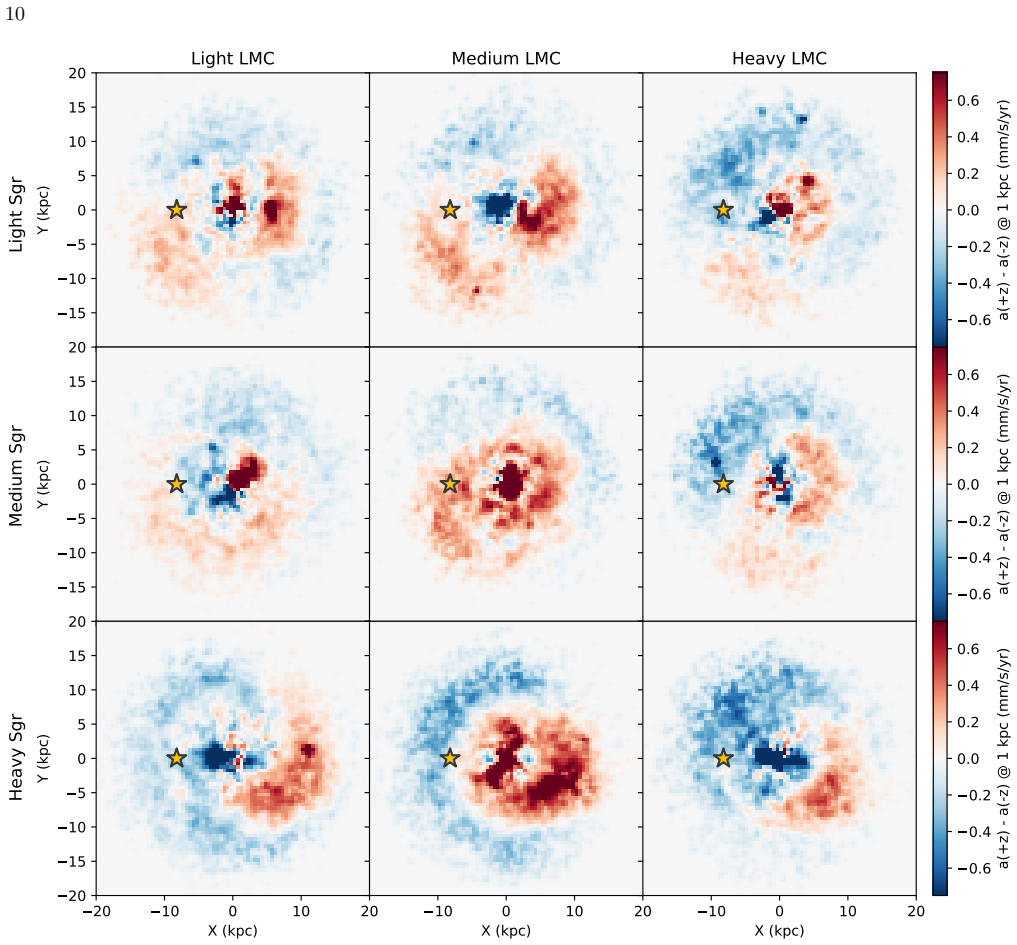
The load-bearing observable is the vertical acceleration asymmetry Δa(z) = a_los,z(+z) − a_los,z(−z): the difference in line-of-sight accelerations measured at equal heights above and below the Galactic midplane. In an equilibrium disk this difference is zero. The machinery producing it is the combination of satellite-induced disk waves and a large-scale offset between the center of mass of the dark halo and that of the baryonic disk. The paper isolates the mass dependence of this asymmetry by running a grid of self-consistent N-body simulations in which the two satellites' masses and scale radii are varied while their present-day positions and velocities are held fixed, then comparing the s
What would settle it
Rerun the best-fit satellite configuration in a host with a more massive or differently shaped dark halo; if the vertical acceleration asymmetry at the Sun changes by more than the quoted 1σ uncertainty, the inferred satellite masses are conditioned on the host model rather than determined by the data. The observational counterpart would be a larger, higher-precision pulsar sample showing whether the asymmetry grows with height exactly as the best-fit simulation predicts.
Extended reading notes
Core claim
The paper's central claim is that the vertical acceleration asymmetry in pulsar data—accelerations toward the disk midplane are stronger just above the plane than just below it—is a gravitational signature of the Large Magellanic Cloud and the Sagittarius dwarf spheroidal. As those satellites orbit the Milky Way, they launch waves in the disk and displace the dark matter halo's center of mass from the baryonic disk's center of mass. Simulations with varying satellite masses show that the amplitude and shape of this asymmetry at the Sun scale with satellite mass, and a best-fit simulation reproduces the pulsar-measured asymmetry within about 1σ. The implied initial total masses are (2.0±0.5)×
Load-bearing premise
The inference assumes the simulated host Milky Way—halo mass 7.3×10^11 solar masses within 200 kpc and total about 8×10^11 solar masses—responds to the satellites the way the real Galaxy does; if the actual Milky Way is more massive or different in shape, the same satellite masses would not produce the same asymmetry, so the inferred masses could lie outside the quoted errors.
Editorial extensions
If this is right
- Direct pulsar accelerations can serve as a mass probe for Milky Way satellites, independent of Jeans modeling, stream fitting, or other stellar kinematic techniques.
- The LMC mass inferred here—about 4.1×10^10 solar masses enclosed within 16.6 kpc today—is consistent with previous estimates, suggesting the method works for the dominant satellite.
- The method is primarily sensitive to the LMC; the Sagittarius mass is constrained only to about 1σ because its multiple disk passages make the asymmetry a non-monotonic function of its mass.
- As pulsar timing baselines lengthen and more pulsars with measured parallaxes are added, the same comparison should sharpen both satellite mass estimates without any new stellar kinematic input.
Reading between the lines
- Because the paper fixes the Milky Way halo at a total mass near 8×10^11 solar masses, a natural testable extension is to repeat the simulation grid with heavier or triaxial halos; if the inferred LMC and Sagittarius masses shift by more than the quoted errors, the host model is the dominant source of systematic uncertainty.
- A discrepancy between the pulsar-derived LMC mass and stream-based masses could be used to separate the halo-wake contribution from direct disk forcing, since those two mechanisms respond differently to host halo properties.
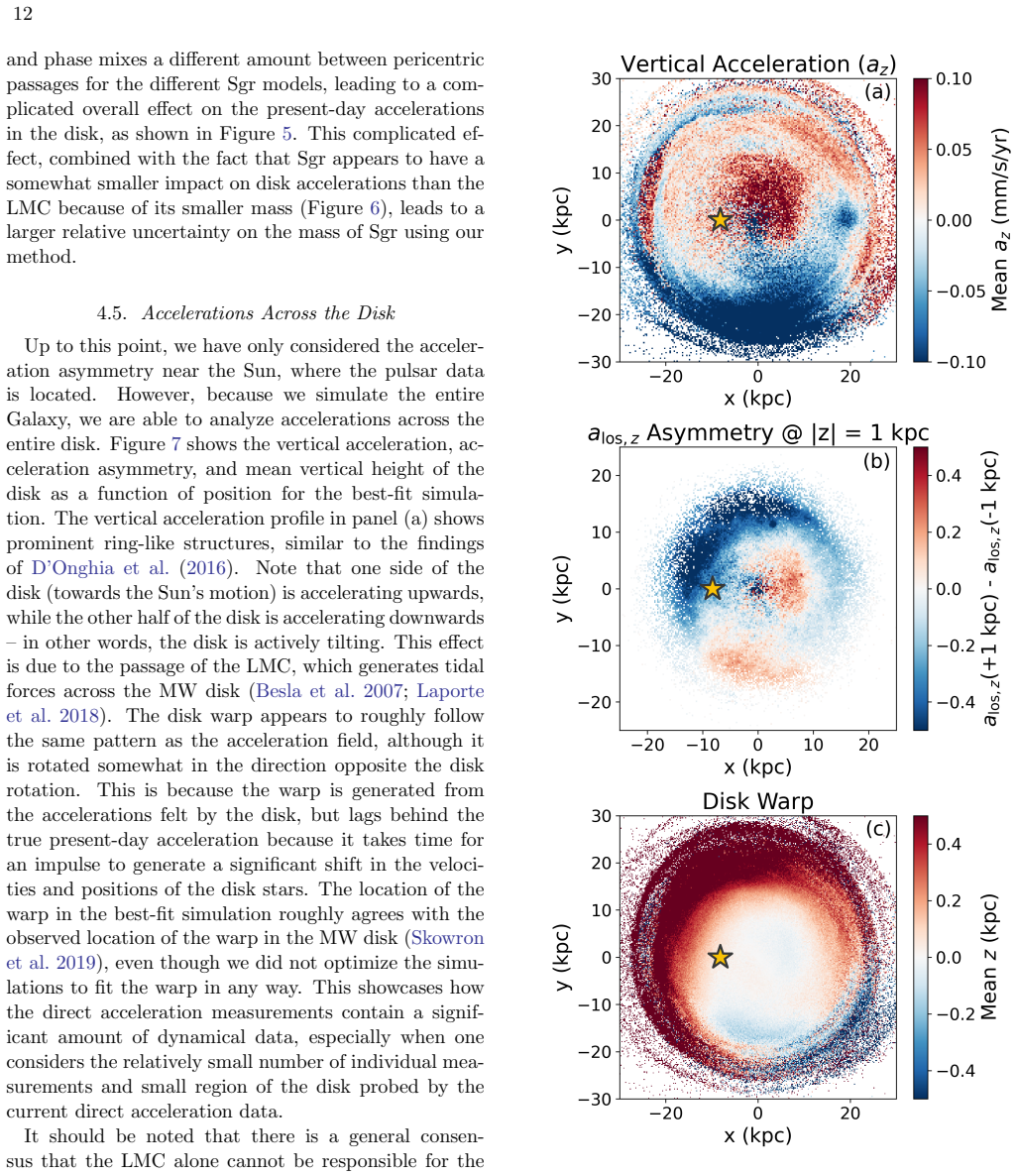
- The best-fit simulation predicts a specific relationship between the vertical acceleration asymmetry across the disk and the disk warp; future acceleration measurements away from the Solar neighborhood could test whether the same satellite configuration explains both features simultaneously.
Editorial analysis
A structured set of objections, weighed in public.
Referee Report
Summary. The paper presents a proof-of-concept method for inferring the total masses of the Milky Way's two most prominent satellites, the LMC and Sgr dSph, using direct line-of-sight accelerations of 53 millisecond pulsars rather than stellar kinematics. The authors run a grid of self-consistent N-body simulations with a fixed MW host and varying initial masses and scale radii for the two satellites, measure the resulting vertical acceleration asymmetry at the Sun, and compare it to the observed pulsar asymmetry. The best-fit simulation yields initial (3 Gyr ago) total masses of 2.0±0.5×10^11 M_sun for the LMC and 4.4±3.1×10^9 M_sun for Sgr, corresponding to present-day enclosed masses of 4.1±1.0×10^10 M_sun within 16.6 kpc and 3.5±2.4×10^8 M_sun within 5 kpc, respectively. The authors argue that these results are consistent with previous determinations and demonstrate a new, independent observational route to satellite masses.
Significance. If the result is robust, this is a genuinely new tool: direct acceleration measurements from pulsar timing would provide the first satellite-mass constraints independent of stellar kinematics, and the method could improve as pulsar timing baselines grow. The paper is strengthened by the public availability of the pulsar acceleration catalog, the use of live N-body simulations that reproduce the observed LMC/Sgr configuration, and an explicit comparison to a broad set of literature mass estimates. The authors also state several caveats about the fixed host galaxy and the coarse simulation grid. However, the quoted uncertainties are conditional on a single MW host model and on a sparse likelihood evaluation, so the central quantitative claim—that the mass constraints are 'competitive with kinematic methods'—is not yet fully supported. The concept is promising and worth publishing after the identified robustness issues are addressed.
major comments (3)
- [§4.2, Eqs. (3)–(5)] The inference is performed for a single fixed MW host model with total mass ~8×10^11 M_sun, which the authors themselves note is on the low side of estimates. The acceleration asymmetry at the Sun arises from the combined response of the disk, halo, and satellites; changing the host mass or shape alters dynamical friction, the halo-disk reflex offset, and the phase of the disk response, and can plausibly shift the best-fit satellite masses beyond the quoted 1σ errors. The Cramér-Rao covariance in Eqs. (3)–(5) is computed from the Hessian at this one host realization and does not propagate host-model uncertainty. A concrete test—e.g., re-fitting with a heavier MW halo (say 10^12 M_sun) or varying halo concentration/triaxiality—is needed before the claim of 'competitive with kinematic methods' is justified.
- [§4.2] The reported 1σ uncertainties are derived from finite-difference Hessian estimates on a half-step grid centered on the best fit. The authors explicitly state that the grid is coarse, that the uncertainties 'should be treated as estimates', and that the best fit may be a local maximum. Given the nonlinear and non-monotonic behavior documented in §4.4 (especially for Sgr), a sparse-grid Hessian is not a reliable covariance estimator. A denser likelihood sampling or a Bayesian exploration is required to support the abstract's error bars. This does not invalidate the proof-of-concept, but the formal uncertainties as quoted are not yet load-bearing.
- [§4.4] The asymmetry does not increase monotonically with satellite mass, and the LMC and Sgr perturbations can add or partially cancel. The best-fit pair is selected from a coarse 3×3 grid plus a half-step refinement; no evidence is presented that this is a global maximum rather than a local one. The text acknowledges this possibility, but the conclusion and abstract still present the inferred masses with formal error bars. To make the central claim robust, the authors should either add a wider/denser search or temper the abstract's language to make the proof-of-concept status explicit.
minor comments (4)
- [Table 1] The LMC 'Heavy' row lists M_Tot = 12.0 in units of 10^11 M_sun, which is inconsistent with the best-fit total mass of 2.0×10^11 M_sun quoted in §4.1 and with the 'Heavy-Plus' value of 2.25. This appears to be a typo: '12.0' should likely read '2.0'.
- [Eq. (3)] The expression for L is unclear as typeset: the integration variable z' appears both as the integration variable and as the upper limit, and the leading '1R' is garbled. Please rewrite with a fixed upper limit (e.g., z_max = 1 kpc) and a single integral, so readers can verify the χ²-like statistic.
- [§4.4] The sentence 'we are also able to constrain the mass of the Sgr dwarf to within better than 1 sigma' is misleading given that the relative uncertainty is about 70% (σ_M/M ≈ 3.1/4.4). Consider rephrasing to 'within about 1σ' or 'to order unity'.
- [§3.2] The iterative orbit-correction procedure uses a frozen-snapshot potential, and the authors note that final positions agree between low- and medium-resolution runs. It would help to state explicitly whether the orbital phase difference between the low- and medium-resolution runs (e.g., the small offset from exactly 3.0 Gyr) affects the acceleration asymmetry at the level of the quoted errors.
Circularity Check
Forward N-body grid fitted to measured pulsar asymmetry; no equation reduces the inference to its inputs; only same-group data and fixed-host conditioning produce minor caveats.
full rationale
The derivation chain is: observed pulsar line-of-sight accelerations (Eqs. 1-2, catalog from Donlon et al. 2025a) -> vertical asymmetry Delta-a(z) = a(+z) - a(-z) -> self-consistent N-body suite with varied LMC/Sgr masses (Section 3.1, Table 1) -> likelihood L (Eq. 3) -> Hessian/Cramer-Rao uncertainties (Eqs. 4-5) -> best-fit masses. The fitted parameter (satellite mass) is not the same quantity as the data being compared: the observed asymmetry is inherited from pulsar timing and the simulated asymmetry is produced by forward dynamics with explicit initial satellite masses. No equation sets a fitted parameter equal to the data by construction, no claimed prediction is just a renamed fit, and no author-supplied uniqueness theorem or ansatz is invoked to force the result. The main caveats—one fixed MW host model with total mass ~8e11 Msun noted as on the low side (Section 3.1), coarse grid and possible local maximum (Section 4.2)—are model/systematic uncertainties, not circularity. The comparison to independent literature mass determinations (Section 4.3, Table 2, Figure 4) is an external benchmark. The same-group citations (Chakrabarti et al. 2021; Donlon et al. 2024, 2025a) provide the empirical acceleration catalog and prior interpretation, but the current inference is tested with new simulations and is not reduced to those citations. Thus no significant circularity is identified; score 2 reflects only the minor self-citation conditioning, not a definitional or fitted-input circularity.
Assumptions & free parameters
free parameters (5)
- LMC initial total mass =
2.0×10^11 M_sun (best-fit grid point)
- Sgr initial total mass =
4.4×10^9 M_sun (best-fit grid point; M_*=2.3e8 + M_DM=4.19e9)
- LMC scale radius =
12.9 kpc (Heavy model)
- Sgr stellar/DM scale radii =
1.0 kpc / 8.0 kpc (Medium model)
- Acceleration noise term (MSP surface-B scatter) =
from Donlon et al. (2025a) appendix
assumptions (4)
- domain assumption Host galaxy model (bulge+disk+halo) from Vasiliev et al. (2021)/Stelea et al. (2024) with reduced disk velocity dispersion is an adequate representation of the MW
- domain assumption The observed pulsar vertical acceleration asymmetry is dominated by the LMC and Sgr; other satellites and disequilibrium processes contribute negligibly
- domain assumption The pulsar acceleration catalog and the asymmetry profile from Donlon et al. (2025a) are correct and adequately deprojected to vertical accelerations
- domain assumption Dynamical friction is small enough to be corrected by iterating the satellite start time by <100 Myr in a frozen potential, and low-resolution orbits match medium-resolution orbits
Cite this review
Pith. "Pith review of Weighing the Milky Way's Satellite Galaxies Using Pulsar Accelerations." pith.science (2026). https://pith.science/paper/ZN75YQ5E
@misc{pith2026251210883,
  author       = {Pith},
  title        = {Pith review of: Weighing the Milky Way's Satellite Galaxies Using Pulsar Accelerations},
  year         = {2026},
  howpublished = {\url{https://pith.science/paper/ZN75YQ5E}},
  note         = {Machine review of arXiv:2512.10883}
}
abstract
The properties of dwarf galaxies orbiting the Milky Way (MW) are useful for testing models of the formation of our Galaxy, and by extension various theories of cosmology. Recent efforts to measure the masses of the MW's satellite dwarf galaxies have relied on the motions and positions of stars in the MW's disk and halo, which are perturbed by the passage of satellite galaxies. As there are many known processes in our Galaxy that lead to observed disequilibrium in stars, these kinematic methods have been limited by the inherent difficulty in identifying only the perturbations due to particular satellite galaxies. We present a novel method for determining the masses of two MW satellite galaxies -- the Large Magellanic Cloud (LMC) and the Sagittarius Dwarf Spheroidal Galaxy (Sgr dSph) -- using only direct, instantaneous acceleration data derived from extremely precise timing of millisecond pulsars near the Sun. As the LMC and Sgr dSph orbit the MW, they cause wave-like distortions in the structure of the disk plus a large-scale offset in the centers of mass of the dark matter halo and the baryonic disk. These two effects lead to asymmetric accelerations above and below the disk midplane near the Sun, which is observed in the pulsar acceleration data. Notably, the amplitude of this asymmetry is shown to depend on the masses of the orbiting satellites. We analyze a grid of simulations with varying masses of each satellite. We find the total (dark + baryon) mass enclosed within the tidal radius at the present day for the LMC to be 4.1 $\pm$ 1.0 $\times$ 10$^{10}$ M$_\odot$ within a radius of 16.6 kpc, and for Sgr to be 3.5 $\pm$ 2.4 $\times$ 10$^8$ M$_\odot$ within a radius of 5 kpc. These results are generally consistent and competitive with previous determinations of the masses of these objects, but entirely independent of any stellar kinematic data for the first time.
Figures


Figures from the paper (5 more)



Forward citations
Cited by 1 Pith paper
-
Reconstructing Galactic Gravitational Potentials from Stellar Kinematics with Physics-Informed Neural Networks
A PINN approach learns galactic gravitational potentials from acceleration data, achieving sub-percent errors on simulations while outperforming analytic models and retaining interpretability via structured priors.
Reference graph
Works this paper leans on
-
[1]
Alves, D. R. 2004, NewAR, 48, 659, doi: 10.1016/j.newar.2004.03.001
-
[2]
2018, Nature, 561, 360, doi: 10.1038/s41586-018-0510-7
Antoja, T., Helmi, A., Romero-G´ omez, M., et al. 2018, Nature, 561, 360, doi: 10.1038/s41586-018-0510-7
-
[3]
Banik, N., Widrow, L. M., & Dodelson, S. 2017, MNRAS, 464, 3775, doi: 10.1093/mnras/stw2603
-
[4]
2023, ApJ, 958, 44, doi: 10.3847/1538-4357/acea79
Baptista, J., Sanderson, R., Huber, D., et al. 2023, ApJ, 958, 44, doi: 10.3847/1538-4357/acea79
-
[5]
2019, MNRAS, 482, 1417, doi: 10.1093/mnras/sty2813 —
Bennett, M., & Bovy, J. 2019, MNRAS, 482, 1417, doi: 10.1093/mnras/sty2813 —. 2021, MNRAS, 503, 376, doi: 10.1093/mnras/stab524
-
[6]
Bennett, M., Bovy, J., & Hunt, J. A. S. 2022, ApJ, 927, 131, doi: 10.3847/1538-4357/ac5021
-
[7]
2007, ApJ, 668, 949, doi: 10.1086/521385 —
Besla, G., Kallivayalil, N., Hernquist, L., et al. 2007, ApJ, 668, 949, doi: 10.1086/521385 —. 2012, MNRAS, 421, 2109, doi: 10.1111/j.1365-2966.2012.20466.x 15
arXiv 2007
-
[8]
2016, ARA&A, 54, 529, doi: 10.1146/annurev-astro-081915-023441
Bland-Hawthorn, J., & Gerhard, O. 2016, ARA&A, 54, 529, doi: 10.1146/annurev-astro-081915-023441
Show all 83 references
-
[9]
2019, MNRAS, 486, 1167, doi: 10.1093/mnras/stz217
Bland-Hawthorn, J., Sharma, S., Tepper-Garcia, T., et al. 2019, MNRAS, 486, 1167, doi: 10.1093/mnras/stz217
2019 doi
-
[10]
V., & Baykova, A
Bobylev, V. V., & Baykova, A. T. 2023, Astronomy Reports, 67, 812, doi: 10.1134/S1063772923080024
2023 doi
-
[11]
M., Cautun, M., Deason, A
Callingham, T. M., Cautun, M., Deason, A. J., et al. 2019, MNRAS, 484, 5453, doi: 10.1093/mnras/stz365
2019 doi
-
[12]
2009, MNRAS, 399, L118, doi: 10.1111/j.1745-3933.2009.00735.x
Chakrabarti, S., & Blitz, L. 2009, MNRAS, 399, L118, doi: 10.1111/j.1745-3933.2009.00735.x
2009
-
[13]
Quillen, A. C. 2021, ApJL, 907, L26, doi: 10.3847/2041-8213/abd635
2021 doi
-
[14]
2025, arXiv e-prints, arXiv:2507.16932, doi: 10.48550/arXiv.2507.16932
Chakrabarti, S., Chang, P., Profumo, S., & Craig, P. 2025, arXiv e-prints, arXiv:2507.16932, doi: 10.48550/arXiv.2507.16932
2025 doi
-
[15]
J., Wright, J., et al
Chakrabarti, S., Stevens, D. J., Wright, J., et al. 2022, ApJL, 928, L17, doi: 10.3847/2041-8213/ac5c43
2022 doi
-
[16]
2020, ApJL, 902, L28, doi: 10.3847/2041-8213/abb9b5
Chakrabarti, S., Wright, J., Chang, P., et al. 2020, ApJL, 902, L28, doi: 10.3847/2041-8213/abb9b5
2020 doi
-
[17]
P., Conroy, C., et al
Chandra, V., Naidu, R. P., Conroy, C., et al. 2025, ApJ, 988, 156, doi: 10.3847/1538-4357/addab6
2025 doi
-
[18]
1943, ApJ, 97, 255, doi: 10.1086/144517
Chandrasekhar, S. 1943, ApJ, 97, 255, doi: 10.1086/144517
1943 doi
-
[19]
R., & Arras, P
Cheng, X., Anguiano, B., Majewski, S. R., & Arras, P. 2024, MNRAS, 527, 959, doi: 10.1093/mnras/stad3013
2024 doi
-
[20]
E., & Nikakhtar, F
Craig, P., Chakrabarti, S., Sanderson, R. E., & Nikakhtar, F. 2023, ApJL, 945, L32, doi: 10.3847/2041-8213/acba15
2023 doi
-
[21]
A., Chakrabarti, S., Baum, S., & Lewis, B
Craig, P. A., Chakrabarti, S., Baum, S., & Lewis, B. T. 2022, MNRAS, 517, 1737, doi: 10.1093/mnras/stac2308
2022 doi
-
[22]
T., Fonseca, E., Ransom, S
Cromartie, H. T., Fonseca, E., Ransom, S. M., et al. 2020, Nature Astronomy, 4, 72, doi: 10.1038/s41550-019-0880-2
2020 doi
-
[23]
2025, arXiv e-prints, arXiv:2511.02031, doi: 10.48550/arXiv.2511.02031
Darragh-Ford, E., Garavito-Camargo, N., Arora, A., et al. 2025, arXiv e-prints, arXiv:2511.02031, doi: 10.48550/arXiv.2511.02031
2025 doi
-
[24]
1986, ApJ, 303, 39, doi: 10.1086/164050
Dekel, A., & Silk, J. 1986, ApJ, 303, 39, doi: 10.1086/164050
1986 doi
- [25]
-
[26]
2016, ApJ, 823, 4, doi: 10.3847/0004-637X/823/1/4
Hernquist, L. 2016, ApJ, 823, 4, doi: 10.3847/0004-637X/823/1/4
2016 doi
-
[27]
2025a, PhRvD, 111, 103036, doi: 10.1103/PhysRevD.111.103036
Donlon, T., Chakrabarti, S., Vanderwaal, S., et al. 2025a, PhRvD, 111, 103036, doi: 10.1103/PhysRevD.111.103036
-
[28]
M., et al
Donlon, T., Chakrabarti, S., Widrow, L. M., et al. 2024, PhRvD, 110, 023026, doi: 10.1103/PhysRevD.110.023026
2024 doi
-
[29]
T., et al
Donlon, T., Chakrabarti, S., Lam, M. T., et al. 2025b, ApJ, 983, 62, doi: 10.3847/1538-4357/adbf90
-
[30]
J., & Elmegreen, B
Edelsohn, D. J., & Elmegreen, B. G. 1997, MNRAS, 287, 947, doi: 10.1093/mnras/287.4.947
1997 doi
-
[31]
Erkal, D., & Belokurov, V. A. 2020, MNRAS, 495, 2554, doi: 10.1093/mnras/staa1238
2020 doi
-
[32]
Erkal, D., Belokurov, V., Laporte, C. F. P., et al. 2019, MNRAS, 487, 2685, doi: 10.1093/mnras/stz1371
2019 doi
-
[33]
A., van der Marel, R
Fardal, M. A., van der Marel, R. P., Law, D. R., et al. 2019, MNRAS, 483, 4724, doi: 10.1093/mnras/sty3428
2019 doi
-
[34]
S., White, S
Frenk, C. S., White, S. D. M., Davis, M., & Efstathiou, G. 1988, ApJ, 327, 507, doi: 10.1086/166213
1988 doi
-
[35]
Garavito-Camargo, N., Besla, G., Laporte, C. F. P., et al. 2021, ApJ, 919, 109, doi: 10.3847/1538-4357/ac0b44 Garc ´ ıa-Ruiz, I., Kuijken, K., & Dubinski, J. 2002, MNRAS, 337, 459, doi: 10.1046/j.1365-8711.2002.05923.x
2021
-
[36]
Gibbons, S. L. J., Belokurov, V., & Evans, N. W. 2017, MNRAS, 464, 794, doi: 10.1093/mnras/stw2328
2017 doi
-
[37]
2022, ApJ, 936, 103, doi: 10.3847/1538-4357/ac86cd
Guo, R., Shen, J., Li, Z.-Y., Liu, C., & Mao, S. 2022, ApJ, 936, 103, doi: 10.3847/1538-4357/ac86cd
2022 doi
-
[38]
2019, ApJL, 879, L15, doi: 10.3847/2041-8213/ab25f3
Hernquist, L. 2019, ApJL, 879, L15, doi: 10.3847/2041-8213/ab25f3
2019 doi
-
[39]
J., Conroy, C., & Hernquist, L
Han, J. J., Conroy, C., & Hernquist, L. 2023a, Nature Astronomy, 7, 1481, doi: 10.1038/s41550-023-02076-9
-
[40]
J., Semenov, V., Conroy, C., & Hernquist, L
Han, J. J., Semenov, V., Conroy, C., & Hernquist, L. 2023b, ApJL, 957, L24, doi: 10.3847/2041-8213/ad0641
-
[41]
J., Conroy, C., Johnson, B
Han, J. J., Conroy, C., Johnson, B. D., et al. 2022a, AJ, 164, 249, doi: 10.3847/1538-3881/ac97e9
-
[42]
J., Naidu, R
Han, J. J., Naidu, R. P., Conroy, C., et al. 2022b, ApJ, 934, 14, doi: 10.3847/1538-4357/ac795f
-
[43]
2020, ARA&A, 58, 205, doi: 10.1146/annurev-astro-032620-021917
Helmi, A. 2020, ARA&A, 58, 205, doi: 10.1146/annurev-astro-032620-021917
2020 doi
-
[44]
Hunt, J. A. S., Stelea, I. A., Johnston, K. V., et al. 2021, MNRAS, 508, 1459, doi: 10.1093/mnras/stab2580
2021 doi
-
[45]
Hunt, J. A. S., & Vasiliev, E. 2025, NewAR, 100, 101721, doi: 10.1016/j.newar.2024.101721
2025
-
[46]
A., Gilmore, G., & Irwin, M
Ibata, R. A., Gilmore, G., & Irwin, M. J. 1994, Nature, 370, 194, doi: 10.1038/370194a0
1994 doi
-
[47]
2016, MNRAS, 461, 2212, doi: 10.1093/mnras/stw1343
Jethwa, P., Erkal, D., & Belokurov, V. 2016, MNRAS, 461, 2212, doi: 10.1093/mnras/stw1343
2016 doi
-
[48]
N., Cohen, J
Kirby, E. N., Cohen, J. G., Guhathakurta, P., et al. 2013, ApJ, 779, 102, doi: 10.1088/0004-637X/779/2/102
2013 doi
-
[49]
E., Erkal, D., Li, T
Koposov, S. E., Erkal, D., Li, T. S., et al. 2023, MNRAS, 521, 4936, doi: 10.1093/mnras/stad551
2023 doi
-
[50]
V., Gnedin, O
Kravtsov, A. V., Gnedin, O. Y., & Klypin, A. A. 2004, ApJ, 609, 482, doi: 10.1086/421322
2004 doi
-
[51]
1991, ApJL, 367, L9, doi: 10.1086/185920
Kuijken, K., & Gilmore, G. 1991, ApJL, 367, L9, doi: 10.1086/185920
1991 doi
-
[52]
Laporte, C. F. P., G´ omez, F. A., Besla, G., Johnston, K. V., & Garavito-Camargo, N. 2018, MNRAS, 473, 1218, doi: 10.1093/mnras/stx2146 16
2018 doi
-
[53]
Laporte, C. F. P., Minchev, I., Johnston, K. V., & G´ omez, F. A. 2019, MNRAS, 485, 3134, doi: 10.1093/mnras/stz583
2019 doi
-
[54]
R., Johnston, K
Law, D. R., Johnston, K. V., & Majewski, S. R. 2005, ApJ, 619, 807, doi: 10.1086/426779
2005 doi
-
[55]
R., & Majewski, S
Law, D. R., & Majewski, S. R. 2010, ApJ, 714, 229, doi: 10.1088/0004-637X/714/1/229 Lokas, E. L. 2019, A&A, 629, A52, doi: 10.1051/0004-6361/201936056 Lokas, E. L., Kazantzidis, S., Majewski, S. R., et al. 2010, ApJ, 725, 1516, doi: 10.1088/0004-637X/725/2/1516
2010 doi
-
[56]
F., Parravano, A., & Hollenbach, D
McKee, C. F., Parravano, A., & Hollenbach, D. J. 2015, ApJ, 814, 13, doi: 10.1088/0004-637X/814/1/13
2015 doi
-
[57]
Moran, A., Mingarelli, C. M. F., Van Tilburg, K., & Good, D. 2024, PhRvD, 109, 123015, doi: 10.1103/PhysRevD.109.123015
2024 doi
-
[58]
2017, A&A, 605, A46, doi: 10.1051/0004-6361/201730707
Mucciarelli, A., Bellazzini, M., Ibata, R., et al. 2017, A&A, 605, A46, doi: 10.1051/0004-6361/201730707
2017 doi
-
[59]
J., Yanny, B., Rockosi, C., et al
Newberg, H. J., Yanny, B., Rockosi, C., et al. 2002, ApJ, 569, 245, doi: 10.1086/338983
2002 doi
-
[60]
Oort, J. H. 1932, BAN, 6, 249 Pe˜ narrubia, J., G´ omez, F. A., Besla, G., Erkal, D., & Ma, Y.-Z. 2016, MNRAS, 456, L54, doi: 10.1093/mnrasl/slv160
1932 doi
-
[61]
Perera, B. B. P., DeCesar, M. E., Demorest, P. B., et al. 2019, MNRAS, 490, 4666, doi: 10.1093/mnras/stz2857
2019 doi
-
[62]
S., & Pe˜ narrubia, J
Petersen, M. S., & Pe˜ narrubia, J. 2021, Nature Astronomy, 5, 251, doi: 10.1038/s41550-020-01254-3
2021 doi
-
[63]
2025, A&A, 699, A199, doi: 10.1051/0004-6361/202451668
Poggio, E., Khanna, S., Drimmel, R., et al. 2025, A&A, 699, A199, doi: 10.1051/0004-6361/202451668
2025 doi
-
[64]
2011, Nature, 477, 301, doi: 10.1038/nature10417
Chakrabarti, S. 2011, Nature, 477, 301, doi: 10.1038/nature10417
2011 doi
-
[65]
2009, MNRAS, 397, 1599, doi: 10.1111/j.1365-2966.2009.15054.x
Haywood, M. 2009, MNRAS, 397, 1599, doi: 10.1111/j.1365-2966.2009.15054.x
2009
-
[66]
D., Frenk, C
Schneider, M. D., Frenk, C. S., & Cole, S. 2012, JCAP, 2012, 030, doi: 10.1088/1475-7516/2012/05/030
2012 doi
-
[67]
2021, ApJ, 923, 149, doi: 10.3847/1538-4357/ac2e93
Shipp, N., Erkal, D., Drlica-Wagner, A., et al. 2021, ApJ, 923, 149, doi: 10.3847/1538-4357/ac2e93
2021 doi
-
[68]
Shklovskii, I. S. 1970, Soviet Ast., 13, 562
1970
-
[69]
M., Skowron, J., Mr´ oz, P., et al
Skowron, D. M., Skowron, J., Mr´ oz, P., et al. 2019, Science, 365, 478, doi: 10.1126/science.aau3181
2019 doi
-
[70]
S., & Dav´ e, R
Somerville, R. S., & Dav´ e, R. 2015, ARA&A, 53, 51, doi: 10.1146/annurev-astro-082812-140951
2015 doi
-
[71]
2021, MNRAS, 506, 2871, doi: 10.1093/mnras/stab1855
Springel, V., Pakmor, R., Zier, O., & Reinecke, M. 2021, MNRAS, 506, 2871, doi: 10.1093/mnras/stab1855
2021 doi
-
[72]
A., Hunt, J
Stelea, I. A., Hunt, J. A. S., & Johnston, K. V. 2024, ApJ, 977, 252, doi: 10.3847/1538-4357/ad901b
2024 doi
-
[73]
E., Bullock, J
Strigari, L. E., Bullock, J. S., Kaplinghat, M., et al. 2008, Nature, 454, 1096, doi: 10.1038/nature07222 van der Marel, R. P., & Kallivayalil, N. 2014, ApJ, 781, 121, doi: 10.1088/0004-637X/781/2/121
2008 doi
- [74]
-
[75]
2020, MNRAS, 497, 4162, doi: 10.1093/mnras/staa2114
Vasiliev, E., & Belokurov, V. 2020, MNRAS, 497, 4162, doi: 10.1093/mnras/staa2114
2020 doi
-
[76]
2021, MNRAS, 501, 2279, doi: 10.1093/mnras/staa3673
Vasiliev, E., Belokurov, V., & Erkal, D. 2021, MNRAS, 501, 2279, doi: 10.1093/mnras/staa3673
2021 doi
-
[77]
F., Mackey, D., & Ibata, R
Wan, Z., Guglielmo, M., Lewis, G. F., Mackey, D., & Ibata, R. A. 2020, MNRAS, 492, 782, doi: 10.1093/mnras/stz3493
2020 doi
-
[78]
Wang, W., Han, J., Cautun, M., Li, Z., & Ishigaki, M. N. 2020, Science China Physics, Mechanics, and Astronomy, 63, 109801, doi: 10.1007/s11433-019-1541-6
2020 doi
-
[79]
T., Newberg, H
Warren, H. T., Newberg, H. J., Guffey, A. G., et al. 2025, ApJ, 994, 161, doi: 10.3847/1538-4357/ae0e6d
2025 doi
-
[80]
M., & Huang, Y
Weisberg, J. M., & Huang, Y. 2016, ApJ, 829, 55, doi: 10.3847/0004-637X/829/1/55
2016 doi
-
[81]
2012, ApJL, 750, L41, doi: 10.1088/2041-8205/750/2/L41
Chen, H.-Y. 2012, ApJL, 750, L41, doi: 10.1088/2041-8205/750/2/L41
2012 doi
-
[82]
J., Carlin, J
Xu, Y., Newberg, H. J., Carlin, J. L., et al. 2015, ApJ, 801, 105, doi: 10.1088/0004-637X/801/2/105
2015 doi
-
[83]
2013, ApJ, 777, 91, doi: 10.1088/0004-637X/777/2/91 17 LMC Constraint or Radius (kpc) Mass (10 11 M⊙) Reference Total Mass 1.8 Besla et al
Yanny, B., & Gardner, S. 2013, ApJ, 777, 91, doi: 10.1088/0004-637X/777/2/91 17 LMC Constraint or Radius (kpc) Mass (10 11 M⊙) Reference Total Mass 1.8 Besla et al. (2012) 8.7 0.17(7) van der Marel & Kallivayalil (2014) Total Mass 2.5(9) Pe˜ narrubia et al. (2016) Total Mass 1...
2013 doi
Reviewed August 3, 2026 · model on record in the stance chip above.
Discussion (0). Continue with ORCID to comment.