REVIEW 4 major objections 5 minor 56 references
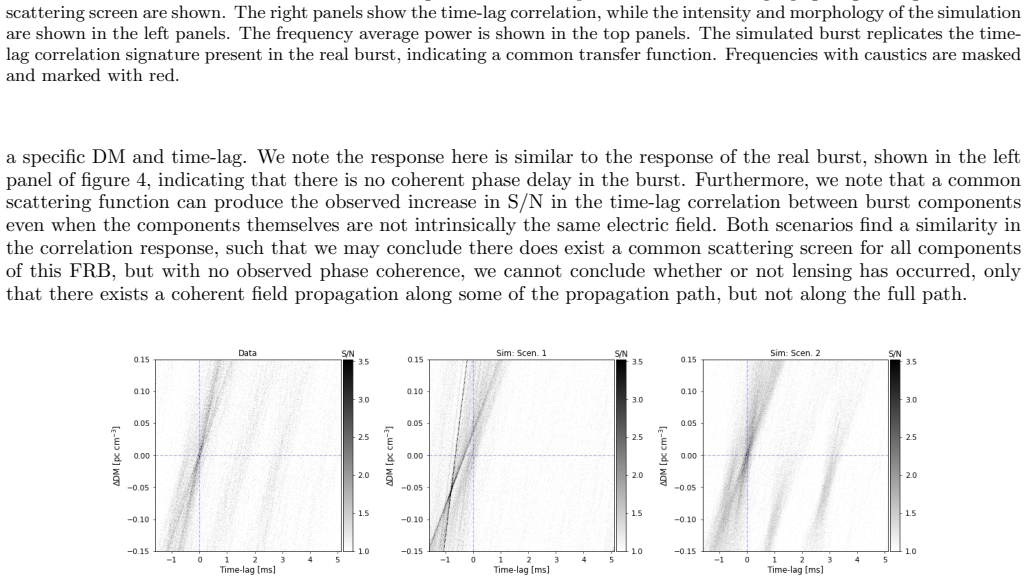
FRB 20220413B's time-separated burst components are correlated in power but not in phase, indicating a common Milky Way scattering screen rather than a coherent plasma lens.
Reviewed by Pith at T0; open to challenge. T0 means a machine referee read the full paper against a public rubric. the ladder, T0–T4 →
T0 review · deepseek-v4-flash
2026-08-03 16:44 UTC pith:2LUC6AZH
load-bearing objection The scintillation result is solid and worth citing; the time-lag "excess" is built on a null that destroys temporal phase coherence, so that part of the evidence does not carry the weight the abstract puts on it. the 4 major comments →
Detection of Partial Coherence due to Multipath Propagation for FRB 20220413B with CHIME/FRB
The pith
A machine-rendered reading of the paper's core claim, the machinery that carries it, and where it could break.
Core claim
The paper reports that FRB 20220413B shows partial coherence rather than full phase coherence across its time-separated components. In the complex-valued voltage data, a matched-filter time-lag correlation recovers excess correlation power at lags matching the burst components, but a search over dispersion measure finds no localized delta-like phase response that would mark coherent images of a single electric field. The intensity spectra of all four components, correlated against themselves and one another, yield a consistent scintillation bandwidth of about 23 kHz at 450 MHz (71 kHz at 600 MHz) with a frequency scaling of 4.2, matching expectations for scattering by the Milky Way and indic
What carries the argument
The central object is the complex-valued, channelized voltage data of the burst, which retain the phase of the electric field. A matched-filter time-lag correlation measures correlation power as a function of time lag per frequency channel, and a subsequent search over dispersion measure in the lag domain looks for a phase-coherent response that would appear as a localized peak at a specific DM and time lag. Separately, a frequency-lag correlation of intensity spectra, fit with a Lorentzian, extracts the scintillation bandwidth and modulation index; the consistency of that bandwidth across components indicates a common screen. For the morphology, a cusp-catastrophe mapping of a one-dimension
Load-bearing premise
The conclusion of no coherent plasma lensing depends on the phase-coherence search being restricted to the 400-500 MHz band, so a lensing response that lives mainly outside that band, or at the masked integer-sample lags, would be missed.
What would settle it
Measure the frequency-lag correlations between components across the full 400-800 MHz band with finer channelization and no masked lags; if any cross-pair correlation shows an additional zero-lag delta response, or if components stop sharing a single scintillation bandwidth, the common-screen explanation would fail. Similarly, a localized DM-time-lag peak appearing in the 500-800 MHz range would reveal coherent lensing that is simply absent from the 400-500 MHz window.
If this is right
- If the common-screen interpretation is right, all burst components of FRB 20220413B travel through the same scattering region in the Milky Way and the burst source remains unresolved by that screen.
- The lack of a phase-coherent response means the time-separated components are not copies of one emitted electric field, so plasma lensing cannot be confirmed from morphology alone.
- The measured scintillation bandwidth and scaling are consistent with a Galactic screen, so scattering alone can account for the excess correlation power seen in the voltage data without a lens.
- If lensing did occur, its phase coherence must have been destroyed before the scattering screen, since the simulated fully coherent lens model would have produced a localized DM-time-lag peak that the data do not show.
- The method offers a template for distinguishing propagation effects from intrinsic emission structure in future complex FRBs observed with voltage data.
Where Pith is reading between the lines
- A testable extension follows directly: repeat the phase-coherence search at higher frequencies, where Galactic scattering is weaker, to see whether the components become phase-coherent; the paper itself notes such searches are worthwhile.
- If this interpretation generalizes, some FRB bursts with multiple components that look like lensing events may instead be single emission events seen through a common scattering screen, meaning coherent-lensing statistics should be built on phase tests, not morphology.
- Because the correlation signature appears only in power, the technique could be used to measure how much of a burst's excess variance is due to scattering versus intrinsic variability by comparing components with different spectral shapes.
Editorial analysis
A structured set of objections, weighed in public.
Referee Report
Summary. This paper presents a multi-stage analysis of FRB 20220413B using CHIME/FRB baseband data, aiming to determine whether its complex time-frequency morphology is produced by coherent plasma lensing or by intrinsic emission plus propagation through a common scattering screen. The authors fit a 1D Gaussian plasma lens near a cusp caustic to the intensity morphology and find agreement in the branching structure but not in the flux. They then compute a time-lag correlation of the complex voltage and report an excess of correlation power at lags corresponding to the separated burst components, but no localized response in a DM-time-lag search, which they interpret as the absence of a coherent phase delay. A frequency-lag correlation analysis of the four components finds a common scintillation bandwidth of 23±2 kHz at 450 MHz, consistent with the NE2001 Milky Way prediction, indicating a common scattering screen. Simulations of a fully coherent plasma-lens plus scattering-screen scenario and an incoherent-emission plus common-screen scenario show that the data resemble the latter. The paper concludes that the burst experienced partially coherent propagation through a common scattering screen, while whether plasma lensing occurred cannot be established.
Significance. If the results hold, the paper provides a valuable demonstration of how complex-valued FRB voltage data can separate a common-scattering-screen signature from fully coherent lensing. The common scintillation bandwidth measured across all subcomponents is a strong, falsifiable result, and the comparison to NE2001 is a useful test of the Galactic screen hypothesis. The paper also makes a methodological contribution by adapting the coherent-lensing search pipeline to chromatic plasma lensing and by using catastrophe theory to constrain lens fits. However, the central time-lag correlation 'excess' lacks a statistical significance estimate, and the null DM search is limited to a sub-band and to masked lags; these points must be addressed before the abstract's claims are fully supported.
major comments (4)
- [Section IV, Eq. (7) and the V_mock definition] The null hypothesis is a single phase-scrambled realization, V_mock(f,t)=|V(f,t)|e^{iφ(f,t)} with φ uniform per time-frequency sample. This removes not only inter-component phase coherence but also all intra-component phase structure. A single realization cannot provide a statistical significance; the text states that the 'excess power ... highlights that this signature is real' (Sec. IV, Fig. 3) but gives no p-value, confidence interval, or ensemble distribution. This is load-bearing for the abstract's claim of 'correlation signatures present in the electric field' and 'excess correlation signature only in absolute power.' Please generate an ensemble of phase-scrambled mocks (or provide an analytic noise model) and report the significance of the observed |C(f,t̂)|² excess at the component-separation lags, and justify that this mock is the correct null for the claim being made.
- [Section IV, Fig. 4] The DM search in the time-lag domain is performed only over 400–500 MHz and with lags of ±2.56 and ±5.12 μs masked. The conclusion 'we do not find evidence for coherent plasma lensing' is therefore conditional on this restricted band and lag set. The fitted critical frequency is f_crit ≈ 728 MHz (Table II), outside the searched band. Please state what lens-parameter space is actually excluded—e.g., the ranges of DM_lens and time delays to which the search is sensitive—and discuss whether a coherent response could be missed outside 400–500 MHz or at the masked lags. Without this, the negative claim is broader than the analysis supports.
- [Section V, Fig. 7] The claim that the scintillation bandwidth is 'consistent' across all component pairs is supported only by visual inspection of the right panel of Fig. 7 and the statement that the width is 'largely consistent.' Please provide a quantitative consistency test (e.g., reduced χ² of the fitted γ_scint values around the weighted mean) and report the uncertainties of the bandwidth for each pair. Also specify the uncertainty assumed for the NE2001 prediction of 31 kHz when assessing the 26% discrepancy with the measured 23±2 kHz.
- [Section VI, Figs. 9–11] The comparison between the data and the two simulated scenarios is qualitative: the text concludes that 'scenario 2 is a better representation' based on visual similarity of the DM-time-lag maps. This is an interpretation rather than a quantitative model comparison. A simple metric—e.g., the correlation between the data and each simulated map, or a likelihood ratio—would make the conclusion more robust. If such a comparison is not possible, the authors should explicitly state that the scenario selection is illustrative rather than a statistical result.
minor comments (5)
- [Fig. 3 caption] The caption says 'The power of the time-lag correlation ... is shown in the left panels, while the intensity of the burst is shown in the right panels.' This appears to be the reverse of the panel layout described in the text; please check and correct.
- [Section IV, Fig. 3] The y-axis label 'S/N−1' is unclear. Define whether it is (S/N − 1), S/N minus one, or an excess in units of S/N, and explain the noise normalization in the caption.
- [Section V, Eq. (8)] The equation for the frequency-lag correlation is formatted ambiguously; the fraction bar appears to be missing. Please ensure the normalization is displayed correctly in the published version.
- [Section III, Eq. (4)] The intrinsic burst is modeled as a Gaussian with no spectral index. This is a strong simplification, particularly for a burst with narrowband components; please justify it or discuss how a spectral index would affect the fitted lens parameters.
- [Section II, Fig. 1] The text says components are labeled 'from left to right in time' as A, B, C, D, but then refers to 'C and D [as] the brightest components left of the broadband structure.' Given that the figure appears to show C and D to the left of the broadband A/B component, the ordering in the text is confusing. Please clarify the component ordering.
Circularity Check
No significant circularity; forward simulations and external NE2001 benchmark keep the derivation self-contained; self-citations are method reuse, not load-bearing.
full rationale
The derivation chain is not circular. The morphological plasma-lens fit (Sec. III) is explicitly a fit, and the paper acknowledges discrepancies and non-uniqueness rather than presenting the fit as an independent prediction. The time-lag correlation (Sec. IV) uses a phase-scrambled mock, V_mock=|V|e^{iφ}, as a null for inter-component phase coherence; while this mock removes all per-sample phase structure, the paper's phase-coherence conclusion does not rest solely on the excess over this mock. It is corroborated by the DM search in the time-lag domain, which finds no localized phase-delay response, and the excess is attributed to amplitude/power correlations. The frequency-lag analysis (Sec. V) is self-contained: Lorentzian widths are fitted to the spectra of the burst components and compared to the external NE2001 model; the consistency of the scintillation bandwidth across correlation pairs is a measured data property, not an input. The scenario simulations in Sec. VI are forward models constructed from the fitted lens and scintillation parameters; they are not fitted to the time-lag correlation data, so comparing them with the data is a discriminator rather than a circular reuse. Self-citations to the pipeline [16] and simulation toolset [7] are method reuse: the relevant equations (Eq. 7, Eq. 8) are reproduced in the text, and no claim is reduced to an unverified self-citation. The 400-500 MHz restriction on the phase-coherence search is a scope limitation, not a circular step.
Axiom & Free-Parameter Ledger
free parameters (6)
- f_crit (critical caustic frequency) =
727.73 ± 0.03 MHz
- DM_lens (lens dispersion measure) =
0.0888 ± 0.0003 pc cm^-3
- y (unitless source offset) =
0.0083 ± 0.0005
- DeltaDM (DM error parameter) =
0.01022 ± 0.00009 pc cm^-3
- A, sigma, t0 (intrinsic burst Gaussian) =
A=4.45±0.01 S/N; sigma=82.2±0.2 µs; t0=8167.0±0.4 µs
- scintillation Lorentzian parameters and scaling index =
gamma=71±7 kHz at 600 MHz; alpha=4.2±0.6; avg gamma=23±2 kHz at 450 MHz
axioms (6)
- standard math The semi-classical stationary-phase approximation to the Kirchhoff-Fresnel diffraction integral is valid for this lensing problem.
- domain assumption The 1D Gaussian plasma lens near a caustic is topologically equivalent to a cusp catastrophe, captured by the Pade approximant cubic.
- ad hoc to paper The intrinsic burst profile is a Gaussian with no spectral index (Eq. 4).
- domain assumption For scenario simulations, the scattering screen is at 1 kpc in the Milky Way and the source at z=0.1.
- domain assumption A matched filter proportional to the frequency-summed intensity is adequate for the time-lag correlation search (Eq. 7).
- domain assumption Smoothing spectra over 10 MHz removes CHIME beam response and a Lorentzian describes the frequency-lag correlation.
read the original abstract
Fast radio bursts (FRBs) are a $\sim$ millisecond-long transient phenomenon that propagate across extragalactic distances and are effectively a point source. Radio wave propagation through inhomogeneous distributions of plasma can act as a lens, generating multiple images of the emitted electric field. A lens can produce images of a point source where the phase of the electric field between images remains coherent when observed by a radio telescope. FRB 20220413B shows a complicated pulse structure with time separated components that may be image copies of the main components due to plasma lensing. We perform several analyses to determine if FRB 20220413B is consistent with expectations of a plasma lensed FRB. We analyze and fit the morphology of the burst to a plasma lens model and find consistency in the spectro-temporal profile but not the observed flux. Using the complex-valued channelized voltage data from the CHIME telescope, we perform a time-lag correlation analysis and report correlation signatures present in the electric field of FRB 20220413B. We find that there exists an excess correlation signature only in absolute power and not in phase. We perform a frequency-lag correlation analysis on the spectra of all subcomponents of the burst and find a consistent scintillation bandwidth across all components. We find the scintillation bandwidth is consistent with expectations of scattering due to the Milky Way. We interpret this as all burst components propagating through the same scintillation screen located in the Milky Way, which would generate the excess variance signature observed, even in the absence of phase coherence between burst components. We find that while the burst morphology can be modeled by a plasma lens, the coherent signature present in the time-lag correlation is consistent with the expectations of a common scattering screen, but not coherent plasma lensing.
Figures



Reference graph
Works this paper leans on
-
[1]
L. Connor and V. Ravi, MNRAS521, 4024 (2023), arXiv:2206.14310 [astro-ph.CO]
Pith/arXiv arXiv 2023
-
[2]
J. B. Mu˜ noz, E. D. Kovetz, L. Dai, and M. Kamionkowski, Phys. Rev. Lett.117, 091301 (2016), arXiv:1605.00008 [astro- ph.CO]
Pith/arXiv arXiv 2016
-
[3]
Eichler, ApJ850, 159 (2017), arXiv:1711.04764 [astro-ph.HE]
D. Eichler, ApJ850, 159 (2017), arXiv:1711.04764 [astro-ph.HE]
Pith/arXiv arXiv 2017
-
[4]
A. Katz, J. Kopp, S. Sibiryakov, and W. Xue, MNRAS496, 564 (2020), arXiv:1912.07620 [astro-ph.CO]
Pith/arXiv arXiv 2020
-
[5]
R. L. Fiedler, B. Dennison, K. J. Johnston, and A. Hewish, Nature326, 675 (1987)
1987
-
[6]
A. W. Clegg, A. L. Fey, and T. J. W. Lazio, ApJ496, 253 (1998), arXiv:astro-ph/9709249 [astro-ph]
Pith/arXiv arXiv 1998
-
[7]
Z. Kader, M. Dobbs, C. Leung, K. W. Masui, and M. W. Sammons, Phys. Rev. D110, 123027 (2024), arXiv:2407.04097 [astro-ph.HE]
Pith/arXiv arXiv 2024
-
[8]
D. R. Lorimer, M. Bailes, M. A. McLaughlin, D. J. Narkevic, and F. Crawford, Science318, 777 (2007), arXiv:0709.4301 [astro-ph]
Pith/arXiv arXiv 2007
-
[9]
C. D. Bochenek, V. Ravi, K. V. Belov, G. Hallinan, J. Kocz, S. R. Kulkarni, and D. L. McKenna, Nature587, 59 (2020), arXiv:2005.10828 [astro-ph.HE]
Pith/arXiv arXiv 2020
-
[10]
E. Petroff, J. W. T. Hessels, and D. R. Lorimer, A&A Rev.30, 2 (2022), arXiv:2107.10113 [astro-ph.HE]
Pith/arXiv arXiv 2022
-
[11]
P. Kumar, P. Beniamini, O. Gupta, and J. M. Cordes, MNRAS527, 457 (2024), arXiv:2307.15294 [astro-ph.HE]
Pith/arXiv arXiv 2024
-
[12]
E. E. Salpeter, ApJ147, 433 (1967)
1967
-
[13]
K. Nimmo, Z. Pleunis, P. Beniamini, P. Kumar, A. E. Lanman, D. Z. Li, R. Main, M. W. Sammons, S. Andrew, M. Bhard- waj, S. Chatterjee, A. P. Curtin, E. Fonseca, B. M. Gaensler, R. C. Joseph, Z. Kader, V. M. Kaspi, M. Lazda, C. Leung, K. W. Masui, R. Mckinven, D. Michilli, A. Pandhi, A. B. Pearlman, M. Rafiei-Ravandi, K. R. Sand, K. Shin, K. Smith, and I. ...
Pith/arXiv arXiv 2025
-
[14]
CHIME/FRB Collaboration, M. Amiri, B. C. Andersen, K. Bandura, S. Berger, M. Bhardwaj, M. M. Boyce, P. J. Boyle, C. Brar, D. Breitman, T. Cassanelli, P. Chawla, T. Chen, J. F. Cliche, A. Cook, D. Cubranic, A. P. Curtin, M. Deng, M. Dobbs, F. A. Dong, G. Eadie, M. Fandino, E. Fonseca, B. M. Gaensler, U. Giri, D. C. Good, M. Halpern, A. S. Hill, G. Hinshaw,...
Pith/arXiv arXiv 2021
-
[15]
D. L. Jow, S. Foreman, U.-L. Pen, and W. Zhu, MNRAS497, 4956 (2020), arXiv:2002.01570 [astro-ph.HE]
Pith/arXiv arXiv 2020
-
[16]
Z. Kader, C. Leung, M. Dobbs, K. W. Masui, D. Michilli, J. Mena-Parra, R. McKinven, C. Ng, K. Bandura, M. Bhardwaj, C. Brar, T. Cassanelli, P. Chawla, F. A. Dong, D. Good, V. Kaspi, A. E. Lanman, H.-H. Lin, B. W. Meyers, A. B. Pearlman, U.-L. Pen, E. Petroff, Z. Pleunis, M. Rafiei-Ravandi, M. Rahman, P. Sanghavi, P. Scholz, K. Shin, S. Siegel, K. M. Smith...
Pith/arXiv arXiv 2022
-
[17]
C. Leung, Z. Kader, K. W. Masui, M. Dobbs, D. Michilli, J. Mena-Parra, R. Mckinven, C. Ng, K. Bandura, M. Bhardwaj, C. Brar, T. Cassanelli, P. Chawla, F. A. Dong, D. Good, V. Kaspi, A. E. Lanman, H.-H. Lin, B. W. Meyers, A. B. Pearlman, U.-L. Pen, E. Petroff, Z. Pleunis, M. Rafiei-Ravandi, M. Rahman, P. Sanghavi, P. Scholz, K. Shin, S. Siegel, K. M. Smith...
Pith/arXiv arXiv 2022
-
[18]
Schneider and J
P. Schneider and J. Schmid-Burgk, A&A148, 369 (1985)
1985
-
[19]
J. M. Cordes, I. Wasserman, J. W. T. Hessels, T. J. W. Lazio, S. Chatterjee, and R. S. Wharton, ApJ842, 35 (2017), arXiv:1703.06580 [astro-ph.HE]
Pith/arXiv arXiv 2017
-
[20]
B. J. Rickett, ARA&A28, 561 (1990)
1990
-
[21]
D. C. Backer, T. Wong, and J. Valanju, ApJ543, 740 (2000), arXiv:astro-ph/0006220 [astro-ph]
Pith/arXiv arXiv 2000
-
[22]
R. Main, I. S. Yang, V. Chan, D. Li, F. X. Lin, N. Mahajan, U.-L. Pen, K. Vanderlinde, and M. H. van Kerkwijk, Nature 557, 522 (2018), arXiv:1805.09348 [astro-ph.HE]
Pith/arXiv arXiv 2018
-
[23]
T. Serafin Nadeau, M. H. van Kerkwijk, J. Luo, R. Main, K. W. Masui, J. W. McKee, and U.-L. Pen, arXiv e-prints , arXiv:2507.23201 (2025), arXiv:2507.23201 [astro-ph.HE]
Pith/arXiv arXiv 2025
-
[24]
K. Masui, H.-H. Lin, J. Sievers, C. J. Anderson, T.-C. Chang, X. Chen, A. Ganguly, M. Jarvis, C.-Y. Kuo, Y.-C. Li, Y.-W. Liao, M. McLaughlin, U.-L. Pen, J. B. Peterson, A. Roman, P. T. Timbie, T. Voytek, and J. K. Yadav, Nature528, 523 (2015), arXiv:1512.00529 [astro-ph.HE]
Pith/arXiv arXiv 2015
-
[25]
D. Michilli, A. Seymour, J. W. T. Hessels, L. G. Spitler, V. Gajjar, A. M. Archibald, G. C. Bower, S. Chatterjee, J. M. Cordes, K. Gourdji, G. H. Heald, V. M. Kaspi, C. J. Law, C. Sobey, E. A. K. Adams, C. G. Bassa, S. Bogdanov, C. Brinkman, P. Demorest, F. Fernandez, G. Hellbourg, T. J. W. Lazio, R. S. Lynch, N. Maddox, B. Marcote, M. A. McLaughlin, Z. P...
Pith/arXiv arXiv 2018
-
[26]
P. Kumar, Y. Qu, and B. Zhang, ApJ974, 160 (2024), arXiv:2406.01266 [astro-ph.HE]
Pith/arXiv arXiv 2024
-
[27]
X. Chen, B. Hu, P. Wang, W. Zheng, D. Li, and X. Er, MNRAS531, 4155 (2024), arXiv:2401.18036 [astro-ph.HE]
Pith/arXiv arXiv 2024
-
[28]
E. Platts, M. Caleb, B. W. Stappers, R. A. Main, A. Weltman, J. P. Shock, M. Kramer, M. C. Bezuidenhout, F. Jankowski, V. Morello, A. Possenti, K. M. Rajwade, L. Rhodes, and J. Wu, MNRAS505, 3041 (2021), arXiv:2105.11822 [astro-ph.HE]
Pith/arXiv arXiv 2021
-
[29]
C. Collaboration, M. Amiri, K. Bandura, A. Boskovic, T. Chen, J.-F. Cliche, M. Deng, N. Denman, M. Dobbs, M. Fandino, S. Foreman, M. Halpern, D. Hanna, A. S. Hill, G. Hinshaw, C. H¨ ofer, J. Kania, P. Klages, T. L. Landecker, J. MacEachern, K. Masui, J. Mena-Parra, N. Milutinovic, A. Mirhosseini, L. Newburgh, R. Nitsche, A. Ordog, U.-L. Pen, T. Pinsonneau...
Pith/arXiv arXiv 2022
-
[30]
C. Collaboration, M. Amiri, K. Bandura, P. Berger, M. Bhardwaj, M. M. Boyce, P. J. Boyle, C. Brar, M. Burhanpurkar, P. Chawla, J. Chowdhury, J. F. Cliche, M. D. Cranmer, D. Cubranic, M. Deng, N. Denman, M. Dobbs, M. Fandino, E. Fonseca, B. M. Gaensler, U. Giri, A. J. Gilbert, D. C. Good, S. Guliani, M. Halpern, G. Hinshaw, C. H¨ ofer, A. Josephy, V. M. Ka...
Pith/arXiv arXiv 2018
-
[31]
D. Michilli, K. W. Masui, R. Mckinven, D. Cubranic, M. Bruneault, C. Brar, C. Patel, P. J. Boyle, I. H. Stairs, A. Renard, K. Bandura, S. Berger, D. Breitman, T. Cassanelli, M. Dobbs, V. M. Kaspi, C. Leung, J. Mena-Parra, Z. Pleunis, L. Russell, P. Scholz, S. R. Siegel, S. P. Tendulkar, and K. Vanderlinde, ApJ910, 147 (2021), arXiv:2010.06748 [astro-ph.HE]
Pith/arXiv arXiv 2021
-
[32]
J. T. Faber, D. Michilli, R. Mckinven, J. Su, A. B. Pearlman, K. Nimmo, R. A. Main, V. Kaspi, M. Bhardwaj, S. Chatterjee, A. P. Curtin, M. Dobbs, G. Eadie, B. M. Gaensler, Z. Kader, C. Leung, K. W. Masui, A. Pandhi, E. Petroff, Z. Pleunis, M. Rafiei-Ravandi, K. R. Sand, P. Scholz, K. Shin, K. Smith, and I. Stairs, The Astrophysical Journal974, 274 (2024)
2024
-
[33]
J. Feldbrugge, U.-L. Pen, and N. Turok, arXiv e-prints , arXiv:1909.04632 (2019), arXiv:1909.04632 [astro-ph.HE]
Pith/arXiv arXiv 1909
-
[34]
D. L. Jow, U.-L. Pen, and D. Baker, arXiv e-prints , arXiv:2301.08344 (2023), arXiv:2301.08344 [astro-ph.HE]
Pith/arXiv arXiv 2023
-
[35]
G. Grillo and J. Cordes, arXiv e-prints , arXiv:1810.09058 (2018), arXiv:1810.09058 [astro-ph.CO]
Pith/arXiv arXiv 2018
-
[36]
T. T. Nakamura and S. Deguchi, Progress of Theoretical Physics Supplement133, 137 (1999)
1999
-
[37]
P. T. Saunders,An Introduction to Catastrophe Theory(Cambridge University Press, 1980)
1980
-
[38]
M. V. Berry and C. Upstill, Progess in Optics18, 257 (1980)
1980
-
[39]
B. J. Rickett, ARA&A15, 479 (1977)
1977
-
[40]
J. P. Macquart, R. M. Shannon, K. W. Bannister, C. W. James, R. D. Ekers, and J. D. Bunton, ApJ872, L19 (2019), arXiv:1810.04353 [astro-ph.HE]
Pith/arXiv arXiv 2019
-
[41]
M. W. Sammons, A. T. Deller, M. Glowacki, K. Gourdji, C. W. James, J. X. Prochaska, H. Qiu, D. R. Scott, R. M. Shannon, and C. M. Trott, MNRAS525, 5653 (2023), arXiv:2305.11477 [astro-ph.HE]. 20
Pith/arXiv arXiv 2023
-
[42]
L. C. Lee and J. R. Jokipii, ApJ196, 695 (1975)
1975
-
[43]
D. L. Jow, U.-L. Pen, and J. Feldbrugge, arXiv e-prints , arXiv:2204.12004 (2022), arXiv:2204.12004 [astro-ph.HE]
Pith/arXiv arXiv 2022
-
[44]
Narayan, Philosophical Transactions of the Royal Society of London Series A341, 151 (1992)
R. Narayan, Philosophical Transactions of the Royal Society of London Series A341, 151 (1992)
1992
-
[45]
We note there is no visible evidence that the frequency-lag correlation for any of the cross pairs contains a zero-lag peak in addition to the Lorentzian response
and is evidence that the scattering screen generating the scintillation originates from the Milky Way rather than in the host galaxy. We note there is no visible evidence that the frequency-lag correlation for any of the cross pairs contains a zero-lag peak in addition to the Lorentzian response. That is to say, for the frequency-lag correlation between t...
2012
-
[46]
J. M. Cordes and T. J. W. Lazio, arXiv e-prints , astro-ph/0207156 (2002), arXiv:astro-ph/0207156 [astro-ph]
Pith/arXiv arXiv 2002
-
[47]
S. K. Ocker and J. M. Cordes, Research Notes of the American Astronomical Society8, 17 (2024), arXiv:2401.05475 [astro-ph.GA]
Pith/arXiv arXiv 2024
-
[48]
R. Main, R. Lin, M. H. van Kerkwijk, U.-L. Pen, A. G. Rudnitskii, M. V. Popov, V. A. Soglasnov, and M. Lyutikov, ApJ 915, 65 (2021)
2021
-
[49]
S. Pradeep E. T., T. Sprenger, O. Wucknitz, R. A. Main, and L. G. Spitler, arXiv e-prints , arXiv:2505.04576 (2025), arXiv:2505.04576 [astro-ph.GA]
Pith/arXiv arXiv 2025
-
[50]
E. Schoen, C. Leung, K. Masui, D. Michilli, P. Chawla, A. B. Pearlman, K. Shin, A. Stock, and C. Collaboration, Research Notes of the American Astronomical Society5, 271 (2021), arXiv:2111.08753 [astro-ph.HE]
Pith/arXiv arXiv 2021
-
[51]
Z.-W. Wu, R. A. Main, W.-W. Zhu, B. Zhang, P. Jiang, J.-R. Niu, J.-L. Han, D. Li, K.-J. Lee, D.-Z. Li, Y.-P. Yang, F.-Y. Wang, R. Luo, P. Wang, C.-H. Niu, H. Xu, B.-J. Wang, W.-Y. Wang, Y.-K. Zhang, Y. Feng, D.-J. Zhou, Y.-H. Xu, C.-M. Deng, and Y.-H. Zhu, Science China Physics, Mechanics, and Astronomy67, 219512 (2024), arXiv:2304.14697 [astro-ph.HE]
Pith/arXiv arXiv 2024
-
[52]
J. P. Macquart, J. X. Prochaska, M. McQuinn, K. W. Bannister, S. Bhandari, C. K. Day, A. T. Deller, R. D. Ekers, C. W. James, L. Marnoch, S. Os lowski, C. Phillips, S. D. Ryder, D. R. Scott, R. M. Shannon, and N. Tejos, Nature581, 391 (2020), arXiv:2005.13161 [astro-ph.CO]
Pith/arXiv arXiv 2020
-
[53]
Z. Pleunis, D. C. Good, V. M. Kaspi, R. Mckinven, S. M. Ransom, P. Scholz, K. Bandura, M. Bhardwaj, P. J. Boyle, C. Brar, T. Cassanelli, P. Chawla, F. (Adam) Dong, E. Fonseca, B. M. Gaensler, A. Josephy, J. F. Kaczmarek, C. Leung, H.-H. Lin, K. W. Masui, J. Mena-Parra, D. Michilli, C. Ng, C. Patel, M. Rafiei-Ravandi, M. Rahman, P. Sanghavi, K. Shin, K. M....
Pith/arXiv arXiv 2021
-
[54]
K. R. Sand, A. P. Curtin, D. Michilli, V. M. Kaspi, E. Fonseca, K. Nimmo, Z. Pleunis, K. Shin, M. Bhardwaj, C. Brar, M. Dobbs, G. M. Eadie, B. M. Gaensler, R. C. Joseph, C. Leung, R. Main, K. W. Masui, R. Mckinven, A. Pandhi, A. B. Pearlman, M. Rafiei-Ravandi, M. W. Sammons, K. Smith, and I. H. Stairs, ApJ979, 160 (2025), arXiv:2408.13215 [astro-ph.HE]
Pith/arXiv arXiv 2025
-
[55]
R. Main, M. van Kerkwijk, U.-L. Pen, N. Mahajan, and K. Vanderlinde, ApJ840, L15 (2017), arXiv:1703.05176 [astro- ph.HE]
Pith/arXiv arXiv 2017
-
[56]
G. A. Baker and P. Graves-Morris,Pad´ e Approximants, 2nd ed., Encyclopedia of Mathematics and its Applications (Cam- bridge University Press, 1996)
1996
discussion (0)
Sign in with ORCID, Apple, or X to comment. Anyone can read and Pith papers without signing in.