Quench induced collective excitations: from breathing to acoustic modes
Pith reviewed 2026-05-16 23:18 UTC · model grok-4.3
The pith
Interaction quenches in two-dimensional Bose-Einstein condensates break scale invariance at low energies, causing collective modes to obey hydrodynamic theory rather than conformal symmetry.
A machine-rendered reading of the paper's core claim, the machinery that carries it, and where it could break.
Core claim
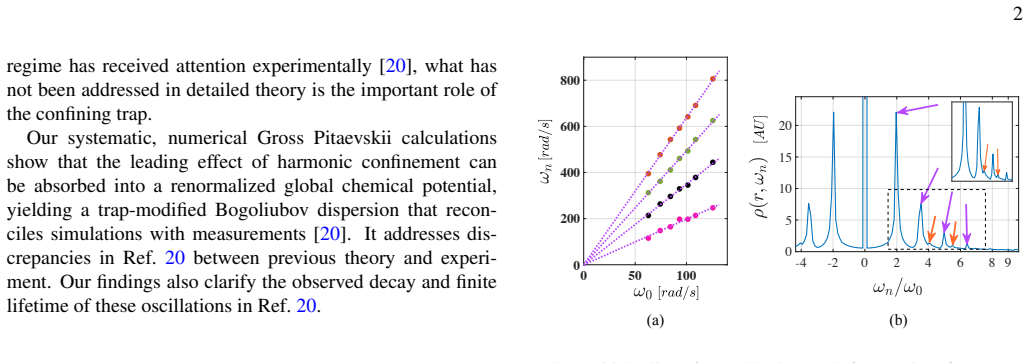
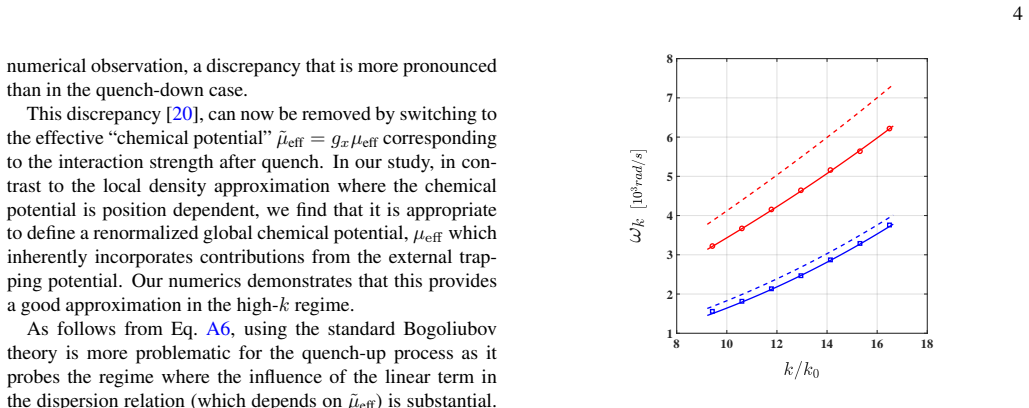
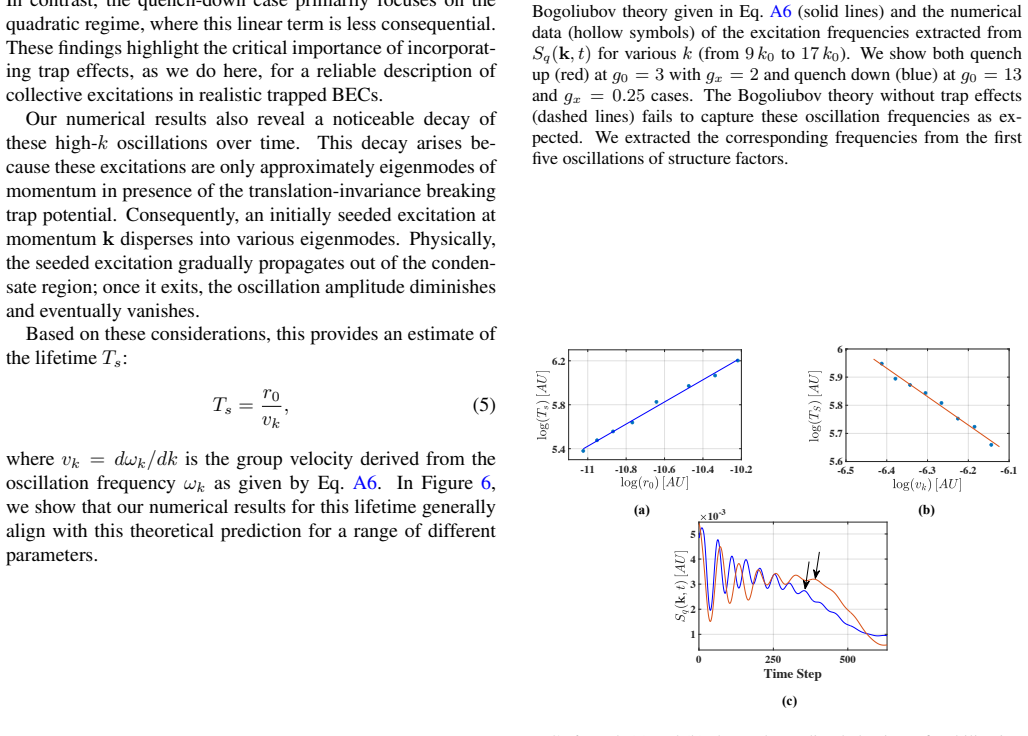
Using numerical Gross-Pitaevskii and analytical schemes, the work shows that in the low-lying regime there is a breakdown of the expected scale invariance so that the collective excitations follow hydrodynamic theory instead of the predictions given by SO(2,1) conformal symmetry, while in the high energy regime important trap effects associated with acoustic oscillations are analyzed, providing a comprehensive picture of quench-induced modes in trapped two-dimensional Bose-Einstein condensates.
What carries the argument
The abrupt interaction quench applied to a harmonically trapped two-dimensional Bose-Einstein condensate, analyzed through the Gross-Pitaevskii framework, which reveals the transition from scale-invariant to hydrodynamic collective modes.
If this is right
- Low-lying collective excitations follow hydrodynamic theory due to scale invariance breakdown.
- High-energy excitations feature acoustic oscillations influenced by the trapping potential.
- Mode frequencies and damping rates act as a spectroscopy tool for the many-body states.
- The contrast between low and high energy regimes is accessible experimentally via quenches.
Where Pith is reading between the lines
- Quench duration could be varied experimentally to pinpoint the transition to the abrupt limit.
- Similar symmetry breakdowns might appear in other quantum fluid systems with tunable interactions.
- Acoustic modes could link to experiments on sound propagation in two-dimensional superfluids.
- The approach might help identify conditions where conformal symmetry holds or fails in trapped gases.
Load-bearing premise
That the interaction quench is sufficiently abrupt and the system stays describable by the Gross-Pitaevskii equation without dominant quantum or thermal fluctuations in the low-energy regime.
What would settle it
A measurement showing that the frequencies of low-lying collective excitations match the scale-invariant SO(2,1) predictions even after a realistic abrupt quench would contradict the breakdown of scale invariance.
Figures


read the original abstract
In trapped Bose-Einstein condensates, interaction quenches which are abrupt changes of the interaction strength typically implemented via Feshbach tuning, are a practical and widely used protocol to address far-from-equilibrium collective modes. Using both numerical Gross Pitaevskii and analytical schemes we study these interaction-quench-induced collective modes in a harmonically trapped two-dimensional Bose--Einstein condensate contrasting the behavior found at low and high energies. In the low-lying regime, we characterize realistic circumstances in which there is a breakdown of the expected scale invariance so that the collective excitations follow hydrodynamic theory instead of the predictions given by SO(2,1) conformal symmetry. In the high energy regime, we focus on important trap effects associated with acoustic oscillations which have been of interest experimentally. This comprehensive analysis of the collective excitations in trapped two-dimensional Bose-Einstein condensates is experimentally accessible. Through their frequencies and damping, this reflects an important built-in spectroscopy of such many-body states.
Editorial analysis
A structured set of objections, weighed in public.
Referee Report
Summary. The paper studies interaction-quench-induced collective excitations in a harmonically trapped 2D Bose-Einstein condensate. Using numerical Gross-Pitaevskii equation (GPE) simulations combined with analytical schemes, it contrasts low- and high-energy regimes. The central claim is that in the low-lying regime there is a realistic breakdown of the expected SO(2,1) scale invariance, so that the modes instead follow hydrodynamic theory; in the high-energy regime it examines trap-induced acoustic oscillations.
Significance. If the central claim holds, the work supplies a concrete characterization of when hydrodynamic scaling supplants conformal symmetry predictions after an abrupt quench, together with an experimentally accessible spectroscopy of many-body states via mode frequencies and damping. The dual numerical-analytical approach is a strength when the mean-field regime is validated.
major comments (2)
- [Low-lying regime analysis] The central claim that low-lying modes deviate from SO(2,1) predictions and obey hydrodynamic scaling rests on GPE evolution. No depletion fraction, Bogoliubov spectrum, or other fluctuation diagnostic is reported to confirm that quantum phase fluctuations remain perturbative for the quoted trap and quench parameters (see skeptic note on 2D logarithmic divergence).
- [Numerical methods and quench protocol] The assumption that the interaction quench is sufficiently abrupt and that the system remains describable by the GPE without dominant quantum or thermal fluctuations is load-bearing for the breakdown claim, yet no quantitative error controls or validity checks for the mean-field approximation are supplied.
minor comments (1)
- [Abstract] The abstract states that the analysis is 'experimentally accessible' but does not list the specific trap frequencies, quench amplitudes, or particle numbers used in the simulations.
Simulated Author's Rebuttal
We thank the referee for the careful reading of our manuscript and the constructive comments. We address each major point below and indicate the revisions that will be incorporated.
read point-by-point responses
-
Referee: [Low-lying regime analysis] The central claim that low-lying modes deviate from SO(2,1) predictions and obey hydrodynamic scaling rests on GPE evolution. No depletion fraction, Bogoliubov spectrum, or other fluctuation diagnostic is reported to confirm that quantum phase fluctuations remain perturbative for the quoted trap and quench parameters (see skeptic note on 2D logarithmic divergence).
Authors: We agree that explicit validation of the mean-field regime is necessary, especially in two dimensions where phase fluctuations exhibit a logarithmic divergence. Although the parameters were selected to lie within the regime where the condensate fraction is high, we will add a dedicated subsection presenting depletion estimates obtained from the Bogoliubov-de Gennes spectrum evaluated on the post-quench ground state. These calculations will quantify the relative size of quantum fluctuations for the quoted trap frequencies and quench amplitudes, thereby confirming that they remain perturbative. revision: yes
-
Referee: [Numerical methods and quench protocol] The assumption that the interaction quench is sufficiently abrupt and that the system remains describable by the GPE without dominant quantum or thermal fluctuations is load-bearing for the breakdown claim, yet no quantitative error controls or validity checks for the mean-field approximation are supplied.
Authors: The quench protocol is implemented as an instantaneous change of the interaction parameter, which is the standard idealization for Feshbach-tuned experiments. To supply the requested quantitative controls, we will include in the revised manuscript an analysis of the validity of the GPE approximation. This will comprise (i) a comparison of the healing length to the trap length scales, (ii) an estimate of the fluctuation-induced depletion as a function of the post-quench interaction strength, and (iii) a brief discussion showing that thermal fluctuations are negligible at the zero-temperature conditions of the simulations. These additions will provide explicit error bounds supporting the mean-field treatment. revision: yes
Circularity Check
No significant circularity in derivation chain
full rationale
The paper derives its claims via direct numerical integration of the Gross-Pitaevskii equation for the quenched 2D condensate, then compares the resulting mode frequencies and damping to two independent external benchmarks: the exact SO(2,1) conformal symmetry predictions (valid under scale invariance) and standard hydrodynamic scaling. Neither benchmark is obtained by fitting parameters from the same data set, nor is it justified by a self-citation chain internal to the authors. The analytical schemes referenced are standard hydrodynamic or sum-rule approaches whose derivations predate the present work and do not incorporate the paper's numerical outputs. Consequently, no step reduces by construction to its own inputs.
Axiom & Free-Parameter Ledger
axioms (1)
- domain assumption Gross-Pitaevskii equation remains valid for the quench dynamics in the regimes studied
Reference graph
Works this paper leans on
-
[1]
A. Polkovnikov, K. Sengupta, A. Silva, and M. Vengalattore, Colloquium: Nonequilibrium dynamics of closed interacting quantum systems, Rev. Mod. Phys.83, 863 (2011)
work page 2011
-
[2]
A. Lamacraft and J. Moore, Chapter 7 - potential insights into nonequilibrium behavior from atomic physics, inUltracold Bosonic and Fermionic Gases, Contemporary Concepts of Con- densed Matter Science, V ol. 5, edited by K. Levin, A. L. Fetter, and D. M. Stamper-Kurn (Elsevier, 2012) pp. 177–202
work page 2012
-
[4]
K. Wang, H. Fu, and K. Levin, Simulating cosmological evolu- tion by quantum quench of an atomic bose-einstein condensate, Phys. Rev. A109, 013316 (2024)
work page 2024
- [5]
-
[6]
A. Griffin,Excitations in a Bose-condensed Liquid, Cambridge Studies in Low Temperature Physics (Cambridge University Press, 1993)
work page 1993
-
[7]
S. Giorgini, L. P. Pitaevskii, and S. Stringari, Theory of ultra- cold atomic fermi gases, Rev. Mod. Phys.80, 1215 (2008)
work page 2008
-
[8]
L. Pitaevskii and S. Stringari,Bose-Einstein Condensation and Superfluidity(2016)
work page 2016
- [9]
-
[10]
C. Chin, R. Grimm, P. Julienne, and E. Tiesinga, Feshbach res- onances in ultracold gases, Rev. Mod. Phys.82, 1225 (2010)
work page 2010
-
[11]
J. M. Kosterlitz and D. J. Thouless, Ordering, metastability and phase transitions in two-dimensional systems, Journal of Physics C: Solid State Physics6, 1181 (1973)
work page 1973
-
[12]
N. Prokof’ev and B. Svistunov, Two-dimensional weakly in- teracting bose gas in the fluctuation region, Phys. Rev. A66, 043608 (2002)
work page 2002
-
[13]
A detailed description of our numerical methodology is pro- vided in Appendix C
-
[14]
C. J. Pethick and H. Smith,Bose–Einstein Condensation in Di- lute Gases, 2nd ed. (Cambridge University Press, Cambridge, 2008)
work page 2008
-
[15]
L. Pitaevskii and S. Stringari,Bose–Einstein Condensation, In- ternational Series of Monographs on Physics, V ol. 116 (Oxford University Press, Oxford, 2003)
work page 2003
-
[16]
Stringari, Collective excitations of a trapped bose-condensed gas, Phys
S. Stringari, Collective excitations of a trapped bose-condensed gas, Phys. Rev. Lett.77, 2360 (1996)
work page 1996
-
[17]
F. Dalfovo, S. Giorgini, L. P. Pitaevskii, and S. Stringari, Theory of bose-einstein condensation in trapped gases, Rev. Mod. Phys. 71, 463 (1999)
work page 1999
-
[18]
L. P. Pitaevskii and A. Rosch, Breathing modes and hidden symmetry of trapped atoms in two dimensions, Phys. Rev. A 55, R853 (1997)
work page 1997
- [19]
-
[20]
C.-L. Hung, V . Gurarie, and C. Chin, From cosmology to cold atoms: Observation of sakharov oscillations in a quenched atomic superfluid, Science341, 1213 (2013)
work page 2013
-
[21]
J. Maki and F. Zhou, Emergent infrared conformal dynamics: Applications to strongly interacting quantum states, Phys. Rev. A109, L051303 (2024)
work page 2024
-
[22]
A. L. Fetter, Rotating trapped bose-einstein condensates, Rev. Mod. Phys.81, 647 (2009)
work page 2009
-
[23]
Y .-W. Luo and J.-S. Chen, Collective excitations of low dimen- sional trapped bose-condensed gas, Communications in Theo- retical Physics60, 673 (2013)
work page 2013
-
[24]
S. N. Bose, Plancks Gesetz und Lichtquantenhypothese, Zeitschrift f¨ur Physik26, 178 (1924)
work page 1924
-
[25]
A. Einstein, Quantentheorie des einatomigen idealen Gases, Sitzungsberichte der Preußischen Akademie der Wissenschaften Physikalisch-mathematische Klasse, 261 (1924). 6 Appendix A: Dispersion Relations To simplify Eq.3 for high-lying excitations with big enough ⃗kcomparing with| ⃗k0|= 2π/r 0, we exploit a separation of length scales. This allows us to app...
work page 1924
discussion (0)
Sign in with ORCID, Apple, or X to comment. Anyone can read and Pith papers without signing in.