Gluon Gravitational D-Form Factor: The σ-Meson as a Dilaton Confronted with Lattice Data II
Pith reviewed 2026-05-21 17:48 UTC · model grok-4.3
The pith
Fits to lattice gluon gravitational form factors yield residues matching dilaton predictions with the sigma meson as dilaton.
A machine-rendered reading of the paper's core claim, the machinery that carries it, and where it could break.
Core claim
The central claim is that the residues obtained by fitting lattice gluon D-form factors to a sigma-meson pole plus background agree with the values predicted by dilaton effective theory, in which the sigma meson is the dilaton, the pseudo-Goldstone boson of spontaneously broken scale symmetry. This agreement is reported for the pion and nucleon, permits derivation of corresponding predictions for the rho and delta, and is presented as consistent with prior total gravitational form factor results, thereby reinforcing evidence that QCD dynamics may be governed by an infrared fixed point.
What carries the argument
The sigma/f0(500)-meson pole term in the parametrization of the gluon gravitational D-form factor, interpreted inside dilaton effective theory as the carrier of approximate scale symmetry.
If this is right
- The dilaton framework supplies explicit predictions for the rho and delta gluon gravitational form factors.
- The same pole-plus-background approach yields comments on the form factors of the eta_c and eta_b mesons.
- The gluon-only results remain consistent with and strengthen the earlier analysis of total (quark plus gluon) gravitational form factors.
- The overall pattern adds weight to the hypothesis that an infrared fixed point governs low-energy QCD dynamics.
Where Pith is reading between the lines
- If the dilaton picture holds, scale symmetry may need to be treated as an approximate but useful organizing principle in low-energy hadron physics alongside chiral symmetry.
- Direct comparison of the extracted residues with independent determinations of the sigma-meson coupling to gluons would provide an external cross-check.
- The interpretation could be tested by repeating the analysis on form factors of other hadrons or at finer lattice spacings.
- An infrared fixed point would imply that certain dimensionless ratios in QCD remain stable even when the quark mass is varied.
Load-bearing premise
That a simple sigma/f0(500)-meson pole supplemented by a polynomial background term is sufficient to extract physically meaningful residues from the lattice gluon gravitational form factors at the simulated pion masses.
What would settle it
Lattice computations at physical pion mass that produce residues for the same form factors differing by more than the quoted uncertainties from the dilaton-theory values would falsify the agreement.
Figures

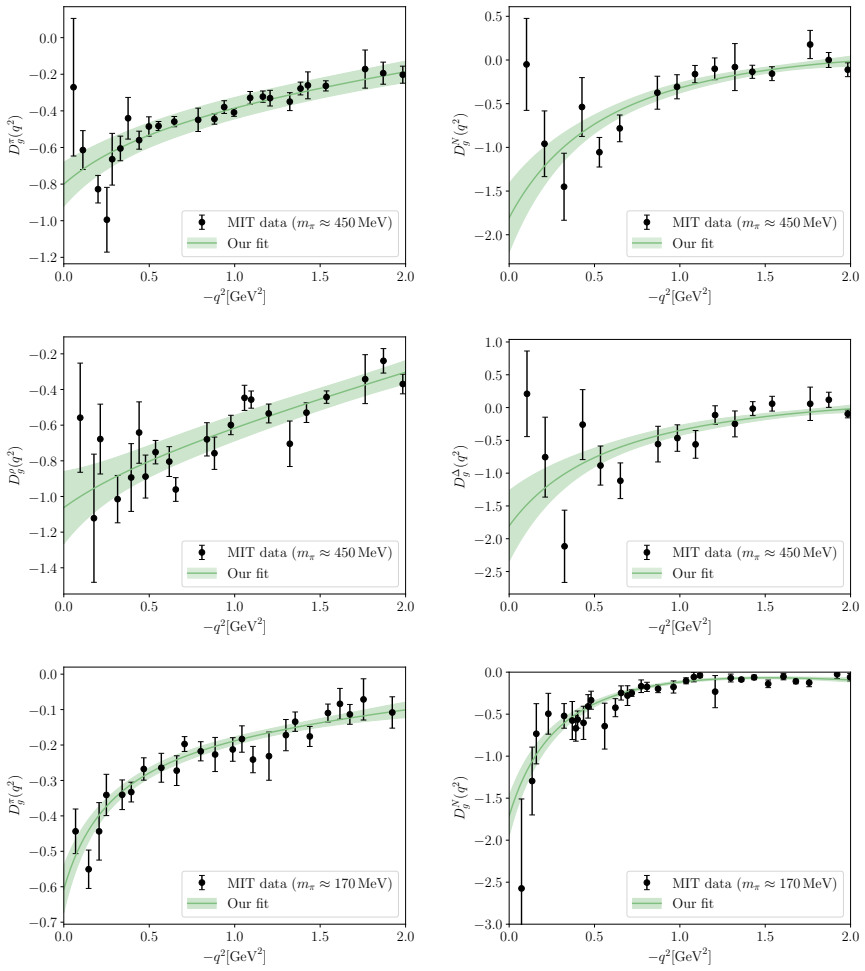


read the original abstract
We investigate the gluon gravitational form factors of the $\pi$, $N$, $\rho$, and $\Delta$ using lattice QCD data at $m_\pi \approx 450 \text{MeV}$ and $m_\pi \approx 170 \text{MeV}$. We base the analysis on fits to a simple $\sigma/f_0(500)$-meson pole, supplemented by a polynomial background term. The fitted residues agree with predictions from dilaton effective theory, in which the $\sigma$-meson acts as the dilaton, the pseudo Goldstone boson of spontaneously broken scale symmetry. We derive new dilaton-based predictions for the $\rho$- and $\Delta$-gravitational form factors, and comment on the $\eta_{c}$- and $\eta_b$-form factors in the context of the dilaton interpretation. These results reinforce our earlier findings, based on lattice total (quark and gluon) gravitational form factors, and provide further evidence that QCD dynamics may be governed by an infrared fixed point.
Editorial analysis
A structured set of objections, weighed in public.
Referee Report
Summary. The manuscript analyzes lattice QCD data for the gluon gravitational form factors of the pion, nucleon, rho, and Delta at pion masses of approximately 450 MeV and 170 MeV. Fits are performed to a simple σ/f0(500)-meson pole supplemented by a polynomial background term. The extracted residues are reported to agree with predictions from dilaton effective theory, in which the σ-meson is the dilaton associated with spontaneous scale symmetry breaking. New dilaton-based predictions are given for the ρ and Δ, with comments on ηc and ηb form factors. The work reinforces prior results on total gravitational form factors and suggests QCD may be governed by an infrared fixed point.
Significance. If the residue agreement is robust, the result would lend support to the dilaton interpretation of the σ-meson and the possibility of an infrared fixed point in QCD, extending earlier lattice-based arguments. The use of two pion masses and the derivation of new predictions for vector and decuplet states add some breadth. However, the significance is limited by the absence of documented systematic tests on the parametrization, which is central to the claim.
major comments (2)
- [Analysis of lattice gluon GFF data] The extraction of residues from the gluon GFFs relies on the parametrization A_g(t) = R_σ/(t - m_σ²) + polynomial background, yet the manuscript provides no systematic variation of polynomial degree, no comparison to dipole or dispersive alternatives, and no explicit checks for stability of R_σ under these changes. At the simulated pion masses the σ is not parametrically light relative to 2m_π thresholds, so a fixed-degree polynomial can absorb or distort the residue if additional spectral structure is present.
- [Fits and residue extraction] The central claim requires that the fitted residues directly correspond to the dilaton coupling in the effective theory. The manuscript does not report χ² values, covariance matrices, or the precise polynomial degree used for each hadron and each pion mass, nor does it show that the residue remains stable when data points near thresholds or lattice artifacts are excluded.
minor comments (1)
- [Introduction and formalism] Notation for the gluon D-form factor and the precise definition of the residue R_σ should be clarified with an explicit equation in the main text rather than relying solely on the abstract.
Simulated Author's Rebuttal
We thank the referee for their careful reading of the manuscript and for highlighting aspects of the analysis that merit further documentation. We address the major comments point by point below and will revise the manuscript accordingly to strengthen the presentation of the results.
read point-by-point responses
-
Referee: [Analysis of lattice gluon GFF data] The extraction of residues from the gluon GFFs relies on the parametrization A_g(t) = R_σ/(t - m_σ²) + polynomial background, yet the manuscript provides no systematic variation of polynomial degree, no comparison to dipole or dispersive alternatives, and no explicit checks for stability of R_σ under these changes. At the simulated pion masses the σ is not parametrically light relative to 2m_π thresholds, so a fixed-degree polynomial can absorb or distort the residue if additional spectral structure is present.
Authors: We agree that additional documentation of the parametrization choices would improve the robustness of the residue extraction. In the revised manuscript we will add an appendix presenting fits with polynomial backgrounds of varying degree (linear through cubic) for each hadron and each pion mass. We will also compare the resulting R_σ values to those obtained from a simple dipole ansatz and discuss the theoretical motivation for the pole-plus-polynomial form within the dilaton effective theory. Explicit stability tests will be included by repeating the fits after excluding the lowest-t points nearest the two-pion threshold and after removing any data points flagged as potential lattice artifacts; the residues remain consistent within the quoted uncertainties. Although the σ is not parametrically light at the simulated pion masses, the agreement of the residues with dilaton predictions at both masses provides supporting evidence for the interpretation. revision: yes
-
Referee: [Fits and residue extraction] The central claim requires that the fitted residues directly correspond to the dilaton coupling in the effective theory. The manuscript does not report χ² values, covariance matrices, or the precise polynomial degree used for each hadron and each pion mass, nor does it show that the residue remains stable when data points near thresholds or lattice artifacts are excluded.
Authors: We acknowledge that reporting quantitative fit diagnostics and stability checks is necessary to substantiate the link between the extracted residues and the dilaton couplings. In the revised version we will state the exact polynomial degree adopted for every hadron and pion-mass combination, quote the χ² per degree of freedom for each fit, and supply the covariance matrices of the fit parameters in an appendix. We will further document the stability of R_σ under the removal of near-threshold points and any suspect lattice artifacts, confirming that the central values and uncertainties are not materially altered. These additions will make the correspondence to the dilaton effective theory more transparent. revision: yes
Circularity Check
No significant circularity; lattice data provides independent test of dilaton predictions
full rationale
The paper fits lattice QCD gluon gravitational form factors at two pion masses to a simple σ/f0(500) pole plus polynomial background and reports that the extracted residues agree with separate predictions from dilaton effective theory. This constitutes a comparison of external lattice results against theory outputs rather than any reduction of the claimed agreement to a fitted parameter or self-referential definition. The reference to earlier findings on total (quark+gluon) form factors supplies context but does not carry the load of the gluon-only analysis or force the current residues by construction. No equations or steps in the provided text exhibit a prediction that is statistically equivalent to the input fit by definition.
Axiom & Free-Parameter Ledger
free parameters (1)
- polynomial background coefficients
axioms (1)
- domain assumption The σ/f0(500) meson acts as the dilaton, the pseudo-Goldstone boson of spontaneously broken scale symmetry.
invented entities (1)
-
Dilaton interpretation of the sigma meson
no independent evidence
Lean theorems connected to this paper
-
IndisputableMonolith/Cost/FunctionalEquation.leanwashburn_uniqueness_aczel unclear?
unclearRelation between the paper passage and the cited Recognition theorem.
We base the analysis on fits to a simple σ/f0(500)-meson pole, supplemented by a polynomial background term. The fitted residues agree with predictions from dilaton effective theory...
-
IndisputableMonolith/Foundation/AlphaCoordinateFixation.leanJ_uniquely_calibrated_via_higher_derivative unclear?
unclearRelation between the paper passage and the cited Recognition theorem.
Dπ(q²) = rπ_σ q²/(q²−m²_σ)−1, DN(q²)=rN_σ/(q²−m²_σ), ... with residues rπ_σ=2/3, rN_σ=4/3 m̄²_N, ...
What do these tags mean?
- matches
- The paper's claim is directly supported by a theorem in the formal canon.
- supports
- The theorem supports part of the paper's argument, but the paper may add assumptions or extra steps.
- extends
- The paper goes beyond the formal theorem; the theorem is a base layer rather than the whole result.
- uses
- The paper appears to rely on the theorem as machinery.
- contradicts
- The paper's claim conflicts with a theorem or certificate in the canon.
- unclear
- Pith found a possible connection, but the passage is too broad, indirect, or ambiguous to say the theorem truly supports the claim.
Forward citations
Cited by 1 Pith paper
-
Particle seismology: mechanical and gravitational properties from parton-hadron duality
A hadronic approach based on dispersion relations and meson dominance achieves a successful description of lattice QCD data for gravitational form factors of pions and nucleons.
Reference graph
Works this paper leans on
-
[1]
Forces inside hadrons: pressure, surface tension, mechanical radius, and all that
M. V. Polyakov and P. Schweitzer, “Forces inside hadrons: pressure, surface tension, mechanical radius, and all that,”Int. J. Mod. Phys. A33no. 26, (2018) 1830025, arXiv:1805.06596 [hep-ph]
work page internal anchor Pith review Pith/arXiv arXiv 2018
-
[2]
Colloquium: Gravitational form factors of the proton,
V. D. Burkert, L. Elouadrhiri, F. X. Girod, C. Lorc´ e, P. Schweitzer, and P. E. Shanahan, “Colloquium: Gravitational form factors of the proton,”Rev. Mod. Phys.95 no. 4, (2023) 041002,arXiv:2303.08347 [hep-ph]
-
[3]
Electromagnetic and gravitational form factors of the nucleon,
C. Lorc´ e, “Electromagnetic and gravitational form factors of the nucleon,”PoS SPIN2023(2024) 010,arXiv:2402.00429 [hep-ph]
-
[4]
Pressure inside hadrons: criticism, conjectures, and all that,
C. Lorc´ e and P. Schweitzer, “Pressure inside hadrons: criticism, conjectures, and all that,”Acta Phys. Polon. B56(2025) 3–A17,arXiv:2501.04622 [hep-ph]
-
[5]
The pressure distribution inside the proton,
V. D. Burkert, L. Elouadrhiri, and F. X. Girod, “The pressure distribution inside the proton,”Nature557no. 7705, (2018) 396–399
work page 2018
-
[6]
Determining the gluonic gravitational form factors of the proton,
B. Duranet al., “Determining the gluonic gravitational form factors of the proton,” Nature615no. 7954, (2023) 813–816,arXiv:2207.05212 [nucl-ex]
-
[7]
Gluon gravitational form factors of the nucleon and the pion from lattice QCD
P. E. Shanahan and W. Detmold, “Gluon gravitational form factors of the nucleon and the pion from lattice QCD,”Phys. Rev. D99no. 1, (2019) 014511,arXiv:1810.04626 [hep-lat]
work page internal anchor Pith review Pith/arXiv arXiv 2019
-
[8]
Gluon gravitational structure of hadrons of different spin,
D. A. Pefkou, D. C. Hackett, and P. E. Shanahan, “Gluon gravitational structure of hadrons of different spin,”Phys. Rev. D105no. 5, (2022) 054509,arXiv:2107.10368 [hep-lat]
-
[9]
Gravitational Form Factors of the Proton from Lattice QCD,
D. C. Hackett, D. A. Pefkou, and P. E. Shanahan, “Gravitational Form Factors of the Proton from Lattice QCD,”Phys. Rev. Lett.132no. 25, (2024) 251904, arXiv:2310.08484 [hep-lat]
-
[10]
Gravitational form factors of the pion from lattice QCD,
D. C. Hackett, P. R. Oare, D. A. Pefkou, and P. E. Shanahan, “Gravitational form factors of the pion from lattice QCD,”Phys. Rev. D108no. 11, (2023) 114504, arXiv:2307.11707 [hep-lat]. [11]χQCDCollaboration, B. Wang, F. He, G. Wang, T. Draper, J. Liang, K.-F. Liu, and Y.-B. Yang, “Trace anomaly form factors from lattice QCD,”Phys. Rev. D109no. 9, (2024) 0...
-
[11]
Lattice evidence that scalar glueballs are small,
R. Abbott, D. C. Hackett, D. A. Pefkou, F. Romero-L´ opez, and P. E. Shanahan, “Lattice evidence that scalar glueballs are small,”arXiv:2508.21821 [hep-lat]
-
[12]
Chiral structure of nucleon gravitational form factors
A. V. Belitsky and X. Ji, “Chiral structure of nucleon gravitational form-factors,” Phys. Lett. B538(2002) 289–297,arXiv:hep-ph/0203276
work page internal anchor Pith review Pith/arXiv arXiv 2002
-
[13]
Chiral theory of ρ-meson gravitational form factors,
E. Epelbaum, J. Gegelia, U. G. Meißner, and M. V. Polyakov, “Chiral theory of ρ-meson gravitational form factors,”Phys. Rev. D105no. 1, (2022) 016018, arXiv:2109.10826 [hep-ph]
-
[14]
Chiral theory of nucleons and pions in the presence of an external gravitational field,
H. Alharazin, D. Djukanovic, J. Gegelia, and M. V. Polyakov, “Chiral theory of nucleons and pions in the presence of an external gravitational field,”Phys. Rev. D102 no. 7, (2020) 076023,arXiv:2006.05890 [hep-ph]
-
[15]
Gravitationalp→∆ + transition form factors in chiral perturbation theory,
H. Alharazin, B. D. Sun, E. Epelbaum, J. Gegelia, and U. G. Meißner, “Gravitationalp→∆ + transition form factors in chiral perturbation theory,”JHEP03 (2024) 007,arXiv:2312.05193 [hep-ph]
-
[16]
Gravitational form factors within light-cone sum rules at leading order
I. V. Anikin, “Gravitational form factors within light-cone sum rules at leading order,” Phys. Rev. D99no. 9, (2019) 094026,arXiv:1902.00094 [hep-ph]
work page internal anchor Pith review Pith/arXiv arXiv 2019
-
[17]
Gravitational formfactors of theρ,π, andK mesons in the light-cone QCD sum rules,
T. M. Aliev, K. S ¸im¸ sek, and T. Barakat, “Gravitational formfactors of theρ,π, andK mesons in the light-cone QCD sum rules,”Phys. Rev. D103(2021) 054001, arXiv:2009.07926 [hep-ph]
-
[18]
Gluon gravitational form factors at large momentum transfer,
X.-B. Tong, J.-P. Ma, and F. Yuan, “Gluon gravitational form factors at large momentum transfer,”Phys. Lett. B823(2021) 136751,arXiv:2101.02395 [hep-ph]
-
[19]
Perturbative calculations of gravitational form factors at large momentum transfer,
X.-B. Tong, J.-P. Ma, and F. Yuan, “Perturbative calculations of gravitational form factors at large momentum transfer,”JHEP10(2022) 046,arXiv:2203.13493 [hep-ph]
-
[20]
Gravitational transition form factors of N→∆ via QCD light-cone sum rules,
U. ¨Ozdem and K. Azizi, “Gravitational transition form factors of N→∆ via QCD light-cone sum rules,”JHEP03(2023) 048,arXiv:2212.07290 [hep-ph]
-
[21]
Gravitational form factors of the ∆ baryon via QCD sum rules,
Z. Dehghan, K. Azizi, and U. ¨Ozdem, “Gravitational form factors of the ∆ baryon via QCD sum rules,”Phys. Rev. D108no. 9, (2023) 094037,arXiv:2307.14880 [hep-ph]
-
[22]
Mechanical properties of proton using flavor-decomposed gravitational form factors,
Z. Dehghan, F. Almaksusi, and K. Azizi, “Mechanical properties of proton using flavor-decomposed gravitational form factors,”JHEP06(2025) 025, arXiv:2502.16689 [hep-ph]
-
[23]
Mechanical properties of the Ω- baryon from gravitational form factors,
Z. Dehghan and K. Azizi, “Mechanical properties of the Ω- baryon from gravitational form factors,”Phys. Rev. D112no. 5, (2025) 054014,arXiv:2507.14840 [hep-ph]
-
[24]
Gravitational form factors of the pion and meson dominance,
W. Broniowski and E. Ruiz Arriola, “Gravitational form factors of the pion and meson dominance,”Phys. Lett. B859(2024) 139138,arXiv:2405.07815 [hep-ph]
-
[25]
Dispersive determination of nucleon gravitational form factors,
X.-H. Cao, F.-K. Guo, Q.-Z. Li, and D.-L. Yao, “Dispersive determination of nucleon gravitational form factors,”Nature Commun.16no. 1, (2025) 6979, arXiv:2411.13398 [hep-ph]. 19
-
[26]
Gravitational form factors and mechanical properties of the nucleon in a meson dominance approach,
W. Broniowski and E. Ruiz Arriola, “Gravitational form factors and mechanical properties of the nucleon in a meson dominance approach,”arXiv:2503.09297 [hep-ph]
-
[27]
Gravitational form factors of pions, kaons and nucleons from dispersion relations,
X.-H. Cao, F.-K. Guo, Q.-Z. Li, B.-W. Wu, and D.-L. Yao, “Gravitational form factors of pions, kaons and nucleons from dispersion relations,”arXiv:2507.05375 [hep-ph]
-
[28]
Pion and kaon electromagnetic and gravitational form factors,
Y.-Z. Xu, M. Ding, K. Raya, C. D. Roberts, J. Rodr´ ıguez-Quintero, and S. M. Schmidt, “Pion and kaon electromagnetic and gravitational form factors,”Eur. Phys. J. C84 no. 2, (2024) 191,arXiv:2311.14832 [hep-ph]
-
[29]
Nucleon gravitational form factors,
Z. Q. Yao, Y. Z. Xu, D. Binosi, Z. F. Cui, M. Ding, K. Raya, C. D. Roberts, J. Rodr´ ıguez-Quintero, and S. M. Schmidt, “Nucleon gravitational form factors,”Eur. Phys. J. A61no. 5, (2025) 92,arXiv:2409.15547 [hep-ph]
-
[30]
Gravitational form factors of pseudoscalar mesons in a contact interaction,
M. A. Sultan, Z. Xing, K. Raya, A. Bashir, and L. Chang, “Gravitational form factors of pseudoscalar mesons in a contact interaction,”Phys. Rev. D110no. 5, (2024) 054034,arXiv:2407.10437 [hep-ph]
-
[31]
The Dichotomous Nature of theσMeson and the Nucleon D-Term,
Z. Xing, K. Raya, Y.-x. Liu, and L. Chang, “The Dichotomous Nature of theσMeson and the Nucleon D-Term,”arXiv:2512.05583 [hep-ph]
-
[32]
The nucleon form-factors of the energy momentum tensor in the Skyrme model
C. Cebulla, K. Goeke, J. Ossmann, and P. Schweitzer, “The Nucleon form-factors of the energy momentum tensor in the Skyrme model,”Nucl. Phys. A794(2007) 87–114, arXiv:hep-ph/0703025
work page internal anchor Pith review Pith/arXiv arXiv 2007
-
[33]
Energy-momentum tensor form factors of the nucleon within a $\pi$-$\rho$-$\omega$ soliton model
J.-H. Jung, U. Yakhshiev, and H.-C. Kim, “Energy–momentum tensor form factors of the nucleon within aπ–ρ–ωsoliton model,”J. Phys. G41(2014) 055107, arXiv:1310.8064 [hep-ph]
work page internal anchor Pith review Pith/arXiv arXiv 2014
-
[34]
Gravitational form factors of a baryon with spin-3/2,
J.-Y. Kim and B.-D. Sun, “Gravitational form factors of a baryon with spin-3/2,”Eur. Phys. J. C81no. 1, (2021) 85,arXiv:2011.00292 [hep-ph]
-
[35]
M. Tanaka, D. Fujii, and M. Kawaguchi, “Gravitational form factors of the nucleon in the Skyrme model based on scale-invariant chiral perturbation theory,” arXiv:2507.21220 [hep-ph]
-
[36]
K. Fukushima and T. Uji, “On pseudo-gauge ambiguity in the distributions of energy density, pressure, and shear force inside the nucleon,”arXiv:2509.10223 [hep-ph]
-
[37]
Gravitational form factors and mechanical properties of proton in a light-front quark-diquark model,
D. Chakrabarti, C. Mondal, A. Mukherjee, S. Nair, and X. Zhao, “Gravitational form factors and mechanical properties of proton in a light-front quark-diquark model,” Phys. Rev. D102(2020) 113011,arXiv:2010.04215 [hep-ph]
-
[38]
Gravitational form factors of the pion in the self-consistent light-front quark model,
Y. Choi, H.-D. Son, and H.-M. Choi, “Gravitational form factors of the pion in the self-consistent light-front quark model,”Phys. Rev. D112no. 1, (2025) 014043, arXiv:2504.14997 [hep-ph]
-
[39]
Nucleon mass radii and distribution: Holographic QCD, Lattice QCD and GlueX data,
K. A. Mamo and I. Zahed, “Nucleon mass radii and distribution: Holographic QCD, Lattice QCD and GlueX data,”Phys. Rev. D103no. 9, (2021) 094010, arXiv:2103.03186 [hep-ph]. 20
-
[40]
J/ψnear threshold in holographic QCD: A and D gravitational form factors,
K. A. Mamo and I. Zahed, “J/ψnear threshold in holographic QCD: A and D gravitational form factors,”Phys. Rev. D106no. 8, (2022) 086004,arXiv:2204.08857 [hep-ph]
-
[41]
Nucleon D-term in holographic quantum chromodynamics,
M. Fujita, Y. Hatta, S. Sugimoto, and T. Ueda, “Nucleon D-term in holographic quantum chromodynamics,”PTEP2022no. 9, (2022) 093B06,arXiv:2206.06578 [hep-th]
-
[42]
Energy-Momentum Tensor and D-term of Baryons in Top-down Holographic QCD,
S. Sugimoto and T. Tsukamoto, “Energy-Momentum Tensor and D-term of Baryons in Top-down Holographic QCD,”arXiv:2503.19492 [hep-th]
-
[43]
Pion Gravitational Form Factors in Holographic QCD,
M. Tanaka, D. Fujii, and A. Iwanaka, “Pion Gravitational Form Factors in Holographic QCD,”arXiv:2504.01115 [hep-ph]
-
[44]
Spontaneous breakdown of conformal symmetry,
C. J. Isham, A. Salam, and J. A. Strathdee, “Spontaneous breakdown of conformal symmetry,”Phys. Lett. B31(1970) 300–302
work page 1970
-
[45]
Zumino,Effective Lagrangians and Broken Symmetries, vol
B. Zumino,Effective Lagrangians and Broken Symmetries, vol. 2 of1970 Brandeis University Summer Institute in Theoretical Physics, Vol. 2. (M.I.T. Press, Cambridge, MA, 1970), Providence, RI, 1970
work page 1970
-
[46]
Phenomenological actions for spontaneously-broken conformal symmetry,
J. R. Ellis, “Phenomenological actions for spontaneously-broken conformal symmetry,” Nucl. Phys. B26(1971) 536–546
work page 1971
-
[47]
$\Delta I=1/2$ rule for kaon decays derived from QCD infrared fixed point
R. J. Crewther and L. C. Tunstall, “∆I= 1/2 rule for kaon decays derived from QCD infrared fixed point,”Phys. Rev. D91no. 3, (2015) 034016,arXiv:1312.3319 [hep-ph]
work page internal anchor Pith review Pith/arXiv arXiv 2015
-
[48]
Status of Chiral-Scale Perturbation Theory
R. J. Crewther and L. C. Tunstall, “Status of Chiral-Scale Perturbation Theory,”PoS CD15(2015) 132,arXiv:1510.01322 [hep-ph]
work page internal anchor Pith review Pith/arXiv arXiv 2015
-
[49]
QCD with an infrared fixed point: The pion sector,
R. Zwicky, “QCD with an infrared fixed point: The pion sector,”Phys. Rev. D109 no. 3, (2024) 034009,arXiv:2306.06752 [hep-ph]
-
[50]
QCD with an infrared fixed point and a dilaton,
R. Zwicky, “QCD with an infrared fixed point and a dilaton,”Phys. Rev. D110no. 1, (2024) 014048,arXiv:2312.13761 [hep-ph]
-
[51]
Soft Theorems and Dilaton Effective Theory,
R. Zwicky, “Soft Theorems and Dilaton Effective Theory,”PoSLATTICE2024 (2025) 151,arXiv:2508.16501 [hep-lat]
-
[52]
Large volumes and spectroscopy of walking theories
L. Del Debbio, B. Lucini, A. Patella, C. Pica, and A. Rago, “Large volumes and spectroscopy of walking theories,”Phys. Rev. D93no. 5, (2016) 054505, arXiv:1512.08242 [hep-lat]
work page internal anchor Pith review Pith/arXiv arXiv 2016
-
[53]
Gradient flow step-scaling function for SU(3) with ten fundamental flavors,
A. Hasenfratz, C. Rebbi, and O. Witzel, “Gradient flow step-scaling function for SU(3) with ten fundamental flavors,”Phys. Rev. D101no. 11, (2020) 114508, arXiv:2004.00754 [hep-lat]
-
[54]
Extended investigation of the twelve-flavor $\beta$-function
Z. Fodor, K. Holland, J. Kuti, D. Nogradi, and C. H. Wong, “Extended investigation of the twelve-flavorβ-function,”Phys. Lett. B779(2018) 230–236,arXiv:1710.09262 [hep-lat]. 21 [56]Lattice Strong DynamicsCollaboration, T. Appelquistet al., “Nonperturbative investigations of SU(3) gauge theory with eight dynamical flavors,”Phys. Rev. D99 no. 1, (2019) 0145...
work page internal anchor Pith review Pith/arXiv arXiv 2018
-
[55]
Meson spectroscopy in the Sp(4) gauge theory with three antisymmetric fermions,
E. Bennett, D. K. Hong, H. Hsiao, J.-W. Lee, C. J. D. Lin, B. Lucini, M. Piai, and D. Vadacchino, “Meson spectroscopy in the Sp(4) gauge theory with three antisymmetric fermions,”Phys. Rev. D111no. 7, (2025) 074511,arXiv:2412.01170 [hep-lat]. [59]LatKMICollaboration, Y. Aoki, T. Aoyama, E. Bennett, T. Maskawa, K. Miura, H. Ohki, E. Rinaldi, A. Shibata, K....
-
[56]
Dilaton EFT Framework For Lattice Data
T. Appelquist, J. Ingoldby, and M. Piai, “Dilaton EFT Framework For Lattice Data,” JHEP07(2017) 035,arXiv:1702.04410 [hep-ph]
work page internal anchor Pith review Pith/arXiv arXiv 2017
-
[57]
Analysis of a Dilaton EFT for Lattice Data
T. Appelquist, J. Ingoldby, and M. Piai, “Analysis of a Dilaton EFT for Lattice Data,” JHEP03(2018) 039,arXiv:1711.00067 [hep-ph]
work page internal anchor Pith review Pith/arXiv arXiv 2018
-
[58]
Dilaton Physics from Asymptotic Freedom,
C. Cresswell-Hogg, D. F. Litim, and R. Zwicky, “Dilaton Physics from Asymptotic Freedom,”arXiv:2502.00107 [hep-th]
-
[59]
Relatingβ*’ andγQ*’ in the N=1 SQCD conformal window,
M. Shifman and R. Zwicky, “Relatingβ*’ andγQ*’ in the N=1 SQCD conformal window,”Phys. Rev. D108no. 11, (2023) 114013,arXiv:2310.16449 [hep-th]
-
[60]
Holographic techni-dilaton at 125 GeV
S. Matsuzaki and K. Yamawaki, “Holographic techni-dilaton at 125 GeV,”Phys. Rev. D86(2012) 115004,arXiv:1209.2017 [hep-ph]
work page internal anchor Pith review Pith/arXiv arXiv 2012
-
[61]
D. D. Dietrich, F. Sannino, and K. Tuominen, “Light composite Higgs from higher representations versus electroweak precision measurements: Predictions for CERN LHC,”Phys. Rev. D72(2005) 055001,arXiv:hep-ph/0505059
work page internal anchor Pith review Pith/arXiv arXiv 2005
-
[62]
O. Cat` a, R. J. Crewther, and L. C. Tunstall, “Crawling technicolor,”Phys. Rev. D100 no. 9, (2019) 095007,arXiv:1803.08513 [hep-ph]
-
[63]
Scaling effective Lagrangians in a dense medium,
G. E. Brown and M. Rho, “Scaling effective Lagrangians in a dense medium,”Phys. Rev. Lett.66(1991) 2720–2723
work page 1991
-
[64]
Manifestation of Hidden Symmetries in Baryonic Matter: From Finite Nuclei to Neutron Stars,
M. Rho and Y.-L. Ma, “Manifestation of Hidden Symmetries in Baryonic Matter: From Finite Nuclei to Neutron Stars,”Mod. Phys. Lett. A36no. 13, (2021) 2130012, arXiv:2101.07121 [nucl-th]
-
[65]
M. Rho and L.-Q. Shao, “Probing for an IR-fixed Point in QCD by Superallowed Gamow-Teller Transitions in Doubly Magic Nuclei,”arXiv:2410.04991 [nucl-th]
-
[66]
GravitationalD-Form Factor: Theσ-Meson as a Dilaton confronted with Lattice Data,
R. Stegeman and R. Zwicky, “GravitationalD-Form Factor: Theσ-Meson as a Dilaton confronted with Lattice Data,”arXiv:2508.18537 [hep-ph]. 22
-
[67]
Gravitational form factors of a spin one particle,
M. V. Polyakov and B.-D. Sun, “Gravitational form factors of a spin one particle,” Phys. Rev. D100no. 3, (2019) 036003,arXiv:1903.02738 [hep-ph]
-
[68]
J. F. Donoghue, E. Golowich, and B. R. Holstein,Dynamics of the standard model, vol. 2. CUP, 2014
work page 2014
-
[69]
M. L. Goldberger and S. B. Treiman, “Decay of the pi meson,”Phys. Rev.110(1958) 1178–1184
work page 1958
-
[70]
The U(1) Goldberger-Treiman Relation and the Two Components of the Proton ’Spin’,
G. M. Shore and G. Veneziano, “The U(1) Goldberger-Treiman Relation and the Two Components of the Proton ’Spin’,”Phys. Lett. B244(1990) 75–82
work page 1990
-
[71]
A. Tarasov and R. Venugopalan, “Role of the chiral anomaly in polarized deeply inelastic scattering: Finding the triangle graph inside the box diagram in Bjorken and Regge asymptotics,”Phys. Rev. D102no. 11, (2020) 114022,arXiv:2008.08104 [hep-ph]
-
[72]
A. Tarasov and R. Venugopalan, “Role of the chiral anomaly in polarized deeply inelastic scattering. II. Topological screening and transitions from emergent axionlike dynamics,”Phys. Rev. D105no. 1, (2022) 014020,arXiv:2109.10370 [hep-ph]
-
[73]
A. Tarasov and R. Venugopalan, “Role of the chiral anomaly in polarized deeply inelastic scattering. III. Wess-Zumino-Witten contributions and chiral Ward identities for finite quark mass,”Phys. Rev. D111no. 7, (2025) 074027,arXiv:2501.10519 [hep-ph]
-
[74]
Chiral and trace anomalies in deeply virtual Compton scattering,
S. Bhattacharya, Y. Hatta, and W. Vogelsang, “Chiral and trace anomalies in deeply virtual Compton scattering,”Phys. Rev. D107no. 1, (2023) 014026, arXiv:2210.13419 [hep-ph]
-
[75]
Chiral and trace anomalies in deeply virtual Compton scattering. II. QCD factorization and beyond,
S. Bhattacharya, Y. Hatta, and W. Vogelsang, “Chiral and trace anomalies in deeply virtual Compton scattering. II. QCD factorization and beyond,”Phys. Rev. D108 no. 1, (2023) 014029,arXiv:2305.09431 [hep-ph]
-
[76]
Gell-Mann,Symmetry violation in hadron physics
M. Gell-Mann,Symmetry violation in hadron physics. 1969
work page 1969
-
[77]
Dilaton and massive hadrons in a conformal phase,
L. Del Debbio and R. Zwicky, “Dilaton and massive hadrons in a conformal phase,” JHEP08(2022) 007,arXiv:2112.11363 [hep-ph]
-
[78]
Dilatons Improve (Non)-Goldstones,
R. Zwicky, “Dilatons Improve (Non)-Goldstones,”arXiv:2306.12914 [hep-th]
-
[79]
On a theory of particles with half integral spin,
W. Rarita and J. Schwinger, “On a theory of particles with half integral spin,”Phys. Rev.60(1941) 61
work page 1941
-
[80]
Finite component field representations of the conformal group,
G. Mack and A. Salam, “Finite component field representations of the conformal group,”Annals Phys.53(1969) 174–202
work page 1969
discussion (0)
Sign in with ORCID, Apple, or X to comment. Anyone can read and Pith papers without signing in.