Expected values for SUSY hierarchies of Jaynes-Cummings Hamiltonian
Pith reviewed 2026-05-21 17:38 UTC · model grok-4.3
The pith
Supersymmetric partner Hamiltonians of the Jaynes-Cummings model alter the time evolution of expectation values for field operators, quadratures, and atomic inversion.
A machine-rendered reading of the paper's core claim, the machinery that carries it, and where it could break.
Core claim
The SUSY partner connection influences the expected values of field operators a±, quadratures, and atomic inversion, particularly affecting the classical and revival times in the Jaynes-Cummings model.
What carries the argument
Supersymmetric partner Hamiltonians associated to the Jaynes-Cummings Hamiltonian, with spectra differing in a finite number of energy levels.
If this is right
- Expectation values for field operators and quadratures evolve differently under the partner Hamiltonians than under the original model.
- Atomic inversion dynamics are modified by the SUSY partner connection.
- Classical times and revival times shift in the partner systems due to the altered dynamics.
- Direct comparisons of dynamical behaviors become possible between systems whose spectra match except for finitely many levels.
Where Pith is reading between the lines
- These spectral near-matches with altered dynamics could be exploited to engineer cavity systems with controlled time scales.
- The method might apply to other integrable quantum optical models where similar partner constructions exist.
- Cavity QED experiments could measure the predicted shifts in revival times to test the partner influence.
Load-bearing premise
That supersymmetric partner Hamiltonians can be constructed for the Jaynes-Cummings Hamiltonian such that their spectra differ only by a finite number of energy levels.
What would settle it
A direct computation or experiment finding identical expectation values and unchanged revival times for the original and partner Hamiltonians would falsify the claimed influence.
Figures





read the original abstract
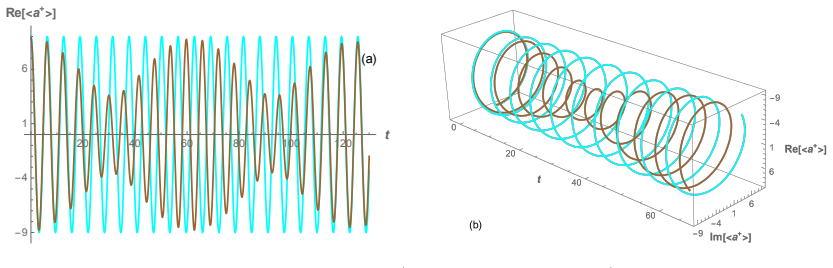
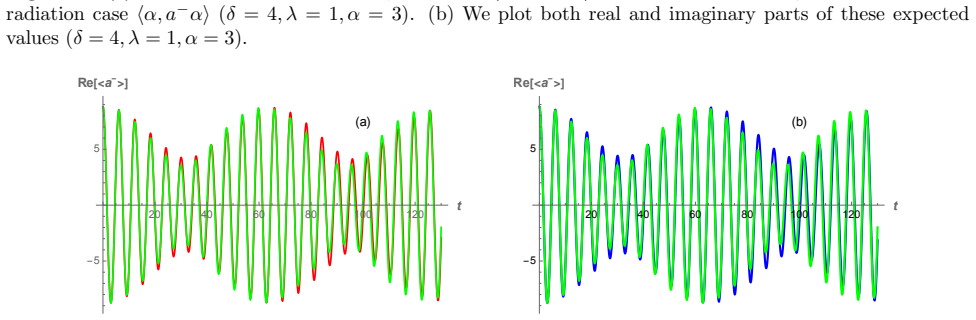
The aim of this letter is to compute the evolution of some expected values, such as the field operators $a^\pm$, quadratures and atomic inversion, under supersymmetric (SUSY) partner Hamiltonians associated to the Jaynes-Cummings Hamiltonian of quantum optics. This kind of SUSY partners are characterized by having spectra which differ in a finite number of energy levels. We wish to elucidate if the partner connection has any influence on these expected values. In particular, we want also to know in which way the classical and revival times are affected by such SUSY partners.
Editorial analysis
A structured set of objections, weighed in public.
Referee Report
Summary. The manuscript computes the time evolution of expectation values for the field operators a±, the quadratures, and the atomic inversion in the Jaynes-Cummings model and its supersymmetric partner Hamiltonians. These partners are constructed to have spectra differing by only a finite number of energy levels. The central aim is to determine whether the SUSY partner connection influences these dynamical quantities and, specifically, how it affects the classical and revival times.
Significance. If the calculations are performed with consistent state preparation and observable definitions across the original and partner systems, the results would clarify how finite spectral modifications propagate into the dynamics of a standard quantum-optical model. The use of established SUSY partner constructions for the JC Hamiltonian is a methodological strength, as it allows direct comparison without introducing new free parameters.
major comments (2)
- [Section 3] The comparison of expectation values requires that initial states and observables be mapped between the original JC system and its SUSY partners via the intertwining operators A and A† that satisfy the standard relations H_partner A = A H. Section 3 (or the dynamics subsection) does not appear to apply these operators when evolving the same formal coherent or atomic state under each Hamiltonian; without this step the reported shifts in expectation values and revival times could arise from an inconsistent identification of the Hilbert spaces rather than from the spectral difference alone.
- [Eq. (X)] Eq. (X) defining the time-dependent expectation value ⟨a±(t)⟩ (or the analogous expressions for quadratures and inversion) is written directly in the original basis without the corresponding transformation under the SUSY map. This makes it unclear whether the plotted or tabulated differences are load-bearing consequences of the partner spectrum or artifacts of the state identification.
minor comments (2)
- [Introduction] The notation for the SUSY partner Hamiltonians and the explicit form of the intertwining operators should be stated once in a dedicated subsection for clarity.
- [Figure 2] Figure captions for the time-evolution plots should explicitly label which curve corresponds to the original JC Hamiltonian and which to each partner.
Simulated Author's Rebuttal
We thank the referee for their careful reading and constructive comments on our manuscript. The concerns regarding consistent mapping of states and observables via the intertwining operators are important for ensuring that observed differences arise from the spectral modifications rather than from Hilbert-space identification. We address each point below and will incorporate the suggested clarifications in the revised version.
read point-by-point responses
-
Referee: [Section 3] The comparison of expectation values requires that initial states and observables be mapped between the original JC system and its SUSY partners via the intertwining operators A and A† that satisfy the standard relations H_partner A = A H. Section 3 (or the dynamics subsection) does not appear to apply these operators when evolving the same formal coherent or atomic state under each Hamiltonian; without this step the reported shifts in expectation values and revival times could arise from an inconsistent identification of the Hilbert spaces rather than from the spectral difference alone.
Authors: We agree that a fully rigorous comparison requires explicit use of the intertwining operators A and A† to map initial states and observables. In the submitted manuscript we prepared states with analogous physical meaning (coherent states for the field and appropriate atomic states) directly in each Hilbert space. To eliminate any ambiguity about whether differences stem from inconsistent identification, we will revise Section 3 to apply the SUSY map explicitly: the initial state in the partner system will be obtained by acting with the appropriate intertwining operator on the original state, and the observables will be transformed accordingly before computing expectation values. This will make the comparison directly attributable to the finite spectral differences. revision: yes
-
Referee: [Eq. (X)] Eq. (X) defining the time-dependent expectation value ⟨a±(t)⟩ (or the analogous expressions for quadratures and inversion) is written directly in the original basis without the corresponding transformation under the SUSY map. This makes it unclear whether the plotted or tabulated differences are load-bearing consequences of the partner spectrum or artifacts of the state identification.
Authors: The referee is correct that the current expressions for the time-dependent expectation values are written in the original basis. We will revise the relevant equations (including those for ⟨a±(t)⟩, the quadratures, and the atomic inversion) to include the transformed operators under the SUSY map. The revised expressions will be derived by conjugating the observables with the intertwining operators, ensuring that any reported shifts in revival times are shown to result from the partner spectrum rather than from an untransformed state identification. revision: yes
Circularity Check
No significant circularity; computations are direct applications of standard SUSY constructions
full rationale
The paper computes time evolution of expectation values for field operators, quadratures, and atomic inversion under the Jaynes-Cummings Hamiltonian and its SUSY partners, where partners differ by a finite number of levels. The abstract and setup rely on established SUSY partner methods for such spectra, which are independent of the specific dynamical quantities being calculated. No equations or steps reduce the reported expectation values or time shifts to fitted parameters, self-definitions, or self-citation chains by construction. The central results follow from applying the partner Hamiltonians to evolve states and evaluate observables, forming a self-contained computational chain without load-bearing circular reductions.
Axiom & Free-Parameter Ledger
axioms (1)
- domain assumption Supersymmetric quantum mechanics can be applied to the Jaynes-Cummings Hamiltonian to generate partner Hamiltonians whose spectra differ by a finite number of energy levels.
Lean theorems connected to this paper
-
IndisputableMonolith.Foundation.RealityFromDistinctionreality_from_one_distinction unclear?
unclearRelation between the paper passage and the cited Recognition theorem.
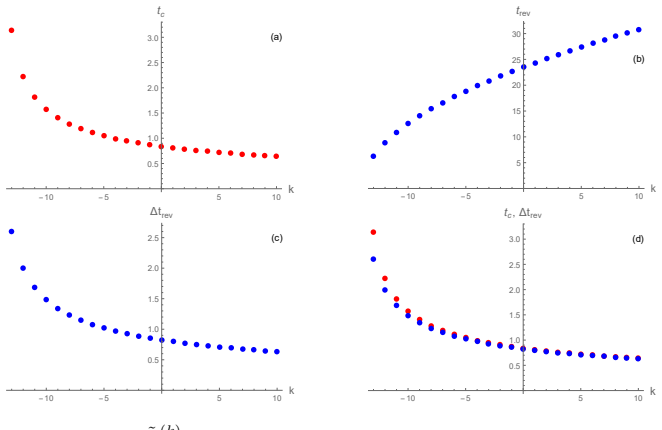
SUSY partners ... spectra which differ in a finite number of energy levels ... intertwining operator L ... H^(k)_JC ... classical time tc = π sqrt(δ² + (n+k+1)λ²), revival time tr
What do these tags mean?
- matches
- The paper's claim is directly supported by a theorem in the formal canon.
- supports
- The theorem supports part of the paper's argument, but the paper may add assumptions or extra steps.
- extends
- The paper goes beyond the formal theorem; the theorem is a base layer rather than the whole result.
- uses
- The paper appears to rely on the theorem as machinery.
- contradicts
- The paper's claim conflicts with a theorem or certificate in the canon.
- unclear
- Pith found a possible connection, but the passage is too broad, indirect, or ambiguous to say the theorem truly supports the claim.
Reference graph
Works this paper leans on
-
[1]
I. B. Ate¸ s, S ¸. Kuru and J. Negro, SUSY hierarchies of Jaynes-Cummings Hamiltonians with different detuning parameters, Phys. Scr.,100, (2025) 085233
work page 2025
-
[2]
E. T. Jaynes and F. W. Cummings, Comparison of quantum and semiclassical radiation theories with applications to the beam maser, Proc. IEEE,51, (1963) 89-109
work page 1963
- [3]
-
[4]
C. Gerry and P. Knight, Introductory Quantum Optics, Cambridge University Press, Cambridge, (2004)
work page 2004
- [5]
-
[6]
D. Z. Rossatto, C. J. Villas-Boas, M. Sanz and E. Solano, Spectral classification of coupling regimes in the quantum Rabi model, Phys. Rev. A,96, (2017) 013849
work page 2017
-
[7]
P. Forn-Diaz, L. Lamata, E. Rico, J. Kono, E. Solano, Ultrastrong coupling regimes of light-matter interaction, Rev. Mod. Phys.,91, (2019) 025005
work page 2019
-
[8]
J.-F. Huang, J.-Q. Liao, L.-M. Kuang, Ultrastrong Jaynes-Cummings model, Phys. Rev. A,101, (2020) 043835
work page 2020
-
[9]
D. J. Fern´ andez C., Supersymmetric quantum mechanics, AIP Conf. Proc.,3, (2010) 1287
work page 2010
- [10]
-
[11]
V. B. Matveev and M. A. Salle, Darboux Transformations and Solitons, Springer, Berlin, (1991)
work page 1991
-
[12]
Junker, Supersymmetric Methods in Quantum and Statistical Physics, Springer Verlag, Berlin, (1996)
G. Junker, Supersymmetric Methods in Quantum and Statistical Physics, Springer Verlag, Berlin, (1996)
work page 1996
-
[13]
L. Infeld and T. E. Hull, The factorization method, Rev. Mod. Phys.,23, (1951) 21-68
work page 1951
-
[14]
D. D. Kızılırmak, S ¸. Kuru, J. Negro, Dirac-like Hamiltonians associated to Schr¨ odinger factoriza- tions, Eur. Phys. J. Plus,136, (2021) 668
work page 2021
-
[15]
B. F. Samsonov, J. Negro, Darboux transformations of the Jaynes-Cummings Hamiltonian, J. Phys. A: Math. Gen.,37, (2004) 10115-10127
work page 2004
-
[16]
V. Hussin, S ¸. Kuru, J. Negro, Generalized Jaynes-Cummings Hamiltonians by shape-invariant hierarchies and their SUSY partners, J. Phys. A: Math. Gen.,39, (2006) 11301-11311
work page 2006
-
[17]
I. A. Bocanegra-Garay, M. Castillo-Celeita J. Negro, L. M. Nieto and F. J. Gomez-Ruiz, Explor- ing supersymmetry: Interchangeability between Jaynes-Cummings and anti-Jaynes-Cummings models, Phys. Rev.,6, (2024) 043218
work page 2024
- [18]
-
[19]
A. D. Alhaidari, Supersymmetric Jaynes-Cummings model and its exact solutions, J. Phys.: Math. Gen.,39, (2006) 15391
work page 2006
- [20]
-
[21]
B. M. Rodr´ ıguez-Lara, F. Soto-Eguibar, A. Z´ arate, H. M. Moya-Cessa, A classical simulation of nonlinear Jaynes-Cummings and Rabi models in photonic lattices, Opt. Express.,21, (2013) 12888-12898
work page 2013
-
[22]
F. H. Maldonado-Villamizar, C. A. Gonz´ alez-Gutierrez, L. Villanueva-Vergara and B. M. Rodrguez-Lara, Underlying SUSY in a generalized Jaynes-Cummings model, Sci. Rep.,11, (2021) 16467
work page 2021
-
[23]
M. R. Abdel-Allah Mubark, R. M. Farghly, S. H. Mohamed, Supersymmetry as an algebraic approach to the Jaynes-Cumming model with stark shift and Kerr-like medium, AUNJMSR,52, (2023) 177-187. 13
work page 2023
-
[24]
A. N. F. Aleixo and A. B. Balantekin, A two-level atom coupled to a two-dimensional supersym- metric and shape-invariant system: models, J. Phys. A: Math. Theor.,40, (2007) 3915
work page 2007
-
[25]
Casta˜ nos, Supersymmetry in the Jaynes-Cummings model, AIP Conf
O. Casta˜ nos, Supersymmetry in the Jaynes-Cummings model, AIP Conf. Proc.,1540, (2013) 77-83
work page 2013
-
[26]
G. Rempe and H. Walther, N. Klein, Observation of quantum collapse and revival in a one-atom maser, Phys. Rev. Lett.,58, (1987) 353
work page 1987
- [27]
-
[28]
R. W. Robinett, Quantum wave packet revivals, Phys. Rep.,392, (2004) 1-119
work page 2004
-
[29]
B. M. Rodr´ ıguez-Lara and H. Moya-Cessa, A. B. Klimov, Combining Jaynes-Cummings and anti- Jaynes-Cummings dynamics in a trapped-ion system driven by a laser, Phys. Rev. A,71, (2005) 023811
work page 2005
- [30]
-
[31]
M. Kh. Ismail, T. M. El-Shahat, N. Metwally, A. S. F. Obada, Entangling power for anti-Jaynes- Cummings model, Optik,325, (2025) 172244. 14
work page 2025
discussion (0)
Sign in with ORCID, Apple, or X to comment. Anyone can read and Pith papers without signing in.