Recognition: 2 theorem links
· Lean TheoremEnergy Loss of a Heavy Quark in a Collisional Quark-Gluon Plasma
Pith reviewed 2026-05-16 22:45 UTC · model grok-4.3
The pith
Collisions in a quark-gluon plasma raise a heavy quark's energy loss by roughly 8% at high velocities.
A machine-rendered reading of the paper's core claim, the machinery that carries it, and where it could break.
Core claim
Using the hard-thermal-loop resummed gluon propagator together with the Bhatnagar-Gross-Krook collisional kernel, the energy loss of a heavy quark in a collisional quark-gluon plasma is found to be larger than in the collisionless limit. For α_s = 0.3 the increase reaches approximately 8% at large incident velocities, and the quark-gluon scattering contribution dominates the total.
What carries the argument
The Bhatnagar-Gross-Krook collisional kernel combined with the hard-thermal-loop resummed gluon propagator, which regulates infrared divergences for arbitrary momentum transfers in scattering processes.
If this is right
- Including collisions among thermal partons leads to a moderate increase in energy loss that grows with the gauge coupling strength.
- Quark-gluon scatterings provide the larger share of the total energy loss in the complete QCD calculation.
- The resummed propagator ensures gauge independence and eliminates unphysical gluon polarizations in the interaction rate.
- The collision-induced correction is somewhat smaller than in the corresponding QED estimate.
Where Pith is reading between the lines
- This correction suggests that models of heavy-quark propagation in heavy-ion collisions should account for medium collisions to improve predictions of suppression patterns.
- The framework could be extended to study the dependence on the quark mass or finite baryon density effects.
- Comparing the predicted energy loss to lattice QCD simulations of heavy quark diffusion might test the validity of the kinetic kernel approach.
Load-bearing premise
The Bhatnagar-Gross-Krook collisional kernel together with the hard-thermal-loop resummed gluon propagator accurately captures the collision effects and regulates infrared divergences for the relevant momentum transfers in the QGP.
What would settle it
A precise measurement of the nuclear modification factor for heavy quarks at high transverse momentum in heavy-ion collisions that shows no deviation from collisionless predictions would falsify the reported 8% increase.
Figures





read the original abstract
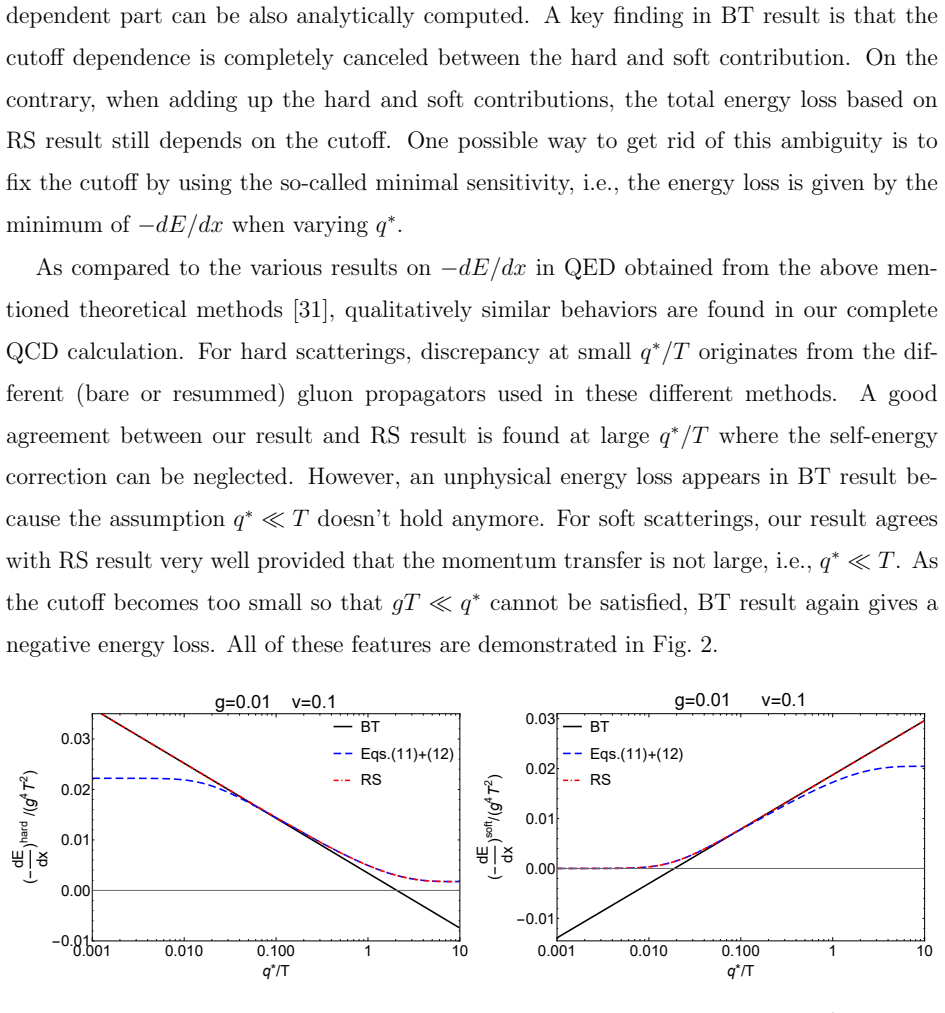
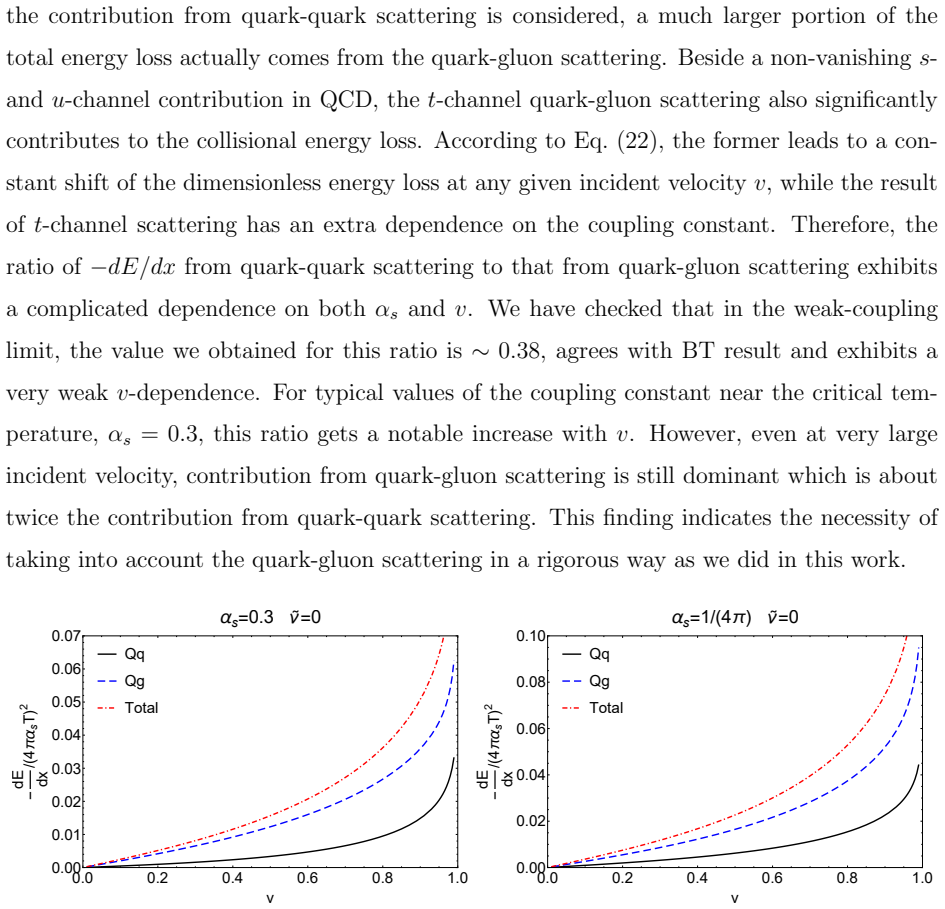
We extend our previous work on the energy loss of a heavy fermion in a QED plasma to the Quark-Gluon plasma, using the same Bhatnagar-Gross-Krook collisional kernel. The calculation is carried out with a theoretical method where the hard-thermal-loop resummed gluon propagator is used for arbitrary momentum transfer in the scattering processes. Encoding the collision effect in a self-consistent manner, the resummed gluon propagator regulates the infrared divergence in the scattering amplitude without introducing an artificial cutoff for the transferred momenta and makes the analysis on the hard and soft processes in a unified framework. To place our computation on a more solid foundation, we also explicitly demonstrate the gauge independence of the interaction rate as well as the elimination of unphysical gluon polarizations by the ghost field under the use of the resummed gluon propagator. In addition, with our complete QCD calculation by including both quark-quark and quark-gluon scatterings, we provide a quantitatively reliable result on the collisional energy loss of a heavy quark where the new contribution from quark-gluon scatterings accounts for a larger portion of the total energy loss. In general, collisions between the thermal partons result in an increased energy loss which becomes more pronounced with increasing gauge coupling. Considering a typical coupling constant in QCD, $\alpha_s = 0.3$, the energy loss increases $\sim 8$% at large incident velocities as compared to the collisionless limit. Such a collision-induced correction is still moderate although it is sightly suppressed as compared to our previous estimate based on a QED calculation using couplings consistent with those expected to be generated in the Quark-Gluon plasma.
Editorial analysis
A structured set of objections, weighed in public.
Referee Report
Summary. The manuscript extends prior QED work on heavy-fermion energy loss to the QCD case for a heavy quark in a collisional quark-gluon plasma. It employs the Bhatnagar-Gross-Krook collisional kernel together with a hard-thermal-loop resummed gluon propagator that is used for arbitrary momentum transfers, thereby regulating infrared divergences in a unified hard/soft framework without artificial cutoffs. The authors state that gauge independence of the interaction rate is demonstrated explicitly, that ghost fields eliminate unphysical gluon polarizations, and that both quark-quark and quark-gluon channels are included. For the representative coupling α_s = 0.3 the collisional energy loss is reported to increase by approximately 8% at large incident velocities relative to the collisionless limit.
Significance. If the central result holds, the work supplies a controlled, gauge-independent estimate of the moderate collisional correction to heavy-quark energy loss in the QGP. This is of direct phenomenological relevance for heavy-flavor observables in heavy-ion collisions. Strengths include the avoidance of ad-hoc cutoffs, the explicit gauge-independence check, the complete QCD channel content, and the modest size of the correction, which is consistent with weak-coupling ordering. The calculation therefore provides a useful benchmark for assessing when collisionless HTL approximations remain adequate.
major comments (2)
- The quantitative claim of an ~8% enhancement (abstract) is the central numerical result, yet the manuscript provides no accompanying error analysis, sensitivity study to the BGK kernel parameters, or explicit integration limits used to extract this figure from the scattering rates. This makes independent verification of the quoted precision difficult.
- The abstract asserts that gauge independence of the interaction rate is shown explicitly and that unphysical polarizations are eliminated by ghosts under the resummed propagator. Because this demonstration is load-bearing for the reliability of the entire approach, the relevant equations or appendix where the cancellation is carried out for the QCD case should be identified and the key steps summarized.
minor comments (1)
- Abstract: 'sightly suppressed' is a typographical error and should read 'slightly suppressed'.
Simulated Author's Rebuttal
We thank the referee for the positive evaluation and constructive comments on our manuscript. We address the major comments point by point below.
read point-by-point responses
-
Referee: The quantitative claim of an ~8% enhancement (abstract) is the central numerical result, yet the manuscript provides no accompanying error analysis, sensitivity study to the BGK kernel parameters, or explicit integration limits used to extract this figure from the scattering rates. This makes independent verification of the quoted precision difficult.
Authors: We agree that additional numerical details would improve verifiability. In the revised manuscript we will add a new paragraph specifying the integration limits over hard and soft momentum transfers, the fixed value of the BGK relaxation-time parameter, a brief sensitivity study under reasonable variations of that parameter, and a numerical uncertainty estimate (arising mainly from discretization and cutoff choices) for the reported ~8% enhancement. revision: yes
-
Referee: The abstract asserts that gauge independence of the interaction rate is shown explicitly and that unphysical polarizations are eliminated by ghosts under the resummed propagator. Because this demonstration is load-bearing for the reliability of the entire approach, the relevant equations or appendix where the cancellation is carried out for the QCD case should be identified and the key steps summarized.
Authors: The explicit demonstration for the QCD case appears in Section III, where the interaction rate is evaluated with the HTL-resummed gluon propagator. The key steps are: (i) insertion of the resummed propagator into the matrix elements for both quark-quark and quark-gluon channels, (ii) contraction with the physical polarization sum supplemented by ghost contributions, and (iii) direct verification that residual gauge-parameter dependence cancels identically. We will revise the abstract to cite Section III explicitly and include a concise summary of these steps in the main text. revision: yes
Circularity Check
Minor self-citation to prior QED work; central QCD calculation independent
full rationale
The derivation extends the authors' earlier QED treatment by applying the same BGK collisional kernel and HTL-resummed gluon propagator to QCD, now including both quark-quark and quark-gluon channels. The ~8% collisional enhancement at α_s=0.3 is obtained directly from the interaction-rate integral with the resummed propagator; no parameter is fitted to the target energy-loss value, and the result is not redefined in terms of itself. Gauge independence and ghost cancellation are shown explicitly in the present calculation. The self-citation supplies only the methodological starting point and does not carry the quantitative QCD claim, which remains self-contained against external benchmarks.
Axiom & Free-Parameter Ledger
free parameters (1)
- α_s =
0.3
axioms (2)
- domain assumption Bhatnagar-Gross-Krook collisional kernel accurately models the effect of collisions in the QGP
- domain assumption Hard-thermal-loop resummed gluon propagator is valid for arbitrary momentum transfer
Lean theorems connected to this paper
-
IndisputableMonolith/Foundation/RealityFromDistinctionreality_from_one_distinction unclear?
unclearRelation between the paper passage and the cited Recognition theorem.
We extend our previous work on the energy loss of a heavy fermion in a QED plasma to the Quark-Gluon plasma, using the same Bhatnagar-Gross-Krook collisional kernel... HTL resummed gluon propagator... gauge independence... quark-quark and quark-gluon scatterings
-
IndisputableMonolith/Cost/FunctionalEquationwashburn_uniqueness_aczel unclear?
unclearRelation between the paper passage and the cited Recognition theorem.
Considering a typical coupling constant in QCD, α_s = 0.3, the energy loss increases ∼8% at large incident velocities as compared to the collisionless limit
What do these tags mean?
- matches
- The paper's claim is directly supported by a theorem in the formal canon.
- supports
- The theorem supports part of the paper's argument, but the paper may add assumptions or extra steps.
- extends
- The paper goes beyond the formal theorem; the theorem is a base layer rather than the whole result.
- uses
- The paper appears to rely on the theorem as machinery.
- contradicts
- The paper's claim conflicts with a theorem or certificate in the canon.
- unclear
- Pith found a possible connection, but the passage is too broad, indirect, or ambiguous to say the theorem truly supports the claim.
Reference graph
Works this paper leans on
-
[1]
J. D. Bjorken, “Energy loss of energetic partons in quark - gluon plasma: Possible extinction of high p(t) jets in hadron - hadron collisions,” (1982)
work page 1982
- [2]
-
[3]
M. H. Thoma and M. Gyulassy, Nucl. Phys. B351, 491 (1991). 26
work page 1991
- [4]
- [5]
-
[6]
Energy Loss of a Heavy Fermion in an Anisotropic QED Plasma
P. Romatschke and M. Strickland, Phys. Rev. D69, 065005 (2004), arXiv:hep-ph/0309093
work page internal anchor Pith review Pith/arXiv arXiv 2004
-
[7]
Collisional Energy Loss of a Heavy Quark in an Anisotropic Quark-Gluon Plasma
P. Romatschke and M. Strickland, Phys. Rev. D71, 125008 (2005), arXiv:hep-ph/0408275
work page internal anchor Pith review Pith/arXiv arXiv 2005
-
[8]
Collisional Energy Loss of a Fast Muon in a Hot QED Plasma
S. Peigne and A. Peshier, Phys. Rev. D77, 014015 (2008), arXiv:0710.1266 [hep-ph]
work page internal anchor Pith review Pith/arXiv arXiv 2008
-
[9]
Collisional energy loss of a fast heavy quark in a quark-gluon plasma
S. Peigne and A. Peshier, Phys. Rev. D77, 114017 (2008), arXiv:0802.4364 [hep-ph]
work page internal anchor Pith review Pith/arXiv arXiv 2008
-
[10]
S. Carignano and C. Manuel, Phys. Rev. D103, 116002 (2021), arXiv:2103.02491 [hep-ph]
- [11]
-
[12]
S. Lin, R. D. Pisarski, and V. V. Skokov, Phys. Lett. B730, 236 (2014), arXiv:1312.3340 [hep-ph]
work page internal anchor Pith review Pith/arXiv arXiv 2014
-
[13]
Y. L. Dokshitzer and D. E. Kharzeev, Phys. Lett. B519, 199 (2001), arXiv:hep-ph/0106202
work page internal anchor Pith review Pith/arXiv arXiv 2001
- [14]
-
[15]
M. G. Mustafa, Phys. Rev. C72, 014905 (2005), arXiv:hep-ph/0412402
work page internal anchor Pith review Pith/arXiv arXiv 2005
-
[16]
Elastic, Inelastic, and Path Length Fluctuations in Jet Tomography
S. Wicks, W. Horowitz, M. Djordjevic, and M. Gyulassy, Nucl. Phys. A784, 426 (2007), arXiv:nucl-th/0512076
work page internal anchor Pith review Pith/arXiv arXiv 2007
-
[17]
Multiple Collisions and Induced Gluon Bremsstrahlung in QCD
M. Gyulassy and X.-n. Wang, Nucl. Phys. B420, 583 (1994), arXiv:nucl-th/9306003
work page internal anchor Pith review Pith/arXiv arXiv 1994
-
[18]
Radiative energy loss of high energy quarks and gluons in a finite volume quark-gluon plasma
R. Baier, Y. L. Dokshitzer, A. H. Mueller, S. Peigne, and D. Schiff, Nucl. Phys. B483, 291 (1997), arXiv:hep-ph/9607355
work page internal anchor Pith review Pith/arXiv arXiv 1997
-
[19]
B. G. Zakharov, JETP Lett.63, 952 (1996), arXiv:hep-ph/9607440
work page internal anchor Pith review Pith/arXiv arXiv 1996
-
[20]
Non-Abelian Energy Loss at Finite Opacity
M. Gyulassy, P. Levai, and I. Vitev, Phys. Rev. Lett.85, 5535 (2000), arXiv:nucl-th/0005032
work page internal anchor Pith review Pith/arXiv arXiv 2000
-
[21]
U. A. Wiedemann, Nucl. Phys. B588, 303 (2000), arXiv:hep-ph/0005129
work page internal anchor Pith review Pith/arXiv arXiv 2000
-
[22]
Multiple Parton Scattering in Nuclei: Parton Energy Loss
X.-N. Wang and X.-f. Guo, Nucl. Phys. A696, 788 (2001), arXiv:hep-ph/0102230
work page internal anchor Pith review Pith/arXiv arXiv 2001
-
[23]
P. B. Arnold, G. D. Moore, and L. G. Yaffe, JHEP12, 009 (2001), arXiv:hep-ph/0111107
work page internal anchor Pith review Pith/arXiv arXiv 2001
-
[24]
P. B. Arnold, G. D. Moore, and L. G. Yaffe, JHEP06, 030 (2002), arXiv:hep-ph/0204343
work page internal anchor Pith review Pith/arXiv arXiv 2002
-
[25]
Heavy Quark Radiative Energy Loss in QCD Matter
M. Djordjevic and M. Gyulassy, Nucl. Phys. A733, 265 (2004), arXiv:nucl-th/0310076
work page internal anchor Pith review Pith/arXiv arXiv 2004
-
[26]
G.-Y. Qin, J. Ruppert, C. Gale, S. Jeon, G. D. Moore, and M. G. Mustafa, Phys. Rev. Lett. 100, 072301 (2008), arXiv:0710.0605 [hep-ph]
work page internal anchor Pith review Pith/arXiv arXiv 2008
-
[27]
The evolving distribution of hard partons traversing a hot strongly interacting plasma
B. Schenke, C. Gale, and G.-Y. Qin, Phys. Rev. C79, 054908 (2009), arXiv:0901.3498 [hep- ph]
work page internal anchor Pith review Pith/arXiv arXiv 2009
-
[28]
MARTINI: An event generator for relativistic heavy-ion collisions
B. Schenke, C. Gale, and S. Jeon, Phys. Rev. C80, 054913 (2009), arXiv:0909.2037 [hep-ph]. 27
work page internal anchor Pith review Pith/arXiv arXiv 2009
- [29]
-
[30]
Collisional Energy Loss in a Finite Size QCD Matter
M. Djordjevic, Phys. Rev. C74, 064907 (2006), arXiv:nucl-th/0603066
work page internal anchor Pith review Pith/arXiv arXiv 2006
- [31]
- [32]
- [33]
-
[34]
M. Yousuf Jamal and V. Chandra, Eur. Phys. J. C79, 761 (2019), arXiv:1907.12033 [nucl-th]
- [35]
-
[36]
A model of the effect of collisions on QCD plasma instabilities
B. Schenke, M. Strickland, C. Greiner, and M. H. Thoma, Phys. Rev. D73, 125004 (2006), arXiv:hep-ph/0603029
work page internal anchor Pith review Pith/arXiv arXiv 2006
-
[37]
M. E. Carrington, T. Fugleberg, D. Pickering, and M. H. Thoma, Can. J. Phys.82, 671 (2004), arXiv:hep-ph/0312103
work page internal anchor Pith review Pith/arXiv arXiv 2004
- [38]
-
[39]
How Wide is the Transition to Deconfinement?
A. Dumitru, Y. Guo, Y. Hidaka, C. P. K. Altes, and R. D. Pisarski, Phys. Rev. D83, 034022 (2011), arXiv:1011.3820 [hep-ph]
work page internal anchor Pith review Pith/arXiv arXiv 2011
-
[40]
Effective matrix model for deconfinement in pure gauge theories
A. Dumitru, Y. Guo, Y. Hidaka, C. P. K. Altes, and R. D. Pisarski, Phys. Rev. D86, 105017 (2012), arXiv:1205.0137 [hep-ph]
work page internal anchor Pith review Pith/arXiv arXiv 2012
-
[41]
Matrix Models for Deconfinement and Their Perturbative Corrections
Y. Guo, JHEP11, 111 (2014), arXiv:1409.6539 [hep-ph]
work page internal anchor Pith review Pith/arXiv arXiv 2014
- [42]
-
[43]
Suppression of the Shear Viscosity in a "semi" Quark Gluon Plasma
Y. Hidaka and R. D. Pisarski, Phys. Rev. D78, 071501 (2008), arXiv:0803.0453 [hep-ph]. 28
work page internal anchor Pith review Pith/arXiv arXiv 2008
discussion (0)
Sign in with ORCID, Apple, or X to comment. Anyone can read and Pith papers without signing in.