On the coverage of electroweak-inos within the pMSSM with SModelS -- a comparison with the ATLAS pMSSM study
Pith reviewed 2026-05-22 11:34 UTC · model grok-4.3
The pith
SModelS v3.0 reproduces ATLAS constraints on pMSSM electroweak-inos to good accuracy
A machine-rendered reading of the paper's core claim, the machinery that carries it, and where it could break.
Core claim
SModelS v3.0 reproduces the ATLAS constraints on the pMSSM electroweak-ino sector to a good degree. Including CMS results and statistical combinations further restricts the allowed parameter space, although certain regions with light electroweak-inos remain valid.
What carries the argument
SModelS v3.0, which decomposes full pMSSM predictions into simplified model topologies and applies them to public SLHA files and search constraints
If this is right
- The ATLAS pMSSM scan results can be independently verified and extended using public tools and data releases.
- Statistical combinations of ATLAS and CMS searches produce stronger overall limits on electroweak-inos.
- Certain light electroweak-ino scenarios in the pMSSM remain consistent with all current LHC searches.
- A broad, multifaceted search strategy is required to close loopholes across the full supersymmetry parameter space.
Where Pith is reading between the lines
- Public SLHA releases enable community-driven cross-checks and combinations beyond what individual experiments publish.
- The surviving light electroweak-ino regions point to specific targets for improved sensitivity in future LHC data taking.
- Decomposition-based tools like SModelS could be applied in similar fashion to other complex beyond-Standard-Model models with many signatures.
Load-bearing premise
The publicly released SLHA files and individual search constraints from ATLAS accurately and completely represent the full scan and analysis performed by the collaboration.
What would settle it
Re-running the ATLAS analyses on the public SLHA files with SModelS and obtaining exclusion fractions or surviving point counts that differ substantially from the ATLAS reported results would falsify the reproduction claim.
Figures






read the original abstract
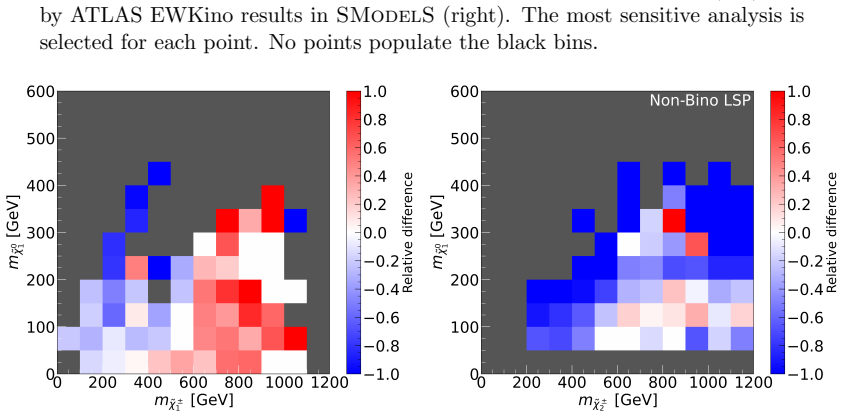
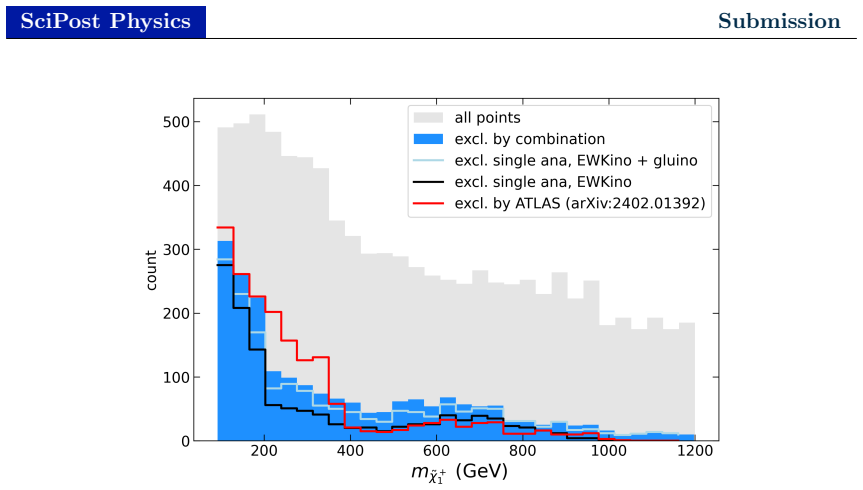
The ATLAS collaboration has recently performed a vast scan of the phenomenological Minimal Supersymmetric Standard Model (pMSSM) with a focus on the electroweak-ino sector, and analysed how their Run 2 searches for electroweak production of supersymmetric (SUSY) particles constrain this dataset. All the SLHA files from the scan as well as the constraints from the eight individual searches considered by ATLAS were made publicly available. We use this material to study how well the ATLAS constraints can be reproduced with SModelS v3.0. Moreover, we explore how the picture changes when also including CMS results, and what can be gained by the statistical combination of analyses. Finally, we discuss the part of parameter space with light electroweak-inos that remains valid despite the stringent LHC limits. Our results underscore the need of a broad, multifaceted approach for maximising sensitivity and closing loopholes in the extensive SUSY parameter space.
Editorial analysis
A structured set of objections, weighed in public.
Referee Report
Summary. The manuscript compares the coverage of electroweak-inos in the pMSSM using SModelS v3.0 against the recent ATLAS pMSSM scan results. It utilizes publicly available SLHA files and the constraints from eight individual ATLAS searches to assess reproduction of exclusions. The study also examines the additional constraints from CMS results and statistical combinations, while identifying surviving parameter space regions with light electroweak-inos.
Significance. This work is significant for validating the use of SModelS in interpreting complex SUSY models against LHC data. By leveraging public data releases, it promotes transparency and allows for independent checks. The findings that SModelS reproduces ATLAS constraints well, and that combinations further restrict the space, support the utility of such tools in SUSY phenomenology. Highlighting remaining valid regions emphasizes the challenges in fully covering the pMSSM parameter space with current searches. The reliance on public SLHA files and released constraints is a clear strength for reproducibility.
major comments (2)
- [Section 3 (Comparison with ATLAS)] The central comparison applies the eight publicly released individual search constraints to the SLHA files. However, the ATLAS pMSSM study likely incorporated joint likelihoods or correlated efficiencies across searches for its overall exclusions. A dedicated discussion (e.g., in the results or methods section) of how well SModelS can reconstruct the combined exclusion surface, or explicit acknowledgment that public data may omit such correlations, is needed to support the claim of reproduction 'to a good degree'.
- [Results section] Table or figure presenting the overlap between SModelS and ATLAS exclusion statuses: quantitative metrics such as the fraction of matching points or discrepancy rates should be reported to make the 'good degree' assessment precise rather than qualitative.
minor comments (2)
- [Abstract] The abstract states that 'some light electroweak-ino regions remain valid' but could briefly note the approximate mass range or number of surviving points for immediate context.
- [Figure captions] Ensure figure captions explicitly label axes and color scales when showing combined ATLAS+CMS constraints versus individual ones.
Simulated Author's Rebuttal
We thank the referee for the careful review, the positive assessment of the work's significance, and the recommendation for minor revision. The comments usefully highlight the need for greater transparency regarding the use of individual constraints and for more quantitative presentation of the agreement. We address both points below and have revised the manuscript accordingly.
read point-by-point responses
-
Referee: [Section 3 (Comparison with ATLAS)] The central comparison applies the eight publicly released individual search constraints to the SLHA files. However, the ATLAS pMSSM study likely incorporated joint likelihoods or correlated efficiencies across searches for its overall exclusions. A dedicated discussion (e.g., in the results or methods section) of how well SModelS can reconstruct the combined exclusion surface, or explicit acknowledgment that public data may omit such correlations, is needed to support the claim of reproduction 'to a good degree'.
Authors: We agree that the ATLAS pMSSM study most likely combined information across searches using joint likelihoods or correlated efficiencies to define the overall exclusion. Because only the individual search constraints were released publicly, SModelS v3.0 can only be applied to those separate results. We have added a dedicated paragraph in Section 3 that explicitly acknowledges this limitation of the public data release and notes that correlations are therefore not accounted for in our reproduction. The paragraph also clarifies that, while this prevents an exact reconstruction of the ATLAS combined exclusion surface, the individual constraints already reproduce the main features of the ATLAS exclusions to a good degree, as shown by the high level of agreement on excluded points. revision: yes
-
Referee: [Results section] Table or figure presenting the overlap between SModelS and ATLAS exclusion statuses: quantitative metrics such as the fraction of matching points or discrepancy rates should be reported to make the 'good degree' assessment precise rather than qualitative.
Authors: We thank the referee for this constructive suggestion. To make the assessment of agreement more precise, we have added a new table (Table 2) in the Results section. The table reports the total number of pMSSM points, the number and fraction of points where SModelS and ATLAS agree on the exclusion status (both excluded or both allowed), and the discrepancy rates (points excluded by SModelS but allowed by ATLAS, and vice versa). These quantitative metrics replace the previous qualitative statement and confirm that the reproduction is indeed to a good degree, with agreement on more than 90% of the points. revision: yes
Circularity Check
No significant circularity; comparison uses external public ATLAS/CMS data
full rationale
The paper applies SModelS v3.0 to publicly released ATLAS SLHA files and the eight individual search constraints, then compares outcomes to ATLAS results while adding CMS data and combinations. No load-bearing step reduces by construction to a self-fitted parameter, self-defined quantity, or self-citation chain; the reproduction claim is tested directly against independent external releases rather than internal normalizations or ansatze. This is the standard case of an honest external-benchmark comparison with no circular reduction.
Axiom & Free-Parameter Ledger
axioms (1)
- domain assumption The released SLHA files and per-search constraints faithfully represent the ATLAS pMSSM scan and analysis.
Lean theorems connected to this paper
-
IndisputableMonolith/Cost/FunctionalEquation.leanwashburn_uniqueness_aczel unclear?
unclearRelation between the paper passage and the cited Recognition theorem.
We use this material to study how well the ATLAS constraints can be reproduced with SModelS v3.0... statistical combination of analyses
-
IndisputableMonolith/Foundation/DimensionForcing.leanalexander_duality_circle_linking unclear?
unclearRelation between the paper passage and the cited Recognition theorem.
The exclusion obtained at single-analysis level... Pathfinderalgorithm... best combination
What do these tags mean?
- matches
- The paper's claim is directly supported by a theorem in the formal canon.
- supports
- The theorem supports part of the paper's argument, but the paper may add assumptions or extra steps.
- extends
- The paper goes beyond the formal theorem; the theorem is a base layer rather than the whole result.
- uses
- The paper appears to rely on the theorem as machinery.
- contradicts
- The paper's claim conflicts with a theorem or certificate in the canon.
- unclear
- Pith found a possible connection, but the passage is too broad, indirect, or ambiguous to say the theorem truly supports the claim.
Forward citations
Cited by 1 Pith paper
-
Symbolic Classification-Enabled LHC Limits Online BSM Global Fits
Symbolic regression produces an approximate classifier for LHC exclusion limits that enables their direct inclusion during pMSSM global fits.
Reference graph
Works this paper leans on
-
[1]
S. Kraml, S. Kulkarni, U. Laa, A. Lessa, W. Magerl, D. Proschofsky-Spindler and W. Waltenberger,SModelS: a tool for interpreting simplified-model results from the LHC and its application to supersymmetry, Eur. Phys. J. C74, 2868 (2014), doi:10.1140/epjc/s10052-014-2868-5, arXiv:1312.4175
work page internal anchor Pith review Pith/arXiv arXiv doi:10.1140/epjc/s10052-014-2868-5 2014
-
[2]
M. M. Altakach, S. Kraml, A. Lessa, S. Narasimha, T. Pascal, T. Reymermier and W. Waltenberger,Global LHC constraints on electroweak-inos with SModelS v2.3, Sci- Post Phys.16(4), 101 (2024), doi:10.21468/SciPostPhys.16.4.101, arXiv:2312.16635
-
[3]
G. Aadet al.,ATLAS Run 2 searches for electroweak production of su- persymmetric particles interpreted within the pMSSM, JHEP05, 106 (2024), doi:10.1007/JHEP05(2024)106, arXiv:2402.01392
-
[4]
A. Djouadiet al.,The Minimal supersymmetric standard model: Group summary report, InGDR (Groupement De Recherche) - Supersymetrie(1998), arXiv:hep- ph/9901246. [5]https://atlas.web.cern.ch/Atlas/GROUPS/PHYSICS/PAPERS/SUSY-2020-15/ inputs/ATLAS_EW_pMSSM_Run2.html
-
[5]
On the coverage of the pMSSM by simplified model results
F. Ambrogi, S. Kraml, S. Kulkarni, U. Laa, A. Lessa and W. Waltenberger,On the coverage of the pMSSM by simplified model results, Eur. Phys. J. C78(3), 215 (2018), doi:10.1140/epjc/s10052-018-5660-0, arXiv:1707.09036
work page internal anchor Pith review Pith/arXiv arXiv doi:10.1140/epjc/s10052-018-5660-0 2018
-
[6]
S. Baum, M. Carena, T. Ou, D. Rocha, N. R. Shah and C. E. M. Wagner,Lighting up the LHC with Dark Matter, JHEP11, 037 (2023), doi:10.1007/JHEP11(2023)037, arXiv:2303.01523
-
[7]
P. Z. Skands, B. Allanach, H. Baer, C. Balazs, G. Belangeret al.,SUSY Les Houches accord: Interfacing SUSY spectrum calculators, decay packages, and event gener- ators, JHEP0407, 036 (2004), doi:10.1088/1126-6708/2004/07/036, arXiv:hep- ph/0311123
-
[8]
M. Ibe, S. Matsumoto and R. Sato,Mass Splitting between Charged and Neutral Winos at Two-Loop Level, Phys. Lett. B721, 252 (2013), doi:10.1016/j.physletb.2013.03.015, arXiv:1212.5989
work page internal anchor Pith review Pith/arXiv arXiv doi:10.1016/j.physletb.2013.03.015 2013
-
[9]
M. Ibe, Y. Nakayama and S. Shirai,Precise estimate of charged Higgsino/Wino decay rate, JHEP03, 012 (2024), doi:10.1007/JHEP03(2024)012, arXiv:2312.08087
-
[10]
W. Porod,SPheno, a program for calculating supersymmetric spectra, SUSY particle decays and SUSY particle production at e+ e- colliders, Comput. Phys. Commun. 153, 275 (2003), doi:10.1016/S0010-4655(03)00222-4, arXiv:hep-ph/0301101
work page internal anchor Pith review Pith/arXiv arXiv doi:10.1016/s0010-4655(03)00222-4 2003
-
[11]
G. Aadet al.,Combination of searches for invisible decays of the Higgs boson using 139 fb −1 of proton-proton collision data at √s= 13TeV collected with the ATLAS experiment, Phys. Lett. B842, 137963 (2023), doi:10.1016/j.physletb.2023.137963, arXiv:2301.10731
-
[12]
G. Aadet al.,Combined measurements of Higgs boson production and decay using up to80fb −1 of proton-proton collision data at √s= 13TeV collected with the ATLAS experiment, Phys. Rev. D101(1), 012002 (2020), doi:10.1103/PhysRevD.101.012002, arXiv:1909.02845. 26 SciPost Physics Submission
-
[13]
B. Fuks, M. Klasen, D. R. Lamprea and M. Rothering,Gaugino production in proton-proton collisions at a center-of-mass energy of 8 TeV, JHEP10, 081 (2012), doi:10.1007/JHEP10(2012)081, arXiv:1207.2159
work page internal anchor Pith review Pith/arXiv arXiv doi:10.1007/jhep10(2012)081 2012
-
[14]
B. Fuks, M. Klasen, D. R. Lamprea and M. Rothering,Precision predictions for electroweak superpartner production at hadron colliders with Resummino, Eur. Phys. J. C73, 2480 (2013), doi:10.1140/epjc/s10052-013-2480-0, arXiv:1304.0790
work page internal anchor Pith review Pith/arXiv arXiv doi:10.1140/epjc/s10052-013-2480-0 2013
-
[15]
G. Aadet al.,Search for charginos and neutralinos in final states with two boosted hadronically decaying bosons and missing transverse momentum inppcollisions at√s= 13TeV with the ATLAS detector, Phys. Rev. D104(11), 112010 (2021), doi:10.1103/PhysRevD.104.112010, arXiv:2108.07586
-
[18]
G. Aadet al.,Searches for new phenomena in events with two leptons, jets, and missing transverse momentum in 139 fb −1 of √s= 13TeVppcollisions with the ATLAS detector, Eur. Phys. J. C83(6), 515 (2023), doi:10.1140/epjc/s10052-023- 11434-w, arXiv:2204.13072
-
[19]
G. Aadet al.,Search for chargino-neutralino pair production in final states with three leptons and missing transverse momentum in √s= 13TeVppcollisions with the ATLAS detector, Eur. Phys. J. C81(12), 1118 (2021), doi:10.1140/epjc/s10052-021- 09749-7, arXiv:2106.01676
-
[20]
G. Aadet al.,Search for supersymmetry in events with four or more charged leptons in 139 fb −1 of √s= 13TeV pp collisions with the ATLAS detector, JHEP07, 167 (2021), doi:10.1007/JHEP07(2021)167, arXiv:2103.11684
-
[22]
G. Aadet al.,Searches for electroweak production of supersymmetric particles with compressed mass spectra in√s= 13TeVppcollisions with the ATLAS detector, Phys. Rev. D101(5), 052005 (2020), doi:10.1103/PhysRevD.101.052005, arXiv:1911.12606
-
[23]
G. Aadet al.,Search for long-lived charginos based on a disappearing-track signature using 136 fb −1 ofppcollisions at √s= 13TeV with the ATLAS detector, Eur. Phys. J. C82(7), 606 (2022), doi:10.1140/epjc/s10052-022-10489-5, arXiv:2201.02472
-
[25]
A. Tumasyanet al.,Search for electroweak production of charginos and neutrali- nos at √s= 13TeV in final states containing hadronic decays of WW, WZ, or WH and missing transverse momentum, Phys. Lett. B842, 137460 (2023), doi:10.1016/j.physletb.2022.137460, arXiv:2205.09597
-
[26]
M. M. Altakach, S. Kraml, A. Lessa, S. Narasimha, T. Pascal and W. Waltenberger, SModelS v2.3: Enabling global likelihood analyses, SciPost Phys.15(5), 185 (2023), doi:10.21468/SciPostPhys.15.5.185, arXiv:2306.17676
-
[27]
LHC SUSY Cross Section Working Group,https://twiki.cern.ch/twiki/bin/ view/LHCPhysics/SUSYCrossSections
-
[28]
B. Fuks, M. Klasen and M. Rothering,Soft gluon resummation for associated gluino- gaugino production at the LHC, JHEP07, 053 (2016), doi:10.1007/JHEP07(2016)053, arXiv:1604.01023
work page internal anchor Pith review Pith/arXiv arXiv doi:10.1007/jhep07(2016)053 2016
-
[29]
A. M. Sirunyanet al.,Search for top squark production in fully-hadronic final states in proton-proton collisions at √s= 13TeV, Phys. Rev. D104(5), 052001 (2021), doi:10.1103/PhysRevD.104.052001, arXiv:2103.01290
-
[30]
M. Aaboudet al.,Search for long-lived charginos based on a disappearing-track sig- nature in pp collisions at √s= 13TeV with the ATLAS detector, JHEP06, 022 (2018), doi:10.1007/JHEP06(2018)022, arXiv:1712.02118
work page internal anchor Pith review Pith/arXiv arXiv doi:10.1007/jhep06(2018)022 2018
-
[32]
A. M. Sirunyanet al.,Search for disappearing tracks in proton-proton collisions at√s= 13TeV, Phys. Lett. B806, 135502 (2020), doi:10.1016/j.physletb.2020.135502, arXiv:2004.05153
-
[33]
G. Aadet al.,Search for electroweak production of charginos and sleptons decaying into final states with two leptons and missing transverse momentum in √s= 13 TeVppcollisions using the ATLAS detector, Eur. Phys. J.C80(2), 123 (2020), doi:10.1140/epjc/s10052-019-7594-6, arXiv:1908.08215
-
[34]
G. Aadet al.,Search for direct production of electroweakinos in final states with one lepton, missing transverse momentum and a Higgs boson decaying into twob-jets in ppcollisions at √s= 13TeV with the ATLAS detector, Eur. Phys. J.C80(8), 691 (2020), doi:10.1140/epjc/s10052-020-8050-3, arXiv:1909.09226
-
[35]
A. M. Sirunyanet al.,Search for electroweak production of charginos and neutralinos in multilepton final states in proton-proton collisions at √s=13 TeV, JHEP03, 166 (2018), doi:10.1007/JHEP03(2018)166, arXiv:1709.05406
work page internal anchor Pith review Pith/arXiv arXiv doi:10.1007/jhep03(2018)166 2018
-
[36]
A. Tumasyanet al.,Search for supersymmetry in final states with two or three soft leptons and missing transverse momentum in proton-proton collisions at √s= 13 TeV, JHEP04, 091 (2022), doi:10.1007/JHEP04(2022)091, arXiv:2111.06296
-
[37]
G. Aadet al.,Search for direct production of charginos, neutralinos and slep- tons in final states with two leptons and missing transverse momentum inpp collisions at √s=8 TeV with the ATLAS detector, JHEP05, 071 (2014), doi:10.1007/JHEP05(2014)071, arXiv:1403.5294. 28 SciPost Physics Submission
work page internal anchor Pith review Pith/arXiv arXiv doi:10.1007/jhep05(2014)071 2014
-
[38]
G. Aadet al.,Search for direct production of charginos and neutralinos in events with three leptons and missing transverse momentum in √s=8 TeVppcollisions with the ATLAS detector, JHEP04, 169 (2014), doi:10.1007/JHEP04(2014)169, arXiv:1402.7029
work page internal anchor Pith review Pith/arXiv arXiv doi:10.1007/jhep04(2014)169 2014
-
[39]
M. Aaboudet al.,Search for squarks and gluinos in final states with jets and missing transverse momentum using 36 fb−1 of √s= 13TeV pp collision data with the ATLAS detector, Phys. Rev.D97(11), 112001 (2018), doi:10.1103/PhysRevD.97.112001, arXiv:1712.02332
work page internal anchor Pith review Pith/arXiv arXiv doi:10.1103/physrevd.97.112001 2018
-
[40]
A. M. Sirunyanet al.,Search for new physics in events with two soft oppositely charged leptons and missing transverse momentum in proton-proton collisions at√s=13 TeV, Phys. Lett. B782, 440 (2018), doi:10.1016/j.physletb.2018.05.062, arXiv:1801.01846
work page internal anchor Pith review Pith/arXiv arXiv doi:10.1016/j.physletb.2018.05.062 2018
-
[41]
M. Aaboudet al.,Search for heavy charged long-lived particles in the ATLAS detector in 36.1 fb −1 of proton-proton collision data at √s= 13TeV, Phys. Rev.D99(9), 092007 (2019), doi:10.1103/PhysRevD.99.092007, arXiv:1902.01636
work page internal anchor Pith review Pith/arXiv arXiv doi:10.1103/physrevd.99.092007 2019
-
[42]
M. Aaboudet al.,Search for electroweak production of supersymmetric particles in final states with two or three leptons at √s= 13TeV with the ATLAS detector, Eur. Phys. J.C78(12), 995 (2018), doi:10.1140/epjc/s10052-018-6423-7, arXiv:1803.02762
work page internal anchor Pith review Pith/arXiv arXiv doi:10.1140/epjc/s10052-018-6423-7 2018
-
[43]
A. M. Sirunyanet al.,Search for supersymmetry in final states with two oppositely charged same-flavor leptons and missing transverse momentum in proton-proton col- lisions at √s=13 TeV, JHEP04, 123 (2021), doi:10.1007/JHEP04(2021)123, arXiv:2012.08600
-
[44]
G. Aadet al.,Search for squarks and gluinos with the ATLAS detector in final states with jets and missing transverse momentum using √s= 8TeV proton–proton colli- sion data, JHEP09, 176 (2014), doi:10.1007/JHEP09(2014)176, arXiv:1405.7875
work page internal anchor Pith review Pith/arXiv arXiv doi:10.1007/jhep09(2014)176 2014
-
[45]
S. Chatrchyanet al.,Search for new physics in the multijet and missing transverse momentum final state in proton-proton collisions at √s= 8 TeV, JHEP06, 055 (2014), doi:10.1007/JHEP06(2014)055, arXiv:1402.4770
work page internal anchor Pith review Pith/arXiv arXiv doi:10.1007/jhep06(2014)055 2014
-
[46]
G. Aadet al.,Search for chargino-neutralino production with mass split- tings near the electroweak scale in three-lepton final states in √s=13 TeVpp collisions with the ATLAS detector, Phys. Rev.D101(7), 072001 (2020), doi:10.1103/PhysRevD.101.072001, arXiv:1912.08479
-
[47]
A. M. Sirunyanet al.,Search for supersymmetry in multijet events with missing transverse momentum in proton-proton collisions at 13 TeV, Phys. Rev.D96(3), 032003 (2017), doi:10.1103/PhysRevD.96.032003, arXiv:1704.07781
work page internal anchor Pith review Pith/arXiv arXiv doi:10.1103/physrevd.96.032003 2017
-
[48]
M. Aaboudet al.,Search for squarks and gluinos in final states with jets and missing transverse momentum at √s=13 TeV with the ATLAS detector, Eur. Phys. J. C76(7), 392 (2016), doi:10.1140/epjc/s10052-016-4184-8, arXiv:1605.03814
work page internal anchor Pith review Pith/arXiv arXiv doi:10.1140/epjc/s10052-016-4184-8 2016
-
[49]
G. Aadet al.,Search for direct production of electroweakinos in final states with missing transverse momentum and a Higgs boson decaying into photons in pp collisions at √s= 13 TeV with the ATLAS detector, JHEP10, 005 (2020), doi:10.1007/JHEP10(2020)005, arXiv:2004.10894. 29 SciPost Physics Submission
-
[50]
A. M. Sirunyanet al.,Search for new phenomena with theM T2 variable in the all- hadronic final state produced in proton–proton collisions at √s= 13TeV, Eur. Phys. J.C77(10), 710 (2017), doi:10.1140/epjc/s10052-017-5267-x, arXiv:1705.04650
work page internal anchor Pith review Pith/arXiv arXiv doi:10.1140/epjc/s10052-017-5267-x 2017
-
[51]
A. M. Sirunyanet al.,Search for supersymmetry in proton-proton collisions at 13 TeV in final states with jets and missing transverse momentum, JHEP10, 244 (2019), doi:10.1007/JHEP10(2019)244, arXiv:1908.04722
-
[52]
J. Y. Araz, A. Buckley, B. Fuks, H. Reyes-Gonzalez, W. Waltenberger, S. L. Williamson and J. Yellen,Strength in numbers: Optimal and scalable com- bination of LHC new-physics searches, SciPost Phys.14(4), 077 (2023), doi:10.21468/SciPostPhys.14.4.077, arXiv:2209.00025
-
[53]
A. Tumasyanet al.,Search for electroweak production of charginos and neu- tralinos in proton-proton collisions at √s= 13 TeV, JHEP04, 147 (2022), doi:10.1007/JHEP04(2022)147, arXiv:2106.14246
-
[54]
J. Mamuzic, talk at the pMSSM taskforce meeting of the LHC REI WG on 4 Dec 2025,https://indico.cern.ch/event/1616848/
- [55]
-
[56]
D. Agin, B. Fuks, M. D. Goodsell and T. Murphy,Monojets reveal overlap- ping excesses for light compressed higgsinos, Phys. Lett. B853, 138597 (2024), doi:10.1016/j.physletb.2024.138597, arXiv:2311.17149
-
[57]
M. Chakraborti, S. Heinemeyer and I. Saha,Consistent excesses in the search for ˜χ0 2 ˜χ± 1 : wino/bino vs. Higgsino dark matter, Eur. Phys. J. C84(8), 812 (2024), doi:10.1140/epjc/s10052-024-13180-z, arXiv:2403.14759
-
[58]
D. Agin, B. Fuks, M. D. Goodsell and T. Murphy,Seeking a coherent explana- tion of LHC excesses for compressed spectra, Eur. Phys. J. C84(11), 1218 (2024), doi:10.1140/epjc/s10052-024-13594-9, arXiv:2404.12423
-
[59]
S. P. Martin,Implications of purity constraints on light Higgsinos, Phys. Rev. D 109(9), 095045 (2024), doi:10.1103/PhysRevD.109.095045, arXiv:2403.19598
-
[60]
G. Aadet al.,Search for new phenomena in events with an energetic jet and miss- ing transverse momentum inppcollisions at √s=13 TeV with the ATLAS de- tector, Phys. Rev. D103(11), 112006 (2021), doi:10.1103/PhysRevD.103.112006, arXiv:2102.10874
-
[61]
A. Tumasyanet al.,Search for new particles in events with energetic jets and large missing transverse momentum in proton-proton collisions at √s= 13 TeV, JHEP 11, 153 (2021), doi:10.1007/JHEP11(2021)153, arXiv:2107.13021
-
[62]
L. Constantin, S. Kraml, A. Lessa, T. Reymermier and W. Waltenberger,Resources for “On the coverage of electroweak-inos within the pMSSM with SModelS - a com- parison with the ATLAS pMSSM study” [Data set], doi:10.5281/zenodo.17949023 (2025)
-
[63]
ATLAS Collaboration,Search for charginos and neutralinos in final states with two boosted hadronically decaying bosons and missing transverse momentum inppcolli- sions at √s= 13TeV with the ATLAS detector (Version 1, 2021-09-06), HEPData (collection),https://doi.org/10.17182/hepdata.104458.v1(2021). 30 SciPost Physics Submission
-
[64]
ATLAS Collaboration,“FullLikelihood forHEPData.tar” of “Search for charginos and neutralinos in final states with two boosted hadronically decaying bosons and miss- ing transverse momentum inppcollisions at √s= 13TeV with the ATLAS detector” (Version 3, updated 2023-11-13), HEPData (other),https://doi.org/10.17182/ hepdata.104458.v3/r9(2023)
work page 2023
-
[65]
L. Heinrich, M. Feickert, G. Stark and K. Cranmer,pyhf: pure-Python implemen- tation of HistFactory statistical models, J. Open Source Softw.6(58), 2823 (2021), doi:10.21105/joss.02823
-
[66]
L. Heinrich, M. Feickert and G. Stark,pyhf: v0.6.3, doi:10.5281/zenodo.1169739, Https://github.com/scikit-hep/pyhf/releases/tag/v0.6.3
- [67]
-
[68]
The Simplified Likelihood Framework
A. Buckley, M. Citron, S. Fichet, S. Kraml, W. Waltenberger and N. War- dle,The Simplified Likelihood Framework, JHEP04, 064 (2019), doi:10.1007/JHEP04(2019)064, arXiv:1809.05548
work page internal anchor Pith review Pith/arXiv arXiv doi:10.1007/jhep04(2019)064 2019
-
[69]
M. Aaboudet al.,Search for photonic signatures of gauge-mediated supersymmetry in 13 TeVppcollisions with the ATLAS detector, Phys. Rev.D97(9), 092006 (2018), doi:10.1103/PhysRevD.97.092006, arXiv:1802.03158
work page internal anchor Pith review Pith/arXiv arXiv doi:10.1103/physrevd.97.092006 2018
-
[70]
M. Aaboudet al.,Search for chargino-neutralino production using recursive jigsaw reconstruction in final states with two or three charged leptons in proton-proton colli- sions at √s= 13TeV with the ATLAS detector, Phys. Rev.D98(9), 092012 (2018), doi:10.1103/PhysRevD.98.092012, arXiv:1806.02293
work page internal anchor Pith review Pith/arXiv arXiv doi:10.1103/physrevd.98.092012 2018
-
[71]
G. Aadet al.,Search for squarks and gluinos in final states with one isolated lep- ton, jets, and missing transverse momentum at √s= 13with the ATLAS de- tector, Eur. Phys. J. C81(7), 600 (2021), doi:10.1140/epjc/s10052-021-09344-w, arXiv:2101.01629
-
[72]
G. Aadet al.,Search for squarks and gluinos in final states with jets and missing trans- verse momentum using 139 fb −1 of √s=13 TeVppcollision data with the ATLAS detector, JHEP02, 143 (2021), doi:10.1007/JHEP02(2021)143, arXiv:2010.14293
-
[73]
G. Aadet al.,Search for heavy, long-lived, charged particles with large ionisation energy loss inppcollisions at √s= 13TeV using the ATLAS experiment and the full Run 2 dataset, JHEP2306, 158 (2023), doi:10.1007/JHEP06(2023)158, arXiv:2205.06013
-
[74]
G. Aadet al.,Search for direct pair production of sleptons and charginos de- caying to two leptons and neutralinos with mass splittings near the W-boson mass in √s= 13 TeV pp collisions with the ATLAS detector, JHEP06, 031 (2023), doi:10.1007/JHEP06(2023)031, arXiv:2209.13935
-
[75]
V. Khachatryanet al.,Search for supersymmetry in the all-hadronic final state using top quark tagging in pp collisions at √s= 13TeV, Phys. Rev.D96(1), 012004 (2017), doi:10.1103/PhysRevD.96.012004, arXiv:1701.01954
work page internal anchor Pith review Pith/arXiv arXiv doi:10.1103/physrevd.96.012004 2017
-
[76]
A. M. Sirunyanet al.,Search for supersymmetry in proton-proton collisions at 13 TeV using identified top quarks, Phys. Rev. D97(1), 012007 (2018), doi:10.1103/PhysRevD.97.012007, arXiv:1710.11188. 31 SciPost Physics Submission
work page internal anchor Pith review Pith/arXiv arXiv doi:10.1103/physrevd.97.012007 2018
-
[77]
A. M. Sirunyanet al.,Search for supersymmetry in events with a photon, jets,b -jets, and missing transverse momentum in proton–proton collisions at 13 TeV, Eur. Phys. J.C79(5), 444 (2019), doi:10.1140/epjc/s10052-019-6926-x, arXiv:1901.06726
work page internal anchor Pith review Pith/arXiv arXiv doi:10.1140/epjc/s10052-019-6926-x 2019
-
[78]
A. M. Sirunyanet al.,Search for physics beyond the standard model in events with jets and two same-sign or at least three charged leptons in proton-proton collisions at√s=13 TeV, Eur. Phys. J. C80(8), 752 (2020), doi:10.1140/epjc/s10052-020-8168- 3, arXiv:2001.10086
-
[79]
A. Tumasyanet al.,Search for higgsinos decaying to two Higgs bosons and missing transverse momentum in proton-proton collisions at √s= 13 TeV, JHEP05, 014 (2022), doi:10.1007/JHEP05(2022)014, arXiv:2201.04206
-
[80]
G. Aadet al.,Search for new phenomena in final states with large jet multiplic- ities and missing transverse momentum at √s=8 TeV proton-proton collisions us- ing the ATLAS experiment, JHEP10, 130 (2013), doi:10.1007/JHEP10(2013)130, 10.1007/JHEP01(2014)109, [Erratum: JHEP01,109(2014)], arXiv:1308.1841
work page internal anchor Pith review Pith/arXiv arXiv doi:10.1007/jhep10(2013)130 2013
-
[81]
G. Aadet al.,Search for supersymmetry at √s=8 TeV in final states with jets and two same-sign leptons or three leptons with the ATLAS detector, JHEP06, 035 (2014), doi:10.1007/JHEP06(2014)035, arXiv:1404.2500
work page internal anchor Pith review Pith/arXiv arXiv doi:10.1007/jhep06(2014)035 2014
-
[82]
G. Aadet al.,Search for strong production of supersymmetric particles in fi- nal states with missing transverse momentum and at least threeb-jets at √s= 8 TeV proton-proton collisions with the ATLAS detector, JHEP10, 024 (2014), doi:10.1007/JHEP10(2014)024, arXiv:1407.0600
work page internal anchor Pith review Pith/arXiv arXiv doi:10.1007/jhep10(2014)024 2014
-
[83]
V. Khachatryanet al.,Constraints on the pMSSM, AMSB model and on other models from the search for long-lived charged particles in proton-proton collisions at sqrt(s) = 8 TeV, Eur. Phys. J.C75(7), 325 (2015), doi:10.1140/epjc/s10052-015-3533-3, arXiv:1502.02522
work page internal anchor Pith review Pith/arXiv arXiv doi:10.1140/epjc/s10052-015-3533-3 2015
-
[84]
CMS Collaboration,Search for supersymmetry in pp collisions at sqrt(s) = 8 TeV in events with two opposite sign leptons, large number of jets, b-tagged jets, and large missing transverse energy., Tech. Rep. CMS-PAS-SUS-13-016, CERN, Geneva (2013)
work page 2013
-
[85]
S. Chatrchyanet al.,Search for Gluino Mediated Bottom- and Top-Squark Production in Multijet Final States inppCollisions at 8 TeV, Phys. Lett.B725, 243 (2013), doi:10.1016/j.physletb.2013.06.058, arXiv:1305.2390
work page internal anchor Pith review Pith/arXiv arXiv doi:10.1016/j.physletb.2013.06.058 2013
discussion (0)
Sign in with ORCID, Apple, or X to comment. Anyone can read and Pith papers without signing in.