REVIEW 3 major objections 5 minor 1 cited by
Model-Based Reinforcement Learning in Discrete-Action Non-Markovian Reward Decision Processes
T0 review · 3 major / 5 minor · reviewed 2026-08-03 · deepseek-v4-flash
Pith's one-line read By separating environment dynamics from the reward automaton, QR-MAX is the first model-based RL algorithm for non-Markovian rewards with a PAC sample bound that drops a |Q| factor.
desk verdict The discrete QR-MAX result is real and worth refereeing; the continuous Bucket-QR-MAX guarantee rests on an unproved SimHash assumption and should be softened or fixed. read the letter →
The pith
A machine-rendered reading of the paper's core claim, the machinery that carries it, and where it could break.
The reading
What carries the argument
The load-bearing identity is the factored transition kernel P(s′,q′|s,q,a)=P(s′|s,a)P(q′|s′,q), where the first factor is Markovian and the second is a deterministic finite-state automaton (the reward machine) update. QR-MAX maintains four separate accumulators — environment transition counts, environment rewards, automaton transition counts, automaton rewards — and labels a component known only after its own threshold (t_E for the environment, t_Q for the automaton). Value iteration on the optimistic model uses only known components, leaving unknown entries at R_max/(1−γ), which is what makes optimism under uncertainty work while reusing each environment sample across all automaton states.
What would settle it
Run QR-MAX on an NMRDP where the reward automaton state is unobservable and the automaton is not known a priori, so the agent cannot maintain q internally; if the algorithm still achieves ε-optimality without ever recovering q, the paper's assumption would be violated. Alternatively, fix |S| and |A|, vary |Q| from 2 to a large value, and measure the number of interactions to reach an ε-optimal policy; a superlinear (or multiplicative |Q|) growth would contradict the stated O(|S||A|+|S||Q|) bound.
Extended reading notes
Core claim
The paper establishes that an NMRDP's transition model factorizes as P(s′|s,a)P(q′|s′,q): the environment's next state depends only on the current environment state and action, while the automaton's next state depends only on the automaton state and the observed next environment state. QR-MAX exploits this by keeping separate visit counters and thresholds for environment pairs (s,a) and automaton pairs (q,s′), so each learned environment transition is reused across every automaton state. With thresholds m_E and m_Q chosen as functions of the desired accuracy ε and confidence δ, the paper proves the greedy policy in the optimistic factored model is ε-optimal after at most N(ε,δ)=2/(1−γ)ε (|S|
Load-bearing premise
For the discrete guarantee, the load-bearing premise is that the agent observes or maintains the current automaton state q at every step (as stated in Section 4); if q is hidden and cannot be reconstructed from history, the factorization collapses and QR-MAX loses its advantage. For the continuous guarantee, the load-bearing premise is Assumption A.5, that every SimHash bucket has diameter at most φ and the MDP is Lipschitz — which SimHash itself does not deterministically en
Editorial extensions
If this is right
- If the central claim holds, model-based RL for non-Markovian tasks no longer needs to explore the joint state space S×Q as if it were opaque; every environment sample contributes to all automaton states.
- The improved bound removes one multiplicative |Q| factor, which yields up to |Q|-fold sample savings when the automaton is comparable in size to the state space, and a smaller constant-factor saving otherwise.
- Since a deterministic automaton is known after t_Q=1 visit, learning the reward machine's dynamics is essentially free in QR-MAX, unlike methods that must estimate transitions on the full product MDP.
- The continuous Bucket-QR-MAX variant means the factorization benefit carries over to real-valued state spaces without manual grid design or neural approximators, provided the SimHash buckets are small enough and the dynamics are Lipschitz.
- The algorithm provides the first PAC-MDP guarantee for model-based RL in discrete-action NMRDPs, giving a formal sample-complexity baseline that future structure-aware algorithms can be measured against.
Reading between the lines
- The decoupling idea is orthogonal to factored-MDP and existing structure-aware methods, so it could plausibly be combined with posterior sampling or regret-minimization objectives to yield regret bounds with the same |Q| reduction.
- The paper's t_Q=1 observation suggests that when the reward machine is deterministic and known, automaton learning is nearly free; an immediate testable extension is to stochastic reward machines, where the same threshold logic applies with a larger t_Q.
- Because SimHash does not deterministically guarantee bucket diameter, the practical guarantee for Bucket-QR-MAX is probabilistic and depends on the unanalyzed δ_LSH term; a concrete next step is to bound this term via the LSH collision probabilities.
- The one-to-two order-of-magnitude empirical gap over QRM hints that model-free algorithms might also benefit from sharing environment transition statistics across automaton states — a direction the paper leaves implicit.
Signed reviews
Editorial analysis
A structured set of objections, weighed in public.
Referee Report
Summary. The paper proposes QR-MAX, a model-based RL algorithm for discrete-action NMRDPs whose non-Markovian reward is specified by a deterministic finite automaton (reward machine). The key idea is to factorize the transition model into the environment component P(s'|s,a) and the automaton component P(q'|q,s'), learning them with separate counters and optimistic value iteration. The authors claim a PAC-MDP bound of O((|S||A|+|S||Q|)/(ε^3(1−γ)^3)) interactions, removing a factor of |Q| relative to running R-MAX on the product S×Q MDP. The paper also extends the approach to continuous state spaces via SimHash-based bucketization (Bucket-QR-MAX), for which a conditional PAC bound is stated under a bounded-discretization assumption. Experiments on gridworlds with reward machines report large sample-efficiency gains over R-MAX, QRM, UCBVI, PSRL, and OPSRL, with code released.
Significance. If the discrete QR-MAX PAC bound is correct, this is a meaningful structural contribution: it is, to my knowledge, the first model-based algorithm for discounted NMRDPs that explicitly decouples environment and automaton dynamics in the sample-complexity analysis, and the improvement — from |S||Q||A| to |S||A|+|S||Q| — is substantial and well motivated. The experimental comparison is extensive, uses a statistically principled stopping rule, and reports large margins over strong baselines. The continuous Bucket-QR-MAX variant is a useful practical heuristic with an honest conditional statement, but its formal guarantee is currently not established for the actual SimHash algorithm.
major comments (3)
- [§4.2, Appendix §A.3–A.4] The PAC-MDP proof is incomplete in a load-bearing way. Lemma A.3 is justified in one sentence: it invokes optimism, a per-step model error bound β, and planning horizon T, but does not state or prove a simulation lemma showing that the greedy policy in the factorized optimistic model has true value within ε of V*. The proof of Theorem A.4 then asserts that non-ε-optimal steps occur only while visiting unknown pairs, but it never proves that every step taken when the current (s,q,a) is known is ε-optimal; it also mentions a 'last T-step value-iteration sweep' in §4.2, which is computation and not an environment interaction. The counting argument needs to be made precise, e.g., in the style of Strehl et al. (2009), with an explicit known-state decomposition and a proof that the induced known model is ε-optimistic.
- [§4.2, threshold m_E / Lemma A.2] The stated threshold m_E = ⌈8 R_max^2 β^{-2} ln(2|S||A|/δ)⌉ is insufficient for the transition-estimation bound used in Lemma A.2. The appendix's Weissman-based condition is (2|S|) exp(−m_E β^2/(2 R_max^2)) ≤ δ/(2N_E), which forces a term proportional to |S| ln 2 inside the logarithm. As written, the displayed m_E does not satisfy the condition for large |S|, so the theorem's concentration part does not follow. The asymptotic eO claim can be repaired by enlarging m_E with a log|S| factor, but the exact statement in §4.2 is wrong and must be corrected.
- [§5, Appendix Theorem A.6, Remark A.7] The continuous PAC-MDP guarantee for Bucket-QR-MAX is conditional on Assumption A.5, which requires every SimHash bucket to have diameter ≤ φ and the dynamics/rewards to be L-Lipschitz. Remark A.7 explicitly concedes that SimHash does not deterministically guarantee such a diameter and defers the analysis of δ_LSH to future work. The sample bound also depends on |B|, which is data-dependent and can grow with the observation stream. Consequently the theorem does not provide a PAC guarantee for the actual algorithm on the underlying continuous MDP; at best it bounds the induced bucket MDP under an assumption the algorithm neither verifies nor controls. The paper should either give a high-probability bound on the partition diameter and on |B|, or clearly frame Bucket-QR-MAX as a heuristic/conditional extension rather than a PAC-MDP algorithm.
minor comments (5)
- [Theorems/Appendix] Theorem numbering is inconsistent: §4.2 refers to 'Theorem A.1' for the discrete PAC bound, but the appendix labels it Theorem A.3/A.4; §5 refers to 'Theorem A.1' for Bucket-QR-MAX, but the appendix has Theorem A.6. Please renumber for consistency.
- [Appendix §A] The appendix says 'full proofs' but Lemma A.3 and Theorem A.4 are proof sketches. Either expand them to full proofs or label them as sketches; the current phrasing overstates the rigor.
- [§6 / footnote 4] The choice t_E=30 is justified only by a 'rule of thumb' for Gaussian means. This is informal and not tied to the theoretical threshold in §4.2; the discrepancy should be acknowledged, and the sensitivity of the results to t_E should be discussed.
- [Algorithm A.1] When done==True in an environment step, the transition counts for (s',q') are updated before the episode reset. Confirm whether terminal transitions are included in the known-state analysis; if not, clarify the pseudocode.
- [Table 5] The memory entry for QR-MAX is listed as O(|S|^2|A|+|S||Q|), which appears to be missing the automaton-count term |S||Q|^2 or a factor of |Q|. Please make the memory accounting consistent with the algorithm's counters.
Circularity Check
No circularity: QR-MAX's PAC bound is a direct counting argument; the continuous guarantee is conditional, not circular.
full rationale
The discrete QR-MAX derivation is self-contained. Section 4.2 and Appendix A.2/A.3 set thresholds m_E and m_Q from Hoeffding/Weissman concentration inequalities and then count visits to still-unknown (s,a) and (q,s') pairs; the resulting N(ε,δ)=2/((1−γ)ε)(|S||A|m_E+|S||Q|m_Q) is the bookkeeping of the algorithm's own counters, not a fitted value or a renamed input. Lemma A.1's accuracy claim is an independent probabilistic statement over empirical estimates; Lemma A.2 is the standard optimism argument. The self-cited product-MDP reduction (Brafman, De Giacomo, and Patrizi 2018) is only background motivation for the baseline R-MAX on S×Q and is not used to prove QR-MAX's factorization; Equations (1)–(2) are derived from the Markov property and determinism of the automaton. The continuous BUCKET-QR-MAX theorem is explicitly conditional on Assumption A.5 (bounded bucket diameter + Lipschitz MDP), and Remark A.7 concedes that SimHash does not deterministically guarantee the diameter and defers δ_LSH. That is an unverified assumption / verification gap, not a circular derivation: the theorem does not assume its own conclusion, it simply states a conditional guarantee whose antecedent is not established. No equation in the paper reduces to a fitted quantity or to the paper's own prior claims, so there is no significant circularity.
Assumptions & free parameters
free parameters (3)
- t_E =
30
- t_Q =
1
- SimHash granularity (L, d_h) =
not reported
assumptions (4)
- domain assumption The agent observes the current automaton state q (or maintains it exactly from a known DFA).
- domain assumption Rewards are bounded and fit the Hoeffding range [0, R_max].
- ad hoc to paper Assumption A.5: SimHash buckets have diameter at most φ and rewards/transitions are L-Lipschitz.
- standard math Standard PAC-MDP concentration arguments apply to adaptively sampled transitions.
Cite this review
Pith. "Pith review of Model-Based Reinforcement Learning in Discrete-Action Non-Markovian Reward Decision Processes." pith.science (2026). https://pith.science/paper/CWSZBWRV
@misc{pith2026251214617,
  author       = {Pith},
  title        = {Pith review of: Model-Based Reinforcement Learning in Discrete-Action Non-Markovian Reward Decision Processes},
  year         = {2026},
  howpublished = {\url{https://pith.science/paper/CWSZBWRV}},
  note         = {Machine review of arXiv:2512.14617}
}
abstract
Many practical decision-making problems involve tasks whose success depends on the entire system history, rather than on achieving a state with desired properties. Markovian Reinforcement Learning (RL) approaches are not suitable for such tasks, while RL with non-Markovian reward decision processes (NMRDPs) enables agents to tackle temporal-dependency tasks. This approach has long been known to lack formal guarantees on both (near-)optimality and sample efficiency. We contribute to solving both issues with QR-MAX, a novel model-based algorithm for discrete NMRDPs that factorizes Markovian transition learning from non-Markovian reward handling via reward machines. To the best of our knowledge, this is the first model-based RL algorithm for discrete-action NMRDPs that exploits this factorization to obtain PAC convergence to $\varepsilon$-optimal policies with polynomial sample complexity. We then extend QR-MAX to continuous state spaces with Bucket-QR-MAX, a SimHash-based discretiser that preserves the same factorized structure and achieves fast and stable learning without manual gridding or function approximation. We experimentally compare our method with modern state-of-the-art model-based RL approaches on environments of increasing complexity, showing a significant improvement in sample efficiency and increased robustness in finding optimal policies.
Figures


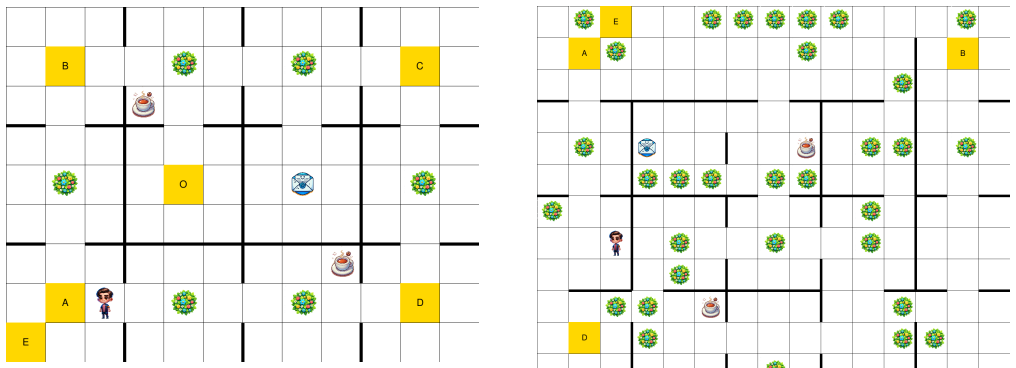
Figures from the paper (15 more)




Forward citations
Cited by 1 Pith paper
-
Theoretical Foundations of $\max$@$k$ Reinforcement Learning
For max@k (best-of-K) finite-horizon MDPs, Markovian policies are suboptimal, a compact (previous-best, current-cumulative) state augmentation restores optimality, exact planning is NP-hard but an FPTAS exists, and th...
Reference graph
Works this paper leans on
-
[1]
simulation-lemma
Discretisation error and abstract MDPLetMbe the true continuous-state MDP and let ¯Mbe theabstract MDP whose states are the bucket–automaton pairs(b, q)∈ B ×Q, with transitions and rewards given by the bucket- averaged quantities. Under Assumption A.5, any two states s, s′ mapped to the same bucketbsatisfy∥s−s ′∥ ≤ϕ. Lip- schitz continuity then implies th...
-
[2]
Estimation error in the bucket MDPWithin the ab- stract MDP ¯Mon(b, q), BUCKET-QRMAX behaves ex- actly as QR-MAX on a discrete MDP with state space S′ =B ×Q. The thresholdsm ET , mER , mQT , mQR are chosen so that, once a triple(b, a, q)is markedknown, the corresponding empirical estimates bPE, bRE, bPQ, bRQ areβ- accurate for ¯Mwith high probability. Mor...
-
[3]
error + V πt ¯M (b, q)−V ∗ ¯M (b, q) | {z } est
Combining the two sources of errorFor any states with bucketb=h(s), we can now decompose the gap be- tween the value of the learned policy inMand the optimal value inMinto three terms: V πt M (s)−V ∗ M (s) ≤ V πt M (s)−V πt ¯M (b, q) | {z } disc. error + V πt ¯M (b, q)−V ∗ ¯M (b, q) | {z } est. error + V ∗ ¯M (b, q)−V ∗ M (s) | {z } disc. error . By step ...
2022
-
[2003]
Journal of Artificial Intelligence Research, 19: 399–468
Efficient Solution Algorithms for Factored MDPs. Journal of Artificial Intelligence Research, 19: 399–468. Gupta, G.; Yin, C.; Deshmukh, J. V .; and Bogdan, P. 2021. Non-Markovian Reinforcement Learning using Fractional Dynamics. InProc. CDC, 1542–1547. Icarte, R. T.; Klassen, T. Q.; Valenzano, R. A.; and McIlraith, S. A. 2022. Reward Machines: Exploiting...
arXiv 2021
-
[2020]
InProc, ICAPS, volume 34, 13659–13662
Restraining bolts for Reinforcement Learning agents. InProc, ICAPS, volume 34, 13659–13662. De Giacomo, G.; and Vardi, M. Y . 2013. Linear Temporal Logic and Linear Dynamic Logic on Finite Traces. InProc, IJCAI, 854–860. Gaon, M.; and Brafman, R. I. 2020. Reinforcement Learning with Non-Markovian Rewards. InProc. AAAI, 3980–3987. Guestrin, C.; Koller, D.;...
2013
-
[2023]
InInternational Conference on Artificial Intelligence and Statistics (AISTATS), 4114–4146
Exploration in Reward Machines with Low Regret. InInternational Conference on Artificial Intelligence and Statistics (AISTATS), 4114–4146. Brafman, R.; De Giacomo, G.; and Patrizi, F. 2018. LTLf/LDLf Non-Markovian Rewards. InProc. AAAI, 1771– 1778. Brafman, R. I.; and Tennenholtz, M. 2003. R-max - a general polynomial time algorithm for near-optimal reinf...
2018
Reviewed August 3, 2026 · model on record in the stance chip above.
Discussion (0). Continue with ORCID to comment.