Comparing cosmic shear nulling methods for Stage-IV surveys
Pith reviewed 2026-05-16 21:20 UTC · model grok-4.3
The pith
Nulling strategies can substantially reduce bias on S8 and dark energy parameters in cosmic shear measurements.
A machine-rendered reading of the paper's core claim, the machinery that carries it, and where it could break.
Core claim
Applying nulling transformations to cosmic shear data vectors, including the BNT transform on the lensing field, LU factorization of the Limber integral, and cross-correlation with large-scale structure tracers, effectively reduces the bias from baryon feedback on cosmological constraints such as S8 and dark energy equation of state parameters, as shown in Fisher matrix forecasts for Stage-IV surveys.
What carries the argument
Nulling transformations applied to the cosmic shear data vector to suppress high-k modes influenced by baryonic physics.
Load-bearing premise
The Fisher forecast model accurately represents the bias reduction from nulling without needing full end-to-end simulations or real data validation, and the assumed baryon feedback model matches reality.
What would settle it
Comparing the bias reductions predicted by the Fisher forecasts to those obtained from applying the nulling methods to simulated mock datasets or real observational data from Stage-III surveys.
Figures




read the original abstract
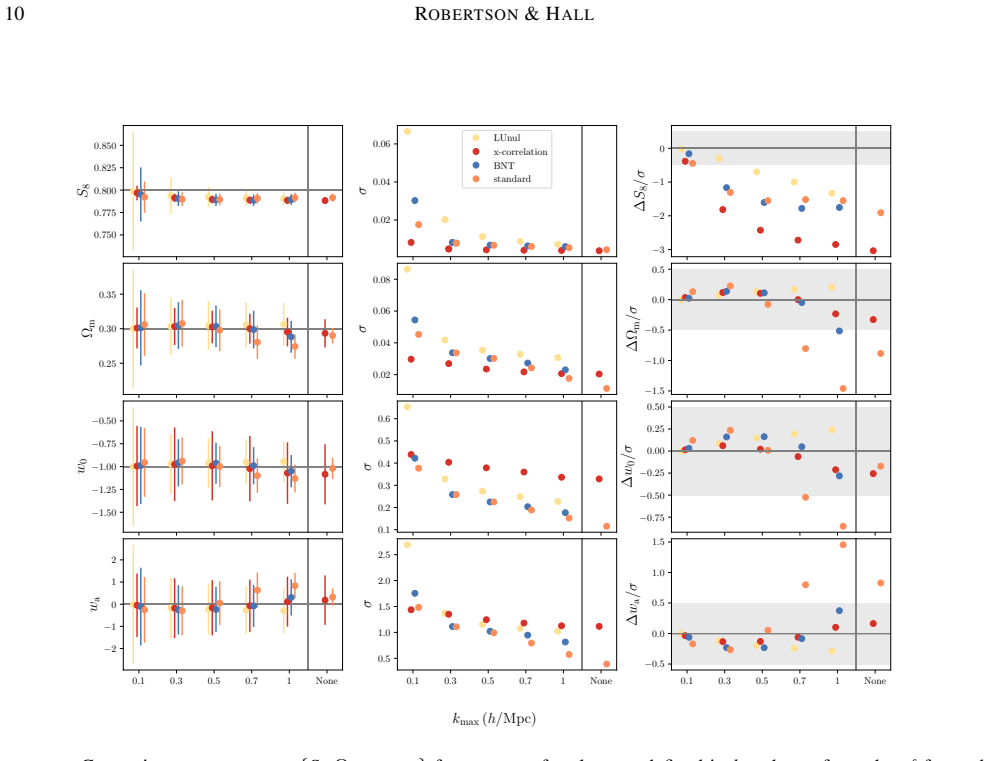
We present an analysis comparing nulling strategies for reducing the impact of baryon feedback on cosmic shear measurements. We consider three different approaches which aim to `null' the high-$k$ modes using transformations applied to the data vector: the Bernardeau-Nishimichi-Taruya (BNT) transform which operates on the lensing field, a new implementation of an LU factorisation of the discretized Limber integral (LUnul) which operates on the lensing two-point statistics, and finally a method which uses a correlated LSS tracers to suppress contributions from lower redshifts (cross-correlation). We compare these methods to un-nulled (or standard) cosmic shear at the data vector level and assess whether these methods are able to reduce the bias on cosmological constraints using a Fisher forecast. We find that the nulling techniques considered can have a large impact on reducing the bias on $S_8$ and Dark Energy parameters. The cross-correlation method is effective at reducing biases in $S_8$, but requires additional information from galaxy clustering. The LUnul method is the most aggressive of the methods and hence reduces biases most efficiently as $k_{\rm max}$ is increased, although this improvement in accuracy comes at the cost of precision. The BNT approach preserves more information than LUnul, and has a more rigorous theoretical grounding. We demonstrate that all three of these methods are effective at mitigating bias, and can be readily applied in forthcoming lensing analyses.
Editorial analysis
A structured set of objections, weighed in public.
Referee Report
Summary. The manuscript compares three nulling techniques—BNT transform on the lensing field, LUnul (LU factorization of the discretized Limber integral) on the two-point statistics, and cross-correlation with LSS tracers—to suppress high-k baryon feedback contributions in cosmic shear data vectors. Using Fisher-matrix forecasts, it evaluates bias reduction on S8 and dark-energy parameters (w0/wa) relative to standard cosmic shear, concluding that all three methods mitigate bias effectively, with LUnul being most aggressive (at precision cost), BNT preserving more information with stronger theoretical grounding, and cross-correlation requiring extra galaxy-clustering data.
Significance. If the reported bias reductions hold, the work supplies a timely, quantitative comparison that can guide analysis choices for Stage-IV surveys (LSST, Euclid, Roman). It explicitly quantifies trade-offs between bias mitigation and information loss, and the BNT method's rigorous grounding is a clear strength. The significance is reduced, however, by the exclusive reliance on Fisher forecasts without mock validation or sensitivity tests to modeling choices.
major comments (2)
- [Fisher forecast setup and results] Fisher-forecast section (methods and results): the central claim that the three nulling transforms produce 'large impact on reducing the bias on S8 and Dark Energy parameters' rests on the assumption that the Fisher matrix accurately captures the post-nulling bias reduction. This assumption is load-bearing because the forecast uses a single baryon-feedback model, Gaussian likelihood, and linear response; it does not propagate the covariance reshaping or non-Gaussianity induced by aggressive nulling (especially LUnul). A concrete mock-based validation would be required to confirm the quoted bias reductions translate to real analyses.
- [Results comparison] Results comparison (likely §4–5): the statement that LUnul 'reduces biases most efficiently as k_max is increased' is not accompanied by a quantitative figure-of-merit loss or explicit error-bar inflation relative to BNT; without these numbers the claimed precision–accuracy trade-off remains qualitative and cannot be directly used by Stage-IV analysts.
minor comments (2)
- [Abstract and method description] Abstract and §2: the description of the 'new implementation of an LU factorisation' lacks a brief equation or reference to the exact discretization of the Limber integral; adding one line would clarify how LUnul differs from prior work.
- [Throughout] Notation: the transformed data vectors for the three methods are denoted inconsistently across sections; standardizing the symbol (e.g., d_nulled) would improve readability.
Simulated Author's Rebuttal
We thank the referee for their constructive and detailed comments on our manuscript. We address each major comment below and have made revisions to strengthen the presentation of our Fisher-forecast results.
read point-by-point responses
-
Referee: Fisher-forecast section (methods and results): the central claim that the three nulling transforms produce 'large impact on reducing the bias on S8 and Dark Energy parameters' rests on the assumption that the Fisher matrix accurately captures the post-nulling bias reduction. This assumption is load-bearing because the forecast uses a single baryon-feedback model, Gaussian likelihood, and linear response; it does not propagate the covariance reshaping or non-Gaussianity induced by aggressive nulling (especially LUnul). A concrete mock-based validation would be required to confirm the quoted bias reductions translate to real analyses.
Authors: We agree that Fisher forecasts rely on simplifying assumptions and do not capture non-Gaussian covariance effects or the full impact of nulling on the data-vector covariance. These methods are nevertheless the standard approach for controlled, apples-to-apples comparisons of analysis techniques in Stage-IV forecasts. In the revised manuscript we have added an explicit discussion of these limitations (new paragraph in Section 6), including the choice of a single baryon-feedback model and the Gaussian likelihood assumption, and we note that end-to-end mock validation would be a valuable extension for future work. The relative ordering of the three nulling methods remains robust under the consistent set of assumptions used here. revision: partial
-
Referee: Results comparison (likely §4–5): the statement that LUnul 'reduces biases most efficiently as k_max is increased' is not accompanied by a quantitative figure-of-merit loss or explicit error-bar inflation relative to BNT; without these numbers the claimed precision–accuracy trade-off remains qualitative and cannot be directly used by Stage-IV analysts.
Authors: We thank the referee for this suggestion. In the revised manuscript we now provide quantitative metrics for the precision–accuracy trade-off. Specifically, we report the DETF dark-energy figure of merit and the fractional increase in the 1σ marginalized errors on S8, w0 and wa for LUnul relative to both BNT and standard cosmic shear, evaluated at several k_max values. These results appear in a new table (Table 3) and are discussed in the updated Section 5, allowing direct use by Stage-IV analysts. revision: yes
Circularity Check
No circularity: independent nulling transforms evaluated via standard Fisher forecasts
full rationale
The paper applies three established nulling transformations (BNT on the lensing field, LUnul via LU factorization of the Limber integral, and cross-correlation with LSS tracers) directly to the data vector. Bias reduction on S8 and dark energy parameters is then quantified using standard Fisher matrix forecasts under a fixed baryon feedback model. No step reduces by construction to a fitted parameter, self-definition, or load-bearing self-citation; the forecasts are external statistical evaluations independent of the nulling choices themselves. The derivation chain remains self-contained against the stated assumptions.
Axiom & Free-Parameter Ledger
axioms (2)
- domain assumption Limber approximation holds for the lensing projections used in the two-point statistics
- domain assumption Fisher matrix provides a reliable estimate of parameter biases and covariances
Reference graph
Works this paper leans on
-
[1]
Abbott T. M. C., et al., 2022, Phys. Rev. D, 105, 023520 Akino D., et al., 2022, PASJ, 74, 175 Amara A., Réfrégier A., 2008, MNRAS, 391, 228 Amodeo S., et al., 2021, Phys. Rev. D, 103, 063514 Amon A., et al., 2022, Phys. Rev. D, 105, 023514 Barthelemy A., Codis S., Uhlemann C., Bernardeau F., Gavazzi R., 2020, MNRAS, 492, 3420 Bernardeau F., Nishimichi T....
discussion (0)
Sign in with ORCID, Apple, or X to comment. Anyone can read and Pith papers without signing in.