REVIEW 5 major objections 5 minor 1 cited by
Learning Semantic Atomic Skills for Multi-Task Robotic Manipulation
T0 review · 5 major / 5 minor · reviewed 2026-08-03 · deepseek-v4-flash
Pith's one-line read The paper claims that dividing demonstrations into semantic atomic skills and chaining them via predicted keyposes yields a reusable skill library that outperforms prior multi-task imitation methods.
desk verdict Solid skill-based imitation learning paper with large reported gains, but the source of the conditioning skill label at inference is never specified, leaving the autonomous-chaining claim unproven. read the letter →
The pith
A machine-rendered reading of the paper's core claim, the machinery that carries it, and where it could break.
The reading
What carries the argument
The central object is the Atomic Skill Space—a discrete codebook of skill embeddings learned from variable-length demonstration segments. It is built by (1) keyframe detection from gripper-state changes to segment trajectories, (2) VLM annotation to assign semantic skill labels, (3) a VQ-VAE encoder that maps resampled action segments to discrete tokens, and (4) supervised contrastive losses L_temp and L_skill that organize the codebook by position and by skill label. The decoder's extra keypose query token predicts the skill's terminal action, which serves as both a spatial target and a transition trigger.
What would settle it
Try AtomSkill on a task with continuous skills that lack gripper-state transitions, such as spreading sauce evenly; if the skill library fragments into inconsistent segments and the policy's success rate drops to near the no-skill baseline, the central claim that gripper-state keyframes plus VLM labels yield semantically coherent skills would be falsified. Alternatively, instrument a roll-out to see whether the skill label s conditioning the sampler is actually generated by the policy itself or injected from the evaluation script.
Extended reading notes
Core claim
AtomSkill's central claim is that a skill space aligned to language-semantic labels—not to low-level motion statistics—is what makes multi-task imitation robust. It constructs this space by detecting gripper-state keyframes, using a vision-language model to label each segment with a skill name, and training a vector-quantized encoder with two contrastive losses so that embeddings group by skill identity and by position within skill sequences. The policy decoder is trained to output both the immediate action chunk and the terminal keypose of the current skill; at inference a diffusion sampler proposes skill embeddings, and the policy transitions to the next skill when its actions approach the
Load-bearing premise
The framework assumes that, at inference time, the skill label s needed by the diffusion sampler is available—the paper trains the sampler conditioned on s but never specifies who provides s during a real roll-out, so if a separate planner or hand-written grammar must supply it, the claimed autonomous skill chaining is not established.
Editorial extensions
If this is right
- Multi-task policies can be trained from modest demo counts (100 per task) without hand-designed grammar: VLM labels plus gripper-state keyframes supply the skill supervision.
- Long-horizon execution becomes a chain of discrete skills where transitions are triggered by the predicted terminal keypose reaching the predicted action, removing manual termination heuristics.
- Spatial-localization tasks benefit most from keypose prediction: the paper's ablation shows ATP rising from 0.35 to 0.53 and SR from 22.2% to 52.2% on those tasks.
- The learned skill library is reusable across tasks—the same atomic skills (grasp, place, handover, insert) appear in multiple RLBench and real-world tasks, so a single shared codebook supports many behaviors.
- Because the skill sampler is a diffusion model over the codebook, the policy can generate plausible skill sequences rather than requiring a pre-specified order, as the paper claims.
Reading between the lines
- An extension not tested here: because skill labels come from a VLM and the codebook is shared, the same pipeline could be applied to a growing set of tasks as long as demonstrations have clear contact transitions; the library could be extended without retraining the whole policy.
- The keypose-proximity transition rule is a general idea for action chunking—it could serve as a termination signal in any chunked policy, not just skill-based ones, although the paper does not claim this.
- The paper's stated limitation suggests a boundary: continuous skills without gripper-state events (e.g., spreading sauce) will fragment inconsistently; a natural testable extension would be to augment keyframe detection with force or velocity thresholds, which the authors do not explore.
- If the VLM labels are noisy, the contrastive alignment might propagate label noise into the codebook; a testable mitigation is to verify performance under corrupted skill labels, which the paper does not analyze.
Editorial analysis
A structured set of objections, weighed in public.
Referee Report
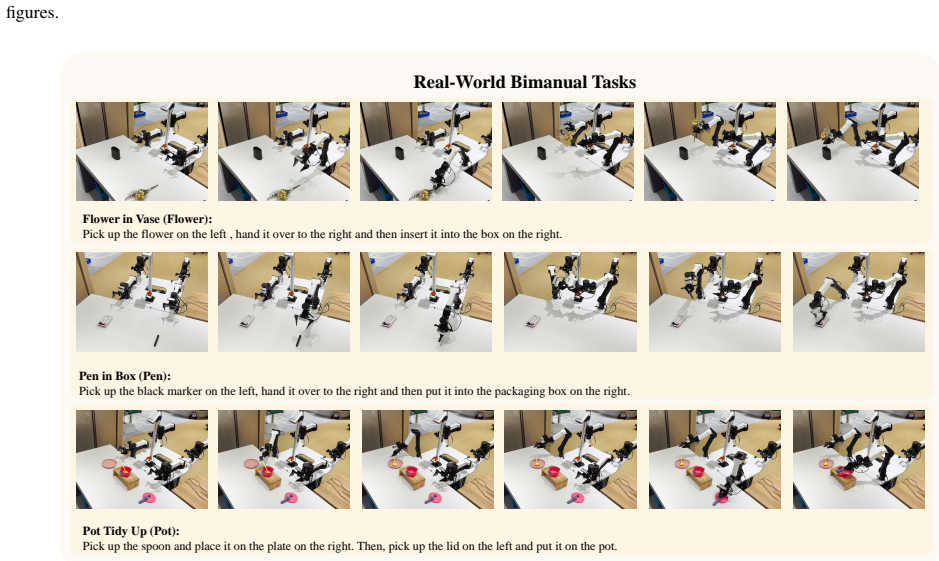
Summary. AtomSkill proposes a multi-task imitation learning framework that decomposes demonstrations into variable-length 'atomic skills' using gripper-state keyframe detection plus VLM annotation, learns a semantically structured skill codebook via VQ-VAE with two contrastive losses (temporal and semantic), and couples a keypose-predicting action decoder with a diffusion-based skill sampler for inference. The paper claims state-of-the-art ATP/SR results on six RLBench tasks (average 0.68 ATP / 67.2% SR) and three real-world bimanual tasks (average 0.60 ATP), with ablations supporting the contrastive losses and keypose prediction. The manuscript is clearly organized and includes supplementary real-world single-arm experiments, task-progress definitions, and a t-SNE skill-library visualization.
Significance. If the central claims hold, the idea of grounding skill abstractions with external VLM labels and chaining them through predicted keyposes could be a useful step toward reusable multi-task manipulation policies. The paper's main strengths are the explicit segmentation into semantically named skills, the use of a contrastive objective to organize the skill space, and the reporting of both simulation and real-world experiments. However, no code or checkpoints are released, and the empirical evidence currently lacks statistical grounding (no seeds/error bars) and is partly measured by a metric tied to the method's own segmentation. The biggest technical gap is that the inference-time source of the conditioning skill label in Eq. (15) is not specified, leaving the claimed autonomous skill-chaining behavior unestablished.
major comments (5)
- [Sec. 3.3, Eq. (15)] The skill sampler is trained as epsilon_theta(z_k, k, o, s), where s is the VLM skill label produced during training-time segmentation (Sec. 3.1). At roll-out, the paper never states where s comes from: no inference-time VLM call, task grammar, or prior over s is described. Consequently the abstract's claims that the sampler 'generates plausible skill sequences' and that keyposes 'autonomously trigger smooth skill chaining' are not established. If s is an oracle label or a hand-designed skill sequence, the contribution reduces to action decoding for a known skill. Please specify the inference-time distribution over s, or reformulate Eq. (15) around the language instruction L only, and verify that chaining works without external skill labels.
- [Sec. 4.1 and Tables 7-8; Sec. B.1] ATP is computed by decomposing each task into keyframe stages, and the paper's own task selection (Sec. B.1) chooses tasks that 'naturally decompose into two to three distinct skills' by gripper-state boundaries. The keyframe stages used for ATP are therefore the same kind of stages used to segment training demonstrations. This creates a self-referential evaluation: a method that aligns with gripper-state keyframe decomposition is rewarded by the metric, while baselines may execute valid but differently granular behavior and receive lower ATP. Report an independent metric (e.g., SR or object-pose error) for real-world tasks, or define ATP without reference to the segmentation keyframes.
- [Tables 1-5, 10] All quantitative results are point estimates with no standard deviations, number of training seeds, or number of evaluation rollouts. Given that Table 1 shows non-uniform gains across tasks (e.g., Umbrella SR is 23.3% vs. ACT* 26.7%), it is impossible to assess whether the claimed average improvements are statistically meaningful. Please report means and variances over multiple seeds and rollouts for the main tables.
- [Sec. 4.2, Table 1] The text states that AtomSkill 'outperforms all baselines on every task,' but Table 1 contradicts this: on Laptop, DP* achieves ATP 0.90 / SR 90.0 vs. Ours 0.77 / 76.7, and ACT* also beats Ours on Laptop ATP (0.78) and on Umbrella SR (26.7 vs. 23.3). Please correct the claim to 'best average performance' and discuss the tasks where the method does not win.
- [Sec. 3.3, Action Chunking with Keypose] The transition rule is: 'the predicted subsequent action is sufficiently close to the predicted keypose in action space.' No threshold, distance metric, or schedule is given anywhere in the paper or supplement. This threshold is also a hand-crafted termination heuristic, despite the claim that the method 'avoids hand-crafted termination heuristics.' Please specify the criterion, its value, and its sensitivity (ideally with an ablation).
minor comments (5)
- [Eqs. (8)-(10)] The denominator in Eq. (8) is written as sum_{a in A(i)} exp(z_i · p / T), but should be sum_{a in A(i)} exp(z_i · z_a / T). The same typo appears to affect Eq. (9).
- [Sec. 3.3] Please add a pseudocode block for the full inference procedure. In particular, it is unclear when the diffusion sampler is queried relative to the action chunks, how the 'sufficiently close' criterion is checked, and what terminates the entire episode.
- [Fig. 2] The figure is dense and the loss formulas are too small to read. A larger version or separate figure for the contrastive losses and inference pipeline would improve clarity.
- [Sec. B.1] The statement that the chosen RLBench tasks are 'ideal for evaluating our skill-based framework' overstates the case. The selection criterion — tasks that naturally decompose via gripper-state changes — is a known limitation and should also appear in the main text's limitations or experimental setup.
- [Appendix D.1] The cross-reference is wrong: the text says 'results reported in Tab. 8' but the single-arm performance results are in Table 10; Table 8 is the task-progress definition.
Circularity Check
No significant circularity: the learned skill labels, keypose supervision, and diffusion conditioning all derive from external VLM annotations and demonstration data, not from the model's own outputs; the main caveats are an unspecified inference-time source for the conditioning skill label s and an ATP metric built on the same gripper-state keyframe cue used for skill segmentation.
full rationale
AtomSkill's derivation chain is not circular at the equation level. Skill labels s come from an external vision-language model in Sec. 3.1, which is independent of the learned embeddings; the contrastive losses in Eqs. (8)-(11) use those labels as supervision rather than as predictions. The VQ codebook and skill encoder/decoder are trained with standard quantization, commitment, and reconstruction losses (Eqs. 7, 13, 14), and the keypose head is supervised by ground-truth terminal actions at gripper-state keyframes (Eq. 16), again external training signal. The skill diffusion sampler in Eq. (15) is trained to denoise skill embeddings conditioned on s and observation o, and no fitted parameter is later renamed as a prediction. The paper is evaluated against external RLBench tasks and real-robot baselines, and no load-bearing claim rests on a self-citation: the only same-author citation ([45]) is a generic reference for diffusion policies. The paper's own Sec. F limitation about gripper-state boundaries is an honest scope restriction, not a circular step. Two caveats are worth flagging but are specification/evaluation issues rather than circularity. First, Eq. (15) conditions on skill label s, but the paper never states how s is obtained at rollout; this leaves the 'plausible skill sequence generation' claim under-supported, since the sampler may effectively be decoding a supplied plan rather than generating one. Second, the ATP metric in Sec. 4.1 decomposes tasks by keyframes and subtasks that share the same gripper-state transition cue used by the method's skill segmentation, so the benchmark is method-aligned in its notion of progress. Neither caveat reduces a predicted quantity to a fitted input by construction, so the appropriate finding is no significant circularity.
Assumptions & free parameters
free parameters (8)
- Codebook size K =
32
- Skill token count n =
8
- Contrastive temperature T =
0.1
- Contrastive loss weight beta_2 =
1e-2
- Commitment loss weight lambda =
0.25
- Action horizon H =
32
- Gripper keyframe threshold =
not reported
- Diffusion denoising steps / schedule =
not reported
assumptions (5)
- domain assumption Gripper state change marks a reliable skill boundary.
- domain assumption VLM annotations provide correct semantic skill labels.
- domain assumption The skill label s is available to the sampler at inference.
- domain assumption VQ bottleneck on fixed-length resampled actions preserves enough spatial detail for localization.
- domain assumption Proximity in action space between predicted action and keypose indicates skill completion.
Cite this review
Pith. "Pith review of Learning Semantic Atomic Skills for Multi-Task Robotic Manipulation." pith.science (2026). https://pith.science/paper/BQNIZHTJ
@misc{pith2026251218368,
  author       = {Pith},
  title        = {Pith review of: Learning Semantic Atomic Skills for Multi-Task Robotic Manipulation},
  year         = {2026},
  howpublished = {\url{https://pith.science/paper/BQNIZHTJ}},
  note         = {Machine review of arXiv:2512.18368}
}
read the original abstract
Scaling imitation learning to diverse multi-task robot manipulation remains challenging due to suboptimal demonstrations, behavioral multi-modality, and destructive interference across tasks. While skill-based methods offer a promising direction by decomposing behaviors into reusable abstractions, existing approaches often learn skills that are either biased toward linguistic structure or lack semantic alignment across tasks, limiting generalization. In this work, we propose AtomSkill, a novel framework that learns a semantically aligned Atomic Skill Space from demonstrations and enables robust long-horizon execution through keypose imagination. Our method introduces: (1) semantic contrastive skill alignment, which partitions demonstrations into variable-length atomic skills and employs a contrastive objective to jointly enforce semantic consistency and temporal coherence, yielding a compact and reusable skill library; and (2) action decoding with keypose imagining, where the policy predicts both a skill's terminal keypose and immediate actions, thereby supporting progress-aware skill transitions. During inference, an atomic skill diffusion sampler generates plausible skill sequences, while predicted keyposes autonomously trigger smooth skill chaining. Extensive experiments in simulation and real-world settings show that AtomSkill consistently outperforms state-of-the-art imitation learning and skill-based baselines. Project page: https://atom-skill.github.io.
Figures


Figures from the paper (6 more)




Forward citations
Cited by 1 Pith paper
-
AC-VLA: Robust Out-of-Distribution Action Execution via Compositional Learning
AC-VLA trains VLA policies on full demonstrations plus decomposed sub-task segments and masks wrist views during place phases, improving LIBERO OOD success by about 28 absolute points over pi0.5.
Reference graph
Works this paper leans on
-
[1]
Gpt-4 technical report.arXiv preprint arXiv:2303.08774,
Josh Achiam, Steven Adler, Sandhini Agarwal, Lama Ah- mad, Ilge Akkaya, Florencia Leoni Aleman, Diogo Almeida, Janko Altenschmidt, Sam Altman, Shyamal Anadkat, et al. Gpt-4 technical report.arXiv preprint arXiv:2303.08774,
-
[2]
Anurag Ajay, Aviral Kumar, Pulkit Agrawal, Sergey Levine, and Ofir Nachum. Opal: Offline primitive discovery for accelerating offline reinforcement learning.arXiv preprint arXiv:2010.13611, 2020. 2
arXiv 2010
-
[3]
Shuai Bai, Keqin Chen, Xuejing Liu, Jialin Wang, Wenbin Ge, Sibo Song, Kai Dang, Peng Wang, Shijie Wang, Jun Tang, et al. Qwen2. 5-vl technical report.arXiv preprint arXiv:2502.13923, 2025. 3
arXiv 2025
-
[4]
Kevin Black, Noah Brown, Danny Driess, Adnan Esmail, Michael Equi, Chelsea Finn, Niccolo Fusai, Lachy Groom, Karol Hausman, Brian Ichter, et al.π 0: A vision-language- action flow model for general robot control.arXiv preprint arXiv:2410.24164, 2024. 2
arXiv 2024
-
[5]
Xi Chen, Ali Ghadirzadeh, Tianhe Yu, Yuan Gao, Jianhao Wang, Wenzhe Li, Bin Liang, Chelsea Finn, and Chongjie Zhang. Latent-variable advantage-weighted policy optimiza- tion for offline rl.arXiv preprint arXiv:2203.08949, 2022. 2
arXiv 2022
-
[6]
Zixuan Chen, Junhui Yin, Yangtao Chen, Jing Huo, Pinzhuo Tian, Jieqi Shi, Yiwen Hou, Yinchuan Li, and Yang Gao. Deco: Task decomposition and skill composition for zero- shot generalization in long-horizon 3d manipulation.arXiv preprint arXiv:2505.00527, 2025. 3
arXiv 2025
-
[7]
Diffusion policy: Visuomotor policy learning via action dif- fusion.The International Journal of Robotics Research, page 02783649241273668, 2023
Cheng Chi, Zhenjia Xu, Siyuan Feng, Eric Cousineau, Yilun Du, Benjamin Burchfiel, Russ Tedrake, and Shuran Song. Diffusion policy: Visuomotor policy learning via action dif- fusion.The International Journal of Robotics Research, page 02783649241273668, 2023. 1, 5, 6, 7, 8, 13, 14
2023
-
[8]
Jinwoo Choi and Seung-Woo Seo. Dynamic contrastive skill learning with state-transition based skill clustering and dy- namic length adjustment.arXiv preprint arXiv:2504.14805,
Show all 54 references
-
[9]
Multi-task policy search for robotics
Marc Peter Deisenroth, Peter Englert, Jan Peters, and Dieter Fox. Multi-task policy search for robotics. In2014 IEEE in- ternational conference on robotics and automation (ICRA), pages 3876–3881. IEEE, 2014. 2
2014
-
[10]
Learning a thousand tasks in a day.Science Robotics, 10(108):eadv7594, 2025
Kamil Dreczkowski, Pietro Vitiello, Vitalis V osylius, and Edward Johns. Learning a thousand tasks in a day.Science Robotics, 10(108):eadv7594, 2025. 2
2025
-
[11]
Taming transformers for high-resolution image synthesis
Patrick Esser, Robin Rombach, and Bjorn Ommer. Taming transformers for high-resolution image synthesis. InPro- ceedings of the IEEE/CVF conference on computer vision and pattern recognition, pages 12873–12883, 2021. 4
2021
-
[12]
Restructuring vector quantization with the rotation trick.arXiv preprint arXiv:2410.06424, 2024
Christopher Fifty, Ronald G Junkins, Dennis Duan, Aniketh Iyengar, Jerry W Liu, Ehsan Amid, Sebastian Thrun, and Christopher R´e. Restructuring vector quantization with the rotation trick.arXiv preprint arXiv:2410.06424, 2024. 2
2024 arXiv
-
[13]
Mobile aloha: Learning bimanual mobile manipulation using low- cost whole-body teleoperation
Zipeng Fu, Tony Z Zhao, and Chelsea Finn. Mobile aloha: Learning bimanual mobile manipulation using low- cost whole-body teleoperation. In8th Annual Conference on Robot Learning, 2024. 6, 12
2024
-
[14]
Lisa: Learning interpretable skill abstractions from language.Advances in Neural Information Processing Systems, 35:21711–21724, 2022
Divyansh Garg, Skanda Vaidyanath, Kuno Kim, Jiaming Song, and Stefano Ermon. Lisa: Learning interpretable skill abstractions from language.Advances in Neural Information Processing Systems, 35:21711–21724, 2022. 1, 2
2022
-
[15]
Baku: An efficient transformer for multi-task policy learning
Siddhant Haldar, Zhuoran Peng, and Lerrel Pinto. Baku: An efficient transformer for multi-task policy learning. Advances in Neural Information Processing Systems, 37: 141208–141239, 2024. 2
2024
-
[16]
Denoising dif- fusion probabilistic models.Advances in neural information processing systems, 33:6840–6851, 2020
Jonathan Ho, Ajay Jain, and Pieter Abbeel. Denoising dif- fusion probabilistic models.Advances in neural information processing systems, 33:6840–6851, 2020. 5
2020
-
[17]
Physical Intelligence, Kevin Black, Noah Brown, James Darpinian, Karan Dhabalia, Danny Driess, Adnan Esmail, Michael Equi, Chelsea Finn, Niccolo Fusai, et al.π 0.5: a vision-language-action model with open-world generaliza- tion.arXiv preprint arXiv:2504.16054, 2025. 2
2025 arXiv
-
[18]
Adaptive mixtures of local experts.Neu- ral computation, 3(1):79–87, 1991
Robert A Jacobs, Michael I Jordan, Steven J Nowlan, and Geoffrey E Hinton. Adaptive mixtures of local experts.Neu- ral computation, 3(1):79–87, 1991. 2
1991
-
[19]
Stephen James, Zicong Ma, David Rovick Arrojo, and An- drew J. Davison. Rlbench: The robot learning benchmark & learning environment.IEEE Robotics and Automation Let- ters, 2020. 6, 12
2020
-
[20]
Rethinking mutual information for language condi- tioned skill discovery on imitation learning
Zhaoxun Ju, Chao Yang, Fuchun Sun, Hongbo Wang, and Yu Qiao. Rethinking mutual information for language condi- tioned skill discovery on imitation learning. InProceedings of the International Conference on Automated Planning and Scheduling, pages 301–309, 2024. 1
2024
-
[21]
3d diffuser actor: Policy diffusion with 3d scene rep- resentations.arXiv preprint arXiv:2402.10885, 2024
Tsung-Wei Ke, Nikolaos Gkanatsios, and Katerina Fragki- adaki. 3d diffuser actor: Policy diffusion with 3d scene rep- resentations.arXiv preprint arXiv:2402.10885, 2024. 2
2024 arXiv
-
[22]
Supervised contrastive learning.Advances in neural information processing systems, 33:18661–18673,
Prannay Khosla, Piotr Teterwak, Chen Wang, Aaron Sarna, Yonglong Tian, Phillip Isola, Aaron Maschinot, Ce Liu, and Dilip Krishnan. Supervised contrastive learning.Advances in neural information processing systems, 33:18661–18673,
-
[23]
Openvla: An open-source vision-language-action model.arXiv preprint arXiv:2406.09246, 2024
Moo Jin Kim, Karl Pertsch, Siddharth Karamcheti, Ted Xiao, Ashwin Balakrishna, Suraj Nair, Rafael Rafailov, Ethan Foster, Grace Lam, Pannag Sanketi, et al. Openvla: An open-source vision-language-action model.arXiv preprint arXiv:2406.09246, 2024. 2
2024 arXiv
-
[24]
Compile: Compositional imita- tion learning and execution
Thomas Kipf, Yujia Li, Hanjun Dai, Vinicius Zambaldi, Alvaro Sanchez-Gonzalez, Edward Grefenstette, Pushmeet Kohli, and Peter Battaglia. Compile: Compositional imita- tion learning and execution. InInternational Conference on Machine Learning, pages 3418–3428. PMLR, 2019. 2
2019
-
[25]
Skill discovery in con- tinuous reinforcement learning domains using skill chain- ing.Advances in neural information processing systems, 22,
George Konidaris and Andrew Barto. Skill discovery in con- tinuous reinforcement learning domains using skill chain- ing.Advances in neural information processing systems, 22,
-
[26]
Be- havior generation with latent actions.arXiv preprint arXiv:2403.03181, 2024
Seungjae Lee, Yibin Wang, Haritheja Etukuru, H Jin Kim, Nur Muhammad Mahi Shafiullah, and Lerrel Pinto. Be- havior generation with latent actions.arXiv preprint arXiv:2403.03181, 2024. 2, 4, 6, 7, 8
2024 arXiv
-
[27]
Star: Learning diverse robot skill ab- stractions through rotation-augmented vector quantization
Hao Li, Qi Lv, Rui Shao, Xiang Deng, Yinchuan Li, Jianye Hao, and Liqiang Nie. Star: Learning diverse robot skill ab- stractions through rotation-augmented vector quantization. arXiv preprint arXiv:2506.03863, 2025. 1, 2, 3, 4
2025 arXiv
-
[28]
Robotic manipulation via imitation learn- ing: Taxonomy, evolution, benchmark, and challenges.arXiv preprint arXiv:2508.17449, 2025
Zezeng Li, Alexandre Chapin, Enda Xiang, Rui Yang, Bruno Machado, Na Lei, Emmanuel Dellandrea, Di Huang, and Liming Chen. Robotic manipulation via imitation learn- ing: Taxonomy, evolution, benchmark, and challenges.arXiv preprint arXiv:2508.17449, 2025. 1
2025 arXiv
-
[29]
Skilldiffuser: Interpretable hi- erarchical planning via skill abstractions in diffusion-based task execution
Zhixuan Liang, Yao Mu, Hengbo Ma, Masayoshi Tomizuka, Mingyu Ding, and Ping Luo. Skilldiffuser: Interpretable hi- erarchical planning via skill abstractions in diffusion-based task execution. InProceedings of the IEEE/CVF Conference on Computer Vision and Pattern Recognition, ...
2024
-
[30]
Flexible multitask learning with factorized dif- fusion policy
Chaoqi Liu. Flexible multitask learning with factorized dif- fusion policy. InSecond Workshop on Out-of-Distribution Generalization in Robotics at RSS 2025, 2025. 2
2025
-
[31]
Rdt-1b: a diffusion foundation model for bimanual manipu- lation.arXiv preprint arXiv:2410.07864, 2024
Songming Liu, Lingxuan Wu, Bangguo Li, Hengkai Tan, Huayu Chen, Zhengyi Wang, Ke Xu, Hang Su, and Jun Zhu. Rdt-1b: a diffusion foundation model for bimanual manipu- lation.arXiv preprint arXiv:2410.07864, 2024. 2, 6, 7, 8, 14
2024 arXiv
-
[32]
Finite scalar quantization: Vq-vae made simple.arXiv preprint arXiv:2309.15505, 2023
Fabian Mentzer, David Minnen, Eirikur Agustsson, and Michael Tschannen. Finite scalar quantization: Vq-vae made simple.arXiv preprint arXiv:2309.15505, 2023. 2, 6
2023 arXiv
-
[33]
Quest: Self-supervised skill abstractions for learning continuous control.Advances in Neural Infor- mation Processing Systems, 37:4062–4089, 2024
Atharva Mete, Haotian Xue, Albert Wilcox, Yongxin Chen, and Animesh Garg. Quest: Self-supervised skill abstractions for learning continuous control.Advances in Neural Infor- mation Processing Systems, 37:4062–4089, 2024. 2, 3, 4, 6, 7, 8, 13, 14
2024
-
[34]
Open x-embodiment: Robotic learning datasets and rt-x models: Open x-embodiment collaboration 0
Abby O’Neill, Abdul Rehman, Abhiram Maddukuri, Ab- hishek Gupta, Abhishek Padalkar, Abraham Lee, Acorn Poo- ley, Agrim Gupta, Ajay Mandlekar, Ajinkya Jain, et al. Open x-embodiment: Robotic learning datasets and rt-x models: Open x-embodiment collaboration 0. In2024 IEEE Inter...
2024
-
[35]
Accelerat- ing reinforcement learning with learned skill priors
Karl Pertsch, Youngwoon Lee, and Joseph Lim. Accelerat- ing reinforcement learning with learned skill priors. InCon- ference on robot learning, pages 188–204. PMLR, 2021. 1, 2
2021
-
[36]
Vision-based multi-task manipu- lation for inexpensive robots using end-to-end learning from demonstration
Rouhollah Rahmatizadeh, Pooya Abolghasemi, Ladislau B¨ol¨oni, and Sergey Levine. Vision-based multi-task manipu- lation for inexpensive robots using end-to-end learning from demonstration. In2018 IEEE international conference on robotics and automation (ICRA), pages 3758–3765. IEEE,
-
[37]
The sparsely-gated mixture-of-experts layer
N Shazeer, A Mirhoseini, K Maziarz, A Davis, Q Le, G Hin- ton, and J Dean. The sparsely-gated mixture-of-experts layer. Outrageously large neural networks, 2, 2017. 2
2017
-
[38]
Perceiver- actor: A multi-task transformer for robotic manipulation
Mohit Shridhar, Lucas Manuelli, and Dieter Fox. Perceiver- actor: A multi-task transformer for robotic manipulation. InConference on Robot Learning, pages 785–799. PMLR,
-
[39]
Be- tween mdps and semi-mdps: A framework for temporal ab- straction in reinforcement learning.Artificial intelligence, 112(1-2):181–211, 1999
Richard S Sutton, Doina Precup, and Satinder Singh. Be- tween mdps and semi-mdps: A framework for temporal ab- straction in reinforcement learning.Artificial intelligence, 112(1-2):181–211, 1999. 1
1999
-
[40]
Octo: An open-source generalist robot policy.arXiv preprint arXiv:2405.12213, 2024
Octo Model Team, Dibya Ghosh, Homer Walke, Karl Pertsch, Kevin Black, Oier Mees, Sudeep Dasari, Joey Hejna, Tobias Kreiman, Charles Xu, et al. Octo: An open-source generalist robot policy.arXiv preprint arXiv:2405.12213, 2024. 2
2024 arXiv
-
[41]
Deep generative models in robotics: A survey on learning from multimodal demonstrations.arXiv preprint arXiv:2408.04380, 2024
Julen Urain, Ajay Mandlekar, Yilun Du, Mahi Shafiullah, Danfei Xu, Katerina Fragkiadaki, Georgia Chalvatzaki, and Jan Peters. Deep generative models in robotics: A survey on learning from multimodal demonstrations.arXiv preprint arXiv:2408.04380, 2024. 1, 5
2024 arXiv
-
[42]
Neural discrete representation learning.Advances in neural information pro- cessing systems, 30, 2017
Aaron Van Den Oord, Oriol Vinyals, et al. Neural discrete representation learning.Advances in neural information pro- cessing systems, 30, 2017. 2
2017
-
[43]
Sparse diffusion policy: A sparse, reusable, and flexible policy for robot learning.arXiv preprint arXiv:2407.01531, 2024
Yixiao Wang, Yifei Zhang, Mingxiao Huo, Ran Tian, Xi- ang Zhang, Yichen Xie, Chenfeng Xu, Pengliang Ji, Wei Zhan, Mingyu Ding, et al. Sparse diffusion policy: A sparse, reusable, and flexible policy for robot learning.arXiv preprint arXiv:2407.01531, 2024. 2
2024 arXiv
-
[44]
Discrete policy: Learning dis- entangled action space for multi-task robotic manipulation
Kun Wu, Yichen Zhu, Jinming Li, Junjie Wen, Ning Liu, Zhiyuan Xu, and Jian Tang. Discrete policy: Learning dis- entangled action space for multi-task robotic manipulation. In2025 IEEE International Conference on Robotics and Au- tomation (ICRA), pages 8811–8818. IEEE, 2025. 2, 3
2025
-
[45]
Afforddp: Gen- eralizable diffusion policy with transferable affordance
Shijie Wu, Yihang Zhu, Yunao Huang, Kaizhen Zhu, Jiayuan Gu, Jingyi Yu, Ye Shi, and Jingya Wang. Afforddp: Gen- eralizable diffusion policy with transferable affordance. In Proceedings of the Computer Vision and Pattern Recognition Conference, pages 6971–6980, 2025. 5
2025
-
[46]
Chaineddiffuser: Uni- fying trajectory diffusion and keypose prediction for robotic manipulation
Zhou Xian, Nikolaos Gkanatsios, Theophile Gervet, Tsung- Wei Ke, and Katerina Fragkiadaki. Chaineddiffuser: Uni- fying trajectory diffusion and keypose prediction for robotic manipulation. In7th Annual Conference on Robot Learning,
-
[47]
Gnfactor: Multi-task real robot learning with generalizable neural feature fields
Yanjie Ze, Ge Yan, Yueh-Hua Wu, Annabella Macaluso, Yuying Ge, Jianglong Ye, Nicklas Hansen, Li Erran Li, and Xiaolong Wang. Gnfactor: Multi-task real robot learning with generalizable neural feature fields. InConference on robot learning, pages 284–301. PMLR, 2023. 2 10
2023
-
[48]
3d diffusion policy: Gen- eralizable visuomotor policy learning via simple 3d repre- sentations.arXiv preprint arXiv:2403.03954, 2024
Yanjie Ze, Gu Zhang, Kangning Zhang, Chenyuan Hu, Muhan Wang, and Huazhe Xu. 3d diffusion policy: Gen- eralizable visuomotor policy learning via simple 3d repre- sentations.arXiv preprint arXiv:2403.03954, 2024. 1
2024 arXiv
-
[49]
Soundstream: An end- to-end neural audio codec.IEEE/ACM Transactions on Au- dio, Speech, and Language Processing, 30:495–507, 2021
Neil Zeghidour, Alejandro Luebs, Ahmed Omran, Jan Skoglund, and Marco Tagliasacchi. Soundstream: An end- to-end neural audio codec.IEEE/ACM Transactions on Au- dio, Speech, and Language Processing, 30:495–507, 2021. 6
2021
-
[50]
Vision-language models for vision tasks: A survey.IEEE transactions on pattern analysis and machine intelligence, 46(8):5625–5644, 2024
Jingyi Zhang, Jiaxing Huang, Sheng Jin, and Shijian Lu. Vision-language models for vision tasks: A survey.IEEE transactions on pattern analysis and machine intelligence, 46(8):5625–5644, 2024. 2
2024
-
[51]
Learning fine-grained bimanual manipulation with low-cost hardware.arXiv preprint arXiv:2304.13705, 2023
Tony Z Zhao, Vikash Kumar, Sergey Levine, and Chelsea Finn. Learning fine-grained bimanual manipulation with low-cost hardware.arXiv preprint arXiv:2304.13705, 2023. 1, 5, 6, 7, 8, 12, 14
2023 arXiv
-
[52]
Imitation learning: Progress, taxonomies and challenges.IEEE Transactions on Neural Networks and Learning Systems, 35(5):6322–6337, 2022
Boyuan Zheng, Sunny Verma, Jianlong Zhou, Ivor W Tsang, and Fang Chen. Imitation learning: Progress, taxonomies and challenges.IEEE Transactions on Neural Networks and Learning Systems, 35(5):6322–6337, 2022. 1
2022
-
[53]
Plas: Latent action space for offline reinforcement learning
Wenxuan Zhou, Sujay Bajracharya, and David Held. Plas: Latent action space for offline reinforcement learning. In Conference on Robot Learning, pages 1719–1735. PMLR,
-
[2021]
Overview This supplementary document provides additional details, results, and visualizations that complement the main paper
2 11 Learning Semantic Atomic Skills for Multi-Task Robotic Manipulation Supplementary Materials A. Overview This supplementary document provides additional details, results, and visualizations that complement the main paper. Specifically, we include: • Detailed descriptions o...
Reviewed August 3, 2026 · model on record in the stance chip above.
Discussion (0). Sign in to comment.