REVIEW 3 major objections 5 minor 55 references
A hybrid global local computational framework for ship hull structural analysis using homogenized model and graph neural network
T0 review · 3 major / 5 minor · reviewed 2026-08-03 · deepseek-v4-flash
Pith's one-line read This paper claims that a coarse equivalent-single-layer hull analysis, combined with a trained heterogeneous graph transformer, can recover detailed panel-level stresses and displacements without running a full 3D finite element model.
desk verdict A genuine ESL+GNN hybrid with an honest error decomposition; the boundary-DOF reconstruction is the load-bearing but least-validated link, and the box-beam evidence is narrower than the abstract implies. read the letter →
The pith
A machine-rendered reading of the paper's core claim, the machinery that carries it, and where it could break.
The reading
What carries the argument
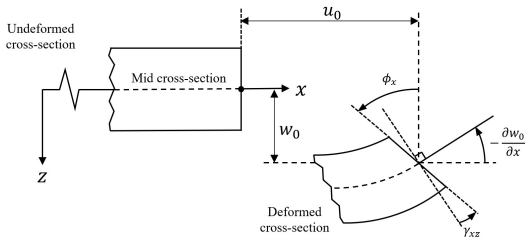
The load-bearing mechanism is the boundary DOF reconstruction rule u_B = u_A + z_B·θ_Ay, which transfers the homogenized plate mid-plane displacement and rotation to the stiffener web and flange edges, together with a heterogeneous graph transformer (HGT), a graph neural network with typed nodes and edges that ingests the reconstructed boundary DOFs, panel dimensions, and pressure loading and outputs spatially resolved stress and displacement fields. The reconstruction provides the missing local kinematics that the homogenized model erases, and the HGT learns the panel-level mechanics from high-fidelity local finite element data, allowing generalization to panels not in the training set.
What would settle it
For a panel with a tall web and thick flange, compare the reconstructed stiffener web displacements from Eq. 22 against the nodal displacements at the same locations in a converged full 3D finite element model of the same bay; the central claim fails if the difference is comparable to the HGT's own prediction error, because then the reconstruction, not the trained surrogate, is the true accuracy limiter.
Extended reading notes
Core claim
The central discovery is a working global-local pipeline in which a coarse homogenized model supplies boundary kinematics that are reconstructed into detailed panel-edge degrees of freedom, and a heterogeneous graph transformer maps those reconstructed boundary DOFs, panel geometry, and loading into full local stress and displacement fields. The paper shows that this trained surrogate reproduces the local 3D finite element reference closely across different panel geometries and loading conditions, and that it reduces panel-wise stress error by at least a factor of three compared with the conventional equivalent-single-layer stress estimation method, while the remaining end-to-end error is do
Load-bearing premise
The stiffener cross-section is assumed to stay essentially perpendicular to its top plate at bulkhead locations, so web and flange displacements are reconstructed from the plate's rotation via Eq. 22; if that kinematic assumption is inaccurate for a given panel, the boundary degrees of freedom fed to the local model and the surrogate are systematically wrong.
Editorial extensions
If this is right
- If the claim holds, optimizing a hull girder requires only cheap global ESL solves plus forward passes through the trained graph network, making repeated design evaluations far more affordable than full 3D finite element analysis.
- The end-to-end error is governed by the ESL model and the boundary reconstruction, so improving those components would directly lower the framework's error without retraining the surrogate.
- The surrogate's ability to predict local stress peaks at stiffener edges with high accuracy means design checks for critical locations no longer need a separate detailed submodeling step.
- Training data can be much smaller than the 6000 samples used here without losing most of the accuracy, lowering the cost of applying the approach to new panel families.
- The same trained surrogate can be reused across many distinct hull girder configurations within the tested geometry and loading ranges, since the graph representation decouples panel shape from network input size.
Reading between the lines
- A natural extension would be to feed the graph network's predicted local stress field back into the global model or boundary reconstruction, potentially correcting the very ESL approximations that currently dominate the total error.
- For real ship hulls with curved panels, bulb stiffeners, or cutouts, the rigid-perpendicular cross-section assumption in the reconstruction would likely need to be replaced by a more general kinematic mapping, and the surrogate retrained on those panel types.
- Since the HGT error is small, further gains are better sought in the homogenization and boundary recovery steps than in larger neural networks or more training data—an editorial inference the paper's error decomposition supports.
- The framework's main commercial payoff would come from embedding it in an optimization loop where thousands of hull girder variants are screened; that is a testable use case the paper motivates but does not itself demonstrate.
Signed reviews
Editorial analysis
A structured set of objections, weighed in public.
Referee Report
Summary. The paper proposes a hybrid global–local framework for ship hull girder analysis. A coarse-mesh equivalent single-layer (ESL) finite element model provides the global displacement field; Section 2.3 reconstructs the detailed boundary degrees of freedom of each stiffened panel, culminating in the kinematic assumption of Eq. (22). These reconstructed DOFs, together with panel geometry and loading, feed a heterogeneous graph transformer (HGT) surrogate trained on local 3D FE solutions of individual panels. The framework is validated on three box-beam case studies. The error decomposition in Table 2 shows that the ESL-plus-reconstruction error dominates the end-to-end error and that the HGT error measured against its local FE training reference is small. Section 4.3.2 further shows that the HGT-based local stress estimates outperform the conventional ESL stress recovery on selected panels.
Significance. If the framework performs as claimed, it would be a practically useful design-cycle tool: after the HGT is trained offline, only a cheap global ESL analysis would be needed to obtain detailed panel-level stress and displacement fields. The paper has real strengths: a clear stage-wise error decomposition, three distinct validation cases, a head-to-head comparison with the conventional ESL stress method, and a dataset-size sensitivity study in Appendix B. However, the central end-to-end claim is currently not fully supported because the boundary-reconstruction assumption in Section 2.3 is unvalidated and because the reported HGT accuracy is measured against the very local FE pipeline used to create its training data. These are load-bearing issues for the claim that the framework 'maintains high local accuracy' from a global ESL solution alone.
major comments (3)
- [Section 2.3, Eq. (22)] The boundary reconstruction assumes the stiffener cross-section remains essentially perpendicular to its top plate at bulkhead locations and sets u_B = u_A + z_B·theta_Ay. This is a strong kinematic assumption for a stiffener-to-bulkhead connection, and the only support cited is 'preliminary studies,' without details or reference. The reconstructed DOFs are used both to generate the local 3D FE training data (Step 3) and as HGT inputs at deployment. If Eq. (22) is inaccurate, the error is baked into the training target itself and cannot be corrected by any surrogate. The ESL error in Table 2 includes this contribution but does not isolate it. Please provide a direct validation of reconstructed boundary DOFs against a detailed global 3D FE model at bulkhead locations, or an explicit sensitivity study of Eq. (22), before the end-to-end local accuracy claim can be accepted.
- [Section 3, data partitioning] The manuscript states that 6000 panel samples per case study are partitioned 80/10/10 and that these samples come from 500, 286, and 200 distinct box-beam geometries for the three case studies. It is not stated whether the split is at the geometry level or the panel level. If panels from the same box-beam geometry appear in both training and test sets, the HGT test error in Table 2 will be optimistically biased because panels from the same geometry share global deformation, loading, and geometry. The claimed generalization across panel geometries requires holding out entire box-beam geometries. Please clarify the split criterion; if the current split is panel-level, re-evaluate with a geometry-level holdout.
- [Sections 4.1 and 4.3.1, Table 2] The 'HGT error' reported in Table 2 is the discrepancy between HGT predictions and the local 3D FE model that was built using the same Section 2.3 reconstructed boundary conditions. Consequently, the statement in Section 4.1 that 'the HGT demonstrates a high level of predictive accuracy' describes agreement with the training pipeline, not physical accuracy. The paper itself notes in Section 4.3.1 that local 3D FEA curves can deviate from the global 3D FEA reference. To support the abstract's claim that the hybrid framework yields accurate local responses from the ESL solution, report HGT accuracy with respect to the global 3D FE model across the full test set, not only for the selected panels in Table 3 and Figs. 10–12.
minor comments (5)
- [Section 3] Steel density is given as 7850 tonnes/m^3; it should be 7850 kg/m^3 (or 7.85 t/m^3).
- [Section 3] The bulkhead description contains a typo: '60 mm thick isotropic platesk' should read 'isotropic plates.'
- [Fig. 12 caption] The caption says 'two example panels in case study 1,' but the corresponding text in Section 4.3.1 refers to case study 3. Correct the caption.
- [Section 2.2.2] The variables q, l, and s in Eqs. (9)–(11) are introduced informally. A sentence defining q as line load per unit width and s as stiffener spacing would improve reproducibility.
- [Section 4.3.1] The phrase 'HGT prediction exceeds 99% accuracy' is not defined as a metric. Use relative error or another explicit definition to avoid ambiguity.
Circularity Check
No circularity: the hybrid framework is validated end-to-end against an external global 3D FE reference; the HGT surrogate is a held-out supervised model, and the boundary-reconstruction assumption is disclosed as the dominant error source rather than fitted and renamed.
full rationale
The derivation chain is: coarse-mesh ESL gives global displacements; Eq. (22) reconstructs panel boundary DOFs under an explicit kinematic assumption; those DOFs drive high-fidelity local 3D FE submodels; the HGT is trained on those submodel responses; and the full framework is finally benchmarked against a complete global 3D FE model (Step 5). The end-to-end comparison is against an external reference that the HGT did not train on and that does not use Eq. (22), so the central claim does not reduce by construction to its inputs. The HGT's 'local accuracy' is indeed measured against its own training reference (local 3D FE), but the paper is explicit about this (Section 4.3.1), and the framework-level tables (Table 2) and panel-level comparison (Table 3) also use the global 3D FE. Eq. (22) is a modeling assumption, not a fitted parameter or a renamed output; the paper openly states that the ESL model plus boundary recovery dominates the error (Section 4.1, Section 5), so the limitation is disclosed rather than masked. Citations [44,45] are self-citations for graph representation and HGT choice, but the representation is fully described in Section 2.4.1 and the surrogate is re-trained and re-validated here; no uniqueness theorem or unverified prior result is invoked to force the conclusion. No circular step found.
Assumptions & free parameters
assumptions (5)
- domain assumption First-order shear deformation theory (FSDT) displacement field (Eq. 1) with von Kármán nonlinear strains (Eqs. 2–3) is adequate for hull girder global response.
- domain assumption The equivalent single layer homogenization with ABD stiffness matrices captures the global response of stiffened panels.
- ad hoc to paper At bulkheads, the stiffener cross-section remains perpendicular to the plate, allowing boundary DOF adjustment via Eq. (22).
- domain assumption The local 3D FE submodel with reconstructed boundary conditions is a valid high-fidelity reference for panel response.
- standard math The HGT architecture can learn the mapping from boundary DOFs, geometry, and loading to stress/displacement fields.
Cite this review
Pith. "Pith review of A hybrid global local computational framework for ship hull structural analysis using homogenized model and graph neural network." pith.science (2026). https://pith.science/paper/TI376C6E
@misc{pith2026251220020,
  author       = {Pith},
  title        = {Pith review of: A hybrid global local computational framework for ship hull structural analysis using homogenized model and graph neural network},
  year         = {2026},
  howpublished = {\url{https://pith.science/paper/TI376C6E}},
  note         = {Machine review of arXiv:2512.20020}
}
read the original abstract
This study presents a computational framework for global local structural analysis of ship hull girders that integrates an equivalent single layer (ESL) model with a graph neural network (GNN). A coarse mesh homogenized ESL model efficiently predicts the global displacement field, from which degrees of freedom (DOFs) along stiffened panel boundaries are extracted. A global to local DOF mapping and reconstruction procedure is developed to recover detailed boundary kinematics for local analysis. The reconstructed DOFs, together with panel geometry and loading, serve as inputs to a heterogeneous graph transformer (HGT), a subtype of GNN, which rapidly and accurately predicts the detailed stress and displacement fields for any panel within the hull girder. The HGT is trained using high fidelity 3D panel finite element model with reconstructed boundary conditions, enabling it to generalize across varying panel geometries, loadings, and boundary behaviors. Once trained, the framework requires only the global ESL solution in order to generate detailed local responses, making it highly suitable for optimization. Validation on three box beam case studies demonstrates that the global prediction error is governed by the coarse mesh ESL solution, while the HGT maintains high local accuracy and clearly outperforms conventional ESL based stress estimation method.
Figures


Figures from the paper (9 more)


Reference graph
Works this paper leans on
-
[1]
R. W. Clough, Original formulation of the finite element method, Finite elements in analysis and design 7 (2) (1990) 89–101
1990
-
[2]
Jelovica, Y
J. Jelovica, Y. Cai, Improved multi-objective structural optimization with adaptive repair-based constraint handling, Engineering Optimization 56 (1) (2024) 118–137
2024
-
[3]
Y.Cai, J.Jelovica, Neuralnetwork-enableddiscoveryofmappingbetweenvariables and constraints for autonomous repair-based constraint handling in multi-objective structural optimization, Knowledge-Based Systems 280 (2023) 111032. 28
2023
-
[4]
Sánchez-Palencia, Non-homogeneous media and vibration theory, Lecture Note in Physics, Springer-Verlag 320 (1980) 57–65
E. Sánchez-Palencia, Non-homogeneous media and vibration theory, Lecture Note in Physics, Springer-Verlag 320 (1980) 57–65
1980
-
[5]
G. W. Milton, The theory of composites, Cambridge University Press, Cambridge, UK, 2002
2002
-
[6]
Yukio, S
U. Yukio, S. M. Rashed, The idealized structural unit method and its application to deep girder structures, Computers & structures 18 (2) (1984) 277–293
1984
-
[7]
C. S. Smith, Influence of local compressive failure on ultimate longitudinal strength of a ship’s, hull., in: Proceedings of the International Symposium on Practical Design in Shipbuilding (PRADS). Tokyo, 17-21 October, 1977, pp. 73–79
1977
-
[8]
IACS, Common structural rules for bulk carriers and oil tankers, International Association of Classification Societies (2014)
C. IACS, Common structural rules for bulk carriers and oil tankers, International Association of Classification Societies (2014)
2014
Show all 55 references
-
[9]
A. K. Noor, W. S. Burton, C. W. Bert, Computational models for sandwich panels and shells, Applied Mechanics Reviews 49 (3) (1996) 155–199
1996
-
[10]
J. N. Reddy, Mechanics of laminated composite plates and shells: theory and analysis, CRC press, 2003
2003
-
[11]
O. F. Hughes, Ship Structural Design: A Rationally-Based, Computer-Aided Opti- mization Approach, The Society of Naval Architects and Marine Engineers, Jersey City, NJ, 2005, previously published by John Wiley & Sons, Inc., 1983
2005
-
[12]
Y. S. Kumar, M. Mukhopadhyay, Finite element analysis of ship structures using a new stiffened plate element, Applied Ocean Research 22 (6) (2000) 361–374
2000
-
[13]
E. Avi, I. Lillemäe, J. Romanoff, A. Niemelä, Equivalent shell element for ship structural design, Ships and Offshore Structures 10 (3) (2015) 239–255
2015
-
[14]
B. R. Goncalves, J. Jelovica, J. Romanoff, A homogenization method for geometric nonlinear analysis of sandwich structures with initial imperfections, International Journal of Solids and Structures 87 (2016) 194–205
2016
-
[15]
Putranto, M
T. Putranto, M. Kõrgesaar, J. Jelovica, K. Tabri, H. Naar, Ultimate strength as- sessment of stiffened panel under uni-axial compression with non-linear equivalent single layer approach, Marine Structures 78 (2021) 103004
2021
-
[16]
Putranto, M
T. Putranto, M. Kõrgesaar, J. Jelovica, Ultimate strength assessment of stiffened panels using equivalent single layer approach under combined in-plane compression and shear, Thin-Walled Structures 180 (2022) 109943. 29
2022
-
[17]
Kõrgesaar, T
M. Kõrgesaar, T. Putranto, J. Jelovica, Equivalent single layer approach for pre- dicting ultimate strength of stiffened panel under different load combinations, in: Advances in the Analysis and Design of Marine Structures, CRC Press, 2023, pp. 347–354
2023
-
[18]
Putranto, M
T. Putranto, M. Kõrgesaar, K. Tabri, Application of equivalent single layer ap- proach for ultimate strength analyses of ship hull girder, Journal of Marine Science and Engineering 10 (10) (2022) 1530
2022
-
[19]
M. K. Thompson, J. M. Thompson, ANSYS mechanical APDL for finite element analysis, Butterworth-Heinemann, 2017
2017
-
[20]
S. Ma, H. Mahfuz, Finite element simulation of composite ship structures with fluid structure interaction, Ocean engineering 52 (2012) 52–59
2012
-
[21]
Samanta, P
A. Samanta, P. Kurinjivelan, Fatigue life assessment of offshore patrol vessel, in: International Conference on Offshore Mechanics and Arctic Engineering, Vol. 43444, 2009, pp. 7–14
2009
-
[22]
V. C. Chen, K.-L. Tsui, R. R. Barton, M. Meckesheimer, A review on design, modeling and applications of computer experiments, IIE transactions 38 (4) (2006) 273–291
2006
-
[23]
H. T. Mai, Q. X. Lieu, J. Kang, J. Lee, A robust unsupervised neural network frameworkforgeometricallynonlinearanalysisofinelastictrussstructures, Applied Mathematical Modelling 107 (2022) 332–352
2022
-
[24]
M. H. Shojaeefard, R. A. Behnagh, M. Akbari, M. K. B. Givi, F. Farhani, Mod- elling and pareto optimization of mechanical properties of friction stir welded aa7075/aa5083 butt joints using neural network and particle swarm algorithm, Materials & Design 44 (2013) 190–198
2013
-
[25]
M. A. B. Kabir, A. S. Hasan, A. M. Billah, Failure mode identification of column base plate connection using data-driven machine learning techniques, Engineering Structures 240 (2021) 112389
2021
-
[26]
Hornik, M
K. Hornik, M. Stinchcombe, H. White, Multilayer feedforward networks are uni- versal approximators, Neural networks 2 (5) (1989) 359–366
1989
-
[27]
Papadrakakis, N
M. Papadrakakis, N. D. Lagaros, Y. Tsompanakis, Structural optimization using evolution strategies and neural networks, Computer methods in applied mechanics and engineering 156 (1-4) (1998) 309–333. 30
1998
-
[28]
Bisagni, L
C. Bisagni, L. Lanzi, Post-buckling optimisation of composite stiffened panels using neural networks, Composite Structures 58 (2) (2002) 237–247
2002
-
[29]
Z. Sun, Z. Lei, R. Bai, H. Jiang, J. Zou, Y. Ma, C. Yan, Prediction of compression buckling load and buckling mode of hat-stiffened panels using artificial neural network, Engineering Structures 242 (2021) 112275
2021
-
[30]
G.Ramkumar, S.Sahoo, G.Anitha, S.Ramesh, P.Nirmala, M.Tamilselvi, R.Sub- biah, S.Rajkumar, Anunconventionalapproachforanalyzingthemechanicalprop- erties of natural fiber composite using convolutional neural network, Advances in Materials Science and Engineering 2021 (2021) 1–15
2021
-
[31]
Q. Wang, X. Zhuang, A cnn-based surrogate model of isogeometric analysis in nonlocal flexoelectric problems, Engineering with Computers 39 (1) (2023) 943– 958
2023
-
[32]
Mokhtari, Y
N. Mokhtari, Y. Cai, J. Jelovica, Comparison of deep learning techniques for pre- diction of stress distribution in stiffened panels, Thin-Walled Structures (2025) 113494
2025
-
[33]
D. Xu, Y. Zhu, C. B. Choy, L. Fei-Fei, Scene graph generation by iterative message passing, in: Proceedings of the IEEE conference on computer vision and pattern recognition, 2017, pp. 5410–5419
2017
-
[34]
Gilmer, S
J. Gilmer, S. S. Schoenholz, P. F. Riley, O. Vinyals, G. E. Dahl, Neural message passing for quantum chemistry, in: International conference on machine learning, PMLR, 2017, pp. 1263–1272
2017
-
[35]
A. Fout, J. Byrd, B. Shariat, A. Ben-Hur, Protein interface prediction using graph convolutional networks, Advances in neural information processing systems 30 (2017)
2017
-
[36]
M. Lino, S. Fotiadis, A. A. Bharath, C. D. Cantwell, Multi-scale rotation- equivariant graph neural networks for unsteady eulerian fluid dynamics, Physics of Fluids 34 (8) (2022)
2022
-
[37]
Pfaff, M
T. Pfaff, M. Fortunato, A. Sanchez-Gonzalez, P. W. Battaglia, Learning mesh- based simulation with graph networks, arXiv preprint arXiv:2010.03409 (2020)
2010 arXiv
-
[38]
R. Gao, I. K. Deo, R. K. Jaiman, Node-element hypergraph message passing for fluid dynamics simulations, arXiv:2212.14545 (2022)
2022 arXiv
-
[39]
Zheng, L
S. Zheng, L. Qiu, F. Lan, Tso-gcn: A graph convolutional network approach for real-time and generalizable truss structural optimization, Applied Soft Computing 134 (2023) 110015. 31
2023
-
[40]
Chou, W.-T
Y.-T. Chou, W.-T. Chang, J. G. Jean, K.-H. Chang, Y.-N. Huang, C.-S. Chen, Structgnn: An efficient graph neural network framework for static structural anal- ysis, Computers & Structures 299 (2024) 107385
2024
-
[41]
T. Xue, S. Adriaenssens, S. Mao, Learning the nonlinear dynamics of mechanical metamaterials with graph networks, International Journal of Mechanical Sciences 238 (2023) 107835
2023
-
[42]
Jiang, Y
B. Jiang, Y. Wang, H. Niu, X. Cheng, P. Zhao, J. Bao, Gnns for mechanical proper- tiespredictionofstrut-basedlatticestructures, InternationalJournalofMechanical Sciences 269 (2024) 109082
2024
-
[43]
A. Jain, E. Haghighat, S. Nelaturi, Latticegraphnet: A two-scale graph neural operator for simulating lattice structures, Engineering with Computers (2024) 1– 16
2024
-
[44]
Y. Cai, J. Jelovica, Efficient graph representation in graph neural networks for stress predictions in stiffened panels, Thin-Walled Structures 203 (2024) 112157
2024
-
[45]
Y. Cai, J. Jelovica, Heterogeneous graph representation of stiffened panels with non-uniform boundary conditions and loads, arXiv preprint arXiv:2510.02472 (2025)
2025
-
[46]
Zhang, M.-X
C. Zhang, M.-X. Tao, C. Wang, J.-S. Fan, End-to-end generation of structural topology for complex architectural layouts with graph neural networks, Computer- Aided Civil and Infrastructure Engineering 39 (5) (2024) 756–775
2024
-
[47]
P. Zhao, W. Liao, Y. Huang, X. Lu, Intelligent beam layout design for frame structure based on graph neural networks, Journal of Building Engineering 63 (2023) 105499
2023
-
[48]
M. Li, Y. Liu, B. C. Wong, V. J. Gan, J. C. Cheng, Automated structural design optimization of steel reinforcement using graph neural network and exploratory genetic algorithms, Automation in Construction 146 (2023) 104677
2023
-
[49]
Zhang, M.-x
C. Zhang, M.-x. Tao, C. Wang, C. Yang, J.-s. Fan, Differentiable automatic struc- tural optimization using graph deep learning, Advanced Engineering Informatics 60 (2024) 102363
2024
-
[50]
Raissi, P
M. Raissi, P. Perdikaris, G. E. Karniadakis, Physics-informed neural networks: A deep learning framework for solving forward and inverse problems involving non- linear partial differential equations, Journal of Computational physics 378 (2019) 686–707. 32
2019
-
[51]
L.-H. Song, C. Wang, J.-S. Fan, H.-M. Lu, Elastic structural analysis based on graph neural network without labeled data, Computer-Aided Civil and Infrastruc- ture Engineering 38 (10) (2023) 1307–1323
2023
-
[52]
Parisi, S
F. Parisi, S. Ruggieri, R. Lovreglio, M. P. Fanti, G. Uva, On the use of mechanics- informed models to structural engineering systems: Application of graph neural networks for structural analysis, in: Structures, Vol. 59, Elsevier, 2024, p. 105712
2024
-
[53]
Metsala, Geometrically nonlinear bending response of steel sandwich box girder using equivalent single layer theory, Master’s thesis, Aalto University, School of Engineering (2016)
M. Metsala, Geometrically nonlinear bending response of steel sandwich box girder using equivalent single layer theory, Master’s thesis, Aalto University, School of Engineering (2016)
2016
-
[54]
W. C. Young, R. G. Budynas, A. M. Sadegh, et al., Roark’s formulas for stress and strain, Vol. 7, McGraw-hill New York, 2002
2002
-
[55]
Z. Hu, Y. Dong, K. Wang, Y. Sun, Heterogeneous graph transformer, in: Pro- ceedings of the International World Wide Web Conference (WWW), 2020, pp. 2704–2710. Appendix A. ESL stress prediction with different boundary conditions The ESL method requires the bending stress determ...
2020
Reviewed August 3, 2026 · model on record in the stance chip above.
Discussion (0). Continue with ORCID to comment.