Effective dynamics of Janis-Newman-Winicour spacetime
Pith reviewed 2026-05-16 20:23 UTC · model grok-4.3
The pith
In the μ0 scheme, loop quantum gravity resolves the singularities of the Janis-Newman-Winicour spacetime with quantum bounces.
A machine-rendered reading of the paper's core claim, the machinery that carries it, and where it could break.
Core claim
In the μ0 scheme the equations of motion from the effective Hamiltonian are solved analytically, yielding a quantum-corrected spacetime that extends previous literature and resolves the naked singularity and the central singularity of the classical JNW spacetime by a series of quantum bounces. In the scheme where quantum parameters are Dirac observables, the effective spacetime retains singularities from zero points of the time reparametrization functions and thus does not remain valid throughout the full spacetime.
What carries the argument
The μ0 scheme regularization of the Hamiltonian constraint, which treats quantum parameters as constants and generates equations of motion whose analytic solutions replace singularities with bounces.
Load-bearing premise
The chosen regularization of the Hamiltonian constraint yields a physically valid effective dynamics throughout the spacetime without higher-order corrections or breakdown of the semiclassical approximation.
What would settle it
A calculation or simulation showing that the effective metric still develops curvature singularities or that the bounce conditions are not met when including higher-order quantum corrections.
Figures



read the original abstract
The effective dynamics of the Janis-Newman-Winicour spacetime inspired by loop quantum gravity is studied. Two different schemes are considered to regularize the Hamiltonian constraint for the quantum dynamics. In the $\mu_0$ scheme in which the quantum parameters are treated as constants, the equations of motion generated by the effective Hamiltonian are solved analytically. The resulting quantum-corrected effective spacetime obviously extends the effective spacetime previously obtained in the literature. In the new effective spacetime, the naked singularity and the central singularity presented in the classical JNW spacetime are resolved by a series of quantum bounces. In the scheme of choosing the quantum parameters as Dirac observables, the effective dynamics is also solved in the light of the solution in $\mu_0$ scheme. It turns out that the resulting effective spacetime has singularities due to the appearance of the zero points of the time reparametrization functions. Hence, the effective theory in this scheme does not remain valid throughout the full spacetime.
Editorial analysis
A structured set of objections, weighed in public.
Referee Report
Summary. The paper studies the effective dynamics of the Janis-Newman-Winicour spacetime in loop quantum gravity using two regularization schemes for the Hamiltonian constraint. In the μ₀ scheme, where quantum parameters are constants, the equations are solved analytically, resulting in a quantum-corrected spacetime where the naked singularity and central singularity are resolved by quantum bounces. In the alternative scheme treating quantum parameters as Dirac observables, the effective spacetime exhibits singularities due to zeros in time reparametrization functions, making the theory invalid throughout the spacetime.
Significance. If the analytical solutions and the claimed resolution of singularities in the μ₀ scheme are confirmed, this work would be significant for demonstrating how loop quantum gravity effective dynamics can resolve singularities in spacetimes featuring naked singularities, extending prior literature. The comparison between schemes underscores the sensitivity of global spacetime structure to the choice of regularization, providing a concrete example of scheme-dependent outcomes in quantum-corrected geometries.
major comments (2)
- [μ0 scheme results] The central claim that both the naked singularity and the central singularity are resolved by a series of quantum bounces in the μ0 scheme (abstract) lacks the explicit effective Hamiltonian or derivation steps, preventing independent verification of the analytical solutions and the bounce trajectories.
- [Effective dynamics analysis] No bound on curvature invariants or error estimate for the semiclassical approximation is provided for the μ0 scheme near the would-be singularities, leaving open whether the bounces are robust or artifacts of the regularization (see the discussion of scheme validity).
minor comments (1)
- The notation and definitions for the time reparametrization functions in the second scheme should be expanded for clarity on the origin of the zero points.
Simulated Author's Rebuttal
We thank the referee for their thorough review and insightful comments on our manuscript. We appreciate the recognition of the potential significance of our work. We address each major comment below and will make the necessary revisions to improve the clarity and completeness of the paper.
read point-by-point responses
-
Referee: The central claim that both the naked singularity and the central singularity are resolved by a series of quantum bounces in the μ0 scheme (abstract) lacks the explicit effective Hamiltonian or derivation steps, preventing independent verification of the analytical solutions and the bounce trajectories.
Authors: We agree with this observation. The manuscript would benefit from a more explicit presentation of the effective Hamiltonian in the μ0 scheme and the detailed derivation of the equations of motion and their analytical solutions. In the revised version, we will include the full expression of the effective Hamiltonian constraint and provide step-by-step derivations leading to the bounce solutions. This will enable readers to independently verify the trajectories and the resolution of the singularities. revision: yes
-
Referee: No bound on curvature invariants or error estimate for the semiclassical approximation is provided for the μ0 scheme near the would-be singularities, leaving open whether the bounces are robust or artifacts of the regularization (see the discussion of scheme validity).
Authors: This is a valid point. While the effective dynamics provides exact solutions within the approximated theory, we recognize the importance of assessing the validity near the classical singularities. In the revision, we will compute and present bounds on key curvature invariants (such as the Kretschmann scalar) along the bounce trajectories to demonstrate that they remain finite. Regarding error estimates for the semiclassical approximation, we will add a discussion referencing the standard assumptions in LQG effective models and provide a qualitative estimate based on the scale of the quantum parameters. We believe this will address concerns about robustness. revision: yes
Circularity Check
No circularity: analytical solution of effective equations yields bounces independently
full rationale
The derivation proceeds by regularizing the Hamiltonian constraint in two schemes, then solving the resulting ODEs analytically in the μ0 case with fixed quantum parameters. The bounces and singularity resolution follow directly from integrating those equations; they are not presupposed by redefining the geometry or by fitting to the target outcome. The second scheme is shown to produce singularities via zero crossings in the reparametrization functions, providing an internal consistency check rather than a self-referential loop. No load-bearing self-citation, ansatz smuggling, or renaming of known results is required for the central claim.
Axiom & Free-Parameter Ledger
free parameters (1)
- quantum parameter μ0
axioms (1)
- domain assumption Loop quantum gravity regularization of the Hamiltonian constraint yields a valid effective classical dynamics
Lean theorems connected to this paper
-
IndisputableMonolith/Foundation/RealityFromDistinction.lean, Cost/FunctionalEquation.leanreality_from_one_distinction, washburn_uniqueness_aczel unclear?
unclearRelation between the paper passage and the cited Recognition theorem.
the effective Hamiltonian ... by making the replacement b→sin(δ_b b)/δ_b and c→sin(δ_c c)/δ_c ... In the μ0 scheme ... p_b and p_c undergo a series of bounces ... resolve the naked singularity and the central singularity
-
IndisputableMonolith/Foundation/AlexanderDuality.leanalexander_duality_circle_linking unclear?
unclearRelation between the paper passage and the cited Recognition theorem.
the scheme of choosing the quantum parameters as Dirac observables ... the resulting effective spacetime has singularities due to the appearance of the zero points of the time reparametrization functions
What do these tags mean?
- matches
- The paper's claim is directly supported by a theorem in the formal canon.
- supports
- The theorem supports part of the paper's argument, but the paper may add assumptions or extra steps.
- extends
- The paper goes beyond the formal theorem; the theorem is a base layer rather than the whole result.
- uses
- The paper appears to rely on the theorem as machinery.
- contradicts
- The paper's claim conflicts with a theorem or certificate in the canon.
- unclear
- Pith found a possible connection, but the passage is too broad, indirect, or ambiguous to say the theorem truly supports the claim.
Reference graph
Works this paper leans on
-
[1]
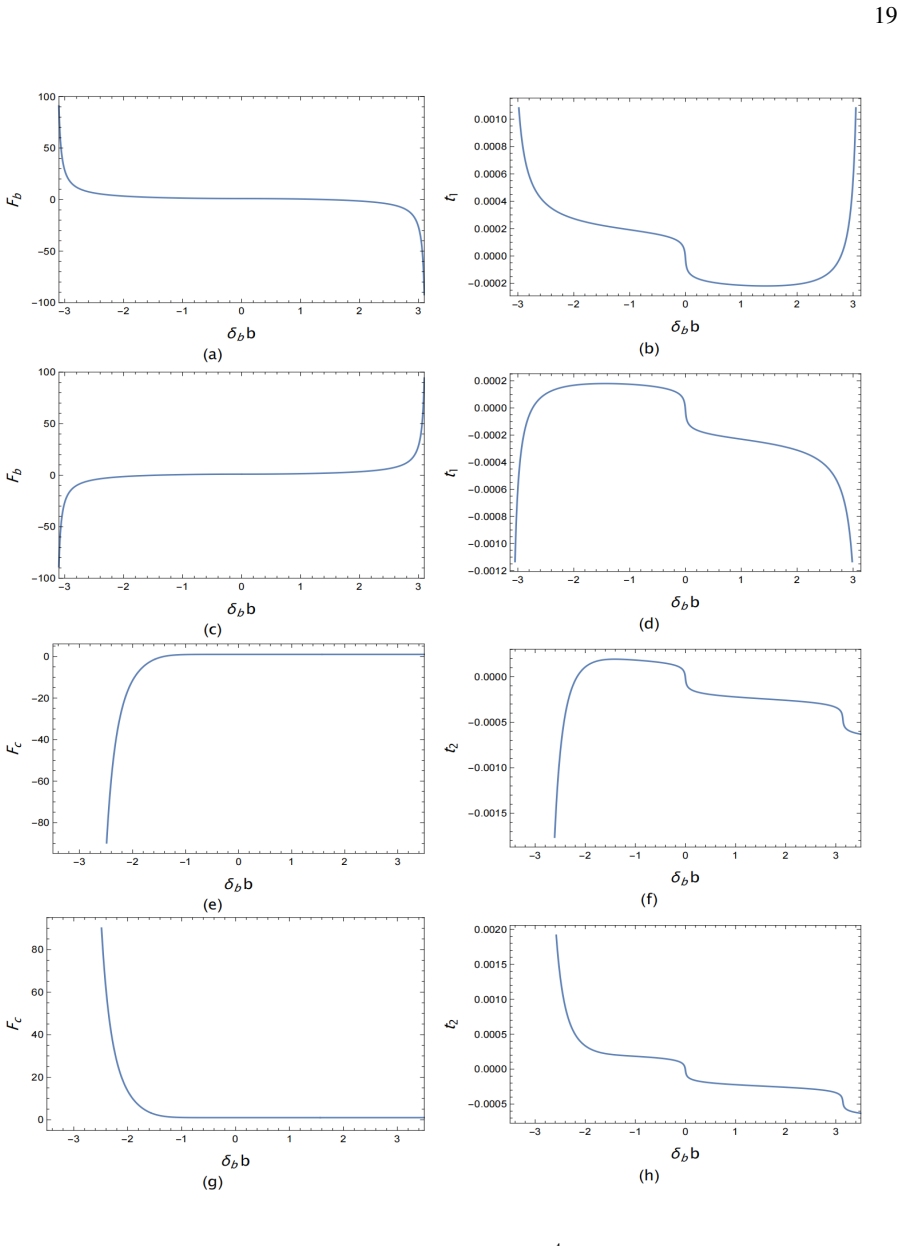
= 0in this case. However, in the case of ∂fc ∂O2 >0, the result is indeterminate and a case-by-case analysis is necessary. The functionsF b,F c,t 1 andt 2 are plotted in Fig.4. It is shown that the functionF b always has a zero point both for ∂fb ∂O1 >0and ∂fb ∂O1 <0, whereas the functionF c has a zero point for ∂fc ∂O2 >0but no zero point for ∂fc ∂O2 <0....
-
[2]
Penrose, Physical Review Letters14, 57 (1965)
R. Penrose, Physical Review Letters14, 57 (1965). 24
work page 1965
-
[3]
S. W. Hawking and G. F. Ellis, The large scale structure of space-time (Cambridge university press, 2023)
work page 2023
-
[4]
R. Penrose, The emperor’s new mind: Concerning computers, minds, and the laws of physics (oxford university press, 2016)
work page 2016
-
[5]
A. Ashtekar and J. Lewandowski, Classical and Quantum Gravity21, R53 (2004)
work page 2004
- [6]
-
[7]
M. Han, Y . Ma, and W. Huang, International Journal of Modern Physics D16, 1397 (2007)
work page 2007
-
[8]
Thiemann, Modern canonical quantum general relativity (Cambridge University Press, 2008)
T. Thiemann, Modern canonical quantum general relativity (Cambridge University Press, 2008)
work page 2008
- [9]
-
[10]
Quantum Theory of Geometry II: Volume operators
A. Ashtekar and J. Lewandowski, arXiv preprint gr-qc/9711031 (1997)
work page internal anchor Pith review Pith/arXiv arXiv 1997
-
[11]
Thiemann, Journal of Mathematical Physics39, 3372 (1998)
T. Thiemann, Journal of Mathematical Physics39, 3372 (1998)
work page 1998
-
[12]
Y . Ma, C. Soo, and J. Yang, Physical Review D—Particles, Fields, Gravitation, and Cosmology81, 124026 (2010)
work page 2010
- [13]
-
[14]
Bojowald, Living Reviews in Relativity11, 1 (2008)
M. Bojowald, Living Reviews in Relativity11, 1 (2008)
work page 2008
-
[15]
Ashtekar, General Relativity and Gravitation41, 707 (2009)
A. Ashtekar, General Relativity and Gravitation41, 707 (2009)
work page 2009
-
[16]
A. Ashtekar and P. Singh, Classical and Quantum Gravity28, 213001 (2011)
work page 2011
-
[17]
K. Banerjee, G. Calcagni, M. Martin-Benito, et al., SIGMA. Symmetry, Integrability and Geometry: Methods and Applications8, 016 (2012)
work page 2012
-
[18]
A. Ashtekar, T. Pawlowski, and P. Singh, Physical Review D—Particles, Fields, Gravitation, and Cosmology73, 124038 (2006)
work page 2006
-
[19]
A. Ashtekar, T. Pawlowski, and P. Singh, Physical Review D—Particles, Fields, Gravitation, and Cosmology74, 084003 (2006)
work page 2006
-
[20]
A. Ashtekar, A. Corichi, and P. Singh, Physical Review D—Particles, Fields, Gravitation, and Cos- mology77, 024046 (2008)
work page 2008
-
[21]
J. Yang, Y . Ding, and Y . Ma, Physics Letters B682, 1 (2009)
work page 2009
- [22]
- [23]
-
[24]
A. Ashtekar and M. Bojowald, Classical and Quantum Gravity23, 391 (2005)
work page 2005
-
[25]
Modesto, Classical and Quantum Gravity23, 5587 (2006)
L. Modesto, Classical and Quantum Gravity23, 5587 (2006)
work page 2006
-
[26]
C. G. Boehmer and K. Vandersloot, Physical Review D—Particles, Fields, Gravitation, and Cosmol- ogy76, 104030 (2007)
work page 2007
-
[27]
Chiou, Physical Review D—Particles, Fields, Gravitation, and Cosmology78, 064040 (2008)
D.-W. Chiou, Physical Review D—Particles, Fields, Gravitation, and Cosmology78, 064040 (2008)
work page 2008
-
[28]
A. Corichi and P. Singh, Classical and Quantum Gravity33, 055006 (2016)
work page 2016
- [29]
- [30]
-
[31]
N. Bodendorfer, F. M. Mele, and J. M ¨unch, Classical and Quantum Gravity36, 187001 (2019). 25
work page 2019
- [32]
- [33]
- [34]
-
[35]
W.-C. Gan, G. Ongole, E. Alesci, Y . An, F.-W. Shu, and A. Wang, Physical Review D106, 126013 (2022)
work page 2022
-
[36]
Modesto, International Journal of Theoretical Physics49, 1649 (2010)
L. Modesto, International Journal of Theoretical Physics49, 1649 (2010)
work page 2010
-
[37]
J.-M. Yan, Q. Wu, C. Liu, T. Zhu, and A. Wang, Journal of Cosmology and Astroparticle Physics 2022, 008 (2022)
work page 2022
-
[38]
C. Liu, T. Zhu, Q. Wu, K. Jusufi, M. Jamil, M. Azreg-A ¨ınou, and A. Wang, Physical Review D103, 089902 (2021)
work page 2021
- [39]
- [40]
-
[41]
A. I. Janis, E. T. Newman, and J. Winicour, Physical Review Letters20, 878 (1968)
work page 1968
-
[42]
Virbhadra, International Journal of Modern Physics A12, 4831 (1997)
K. Virbhadra, International Journal of Modern Physics A12, 4831 (1997)
work page 1997
-
[43]
K. S. Virbhadra and G. F. Ellis, Physical Review D65, 103004 (2002)
work page 2002
-
[44]
M. Patil and P. S. Joshi, Physical Review D—Particles, Fields, Gravitation, and Cosmology85, 104014 (2012)
work page 2012
-
[45]
Chiou, Physical Review D—Particles, Fields, Gravitation, and Cosmology78, 044019 (2008)
D.-W. Chiou, Physical Review D—Particles, Fields, Gravitation, and Cosmology78, 044019 (2008)
work page 2008
- [46]
-
[47]
Ashtekar, Physical Review D36, 1587 (1987)
A. Ashtekar, Physical Review D36, 1587 (1987)
work page 1987
-
[48]
J. F. Barbero, arXiv preprint gr-qc/9410014 (1994)
work page internal anchor Pith review Pith/arXiv arXiv 1994
-
[49]
Immirzi, Classical and Quantum Gravity14, L177 (1997)
G. Immirzi, Classical and Quantum Gravity14, L177 (1997)
work page 1997
-
[50]
A. Perez and C. Rovelli, Physical Review D—Particles, Fields, Gravitation, and Cosmology73, 044013 (2006)
work page 2006
- [51]
discussion (0)
Sign in with ORCID, Apple, or X to comment. Anyone can read and Pith papers without signing in.