REVIEW 5 major objections 5 minor 5 cited by
This paper argues that typical pure states dual to the static BTZ black hole have a genuine tripartite multi-entropy that grows linearly with subsystem size at high temperature—a volume-law signature absent in vacuum AdS3—until a subsystem
Reviewed by Pith at T0; open to challenge. T0 means a machine referee read the full paper against a public rubric. the ladder, T0–T4 →
T0 review · deepseek-v4-flash
2026-08-03 14:15 UTC pith:LGTAEVSQ
load-bearing objection Solid BTZ computation of holographic multi-entropy with a new volume-law phase structure; the physics hangs on the conjectural Steiner-tree prescription and an under-discussed typicality assumption. the 5 major comments →
Black hole as a multipartite entangler: multi-entropy in AdS{}₃/CFT{}₂
The pith
A machine-rendered reading of the paper's core claim, the machinery that carries it, and where it could break.
Core claim
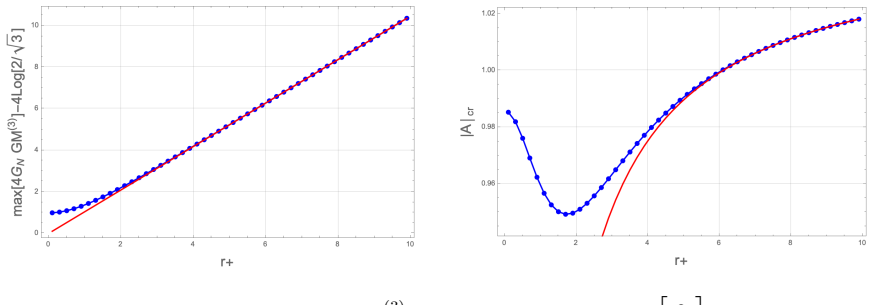
Working in AdS3/CFT2 and assuming the holographic identification of multi-entropy with the minimal area of Steiner trees, the paper analyzes typical pure states dual to the static BTZ black hole. It finds that at sufficiently high temperature the genuine tripartite multi-entropy of three adjacent boundary intervals is not the universal constant of empty AdS3 but grows linearly with subsystem size. For 0<|A|<2π/3 it is (3/(4G_N))log(2/√3) + r_+|A|/(8G_N); for 2π/3<|A|<π it is (3/(4G_N))log(2/√3) + r_+(2π−2|A|)/(8G_N); and once |A|>π the volume term disappears and the value reduces to the global-AdS3 constant. The maximum genuine tripartite entanglement occurs for equal subsystem sizes and equ
What carries the argument
The central object is the holographic multi-entropy prescription: for a pure state, the q-party multi-entropy is (1/(4G_N)) times the minimal total area of a network of codimension-two surfaces—Steiner trees—that partition the bulk into regions homologous to the boundary subsystems. In the BTZ background, each geodesic segment carries an integer winding label from the angular identification, so minimization includes choosing winding numbers. Competing winding choices generate the three phases: the volume-law phase, the half-system phase, and the vacuum phase. The 'genuine' version subtracts all lower-partite entanglement entropies, leaving only irreducible tripartite entanglement.
Load-bearing premise
All quantitative results rest on the conjectural bulk rule that multi-entropy equals the minimum area of a geodesic tree—a rule the paper admits it cannot derive for three or more parties—and on the assumption that typical pure black-hole microstates allow minimal surfaces to pass through the horizon.
What would settle it
An independent boundary computation of the triple-replica entropy in a high-temperature typical pure state of a large-central-charge CFT: if the genuine three-party contribution does not grow linearly with subsystem size, or does not jump at the half-system threshold, the Steiner-tree prescription in the BTZ background is falsified.
If this is right
- In high-temperature typical pure states dual to a static BTZ black hole, genuine tripartite multi-entropy grows linearly with subsystem size, in sharp contrast to the size-independent constant of vacuum AdS3.
- The maximum genuine tripartite entanglement is bounded by a universal constant plus one-sixth of the black hole entropy, giving a concrete capacity bound for black holes as tripartite entanglers.
- When any one subsystem exceeds half of the total boundary system, the leading genuine tripartite multi-entropy vanishes and reduces to the global-AdS3 value.
- For disconnected tripartite configurations, the same computation gives a critical size above which the genuine contribution drops to zero, with the maximum again reaching one-sixth of the black hole entropy.
- At a finite radial cutoff, genuine multi-entropy acquires nontrivial size dependence and decreases monotonically in AdS3, while the BTZ case shows that backreaction tempers this decrease.
- The four-partite genuine multi-entropy in the symmetric BTZ setup is proportional to a free parameter and reaches a/2 times the black hole entropy at its maximum.
Where Pith is reading between the lines
- If the central claim is correct, black-hole microstates have a strict multipartite entanglement budget: no matter how the boundary is divided, irreducible tripartite entanglement cannot exceed one-sixth of the black hole entropy. This could be used to distinguish black-hole tensors from generic random tensors of the same Hilbert-space dimension.
- The sharp transition at the half-system threshold is likely a generic fingerprint of Haar-typical multipartite structure; a tensor-network simulation of a random state with matching entropies should reproduce the same two-phase curve, providing a direct test of the conjecture.
- The 'area-law' constant term proportional to the number of boundary points may be a universal UV contribution in two-dimensional CFTs, so isolating it in lattice models or in TT-deformed CFT computations could expose the genuine multipartite content of the vacuum.
- Because the volume-law phase disappears exactly when one subsystem becomes larger than half the circle, the same calculation suggests that accessible genuine tripartite entanglement is concentrated in balanced partitions; unbalanced partitions hide it behind the vacuum contribution.
Editorial analysis
A structured set of objections, weighed in public.
Referee Report
Summary. Using the holographic multi-entropy prescription of Gadde-Krishna-Sharma and Penington-Walter-Witteveen, the authors compute genuine multi-entropy for typical pure states dual to static BTZ black holes in AdS3/CFT2. They formulate minimal Steiner-tree geodesic networks in an embedding-space formalism, minimize over BTZ winding sectors, and obtain a three-phase formula for GM^(3) with adjacent intervals: a volume-law term r_+|A|/(8G_N) for 0<|A|<2π/3, a decreasing linear phase for 2π/3<|A|<π, and the pure-AdS universal constant once |A|>π. The maximum is the universal constant plus (1/6)S_BH. For symmetric disconnected intervals and four-partite configurations they find analogous bounds, and for finite radial cutoff they find size-dependent GM^(3) in AdS3 and milder BTZ corrections. They interpret these results as evidence that black holes are bounded multipartite entanglers and connect the half-system transition to Haar-random tripartite states. The internal geometry minimization is largely explicit and reproducible, but the central claims rest on two unproved dictionary steps: the conjectural multi-entropy prescription (2.16) and the assertion that typical pure microstates are described by the unrestricted BTZ interior with homology-free passage through the horizon.
Significance. If the underlying dictionary assumptions are accepted, the paper supplies a quantitative and non-trivial structure for multipartite entanglement in black-hole microstates: a horizon-radius-dependent volume-law coefficient, a sharp half-system phase transition, and an upper bound max GM^(3) = 3/(4G_N) log(2/sqrt(3)) + (1/6)S_BH. The analytic minimization over winding sectors is a genuine strength, as are the numerical checks for finite r_+ and r_b (e.g. Figs. 7, 8, 12, 13). The paper is also candid that the bulk prescription (2.16) lacks a Lewkowycz-Maldacena justification for n>2 (footnote 3). The result is a falsifiable target for CFT or tensor-network tests, and the explicit separation of universal constant and S_BH-proportional pieces is informative. The main qualification is that the advertised generality of the phase structure is not established beyond symmetric partitions and that the pure-state/BTZ dictionary is asserted rather than derived.
major comments (5)
- [Sec. 4, p. 15, first paragraph and footnote 4] The one-sentence assumption that typical pure microstates allow minimal surfaces to pass through the black hole without homology obstruction is load-bearing. Every volume-law coefficient and the (1/6)S_BH bound in Eqs. (4.9)-(4.10) and (4.19)-(4.20) follows from minimizing over unrestricted winding sectors n_i in the BTZ quotient. If a generic pure microstate has a different interior (e.g. a capped geometry or end-of-world brane), the homology constraints and allowed winding sectors change, and the leading GM^(3) could differ. This is structurally separate from the acknowledged conjectural status of (2.16). The authors should either derive this dictionary from a solvable microstate model, supply evidence that unrestricted winding sectors are correct for typical states, or state explicitly that the results are conditional on this unproved mapping.
- [Sec. 4.1, Eqs. (4.7)-(4.9)] The three-phase formula and the half-system threshold are derived only for the symmetric case |B|=|C|=pi-|A|/2. The abstract and Introduction, however, state the transition as a general feature: "once one subsystem exceeds half of the total system, the leading genuine tripartite entanglement vanishes." For a generic tripartition, the minimization in (4.3) has more independent interval lengths, and the phase boundary may depend on the other sizes and need not sit exactly at half the total system. Please either prove the general statement or restrict the abstract/intro claims to the symmetric partitions actually analyzed.
- [Sec. 2.2, Eq. (2.16), footnote 3] All quantitative output is a consequence of the holographic prescription (2.16), for which analytic continuation for n>2 is not justified because of replica symmetry breaking. The paper is transparent about this in a footnote, but the abstract and Introduction present the volume law and the (1/6)S_BH bound as holographic results. I recommend making the conditional status of (2.16) visible in the main text and the abstract, and adding a paragraph on possible corrections or on independent evidence from tensor networks / low-Renyi CFT checks. This is not a fatal objection, but it is a central premise and should be flagged wherever the final claims are summarized.
- [Sec. 4.2, Eq. (4.33) and Fig. 8] The fourpartite maximum is max GM^(4) = (a/2) S_BH, where a is an undetermined parameter in the definition of GM^(4). Thus the statement that the BTZ black hole has more fourpartite entanglement than AdS3 is, as presented, a-dependent: for a near zero the quantitative gap in Fig. 8 can change, and GM^(4) can even become negative. The authors do discuss the a-ambiguity in the following paragraph, but the fourpartite conclusions in the abstract-adjacent summary should clearly state that only the tripartite bound is parameter-free and that the fourpartite result is qualitative.
- [Sec. 4.2, Eq. (4.21)] The "area-law" conjecture for the constant term, (# anchoring points) x (1/4G_N) log(2/sqrt(3)), is inferred from exactly two examples (connected tripartite and disconnected tripartite). This is a plausible pattern, but it is not demonstrated. Please mark it as a conjecture and, if possible, test it against the fourpartite constant term in (4.27), which appears to have a different structure.
minor comments (5)
- [Sec. 4.2, Eq. (4.12)] The notation "r coshr + (|A|/2 - alpha)" appears to be a typesetting artifact; it should presumably be r cosh(r_+(|A|/2 - alpha)) or similar. Please correct.
- [Sec. 4.2, Eqs. (4.19)-(4.20)] The constant "3 log(4/3)" in (4.19) and the constant "4 log(2/sqrt(3))" in (4.20) are reconciled only after substituting |A|_cr from (4.18). A one-line remark making this cancellation explicit would prevent an apparent inconsistency.
- [Fig. 3] The figure caption says the symmetry |B|=|C| is slightly broken, while Eq. (4.9) and the surrounding text assume |B|=|C|. Please clarify that the figure is schematic and that the displayed phases correspond to the symmetric formula.
- [Sec. 4, footnote 4] The remark that typical pure states are not heavy primary states is important but easy to miss. Consider moving it to the main text or adding one sentence explaining why heavy primaries are atypical and what class of states is being assumed.
- [Sec. 1 and Abstract] The phrase "volume-law scaling" could be confused with the spatial volume law in higher dimensions. Since the effect is linear in the size |A| of a one-dimensional subsystem, please define the term explicitly at first use.
Circularity Check
No circularity: S^(3) and GM^(3) are computed by explicit geometric minimization in BTZ; caveats are acknowledged assumptions, not fitted-input redefinitions.
full rationale
The core derivation is self-contained conditional on the stated holographic dictionary. The bulk prescription (2.16) is explicitly identified as a conjecture from [15,16], and footnote 3 concedes that a Lewkowycz–Maldacena justification fails for n>2 because of replica symmetry breaking; invoking a conjectural but external prescription is not circularity. Equations (4.3)–(4.9) compute S^(3) by minimizing a concrete winding-number-dependent functional in the BTZ embedding, and GM^(3) is obtained by subtracting the separately computed RT entropies via definition (2.14). No parameter is fitted to any target output: the volume-law coefficient r_+|A|/(8G_N) and the phase boundaries follow from minimizing hyperbolic sine arguments, not from matching known values. The maximum bound (4.10) is the value of that explicitly minimized expression at |A|=|B|=|C|, which arithmetically equals (1/6)S_BH. The load-bearing statement that typical pure black-hole microstates allow minimal surfaces to pass through the horizon is an unproved dictionary assumption, but it is not equivalent to the claimed result; if it failed, the prediction would change, which is a correctness risk, not a circular reduction. The only same-author citation, [52], appears in the Discussion as an outlook and is not used to justify the central result. The free parameter a in GM^(4) is inherited openly from the definition of genuine four-partite multi-entropy [17] and its dependence is shown explicitly. No circular step is present.
Axiom & Free-Parameter Ledger
free parameters (1)
- a (GM^(4) definitional parameter) =
undetermined (a ∈ ℝ; plotted for a=0, 1/3, 1)
axioms (4)
- domain assumption Holographic prescription: multi-entropy S^(q)({A_i}) = (1/4G_N) min Area(W) over Steiner-tree partitions (Eq. (2.16))
- ad hoc to paper Typical pure BTZ microstates allow minimal surfaces to pass through the horizon without homology obstruction, giving pure-state rather than thermal entanglement
- standard math Embedding-space geodesic distance σ(X1,X2)=cosh^{-1}(-X1·X2), BTZ quotient identification (3.11), stationarity equations (3.13)-(3.17)
- domain assumption Large-r_+ and large-r_b limits with exponentially suppressed corrections; leading-order hyperbolic approximations in the Section 4.2 minimization
read the original abstract
We study multipartite entanglement in typical pure states holographically dual to pure BTZ black holes, using multi-entropy and its ``genuine'' version. In the bulk, these quantities are computed by minimal geodesic networks (so-called Steiner trees). We find that at sufficiently high temperature, the genuine tripartite multi-entropy exhibits a volume-law scaling in sharp contrast to vacuum AdS$_3$, where the genuine contribution is universal and size-independent. Moreover, we find another phase: once one subsystem exceeds half of the total system, the leading genuine tripartite entanglement vanishes and reduces to that for global AdS${}_3$. This transition is indeed consistent with recent arguments for distillable EPR pairs in tripartite Haar-random states. Motivated by finite-cutoff holography, we further study the radial cutoff dependence of multi-entropy and show that genuine multi-entropy acquires nontrivial size dependence even for the tripartite case in AdS${}_3$. As a byproduct, we also observe an intriguing ``area-law'' contribution to multi-entropy that is relevant to vacuum AdS${}_3$.
Figures




Forward citations
Cited by 5 Pith papers
-
Multi-entropy in random tensor networks
For n=2, Rényi multi-entropies in RTNs are determined by minimal multiway cuts; the minimal multiway cut conjecture fails for integer n>2 with explicit counterexamples.
-
The Entanglement Wedge Polygon
The paper defines the entanglement wedge polygon as the intersection of entanglement wedges external to individual homology regions and studies its topological and geometric properties in AdS examples.
-
The Entanglement Wedge Polygon
The entanglement wedge polygon volume is proposed as a holographic probe of multipartite entanglement; in AdS3 it is topologically quantized, and a mixed-state generalization is constructed.
-
Multi-entropy in heavy local quenches
Genuine multi-entropy in heavy local quenches in 2D holographic CFTs is kinematically fixed to logarithms of rational functions of time, independent of heavy operator dimension, due to global saddle selection in the g...
-
The Junction Law for Multipartite Entanglement in Confining Holographic Backgrounds
The junction law for multipartite entanglement persists in confining holographic backgrounds, but phase structure and GM short-distance scaling (L^{-4}, L^{-2}, or L^{-2}(log L)^2) are background-dependent.
Reference graph
Works this paper leans on
-
[1]
J. M. Maldacena,The Large N limit of superconformal field theories and supergravity,Adv. Theor. Math. Phys.2(1998) 231 [hep-th/9711200]. 1
Pith/arXiv arXiv 1998
-
[2]
S. Ryu and T. Takayanagi,Holographic derivation of entanglement entropy from AdS/CFT,Phys. Rev. Lett.96(2006) 181602 [hep-th/0603001]. 1
Pith/arXiv arXiv 2006
-
[3]
V. E. Hubeny, M. Rangamani and T. Takayanagi,A Covariant holographic entanglement entropy proposal,JHEP07(2007) 062 [0705.0016]. 1
Pith/arXiv arXiv 2007
-
[4]
T. Faulkner, A. Lewkowycz and J. Maldacena,Quantum corrections to holographic entanglement entropy,JHEP11(2013) 074 [1307.2892]. 1
Pith/arXiv arXiv 2013
-
[5]
N. Engelhardt and A. C. Wall,Quantum Extremal Surfaces: Holographic Entanglement Entropy beyond the Classical Regime,JHEP01(2015) 073 [1408.3203]. 1
Pith/arXiv arXiv 2015
-
[6]
Swingle,Entanglement Renormalization and Holography,Phys
B. Swingle,Entanglement Renormalization and Holography,Phys. Rev. D86 (2012) 065007 [0905.1317]. 1
Pith/arXiv arXiv 2012
-
[7]
Vidal,Entanglement Renormalization,Phys
G. Vidal,Entanglement Renormalization,Phys. Rev. Lett.99(2007) 220405 [cond-mat/0512165]. 1
Pith/arXiv arXiv 2007
-
[8]
J. Haegeman, T. J. Osborne, H. Verschelde and F. Verstraete,Entanglement Renormalization for Quantum Fields in Real Space,Phys. Rev. Lett.110(2013) 100402 [1102.5524]. 1 38
Pith/arXiv arXiv 2013
-
[9]
F. Pastawski, B. Yoshida, D. Harlow and J. Preskill,Holographic quantum error-correcting codes: Toy models for the bulk/boundary correspondence,JHEP06 (2015) 149 [1503.06237]. 2
Pith/arXiv arXiv 2015
-
[10]
Umemoto,Quantum and Classical Correlations Inside the Entanglement Wedge, Phys
K. Umemoto,Quantum and Classical Correlations Inside the Entanglement Wedge, Phys. Rev. D100(2019) 126021 [1907.12555]. 2
Pith/arXiv arXiv 2019
-
[11]
C. Akers and P. Rath,Entanglement Wedge Cross Sections Require Tripartite Entanglement,JHEP04(2020) 208 [1911.07852]. 2
Pith/arXiv arXiv 2020
-
[12]
P. Hayden, O. Parrikar and J. Sorce,The Markov gap for geometric reflected entropy,JHEP10(2021) 047 [2107.00009]. 2
Pith/arXiv arXiv 2021
-
[13]
N. Iizuka, S. Lin and M. Nishida,Why many-partite entanglement is essential for holography,2504.01625. 2
-
[14]
V. Balasubramanian, M. J. Kang, C. Cummings, C. Murdia and S. F. Ross,Purely GHZ-like entanglement is forbidden in holography,2509.03621. 2
-
[15]
A. Gadde, V. Krishna and T. Sharma,New multipartite entanglement measure and its holographic dual,Phys. Rev. D106(2022) 126001 [2206.09723]. 2, 4, 5, 9
Pith/arXiv arXiv 2022
-
[16]
G. Penington, M. Walter and F. Witteveen,Fun with replicas: tripartitions in tensor networks and gravity,JHEP05(2023) 008 [2211.16045]. 2, 4, 5, 9
Pith/arXiv arXiv 2023
-
[17]
N. Iizuka and M. Nishida,Genuine multientropy and holography,Phys. Rev. D112 (2025) 026011 [2502.07995]. 2, 8, 24
Pith/arXiv arXiv 2025
-
[18]
A. Gadde, V. Krishna and T. Sharma,Towards a classification of holographic multi-partite entanglement measures,JHEP08(2023) 202 [2304.06082]. 2, 9, 13, 14, 23
Pith/arXiv arXiv 2023
-
[19]
A. Gadde, S. Jain, V. Krishna, H. Kulkarni and T. Sharma,Monotonicity conjecture for multi-party entanglement. Part I,JHEP02(2024) 025 [2308.16247]. 2
Pith/arXiv arXiv 2024
-
[20]
J. Harper, T. Takayanagi and T. Tsuda,Multi-entropy at low Renyi index in 2d CFTs,SciPost Phys.16(2024) 125 [2401.04236]. 2, 3, 9
Pith/arXiv arXiv 2024
-
[21]
B. Liu, J. Zhang, S. Ohyama, Y. Kusuki and S. Ryu,Multiwavefunction overlap and multientropy for topological ground states in (2+1) dimensions,Phys. Rev. B 112(2025) 125160 [2410.08284]. 2, 8
arXiv 2025
-
[22]
M.-K. Yuan, M. Li and Y. Zhou,Reflected Multientropy and Its Holographic Dual, Phys. Rev. Lett.135(2025) 091604 [2410.08546]. 2
arXiv 2025
-
[23]
A. Gadde, J. Harper and V. Krishna,Multi-invariants and bulk replica symmetry, JHEP06(2025) 116 [2411.00935]. 2, 9 39
Pith/arXiv arXiv 2025
-
[24]
N. Iizuka, S. Lin and M. Nishida,Black hole multi-entropy curves — secret entanglement between Hawking particles,JHEP03(2025) 037 [2412.07549]. 2
Pith/arXiv arXiv 2025
-
[25]
N. Iizuka, S. Lin and M. Nishida,More on genuine multientropy and holography, Phys. Rev. D112(2025) 066014 [2504.16589]. 2
Pith/arXiv arXiv 2025
-
[26]
T. Mori,Quantum correlation beyond entanglement: Holographic discord and multipartite generalizations,2506.02131. 2
-
[27]
J. Harper, A. Mollabashi, T. Takayanagi and K. Tasuki,Multientropy and the dihedral measures at quantum critical points,Phys. Rev. Res.7(2025) 043194 [2506.10396]. 2
Pith/arXiv arXiv 2025
- [28]
- [29]
-
[30]
C. Berthi` ere and P. Gaudin,Genuine multi-entropy, dihedral invariants and Lifshitz theory,2509.00593. 2
-
[31]
M.-K. Yuan, M. Li and Y. Zhou,Multi-entropy from Linking in Chern-Simons Theory,2510.18408. 2
-
[32]
B. Ahn, J. K. Basak, K.-Y. Kim, G. B. Koo, V. Malvimat and J. Yoon,Probing the Hierarchy of Genuine Multipartite Entanglement with Generalized Latent Entropy, 2510.19922. 2
-
[33]
N. Iizuka and S. Lin,Symmetry-resolved genuine multi-entropy: Haar random and graph states,2511.00905. 2
-
[34]
Y. Sheffer, R. Fan, A. Stern, E. Berg and S. Ryu,Probing chiral topological states with permutation defects,2512.04649. 2
-
[35]
Z. Li, T. Mori and B. Yoshida,Tripartite Haar random state has no bipartite entanglement,2502.04437. 3, 34
-
[36]
A. B. Zamolodchikov,Expectation value of composite field T anti-T in two-dimensional quantum field theory,hep-th/0401146. 3
-
[37]
F. A. Smirnov and A. B. Zamolodchikov,On space of integrable quantum field theories,Nucl. Phys. B915(2017) 363 [1608.05499]. 3
Pith/arXiv arXiv 2017
-
[38]
L. McGough, M. Mezei and H. Verlinde,Moving the CFT into the bulk withT T, JHEP04(2018) 010 [1611.03470]. 3, 27 40
Pith/arXiv arXiv 2018
- [39]
-
[40]
M. Headrick and T. Takayanagi,A Holographic proof of the strong subadditivity of entanglement entropy,Phys. Rev. D76(2007) 106013 [0704.3719]. 10
Pith/arXiv arXiv 2007
-
[41]
P. Hayden, M. Headrick and A. Maloney,Holographic Mutual Information is Monogamous,Phys. Rev. D87(2013) 046003 [1107.2940]. 10, 27
Pith/arXiv arXiv 2013
-
[42]
S. Datta, P. Kraus and B. Michel,Typicality and thermality in 2d CFT,JHEP07 (2019) 143 [1904.00668]. 15
Pith/arXiv arXiv 2019
-
[43]
Y. Kusuki and K. Tamaoka,Dynamics of entanglement wedge cross section from conformal field theories,Phys. Lett. B814(2021) 136105 [1907.06646]. 15
Pith/arXiv arXiv 2021
-
[44]
Y. Kusuki and K. Tamaoka,Entanglement Wedge Cross Section from CFT: Dynamics of Local Operator Quench,JHEP02(2020) 017 [1909.06790]. 15
Pith/arXiv arXiv 2020
-
[45]
N. Bao and H. Ooguri,Distinguishability of black hole microstates,Phys. Rev. D96 (2017) 066017 [1705.07943]. 15
Pith/arXiv arXiv 2017
-
[46]
A. Lewkowycz, J. Liu, E. Silverstein and G. Torroba,T Tand EE, with implications for (A)dS subregion encodings,JHEP04(2020) 152 [1909.13808]. 29
arXiv 2020
-
[47]
J. D. Brown and M. Henneaux,Central Charges in the Canonical Realization of Asymptotic Symmetries: An Example from Three-Dimensional Gravity,Commun. Math. Phys.104(1986) 207. 34
1986
-
[48]
G. Araujo-Regado, R. Khan and A. C. Wall,Cauchy slice holography: a new AdS/CFT dictionary,JHEP03(2023) 026 [2204.00591]. 35
Pith/arXiv arXiv 2023
-
[49]
R. M. Soni and A. C. Wall,A New Covariant Entropy Bound from Cauchy Slice Holography,2407.16769. 35
-
[50]
S. Ali Ahmad, A. Almheiri and S. Lin,T Tand the black hole interior,2503.19854. 35
-
[51]
T. Hartman and J. Maldacena,Time Evolution of Entanglement Entropy from Black Hole Interiors,JHEP05(2013) 014 [1303.1080]. 35
Pith/arXiv arXiv 2013
-
[52]
T. Anegawa and K. Tamaoka,Holographic AME states in black hole interiors, accecpted in PRL(2025) [2508.07634]. 35
arXiv 2025
-
[53]
C. Akers, N. Engelhardt, D. Harlow, G. Penington and S. Vardhan,The black hole interior from non-isometric codes and complexity,JHEP06(2024) 155 [2207.06536]. 35 41
Pith/arXiv arXiv 2024
-
[54]
Y. Nakata, T. Takayanagi, Y. Taki, K. Tamaoka and Z. Wei,New holographic generalization of entanglement entropy,Phys. Rev. D103(2021) 026005 [2005.13801]. 35 42
Pith/arXiv arXiv 2021
discussion (0)
Sign in with ORCID, Apple, or X to comment. Anyone can read and Pith papers without signing in.