Reputation and Disclosure in Dynamic Networks
Pith reviewed 2026-05-21 17:27 UTC · model grok-4.3
The pith
In a dynamic network disclosure model, common-record censoring from retention generates network value missed by pairwise formation under reputational discipline.
A machine-rendered reading of the paper's core claim, the machinery that carries it, and where it could break.
Core claim
This common-record censoring creates a network value that pairwise formation can miss.
Load-bearing premise
The model assumes interval strategies under which the support of the restricted Gaussian reference likelihood is tracked by finitely many endpoints, allowing the Ornstein-Uhlenbeck quadratic benchmark to verify Markov perfect Bayesian equilibria with finite-time resolution.
Figures
read the original abstract
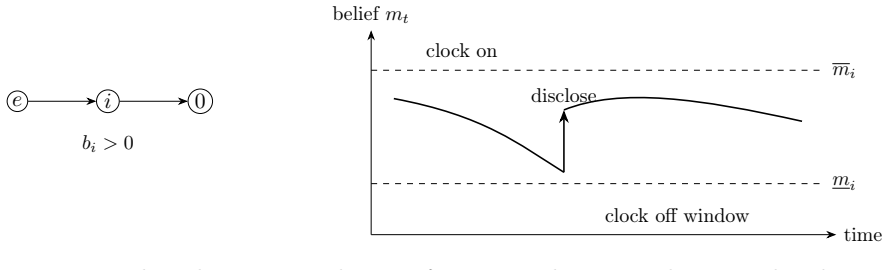
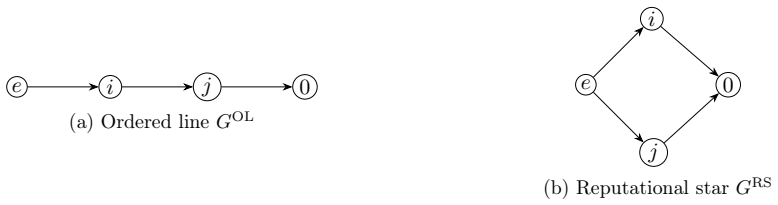
Public delay can be informative when the existence, custodian, and review dates of hard evidence are observed. I study a disclosure protocol in which a sealed record is docketed, held by a public custodian, and revealed only at terminal disclosure. At each review, retention is not silence: it rules out the states in which the holder would have relayed or disclosed. This censoring event yields an exact Bayesian filter. Under interval strategies, the public posterior is summarized by finitely many support endpoints. A compact reputation benchmark verifies Markov perfect Bayesian equilibria with such strategies and gives finite time resolution on compact unresolved slices. With two certified routes for the same record, retention on one route changes what remains feasible on the other before it acts. Common record censoring creates network value that pairwise formation can miss.
Editorial analysis
A structured set of objections, weighed in public.
Referee Report
Summary. The manuscript models a disclosure protocol in dynamic networks where a dated sealed record moves through public custody with public review dates and terminal disclosure only. Retention at review dates functions as a censoring event that restricts the support of a Gaussian reference likelihood obtained from Bayes' rule. Under interval strategies the support is tracked by finitely many endpoints. An Ornstein-Uhlenbeck quadratic benchmark is used to verify Markov perfect Bayesian equilibria within this strategy class and to obtain finite-time resolution under reputational discipline with tail bounds. The central result is that common-record censoring across two certified routes for the same record generates a network value that pairwise formation misses.
Significance. If the technical claims hold, particularly the preservation of finite-endpoint tracking and Markov perfection under multi-route interactions, the paper identifies a novel mechanism for network value arising from interdependent censoring and reputation. The Ornstein-Uhlenbeck benchmark supplies a concrete, tractable way to handle continuous-time belief dynamics and tail bounds, which is a methodological contribution that could extend to other models of dynamic information transmission and certification.
major comments (2)
- [Model and Equilibrium Verification] The claim that interval strategies allow the restricted Gaussian reference likelihood to be tracked by finitely many endpoints (stated in the abstract and used for equilibrium verification) is load-bearing for finite-time resolution and the network-value comparison. Retention on one route altering feasible continuations on the other creates interdependent information sets; this can split or shift the support in ways that add endpoints, potentially violating the finite-tracking property and rendering the Ornstein-Uhlenbeck quadratic benchmark inapplicable. A formal argument showing that the number of endpoints remains finite despite cross-route events is required.
- [Multi-Route Extension] The demonstration that common-record censoring creates value missed by pairwise formation (abstract) rests on equilibria remaining verifiable inside the maintained interval-strategy class. If cross-route censoring interactions cause the belief support to cease being a simple interval whose boundaries evolve continuously, the Markov-perfect Bayesian equilibrium characterization and the resulting network-value ranking would need re-derivation.
minor comments (2)
- The abstract is information-dense; separating the single-record benchmark from the two-route extension into distinct sentences would improve readability.
- [Model Description] Notation for the endpoints tracking the restricted support should be introduced with an explicit recursive definition or diagram to clarify how new endpoints are (or are not) generated at each review date.
Simulated Author's Rebuttal
We thank the referee for the thoughtful and constructive report. The concerns raised about the robustness of the finite-endpoint tracking property and the extension to multi-route interactions are well-taken. Below we provide point-by-point responses and indicate the revisions we plan to implement to address these issues.
read point-by-point responses
-
Referee: The claim that interval strategies allow the restricted Gaussian reference likelihood to be tracked by finitely many endpoints (stated in the abstract and used for equilibrium verification) is load-bearing for finite-time resolution and the network-value comparison. Retention on one route altering feasible continuations on the other creates interdependent information sets; this can split or shift the support in ways that add endpoints, potentially violating the finite-tracking property and rendering the Ornstein-Uhlenbeck quadratic benchmark inapplicable. A formal argument showing that the number of endpoints remains finite despite cross-route events is required.
Authors: We acknowledge that the manuscript would benefit from an explicit formal argument demonstrating that the finite number of endpoints is preserved under cross-route censoring. While the single-route case is handled by tracking the boundaries of the restricted support under interval strategies, the multi-route setting introduces interdependence through shared records. We argue that because retention on one route only eliminates states consistent with non-retention on that route, and the strategies are interval-based, the overall support remains a single interval whose endpoints evolve continuously. To make this rigorous, we will add a new lemma in the revised version that proves the preservation of the finite-endpoint property by showing that cross-route events correspond to additional restrictions that do not increase the number of boundary points beyond a finite set. This will also confirm the applicability of the Ornstein-Uhlenbeck quadratic benchmark for verifying Markov perfect Bayesian equilibria in the network setting. revision: yes
-
Referee: The demonstration that common-record censoring creates value missed by pairwise formation (abstract) rests on equilibria remaining verifiable inside the maintained interval-strategy class. If cross-route censoring interactions cause the belief support to cease being a simple interval whose boundaries evolve continuously, the Markov-perfect Bayesian equilibrium characterization and the resulting network-value ranking would need re-derivation.
Authors: The network-value result relies on the fact that common-record censoring generates additional reputational discipline that pairwise formation cannot replicate, even while keeping the belief dynamics within the interval-strategy class. We do not believe that cross-route interactions cause the support to cease being a simple interval; rather, the interdependent restrictions maintain the interval structure because the Gaussian reference likelihood is updated conditionally on the joint retention events. In the revision, we will include an extension of the equilibrium characterization proposition to explicitly cover the multi-route case, showing that the Markov perfection and the value comparison hold without re-derivation of the core tail bounds or finite-time resolution. This addresses the concern while preserving the central contribution. revision: yes
Circularity Check
No circularity: derivation rests on explicit modeling assumptions and external benchmark
full rationale
The paper states that Bayes' rule yields a Gaussian reference likelihood restricted to remaining support, and that under interval strategies this support is tracked by finitely many endpoints. It then invokes an Ornstein-Uhlenbeck quadratic benchmark to verify Markov perfect Bayesian equilibria with finite-time resolution. These are presented as maintained assumptions that enable the subsequent comparison of network value under common-record censoring versus pairwise formation. No equation is shown to equal its own input by construction, no parameter is fitted to a subset and then relabeled as a prediction, and no load-bearing step reduces to a self-citation whose content is itself unverified. The finite-endpoint claim is an explicit restriction on strategy class rather than a derived result, and the network-value conclusion is asserted to follow directly from the cross-route feasibility interaction once the benchmark is applied. The derivation chain therefore remains self-contained against the stated assumptions.
Axiom & Free-Parameter Ledger
axioms (3)
- domain assumption Players employ interval strategies in the disclosure game.
- domain assumption The Ornstein-Uhlenbeck quadratic benchmark verifies the Markov perfect Bayesian equilibria.
- domain assumption Custody is separated from audit information, allowing Bayes' rule to produce a Gaussian reference likelihood on remaining support.
invented entities (1)
-
Dated sealed record moving through public custody with terminal disclosure
no independent evidence
Lean theorems connected to this paper
-
IndisputableMonolith/Cost/FunctionalEquation.leanwashburn_uniqueness_aczel unclear?
unclearRelation between the paper passage and the cited Recognition theorem.
ladder representation: disclosure and clock choices are pinned down by finitely many posterior cutoffs... Ornstein-Uhlenbeck quadratic benchmark verifies Markov perfect Bayesian equilibria
What do these tags mean?
- matches
- The paper's claim is directly supported by a theorem in the formal canon.
- supports
- The theorem supports part of the paper's argument, but the paper may add assumptions or extra steps.
- extends
- The paper goes beyond the formal theorem; the theorem is a base layer rather than the whole result.
- uses
- The paper appears to rely on the theorem as machinery.
- contradicts
- The paper's claim conflicts with a theorem or certificate in the canon.
- unclear
- Pith found a possible connection, but the passage is too broad, indirect, or ambiguous to say the theorem truly supports the claim.
discussion (0)
Sign in with ORCID, Apple, or X to comment. Anyone can read and Pith papers without signing in.