From QCD-Based Descriptions to Direct Fits: A Unified Study of Nucleon Electromagnetic Form Factors
Pith reviewed 2026-05-16 18:41 UTC · model grok-4.3
The pith
A linear combination of two GPD-based contributions and vector-meson exchange, fitted to data, accurately describes nucleon electromagnetic form factors and yields stable Padé parametrizations.
A machine-rendered reading of the paper's core claim, the machinery that carries it, and where it could break.
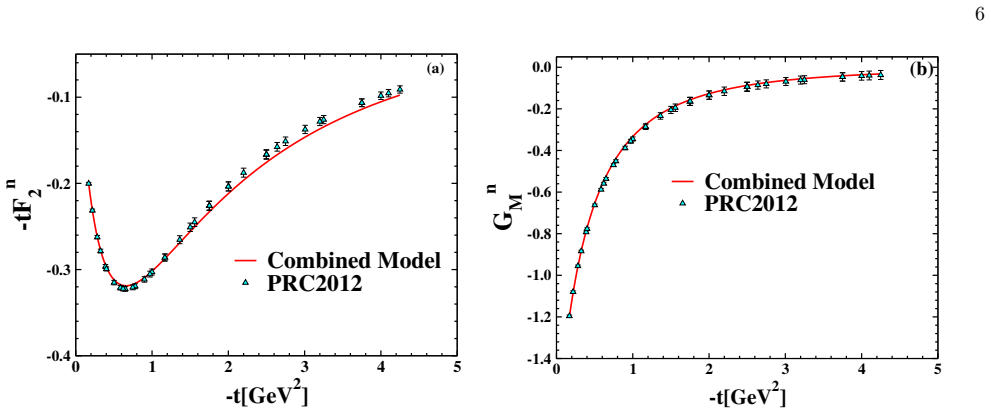
Core claim
The authors demonstrate that a linear combination of two GPD-based contributions and a vector-meson exchange component, with optimally determined weights and shape parameters, reproduces the experimental nucleon electromagnetic form factors. Starting from local Taylor expansions of these fits, they construct global Padé-based parametrizations that remain stable over the analyzed range of t for four distinct groups of form factors.
What carries the argument
The combined framework of two GPD-based contributions plus vector-meson exchange term, with data-fitted weights and shape parameters, that serves as input for constructing global Padé approximants from Taylor expansions.
If this is right
- The fitted combination reproduces experimental proton and neutron form factors across the studied spacelike range.
- Global Padé approximants constructed from the fits provide stable analytic parametrizations.
- Optimal weights and shape parameters are extracted for each of the three contributing terms.
- The resulting framework maintains a controlled model dependence while remaining physically motivated.
Where Pith is reading between the lines
- The same fitting procedure could be applied to other baryon electromagnetic or transition form factors to test consistency.
- The Padé parametrizations may serve as improved analytic inputs for dispersion-relation studies or sum-rule calculations.
- Direct comparison of the high-momentum predictions with lattice QCD computations could provide an independent test of the extracted parameters.
Load-bearing premise
That fitting a linear combination of the two GPD terms and the vector-meson exchange term to existing data is sufficient to capture the dominant physics without large unaccounted contributions or inconsistencies.
What would settle it
A precise measurement of any nucleon form factor at a momentum transfer outside the fitted range that deviates systematically from the corresponding Padé parametrization by more than experimental uncertainty.
Figures




read the original abstract
We present a detailed study of the nucleon electromagnetic form factors in the spacelike region by combining three complementary approaches: two GPD-based contributions and a vector-meson exchange component. By fitting experimental data, we extract the optimal weights and shape parameters describing the proton and neutron form factors. Global Pad\'e-based fits are then constructed for four distinct groups of form factors, starting from local Taylor expansions and yielding stable analytic parametrizations over the analyzed $t$ range. The combined framework provides an accurate and physically motivated description of nucleon structure within a controlled model-dependent setting across a wide range of momentum transfers.
Editorial analysis
A structured set of objections, weighed in public.
Referee Report
Summary. The manuscript presents a detailed study of the nucleon electromagnetic form factors in the spacelike region by combining three complementary approaches: two GPD-based contributions and a vector-meson exchange component. By fitting experimental data, optimal weights and shape parameters are extracted for the proton and neutron form factors. Global Padé-based fits are then constructed for four distinct groups of form factors, starting from local Taylor expansions and yielding stable analytic parametrizations over the analyzed t range. The combined framework provides an accurate and physically motivated description of nucleon structure within a controlled model-dependent setting across a wide range of momentum transfers.
Significance. If the results hold, the paper contributes a unified, data-fitted framework that integrates GPD-based and vector-meson descriptions into stable Padé parametrizations. This could be significant for providing practical, analytic forms for nucleon form factors over wide momentum ranges, with credit due to the standard yet controlled use of Padé approximants from Taylor expansions for ensuring analytic properties. The approach is model-dependent but offers a way to combine complementary methods.
major comments (1)
- [Abstract] The fitting of weights and shape parameters directly to the experimental data that the final parametrizations aim to describe introduces a circularity: the 'description' largely reproduces the input data by construction, as the Padé fits are built from these fitted quantities. This undermines the claim of providing an independent validation or physically motivated insight beyond the fit itself.
minor comments (1)
- Details on data selection, error treatment, and validation against independent measurements are missing from the abstract and should be explicitly addressed in the main text to support the soundness of the fits.
Simulated Author's Rebuttal
We thank the referee for the thorough review and the recommendation for major revision. We address the single major comment below, clarifying the structure of our procedure while acknowledging the need for improved wording in the abstract.
read point-by-point responses
-
Referee: [Abstract] The fitting of weights and shape parameters directly to the experimental data that the final parametrizations aim to describe introduces a circularity: the 'description' largely reproduces the input data by construction, as the Padé fits are built from these fitted quantities. This undermines the claim of providing an independent validation or physically motivated insight beyond the fit itself.
Authors: We agree that the abstract wording could be read as implying a direct, circular reproduction of the input data. However, the procedure is two-step and model-constrained: the weights and shape parameters are determined by fitting the combined GPD-based plus vector-meson model to the data, thereby fixing the relative contributions of each physically motivated component. The global Padé approximants are subsequently constructed from local Taylor expansions of the resulting model predictions (not from a direct fit to the raw data). This ensures that the final parametrizations inherit the analytic properties and theoretical constraints of the underlying framework while remaining stable over the full t range. We do not claim an independent validation outside the fit; the value lies in the controlled, unified description that interpolates between complementary QCD-inspired approaches. We will revise the abstract to make this two-step, model-constrained character explicit. revision: partial
Circularity Check
No significant circularity; standard data-driven fitting and parametrization
full rationale
The paper explicitly fits weights and shape parameters of a linear combination of GPD-based terms plus vector-meson exchange directly to experimental nucleon form-factor data, then constructs global Padé approximants from the resulting local Taylor expansions. This sequence is a conventional two-stage parametrization workflow (model fit followed by analytic continuation/representation) rather than a derivation that reduces to its own inputs by construction. No load-bearing step equates a claimed prediction or first-principles result to the fitted quantities themselves; the accuracy claim is evaluated against the same external data used for fitting, which is the normal and non-circular practice for phenomenological models. The manuscript does not invoke self-citations for uniqueness theorems or smuggle ansätze; the central result remains the empirical adequacy of the chosen functional form within its stated model-dependent scope.
Axiom & Free-Parameter Ledger
free parameters (2)
- weights for the three contributions
- shape parameters
axioms (2)
- domain assumption GPD-based models remain valid for nucleon electromagnetic form factors in the spacelike region
- ad hoc to paper Linear superposition of the three contributions is adequate
Lean theorems connected to this paper
-
IndisputableMonolith/Cost/FunctionalEquation.leanwashburn_uniqueness_aczel unclear?
unclearRelation between the paper passage and the cited Recognition theorem.
combined model ... W1 F_VMD + W2 F_VS24 + W3 F_ER ... fitted to experimental data
-
IndisputableMonolith/Foundation/AlphaCoordinateFixation.leanJ_uniquely_calibrated_via_higher_derivative unclear?
unclearRelation between the paper passage and the cited Recognition theorem.
Padé approximants ... from local Taylor expansions
What do these tags mean?
- matches
- The paper's claim is directly supported by a theorem in the formal canon.
- supports
- The theorem supports part of the paper's argument, but the paper may add assumptions or extra steps.
- extends
- The paper goes beyond the formal theorem; the theorem is a base layer rather than the whole result.
- uses
- The paper appears to rely on the theorem as machinery.
- contradicts
- The paper's claim conflicts with a theorem or certificate in the canon.
- unclear
- Pith found a possible connection, but the passage is too broad, indirect, or ambiguous to say the theorem truly supports the claim.
Reference graph
Works this paper leans on
-
[1]
913, which imposes con- straints on κ q: κ u = κ n + 2κ p, κ d = 2κ n + κ p
793 and F n 2 (0) = κ n = − 1. 913, which imposes con- straints on κ q: κ u = κ n + 2κ p, κ d = 2κ n + κ p. (17) where the normalization factors Nu and Nd are deter- mined as [ 27]: Nu = ˆ1 0 dx(1 − x)η u uv(x), (18) Nd = ˆ1 0 dx(1 − x)η d dv(x). In order to satisfy Eq. ( 15), the nucleon form factor data can be fitted to obtain the values of ηu and ηd. Th...
-
[2]
T able VI: Padé coefficients for group 1
As can be seen, the resulting parametrizations exhibit the expected qualitative behavior in the limits t → 0 and t → ∞ , consistent with QCD expectations. T able VI: Padé coefficients for group 1. The Padé form is given in Eq. ( 38). The corresponding Padé parametrization for this group is shown in Fig. 6(a). tF p 1 tF p 2 Gp E Gp M a0 7. 33 × 10− 10 3. 39 ...
-
[3]
Finally, the constants c0 and c1 in Eq
using products of monopole terms for both isoscalar and isovector chan- nels. Finally, the constants c0 and c1 in Eq. (
-
[4]
( 8), using known meson–nucleon and meson–photon couplings
were determined via matching conditions in Eq. ( 8), using known meson–nucleon and meson–photon couplings. In the combined model, this method enters with the weight parameter W1. GPDs encode the three-dimensional structure of nu- cleons. The formalism of GPDs is presented in detail in Eqs. ( 9– 20) in Sec. III. The PDFs and ansatzes used in this work are ...
-
[5]
are given in Tab. IV and Fig. 4. Finally, the effective ranges of each component across different Q2 domains are summarized in Tab. V. 12 Sec. V examined two phenomenological representations of the neutron form factors as a validation step for the combined model. A Regge-inspired linear fit was applied to the scaled Dirac form factor tF n 1 (t) [ 43, 44], yi...
-
[6]
These results show that the Padé parametrizations provide an accurate and numerically stable description of the data, while avoiding extrapo- lation instabilities and unphysical behavior at large |t|. The shaded bands illustrate the intrinsic sensitivity of the Padé representation to controlled coefficient varia- tions, as discussed in Sec. VI From the QCD ...
work page 2021
-
[7]
G. A. Miller, B. M. K. Nefkens and I. Slaus, Phys. Rept. 194, 1-116 (1990)
work page 1990
-
[8]
S. D. Drell and T. M. Yan, Phys. Rev. Lett. 24, 181-185 (1970)
work page 1970
-
[9]
A. V. Radyushkin, Phys. Rev. D 83,076006 (2011)
work page 2011
-
[10]
S. N. Santiesteban et al. [Jefferson Lab Hall A], Phys. Rev. Lett. 132, no.16, 162501 (2024)
work page 2024
- [11]
- [12]
-
[13]
M. N. Rosenbluth, Phys. Rev. D 79,079615 (1950)
work page 1950
- [14]
-
[15]
A. D. Martin, W. J. Stirling, R. S. Thorne and G. Watt, Eur. Phys. J. C 63, 189-285 (2009)
work page 2009
- [16]
-
[17]
A. V. Manohar, Effective Field Theories, in Probing the Standard Model of Particle Interactions , eds. R. Gupta et al. (Kluwer Academic, Dordrecht, 1998), pp. 311–362
work page 1998
- [18]
-
[19]
O. V. Selyugin and O. V. Teryaev, Phys. Atom. Nucl. 87, no.4, 518-522 (2024)
work page 2024
-
[20]
H. Haji Hosseini Mojeni and M. R. Shojaei, Phys. Rev. C 105, no.2, 025202 (2022)
work page 2022
-
[21]
N. S. Nikkhoo and M. R. Shojaei, Int. J. Mod. Phys. E 24, no.11, 1550086 (2015)
work page 2015
-
[22]
N. Sattary Nikkhoo and M. R. Shojaei, Phys. Rev. C 97, no.5, 055211 (2018)
work page 2018
-
[23]
H. Haji Hosseini Mojeni and M. R. Shojaei, Eur. Phys. J. Plus 137,no.8, 938 (2022)
work page 2022
- [24]
- [25]
-
[26]
A. V. Radyushkin, Phys. Rev. D 56, 5524-5557 (1997)
work page 1997
-
[27]
J. J. Sakurai, Z. Phys. C 11,1-48 (1960)
work page 1960
-
[28]
P. Masjuan, E. Ruiz Arriola and W. Broniowski, Phys. Rev. D 87,no.1, 014005 (2013)
work page 2013
-
[29]
H. Vaziri and M. R. Shojaei, Eur. Phys. J. Plus. 139, no.10, 905 (2024) ’
work page 2024
- [30]
-
[31]
H. Vaziri. M. R. Shojaei, Chinese Physics C 49, (2025)
work page 2025
-
[32]
A. N. Khorramian, H. Khanpour and S. A. Tehrani, Phys. Rev. D 81, 014013 (2010)
work page 2010
- [33]
-
[34]
A. D. Martin, R. G. Roberts, W. J. Stirling and R. S. Thorne, Phys. Lett. B 531,216-224 (2002)
work page 2002
- [35]
-
[36]
I. A. Qattan and J. Arrington, Phys. Rev. C 86, 065210 (2012)
work page 2012
-
[37]
P. Masjuan, E. Ruiz Arriola and W. Broniowski, EPJ Web Conf. 73, 04021 (2014) . 13
work page 2014
- [38]
-
[39]
O. V. Selyugin and O. V. Teryaev, Phys. Rev. D 79, 033003 (2009)
work page 2009
-
[40]
N. S. Nikkhoo and M. R. Shojaei, Int. J. Mod. Phys. A. 32, no.17, 1750097 (2017)
work page 2017
-
[41]
H. H. H. Mojeni and M. R. Shojaei, J. Exp. Theor. Phys. 131, , no.6, 910-916 (2020)
work page 2020
-
[42]
M. R. Shojaei and N. S. Nikkhoo, Nucl. Phys. A 943, 137-146 (2015)
work page 2015
-
[43]
Systematics of radial and angular-momentum Regge trajectories of light non-strange q\bar{q}-states
P. Masjuan, E. Ruiz Arriola and W. Broniowski, Phys. Rev. D 85 (2012), 094006 [arXiv:1203.4782 [hep-ph]]
work page internal anchor Pith review Pith/arXiv arXiv 2012
-
[44]
F. J. Ernst, R. G. Sachs and K. C. Wali, Phys. Rev. 119, 1105-1114 (1960)
work page 1960
-
[45]
J. Blumlein, H. Bottcher and A. Guffanti, Nucl. Phys. B 774, 182-207 (2007)
work page 2007
- [46]
- [47]
-
[48]
M. Abramowitz and I. A. Stegun, Handbook of Mathe- matical Functions with Formulas, Graphs, and Mathe- matical Tables , National Bureau of Standards, Applied Mathematics Series 55, (U.S. Government Printing Of- fice, Washington, D.C., 1972)
work page 1972
-
[49]
P. D. B. Collins, An Introduction to Regge Theory and High Energy Physics
-
[50]
A. Donnachie, H. G. Dosch, P. V. Landshoff and O. Nachtmann, Pomeron Physics and QCD , Cambridge University Press (2002)
work page 2002
-
[51]
J. Arrington, W. Melnitchouk, and J. A. Tjon, Phys. Rev. C 76, 035205 (2007)
work page 2007
- [52]
-
[53]
R. Escribano, P. Masjuan and P. Sanchez-Puertas, Eur. Phys. J. C 75 (2015) no.9, 414
work page 2015
-
[54]
R. Escribano, S. Gonzàlez-Solís, P. Masjuan and P. Sanchez-Puertas, Phys. Rev. D 94 (2016) no.5, 054033
work page 2016
- [55]
-
[56]
B. Duch and P. Masjuan, [arXiv:2512.20721 [hep-ph]]
work page internal anchor Pith review Pith/arXiv arXiv
discussion (0)
Sign in with ORCID, Apple, or X to comment. Anyone can read and Pith papers without signing in.