REVIEW 2 major objections 3 minor 44 references
Multimodal sampling via Schr\"odinger-F\"ollmer samplers with temperatures
T0 review · 2 major / 3 minor · reviewed 2026-08-03 · deepseek-v4-flash
Pith's one-line read Introducing a temperature parameter into Schrödinger–Föllmer samplers cuts their Euler-discretization error from O(√h) to O(h) in Wasserstein distance, without convexity or ergodicity requirements.
desk verdict Genuine O(h) upgrade for exact-drift Schrödinger–Föllmer samplers, but the Monte-Carlo half of the paper has a real, fixable flaw in Theorem 3.7. read the letter →
The pith
A machine-rendered reading of the paper's core claim, the machinery that carries it, and where it could break.
The reading
What carries the argument
The load-bearing object is the temperature-parameterized Schrödinger–Föllmer diffusion (2.7), whose drift f_β(x,t) = β ∇ log(Q^β_{1−t}g_β(x)) is built from the density ratio g_β = dμ/dN(0,βI_d) and its heat-semigroup smoothing. This process connects δ_0 at t=0 to μ at t=1 without ergodicity, and β rescales drift and noise together, which is what lets the sampler explore across modes. The proof machinery is a refined Euler-error decomposition: the authors use Itô's formula to expand f_β(X_s,s) − f_β(X_{t_{i−1}},t_{i−1}) and bound the four resulting terms using the integrable singularity ‖∂_t f_β(x,t)‖ ≤ L̃_f d^{1/2}/√(1−t); that bound is the reason the Wasserstein error becomes O(h) rather th
What would settle it
Take a target whose density ratio g_β has genuinely heavy tails (so the lower bound g_β ≥ ρ fails), for example a single Gaussian with small variance at β=1, run the Euler scheme (3.1) with exact drift for step sizes h=2^{−5},…,2^{−9}, and measure W2(Law(Y_1), μ) by Monte Carlo; if the error decays like h^{1/2} rather than h, the theorem's assumptions are not merely technical. A cleaner check is to verify the integrable-singularity bound (3.3) directly for that target's drift.
Extended reading notes
Core claim
The paper's central discovery is that the temperature-scaled Schrödinger–Föllmer process dX_t = f_β(X_t,t) dt + √β dW_t, with drift f_β = β ∇ log(Q^β_{1−t} g_β), still transports δ_0 to the target μ at time 1, and does so in a way amenable to first-order discretization analysis. Under smoothness of the drift and a positive lower bound on the density ratio g_β, the authors prove for the Euler–Maruyama scheme with exact drift that W2(Law(Y_1), μ) ≤ C d h, and for the scheme with an M-sample Monte Carlo drift that W2(Law(Ỹ^M_1), μ) ≤ C d h + C √(d/M). The temperature parameter does more than generalize the earlier β=1 case: numerical experiments show that higher β is what allows the sampler to
Load-bearing premise
The O(h) rate rests on Assumption 3.1 — the drift's time derivative obeys ‖∂_t f_β(x,t)‖ ≤ L̃_f d^{1/2}/√(1−t) — together with the positive lower bound g_β ≥ ρ > 0; if either fails for a target, the enhanced first-order error bound is not proven and the earlier √h-type behavior may reappear.
Editorial extensions
If this is right
- With exact drift, the order-one bound W2 ≤ C d h means a target Wasserstein accuracy ϵ needs only O(d/ϵ) drift evaluations and Brownian increments, a quadratic-to-linear improvement over the earlier O(d/ϵ²) cost.
- With the Monte Carlo drift, the bound W2 ≤ C d h + C√(d/M) means the same Gaussian samples can be generated once and reused at every time step, reducing MC cost to O(M) rather than O(N·M).
- The convergence analysis requires neither convexity nor a log-Sobolev inequality nor ergodicity, so the sampler is applicable to non-log-concave targets where Langevin-style guarantees typically need extra mixing assumptions.
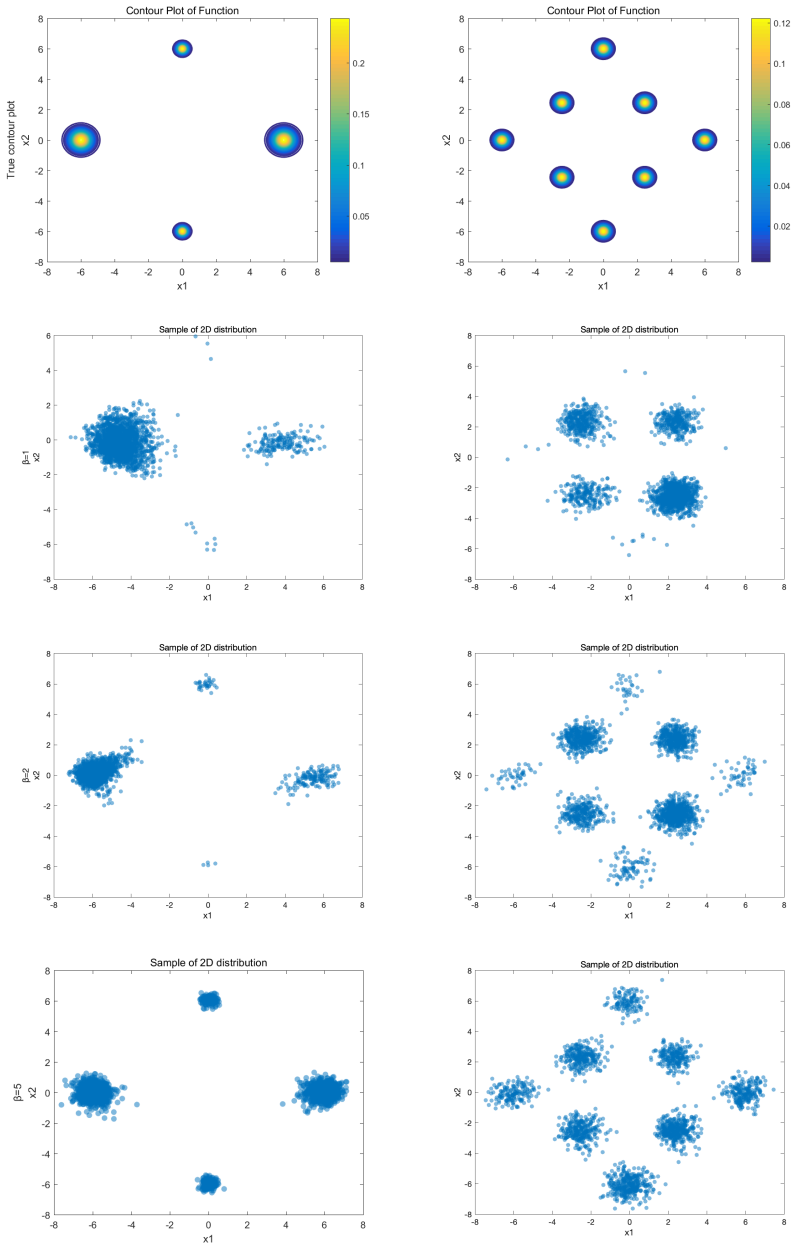
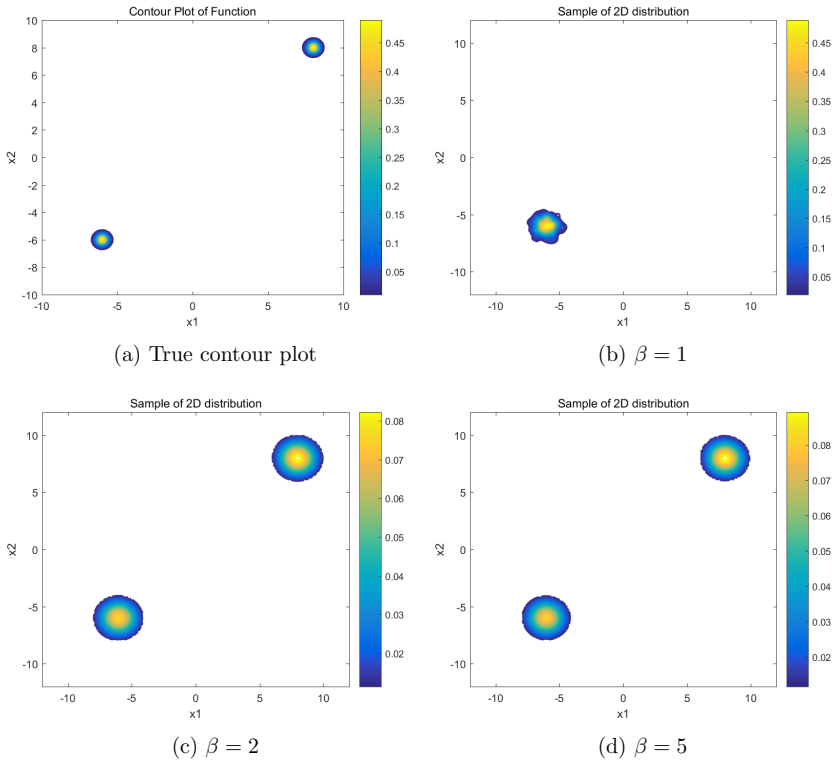
- Numerical experiments show the temperature parameter β directly controls mode exploration: β=1 can miss modes of Gaussian mixtures, while β=2 or 5 recovers all modes without changing the target at time 1.
- The empirical mean-square convergence rates for Gaussian mixtures and Bayesian ridge regression are close to order one, consistent with the theorems.
Reading between the lines
- An implication the paper leaves implicit is an annealing reading: increasing β flattens the effective potential in g_β ∝ exp(−V(x)+‖x‖²/(2β)), so the 'temperature' is doing the same barrier-crossing work as in simulated tempering; this suggests a time-varying β(t) schedule could combine exploration at high β with accuracy at low β, a mechanism not analyzed here.
- The theory assumes g_β ≥ ρ > 0, but two of the paper's own shaped-distribution experiments (p₁ and p₃ at β=1) have density ratios that are unbounded above and decay to zero in the tails, so those experiments demonstrate robustness beyond the theorem's assumptions rather than a verified regime.
- Because the sampler is gradient-free and runs on a fixed interval [0,1], it resembles a diffusion-model-style transport map; a natural testable variant would replace the Monte Carlo drift with a learned or adaptive estimator and check whether the O(h) discretization rate survives, but that is outside this paper.
- The dimension dependence d in the O(dh) bound is worse than the √d or dimension-free rates common for log-concave Langevin analysis; a refined analysis might trade the strong smoothness assumption for a smaller dimension factor, but the paper does not attempt this.
Editorial analysis
A structured set of objections, weighed in public.
Referee Report
Summary. The paper introduces a temperature parameter β into the Schrödinger–Föllmer diffusion, studies Euler samplers with exact and Monte Carlo drift, and claims W2 error bounds of order O(dh) for the exact-drift sampler (Theorem 3.4) and O(dh + sqrt(d/M)) for the Monte-Carlo-drift sampler (Theorem 3.7), without convexity or ergodicity assumptions. Numerical experiments illustrate the benefit of high temperatures for multimodal targets. The proof of Theorem 3.4 is a genuinely new analysis: it expands the drift increment by Itô's formula and uses the integrable singularity of ∂_t fβ to upgrade the previous O(sqrt(h)) rate. However, the proof of Theorem 3.7 rests on a Monte-Carlo error bound that is not valid for the gradient-free estimator displayed in Eq. (3.10), so the second main theorem is currently unsupported as stated.
Significance. If Theorem 3.4 stands, it is a substantial improvement over the O(sqrt(h)) rate of Huang et al. [21] for Schrödinger–Föllmer samplers, and the technique of handling the terminal singularity of ∂_t fβ by Itô expansion is a useful contribution. The temperature mechanism is also empirically attractive for multimodal sampling. The exact-drift result appears internally coherent and the T1–T4 estimates in Section 4.1 are plausible. The Monte-Carlo-drift theorem, however, is not: the estimator in Eq. (3.10) is ambiguous, and for the natural gradient-free form the uniform O(d/M) variance bound of Lemma 4.2 is false, with variance growing like 1/(1−t). This affects a central advertised result and requires major revision.
major comments (2)
- [§3.2] The two expressions in (3.10) are not equal for finite M. Stein's lemma gives an identity between expectations, not between sample averages. For the second, gradient-free estimator, at t_n=1−h one has \hat f^M ≈ β/(√(hβ)) · (1/M)Σ_j ξ_j g(x+√(hβ)ξ_j)/( (1/M)Σ_j g(...) ) ≈ √(β/h) · (1/M)Σ_j ξ_j as h→0, giving E||\hat f^M − f||² = O(β d/(hM)). Thus Lemma 4.2's uniform-in-n bound O(d/M) is false for this estimator, and the J2 estimate in (4.15) misses at least a log(1/h) factor after summation. The citation to [21, Lemma A.6] is insufficient, especially because that lemma, if it concerns the ∇g-form, lacks the singular 1/√(1−t) denominator. The authors must specify exactly which estimator is used, provide a self-contained proof of the relevant t-uniform MC bound, or revise the MC term in Theorem 3.7. Proposition 3.6's uniform Lipschitz bound is also only plausible for the first, ∇g-based ex
- [§5.1/§5.2] The numerical experiments systematically run the sampler outside the assumptions of the theorems. For p1 and p3 at β=1, g1 is proportional to exp((8x1+8x2−x1²x2²)/2) and exp(2αx1), both unbounded; for p2, g1 decays to 0 as r→∞. Hence Assumption 2.2 (gβ ≥ ρ > 0) fails for all three shaped distributions. The Gaussian-mixture examples with covariance Σi=1/5 I_d, 1/4 I_d, or 4/5 I_d at β=1 also have gβ → 0 at infinity, so the lower-bound assumption fails there as well. The paper suggests a regularization in Section 3.1 but does not use it in the numerics. This should be explicitly acknowledged as extrapolation; otherwise the numerical sections do not confirm the theorems under the stated hypotheses.
minor comments (3)
- [§4.1, after Eq. (4.12)] The sentence 'The proof of Theorem 3.7 is completed' should refer to Theorem 3.4.
- [Throughout] Typos: 'dose not' in §3.1 and §3.2; 'geven' in Lemma 2.4; 'Schr¨ odinger' spacing in the references. A light proofreading pass is needed.
- [§3.2] The statement 'M independent Gaussian random variables are only generated once and repeatedly used' is a useful algorithmic detail, but the paper should clarify how this interacts with the MC variance bound in Lemma 4.2, since the ξ_j are not refreshed at each time step.
Circularity Check
No significant circularity: the O(h) bounds are derived from explicit assumptions and external lemmas; self-citations are not load-bearing.
full rationale
The paper's central derivation is self-contained rather than circular. Theorem 3.4 bounds the Euler discretization error by first writing the remainder R_i in (4.2), applying Itô's formula, and then using Assumption 3.1 — in particular the integrable singularity bound (3.3) — together with Hölder, Itô isometry, and discrete Gronwall. The O(h) rate is obtained, not assumed as the conclusion. Proposition 3.2 verifies Assumption 3.1 from primitive smoothness and lower-bound conditions on g_beta, and Proposition 3.3 gives sufficient conditions on V; these are forward assumptions, not definitions of the target result. Theorem 3.7 adds the Monte-Carlo drift error through Lemma 4.2, which is referred to the external result [21, Lemma A.6]; even if the uniformity of that lemma were questionable, that would be a proof gap rather than a self-referential reduction. No fitted parameters are renamed as predictions, no uniqueness theorem is imported from the authors' own prior work, and no ansatz is smuggled in through self-citation. The citations [30] and [42] appear only as statements about ongoing projects and carry no weight in the proofs. The temperature experiments are empirical demonstrations, not presented as consequences forced by assumptions. Therefore no circular step is exhibited.
Assumptions & free parameters
free parameters (1)
- Temperature β =
β = 1, 2, 5 in numerical experiments; arbitrary β > 0 in theory
assumptions (5)
- domain assumption g_β ≥ ρ > 0 and g_β, ∇g_β are L_g-Lipschitz (Assumption 2.2)
- domain assumption Drift smoothness and singular time-derivative bound ‖∂_t f_β(x,t)‖ ≤ L̃_f d^{1/2}/√(1−t) (Assumption 3.1, eq. (3.3))
- domain assumption Well-posedness and X₁ ∼ μ of (2.7) (Prop. 2.3, via [21, Appendix B])
- domain assumption Uniform Monte-Carlo variance bound E^ξ‖f_β − f̃^M_β‖² ≤ C₂d/M (Lemma 4.2, cited to [21, Lemma A.6])
- standard math Stein’s lemma, Itô formula, Itô isometry, discrete Gronwall, moment bounds (Lemma 2.4 via [21, Lemmas A.3–A.4])
invented entities (1)
-
Temperature-parameterized Schrödinger–Föllmer process (2.7) and samplers (3.1)/(3.11)
Cite this review
Pith. "Pith review of Multimodal sampling via Schr\"odinger-F\"ollmer samplers with temperatures." pith.science (2026). https://pith.science/paper/FHGHSNGN
@misc{pith2026251223965,
  author       = {Pith},
  title        = {Pith review of: Multimodal sampling via Schr\"odinger-F\"ollmer samplers with temperatures},
  year         = {2026},
  howpublished = {\url{https://pith.science/paper/FHGHSNGN}},
  note         = {Machine review of arXiv:2512.23965}
}
abstract
Generating samples from complex and high-dimensional distributions is ubiquitous in various scientific fields of statistical physics, Bayesian inference, scientific computing and machine learning. Very recently, Huang et al. (IEEE Trans. Inform. Theory, 2025) proposed new Schr\"odinger-F\"ollmer samplers (SFS), based on the Euler discretization of the Schr\"odinger-F\"ollmer diffusion evolving on the unit interval $[0, 1]$. There, a convergence rate of order $\mathcal{O}(\sqrt{h})$ in the $L^2$-Wasserstein distance was obtained for the Euler discretization with a uniform time step-size $h>0$. By introducing a temperature parameter, different samplers are proposed in this paper, based on the Euler discretization of the Schr\"odinger-F\"ollmer process with temperatures. As revealed by numerical experiments, high temperatures are vital, particularly in sampling from multimodal distributions. Further, a novel approach of error analysis is developed for the time discretization and an enhanced convergence rate of order $\mathcal{O}(h)$ is obtained in the $L^2$-Wasserstein distance, under certain smoothness conditions on the drift. This significantly improves the existing order-half convergence in the aforementioned paper. Unlike Langevin samplers, SFS is gradient-free, works in a unit interval $[0, 1]$ and does not require any ergodicity. Numerical experiments confirm the convergence rate and show that, the SFS substantially outperforms vanilla Langevin samplers, particularly in sampling from multimodal distributions.
Figures


Figures from the paper (7 more)




Reference graph
Works this paper leans on
-
[21]
Schr¨ odinger-F¨ ollmer sampler.IEEE Trans
Jian Huang, Yuling Jiao, Lican Kang, Xu Liao, Jin Liu, and Yanyan Liu. Schr¨ odinger-F¨ ollmer sampler.IEEE Trans. Inform. Theory, 71(2):1283–1299, 2025
2025
-
[1]
Michael S Albergo, Nicholas M Boffi, and Eric Vanden-Eijnden. Stochastic interpolants: A unifying framework for flows and diffusions.arXiv preprint arXiv:2303.08797, 2023
arXiv 2023
-
[2]
Building Normalizing Flows with Stochas- tic Interpolants.In International Conference on Learning Representations, 2023
Michael Samuel Albergo and Eric Vanden-Eijnden. Building Normalizing Flows with Stochas- tic Interpolants.In International Conference on Learning Representations, 2023
2023
-
[3]
Jason M. Altschuler and Sinho Chewi. Shifted Composition III: Local Error Framework for KL Divergence.ArXiv, abs/2412.17997, 2024
arXiv 2024
-
[4]
Evan Camrud, Alain Durmus, Pierre Monmarch´ e, and Gabriel Stoltz. Second order quantitative bounds for unadjusted generalized Hamiltonian Monte Carlo.arXiv preprint arXiv:2306.09513, 2023
arXiv 2023
-
[5]
Improved analysis of score-based generative modeling: User-friendly bounds under minimal smoothness assumptions
Hongrui Chen, Holden Lee, and Jianfeng Lu. Improved analysis of score-based generative modeling: User-friendly bounds under minimal smoothness assumptions. InInternational Conference on Machine Learning, pages 4735–4763. PMLR, 2023
2023
-
[6]
Zongchen Chen and Santosh S. Vempala. Optimal convergence rate of Hamiltonian Monte Carlo for strongly logconcave distributions.Theory Comput., 18:Paper No. 9, 18, 2022
2022
-
[7]
Xiang Cheng, Niladri S Chatterji, Yasin Abbasi-Yadkori, Peter L Bartlett, and Michael I Jordan. Sharp convergence rates for Langevin dynamics in the nonconvex setting.arXiv preprint arXiv:1805.01648, 2018
arXiv 2018
Show all 44 references
-
[8]
Underdamped Langevin MCMC: A non-asymptotic analysis
Xiang Cheng, Niladri S Chatterji, Peter L Bartlett, and Michael I Jordan. Underdamped Langevin MCMC: A non-asymptotic analysis. InConference on learning theory, pages 300–
-
[9]
Global optimization via Schr¨ odinger-F¨ ollmer diffusion.SIAM J
Yin Dai, Yuling Jiao, Lican Kang, Xiliang Lu, and Jerry Zhijian Yang. Global optimization via Schr¨ odinger-F¨ ollmer diffusion.SIAM J. Control Optim., 61(5):2953–2980, 2023
2023
-
[10]
Dalalyan
Arnak S. Dalalyan. Theoretical guarantees for approximate sampling from smooth and log- concave densities.J. R. Stat. Soc. Ser. B. Stat. Methodol., 79(3):651–676, 2017
2017
-
[11]
Dalalyan and Avetik Karagulyan
Arnak S. Dalalyan and Avetik Karagulyan. User-friendly guarantees for the Langevin Monte Carlo with inaccurate gradient.Stochastic Process. Appl., 129(12):5278–5311, 2019. 28
2019
-
[12]
Dalalyan and Lionel Riou-Durand
Arnak S. Dalalyan and Lionel Riou-Durand. On sampling from a log-concave density using kinetic Langevin diffusions.Bernoulli, 26(3):1956–1988, 2020
1956
-
[13]
Nonasymptotic convergence analysis for the unadjusted Langevin algorithm.Ann
Alain Durmus and ´Eric Moulines. Nonasymptotic convergence analysis for the unadjusted Langevin algorithm.Ann. Appl. Probab., 27(3):1551–1587, 2017
2017
-
[14]
High-dimensional Bayesian inference via the unadjusted Langevin algorithm.Bernoulli, 25(4A):2854–2882, 2019
Alain Durmus and ´Eric Moulines. High-dimensional Bayesian inference via the unadjusted Langevin algorithm.Bernoulli, 25(4A):2854–2882, 2019
2019
-
[15]
Reflection couplings and contraction rates for diffusions.Probab
Andreas Eberle. Reflection couplings and contraction rates for diffusions.Probab. Theory Related Fields, 166(3-4):851–886, 2016
2016
-
[16]
Random fields and diffusion processes.Lect
Hans F¨ ollmer. Random fields and diffusion processes.Lect. Notes Math, 1362:101–204, 1988
1988
-
[17]
An entropy approach to the time reversal of diffusion processes
Hans F¨ ollmer. An entropy approach to the time reversal of diffusion processes. InStochas- tic Differential Systems Filtering and Control: Proceedings of the IFIP-WG 7/1 Working Conference Marseille-Luminy, France, March 12–17, 1984, pages 156–163. Springer, 2005
1984
-
[18]
OUP Oxford, 2002
Paul H Garthwaite, Ian T Jolliffe, and Byron Jones.Statistical inference. OUP Oxford, 2002
2002
-
[19]
Michael B. Giles. Multilevel Monte Carlo path simulation.Oper. Res., 56(3):607–617, 2008
2008
-
[20]
Multilevel monte carlo methods
Stefan Heinrich. Multilevel monte carlo methods. InInternational Conference on Large-Scale Scientific Computing, pages 58–67. Springer, 2001
2001
-
[22]
World Scientific Publishing Company, 2012
Fima C Klebaner.Introduction to stochastic calculus with applications. World Scientific Publishing Company, 2012
2012
-
[23]
A randomized Milstein method for stochastic differential equa- tions with non-differentiable drift coefficients.Discrete Contin
Raphael Kruse and Yue Wu. A randomized Milstein method for stochastic differential equa- tions with non-differentiable drift coefficients.Discrete Contin. Dyn. Syst. Ser. B, 24(8):3475– 3502, 2019
2019
-
[24]
Approximation of expectation of diffusion process and mathematical finance
Shigeo Kusuoka. Approximation of expectation of diffusion process and mathematical finance. InTaniguchi Conference on Mathematics Nara ’98, volume 31 ofAdv. Stud. Pure Math., pages 147–165. Math. Soc. Japan, Tokyo, 2001
2001
-
[25]
Representation formula for the entropy and functional inequalities.Ann
Joseph Lehec. Representation formula for the entropy and functional inequalities.Ann. Inst. Henri Poincar´ e Probab. Stat., 49(3):885–899, 2013
2013
-
[26]
Rational construction of stochastic numerical methods for molecular sampling.Appl
Benedict Leimkuhler and Charles Matthews. Rational construction of stochastic numerical methods for molecular sampling.Appl. Math. Res. Express. AMRX, (1):34–56, 2013
2013
-
[27]
Mattingly, and Lihan Wang
Lei Li, Jianfeng Lu, Jonathan C. Mattingly, and Lihan Wang. Numerical methods for stochas- tic differential equations based on Gaussian mixture.Commun. Math. Sci., 19(6):1549–1577, 2021. 29
2021
-
[28]
A sharp uniform-in-time error estimate for Stochastic Gradient Langevin Dynamics.arXiv preprint arXiv:2207.09304, 2022
Lei Li and Yuliang Wang. A sharp uniform-in-time error estimate for Stochastic Gradient Langevin Dynamics.arXiv preprint arXiv:2207.09304, 2022
2022 arXiv
-
[29]
Sqrt (d) dimension Dependence of Langevin Monte Carlo
Ruilin Li, Hongyuan Zha, and Molei Tao. Sqrt (d) dimension Dependence of Langevin Monte Carlo. InThe International Conference on Learning Representations, 2022
2022
-
[30]
Accelerating the Schr¨ odinger-F¨ ollmer diffu- sion based multimodal sampling via stochastic Runge-Kutta.Preprint, 2025
Haotian Lin, Xiaojie Wang, and Xiaoyan Zhang. Accelerating the Schr¨ odinger-F¨ ollmer diffu- sion based multimodal sampling via stochastic Runge-Kutta.Preprint, 2025
2025
-
[31]
Cubature on wiener space.Proceedings of the Royal Society of London
Terry Lyons and Nicolas Victoir. Cubature on wiener space.Proceedings of the Royal Society of London. Series A: Mathematical, Physical and Engineering Sciences, 460(2041):169–198, 2004
-
[32]
Elsevier, 2007
Xuerong Mao.Stochastic differential equations and applications. Elsevier, 2007
2007
-
[33]
High-dimensional MCMC with a standard splitting scheme for the un- derdamped Langevin diffusion.Electron
Pierre Monmarch´ e. High-dimensional MCMC with a standard splitting scheme for the un- derdamped Langevin diffusion.Electron. J. Stat., 15(2):4117–4166, 2021
2021
-
[34]
Wainwright, and Peter L
Wenlong Mou, Nicolas Flammarion, Martin J. Wainwright, and Peter L. Bartlett. Im- proved bounds for discretization of Langevin diffusions: near-optimal rates without convexity. Bernoulli, 28(3):1577–1601, 2022
2022
-
[35]
Springer Science & Business Media, 2013
Bernt Oksendal.Stochastic differential equations: an introduction with applications. Springer Science & Business Media, 2013
2013
-
[36]
Projected Langevin Monte Carlo algorithms in non-convex and super-linear setting.J
Chenxu Pang, Xiaojie Wang, and Yue Wu. Projected Langevin Monte Carlo algorithms in non-convex and super-linear setting.J. Comput. Phys., 526:Paper No. 113754, 33, 2025
2025
-
[37]
John Wiley & Sons, 2016
Reuven Y Rubinstein and Dirk P Kroese.Simulation and the Monte Carlo method. John Wiley & Sons, 2016
2016
-
[38]
Unbiased estimation using a class of diffusion processes.J
Hamza Ruzayqat, Alexandros Beskos, Dan Crisan, Ajay Jasra, and Nikolas Kantas. Unbiased estimation using a class of diffusion processes.J. Comput. Phys., 472:Paper No. 111643, 21, 2023
2023
-
[39]
Sur la th´ eorie relativiste de l’´ electron et l’interpr´ etation de la m´ ecanique quantique
Erwin Schr¨ odinger. Sur la th´ eorie relativiste de l’´ electron et l’interpr´ etation de la m´ ecanique quantique. InAnnales de l’institut Henri Poincar´ e, volume 2, pages 269–310, 1932
1932
-
[40]
Convergence of kinetic Langevin samplers for non- convex potentials.arXiv preprint arXiv:2405.09992, 2024
Katharina Schuh and Peter A Whalley. Convergence of kinetic Langevin samplers for non- convex potentials.arXiv preprint arXiv:2405.09992, 2024
2024 arXiv
-
[41]
Theoretical guarantees for sampling and inference in generative models with latent diffusions
Belinda Tzen and Maxim Raginsky. Theoretical guarantees for sampling and inference in generative models with latent diffusions. InConference on Learning Theory, pages 3084–
-
[42]
When Schr¨ odinger-F¨ ollmer samplers meet randomization: order one convergence with sqrt(d) dimension dependence.Preprint, 2025
Xiaojie Wang and Xiaoyan Zhang. When Schr¨ odinger-F¨ ollmer samplers meet randomization: order one convergence with sqrt(d) dimension dependence.Preprint, 2025. 30
2025
-
[43]
Bin Yang and Xiaojie Wang. Non-asymptotic Error Bounds inW 2-Distance with Sqrt(d) Dimension Dependence and First Order Convergence for Langevin Monte Carlo beyond Log- Concavity.International Conference on Machine Learning, 2025
2025
-
[44]
Stochastic Transport Maps in Diffusion Models and Sampling.arXiv preprint arXiv:2503.20573, 2025
Xicheng Zhang. Stochastic Transport Maps in Diffusion Models and Sampling.arXiv preprint arXiv:2503.20573, 2025. A Proof of Proposition 3.2 Proof.Under the given assumptions, the functiong β is of classC 3, and moreover,g β,∇g β,∇ 2gβ are Lipschitz continuous. Then there exist...
2025 arXiv
Reviewed August 3, 2026 · model on record in the stance chip above.
Discussion (0). Sign in to comment.