Superluminal modes in a quantum field simulator for cosmology from analog trans-Planckian physics
Pith reviewed 2026-05-21 16:36 UTC · model grok-4.3
The pith
Time-dependent scattering length changes in a Bose-Einstein condensate introduce dispersive damping that breaks scale invariance during analog exponential expansion but restores a new invariant spectrum at high momenta.
A machine-rendered reading of the paper's core claim, the machinery that carries it, and where it could break.
Core claim
Mapping the effective action of a BEC with time-dependent s-wave scattering length to a relativistic field theory on a rainbow cosmological background with superluminal dispersion shows that non-adiabatic particle production acquires a dispersive character. In exponentially expanding (2+1)-dimensional spacetimes this produces trans-Planckian damping that violates scale invariance when the cutoff scale is not well separated from horizon crossing, yet the damping saturates and the power spectrum approaches a distinct scale-invariant plateau at very high momenta where dispersion suppresses further transitions.
What carries the argument
The mapping from Bogoliubov theory beyond the acoustic approximation to a relativistic quantum field theory on a dispersive (rainbow) cosmological spacetime with a superluminal Corley-Jacobson dispersion relation, where the time-dependent healing length functions as an analog Planck length in the comoving frame.
If this is right
- Non-adiabatic transitions acquire a dispersive character set by the time-dependent healing length.
- Trans-Planckian damping explicitly breaks scale invariance in exponential expansion when the cutoff and horizon scales are comparable.
- In the far ultraviolet the spectrum converges to a second scale-invariant plateau because strong dispersion suppresses non-adiabatic transitions.
- The framework supplies quantitative predictions for analog cosmological scenarios that remain predictive even in the ultraviolet.
Where Pith is reading between the lines
- Similar damping and UV restoration could appear in analog simulations of power-law contraction, offering a way to compare different expansion histories in the same apparatus.
- The existence of a second scale-invariant plateau suggests that high-momentum observables may be insensitive to the precise form of the dispersion once the cutoff is exceeded.
- Extending the same mapping to three spatial dimensions would test whether the damping pattern persists in more realistic analog cosmologies.
Load-bearing premise
The effective action derived from Bogoliubov theory can be mapped to a relativistic quantum field theory whose dispersion relation remains valid throughout the entire dynamical evolution of the background.
What would settle it
A laboratory measurement of the momentum spectrum of quasiparticles produced during a controlled exponential expansion of a BEC that either shows no intermediate-scale damping or fails to recover scale invariance at the highest accessible momenta would falsify the mapping.
Figures






read the original abstract
The quantum-field-theoretic description for the U(1)-Goldstone boson of a scalar Bose-Einstein condensate with time-dependent contact interactions is developed beyond the acoustic approximation in accordance with Bogoliubov theory. The resulting effective action is mapped to a relativistic quantum field theory on a dispersive (or rainbow) cosmological spacetime which has a superluminal Corley-Jacobson dispersion relation. Time-dependent changes of the s-wave scattering length to quantum-simulate cosmological particle production are accompanied by a time-dependent healing length that can be interpreted as an analog Planck length in the comoving frame. Non-adiabatic transitions acquire a dispersive character, which is thoroughly discussed. The framework is applied to exponentially expanding or power-law contracting $(2+1)$-dimensional spacetimes which are known to produce scale-invariant cosmological power spectra. The sensitivity of these scenarios to the time-dependence of the Bogoliubov dispersion is investigated: We find a violation of scale-invariance via analytically trackable Transplanckian damping effects if the cut-off scale is not well separated from the horizon-crossing scale. In case of the exponential expansion, these damping effects remarkably settle and converge to another scale-invariant plateau in the far ultraviolet regime where non-adiabatic transitions are suppressed by the high dispersion. The developed framework enables quantitative access to more drastic analog cosmological scenarios with improved predictability in the ultraviolet regime that ultimately may lead to the observation of a scale-invariant cosmological power spectrum in the laboratory.
Editorial analysis
A structured set of objections, weighed in public.
Referee Report
Summary. The manuscript develops the quantum-field-theoretic description of the U(1)-Goldstone boson for a scalar Bose-Einstein condensate with time-dependent contact interactions, using Bogoliubov theory beyond the acoustic approximation. The resulting quadratic effective action is mapped to a free scalar field with fixed Corley-Jacobson dispersion relation propagating on a (2+1)-dimensional FLRW background with time-dependent speed of sound. The framework is applied to exponentially expanding and power-law contracting analog spacetimes, where non-adiabatic transitions acquire a dispersive character; the authors report analytically trackable trans-Planckian damping that violates scale invariance when the cutoff is not well separated from horizon crossing, yet converges to a new scale-invariant plateau in the far ultraviolet where dispersion suppresses transitions.
Significance. If the central mapping holds with controlled error, the work supplies a concrete analog system in which trans-Planckian effects on cosmological spectra can be computed quantitatively rather than phenomenologically, including an explicit far-UV plateau that is robust against dispersion. The analytic trackability of the damping and the identification of a second scale-invariant regime are genuine strengths that would improve predictability for laboratory simulations of early-universe physics.
major comments (2)
- [Effective action from Bogoliubov theory and rainbow mapping] The mapping from the time-dependent Bogoliubov quadratic action to the rainbow-metric action (stated after the abstract and developed in the effective-action section) omits explicit ġ(t) contributions to the effective potential and mode-mixing terms that arise upon linearization of the Gross-Pitaevskii equation when a_s(t) varies. These terms are absent from the standard Corley-Jacobson action yet directly affect the non-adiabatic transition amplitudes that generate the claimed trans-Planckian damping and the far-UV plateau. Please supply the full derivation steps together with an estimate of the size of the omitted terms relative to the retained dispersive corrections.
- [Application to exponentially expanding spacetimes] The abstract asserts that the central results are 'analytically trackable,' yet the provided text contains no visible intermediate steps or error estimates for the reduction from microscopic Bogoliubov theory to the effective rainbow spacetime. Without these steps it is impossible to assess whether the claimed convergence to a second scale-invariant plateau survives the inclusion of the missing time-derivative terms.
minor comments (2)
- [Introduction] Notation for the time-dependent healing length (identified with an analog Planck length) should be introduced with an explicit equation number the first time it appears.
- [Numerical results] Figure captions for the power spectra should state the precise range of k over which the far-UV plateau is observed and whether the curves include or exclude the omitted ġ(t) terms.
Simulated Author's Rebuttal
We thank the referee for the careful and constructive review of our manuscript. We address each major comment below and have revised the manuscript to incorporate additional derivations and estimates as requested.
read point-by-point responses
-
Referee: [Effective action from Bogoliubov theory and rainbow mapping] The mapping from the time-dependent Bogoliubov quadratic action to the rainbow-metric action (stated after the abstract and developed in the effective-action section) omits explicit ġ(t) contributions to the effective potential and mode-mixing terms that arise upon linearization of the Gross-Pitaevskii equation when a_s(t) varies. These terms are absent from the standard Corley-Jacobson action yet directly affect the non-adiabatic transition amplitudes that generate the claimed trans-Planckian damping and the far-UV plateau. Please supply the full derivation steps together with an estimate of the size of the omitted terms relative to the retained dispersive corrections.
Authors: We agree that the original presentation would benefit from a more explicit treatment of these contributions. In the revised manuscript we have added a complete derivation of the quadratic action starting from the time-dependent Gross-Pitaevskii equation, retaining all ġ(t) terms that appear upon linearization. These terms modify the effective potential but are suppressed by a factor (da_s/dt) * (healing length)^2 relative to the leading dispersive corrections when the scattering-length variation is adiabatic on the scale of the inverse healing time. We provide an order-of-magnitude estimate showing that their effect on the non-adiabatic transition amplitudes is at most a few percent in the regime where the cutoff is comparable to horizon crossing, and does not remove the convergence to the far-UV plateau. The mode-mixing contributions are absorbed into the definition of the rainbow metric without altering the qualitative results. revision: yes
-
Referee: [Application to exponentially expanding spacetimes] The abstract asserts that the central results are 'analytically trackable,' yet the provided text contains no visible intermediate steps or error estimates for the reduction from microscopic Bogoliubov theory to the effective rainbow spacetime. Without these steps it is impossible to assess whether the claimed convergence to a second scale-invariant plateau survives the inclusion of the missing time-derivative terms.
Authors: We have expanded the relevant section to include the intermediate analytic steps for the exponentially expanding case, together with explicit error estimates that now incorporate the time-derivative terms identified by the referee. These steps confirm that the trans-Planckian damping still converges to a second scale-invariant plateau in the far ultraviolet; the additional terms produce only sub-leading corrections that become negligible once the dispersion scale is well above the horizon-crossing scale. The revised text therefore substantiates the claim of analytic trackability. revision: yes
Circularity Check
No significant circularity; derivation proceeds from Bogoliubov theory to rainbow mapping without reduction to inputs
full rationale
The paper derives the effective action for Goldstone modes from standard Bogoliubov theory applied to a BEC with explicit time-dependent scattering length a_s(t), then maps the resulting quadratic action to a dispersive rainbow metric with Corley-Jacobson dispersion. This mapping is presented as an output of the linearization procedure rather than an input assumption. No parameters are fitted to data and then relabeled as predictions, no self-citation chain is invoked to establish uniqueness of the dispersion or metric, and the scale-invariant plateau and trans-Planckian damping are computed directly from the time-dependent mode equations on the derived background. The derivation remains self-contained against external benchmarks such as the known Bogoliubov spectrum and FLRW mode equations.
Axiom & Free-Parameter Ledger
free parameters (1)
- time dependence of s-wave scattering length
axioms (1)
- domain assumption Bogoliubov theory remains valid for time-dependent contact interactions beyond the acoustic approximation
Reference graph
Works this paper leans on
-
[1]
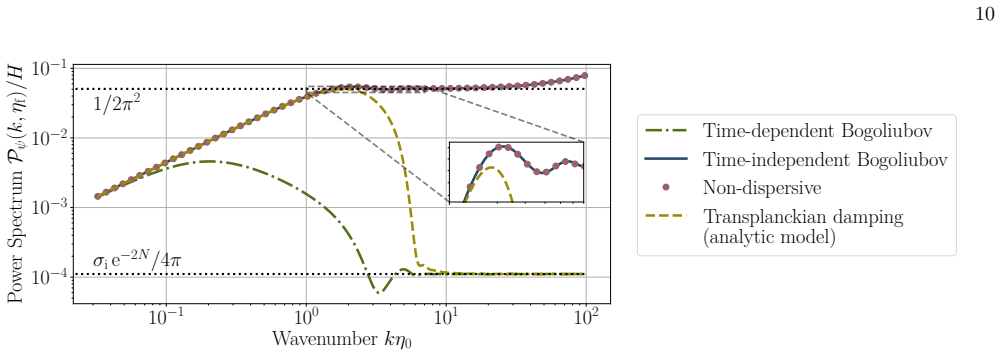
Exponential expansion In fig. 4 we show how these three cases modify the power spectrum created by an exponential expansion with reference values ( 71) using numerical simulations of the mode evolution. The time-independent Bogoli- ubov dispersion (which is equivalent to the superluminal Corley-Jacobson case [ 34]) does respect scale-invariance as it is we...
-
[2]
Contraction In fig. 5 we show the sensitivity of the power-law con- traction with reference values ( 80) to the dispersive ef- fects described in cases (i) - (iii). Therein, the situation is reversed in the sense that the time-dependent dispersion weakly alters the non-dispersive power spectrum by small oscillations whereas the time-independent case leads ...
-
[3]
The resulting effective mass and the purely dispersive term are shown in the left panel of fig
Linear expansion A linear expansion between initial and final scale-factor values ai,f corresponds to a(t)/ai = 1 + H0t where the constant Hubble rate is H0 = (af /ai − 1)/(ci s∆t) in terms of the expansion duration ∆t. The resulting effective mass and the purely dispersive term are shown in the left panel of fig. 9, where one sees that the latter domi- nate...
-
[4]
This has the advantage that the probability of non-adiabatic transi- tions is boosted by the cusp
Bouncing cusps To increase the magnitude of the particle production signal, one can consider a cosmological contraction fol- lowed by an expansion by a ratio ab/ai < 1 via the scale- factor acusp(t) = (ab/ai)2 − |cos(ω0t)| −1/2 , (120) with a cusp-singularity at the turning point. This has the advantage that the probability of non-adiabatic transi- tions ...
-
[5]
Atomic density correlations At linear order, the total atomic density operator is expanded into a background- and fluctuating part ˆρ(t, x) = ρ0 + √ρ0 (δ ˆϕ + δ ˆϕ†). (A4) The connected equal-time density correlator, Gρρ(t, x; t′, x′) = ⟨ˆρ(t, x)ˆρ(t, x′)⟩ − ⟨ ˆρ(t, x)⟩⟨ˆρ(t, x′)⟩ (A5) can be expanded in Fourier space, Gρρ(t, k; t′, k′) = Z dx dx′e−i(kx+k′...
-
[6]
Collective excitations The Hamiltonian of the linear perturbations is diago- nalized by the Bogoliubov transformation δϕk = uk ˆφk + v∗ −k ˆφ† −k, (A11) where we introduce the quasi-particle operators ˆφk, ˆφ† k. The Bogoliubov coefficients can be parametrized as uk = cosh χk, v k = sinh χk, (A12) 18 with coth(2χk) = −1 − k2ξ2, (A13) where ℏ2 2mξ2 = λn0 = m...
-
[7]
Mild ultraviolet regime As long as (kη0)4 < 1/σ we have ν(k) ∈ R and there- fore can approximate Yν(k)(kη0e−N ) ≈ − Γ(ν(k)) π kη0e−N 2 −ν(k) , (D10) to find Pψ(k, ηf ) = H 32π Γ2(ν(k)) kη0 2 1−2ν(k) e−2N (1−ν(k)) p 1 + (kη0σ)2 (−1 + 2ν(k))Jν(k)(kη0) − 2kη0Jν(k)−1(kη0) 2 + (2ωiη0)2Jν(k)(kη0)2 , (D11) which converges to the non-dispersive result ( 68) in the...
-
[8]
F ar ultraviolet regime For (kη0)4 > 1/σi, the order ν(k) becomes purely imaginary, ν(k) ∈ iR. This requires to write the mode solution in a different basis, ψk(η) = iπ 4 1√2ωi r η0 − η η0 × rF|ν(k)|[k(η0 − η)] + sG|ν(k)|[k(η0 − η)] , (D12) with the coefficients r = −(1 + 2iωiη0)G|ν(k)|(kη0) − 2kη0∂xG|ν(k)|(x)|x=kη0 , (D13) s = (1 + 2i ωiη0)F|ν(k)|(kη0) + 2k...
-
[9]
Infrared (acoustic) limit The relation ( 102) between the density-density corre- lations Gnn and the power spectrum S(k) reduces to Gnn(t, L) = ℏaf mn0 Z k J0(kL) k S(k), (E1) which coincides with the acoustic result [ 93]
-
[10]
(102) for the density correlation function
Ultraviolet limit: Shot-noise As a consistency check, let us apply this limit to eq. (102) for the density correlation function. As a conse- quence of abscent quasi-particles, the limit of the excita- tion spectrum assumes the value S(k) ≃ 1/2 and becomes static. From the integrand of eq. ( 102) we can read off that ⟨δc(k)δc(k′)⟩ = ℏaf mn0 k S(k)q 1 + 1 2 ...
-
[11]
S. W. Hawking, Nature 248, 30 (1974)
work page 1974
-
[12]
S. W. Hawking, Comm. Math. Phys. 43, 199 (1975)
work page 1975
- [13]
-
[14]
Y. B. Zel’Dovich, Soviet Journal of Experimental and Theoretical Physics Letters 14, 180 (1971)
work page 1971
-
[15]
W. G. Unruh, Phys. Rev. D 10, 3194 (1974)
work page 1974
-
[16]
G. T. Moore, Journal of Mathematical Physics 11, 26792691 (1970)
work page 1970
-
[17]
Proceedings of the Royal Society of London. A. Mathe- matical and Physical Sciences 348, 393414 (1976)
work page 1976
-
[18]
M. J. Jacquet, T. Boulier, F. Claude, A. Maître, E. Can- cellieri, C. Adrados, A. Amo, S. Pigeon, Q. Glorieux, A. Bramati, and E. Giacobino, Philosophical Transac- tions of the Royal Society A: Mathematical, Physical and Engineering Sciences 378, 20190225 (2020)
work page 2020
-
[19]
C. Barcelo, S. Liberati, and M. Visser, (2024), arXiv:gr- qc/0505065v4 [gr-qc]
-
[20]
Schützhold, (2025), arXiv:2501.03785 [quant-ph]
R. Schützhold, (2025), arXiv:2501.03785 [quant-ph]
- [21]
-
[22]
A. A. Starobinsky, JETP Lett. 30, 682 (1979)
work page 1979
-
[23]
V. F. Mukhanov and G. V. Chibisov, JETP Lett. 33, 532 (1981)
work page 1981
-
[24]
V. Mukhanov, H. Feldman, and R. Brandenberger, Physics Reports 215, 203 (1992)
work page 1992
- [25]
- [26]
-
[27]
R. H. Brandenberger, (2012), arXiv:1206.4196 [astro- ph.CO]
work page internal anchor Pith review Pith/arXiv arXiv 2012
- [28]
-
[29]
R. H. Brandenberger, Inflationary cosmology: Progress and problems (Springer Netherlands, Dordrecht, 2000) pp. 169–211
work page 2000
-
[30]
Planck 2018 results. X. Constraints on inflation
Y. Akrami et al. (Planck), Astron. Astrophys. 641, A10 (2020), arXiv:1807.06211 [astro-ph.CO]
work page internal anchor Pith review Pith/arXiv arXiv 2020
-
[31]
R. H. Brandenberger and J. Martin, Classical and Quan- tum Gravity 30, 113001 (2013)
work page 2013
- [32]
- [33]
-
[34]
T. P. Sotiriou, M. Visser, and S. Weinfurtner, Phys. Rev. Lett. 102, 251601 (2009)
work page 2009
-
[35]
G. E. Volovik, JETP Letters 89, 525528 (2009)
work page 2009
-
[36]
T. P. Sotiriou, Journal of Physics: Conference Series 283, 012034 (2011)
work page 2011
- [37]
- [38]
-
[39]
Liberati, Classical and Quantum Gravity 30, 133001 (2013)
S. Liberati, Classical and Quantum Gravity 30, 133001 (2013)
work page 2013
-
[40]
W. G. Unruh, Phys. Rev. Lett. 46, 1351 (1981)
work page 1981
-
[41]
W. G. Unruh, Phys. Rev. D 51, 2827 (1995)
work page 1995
- [42]
- [43]
- [44]
-
[45]
Jacobson, Progress of Theoretical Physics Supple- ment 136, 117 (1999)
T. Jacobson, Progress of Theoretical Physics Supple- ment 136, 117 (1999)
work page 1999
-
[46]
A Cosmological Window on Trans-Planckian Physics
J. Martin and R. H. Brandenberger, in 9th Marcel Grossmann Meeting on Recent Developments in The- oretical and Experimental General Relativity, Gravita- tion and Relativistic Field Theories (MG 9) (2000) pp. 2001–2002, arXiv:astro-ph/0012031
work page internal anchor Pith review Pith/arXiv arXiv 2000
- [47]
-
[48]
R. H. Brandenberger and J. Martin, Modern Physics Letters A 16, 9991006 (2001)
work page 2001
- [49]
-
[50]
R. H. Brandenberger, S. E. Jorás, and J. Martin, Phys. Rev. D 66, 083514 (2002)
work page 2002
-
[51]
J. C. Niemeyer, Phys. Rev. D 63, 123502 (2001)
work page 2001
-
[52]
J. C. Niemeyer and R. Parentani, Phys. Rev. D 64, 101301 (2001)
work page 2001
-
[53]
Parentani, International Journal of Modern Physics A 17, 27212725 (2002)
R. Parentani, International Journal of Modern Physics A 17, 27212725 (2002)
work page 2002
- [54]
-
[55]
A. A. Starobinsky, Journal of Experimental and Theo- retical Physics Letters 73, 371374 (2001)
work page 2001
-
[56]
W. G. Unruh and R. Schützhold, Phys. Rev. D 71, 024028 (2005)
work page 2005
- [58]
-
[59]
R. H. Brandenberger and J. Martin, International Jour- 24 nal of Modern Physics A 17, 36633680 (2002)
work page 2002
-
[60]
F. Belgiorno, S. L. Cacciatori, M. Clerici, V. Gorini, G. Ortenzi, L. Rizzi, E. Rubino, V. G. Sala, and D. Fac- cio, Phys. Rev. Lett. 105, 203901 (2010)
work page 2010
-
[61]
S. Weinfurtner, E. W. Tedford, M. C. J. Penrice, W. G. Unruh, and G. A. Lawrence, Phys. Rev. Lett. 106, 021302 (2011)
work page 2011
-
[62]
J.-C. Jaskula, G. B. Partridge, M. Bonneau, R. Lopes, J. Ruaudel, D. Boiron, and C. I. Westbrook, Phys. Rev. Lett. 109, 220401 (2012)
work page 2012
-
[63]
C.-L. Hung, V. Gurarie, and C. Chin, Science 341, 12131215 (2013)
work page 2013
- [64]
- [65]
- [66]
-
[67]
M. Wittemer, F. Hakelberg, P. Kiefer, J.-P. Schröder, C. Fey, R. Schützhold, U. Warring, and T. Schaetz, Phys. Rev. Lett. 123, 180502 (2019)
work page 2019
-
[68]
C.-A. Chen, S. Khlebnikov, and C.-L. Hung, Phys. Rev. Lett. 127, 060404 (2021)
work page 2021
-
[69]
M. C. Braidotti, R. Prizia, C. Maitland, F. Marino, A. Prain, I. Starshynov, N. Westerberg, E. M. Wright, and D. Faccio, Phys. Rev. Lett. 128, 013901 (2022)
work page 2022
-
[70]
J. Steinhauer, M. Abuzarli, T. Aladjidi, T. Bien- aimé, C. Piekarski, W. Liu, E. Giacobino, A. Bra- mati, and Q. Glorieux, Nature Communications 13, 10.1038/s41467-022-30603-1 (2022)
-
[71]
C. Viermann, M. Sparn, N. Liebster, M. Hans, E. Kath, Á. Parra-López, M. Tolosa-Simeón, N. Sánchez-Kuntz, T. Haas, H. Strobel, S. Floerchinger, and M. K. Oberthaler, Nature 611, 260 (2022)
work page 2022
- [72]
-
[73]
V. Gondret, R. Dias, C. Lamirault, L. Camier, A. Micheli, C. Leprince, Q. Marolleau, S. Robertson, D. Boiron, and C. I. Westbrook, Comptes Rendus. Physique 10.5802/crphys.266 (2024), online first
- [74]
-
[75]
S. Weinfurtner, A. White, and M. Visser, Phys. Rev. D 76, 124008 (2007)
work page 2007
-
[76]
S. Weinfurtner, P. Jain, M. Visser, and C. W. Gardiner, Classical and Quantum Gravity 26, 065012 (2009)
work page 2009
- [77]
- [78]
- [79]
- [80]
-
[81]
S. Finazzi and R. Parentani, Journal of Physics: Con- ference Series 314, 012030 (2011)
work page 2011
discussion (0)
Sign in with ORCID, Apple, or X to comment. Anyone can read and Pith papers without signing in.