Phonon-induced Markovian and non-Markovian effects on absorption spectra of moir\'e excitons in twisted transition metal dichalcogenide bilayers
Pith reviewed 2026-05-16 15:42 UTC · model grok-4.3
The pith
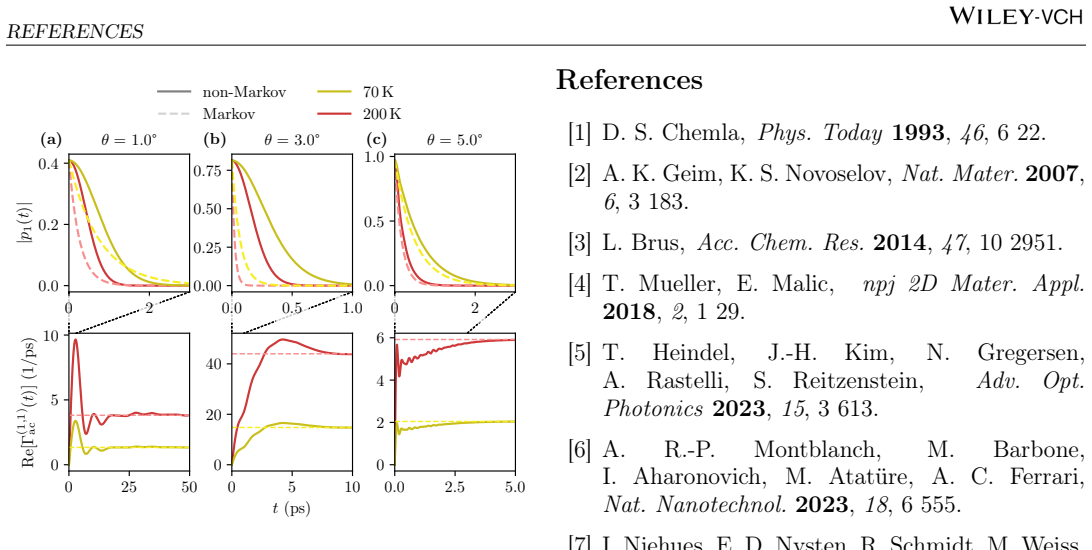
Twist angle tunes exciton-phonon coupling in TMDC bilayers from non-Markovian polarization with sidebands at small angles to Markovian broadening at larger angles.
A machine-rendered reading of the paper's core claim, the machinery that carries it, and where it could break.
Core claim
For the lowest-lying intralayer moiré exciton the exciton-phonon coupling interpolates between two regimes with twist angle. Small angles produce non-Markovian polarization dynamics and phonon sidebands that dominate the absorption spectra of localized excitons; larger angles make Markovian processes dominant and add line broadening. With several bright moiré bands present, intraband scattering by optical phonons suppresses absorption peaks of higher-lying bands when their bandwidth exceeds the optical phonon energy.
What carries the argument
Twist-angle-dependent exciton-phonon coupling matrix elements that interpolate between localized and delocalized exciton regimes without extra fitting parameters.
If this is right
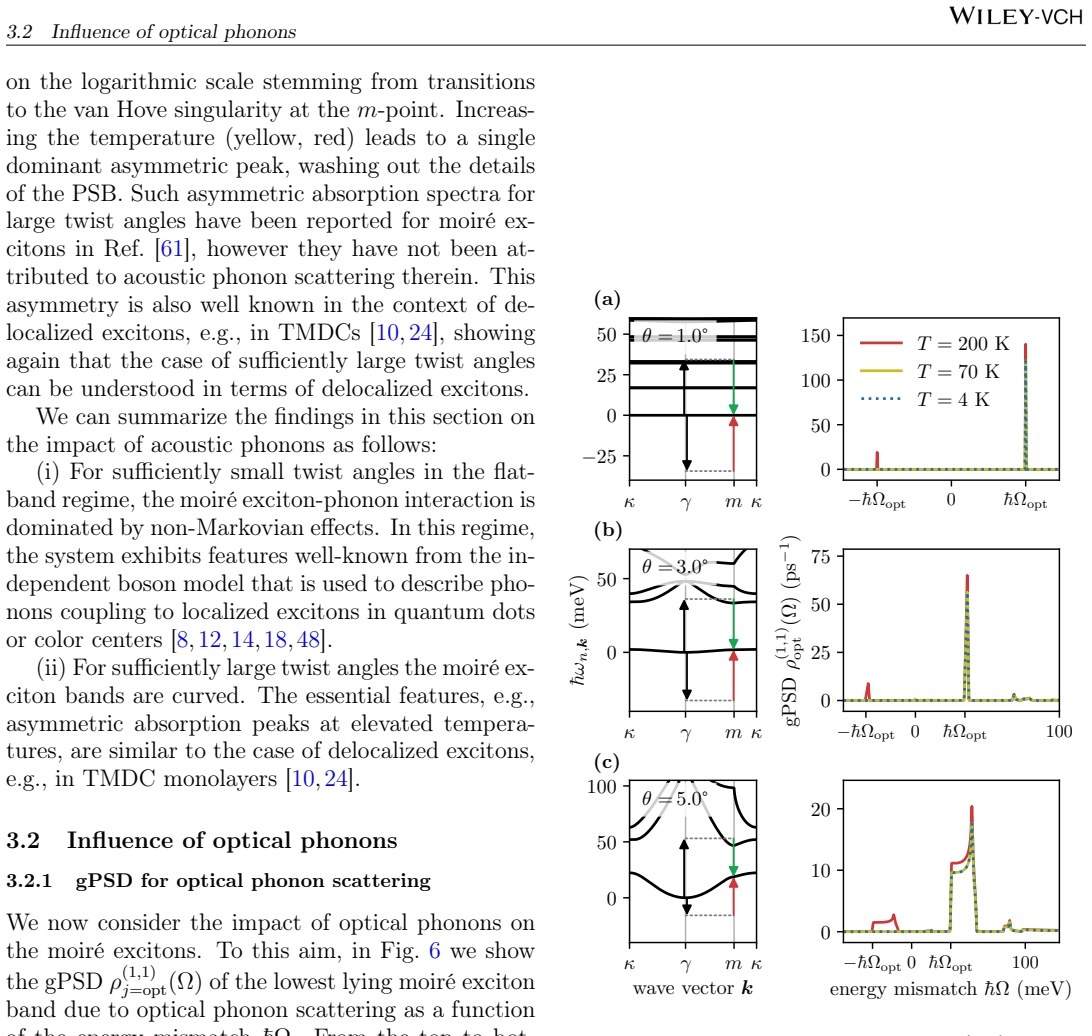
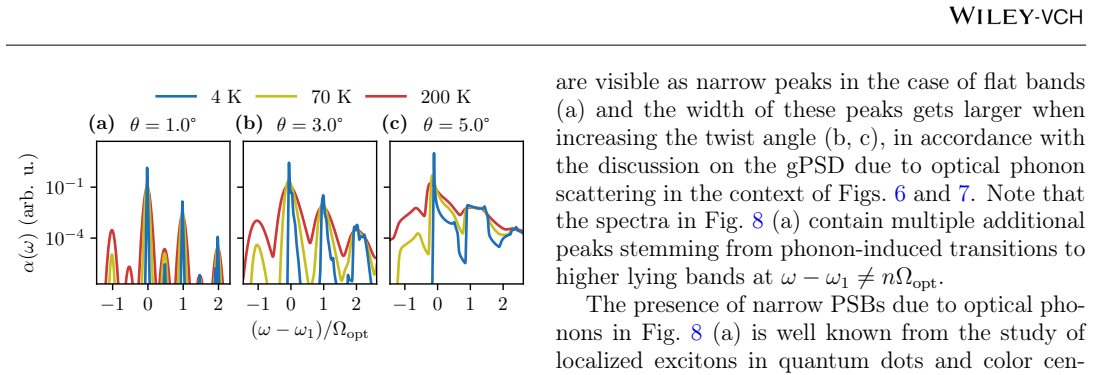
- Absorption spectra of localized moiré excitons at small twist angles display distinct phonon sidebands that cannot be reproduced by Markovian rate equations.
- Line broadening increases with twist angle once the exciton becomes sufficiently delocalized for Markovian scattering to dominate.
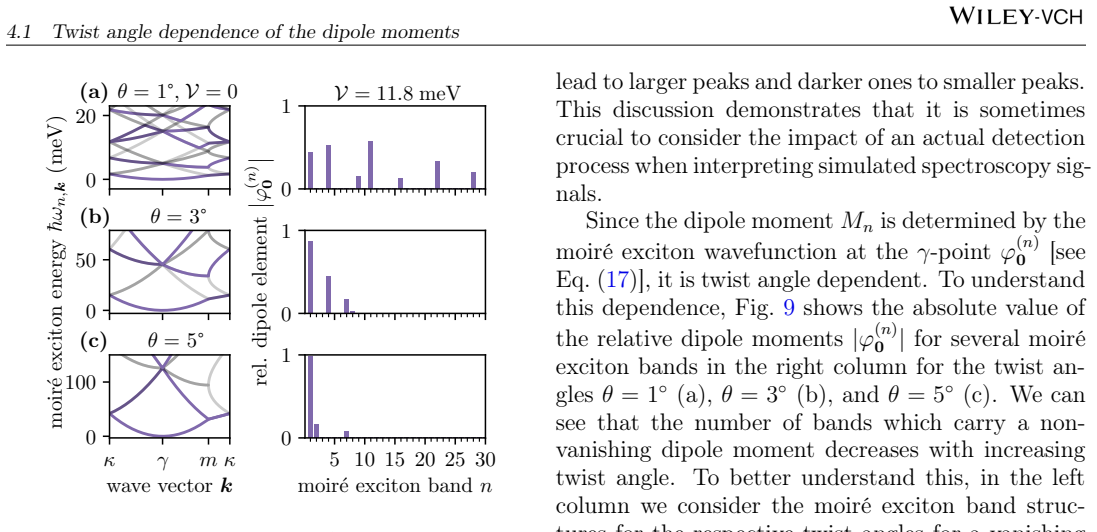
- Higher-lying bright moiré bands lose spectral weight when their bandwidth exceeds the optical-phonon energy due to intraband phonon scattering.
Where Pith is reading between the lines
- Similar twist-angle crossovers may appear in other moiré systems once the exciton localization length becomes comparable to the phonon wavelength.
- The predicted suppression of higher bands could be tested by comparing spectra with and without optical-phonon modes included in the calculation.
- If lattice relaxation alters the coupling matrix elements, the crossover angle would shift, providing a direct experimental handle on relaxation effects.
Load-bearing premise
The exciton-phonon coupling matrix elements follow the specific interpolation set by the moiré potential alone, so that the non-Markovian to Markovian crossover occurs exactly as predicted.
What would settle it
Measure the absorption spectrum of the lowest moiré exciton while continuously varying the twist angle across the predicted crossover point and check whether phonon sidebands give way to symmetric broadening without additional fitting.
Figures


read the original abstract
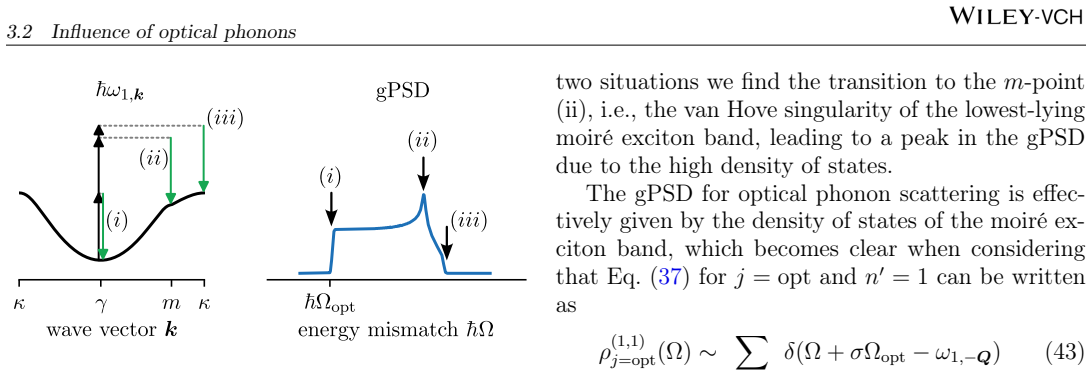
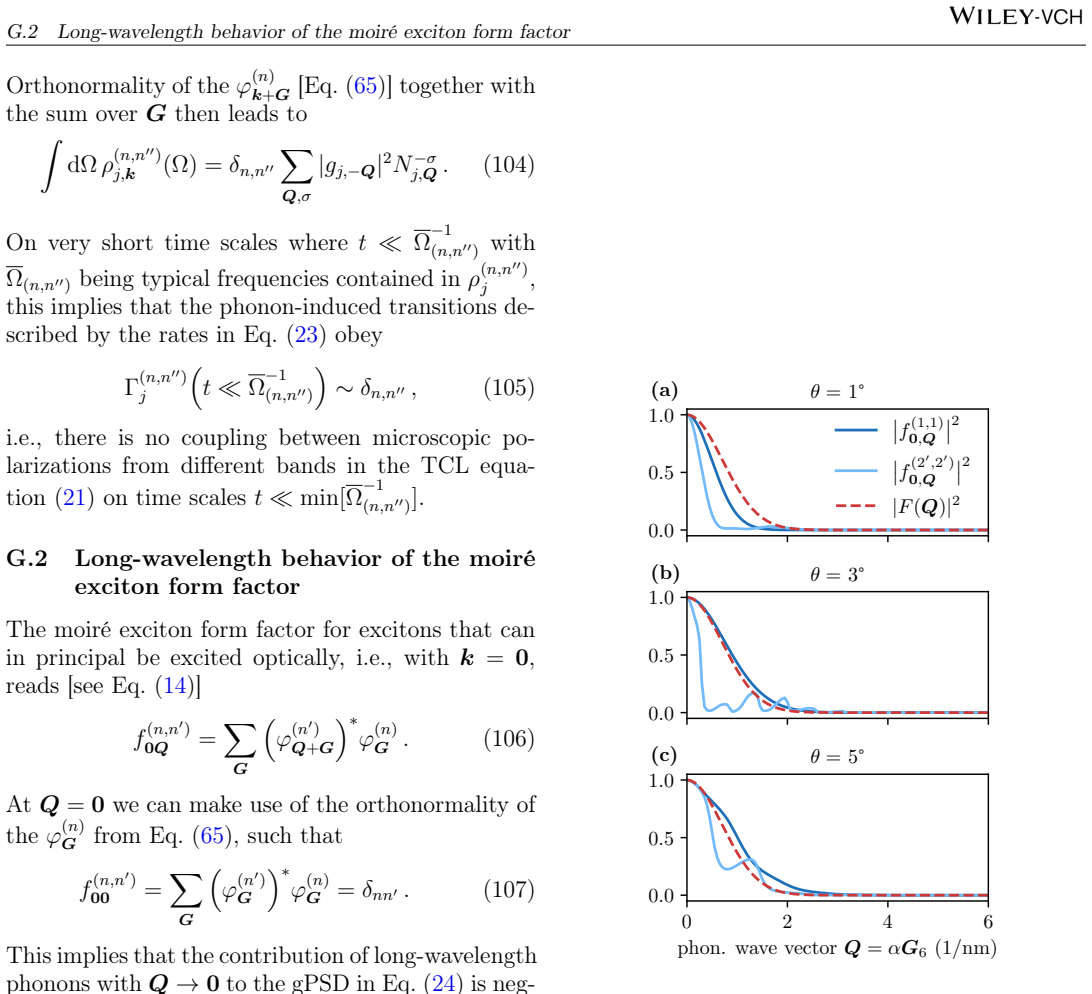
The properties of moir\'e excitons in twisted bilayers of transition metal dichalcogenides (TMDCs) vary significantly with the twist angle, ranging from quasi localized excitons with flat dispersions for small twist angles to delocalized excitons for larger ones. This twist angle dependence directly impacts the exciton-phonon coupling, which plays a significant role for the optical properties of these materials. In this work we theoretically investigate the twist angle dependent influence of phonons on absorption spectra of intralayer moir\'e excitons in a twisted TMDC hetero-bilayer. For the lowest-lying intralayer moir\'e exciton we find that the exciton-phonon coupling interpolates between two physically distinct regimes when tuning the twist angle. At small twist angles non-Markovian polarization dynamics and phonon sidebands dominate the properties of absorption spectra for localized excitons. For larger twist angles Markovian processes become more important leading to additional line broadening. Furthermore, the absorption spectra here show a characteristic asymmetric peak similar to monolayer TMDCs. When taking into account multiple bright moir\'e exciton bands we find that intraband scattering due to optical phonons has a significant impact on absorption spectra, effectively suppressing absorption peaks of higher lying bands when their bandwidth surpasses the optical phonon energy.
Editorial analysis
A structured set of objections, weighed in public.
Referee Report
Summary. The paper investigates the twist-angle dependence of phonon effects on absorption spectra of intralayer moiré excitons in twisted TMDC hetero-bilayers. It claims that the exciton-phonon coupling for the lowest-lying intralayer moiré exciton interpolates between non-Markovian (small twists: localized excitons with phonon sidebands dominating polarization dynamics) and Markovian (larger twists: delocalized excitons with additional line broadening) regimes. With multiple bright bands included, intraband scattering by optical phonons suppresses absorption peaks of higher-lying bands when their bandwidth exceeds the optical phonon energy. The model uses the twist-dependent moiré potential to determine the coupling matrix elements without additional free parameters.
Significance. If the central claims hold, the work provides a concrete mechanism by which twist angle tunes the optical response of moiré excitons through phonon interactions, predicting a crossover from sideband-dominated to broadening-dominated spectra and a suppression effect for higher bands. The parameter-free interpolation via the moiré potential is a notable strength, offering falsifiable predictions for experiments on TMDC heterostructures.
major comments (2)
- [Model description and exciton-phonon coupling] The central claim of a smooth interpolation between non-Markovian and Markovian regimes rests on the specific form chosen for the exciton-phonon coupling matrix elements, which is taken to depend only on the twist-angle-dependent moiré potential (abstract and model description). This assumption is load-bearing: if lattice relaxation modifies local strain and thereby alters the coupling strengths (especially for optical phonons), the predicted crossover and the suppression of higher bands would not occur. A concrete test against relaxed lattice structures is required.
- [§4 (multiple bright moiré exciton bands)] The truncation to a finite number of exciton bands and the selection of phonon modes are not shown to be robust; the abstract notes that post-hoc choices could affect the claimed crossover and the intraband scattering suppression. §4 (results on multiple bands) should demonstrate that the qualitative features survive reasonable variations in cutoff and mode inclusion.
minor comments (2)
- [Theory section] Notation for the polarization dynamics and the Markovian vs. non-Markovian limits should be defined more explicitly in the main text rather than relying on supplementary material.
- [Figures 3 and 4] Figure captions for the absorption spectra should state the precise twist angles and phonon energies used so that the crossover is directly readable from the plots.
Simulated Author's Rebuttal
We thank the referee for their thorough review and constructive feedback on our manuscript. We address each of the major comments in detail below, providing clarifications and indicating revisions where appropriate.
read point-by-point responses
-
Referee: The central claim of a smooth interpolation between non-Markovian and Markovian regimes rests on the specific form chosen for the exciton-phonon coupling matrix elements, which is taken to depend only on the twist-angle-dependent moiré potential (abstract and model description). This assumption is load-bearing: if lattice relaxation modifies local strain and thereby alters the coupling strengths (especially for optical phonons), the predicted crossover and the suppression of higher bands would not occur. A concrete test against relaxed lattice structures is required.
Authors: We acknowledge the importance of considering lattice relaxation effects on the exciton-phonon coupling. Our approach derives the coupling matrix elements from the twist-dependent moiré potential without additional parameters, as this potential encapsulates the dominant modulation due to the twist angle. While lattice relaxation can introduce local strain variations, for the twist angles studied (typically 1-5 degrees), the moiré potential remains the primary determinant. We have added a paragraph in the model section discussing this approximation and arguing that the qualitative crossover and suppression effects are robust against moderate strain perturbations. A full calculation with relaxed structures would require large-scale DFT relaxations, which we suggest as future work but is beyond the current scope. revision: partial
-
Referee: The truncation to a finite number of exciton bands and the selection of phonon modes are not shown to be robust; the abstract notes that post-hoc choices could affect the claimed crossover and the intraband scattering suppression. §4 (results on multiple bands) should demonstrate that the qualitative features survive reasonable variations in cutoff and mode inclusion.
Authors: We appreciate this suggestion for demonstrating robustness. In the revised version of §4, we have included additional figures and text showing the absorption spectra computed with varying numbers of exciton bands (from 2 to 6) and different phonon mode selections (including only acoustic, only optical, and both). The key features—the non-Markovian to Markovian crossover for the lowest band and the suppression of higher bands via intraband optical phonon scattering when bandwidth > phonon energy—persist across these choices. We have updated the abstract slightly for clarity and added convergence tests. revision: yes
Circularity Check
No circularity: derivation computes interpolation from moiré wavefunctions
full rationale
The paper starts from the twist-angle-dependent moiré potential to obtain exciton wavefunctions, computes the exciton-phonon matrix elements directly from those wavefunctions via overlap integrals, and solves the resulting polarization dynamics and spectra. The claimed crossover from non-Markovian sidebands (small twist, localized) to Markovian broadening (larger twist, delocalized) is an output of this calculation rather than an input or redefinition. No step reduces by construction to a fitted parameter, self-citation chain, or ansatz smuggled from prior work; the model remains self-contained against its stated assumptions about the coupling form.
Axiom & Free-Parameter Ledger
Lean theorems connected to this paper
-
IndisputableMonolith/Cost/FunctionalEquation.leanwashburn_uniqueness_aczel unclear?
unclearRelation between the paper passage and the cited Recognition theorem.
TCL master equation (21) for polarizations p_n(t) with dissipation matrix Γ_j(t) from gPSD ρ(Ω) (24); acoustic/optical phonon branches with linear/dispersionless Ω(Q) and deformation-potential g_j,Q
-
IndisputableMonolith/Foundation/DimensionForcing.leanalexander_duality_circle_linking unclear?
unclearRelation between the paper passage and the cited Recognition theorem.
Twist-angle dependence of moiré exciton bands via Eq. (6) eigenvalue problem with phenomenological V_G (4); crossover at magic angle θ_c where bandwidth matches phonon energy
What do these tags mean?
- matches
- The paper's claim is directly supported by a theorem in the formal canon.
- supports
- The theorem supports part of the paper's argument, but the paper may add assumptions or extra steps.
- extends
- The paper goes beyond the formal theorem; the theorem is a base layer rather than the whole result.
- uses
- The paper appears to rely on the theorem as machinery.
- contradicts
- The paper's claim conflicts with a theorem or certificate in the canon.
- unclear
- Pith found a possible connection, but the passage is too broad, indirect, or ambiguous to say the theorem truly supports the claim.
Reference graph
Works this paper leans on
-
[1]
C. F. Klingshirn,Semiconductor Optics, Springer, Berlin Heidelberg,2012
work page 2012
-
[2]
G. D. Mahan,Many-Particle Physics, Springer, New York,2000
work page 2000
- [3]
-
[4]
L. Novotny, B. Hecht,Principles of nano-optics, Cambridge University Press,2012
work page 2012
- [5]
- [6]
-
[7]
F. A. Rasmussen, K. S. Thygesen,J. Phys. Chem. C2015,119, 23 13169
-
[8]
X. Li, J. T. Mullen, Z. Jin, K. M. Borysenko, M. Buongiorno Nardelli, K. W. Kim,Phys. Rev. B2013,87, 11 115418
-
[9]
Z. Jin, X. Li, J. T. Mullen, K. W. Kim,Phys. Rev. B2014,90045422
- [10]
- [11]
-
[12]
G. Wang, L. Bouet, D. Lagarde, M. Vidal, A. Balocchi, T. Amand, X. Marie, B. Urbaszek, Phys. Rev. B2014,90, 7 075413
-
[13]
D. Lagarde, L. Bouet, X. Marie, C. Zhu, B. Liu, T. Amand, P. Tan, B. Urbaszek,Phys. Rev. Lett.2014,112, 4 047401
work page 2014
-
[14]
G. Lindwall, A. Wacker, C. Weber, A. Knorr, Phys. Rev. Lett.2007,99, 8 087401
work page 2007
-
[15]
C. Jin, E. C. Regan, A. Yan, M. Iqbal Bakti Utama, D. Wang, S. Zhao, Y. Qin, S. Yang, Z. Zheng, S. Shi, K. Watanabe, T. Taniguchi, S. Tongay, A. Zettl, F. Wang,Na- ture2019,567, 7746 76
-
[16]
J. H. Eberly, K. Wódkiewicz,J. Opt. Soc. Am. 1977,671252
work page 1977
-
[17]
W.-K. Li, S. M. Blinder,J. Math. Phys.1985, 26, 11 2784
work page 1985
-
[18]
D. A. Ruiz-Tijerina, I. Soltero, F. Mireles,Phys. Rev. B2020,102, 19 195403
-
[19]
V. M. Axt, A. Stahl,Z. Phys. B1994,93, 2 195. 30
discussion (0)
Sign in with ORCID, Apple, or X to comment. Anyone can read and Pith papers without signing in.