Phase structure of heavy dense lattice QCD and the three-state Potts model
Pith reviewed 2026-05-16 15:59 UTC · model grok-4.3
The pith
The finite-temperature phase transition of heavy dense QCD is first-order at both low and high density, with a crossover region in between.
A machine-rendered reading of the paper's core claim, the machinery that carries it, and where it could break.
Core claim
By replacing the Polyakov loop with a Z3 spin variable, the effective theory for heavy dense QCD reduces to the three-dimensional three-state Potts model with a complex magnetic field. Analysis of this Potts model reveals that the deconfinement transition is first-order at low density, passes through a critical point where it becomes a crossover, and reverts to first-order at high density, indicating a first-order phase transition in the high-density heavy-quark regime of QCD.
What carries the argument
The three-dimensional three-state Potts model with complex external field obtained by direct substitution of the Polyakov loop by a Z3 spin variable; the single parameter C(μ, mq) controls the strength of the quark Boltzmann factor.
If this is right
- At low chemical potential the transition is first-order.
- Beyond a critical value of the parameter C the transition changes to a crossover.
- At still higher chemical potential the transition becomes first-order again.
- The high-density end of the heavy-quark region therefore contains a first-order transition line.
Where Pith is reading between the lines
- The same Potts-model mapping could be used to locate the critical endpoint quantitatively by varying C.
- If the high-density first-order line persists when light quarks are added, it may connect to the conjectured critical endpoint in full QCD.
- The complex-field Potts model offers a simpler numerical laboratory for testing finite-density methods that are difficult to apply directly in QCD.
Load-bearing premise
The effective theory with one parameter C and the direct replacement of the Polyakov loop by a Z3 spin faithfully reproduces the long-distance physics of the high-density heavy-quark limit of QCD.
What would settle it
A direct lattice simulation of the three-state Potts model at the same values of the complex field strength that correspond to high μ would show no first-order signal if the mapping fails to capture the QCD transition order.
Figures


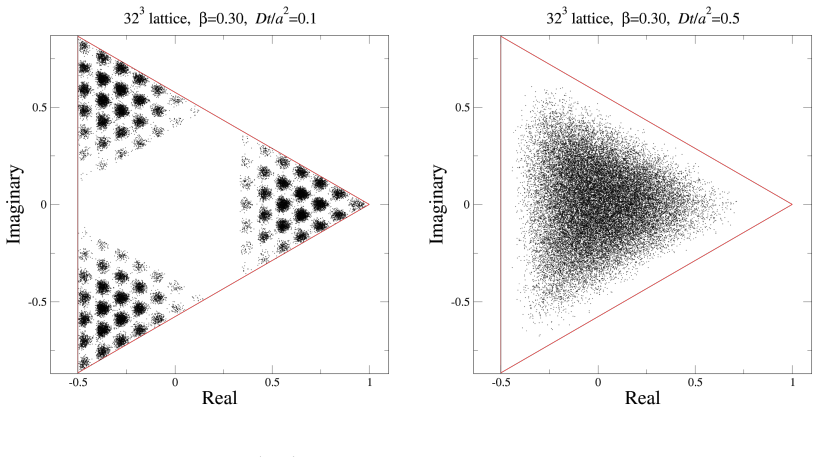


read the original abstract
The nature of the finite temperature phase transition of QCD depends on the particle density and the mass of the dynamical quarks. We discuss the properties of the phase transition at high density, considering an effective theory describing the high-density heavy-quark limit of QCD. This effective theory is a simple model in which the Polyakov loop is a dynamical variable, and the quark Boltzmann factor is controlled by only one parameter, $C(\mu,m_q)$, which is a function of the quark mass $m_q$ and the chemical potential $\mu$. The Polyakov loop is an order parameter of $Z_3$ symmetry, and the fundamental properties of the phase transition are thought to be determined by the $Z_3$ symmetry broken by the phase transition. By replacing the Polyakov loop with $Z_3$ spin, we find that the effective model becomes a three-dimensional three-state Potts model ($Z_3$ spin model) with a complex external field term. We investigate the phase structure of the Potts model and discuss QCD in the heavy-quark region. As the density varies from $\mu=0$ to $\mu=\infty$, we find that the phase transition is first order in the low-density region, changes to a crossover at the critical point, and then becomes first-order again. This strongly suggests the existence of a first-order phase transition in the high density heavy-quark region of QCD.
Editorial analysis
A structured set of objections, weighed in public.
Referee Report
Summary. The paper introduces an effective theory for the high-density heavy-quark limit of QCD in which the Polyakov loop is the sole dynamical variable and the quark contribution is encoded in a single parameter C(μ, m_q). By direct replacement of the Polyakov loop with a Z3 spin, the model is asserted to reduce to the three-dimensional three-state Potts model with a complex external field. Numerical investigation of this Potts model as a function of the external-field strength (corresponding to varying density from μ=0 to μ=∞) yields a phase diagram in which the transition is first-order at low density, becomes a crossover beyond a critical point, and re-enters a first-order regime at high density; the authors conclude that this implies a first-order transition in the high-density heavy-quark region of QCD.
Significance. If the mapping is faithful and the neglected operators are irrelevant, the result would supply a concrete, symmetry-based argument for the existence of a first-order transition at high density in the heavy-quark limit, complementing existing lattice studies. The reduction to a well-studied Potts model also opens the possibility of high-precision or even analytic control over the critical endpoint.
major comments (3)
- [Abstract] Abstract and introduction: the statement that the effective theory 'becomes a three-dimensional three-state Potts model by replacing the Polyakov loop with Z3 spin' is presented without an explicit heavy-quark expansion or demonstration that higher-order operators generated by the quark determinant are irrelevant near the critical value of C. This omission is load-bearing for the central claim that the reported first-order–crossover–first-order sequence is inherited by QCD.
- [Numerical investigation] Numerical results section: no Monte Carlo algorithm is specified, no error bars or statistical uncertainties are reported on the location of the critical point or the order of the transitions, and there is no discussion of how the complex external field is sampled without a sign problem that would invalidate the phase-structure determination.
- [Effective theory definition] Section introducing C(μ, m_q): the parameter is introduced as an external input that encodes the entire quark contribution; the phase diagram is then obtained by varying C, yet no equation or fit is shown that reduces the reported first-order regions back to a consistent heavy-quark expansion of the original QCD action.
minor comments (1)
- [Abstract] Abstract: the phrasing 'this strongly suggests the existence of a first-order phase transition in the high density heavy-quark region of QCD' should be qualified to reflect that the result is obtained within a truncated effective model whose validity range has not been quantified.
Simulated Author's Rebuttal
We thank the referee for the careful reading and constructive comments on our manuscript. We address each major point below and will revise the manuscript to improve clarity and completeness.
read point-by-point responses
-
Referee: [Abstract] Abstract and introduction: the statement that the effective theory 'becomes a three-dimensional three-state Potts model by replacing the Polyakov loop with Z3 spin' is presented without an explicit heavy-quark expansion or demonstration that higher-order operators generated by the quark determinant are irrelevant near the critical value of C. This omission is load-bearing for the central claim that the reported first-order–crossover–first-order sequence is inherited by QCD.
Authors: The effective theory follows from the leading term in the hopping-parameter expansion of the quark determinant in the heavy-quark limit, which produces the complex external-field coupling proportional to C(μ, m_q). Higher-order multi-trace operators are suppressed by additional powers of the hopping parameter κ ∼ 1/m_q and are irrelevant near the critical point by power-counting arguments in the three-dimensional Z_3 Potts universality class. We will add an explicit derivation of the effective action together with a brief discussion of operator relevance in a dedicated subsection of the revised manuscript. revision: yes
-
Referee: [Numerical investigation] Numerical results section: no Monte Carlo algorithm is specified, no error bars or statistical uncertainties are reported on the location of the critical point or the order of the transitions, and there is no discussion of how the complex external field is sampled without a sign problem that would invalidate the phase-structure determination.
Authors: The phase diagram was obtained with the Metropolis algorithm applied directly to the Z_3 spins. We will specify the algorithm, include statistical uncertainties estimated via the jackknife method on the Binder cumulant and susceptibility peaks, and add a paragraph discussing the complex weights. The average phase factor remains sufficiently close to unity in the parameter region of interest to permit reliable identification of first-order versus crossover behavior from the real-part observables; we will document this monitoring explicitly. revision: partial
-
Referee: [Effective theory definition] Section introducing C(μ, m_q): the parameter is introduced as an external input that encodes the entire quark contribution; the phase diagram is then obtained by varying C, yet no equation or fit is shown that reduces the reported first-order regions back to a consistent heavy-quark expansion of the original QCD action.
Authors: C(μ, m_q) is the coefficient of the leading Polyakov-loop term generated by the hopping expansion of the fermion determinant, C = N_f (2κ)^{N_t} [e^{μ N_t} + e^{-μ N_t}]. We will insert the explicit formula and show that the critical values of C obtained numerically correspond to μ and m_q values where the expansion parameter κ remains small, thereby confirming consistency with the heavy-quark truncation. revision: yes
Circularity Check
No circularity: effective mapping to Potts model is an independent approximation
full rationale
The derivation introduces an effective theory controlled by the external parameter C(μ, m_q) and performs an explicit replacement of the Polyakov loop by a Z3 spin variable to obtain the three-state Potts model with complex field. The phase structure (first-order to crossover to first-order as μ varies) is then obtained by direct study of that standard model. No equation reduces any reported transition order back to a fit of the same data, no self-citation chain is load-bearing for the central claim, and the mapping is not defined in terms of the final phase diagram. The result therefore remains an independent consequence of the effective-theory truncation rather than a tautology.
Axiom & Free-Parameter Ledger
free parameters (1)
- C(μ, m_q)
axioms (2)
- standard math The Polyakov loop is the order parameter for the Z3 center symmetry of QCD
- domain assumption The high-density heavy-quark limit of QCD is faithfully described by the stated effective theory
Lean theorems connected to this paper
-
IndisputableMonolith/Foundation/AlexanderDuality.leanalexander_duality_circle_linking echoes?
echoesECHOES: this paper passage has the same mathematical shape or conceptual pattern as the Recognition theorem, but is not a direct formal dependency.
By replacing the Polyakov loop with Z3 spin, we find that the effective model becomes a three-dimensional three-state Potts model (Z3 spin model) with a complex external field term.
What do these tags mean?
- matches
- The paper's claim is directly supported by a theorem in the formal canon.
- supports
- The theorem supports part of the paper's argument, but the paper may add assumptions or extra steps.
- extends
- The paper goes beyond the formal theorem; the theorem is a base layer rather than the whole result.
- uses
- The paper appears to rely on the theorem as machinery.
- contradicts
- The paper's claim conflicts with a theorem or certificate in the canon.
- unclear
- Pith found a possible connection, but the passage is too broad, indirect, or ambiguous to say the theorem truly supports the claim.
Forward citations
Cited by 2 Pith papers
-
The canonical approach at high temperature revisited
The paradox in the canonical approach at high temperature with the Roberge-Weiss transition originates from infinite-size effects and vanishes in finite-size systems due to smearing, validating the approach for lattice QCD.
-
Lee-Yang zeros and edge singularity in a mean-field approach
The study analyzes temperature dependence of Lee-Yang zeros and edge singularities in a finite-volume mean-field QCD model and compares finite-size scaling methods for identifying the critical point.
Reference graph
Works this paper leans on
-
[1]
Phase structure of finite temperature QCD in the heavy quark region,
H. Saito, S. Ejiri, S. Aoki, T. Hatsuda, K. Kanaya, Y. Maezawa, H. Ohno, T. Umeda [WHOT- QCD], “Phase structure of finite temperature QCD in the heavy quark region,” Phys. Rev. D 84, 054502 (2011)
work page 2011
-
[2]
Histograms in heavy-quark QCD at finite temperature and density,
H. Saito, S. Ejiri, S. Aoki, K. Kanaya, Y. Nakagawa, H. Ohno, K. Okuno and T. Umeda, “Histograms in heavy-quark QCD at finite temperature and density,” Phys. Rev. D89, 034507 (2014)
work page 2014
-
[3]
S. Ejiri, S. Itagaki, R. Iwami, K. Kanaya, M. Kitazawa, A. Kiyohara, M. Shirogane, T. Umeda [WHOT-QCD], “End point of the first-order phase transition of QCD in the heavy quark region by reweighting from quenched QCD,” Phys. Rev. D101, 054505 (2020)
work page 2020
-
[4]
Finite-size scaling around the critical point in the heavy quark region of QCD,
A. Kiyohara, M. Kitazawa, S. Ejiri and K. Kanaya, “Finite-size scaling around the critical point in the heavy quark region of QCD,” Phys. Rev. D104, 114509 (2021)
work page 2021
-
[5]
High-precision analysis of the critical point in heavy-quark QCD at Nt=6,
R. Ashikawa, M. Kitazawa, S. Ejiri and K. Kanaya, “High-precision analysis of the critical point in heavy-quark QCD at Nt=6,” Phys. Rev. D110, 074508 (2024)
work page 2024
-
[6]
Deconfinement critical point of lattice QCD withN f=2 Wilson fermions,
F. Cuteri, O. Philipsen, A. Sch¨ on and A. Sciarra, “Deconfinement critical point of lattice QCD withN f=2 Wilson fermions,” Phys. Rev. D103, 014513 (2021)
work page 2021
-
[7]
Chiral phase structure of three flavor QCD at vanishing baryon number density,
A. Bazavov, H. T. Ding, P. Hegde, F. Karsch, E. Laermann, S. Mukherjee, P. Petreczky and C. Schmidt, “Chiral phase structure of three flavor QCD at vanishing baryon number density,” Phys. Rev. D95, 074505 (2017)
work page 2017
-
[8]
X. Y. Jin, Y. Kuramashi, Y. Nakamura, S. Takeda and A. Ukawa, “Critical point phase transition for finite temperature 3-flavor QCD with non-perturbatively O(a) improved Wilson fermions atN t = 10,” Phys. Rev. D96, 034523 (2017)
work page 2017
-
[9]
Chiral crossover in QCD at zero and non-zero chemical poten- tials,
A. Bazavovet al.[HotQCD], “Chiral crossover in QCD at zero and non-zero chemical poten- tials,” Phys. Lett. B795, 15-21 (2019)
work page 2019
-
[10]
Y. Kuramashi, Y. Nakamura, H. Ohno and S. Takeda, “Nature of the phase transition for finite temperatureN f = 3 QCD with nonperturbatively O(a) improved Wilson fermions at Nt = 12,” Phys. Rev. D101, 054509 (2020)
work page 2020
-
[11]
QCD Crossover at Finite Chemical Potential from Lattice Simulations,
S. Borsanyi, Z. Fodor, J. N. Guenther, R. Kara, S. D. Katz, P. Parotto, A. Pasztor, C. Ratti and K. K. Szabo, “QCD Crossover at Finite Chemical Potential from Lattice Simulations,” Phys. Rev. Lett.125, 052001 (2020)
work page 2020
-
[12]
On the order of the QCD chiral phase transition for different numbers of quark flavours,
F. Cuteri, O. Philipsen and A. Sciarra, “On the order of the QCD chiral phase transition for different numbers of quark flavours,” JHEP11, 141 (2021)
work page 2021
-
[13]
Chiral phase transition in three-flavor QCD from lattice QCD,
L. Dini, P. Hegde, F. Karsch, A. Lahiri, C. Schmidt and S. Sharma, “Chiral phase transition in three-flavor QCD from lattice QCD,” Phys. Rev. D105, 034510 (2022)
work page 2022
-
[14]
Lattice simulations of the QCD chiral transition at real baryon density,
S. Borsanyi, Z. Fodor, M. Giordano, S. D. Katz, D. Nogradi, A. Pasztor and C. H. Wong, “Lattice simulations of the QCD chiral transition at real baryon density,” Phys. Rev. D105, L051506 (2022)
work page 2022
-
[15]
Aspects of the chiral crossover transition in (2+1)-flavor QCD with M¨ obius domain-wall fermions,
R. V. Gavai, M. E. Jaensch, O. Kaczmarek, F. Karsch, M. Sarkar, R. Shanker, S. Sharma, S. Sharma and T. Ueding, “Aspects of the chiral crossover transition in (2+1)-flavor QCD with M¨ obius domain-wall fermions,” Phys. Rev. D111, 034507 (2025)
work page 2025
-
[16]
Three flavor QCD phase transition with Mobius domain wall fermions,
Y. Zhang, Y. Aoki, S. Hashimoto, I. Kanamori, T. Kaneko and Y. Nakamura, “Three flavor QCD phase transition with Mobius domain wall fermions,” PoSLATTICE2024, 193 (2025)
work page 2025
-
[17]
Remarks on the Chiral Phase Transition in Chromodynamics,
R. D. Pisarski and F. Wilczek, “Remarks on the Chiral Phase Transition in Chromodynamics,” Phys. Rev. D29, 338-341 (1984). 26
work page 1984
-
[18]
S. Ejiri, K. Kanaya and M. Kitazawa, “Chemical potential dependence of the endpoint of first-order phase transition in heavy-quark region of finite-temperature lattice QCD,” PoS LATTICE2023, 174 (2024)
work page 2024
-
[19]
Where is the chiral critical point in three flavor QCD?,
F. Karsch, C. R. Allton, S. Ejiri, S. J. Hands, O. Kaczmarek, E. Laermann and C. Schmidt, “Where is the chiral critical point in three flavor QCD?,” Nucl. Phys. B Proc. Suppl.129, 614-616 (2004)
work page 2004
-
[20]
The QCD phase diagram for three degenerate flavors and small baryon density,
P. de Forcrand and O. Philipsen, “The QCD phase diagram for three degenerate flavors and small baryon density,” Nucl. Phys. B673, 170-186 (2003)
work page 2003
-
[21]
S. Ejiri and N. Yamada, “End Point of a First-Order Phase Transition in Many-Flavor Lattice QCD at Finite Temperature and Density,” Phys. Rev. Lett.110, 172001 (2013)
work page 2013
-
[22]
Finite size scaling study ofN f = 4 finite density QCD on the lattice,
X. Y. Jin, Y. Kuramashi, Y. Nakamura, S. Takeda and A. Ukawa, “Finite size scaling study ofN f = 4 finite density QCD on the lattice,” Phys. Rev. D88, 094508 (2013)
work page 2013
- [23]
-
[24]
T. A. DeGrand and C. E. DeTar, “Phase Structure of QCD at High Temperature With Massive Quarks and Finite Quark Density: AZ(3) Paradigm,” Nucl. Phys. B225, 590 (1983)
work page 1983
-
[25]
Deconfining and Chiral Phase Transitions in Quantum Chromody- namics at Finite Temperature,
T. Banks and A. Ukawa, “Deconfining and Chiral Phase Transitions in Quantum Chromody- namics at Finite Temperature,” Nucl. Phys. B225, 145-155 (1983)
work page 1983
-
[26]
High density QCD with static quarks,
T. C. Blum, J. E. Hetrick and D. Toussaint, “High density QCD with static quarks,” Phys. Rev. Lett.76, 1019-1022 (1996)
work page 1996
-
[27]
Stochastic quantization at finite chemical potential,
G. Aarts and I. O. Stamatescu, “Stochastic quantization at finite chemical potential,” JHEP 09, 018 (2008)
work page 2008
-
[28]
Complex Langevin dynamics and zeroes of the fermion determinant,
G. Aarts, E. Seiler, D. Sexty and I. O. Stamatescu, “Complex Langevin dynamics and zeroes of the fermion determinant,” JHEP05, 044 (2017)
work page 2017
-
[29]
Coarse-graining renor- malization by higher-order singular value decomposition,
Z. Y. Xie, J. Chen, M. P. Qin, J. W. Zhu, L. P. Yang and T. Xiang, “Coarse-graining renor- malization by higher-order singular value decomposition,” Phys. Rev. B86, 045139 (2012)
work page 2012
-
[30]
Calculation of higher-order moments by higher-order tensor renormalization group,
S. Morita and N. Kawashima, “Calculation of higher-order moments by higher-order tensor renormalization group,” Comput. Phys. Commun.236, 65-71 (2019)
work page 2019
-
[31]
N. Wakabayashi, S. Ejiri, K. Kanaya and M. Kitazawa, “Scope and convergence of the hop- ping parameter expansion in finite-temperature quantum chromodynamics with heavy quarks around the critical point,” PTEP2022, 033B05 (2022)
work page 2022
-
[32]
Canonical partition function and center symmetry breaking in finite density lattice gauge theories,
S. Ejiri, “Canonical partition function and center symmetry breaking in finite density lattice gauge theories,” Phys. Rev. D106, 114505 (2022)
work page 2022
-
[33]
The Three-dimensional, three state Potts model in an external field,
F. Karsch and S. Stickan, “The Three-dimensional, three state Potts model in an external field,” Phys. Lett. B488, 319-325 (2000)
work page 2000
-
[34]
R. Narayanan and H. Neuberger, Infinite N phase transitions in continuum Wilson loop op- erators, J. High Energy Phys.03, 064 (2006)
work page 2006
-
[35]
Luscher, Trivializing maps, the Wilson flow and the HMC algorithm, Commun
M. Luscher, Trivializing maps, the Wilson flow and the HMC algorithm, Commun. Math. Phys.293, 899 (2010)
work page 2010
-
[36]
L¨ uscher, Properties and uses of the Wilson flow in lattice QCD, J
M. L¨ uscher, Properties and uses of the Wilson flow in lattice QCD, J. High Energy Phys.08, 071 (2010)
work page 2010
-
[37]
New Monte Carlo Technique for Studying Phase Transitions,
A. M. Ferrenberg and R. H. Swendsen, “New Monte Carlo Technique for Studying Phase Transitions,” Phys. Rev. Lett.61, 2635-2638 (1988)
work page 1988
-
[38]
Finite size scaling analysis of Ising model block distribution functions,
K. Binder, “Finite size scaling analysis of Ising model block distribution functions,” Z. Phys. B43, 119-140 (1981)
work page 1981
-
[39]
Critical phenomena and renormalization group theory,
A. Pelissetto and E. Vicari, “Critical phenomena and renormalization group theory,” Phys. Rept.368, 549-727 (2002). 27
work page 2002
-
[40]
On the existence of the critical point in finite density lattice QCD,
S. Ejiri, “On the existence of the critical point in finite density lattice QCD,” Phys. Rev. D 77, 014508 (2008)
work page 2008
-
[41]
S. Ejiriet al.[WHOT-QCD], “Equation of State and Heavy-Quark Free Energy at Finite Temperature and Density in Two Flavor Lattice QCD with Wilson Quark Action,” Phys. Rev. D82, 014508 (2010)
work page 2010
-
[42]
S. Ejiri, “First-order phase transitions in the heavy quark region of lattice QCD at high temperatures and high densities,” PoSLATTICE2024, 162 (2025)
work page 2025
-
[43]
The three-dimensional, three state Potts model in a negative external field,
C. Bonati and M. D’Elia, “The three-dimensional, three state Potts model in a negative external field,” Phys. Rev. D82, 114515 (2010)
work page 2010
-
[44]
Gauge Theories With Imaginary Chemical Potential and the Phases of QCD,
A. Roberge and N. Weiss, “Gauge Theories With Imaginary Chemical Potential and the Phases of QCD,” Nucl. Phys. B275, 734-745 (1986)
work page 1986
-
[45]
Statistical theory of equations of state and phase transitions. 1. Theory of condensation,
C. N. Yang and T. D. Lee, “Statistical theory of equations of state and phase transitions. 1. Theory of condensation,” Phys. Rev.87, 404-409 (1952)
work page 1952
-
[46]
Statistical theory of equations of state and phase transitions. 2. Lattice gas and Ising model,
T. D. Lee and C. N. Yang, “Statistical theory of equations of state and phase transitions. 2. Lattice gas and Ising model,” Phys. Rev.87, 410-419 (1952)
work page 1952
-
[47]
Lee-Yang zero analysis for the study of QCD phase structure,
S. Ejiri, “Lee-Yang zero analysis for the study of QCD phase structure,” Phys. Rev. D73, 054502 (2006). 28
work page 2006
discussion (0)
Sign in with ORCID, Apple, or X to comment. Anyone can read and Pith papers without signing in.