Comparison of Two-Level System Microwave Losses in Pure Bulk Microcrystalline Nb2O5 and NbO2 Oxide Samples
Pith reviewed 2026-05-16 15:22 UTC · model grok-4.3
The pith
Bulk Nb2O5 powder exhibits two-level system microwave losses matching models while NbO2 shows none.
A machine-rendered reading of the paper's core claim, the machinery that carries it, and where it could break.
Core claim
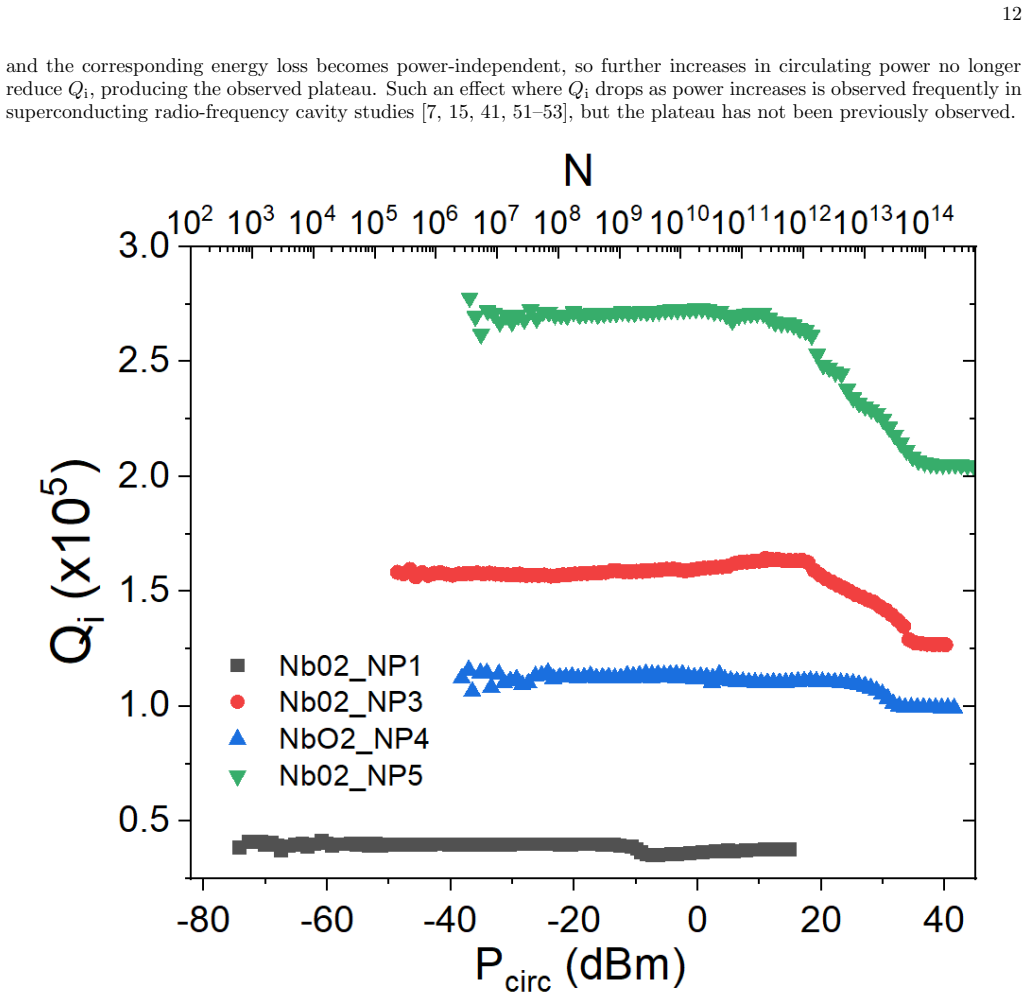
Using a superconducting 3D cavity, measurements on bulk Nb2O5 oxide powder samples reveal losses that follow the power and temperature behavior expected for TLS and agree with existing models, whereas NbO2 bulk powder samples exhibit no detectable TLS loss signatures. This leads to the proposal that TLS losses in practical Nb cavities could be reduced by having high quality microcrystalline NbO2 dominate over Nb2O5.
What carries the argument
Bulk microcrystalline oxide powders placed in a superconducting 3D microwave cavity to directly compare TLS loss characteristics of Nb2O5 and NbO2.
If this is right
- Niobium resonators could have lower losses if their natural oxide is engineered to favor the NbO2 phase.
- Materials-based strategies can isolate contributions from specific oxide phases to TLS losses.
- Reference data is now available for Nb2O5 and NbO2 phases relevant to quantum devices.
- Reducing TLS in Nb cavities may improve performance of superconducting qubits and microwave cavities.
Where Pith is reading between the lines
- Similar bulk measurements could be applied to other metal oxides to identify low-loss phases for quantum applications.
- If thin oxide layers on Nb behave like the bulk powders, phase control during fabrication would directly impact device coherence.
- Future work might test whether annealing or other treatments can convert Nb2O5 to NbO2 on actual resonator surfaces.
Load-bearing premise
Bulk microcrystalline powder samples accurately represent the thin natural oxide layers on niobium in practical resonators and cavities.
What would settle it
Fabricate niobium resonators with controlled surface oxide phases rich in NbO2 versus Nb2O5 and measure their TLS loss contributions to see if they match the bulk powder results.
Figures




read the original abstract
Losses from two-level systems (TLS) associated with amorphous oxides remain one of the primary limitations to the performance of superconducting qubits and microwave cavities. Niobium resonators are widely used in quantum science experiments, yet niobium's natural oxide layer contains various types of oxides whose relative contributions to TLS loss have not been clearly distinguished. Here, we use a superconducting 3D microwave cavity to measure commercial 99.9\% trace metal pure, microcrystalline oxide powders \ch{Nb2O5} and \ch{NbO2} in bulk amounts. Using this approach, we directly compare the loss characteristics of \ch{Nb2O5} and \ch{NbO2}. Our measurements show that the nominal \ch{Nb2O5} bulk oxide powder samples exhibit losses which have the power and temperature behavior expected for TLS. Moreover, the measurements agree with existing theoretical models. Analogous measurements performed on \ch{NbO2} bulk powder samples do not show any detectable TLS loss signatures. Based on our results we propose that the TLS losses might be reduced if a high quality microcrystalline \ch{NbO2} oxide dominates the \ch{Nb2O5} oxide in practical Nb cavities. These results establish a materials based strategy for isolating oxide specific TLS losses and provide a reference measurement for niobium oxide phases relevant to superconducting quantum devices.
Editorial analysis
A structured set of objections, weighed in public.
Referee Report
Summary. The manuscript measures microwave losses from commercial 99.9% pure microcrystalline Nb2O5 and NbO2 bulk powders inside a superconducting 3D cavity. It reports that Nb2O5 powders display power- and temperature-dependent losses whose qualitative behavior matches expectations for two-level systems (TLS) and existing theoretical models, while NbO2 powders show no detectable TLS signatures. The authors conclude that TLS losses in practical Nb cavities might be reduced if a high-quality microcrystalline NbO2 phase dominates the natural oxide layer.
Significance. If the bulk-powder results translate to thin natural oxides, the work supplies a concrete materials strategy for isolating oxide-specific TLS contributions and a reference data set for Nb-based quantum devices. The direct experimental comparison of two distinct Nb oxide phases is useful. However, the significance hinges on an untested proxy assumption whose validity is not demonstrated within the manuscript.
major comments (3)
- [Abstract and Discussion] Abstract and Discussion section: the central claim of 'qualitative agreement with TLS models' is presented without quantitative fits, extracted TLS parameters, or reported uncertainties on the loss data. This leaves the agreement observational and prevents a rigorous test of the models cited.
- [Methods and Experimental Setup] Methods and Experimental Setup: no morphological, structural, or interface characterization (XRD, SEM, XPS, or grain-size distribution) of the commercial microcrystalline powders is provided. Without this, the assumption that bulk 99.9% pure powders accurately represent the few-nm amorphous or strained natural oxides on Nb surfaces remains untested and load-bearing for the proposed cavity strategy.
- [Results] Results section: the absence of detectable TLS loss in NbO2 is stated, but no upper-bound estimate on the TLS loss tangent or comparison of cavity Q values with and without the powder is given, making the 'no detectable signature' claim difficult to quantify or reproduce.
minor comments (2)
- Notation: chemical formulas are rendered with the mhchem package; ensure every occurrence of Nb2O5 and NbO2 is consistently formatted and that subscripts are not omitted in figure labels.
- Figure clarity: power- and temperature-dependence plots should include error bars (or state that they are smaller than symbols) and explicit legends distinguishing the two oxide samples.
Simulated Author's Rebuttal
We thank the referee for their careful reading and constructive comments on our manuscript. We address each major comment point by point below, indicating where revisions will be made.
read point-by-point responses
-
Referee: [Abstract and Discussion] Abstract and Discussion section: the central claim of 'qualitative agreement with TLS models' is presented without quantitative fits, extracted TLS parameters, or reported uncertainties on the loss data. This leaves the agreement observational and prevents a rigorous test of the models cited.
Authors: We agree that quantitative fits would strengthen the manuscript. In the revised version we will add explicit fits to the standard TLS model in the Discussion, reporting extracted parameters (e.g., loss tangent, relaxation rates) together with uncertainties obtained from the data. The abstract will retain its qualitative phrasing while the main text will enable a more rigorous comparison with the cited models. revision: yes
-
Referee: [Methods and Experimental Setup] Methods and Experimental Setup: no morphological, structural, or interface characterization (XRD, SEM, XPS, or grain-size distribution) of the commercial microcrystalline powders is provided. Without this, the assumption that bulk 99.9% pure powders accurately represent the few-nm amorphous or strained natural oxides on Nb surfaces remains untested and load-bearing for the proposed cavity strategy.
Authors: The referee is correct that we relied on the commercial specification without additional in-house structural characterization. We will revise the Methods and Discussion sections to state the proxy assumption explicitly, note its untested character for thin-film oxides, and include any supplier-provided purity and particle-size information. Full XRD/SEM/XPS analysis of the specific batches would require new experiments outside the present study. revision: partial
-
Referee: [Results] Results section: the absence of detectable TLS loss in NbO2 is stated, but no upper-bound estimate on the TLS loss tangent or comparison of cavity Q values with and without the powder is given, making the 'no detectable signature' claim difficult to quantify or reproduce.
Authors: We will revise the Results section to report a quantitative upper bound on the TLS loss tangent for NbO2, derived from the measurement noise floor and from direct comparisons of cavity Q with and without the NbO2 powder. This will make the non-detection claim precise and reproducible. revision: yes
Circularity Check
No circularity: purely experimental comparison to independent external models
full rationale
The paper reports direct cavity measurements of loss in commercial bulk Nb2O5 and NbO2 powders, observing power and temperature dependence that matches the expected TLS signatures from pre-existing literature models. No parameters are fitted to the present data and then re-used as 'predictions,' no self-definitional relations appear, and no load-bearing self-citations or uniqueness theorems are invoked to close the argument. The central claim therefore rests on empirical observation rather than any reduction of outputs to the paper's own inputs by construction.
Axiom & Free-Parameter Ledger
axioms (1)
- domain assumption TLS exhibit characteristic power and temperature dependent losses as per standard models
Lean theorems connected to this paper
-
IndisputableMonolith/Cost/FunctionalEquation.leanwashburn_uniqueness_aczel unclear?
unclearRelation between the paper passage and the cited Recognition theorem.
Our measurements show that the nominal Nb2O5 bulk oxide powder samples exhibit losses which have the power and temperature behavior expected for TLS. Moreover the measurements agree with existing theoretical models.
-
IndisputableMonolith/Foundation/AlphaCoordinateFixation.leanJ_uniquely_calibrated_via_higher_derivative unclear?
unclearRelation between the paper passage and the cited Recognition theorem.
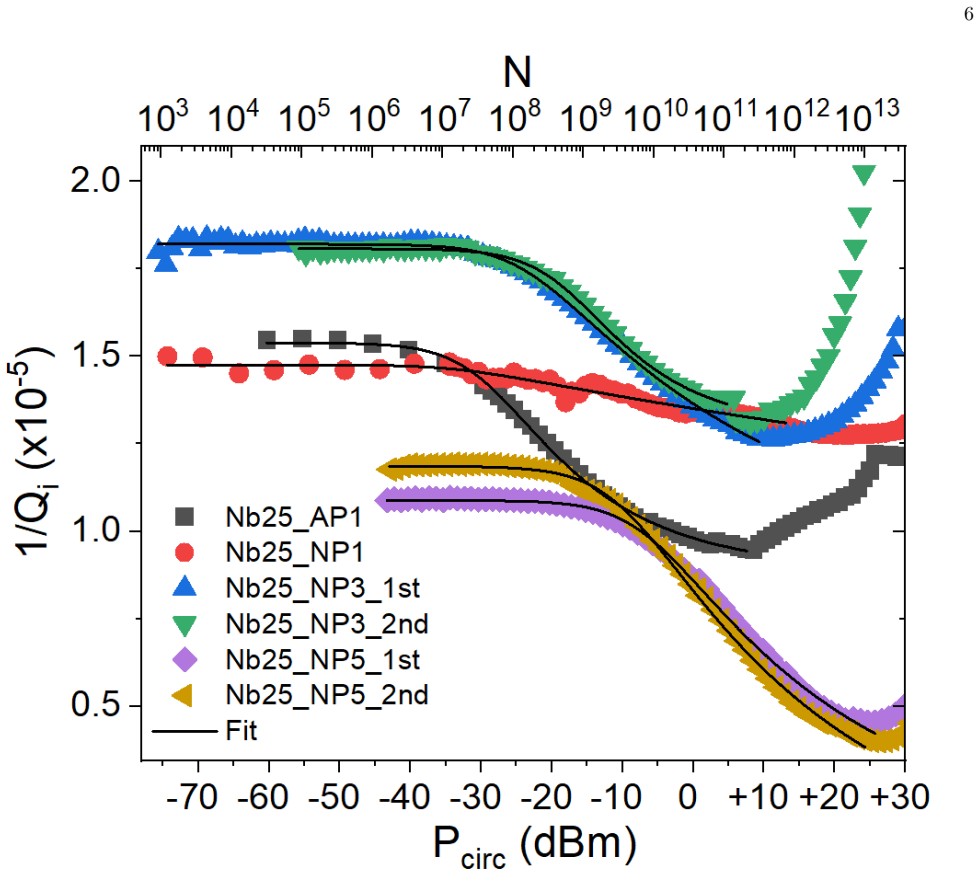
Fits to the standard TLS model indicate TLS-TLS interactions in Nb2O5, evidenced by the small β term
What do these tags mean?
- matches
- The paper's claim is directly supported by a theorem in the formal canon.
- supports
- The theorem supports part of the paper's argument, but the paper may add assumptions or extra steps.
- extends
- The paper goes beyond the formal theorem; the theorem is a base layer rather than the whole result.
- uses
- The paper appears to rely on the theorem as machinery.
- contradicts
- The paper's claim conflicts with a theorem or certificate in the canon.
- unclear
- Pith found a possible connection, but the passage is too broad, indirect, or ambiguous to say the theorem truly supports the claim.
Reference graph
Works this paper leans on
-
[1]
John M. Martinis, K. B. Cooper, R. McDermott, M. Steffen, M. Ansmann, K. D. Osborn, K. Cicak, S. Oh, D. P. Pappas, R. W. Simmonds, and C. C. Yu. Decoherence in josephson qubits from dielectric loss.Physical Review Letters, 95(21):210503, 2005
work page 2005
- [2]
-
[3]
Kevin D. Crowley, Russell A. McLellan, Aveek Dutta, Nana Shumiya, Alexander P. M. Place, Xuan Hoang Le, Youqi Gang, Trisha Madhavan, Matthew P. Bland, Ray Chang, Nishaad Khedkar, Yiming Cady Feng, Esha A. Umbarkar, Xin Gui, Lila V. H. Rodgers, Yichen Jia, Mayer M. Feldman, Stephen A. Lyon, Mingzhao Liu, Robert J. Cava, Andrew A. Houck, and Nathalie P. de ...
work page 2023
-
[4]
Andr´ e Valli` eres, Megan E. Russell, Xinyuan You, David A. Garcia-Wetten, Dominic P. Goronzy, Mitchell J. Walker, Michael J. Bedzyk, Mark C. Hersam, Alexander Romanenko, Yao Lu, Anna Grassellino, Jens Koch, and Corey Rae H. McRae. Loss tangent fluctuations due to two-level systems in superconducting microwave resonators.Applied Physics Letters, 126(12):...
work page 2025
-
[5]
Clemens M¨ uller, Jared H Cole, and J¨ urgen Lisenfeld. Towards understanding two-level-systems in amorphous solids: Insights from quantum circuits.Reports on Progress in Physics, 82(12):124501, 2019
work page 2019
-
[6]
Three-dimensional niobium coaxial cavity with 0.1-second lifetime.Phys
Takaaki Takenaka, Takayuki Kubo, Imran Mahboob, Kosuke Mizuno, Hitoshi Inoue, Takayuki Saeki, and Shiro Saito. Three-dimensional niobium coaxial cavity with 0.1-second lifetime.Phys. Rev. Appl., pages –, Feb 2026
work page 2026
-
[7]
A. Romanenko, R. Pilipenko, S. Zorzetti, D. Frolov, M. Awida, S. Belomestnykh, S. Posen, and A. Grassellino. Three- dimensional superconducting resonators att <20 mk with photon lifetimes up toτ= 2 s.Phys. Rev. Appl., 13:034032, Mar 2020
work page 2020
- [8]
-
[9]
de Ory, David Rodriguez, Maria T
Marina C. de Ory, David Rodriguez, Maria T. Magaz, V´ ıctor Rollano, Daniel Granados, and Alicia Gomez. Low loss hybrid nb/au superconducting resonators for quantum circuit applications, 2024. 14
work page 2024
-
[10]
Y. Kalboussi, B. Delatte, S. Bira, K. Dembele, X. Li, F. Miserque, N. Brun, M. Walls, J. L. Maurice, D. Dragoe, and et al. Reducing two-level systems dissipations in 3d superconducting niobium resonators by atomic layer deposition and high temperature heat treatment.Applied Physics Letters, 124(13), Mar 2024
work page 2024
-
[11]
C. M. Quintana, A. Megrant, Z. Chen, A. Dunsworth, B. Chiaro, R. Barends, B. Campbell, Yu Chen, I.-C. Hoi, E. Jeffrey, J. Kelly, J. Y. Mutus, P. J. J. O’Malley, C. Neill, P. Roushan, D. Sank, A. Vainsencher, J. Wenner, T. C. White, A. N. Cleland, and John M. Martinis. Characterization and reduction of microfabrication-induced decoherence in superconductin...
work page 2014
-
[12]
B Chiaro, A Megrant, A Dunsworth, Z Chen, R Barends, B Campbell, Y Chen, A Fowler, I C Hoi, E Jeffrey, J Kelly, J Mutus, C Neill, P J J O’Malley, C Quintana, P Roushan, D Sank, A Vainsencher, J Wenner, T C White, and John M Martinis. Dielectric surface loss in superconducting resonators with flux-trapping holes.Superconductor Science and Technology, 29(10...
work page 2016
-
[13]
J. Halbritter. On the oxidation and on the superconductivity of niobium.Applied Physics A, 43(1):1–28, 1987
work page 1987
-
[14]
Murthy, Paul Masih Das, Stephanie M
Akshay A. Murthy, Paul Masih Das, Stephanie M. Ribet, Cameron Kopas, Jaeyel Lee, Matthew J. Reagor, Lin Zhou, Matthew J. Kramer, Mark C. Hersam, Mattia Checchin, Anna Grassellino, Roberto dos Reis, Vinayak P. Dravid, and Alexander Romanenko. Developing a chemical and structural understanding of the surface oxide in a niobium supercon- ducting qubit.ACS Na...
work page 2022
-
[15]
A. Romanenko and D.I. Schuster. Understanding quality factor degradation in superconducting niobium cavities at low microwave field amplitudes.Physical Review Letters, 119(26), Dec 2017
work page 2017
-
[16]
Alex Gurevich. Theory of rf superconductivity for resonant cavities.Superconductor Science and Technology, 30(3):034004, jan 2017
work page 2017
-
[17]
Takayuki Kubo and Alex Gurevich. Field-dependent nonlinear surface resistance and its optimization by surface nanos- tructuring in superconductors.Phys. Rev. B, 100:064522, Aug 2019
work page 2019
- [18]
-
[19]
Yegor Tamashevich, Alena Prudnikava, Alexander Matveenko, Axel Neumann, Oliver Kugeler, and Jens Knobloch. Im- proved rf performance of niobium cavities via in-situ vacuum heat treatment technique.Superconductor Science and Technology, 38(4):045006, Mar 2025
work page 2025
-
[20]
David M. Pozar.Microwave engineering. Wiley, Hoboken, NJ, 4th ed edition, 2012. OCLC: ocn714728044
work page 2012
-
[21]
Honasoge, Fabian Kronowetter, Yuki Nojiri, Michael Renger, Kirill G
Qi-Ming Chen, Meike Pfeiffer, Matti Partanen, Florian Fesquet, Kedar E. Honasoge, Fabian Kronowetter, Yuki Nojiri, Michael Renger, Kirill G. Fedorov, Achim Marx, Frank Deppe, and Rudolf Gross. Scattering coefficients of superconducting microwave resonators. i. transfer matrix approach.Phys. Rev. B, 106:214505, Dec 2022
work page 2022
-
[22]
Honasoge, Fabian Kronowetter, Yuki Nojiri, Michael Renger, Kirill G
Qi-Ming Chen, Matti Partanen, Florian Fesquet, Kedar E. Honasoge, Fabian Kronowetter, Yuki Nojiri, Michael Renger, Kirill G. Fedorov, Achim Marx, Frank Deppe, and Rudolf Gross. Scattering coefficients of superconducting microwave resonators. ii. system-bath approach.Phys. Rev. B, 106:214506, Dec 2022
work page 2022
-
[23]
M. S. Khalil, M. J. A. Stoutimore, F. C. Wellstood, and K. D. Osborn. Loss dependence on geometry and applied power in superconducting coplanar resonators.J. Appl. Phys., 111:054510, 2012
work page 2012
- [24]
-
[25]
Takayuki Kubo. Effects of nonmagnetic impurities and subgap states on the kinetic inductance, complex conductivity, quality factor, and depairing current density.Phys. Rev. Appl., 17:014018, Jan 2022
work page 2022
-
[26]
Alex Gurevich. Tuning microwave losses in superconducting resonators.Superconductor Science and Technology, 36(6):063002, apr 2023
work page 2023
-
[27]
S. Posen, M. Checchin, A. C. Crawford, A. Grassellino, M. Martinello, O. S. Melnychuk, A. Romanenko, D. A. Sergatskov, and Y. Trenikhina. Efficient expulsion of magnetic flux in superconducting radiofrequency cavities for high q applications. Journal of Applied Physics, 119(21):213903, 06 2016
work page 2016
-
[28]
Shichun Huang, Takayuki Kubo, and R. L. Geng. Dependence of trapped-flux-induced surface resistance of a large-grain nb superconducting radio-frequency cavity on spatial temperature gradient during cooldown throughT c.Phys. Rev. Accel. Beams, 19:082001, Aug 2016
work page 2016
-
[29]
T. Lindstr¨ om, J. E. Healey, M. S. Colclough, C. M. Muirhead, and A. Ya. Tzalenchuk. Properties of superconducting planar resonators at millikelvin temperatures.Phys. Rev. B, 80:132501, Oct 2009
work page 2009
-
[30]
PhD thesis, California Institute of Technology, 2008
Jiansong Gao.The Physics of Superconducting Microwave Resonators. PhD thesis, California Institute of Technology, 2008
work page 2008
-
[31]
Two-level states in glasses.Reports on Progress in Physics, 50(12):1657–1708, Dec 1987
W A Phillips. Two-level states in glasses.Reports on Progress in Physics, 50(12):1657–1708, Dec 1987
work page 1987
-
[32]
Zollitsch, Sebastian Meier, Michael Fischer, Peter Eder, Edwar Xie, Kirill G
Jan Goetz, Frank Deppe, Max Haeberlein, Friedrich Wulschner, Christoph W. Zollitsch, Sebastian Meier, Michael Fischer, Peter Eder, Edwar Xie, Kirill G. Fedorov, and et al. Loss mechanisms in superconducting thin film microwave resonators. Journal of Applied Physics, 119(1), Jan 2016
work page 2016
-
[33]
J. Burnett, L. Faoro, and T. Lindstr¨ om. Evidence for interacting two-level systems from the 1/f noise of a superconducting resonator.Nature Communications, 5:4119, 2014
work page 2014
-
[34]
Lara Faoro and Lev B. Ioffe. Interacting tunneling model for two-level systems in amorphous materials and its predictions for the low-temperature properties of glasses.Physical Review B, 91(1):014201, 2015
work page 2015
- [35]
-
[36]
Timothy C. DuBois, Manolo C. Per, Salvy P. Russo, and Jared H. Cole. Delocalized oxygen as the origin of two-level defects in josephson junctions.Physical Review Letters, 110(7), Feb 2013. 15
work page 2013
-
[37]
J. Burnett, J. Sagar, O.W. Kennedy, P.A. Warburton, and J.C. Fenton. Low-loss superconducting nanowire circuits using a neon focused ion beam.Physical Review Applied, 8(1), Jul 2017
work page 2017
-
[38]
J. Verjauw, A. Potoˇ cnik, M. Mongillo, R. Acharya, F. Mohiyaddin, G. Simion, A. Pacco, Ts. Ivanov, D. Wan, A. Vanleen- hove, and et al. Investigation of microwave loss induced by oxide regrowth in high-q niobium resonators.Physical Review Applied, 16(1), Jul 2021
work page 2021
-
[39]
Y. Kalboussi, I. Curci, F. Miserque, D. Troadec, N. Brun, M. Walls, G. Jullien, F. Eozenou, M. Baudrier, L. Maurice, Q. Bertrand, P. Sahuquet, and T. Proslier. Crystallinity in niobium oxides: A pathway to mitigate two-level-system defects in niobium three-dimensional resonators for quantum applications.Phys. Rev. Appl., 23:044023, Apr 2025
work page 2025
-
[40]
Takayuki Kubo. Nonequilibrium nonlinear response theory of amplitude-dependent dissipative conductivity in disordered superconductors.Phys. Rev. Appl., 24:064061, Dec 2025
work page 2025
- [41]
-
[42]
David P. Pappas, Michael R. Vissers, David S. Wisbey, Jeffrey S. Kline, and Jiansong Gao. Two level system loss in superconducting microwave resonators.IEEE Transactions on Applied Superconductivity, 21(3):871–874, 2011
work page 2011
-
[43]
Wisbey, Jiansong Gao, Michael R
David S. Wisbey, Jiansong Gao, Michael R. Vissers, Fabio C. S. da Silva, Jeffrey S. Kline, Leila Vale, and David P. Pappas. Effect of metal/substrate interfaces on radio-frequency loss in superconducting coplanar waveguides.Journal of Applied Physics, 108(9):093918, 11 2010
work page 2010
-
[44]
Glazman and Gianluigi Catelani
Leonid I. Glazman and Gianluigi Catelani. Bogoliubov quasiparticles in superconducting qubits.SciPost Phys. Lect. Notes, page 31, 2021
work page 2021
-
[45]
R. Barends, J. Wenner, M. Lenander, Y. Chen, R. C. Bialczak, J. Kelly, E. Lucero, P. O’Malley, M. Mariantoni, D. Sank, H. Wang, T. C. White, Y. Yin, J. Zhao, A. N. Cleland, John M. Martinis, and J. J. A. Baselmans. Minimizing quasiparticle generation from stray infrared light in superconducting quantum circuits.Applied Physics Letters, 99(11):113507, 09 2011
work page 2011
-
[46]
C. H. Liu, D. C. Harrison, S. Patel, C. D. Wilen, O. Rafferty, A. Shearrow, A. Ballard, V. Iaia, J. Ku, B. L. T. Plourde, and R. McDermott. Quasiparticle poisoning of superconducting qubits from resonant absorption of pair-breaking photons. Phys. Rev. Lett., 132:017001, Jan 2024
work page 2024
-
[47]
D J Goldie and S Withington. Non-equilibrium superconductivity in quantum-sensing superconducting resonators.Super- conductor Science and Technology, 26(1):015004, nov 2012
work page 2012
-
[48]
P. J. de Visser, D. J. Goldie, P. Diener, S. Withington, J. J. A. Baselmans, and T. M. Klapwijk. Evidence of a nonequilibrium distribution of quasiparticles in the microwave response of a superconducting aluminum resonator.Phys. Rev. Lett., 112:047004, Jan 2014
work page 2014
-
[49]
Formation of niobium hydride precipitates in superconducting qubits.Phys
Zuhawn Sung, Daniel Bafia, Arely Cano, Akshay Murthy, Jaeyel Lee, Matthew J Reagor, Juan Rubio-Zuazo, Anna Grassellino, and Alexander Romanenko. Formation of niobium hydride precipitates in superconducting qubits.Phys. Rev. Mater., 10:016201, Jan 2026
work page 2026
-
[50]
Zuhawn Sung, Arely Cano, Akshay Murthy, Daniel Bafia, Ekaterina Karapetrova, Martina Martinello, Jaeyel Lee, Anna Grassellino, and Alexander Romanenko. Direct observation of nanometer size hydride precipitations in superconducting niobium.Scientific Reports, 14(1):26916, 2024
work page 2024
-
[51]
A. Romanenko, A. Grassellino, F. Barkov, and J. P. Ozelis. Effect of mild baking on superconducting niobium cavities investigated by sequential nanoremoval.Phys. Rev. ST Accel. Beams, 16:012001, Jan 2013
work page 2013
-
[52]
A. Romanenko, A. Grassellino, D. A. Sergatskov, O. Melnychuk, Y. Trenikhina, A. C. Crawford, A. Rowe, C. P. Welsch, T. Khabiboulline, and V. P. Yakovlev. Intrinsic losses in superconducting niobium cavities at millikelvin temperatures.J. Appl. Phys., 115:184903, 2014
work page 2014
-
[53]
M. Martinello, M. Checchin, A. Romanenko, A. Grassellino, S. Aderhold, S. K. Chandrasekeran, O. Melnychuk, S. Posen, and D. A. Sergatskov. Field-enhanced superconductivity in high-frequency niobium accelerating cavities.Phys. Rev. Lett., 121:224801, Nov 2018
work page 2018
-
[54]
Charles Kittel.Introduction to Solid State Physics. Wiley, 8 edition, 2004
work page 2004
-
[55]
Richard J. D. Tilley.Defects in Solids. John Wiley & Sons, Chichester, 2008
work page 2008
-
[56]
C. Hammond.The basics of crystallography and diffraction / Christopher Hammond.International Union of Crystallog- raphy texts on crystallography 5. Oxford University Press, New York, 2nd ed. edition, 2001
work page 2001
-
[57]
The investigation of oxygen compounds of niobium in region of nbosub2– nbsub2o .Izv
A Burdeze, E V Tkachenko, and F Abbattista. The investigation of oxygen compounds of niobium in region of nbosub2– nbsub2o .Izv. Akad. Nauk SSSR, Neorg. Mater. 5: 1957-62(Nov 1969)., 01 1969
work page 1957
-
[58]
K. Sakata. The crystal structure of niobium dioxide.Acta Crystallographica Section B: Structural Crystallography and Crystal Chemistry, 35:2836–2841, 1979
work page 1979
-
[59]
Jerzy Krupka, Krzysztof Derzakowski, Michael Tobar, John Hartnett, and Richard G Geyer. Complex permittivity of some ultralow loss dielectric crystals at cryogenic temperatures.Measurement Science and Technology, 10(5):387–392, 1999
work page 1999
-
[60]
Chia-Jung Shih, Meng-Hung Tsai, Yu-Chen Chen, Yu-Ta Chen, Ming-Jen Li, Hung-Chi Yen, and Cheng-Liang Huang. Investigation of the dynamic interaction between dopants and oxygen vacancies in amorphous Nb 2O5: Simulation and experimental study.Materials Science and Engineering: B, 298:116891, 2023
work page 2023
-
[61]
Dielectric properties of amorphous Nb 2O5 thin films.Thin Solid Films, 30(1):145–154, 1975
N Fuschillo, B Lalevic, and NK Annamalai. Dielectric properties of amorphous Nb 2O5 thin films.Thin Solid Films, 30(1):145–154, 1975. 16 Appendix A: X-ray Diffraction To chemically characterize the Nb2O5 and NbO2 powders, we measured representative samples of each using XRD. Fig.8 shows the room-temperature diffraction patterns for both oxides. The presen...
work page 1975
discussion (0)
Sign in with ORCID, Apple, or X to comment. Anyone can read and Pith papers without signing in.