REVIEW 3 major objections 5 minor 97 references
A 7B multimodal model that structures multi-image reasoning into five human-like steps (global, focus, hint, think, answer) outperforms GPT-4o on the MUIR and MV-Math benchmarks and beats video-specialized models on video understanding.
Reviewed by Pith at T0; open to challenge. T0 means a machine referee read the full paper against a public rubric. the ladder, T0–T4 →
T0 review · deepseek-v4-flash
2026-08-03 11:07 UTC pith:RDGM2JED
load-bearing objection A plausible training recipe with real benchmark gains, but the cognition story, the two-stage RL advantage, and the reproducibility are all thinner than the abstract suggests. the 3 major comments →
Mimic Human Cognition, Master Multi-Image Reasoning: A Meta-Action Framework for Enhanced Visual Understanding
The pith
A machine-rendered reading of the paper's core claim, the machinery that carries it, and where it could break.
Core claim
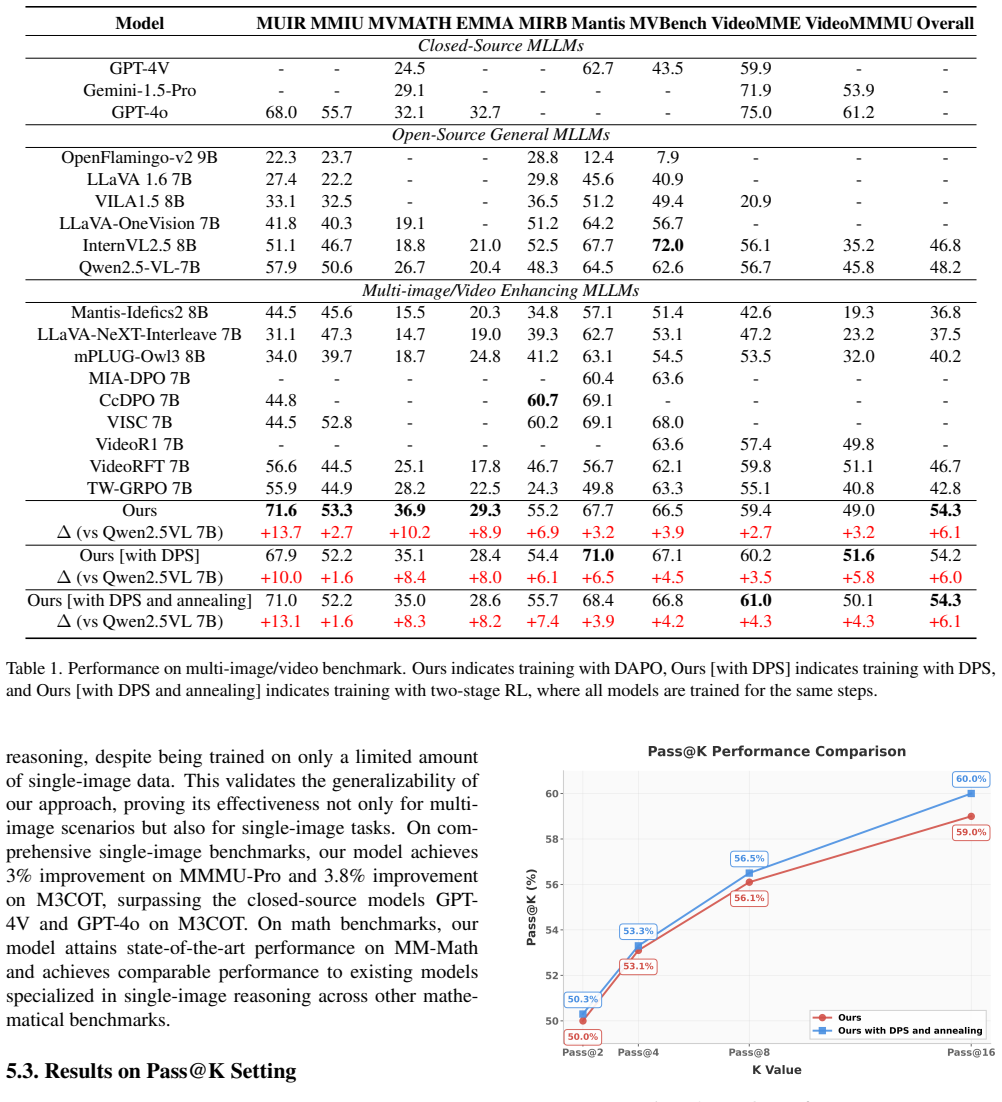
The central claim is that decomposing multi-image reasoning into a fixed sequence of five meta-actions — Global, Focus, Hint, Think, Answer — and training a model to emit them in order yields large, transferable gains over unstructured reasoning. The paper shows that a 7B model trained this way, on a mix of cold-start and reinforcement-learning data, reaches 71.6 on MUIR and 36.9 on MV-Math, surpassing GPT-4o's 68.0 and 32.1, and that the same model outperforms video-specialized systems on video benchmarks despite not being designed for video. Each meta-action ablation hurts performance, and the two-trajectory cold-start beats single-trajectory and conventional chain-of-thought training.
What carries the argument
The load-bearing mechanism is the pair of training strategies around the meta-action tags. Retrieval-Based Tree Sampling produces cold-start targets by letting a small student model attempt a problem, a stronger teacher (GPT-4o) corrects while keeping the student's action sequence, and a trajectory database returns a second, dissimilar correct path — yielding two distinct reasoning traces per problem. Then a two-stage reinforcement learning pass, Diversity-Preserving Strategy followed by annealed DAPO (a policy-optimization scheme with clip-higher and dynamic sampling), keeps the policy from collapsing onto one trajectory pattern while rewards combine accuracy, format validity, and a homogen
Load-bearing premise
The paper assumes the five meta-action tags are semantically load-bearing — that the model actually performs the named cognitive steps when it emits those tags — but only the tags' presence, not their content, is rewarded.
What would settle it
A control experiment that trains the same pipeline with five arbitrary random tags (or with a single generic 'reason' tag repeated five times) and finds equal or similar benchmark gains would falsify the cognitive-decomposition claim, showing the gains come from enforced structure and longer outputs rather than from the specific Global/Focus/Hint/Think/Answer semantics.
If this is right
- Because the same 7B backbone, trained with meta-actions, improves on multi-image, video, and single-image benchmarks, the reasoning structure — not task-specific tuning — is doing the work.
- The two-trajectory cold-start strategy beats both single-trajectory and conventional chain-of-thought cold-starts, and the advantage persists after reinforcement learning.
- The two-stage RL (diversity-preserving then annealing) keeps policy entropy higher than standard RL and improves Pass@K scores up to K=16, so the gains are not just from the best single rollout.
Where Pith is reading between the lines
- A natural control — training with arbitrary tags instead of Global/Focus/Hint/Think/Answer — would separate the effect of enforced structure from the semantic cognitive decomposition; the paper does not run it, but its format-only reward leaves that possibility open.
- The paper's reward penalizes identical tag sequences among correct answers, meaning the diversity pressure is on surface trajectory patterns; deeper diversity in the actual analytic content is not measured, so the method may under-explore alternative visual strategies.
- If the meta-action scaffolding is what drives the gains, similar decompositions could be designed for other structured multimodal tasks (documents, charts, spatial reasoning) where a fixed step sequence maps naturally onto human practice.
Editorial analysis
A structured set of objections, weighed in public.
Referee Report
Summary. The paper proposes CINEMA, a framework for multi-image MLLM reasoning that decomposes reasoning into five meta-actions (Global, Focus, Hint, Think, Answer), augments cold-start SFT with retrieval-based tree-sampled trajectories, and then applies a two-stage RL scheme (DPS for diversity preservation followed by annealed DAPO). The model, built on Qwen2.5-VL-7B, is evaluated on multi-image, video, and single-image benchmarks. It reports state-of-the-art results on MUIR, MV-Math, EMMA, VideoMME, and VideoMMMU, surpassing GPT-4o on MUIR and MV-Math.
Significance. If the reported results hold, this is a practically important empirical contribution: a 7B model beating GPT-4o on two multi-image benchmarks and matching or exceeding specialized video reasoning models would be a strong demonstration of what structured-output RL and diverse cold-start trajectories can do for multi-image reasoning. The paper is also commendable for the breadth of benchmarks, the detailed training-data table in the appendix, and the inclusion of full hyperparameter settings. The core novelty claims, however, are not yet established: the cognitive semantics of the meta-actions are never validated, and the main tables do not show a clean benefit of the proposed two-stage RL over plain DAPO.
major comments (3)
- [§3.1/§4.2, Eq. (2)] The only structure-aware reward is R_format, a binary check that 'all meta-actions in the response are valid.' Validity is defined purely syntactically in §4.2: global is mandatory for multi-image and disallowed for single-image. The paper never verifies that the content inside <global>, <focus>, <hint>, or <think> actually performs cross-image analysis, selective focus, key-point summarization, or internal reasoning, nor does it compare against a control with the same five tag names permuted or replaced by arbitrary labels. Table 4 removes whole tags and retrains, so output length and structure change simultaneously with the tag set. The central 'cognition-inspired' interpretation is therefore unsupported; the gains could be due to structured-output RL plus longer outputs. A concrete fix is to measure tag-content agreement against the §3.1 definitions (LLM-judge or human annotation) and
- [Tables 1 and 2] The two-stage DPS+annealing claim is not supported by the main tables. In Table 1, 'Ours' (DAPO only) has Overall 54.3, while 'Ours [with DPS and annealing]' also has Overall 54.3; several per-benchmark entries differ by less than 1 point. In Table 2 the corresponding Overall scores are 45.5 vs 45.6. Since all rows are trained for the same steps, the aggregate benchmarks show no benefit from DPS or annealing. The Pass@K experiment (Figure 2) is the only supporting evidence, but it reports only curves with no numeric table, no standard errors, and no explicit comparison against plain DAPO under identical decoding. Please provide exact Pass@K numbers and statistical estimates, or re-scope the two-stage RL claim.
- [Appendix 9, Table 5; Table 2] The training-data table lists 'M3COT 1147' under SFT, and Table 2 evaluates the model on the M3COT benchmark. It is not stated whether these 1,147 SFT instances come from the M3COT train split and whether the evaluation uses the official benchmark test split. If the training examples are drawn from the same benchmark collection, the reported +3.4 improvement on M3COT (63.5 vs 60.1) could be partially due to train/eval overlap. The authors should state the exact source splits and confirm that no training instance overlaps with the evaluation set.
minor comments (5)
- [Abstract / §1] The cold-start dataset size is given as 56k in the abstract and 57k in the introduction and conclusion. Please make this consistent.
- [§3] Typo: 'The famework of our method' should be 'The framework of our method'.
- [§5.4, RQ1 and Table 3] The text says 'MUIR, MMMU and EMMA' but Table 3 columns are MUIR, MMIU, and EMMA. MMMU should likely be MMIU; the same ambiguity appears in RQ2 where the text mentions 'MMMU contains samples with 2-32 input images'.
- [§6] Conclusion contains 'effectively effectively improve' — remove the duplicated word.
- [Table 1] The baseline 'CcDPO 7B' appears in the table but is not named in the baselines list in §4.1; please add it or remove it.
Circularity Check
Global action's 'essential role' is partly guaranteed by the format reward; main benchmark gains remain externally grounded.
specific steps
-
self definitional
[Section 4.2 (Eq. 2) / Section 5.4 RQ4, Table 4]
"Specifically, for single-image inputs, the global action is disallowed, whereas for multi-image inputs, the inclusion of the global action is mandatory. ... The results show that removing any of the actions leads to performance degradation, indicating that each meta-action plays an essential role in CINEMA."
Table 4 ablates <global> on multi-image benchmarks (MUIR, MIRB, VideoMME). By Eq. 2, R_format=1 only if all meta actions are valid, and by the quoted rule <global> is mandatory for multi-image inputs. Thus any response lacking <global> receives R_format=0 by construction; a model trained without <global> is structurally barred from the format reward. The observed drop therefore does not independently establish that Global's semantic content (global inter-image analysis) is essential; it mostly confirms the reward's own mandatory-token rule. The held-out benchmark comparisons are not affected by this, but the claim that every meta-action is essential is partly self-definitional for <global>.
full rationale
The paper's headline results are measured on held-out benchmarks (MUIR, MVMath, EMMA, VideoMME, VideoMMMU) that do not appear in the training-data table, and the gains over Qwen2.5-VL-7B and GPT-4o are externally falsifiable; distillation from a GPT-4o teacher surpassing the teacher is not circular. The one load-bearing internal argument with a by-construction component is RQ4: <global>'s 'essential role' is partly guaranteed by the format-reward rule that makes <global> mandatory for multi-image inputs, so the ablation drop does not independently validate the semantic cognitive claim. The Pass@K evidence is aligned with the diversity reward (Eq. 1) but is not exactly identical to it, so at most it is a mild self-confirmation rather than a reduction. Reference [40] is a self-citation for the entropy-collapse motivation, but it is accompanied by independent citations [14,71] and is not load-bearing. The deeper concern that tag content is never validated and the 'cognition-inspired' interpretation could be arbitrary structured-output regularization is an evidential gap, not a circular derivation.
Axiom & Free-Parameter Ledger
free parameters (3)
- Reward weighting coefficients (accuracy vs format) =
0.5 / 0.5
- Diversity penalty scale =
0.1
- Stage step allocation =
700 DPS steps + 300 DAPO steps
axioms (4)
- domain assumption Humans use global-to-local perception and self-explanation, which motivates the meta-action order and content.
- domain assumption GPT-4o produces correct cold-start trajectories for the easy split and is a reliable teacher for student trajectory refinement.
- domain assumption The format constraint (global mandatory for multi-image, disallowed for single-image) is beneficial and does not distort learning.
- domain assumption Benchmark ground-truth answers and the math/string-matching verifiers are reliable reward sources for RL.
read the original abstract
While Multimodal Large Language Models (MLLMs) excel at single-image understanding, they exhibit significantly degraded performance in multi-image reasoning scenarios. Multi-image reasoning presents fundamental challenges including complex inter-relationships between images and scattered critical information across image sets. Inspired by human cognitive processes, we propose a Cognition-Inspired Meta-Action Framework (CINEMA), which decomposes multi-image reasoning into five structured meta-actions: Global, Focus, Hint, Think, and Answer, explicitly modeling the sequential cognitive steps humans naturally employ. For cold-start training, we introduce a Retrieval-Based Tree Sampling strategy that generates high-quality meta-action trajectories to bootstrap the model with reasoning patterns. During reinforcement learning, we adopt a two-stage paradigm: an exploration phase with Diversity-Preserving Strategy to avoid entropy collapse, followed by an annealed exploitation phase with DAPO to gradually strengthen exploitation. To train our model, we construct a dataset of 56k cold-start and 58k reinforcement learning instances spanning multi-image, multi-frame, and single-image tasks. We conduct extensive evaluations on multi-image reasoning benchmarks, video understanding benchmarks, and single-image benchmarks, achieving competitive state-of-the-art performance on several key benchmarks. Our model surpasses GPT-4o on the MUIR and MVMath benchmarks and notably outperforms specialized video reasoning models on video understanding benchmarks, demonstrating the effectiveness and generalizability of our human cognition-inspired reasoning framework.
Figures



Reference graph
Works this paper leans on
-
[1]
Gpt-4 technical report.arXiv preprint arXiv:2303.08774,
Josh Achiam, Steven Adler, Sandhini Agarwal, Lama Ah- mad, Ilge Akkaya, Florencia Leoni Aleman, Diogo Almeida, Janko Altenschmidt, Sam Altman, Shyamal Anadkat, et al. Gpt-4 technical report.arXiv preprint arXiv:2303.08774,
-
[2]
Anas Awadalla, Irena Gao, Josh Gardner, Jack Hessel, Yusuf Hanafy, Wanrong Zhu, Kalyani Marathe, Yonatan Bitton, Samir Gadre, Shiori Sagawa, et al. Openflamingo: An open- source framework for training large autoregressive vision- language models.arXiv preprint arXiv:2308.01390, 2023. 5
Pith/arXiv arXiv 2023
-
[3]
Shuai Bai, Keqin Chen, Xuejing Liu, Jialin Wang, Wenbin Ge, Sibo Song, Kai Dang, Peng Wang, Shijie Wang, Jun Tang, et al. Qwen2. 5-vl technical report.arXiv preprint arXiv:2502.13923, 2025. 1, 5
Pith/arXiv arXiv 2025
-
[4]
Visual question answering on image sets
Ankan Bansal, Yuting Zhang, and Rama Chellappa. Visual question answering on image sets. InEuropean Conference on Computer Vision, pages 51–67. Springer, 2020. 3
2020
-
[5]
An augmented benchmark dataset for geometric question answering through dual parallel text en- coding
Jie Cao and Jing Xiao. An augmented benchmark dataset for geometric question answering through dual parallel text en- coding. InProceedings of the 29th international conference on computational linguistics, pages 1511–1520, 2022. 3
2022
-
[6]
Hardy Chen, Haoqin Tu, Fali Wang, Hui Liu, Xianfeng Tang, Xinya Du, Yuyin Zhou, and Cihang Xie. Sft or rl? an early investigation into training r1-like reasoning large vision-language models.arXiv preprint arXiv:2504.11468,
-
[7]
Huayu Chen, Kaiwen Zheng, Qinsheng Zhang, Ganqu Cui, Yin Cui, Haotian Ye, Tsung-Yi Lin, Ming-Yu Liu, Jun Zhu, and Haoxiang Wang. Bridging supervised learning and re- inforcement learning in math reasoning.arXiv preprint arXiv:2505.18116, 2025. 2
arXiv 2025
-
[8]
Minghan Chen, Guikun Chen, Wenguan Wang, and Yi Yang. Seed-grpo: Semantic entropy enhanced grpo for uncertainty-aware policy optimization.arXiv preprint arXiv:2505.12346, 2025. 3
Pith/arXiv arXiv 2025
-
[9]
M3cot: A novel benchmark for multi- domain multi-step multi-modal chain-of-thought
Qiguang Chen, Libo Qin, Jin Zhang, Zhi Chen, Xiao Xu, and Wanxiang Che. M3cot: A novel benchmark for multi- domain multi-step multi-modal chain-of-thought. InPro- ceedings of the 62nd Annual Meeting of the Association for Computational Linguistics (Volume 1: Long Papers), pages 8199–8221, 2024. 5, 2, 3
2024
-
[10]
Xiwen Chen, Wenhui Zhu, Peijie Qiu, Xuanzhao Dong, Hao Wang, Haiyu Wu, Huayu Li, Aristeidis Sotiras, Yalin Wang, and Abolfazl Razi. Dra-grpo: Exploring diversity-aware re- ward adjustment for r1-zero-like training of large language models.arXiv preprint arXiv:2505.09655, 2025. 3
arXiv 2025
-
[11]
Zhe Chen, Weiyun Wang, Yue Cao, Yangzhou Liu, Zhang- wei Gao, Erfei Cui, Jinguo Zhu, Shenglong Ye, Hao Tian, Zhaoyang Liu, et al. Expanding performance boundaries of open-source multimodal models with model, data, and test- time scaling.arXiv preprint arXiv:2412.05271, 2024. 1, 5
Pith/arXiv arXiv 2024
-
[12]
Reason- ing with exploration: An entropy perspective.arXiv preprint arXiv:2506.14758, 2025
Daixuan Cheng, Shaohan Huang, Xuekai Zhu, Bo Dai, Wayne Xin Zhao, Zhenliang Zhang, and Furu Wei. Reason- ing with exploration: An entropy perspective.arXiv preprint arXiv:2506.14758, 2025. 2
Pith/arXiv arXiv 2025
-
[13]
Eliciting self-explanations im- proves understanding.Cognitive science, 18(3):439–477,
Michelene TH Chi, Nicholas De Leeuw, Mei-Hung Chiu, and Christian LaVancher. Eliciting self-explanations im- proves understanding.Cognitive science, 18(3):439–477,
-
[14]
Ganqu Cui, Yuchen Zhang, Jiacheng Chen, Lifan Yuan, Zhi Wang, Yuxin Zuo, Haozhan Li, Yuchen Fan, Huayu Chen, Weize Chen, et al. The entropy mechanism of reinforce- ment learning for reasoning language models.arXiv preprint arXiv:2505.22617, 2025. 2
Pith/arXiv arXiv 2025
-
[15]
Insight-v: Ex- ploring long-chain visual reasoning with multimodal large language models
Yuhao Dong, Zuyan Liu, Hai-Long Sun, Jingkang Yang, Winston Hu, Yongming Rao, and Ziwei Liu. Insight-v: Ex- ploring long-chain visual reasoning with multimodal large language models. InProceedings of the Computer Vision and Pattern Recognition Conference, pages 9062–9072, 2025. 2
2025
-
[16]
Video-r1: Reinforcing video reasoning in mllms.arXiv preprint arXiv:2503.21776,
Kaituo Feng, Kaixiong Gong, Bohao Li, Zonghao Guo, Yibing Wang, Tianshuo Peng, Junfei Wu, Xiaoying Zhang, Benyou Wang, and Xiangyu Yue. Video-r1: Reinforcing video reasoning in mllms.arXiv preprint arXiv:2503.21776,
-
[17]
Video-mme: The first-ever comprehensive evaluation benchmark of multi-modal llms in video analysis
Chaoyou Fu, Yuhan Dai, Yongdong Luo, Lei Li, Shuhuai Ren, Renrui Zhang, Zihan Wang, Chenyu Zhou, Yunhang Shen, Mengdan Zhang, et al. Video-mme: The first-ever comprehensive evaluation benchmark of multi-modal llms in video analysis. InProceedings of the Computer Vision and Pattern Recognition Conference, pages 24108–24118, 2025. 5, 2
2025
-
[18]
Daya Guo, Dejian Yang, Haowei Zhang, Junxiao Song, Ruoyu Zhang, Runxin Xu, Qihao Zhu, Shirong Ma, Peiyi Wang, Xiao Bi, et al. Deepseek-r1: Incentivizing reasoning capability in llms via reinforcement learning.arXiv preprint arXiv:2501.12948, 2025. 2, 1
Pith/arXiv arXiv 2025
-
[19]
Can mllms reason in multimodality? emma: An enhanced multimodal reasoning benchmark
Yunzhuo Hao, Jiawei Gu, Huichen Will Wang, Linjie Li, Zhengyuan Yang, Lijuan Wang, and Yu Cheng. Can mllms reason in multimodality? emma: An enhanced multimodal reasoning benchmark. InForty-second International Confer- ence on Machine Learning. 5, 1
-
[20]
Skywork open reasoner 1 technical re- port.arXiv preprint arXiv:2505.22312, 2025
Jujie He, Jiacai Liu, Chris Yuhao Liu, Rui Yan, Chaojie Wang, Peng Cheng, Xiaoyu Zhang, Fuxiang Zhang, Jiacheng Xu, Wei Shen, et al. Skywork open reasoner 1 technical re- port.arXiv preprint arXiv:2505.22312, 2025. 2
Pith/arXiv arXiv 2025
-
[21]
Mathruler.https : / / github
hiyouga. Mathruler.https : / / github . com / hiyouga/MathRuler, 2025. 5
2025
-
[22]
Jingcheng Hu, Yinmin Zhang, Qi Han, Daxin Jiang, Xiangyu Zhang, and Heung-Yeung Shum. Open-reasoner-zero: An open source approach to scaling up reinforcement learning 9 on the base model.arXiv preprint arXiv:2503.24290, 2025. 2
Pith/arXiv arXiv 2025
-
[23]
Kairui Hu, Penghao Wu, Fanyi Pu, Wang Xiao, Yuanhan Zhang, Xiang Yue, Bo Li, and Ziwei Liu. Video-mmmu: Evaluating knowledge acquisition from multi-discipline pro- fessional videos.arXiv preprint arXiv:2501.13826, 2025. 5, 2
Pith/arXiv arXiv 2025
-
[24]
Visual sketchpad: Sketching as a visual chain of thought for multimodal language models.Advances in Neural Informa- tion Processing Systems, 37:139348–139379, 2024
Yushi Hu, Weijia Shi, Xingyu Fu, Dan Roth, Mari Osten- dorf, Luke Zettlemoyer, Noah A Smith, and Ranjay Krishna. Visual sketchpad: Sketching as a visual chain of thought for multimodal language models.Advances in Neural Informa- tion Processing Systems, 37:139348–139379, 2024. 2
2024
-
[25]
Wenxuan Huang, Bohan Jia, Zijie Zhai, Shaosheng Cao, Zheyu Ye, Fei Zhao, Zhe Xu, Yao Hu, and Shaohui Lin. Vision-r1: Incentivizing reasoning capability in multimodal large language models.arXiv preprint arXiv:2503.06749,
-
[26]
Gqa: A new dataset for real-world visual reasoning and compositional question answering
Drew A Hudson and Christopher D Manning. Gqa: A new dataset for real-world visual reasoning and compositional question answering. InProceedings of the IEEE/CVF con- ference on computer vision and pattern recognition, pages 6700–6709, 2019. 3
2019
-
[27]
Mm algorithms for generalized bradley- terry models.The annals of statistics, 32(1):384–406, 2004
David R Hunter. Mm algorithms for generalized bradley- terry models.The annals of statistics, 32(1):384–406, 2004. 2
2004
-
[28]
Aaron Hurst, Adam Lerer, Adam P Goucher, Adam Perel- man, Aditya Ramesh, Aidan Clark, AJ Ostrow, Akila Weli- hinda, Alan Hayes, Alec Radford, et al. Gpt-4o system card. arXiv preprint arXiv:2410.21276, 2024. 1, 5
Pith/arXiv arXiv 2024
-
[29]
Harsh Jhamtani and Taylor Berg-Kirkpatrick. Learning to describe differences between pairs of similar images.arXiv preprint arXiv:1808.10584, 2018. 3
Pith/arXiv arXiv 2018
-
[30]
Leopard: A vision language model for text- rich multi-image tasks.Transactions on Machine Learning Research
Mengzhao Jia, Wenhao Yu, Kaixin Ma, Tianqing Fang, Zhi- han Zhang, Siru Ouyang, Hongming Zhang, Dong Yu, and Meng Jiang. Leopard: A vision language model for text- rich multi-image tasks.Transactions on Machine Learning Research. 2, 3
-
[31]
Mantis: Interleaved multi-image instruction tuning.Transactions on Machine Learning Re- search
Dongfu Jiang, Xuan He, Huaye Zeng, Cong Wei, Max Ku, Qian Liu, and Wenhu Chen. Mantis: Interleaved multi-image instruction tuning.Transactions on Machine Learning Re- search. 5, 1, 2
-
[32]
Clevr: A diagnostic dataset for compositional language and elementary visual reasoning
Justin Johnson, Bharath Hariharan, Laurens Van Der Maaten, Li Fei-Fei, C Lawrence Zitnick, and Ross Girshick. Clevr: A diagnostic dataset for compositional language and elementary visual reasoning. InProceedings of the IEEE conference on computer vision and pattern recognition, pages 2901–2910, 2017. 3
2017
-
[33]
A diagram is worth a dozen images
Aniruddha Kembhavi, Mike Salvato, Eric Kolve, Minjoon Seo, Hannaneh Hajishirzi, and Ali Farhadi. A diagram is worth a dozen images. InEuropean conference on computer vision, pages 235–251. Springer, 2016. 3
2016
-
[34]
Math-Verify: Math Verification Library
Hynek Kydl ´ıˇcek. Math-Verify: Math Verification Library. 5
-
[35]
Llava-onevision: Easy visual task transfer
Bo Li, Yuanhan Zhang, Dong Guo, Renrui Zhang, Feng Li, Hao Zhang, Kaichen Zhang, Peiyuan Zhang, Yanwei Li, Zi- wei Liu, et al. Llava-onevision: Easy visual task transfer. Transactions on Machine Learning Research. 5
-
[36]
Feng Li, Renrui Zhang, Hao Zhang, Yuanhan Zhang, Bo Li, Wei Li, Zejun Ma, and Chunyuan Li. Llava-next-interleave: Tackling multi-image, video, and 3d in large multimodal models.arXiv preprint arXiv:2407.07895, 2024. 5, 2
Pith/arXiv arXiv 2024
-
[37]
Dual-glance model for deciphering social relation- ships
Junnan Li, Yongkang Wong, Qi Zhao, and Mohan S Kankan- halli. Dual-glance model for deciphering social relation- ships. InProceedings of the IEEE international conference on computer vision, pages 2650–2659, 2017. 3
2017
-
[38]
A survey on benchmarks of multimodal large language models
Jian Li, Weiheng Lu, Hao Fei, Meng Luo, Ming Dai, Min Xia, Yizhang Jin, Zhenye Gan, Ding Qi, Chaoyou Fu, et al. A survey on benchmarks of multimodal large language models. arXiv preprint arXiv:2408.08632, 2024. 1
Pith/arXiv arXiv 2024
-
[39]
Mvbench: A comprehensive multi-modal video understand- ing benchmark
Kunchang Li, Yali Wang, Yinan He, Yizhuo Li, Yi Wang, Yi Liu, Zun Wang, Jilan Xu, Guo Chen, Ping Luo, et al. Mvbench: A comprehensive multi-modal video understand- ing benchmark. InProceedings of the IEEE/CVF Conference on Computer Vision and Pattern Recognition, pages 22195– 22206, 2024. 5, 1
2024
-
[40]
Qingbin Li, Rongkun Xue, Jie Wang, Ming Zhou, Zhi Li, Xiaofeng Ji, Yongqi Wang, Miao Liu, Zheming Yang, Minghui Qiu, et al. Cure: Critical-token-guided re-concatenation for entropy-collapse prevention.arXiv preprint arXiv:2508.11016, 2025. 2
Pith/arXiv arXiv 2025
-
[41]
Vila: On pre-training for vi- sual language models
Ji Lin, Hongxu Yin, Wei Ping, Pavlo Molchanov, Moham- mad Shoeybi, and Song Han. Vila: On pre-training for vi- sual language models. InProceedings of the IEEE/CVF con- ference on computer vision and pattern recognition, pages 26689–26699, 2024. 5
2024
-
[42]
Microsoft coco: Common objects in context
Tsung-Yi Lin, Michael Maire, Serge Belongie, James Hays, Pietro Perona, Deva Ramanan, Piotr Doll´ar, and C Lawrence Zitnick. Microsoft coco: Common objects in context. In European conference on computer vision, pages 740–755. Springer, 2014. 3
2014
-
[43]
Fuxiao Liu, Kevin Lin, Linjie Li, Jianfeng Wang, Yaser Ya- coob, and Lijuan Wang. Mitigating hallucination in large multi-modal models via robust instruction tuning.arXiv preprint arXiv:2306.14565, 2023. 3
Pith/arXiv arXiv 2023
-
[44]
Llava-next: Im- proved reasoning, ocr, and world knowledge, 2024
Haotian Liu, Chunyuan Li, Yuheng Li, Bo Li, Yuanhan Zhang, Sheng Shen, and Yong Jae Lee. Llava-next: Im- proved reasoning, ocr, and world knowledge, 2024. 5
2024
-
[45]
Mingjie Liu, Shizhe Diao, Ximing Lu, Jian Hu, Xin Dong, Yejin Choi, Jan Kautz, and Yi Dong. Prorl: Prolonged re- inforcement learning expands reasoning boundaries in large language models.arXiv preprint arXiv:2505.24864, 2025. 2
Pith/arXiv arXiv 2025
-
[46]
Understanding r1-zero-like training: A critical perspective.arXiv preprint arXiv:2503.20783, 2025
Zichen Liu, Changyu Chen, Wenjun Li, Penghui Qi, Tianyu Pang, Chao Du, Wee Sun Lee, and Min Lin. Understanding r1-zero-like training: A critical perspective.arXiv preprint arXiv:2503.20783, 2025. 2
Pith/arXiv arXiv 2025
-
[47]
Mia-dpo: Multi-image augmented di- rect preference optimization for large vision-language mod- els
Ziyu Liu, Yuhang Zang, Xiaoyi Dong, Pan Zhang, Yuhang Cao, Haodong Duan, Conghui He, Yuanjun Xiong, Dahua Lin, and Jiaqi Wang. Mia-dpo: Multi-image augmented di- rect preference optimization for large vision-language mod- els. InThe Thirteenth International Conference on Learning Representations, 2025. 2, 5
2025
-
[48]
Pan Lu, Ran Gong, Shibiao Jiang, Liang Qiu, Siyuan Huang, Xiaodan Liang, and Song-Chun Zhu. Inter-gps: Interpretable geometry problem solving with formal language and sym- bolic reasoning.arXiv preprint arXiv:2105.04165, 2021. 3
Pith/arXiv arXiv 2021
-
[49]
Pan Lu, Liang Qiu, Jiaqi Chen, Tony Xia, Yizhou Zhao, Wei Zhang, Zhou Yu, Xiaodan Liang, and Song-Chun Zhu. 10 Iconqa: A new benchmark for abstract diagram under- standing and visual language reasoning.arXiv preprint arXiv:2110.13214, 2021. 3
Pith/arXiv arXiv 2021
-
[50]
Learn to explain: Multimodal reasoning via thought chains for science question answering.Advances in Neural Information Processing Systems, 35:2507–2521,
Pan Lu, Swaroop Mishra, Tanglin Xia, Liang Qiu, Kai-Wei Chang, Song-Chun Zhu, Oyvind Tafjord, Peter Clark, and Ashwin Kalyan. Learn to explain: Multimodal reasoning via thought chains for science question answering.Advances in Neural Information Processing Systems, 35:2507–2521,
-
[51]
Mathvista: Evaluating math rea- soning in visual contexts with gpt-4v, bard, and other large multimodal models.CoRR, 2023
Pan Lu, Hritik Bansal, Tony Xia, Jiacheng Liu, Chunyuan Li, Hannaneh Hajishirzi, Hao Cheng, Kai-Wei Chang, Michel Galley, and Jianfeng Gao. Mathvista: Evaluating math rea- soning in visual contexts with gpt-4v, bard, and other large multimodal models.CoRR, 2023. 5, 2
2023
-
[52]
Local and global processing: The role of sparsity.Memory & Cognition, 7(6):476–484, 1979
Maryanne Martin. Local and global processing: The role of sparsity.Memory & Cognition, 7(6):476–484, 1979. 1
1979
-
[53]
Fanqing Meng, Lingxiao Du, Zongkai Liu, Zhixiang Zhou, Quanfeng Lu, Daocheng Fu, Tiancheng Han, Botian Shi, Wenhai Wang, Junjun He, et al. Mm-eureka: Exploring the frontiers of multimodal reasoning with rule-based reinforce- ment learning.arXiv preprint arXiv:2503.07365, 2025. 3
Pith/arXiv arXiv 2025
-
[54]
Mmiu: Multimodal multi-image understand- ing for evaluating large vision-language models
Fanqing Meng, Jin Wang, Chuanhao Li, Quanfeng Lu, Hao Tian, Tianshuo Yang, Jiaqi Liao, Xizhou Zhu, Jifeng Dai, Yu Qiao, et al. Mmiu: Multimodal multi-image understand- ing for evaluating large vision-language models. InThe Thirteenth International Conference on Learning Represen- tations, 2025. 1, 5
2025
-
[55]
Forest before trees: The precedence of global features in visual perception.Cognitive psychology, 9(3): 353–383, 1977
David Navon. Forest before trees: The precedence of global features in visual perception.Cognitive psychology, 9(3): 353–383, 1977. 1
1977
-
[56]
Training language models to follow instructions with human feedback.Ad- vances in neural information processing systems, 35:27730– 27744, 2022
Long Ouyang, Jeffrey Wu, Xu Jiang, Diogo Almeida, Car- roll Wainwright, Pamela Mishkin, Chong Zhang, Sandhini Agarwal, Katarina Slama, Alex Ray, et al. Training language models to follow instructions with human feedback.Ad- vances in neural information processing systems, 35:27730– 27744, 2022. 2
2022
-
[57]
Per- ception test: A diagnostic benchmark for multimodal video models.Advances in Neural Information Processing Sys- tems, 36:42748–42761, 2023
Viorica Patraucean, Lucas Smaira, Ankush Gupta, Adria Re- casens, Larisa Markeeva, Dylan Banarse, Skanda Koppula, Mateusz Malinowski, Yi Yang, Carl Doersch, et al. Per- ception test: A diagnostic benchmark for multimodal video models.Advances in Neural Information Processing Sys- tems, 36:42748–42761, 2023. 3
2023
-
[58]
Direct preference optimization: Your language model is secretly a reward model.Advances in neural information processing systems, 36:53728–53741, 2023
Rafael Rafailov, Archit Sharma, Eric Mitchell, Christo- pher D Manning, Stefano Ermon, and Chelsea Finn. Direct preference optimization: Your language model is secretly a reward model.Advances in neural information processing systems, 36:53728–53741, 2023. 2
2023
-
[59]
Hybridflow: A flexible and efficient rlhf frame- work.arXiv preprint arXiv: 2409.19256, 2024
Guangming Sheng, Chi Zhang, Zilingfeng Ye, Xibin Wu, Wang Zhang, Ru Zhang, Yanghua Peng, Haibin Lin, and Chuan Wu. Hybridflow: A flexible and efficient rlhf frame- work.arXiv preprint arXiv: 2409.19256, 2024. 2
Pith/arXiv arXiv 2024
-
[60]
Alfred: A benchmark for interpreting grounded instructions for everyday tasks
Mohit Shridhar, Jesse Thomason, Daniel Gordon, Yonatan Bisk, Winson Han, Roozbeh Mottaghi, Luke Zettlemoyer, and Dieter Fox. Alfred: A benchmark for interpreting grounded instructions for everyday tasks. InProceedings of the IEEE/CVF conference on computer vision and pattern recognition, pages 10740–10749, 2020. 3
2020
-
[61]
Zhaochen Su, Peng Xia, Hangyu Guo, Zhenhua Liu, Yan Ma, Xiaoye Qu, Jiaqi Liu, Yanshu Li, Kaide Zeng, Zhengyuan Yang, et al. Thinking with images for multimodal reasoning: Foundations, methods, and future frontiers.arXiv preprint arXiv:2506.23918, 2025. 2
Pith/arXiv arXiv 2025
-
[62]
Alane Suhr, Stephanie Zhou, Ally Zhang, Iris Zhang, Hua- jun Bai, and Yoav Artzi. A corpus for reasoning about natural language grounded in photographs.arXiv preprint arXiv:1811.00491, 2018. 3
Pith/arXiv arXiv 2018
-
[63]
Mm- math: Advancing multimodal math evaluation with process evaluation and fine-grained classification
Kai Sun, Yushi Bai, Ji Qi, Lei Hou, and Juanzi Li. Mm- math: Advancing multimodal math evaluation with process evaluation and fine-grained classification. InFindings of the Association for Computational Linguistics: EMNLP 2024, pages 1358–1375, 2024. 5, 2
2024
-
[64]
Gemini: a family of highly capable multimodal models.arXiv preprint arXiv:2312.11805, 2023
Gemini Team, Rohan Anil, Sebastian Borgeaud, Jean- Baptiste Alayrac, Jiahui Yu, Radu Soricut, Johan Schalkwyk, Andrew M Dai, Anja Hauth, Katie Millican, et al. Gemini: a family of highly capable multimodal models.arXiv preprint arXiv:2312.11805, 2023. 5
Pith/arXiv arXiv 2023
-
[65]
Kimi Team, Angang Du, Bofei Gao, Bowei Xing, Changjiu Jiang, Cheng Chen, Cheng Li, Chenjun Xiao, Chenzhuang Du, Chonghua Liao, et al. Kimi k1. 5: Scaling reinforcement learning with llms.arXiv preprint arXiv:2501.12599, 2025. 2
Pith/arXiv arXiv 2025
-
[66]
Muirbench: A comprehensive benchmark for robust multi-image understanding
Fei Wang, Xingyu Fu, James Y Huang, Zekun Li, Qin Liu, Xiaogeng Liu, Mingyu Derek Ma, Nan Xu, Wenxuan Zhou, Kai Zhang, et al. Muirbench: A comprehensive benchmark for robust multi-image understanding. InThe Thirteenth In- ternational Conference on Learning Representations, 2025. 1, 5
2025
-
[67]
Jiaqi Wang, Hanqi Jiang, Yiheng Liu, Chong Ma, Xu Zhang, Yi Pan, Mengyuan Liu, Peiran Gu, Sichen Xia, Wenjun Li, et al. A comprehensive review of multimodal large language models: Performance and challenges across different tasks. arXiv preprint arXiv:2408.01319, 2024. 1
Pith/arXiv arXiv 2024
-
[68]
Mea- suring multimodal mathematical reasoning with math-vision dataset.Advances in Neural Information Processing Sys- tems, 37:95095–95169, 2024
Ke Wang, Junting Pan, Weikang Shi, Zimu Lu, Houxing Ren, Aojun Zhou, Mingjie Zhan, and Hongsheng Li. Mea- suring multimodal mathematical reasoning with math-vision dataset.Advances in Neural Information Processing Sys- tems, 37:95095–95169, 2024. 5, 2
2024
-
[69]
Mv-math: Evaluating multimodal math reasoning in multi-visual contexts
Peijie Wang, Zhong-Zhi Li, Fei Yin, Dekang Ran, and Cheng-Lin Liu. Mv-math: Evaluating multimodal math reasoning in multi-visual contexts. InProceedings of the Computer Vision and Pattern Recognition Conference, pages 19541–19551, 2025. 5, 1
2025
-
[70]
Qi Wang, Yanrui Yu, Ye Yuan, Rui Mao, and Tianfei Zhou. Videorft: Incentivizing video reasoning capability in mllms via reinforced fine-tuning.arXiv preprint arXiv:2505.12434,
-
[71]
Shenzhi Wang, Le Yu, Chang Gao, Chujie Zheng, Shix- uan Liu, Rui Lu, Kai Dang, Xionghui Chen, Jianxin Yang, Zhenru Zhang, et al. Beyond the 80/20 rule: High-entropy minority tokens drive effective reinforcement learning for llm reasoning.arXiv preprint arXiv:2506.01939, 2025. 2
Pith/arXiv arXiv 2025
-
[72]
Multimodal chain-of-thought reasoning: A comprehensive survey.arXiv preprint arXiv:2503.12605, 2025
Yaoting Wang, Shengqiong Wu, Yuecheng Zhang, Shuicheng Yan, Ziwei Liu, Jiebo Luo, and Hao Fei. Multimodal chain-of-thought reasoning: A comprehensive survey.arXiv preprint arXiv:2503.12605, 2025. 1 11
Pith/arXiv arXiv 2025
-
[73]
Star: A benchmark for situated reason- ing in real-world videos.arXiv preprint arXiv:2405.09711,
Bo Wu, Shoubin Yu, Zhenfang Chen, Joshua B Tenenbaum, and Chuang Gan. Star: A benchmark for situated reason- ing in real-world videos.arXiv preprint arXiv:2405.09711,
-
[74]
Next-qa: Next phase of question-answering to explaining temporal actions
Junbin Xiao, Xindi Shang, Angela Yao, and Tat-Seng Chua. Next-qa: Next phase of question-answering to explaining temporal actions. InProceedings of the IEEE/CVF con- ference on computer vision and pattern recognition, pages 9777–9786, 2021. 3
2021
-
[75]
Shilin Xu, Yanwei Li, Rui Yang, Tao Zhang, Yueyi Sun, Wei Chow, Linfeng Li, Hang Song, Qi Xu, Yunhai Tong, et al. Mixed-r1: Unified reward perspective for reasoning capa- bility in multimodal large language models.arXiv preprint arXiv:2505.24164, 2025. 5
Pith/arXiv arXiv 2025
-
[76]
Recipeqa: A challenge dataset for multi- modal comprehension of cooking recipes
Semih Yagcioglu, Aykut Erdem, Erkut Erdem, and Nazli Ikizler-Cinbis. Recipeqa: A challenge dataset for multi- modal comprehension of cooking recipes. InProceedings of the 2018 Conference on Empirical Methods in Natural Lan- guage Processing, pages 1358–1368, 2018. 3
2018
-
[77]
Learning to reason un- der off-policy guidance.arXiv preprint arXiv:2504.14945,
Jianhao Yan, Yafu Li, Zican Hu, Zhi Wang, Ganqu Cui, Xi- aoye Qu, Yu Cheng, and Yue Zhang. Learning to reason un- der off-policy guidance.arXiv preprint arXiv:2504.14945,
-
[78]
Look-back: Implicit visual re-focusing in mllm reasoning.arXiv preprint arXiv:2507.03019, 2025
Shuo Yang, Yuwei Niu, Yuyang Liu, Yang Ye, Bin Lin, and Li Yuan. Look-back: Implicit visual re-focusing in mllm reasoning.arXiv preprint arXiv:2507.03019, 2025. 2
Pith/arXiv arXiv 2025
-
[79]
Yi Yang, Xiaoxuan He, Hongkun Pan, Xiyan Jiang, Yan Deng, Xingtao Yang, Haoyu Lu, Dacheng Yin, Fengyun Rao, Minfeng Zhu, et al. R1-onevision: Advancing gen- eralized multimodal reasoning through cross-modal formal- ization.arXiv preprint arXiv:2503.10615, 2025. 1, 5
Pith/arXiv arXiv 2025
-
[80]
Huanjin Yao, Jiaxing Huang, Wenhao Wu, Jingyi Zhang, Yibo Wang, Shunyu Liu, Yingjie Wang, Yuxin Song, Haocheng Feng, Li Shen, et al. Mulberry: Empowering mllm with o1-like reasoning and reflection via collective monte carlo tree search.arXiv preprint arXiv:2412.18319, 2024. 5
Pith/arXiv arXiv 2024
discussion (0)
Sign in with ORCID, Apple, or X to comment. Anyone can read and Pith papers without signing in.