Classification and design of two-dimensional altermagnets
Pith reviewed 2026-05-16 14:32 UTC · model grok-4.3
The pith
Spin-group theory classifies two-dimensional altermagnets and flags materials with large spin splitting.
A machine-rendered reading of the paper's core claim, the machinery that carries it, and where it could break.
Core claim
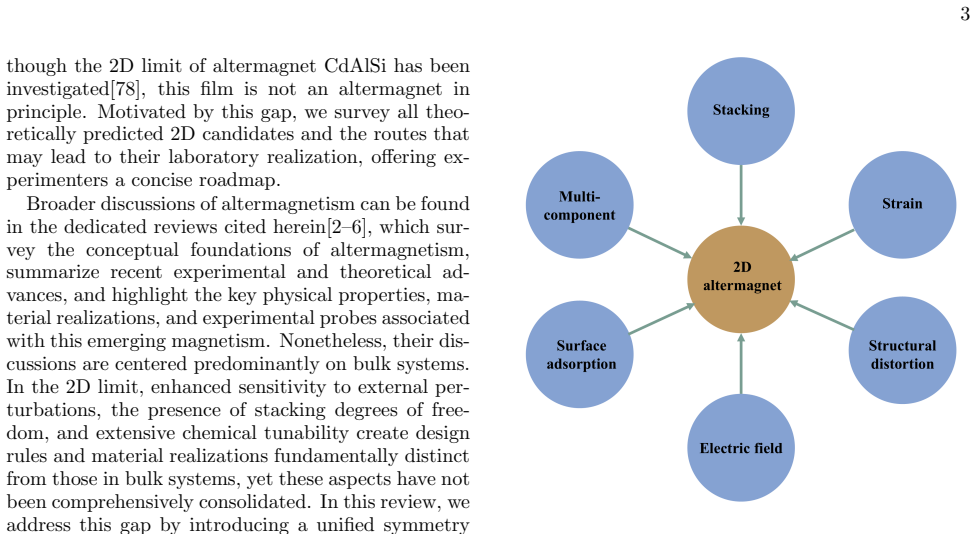
Altermagnets in two dimensions are collinear antiferromagnets that exhibit symmetry-protected spin splitting without net magnetization or relativistic mechanisms. Spin-group theory supplies the classification that distinguishes allowed symmetry classes and predicts the momentum-dependent spin polarization in the electronic bands. The review compiles candidate materials with large predicted splittings and outlines design strategies including lattice engineering and interface control to realize these properties in atomically thin crystals.
What carries the argument
Spin-group theory, which augments conventional magnetic point groups with spin rotations to determine the symmetry-allowed patterns of spin splitting in collinear antiferromagnetic order.
If this is right
- Prioritized candidates become targets for thin-film growth and transport experiments.
- Engineering methods allow systematic tuning of the spin-splitting magnitude and direction.
- Two-dimensional altermagnets can be stacked into van der Waals heterostructures without introducing stray magnetic fields.
- The symmetry classification supplies a systematic search criterion for additional material families.
Where Pith is reading between the lines
- Integration with other two-dimensional phenomena such as ferroelectricity or superconductivity could produce multifunctional devices.
- The absence of net moment may simplify scaling to nanoscale spintronic circuits compared with ferromagnets.
- Room-temperature operation hinges on verifying that the predicted splittings survive thermal fluctuations in real samples.
Load-bearing premise
That the listed candidate materials will retain the predicted altermagnetic band structure once fabricated, without strong electron correlations or relativistic corrections washing out the non-relativistic spin splitting.
What would settle it
Fabrication and angle-resolved photoemission measurement of a top candidate showing either finite net magnetization or zero spin splitting across the Brillouin zone would falsify the classification for that material.
Figures



read the original abstract
Altermagnets -- newly identified collinear antiferromagnets -- carry zero net moment with non-relativistic, spin-polarized bands, distilling the best of ferromagnets and antiferromagnets into a single spintronic platform. Shrunking to the two-dimensional limit, they inherit the tunability of two-dimensional crystals while adding symmetry-protected spin splitting, a combination now driving intense experimental interest. Here, we review the symmetry classification of two-dimensional altermagnets based on spin-group theory and survey the growing list of candidate materials, emphasizing those with large spin splitting for experimental realization. We then examine strategies for engineering two-dimensional altermagnetism. This Review aims to consolidate theoretically proposed candidate materials and realization strategies for two-dimensional altermagnets, providing insights for future experimental efforts in this emerging field.
Editorial analysis
A structured set of objections, weighed in public.
Referee Report
Summary. The paper reviews the symmetry classification of two-dimensional altermagnets using spin-group theory, surveys a list of candidate materials (emphasizing those with large spin splitting), and discusses engineering strategies for realizing 2D altermagnetism, with the goal of consolidating theoretical proposals to guide experimental efforts.
Significance. If the spin-group classification remains valid for real materials, the review consolidates symmetry-allowed spin splittings and material candidates in a rapidly emerging area, providing a useful reference for spintronic platforms that combine zero net magnetization with non-relativistic spin polarization and 2D tunability.
major comments (1)
- [§2–3] §2–3: The derivation of allowed spin splittings from spin-group operations assumes the non-relativistic limit, but the manuscript provides no SOC strength estimates or Hubbard U values for any entry in Table 1 (e.g., Cr2Se2 or FeSe monolayers). In 2D, substrate-enhanced SOC can reach tens of meV and may mix the spin channels or close the reported splittings, weakening the central premise that the splitting is symmetry-protected and non-relativistic.
minor comments (1)
- [Abstract] Abstract: 'Shrunking' is a typographical error and should read 'Shrinking'.
Simulated Author's Rebuttal
We thank the referee for the positive evaluation and the constructive comment on the non-relativistic approximation. We address the point below and will revise the manuscript accordingly.
read point-by-point responses
-
Referee: [§2–3] §2–3: The derivation of allowed spin splittings from spin-group operations assumes the non-relativistic limit, but the manuscript provides no SOC strength estimates or Hubbard U values for any entry in Table 1 (e.g., Cr2Se2 or FeSe monolayers). In 2D, substrate-enhanced SOC can reach tens of meV and may mix the spin channels or close the reported splittings, weakening the central premise that the splitting is symmetry-protected and non-relativistic.
Authors: We agree that the spin-group classification in §§2–3 is formulated in the non-relativistic limit, as is standard for altermagnetism to isolate symmetry-protected spin splitting. The original manuscript indeed omits explicit SOC estimates and Hubbard U values for Table 1 entries. In the revised version we will add a dedicated paragraph (or short subsection) providing literature-based SOC strengths and the Hubbard U parameters employed in the referenced calculations for the key candidates (including Cr2Se2 and FeSe monolayers). We will also discuss the robustness of the reported splittings against moderate SOC, noting that many listed materials exhibit non-relativistic splittings substantially larger than typical 2D SOC values (~10–30 meV), so that the altermagnetic signatures remain observable. This addition will clarify the regime of validity without changing the central symmetry-based premise. revision: yes
Circularity Check
No significant circularity: review relies on external spin-group literature and prior calculations
full rationale
The manuscript is a review that applies spin-group theory to classify 2D altermagnets and surveys candidate materials drawn from external literature. No parameters are fitted within the paper, no predictions are generated from the paper's own data or equations, and no derivation reduces by construction to its inputs. Central statements on symmetry-protected spin splitting rest on cited prior calculations rather than self-referential re-derivation. The classification chain is self-contained against external benchmarks, with no load-bearing self-citations that collapse the argument to unverified assumptions internal to this work.
Axiom & Free-Parameter Ledger
axioms (1)
- domain assumption Spin-group theory provides a complete and sufficient classification framework for collinear magnetic symmetries in two-dimensional crystals.
Lean theorems connected to this paper
-
IndisputableMonolith/Foundation/AlexanderDuality.leanalexander_duality_circle_linking unclear?
unclearRelation between the paper passage and the cited Recognition theorem.
All nontrivial spin Laue groups describing 2D altermagnets are listed in Table I. They are classified into three types, including d-, g-, i-wave, according to the basic characteristic of spin-momentum locking... When the characteristic integer is 2, 4, or 6, the corresponding types... are respectively classified as d-wave, g-wave, and i-wave.
-
IndisputableMonolith/Foundation/ArithmeticFromLogic.leanreality_from_one_distinction unclear?
unclearRelation between the paper passage and the cited Recognition theorem.
Altermagnetism is a nonrelativistic phenomenon and is therefore governed primarily by spin group symmetries... For two-dimensional magnetic materials, the real-space part of the nontrivial spin group should be a layer group.
What do these tags mean?
- matches
- The paper's claim is directly supported by a theorem in the formal canon.
- supports
- The theorem supports part of the paper's argument, but the paper may add assumptions or extra steps.
- extends
- The paper goes beyond the formal theorem; the theorem is a base layer rather than the whole result.
- uses
- The paper appears to rely on the theorem as machinery.
- contradicts
- The paper's claim conflicts with a theorem or certificate in the canon.
- unclear
- Pith found a possible connection, but the passage is too broad, indirect, or ambiguous to say the theorem truly supports the claim.
Reference graph
Works this paper leans on
-
[1]
L. ˇSmejkal, J. Sinova, and T. Jungwirth, Be- yond conventional ferromagnetism and antiferro- magnetism: A phase with nonrelativistic spin and crystal rotation symmetry, Physical Review X 12, 031042 (2022)
work page 2022
-
[2]
L. ˇSmejkal, J. Sinova, and T. Jungwirth, Emerging research landscape of altermagnetism, Physical Re- view X 12, 040501 (2022)
work page 2022
-
[3]
L. Bai, W. Feng, S. Liu, L. ˇSmejkal, Y. Mokrousov, and Y. Yao, Altermagnetism: Exploring new fron- tiers in magnetism and spintronics, Advanced Func- tional Materials 34, 2409327 (2024)
work page 2024
-
[4]
C. Song, H. Bai, Z. Zhou, L. Han, H. Reichlova, J. H. Dil, J. Liu, X. Chen, and F. Pan, Altermagnets as a new class of functional materials, Nature Reviews Materials 10, 473 (2025)
work page 2025
-
[5]
S. S. Fender, O. Gonzalez, and D. K. Bediako, Alter- magnetism: A chemical perspective, Journal of the American Chemical Society 147, 2257 (2025)
work page 2025
- [6]
-
[7]
L. ˇSmejkal, R. Gonz´ alez-Hern´ andez, T. Jungwirth, and J. Sinova, Crystal time-reversal symmetry breaking and spontaneous Hall effect in collinear an- tiferromagnets, Science advances 6, eaaz8809 (2020)
work page 2020
-
[8]
C. Wu, K. Sun, E. Fradkin, and S.-C. Zhang, Fermi liquid instabilities in the spin channel, Physical Re- view B 75, 115103 (2007)
work page 2007
- [9]
-
[10]
L.-D. Yuan, Z. Wang, J.-W. Luo, E. I. Rashba, and A. Zunger, Giant momentum-dependent spin splitting in centrosymmetric low- Z antiferromag- nets, Physical Review B 102, 014422 (2020)
work page 2020
-
[11]
I. I. Mazin, K. Koepernik, M. D. Johannes, R. Gonz´ alez-Hern´ andez, and L.ˇSmejkal, Prediction of unconventional magnetism in doped FeSb 2, Pro- ceedings of the National Academy of Sciences 118, e2108924118 (2021)
work page 2021
-
[12]
H.-Y. Ma, M. Hu, N. Li, J. Liu, W. Yao, J.- F. Jia, and J. Liu, Multifunctional antiferromag- netic materials with giant piezomagnetism and non- collinear spin current, Nature Communications 12, 2846 (2021)
work page 2021
-
[13]
P. Liu, J. Li, J. Han, X. Wan, and Q. Liu, Spin-group symmetry in magnetic materials with negligible spin- orbit coupling, Physical Review X12, 021016 (2022)
work page 2022
- [14]
-
[15]
T. Jungwirth, X. Marti, P. Wadley, and J. Wun- derlich, Antiferromagnetic spintronics, Nature nan- otechnology 11, 231 (2016)
work page 2016
-
[16]
S. Lee, S. Lee, S. Jung, J. Jung, D. Kim, Y. Lee, 22 B. Seok, J. Kim, B. G. Park, L. ˇSmejkal, C.-J. Kang, and C. Kim, Broken kramers degeneracy in altermagnetic MnTe, Physical Review Letters 132, 036702 (2024)
work page 2024
- [17]
-
[18]
J. Ding, Z. Jiang, X. Chen, Z. Tao, Z. Liu, T. Li, J. Liu, J. Sun, J. Cheng, J. Liu, Y. Yang, R. Zhang, L. Deng, W. Jing, Y. Huang, Y. Shi, M. Ye, S. Qiao, Y. Wang, Y. Guo, D. Feng, and D. Shen, Large band splitting in g-wave altermagnet CrSb, Physical Re- view Letters 133, 206401 (2024)
work page 2024
-
[19]
M. Zeng, M.-Y. Zhu, Y.-P. Zhu, X.-R. Liu, X.- M. Ma, Y.-J. Hao, P. Liu, G. Qu, Y. Yang, Z. Jiang, et al. , Observation of spin splitting in room-temperature metallic antiferromagnet CrSb, Advanced Science 11, 2406529 (2024)
work page 2024
-
[20]
S. Reimers, L. Odenbreit, L. ˇSmejkal, V. N. Strocov, P. Constantinou, A. B. Hellenes, R. Jaeschke Ubiergo, W. H. Campos, V. K. Bharadwaj, A. Chakraborty, et al. , Direct observa- tion of altermagnetic band splitting in CrSb thin films, Nature Communications 15, 2116 (2024)
work page 2024
-
[21]
G. Yang, Z. Li, S. Yang, J. Li, H. Zheng, W. Zhu, Z. Pan, Y. Xu, S. Cao, W. Zhao, et al. , Three- dimensional mapping of the altermagnetic spin split- ting in CrSb, Nature Communications 16, 1442 (2025)
work page 2025
- [22]
-
[23]
F. Zhang, X. Cheng, Z. Yin, C. Liu, L. Deng, Y. Qiao, Z. Shi, S. Zhang, J. Lin, Z. Liu, M. Ye, Y. Huang, X. Meng, C. Zhang, T. Okuda, K. Shi- mada, S. Cui, Y. Zhao, G.-H. Cao, S. Qiao, J. Liu, and C. Chen, Crystal-symmetry-paired spin–valley locking in a layered room-temperature metallic alter- magnet candidate, Nature Physics 21, 760 (2025)
work page 2025
-
[24]
R. Yamamoto, L. A. Turnbull, M. Schmidt, J. C. Corsaletti Filho, H. J. Binger, M. Di Pietro Mart´ ınez, M. Weigand, S. Finizio, Y. Prots, G. M. Ferguson, U. Vool, S. Wintz, and C. Donnelly, Altermagnetic nanotextures revealed in bulk MnTe, Physical Review Applied 24, 034037 (2025)
work page 2025
-
[25]
L. ˇSmejkal, A. B. Hellenes, R. Gonz´ alez-Hern´ andez, J. Sinova, and T. Jungwirth, Giant and tunneling magnetoresistance in unconventional collinear an- tiferromagnets with nonrelativistic spin-momentum coupling, Physical Review X 12, 011028 (2022)
work page 2022
-
[26]
C.-T. Liao, Y.-C. Wang, Y.-C. Tien, S.-Y. Huang, and D. Qu, Separation of Inverse Altermagnetic Spin-Splitting Effect from Inverse Spin Hall Effect in RuO2, Physical Review Letters 133, 056701 (2024)
work page 2024
-
[27]
Q. Cui, B. Zeng, P. Cui, T. Yu, and H. Yang, Efficient spin Seebeck and spin Nernst effects of magnons in altermagnets, Physical Review B 108, L180401 (2023)
work page 2023
-
[28]
Gonz´ alez-Hern´ andez, L.ˇSmejkal, K
R. Gonz´ alez-Hern´ andez, L.ˇSmejkal, K. V´ yborn´ y, Y. Yahagi, J. Sinova, T. Jungwirth, and J. ˇZelezn´ y, Efficient electrical spin splitter based on nonrela- tivistic collinear antiferromagnetism, Physical Re- view Letters 126, 127701 (2021)
work page 2021
- [29]
-
[30]
H. Bai, L. Han, X. Y. Feng, Y. J. Zhou, R. X. Su, Q. Wang, L. Y. Liao, W. X. Zhu, X. Z. Chen, F. Pan, X. L. Fan, and C. Song, Observation of spin splitting torque in a collinear antiferromagnet RuO2, Physical Review Letters 128, 197202 (2022)
work page 2022
-
[31]
H.-Y. Ma and J.-F. Jia, Altermagnetic topological insulator and the selection rules, Physical Review B 110, 064426 (2024)
work page 2024
-
[32]
Y.-X. Li, Y. Liu, and C.-C. Liu, Creation and ma- nipulation of higher-order topological states by alter- magnets, Physical Review B 109, L201109 (2024)
work page 2024
- [33]
- [34]
-
[35]
S.-D. Guo, Y. Liu, J. Yu, and C.-C. Liu, Valley polar- ization in twisted altermagnetism, Physical Review B 110, L220402 (2024)
work page 2024
- [36]
-
[37]
Y.-X. Li, Realizing tunable higher-order topological superconductors with altermagnets, Physical Review B 109, 224502 (2024)
work page 2024
-
[38]
S. Banerjee and M. S. Scheurer, Altermagnetic su- perconducting diode effect, Physical Review B 110, 024503 (2024)
work page 2024
-
[39]
M. Papaj, Andreev reflection at the altermagnet- superconductor interface, Physical Review B 108, L060508 (2023)
work page 2023
- [40]
-
[41]
D. Chakraborty and A. M. Black-Schaffer, Perfect superconducting diode effect in altermagnets, Phys- ical Review Letters 135, 026001 (2025)
work page 2025
-
[42]
H. G. Giil and J. Linder, Superconductor- altermagnet memory functionality without stray fields, Physical Review B 109, 134511 (2024)
work page 2024
-
[43]
P. O. Sukhachov, E. W. Hodt, and J. Linder, Thermoelectric effect in altermagnet-superconductor junctions, Physical Review B 110, 094508 (2024)
work page 2024
- [44]
-
[45]
L. Han, X. Fu, W. He, J. Dai, Y. Zhu, W. Yang, Y. Chen, J. Zhang, W. Zhu, H. Bai, C. Chen, D. Hou, C. Wan, X. Han, C. Song, J. Liu, and F. Pan, Non- volatile anomalous nernst effect in Mn 5Si3 with a collinear N´ eel vector, Physical Review Applied 23, 044066 (2025)
work page 2025
-
[46]
X.-J. Yi, Y. Mao, X. Lu, and Q.-F. Sun, Spin split- ting nernst effect in altermagnets, Physical Review 23 B 111, 035423 (2025)
work page 2025
-
[47]
M. Weißenhofer and A. Marmodoro, Atomistic spin dynamics simulations of magnonic spin Seebeck and spin Nernst effects in altermagnets, Physical Review B 110, 094427 (2024)
work page 2024
- [48]
-
[49]
X. Duan, J. Zhang, Z. Zhu, Y. Liu, Z. Zhang, I. ˇZuti´ c, and T. Zhou, Antiferroelectric altermagnets: Antiferroelectricity alters magnets, Physical Review Letters 134, 106801 (2025)
work page 2025
-
[50]
W. Sun, C. Yang, W. Wang, Y. Liu, X. Wang, S. Huang, and Z. Cheng, Proposing altermagnetic- ferroelectric Type-III multiferroics with robust mag- netoelectric coupling, Advanced Materials , 2502575 (2025)
work page 2025
-
[51]
L. ˇSmejkal, Altermagnetic multiferroics and altermagnetoelectric effect, arXiv preprint arXiv:2411.19928 (2024)
-
[52]
M. Gu, Y. Liu, H. Zhu, K. Yananose, X. Chen, Y. Hu, A. Stroppa, and Q. Liu, Ferroelectric switch- able altermagnetism, Physical Review Letters 134, 106802 (2025)
work page 2025
-
[53]
C. Gong, L. Li, Z. Li, H. Ji, A. Stern, Y. Xia, T. Cao, W. Bao, C. Wang, Y. Wang, et al. , Discovery of in- trinsic ferromagnetism in two-dimensional van der Waals crystals, Nature 546, 265 (2017)
work page 2017
- [54]
-
[55]
Q. H. Wang, A. Bedoya-Pinto, M. Blei, A. H. Dis- mukes, A. Hamo, S. Jenkins, M. Koperski, Y. Liu, Q.-C. Sun, E. J. Telford,et al., The magnetic genome of two-dimensional van der Waals materials, ACS nano 16, 6960 (2022)
work page 2022
-
[56]
K. F. Mak, J. Shan, and D. C. Ralph, Probing and controlling magnetic states in 2D layered magnetic materials, Nature Reviews Physics 1, 646 (2019)
work page 2019
- [57]
- [58]
-
[59]
Y. Xu, A. Ray, Y.-T. Shao, S. Jiang, K. Lee, D. We- ber, J. E. Goldberger, K. Watanabe, T. Taniguchi, D. A. Muller, et al. , Coexisting ferromagnetic– antiferromagnetic state in twisted bilayer CrI 3, Na- ture nanotechnology 17, 143 (2022)
work page 2022
-
[60]
H. Xie, X. Luo, G. Ye, Z. Ye, H. Ge, S. H. Sung, E. Rennich, S. Yan, Y. Fu, S. Tian,et al., Twist engi- neering of the two-dimensional magnetism in double bilayer chromium triiodide homostructures, Nature Physics 18, 30 (2022)
work page 2022
-
[61]
Y. Qi, J. Zhao, and H. Zeng, Spin-layer coupling in two-dimensional altermagnetic bilayers with tunable spin and valley splitting properties, Physical Review B 110, 014442 (2024)
work page 2024
-
[62]
Y. Wu, L. Deng, X. Yin, J. Tong, F. Tian, and X. Zhang, Valley-related multipiezo effect and non- collinear spin current in an altermagnet Fe 2Se2O monolayer, Nano Letters 24, 10534 (2024)
work page 2024
- [63]
-
[65]
J.-Y. Zhan, R. He, D. Wang, M.-D. He, N. Luo, J. Zeng, K.-Q. Chen, and L.-M. Tang, Multiphysics field driven valley polarization in tetragonal alter- magnets, Physical Review B 112, 024408 (2025)
work page 2025
-
[66]
S. Sheoran and P. Dev, Spontaneous anomalous Hall effect in two-dimensional altermagnets, Physical Re- view B 111, 184407 (2025)
work page 2025
-
[67]
S. Liu, Z. Zhang, L. Bai, and W. Feng, Anomalous transport properties in the two-dimensional topolog- ical altermagnet V 2Te2O, Physical Review B 111, 184437 (2025)
work page 2025
-
[68]
H. Jin, Z. Tan, Z. Gong, and J. Wang, Anomalous Hall effect in two-dimensional vanadium tetrahalo- gen with altermagnetic phase, Physical Review B 110, 155125 (2024)
work page 2024
-
[69]
M. Yarmohammadi, U. Z¨ ulicke, J. Berakdar, J. Lin- der, and J. K. Freericks, Anisotropic light-tailored RKKY interaction in two-dimensional d-wave alter- magnets, Physical Review B 111, 224412 (2025)
work page 2025
-
[70]
Z. Zhu, X. Duan, J. Zhang, B. Hao, I. ˇZuti´ c, and T. Zhou, Two-Dimensional Ferroelectric Altermag- nets: From Model to Material Realization, Nano Let- ters 25, 9456 (2025)
work page 2025
-
[71]
W. Sun, H. Ye, L. Liang, N. Ding, S. Dong, and S.- S. Wang, Stacking-dependent ferroicity of a reversed bilayer: Altermagnetism or ferroelectricity, Physical Review B 110, 224418 (2024)
work page 2024
-
[72]
W. Sun, W. Wang, C. Yang, R. Hu, S. Yan, S. Huang, and Z. Cheng, Altermagnetism induced by sliding ferroelectricity via lattice symmetry- mediated magnetoelectric coupling, Nano Letters 24, 11179 (2024)
work page 2024
-
[73]
Y. Zhu, M. Gu, Y. Liu, X. Chen, Y. Li, S. Du, and Q. Liu, Sliding ferroelectric control of unconven- tional magnetism in stacked bilayers, Physical Re- view Letters 135, 056801 (2025)
work page 2025
-
[74]
S. Wang, W.-W. Wang, J. Fan, X. Zhou, X.-P. Li, and L. Wang, Two-Dimensional Dual-Switchable Ferroelectric Altermagnets: Altering Electrons and Magnons, Nano Letters 25, 14618 (2025)
work page 2025
- [75]
-
[76]
M. Wei, Gapless superconducting state and mi- rage gap in altermagnets, Physical Review B 109, L201404 (2024)
work page 2024
-
[77]
M. Wei, Unconventional Hall Effect in Gapless Su- perconductors: Transverse Supercurrent Converted from Normal Current, Physical Review Letters 135, 166304 (2025)
work page 2025
-
[78]
O. E. Parfenov, D. V. Averyanov, I. S. Sokolov, A. N. Mihalyuk, O. A. Kondratev, A. N. Taldenkov, A. M. Tokmachev, and V. G. Storchak, Pushing an alter- magnet to the ultimate 2D limit: Symmetry break- 24 ing in monolayers of GdAlSi, Journal of the Ameri- can Chemical Society 147, 5911 (2025)
work page 2025
-
[79]
W. Brinkman and R. J. Elliott, Theory of spin-space groups, Proceedings of the Royal Society of London. Series A. Mathematical and Physical Sciences 294, 343 (1966)
work page 1966
-
[80]
D. B. Litvin and W. Opechowski, Spin groups, Phys- ica 76, 538 (1974)
work page 1974
-
[81]
D. B. Litvin, Spin point groups, Acta Crystallo- graphica Section A: Crystal Physics, Diffraction, Theoretical and General Crystallography 33, 279 (1977)
work page 1977
discussion (0)
Sign in with ORCID, Apple, or X to comment. Anyone can read and Pith papers without signing in.