Recognition: 2 theorem links
· Lean TheoremSystematic study of the strong decays of the P_c states and their possible isospin cousins via the QCD sum rules
Pith reviewed 2026-05-16 12:39 UTC · model grok-4.3
The pith
QCD sum rules calculations show that the decay widths of Pc(4380), Pc(4440) and Pc(4457) match experiments when the states are treated as meson-baryon molecules.
A machine-rendered reading of the paper's core claim, the machinery that carries it, and where it could break.
Core claim
Under the meson-baryon molecular assignment, the QCD sum rules framework produces strong decay widths for Pc(4380), Pc(4440) and Pc(4457) that agree with experimental data, while also forecasting the decay channels and widths of their possible isospin cousins.
What carries the argument
QCD sum rules applied to interpolating currents built from meson-baryon molecular configurations, used to extract decay constants and compute two-body strong decay widths.
If this is right
- The calculated widths for the three observed Pc states reproduce the experimental measurements.
- Specific partial widths and branching fractions are predicted for the unobserved isospin partner states.
- Agreement with future observations of the partners would support the molecular picture.
- Discrepancies would indicate the need for additional structure components.
Where Pith is reading between the lines
- The same sum-rule technique could be applied to other candidate molecular states to generate testable decay patterns.
- Observation of the isospin cousins with widths close to the predictions would help separate molecular from compact pentaquark interpretations.
- The method supplies a concrete way to use decay data to constrain the internal structure of exotic hadrons.
Load-bearing premise
The Pc states are pure meson-baryon molecular states without significant mixing from other configurations.
What would settle it
Future measurement of a decay width for one of the predicted isospin partner states that differs substantially from the calculated value.
Figures



read the original abstract
In the present work, the strong decays of the discovered $P_c(4380)$, $P_c(4440)$, $P_c(4457)$ and their possible isospin cousins are systematically studied via the assignment that they are the meson-baryon molecular states. In detail, the strong decay constants, partial decay widths of their decay channels are calculated under the framework of QCD sum rules. The decay withes of the discovered $P_c(4380)$, $P_c(4440)$ and $P_c(4457)$ are in good agreement with the experiments. The predictions of the decays of these three related possible isospin cousins are presented which would shed light for their findings in experiment, in return, this may testify the assignments of the discovered $P_c$ states.
Editorial analysis
A structured set of objections, weighed in public.
Referee Report
Summary. The manuscript assigns the observed Pc(4380), Pc(4440) and Pc(4457) as meson-baryon molecular states and uses three-point QCD sum rules to compute their strong decay constants and partial widths. It reports that the calculated widths for the three discovered states agree with experimental values and supplies predictions for the decays of their possible isospin partners.
Significance. If the molecular assignments hold and the sum-rule results are stable, the work would provide a systematic QCD-based calculation of decay properties for these exotic states, offering falsifiable predictions for unobserved isospin cousins that could be tested in future experiments and thereby helping to discriminate among competing interpretations.
major comments (2)
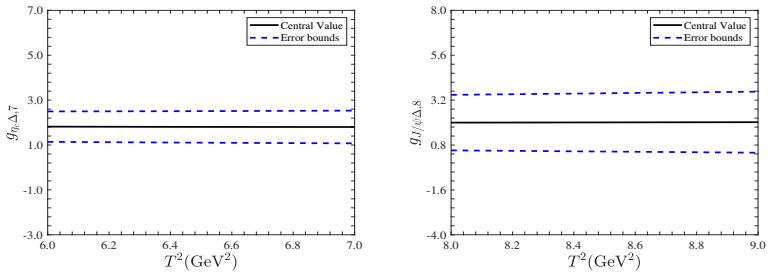
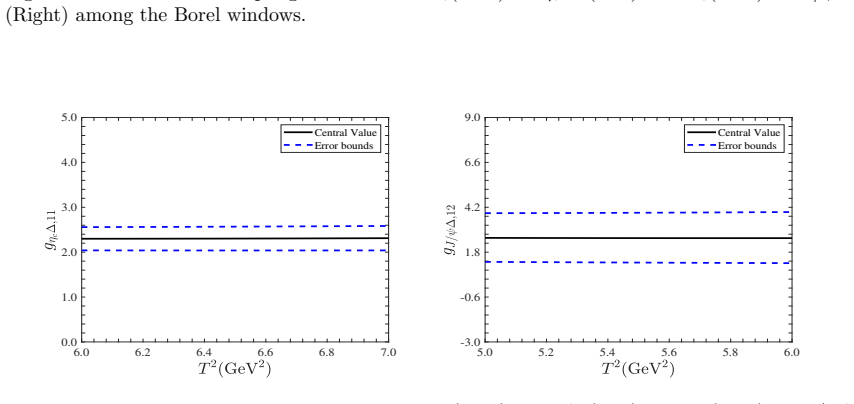
- [Numerical analysis of decay widths] The Borel windows and continuum thresholds s0 are determined solely from the two-point mass sum rules and then transferred unchanged to the three-point decay sum rules. No separate stability analysis is shown for the decay widths as functions of M^2 inside the window or for s0 outside the narrow interval fixed by the mass analysis; because the widths scale with the square of the decay constants, this omission leaves the reported agreement with data sensitive to parameter choice.
- [Abstract and conclusions] The central claim that the widths of Pc(4380), Pc(4440) and Pc(4457) are 'in good agreement with the experiments' is presented without quantified uncertainties arising from the shared parameter set; a systematic scan demonstrating that the agreement survives reasonable variations in s0 and M^2 is required to establish that the result is not an artifact of the tuning performed for the masses.
minor comments (1)
- [Abstract] Typo in abstract: 'decay withes' should read 'decay widths'.
Simulated Author's Rebuttal
We thank the referee for the careful reading of our manuscript and the constructive comments on the numerical stability and uncertainty quantification. We address each major comment below and will revise the manuscript to incorporate additional analysis as outlined.
read point-by-point responses
-
Referee: [Numerical analysis of decay widths] The Borel windows and continuum thresholds s0 are determined solely from the two-point mass sum rules and then transferred unchanged to the three-point decay sum rules. No separate stability analysis is shown for the decay widths as functions of M^2 inside the window or for s0 outside the narrow interval fixed by the mass analysis; because the widths scale with the square of the decay constants, this omission leaves the reported agreement with data sensitive to parameter choice.
Authors: We agree that dedicated stability plots for the three-point sum rules would strengthen the presentation. The Borel windows were chosen using standard criteria ensuring pole dominance (>50%) and OPE convergence, which apply consistently to both two- and three-point functions in our framework. Within these windows the decay widths exhibit mild M^2 dependence, supporting the reported central values. To address the concern directly, we will add explicit figures in the revised manuscript showing the variation of the decay widths versus M^2 and s0, confirming that the agreement with experimental data remains stable under small parameter shifts. revision: yes
-
Referee: [Abstract and conclusions] The central claim that the widths of Pc(4380), Pc(4440) and Pc(4457) are 'in good agreement with the experiments' is presented without quantified uncertainties arising from the shared parameter set; a systematic scan demonstrating that the agreement survives reasonable variations in s0 and M^2 is required to establish that the result is not an artifact of the tuning performed for the masses.
Authors: We acknowledge that the original presentation would benefit from explicit uncertainty quantification and a systematic scan. The agreement is based on central values obtained within the windows fixed by the mass sum rules, but we recognize the value of demonstrating robustness. In the revision we will include a parameter scan over reasonable ranges of s0 and M^2, report the resulting variation as uncertainties on the widths, and update the abstract and conclusions to state the agreement with quantified errors. revision: yes
Circularity Check
Decay widths obtained from three-point sum rules using Borel windows and s0 thresholds already tuned to reproduce masses in two-point sum rules
specific steps
-
fitted input called prediction
[Abstract and QCD sum rules framework]
"the strong decay constants, partial decay widths of their decay channels are calculated under the framework of QCD sum rules. The decay widths of the discovered Pc(4380), Pc(4440) and Pc(4457) are in good agreement with the experiments."
The phenomenological side of the three-point sum rules employs the identical Borel parameter M^2 and continuum threshold s0 that were already chosen to reproduce the masses in the two-point sum rules; the resulting widths therefore inherit the same parameter tuning rather than constituting an independent prediction.
full rationale
The central claim of agreement between computed partial widths and experimental values for Pc(4380), Pc(4440), Pc(4457) rests on the molecular assignment plus the same continuum thresholds and Borel parameters fixed by the mass analysis. Because the decay constants enter linearly into the width formula and the working windows are not scanned independently for the decay channels, the numerical agreement is not an independent test but follows from the shared fitted inputs. This matches the fitted-input-called-prediction pattern without requiring external self-citations.
Axiom & Free-Parameter Ledger
free parameters (2)
- Borel parameters
- Continuum thresholds
axioms (1)
- domain assumption The Pc states are meson-baryon molecular states
Lean theorems connected to this paper
-
IndisputableMonolith/Foundation/RealityFromDistinction.leanreality_from_one_distinction unclear?
unclearRelation between the paper passage and the cited Recognition theorem.
The decay widths of the discovered Pc(4380), Pc(4440) and Pc(4457) are in good agreement with the experiments... via the assignment that they are the meson-baryon molecular states... three-point QCD sum rules
-
IndisputableMonolith/Cost/FunctionalEquation.leanwashburn_uniqueness_aczel contradicts?
contradictsCONTRADICTS: the theorem conflicts with this paper passage, or marks a claim that would need revision before publication.
Borel windows... continuum thresholds s0... C1..C12 free parameters... flat platforms
What do these tags mean?
- matches
- The paper's claim is directly supported by a theorem in the formal canon.
- supports
- The theorem supports part of the paper's argument, but the paper may add assumptions or extra steps.
- extends
- The paper goes beyond the formal theorem; the theorem is a base layer rather than the whole result.
- uses
- The paper appears to rely on the theorem as machinery.
- contradicts
- The paper's claim conflicts with a theorem or certificate in the canon.
- unclear
- Pith found a possible connection, but the passage is too broad, indirect, or ambiguous to say the theorem truly supports the claim.
Reference graph
Works this paper leans on
- [1]
- [2]
- [3]
-
[4]
X. W. Wang and Z. G. Wang, Chin. Phys. C48 (2024) 053102
work page 2024
-
[5]
J. He, Eur. Phys. J. C79 (2019) 393
work page 2019
-
[6]
H. X. Chen, W. Chen, X. Liu and S. L. Zhu, Phys. Rev. Lett. 115 (2015) 172001
work page 2015
-
[7]
H. X. Chen, W. Chen and S. L. Zhu, Phys. Rev. D100 (2019) 051501
work page 2019
-
[8]
Z. G. Wang, Int. J. Mod. Phys. A34 (2019) 1950097. 12
work page 2019
-
[9]
M. L. Du, V. Baru, F. K. Guo, C. Hanhart, U. G. Meissner, J. A. O ller and Q. Wang, Phys. Rev. Lett. 124 (2020) 072001
work page 2020
-
[10]
L. Meng, B. Wang, G. J. Wang and S. L. Zhu, Phys. Rev. D100 (2019) 014031
work page 2019
-
[11]
M. Z. Liu, T. W. Wu, M. S. Sanchez, M. P. Valderrama, L. S. Geng and J. J. Xie, Phys. Rev. D103 (2021) 054004
work page 2021
-
[12]
J. R. Zhang, Eur. Phys. J. C79 (2019) 1001
work page 2019
- [13]
-
[14]
C. W. Xiao, J. Nieves and E. Oset, Phys. Rev. D88 (2013) 056012
work page 2013
-
[15]
H. X. Chen, E. L. Cui, W. Chen, X. Liu, T. G. Steele and S. L. Zhu, Eur. Phys. J. C76 (2016) 572
work page 2016
-
[16]
M. Z. Liu, F. Z. Peng, M. S´ anchez S´ anchez and M. P. Valderra ma, Phys. Rev. D98 (2018) 114030
work page 2018
-
[17]
M. Z. Liu, Y. W. Pan, F. Z. Peng, M. S´ anchez S´ anchez, L. S. G eng, A. Hosaka and M. Pavon Valderrama, Phys. Rev. Lett. 122 (2019) 242001
work page 2019
-
[18]
C. W. Xiao, J. Nieves and E. Oset, Phys. Rev. D100 (2019) 014021
work page 2019
- [19]
-
[20]
Z. G. Wang, Eur. Phys. J. C76 (2016) 70
work page 2016
-
[21]
Z. G. Wang, Int. J. Mod. Phys. A35 (2020) 2050003
work page 2020
-
[22]
Z. G. Wang, Eur. Phys. J. C76 (2016) 142
work page 2016
-
[23]
Z. G. Wang, Int. J. Mod. Phys. A36 (2021) 2150071
work page 2021
- [24]
-
[25]
R. Zhu, X. Liu, H. Huang and C. F. Qiao, Phys. Lett. B797 (2019) 134869
work page 2019
-
[26]
J. F. Giron, R. F. Lebed and C. T. Peterson, JHEP 05 (2019) 061
work page 2019
- [27]
-
[28]
J. F. Giron and R. F. Lebed, Phys. Rev. D104 (2021) 114028
work page 2021
-
[29]
Y. H. Lin and B. S. Zou, Phys. Rev. D100 (2019) 056005
work page 2019
- [30]
-
[31]
N. Yalikun, Y. H. Lin, F. K. Guo, Y. Kamiya and B. S. Zou, Phys. Re v. D104 (2021) 094039
work page 2021
- [32]
-
[33]
M. L. Du, V. Baru, F. K. Guo, C. Hanhart, U. G. Meißner, J. A. O ller and Q. Wang, JHEP 08 (2021) 157
work page 2021
-
[34]
F. Z. Peng, L. S. Geng and J. J. Xie, Phys. Rev. D111 (2025) 054029
work page 2025
-
[35]
F. K. Guo, X. H. Liu and S. Sakai, Prog. Part. Nucl. Phys. 112 (2020) 103757
work page 2020
-
[36]
H. X. Chen, W. Chen, X. Liu, Y. R. Liu and S. L. Zhu, Rept. Prog. Phys. 86 (2022) 026201. 13
work page 2022
-
[37]
L. Meng, B. Wang, G. J. Wang and S. L. Zhu, Phys. Rept. 1019 (2023) 2266
work page 2023
-
[38]
Z. G. Wang, Front. Phys. (Beijing) 21 (2026) 016300
work page 2026
-
[39]
X. W. Wang, Z. G. Wang, G. L. Yu and Q. Xin, Sci. China Phys. Mech . Astron. 65 (2022) 291011
work page 2022
-
[40]
X. W. Wang and Z. G. Wang, Chin. Phys. C47 (2023) 013109
work page 2023
-
[41]
Z. G. Wang, Chin. Phys. C45 (2021) 073107
work page 2021
-
[42]
G. J. Wang, L. Y. Xiao, R. Chen, X. H. Liu, X. Liu and S. L. Zhu, Ph ys. Rev. D102 (2020) 036012
work page 2020
- [43]
-
[44]
Z. G. Wang and X. Wang, Chin. Phys. C44 (2020) 103102
work page 2020
-
[45]
Y. J. Xu, C. Y. Cui, Y. L. Liu and M. Q. Huang, Phys. Rev. D102 (2020) 034028
work page 2020
-
[46]
X. W. Wang and Z. G. Wang, Int. J. Mod. Phys. A37 (2022) 2250189
work page 2022
-
[47]
Z. G. Wang and J. X. Zhang, Eur. Phys. J. C78 (2018) 14
work page 2018
-
[48]
Z. G. Wang, Eur. Phys. J. C79 (2019) 184
work page 2019
-
[49]
Z. G. Wang and Z. Y. Di, Eur. Phys. J. C79 (2019) 72
work page 2019
-
[50]
Z. G. Wang, Acta Phys. Polon. B51 (2020) 435
work page 2020
-
[51]
Z. G. Wang, Int. J. Mod. Phys. A34 (2019) 1950110
work page 2019
-
[52]
Z. G. Wang, H. J. Wang and Q. Xin, Chin. Phys. C45 (2021) 063104
work page 2021
-
[53]
M. A. Shifman, A. I. Vainshtein and V. I. Zakharov, Nucl. Phys. B147 (1979) 385
work page 1979
-
[54]
M. A. Shifman, A. I. Vainshtein and V. I. Zakharov, Nucl. Phys. B147 (1979) 448
work page 1979
-
[55]
L. J. Reinders, H. Rubinstein and S. Yazaki, Phys. Rept. 127 (1985) 1
work page 1985
-
[56]
QCD Sum Rules, a Modern Perspective
P. Colangelo and A. Khodjamirian, hep-ph/0010175
work page internal anchor Pith review Pith/arXiv arXiv
-
[57]
P. A. Zyla et al, Prog. Theor. Exp. Phys. 2020 (2020) 083C01
work page 2020
- [58]
-
[59]
Z. G. Wang and T. Huang, Phys. Rev. D89 (2014) 054019
work page 2014
-
[60]
D. Becirevic, G. Duplancic, B. Klajn, B. Melic and F. Sanfilippo, Nuc l. Phys. B883 (2014) 306
work page 2014
-
[61]
B. L. Ioffe, Prog. Part. Nucl. Phys. 56 (2006) 232
work page 2006
-
[62]
Z. G. Wang, Chin. Phys. C46 (2022) 123106
work page 2022
-
[63]
X. W. Wang and Z. G. Wang, Phys. Rev. D110 (2024) 014008. 14 Appendix κ 2 = 4(m2 J/ψ τ +m2 N ) 3m2 J/ψ ξ + 8mNmPA 3m2 J/ψ ξ (63) κ 3 = − 4m2 ηcτ2 9m2 ∆ ξ + 4m2 ∆ 9m2 ηcξ + 8m2 ηcτ 9m2 ∆ + 4m∆ mPB 3m2 ηcξ − 4m2 ηcξ 9m∆ mPB + 4m2 ηcτ 9m∆ mPB − 4mPBτ 3m∆ ξ + 8mPB 3m∆ + 16 9 (64) κ 4 = − 8m2 ∆ mPB 9m2 J/ψ ξ + 2m2 ∆ 9mPB + 2m3 ∆ 9m2 J/ψ ξ + 2m2 J/ψ τ2 9m∆ ξ − ...
work page 2024
discussion (0)
Sign in with ORCID, Apple, or X to comment. Anyone can read and Pith papers without signing in.