A radially broad collisional cascade in the debris disk of γ Ophiuchi observed by JWST
Pith reviewed 2026-05-21 15:33 UTC · model grok-4.3
The pith
The mid-infrared radial profile of the γ Ophiuchi debris disk indicates a single radially broad steady-state collisional cascade with uniform grain sizes throughout.
A machine-rendered reading of the paper's core claim, the machinery that carries it, and where it could break.
Core claim
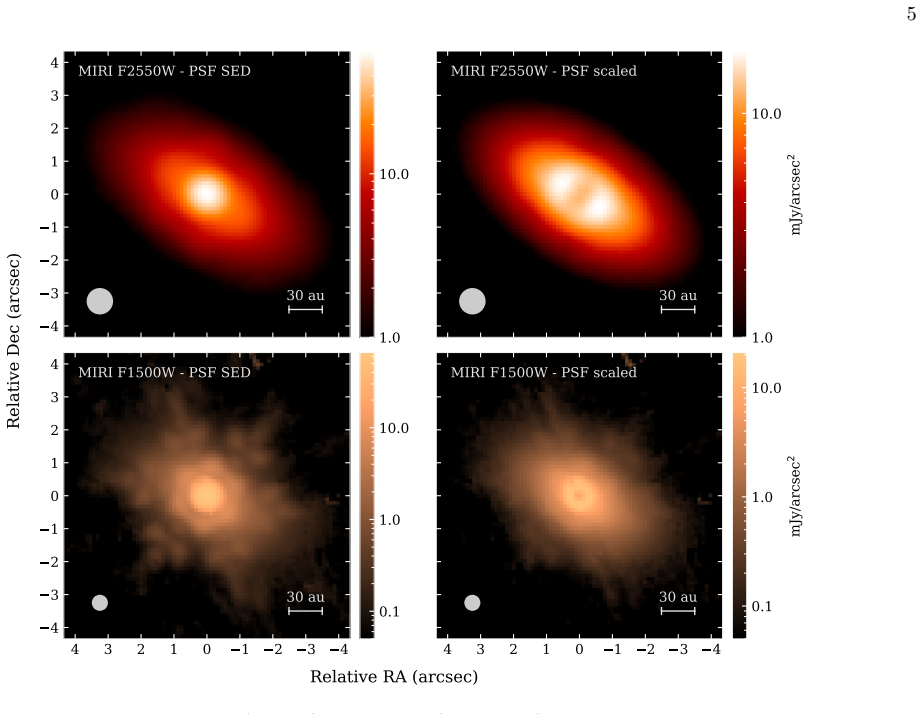
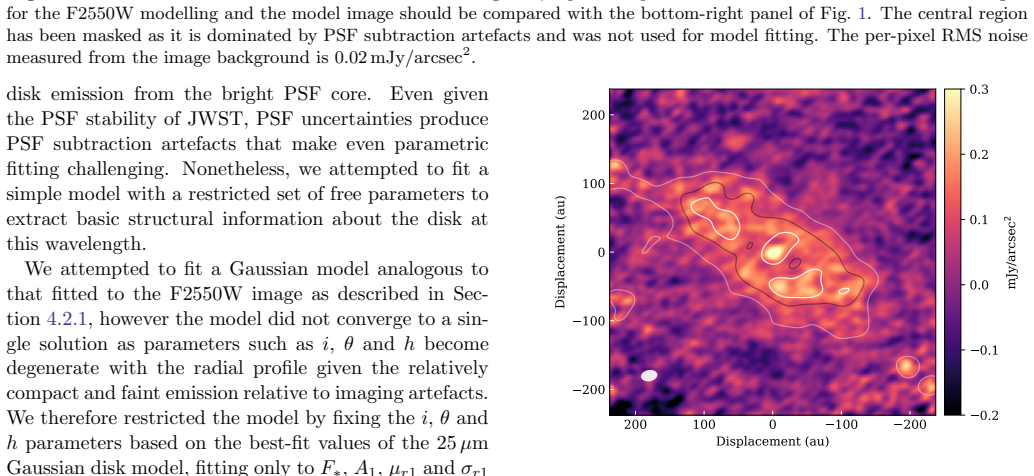
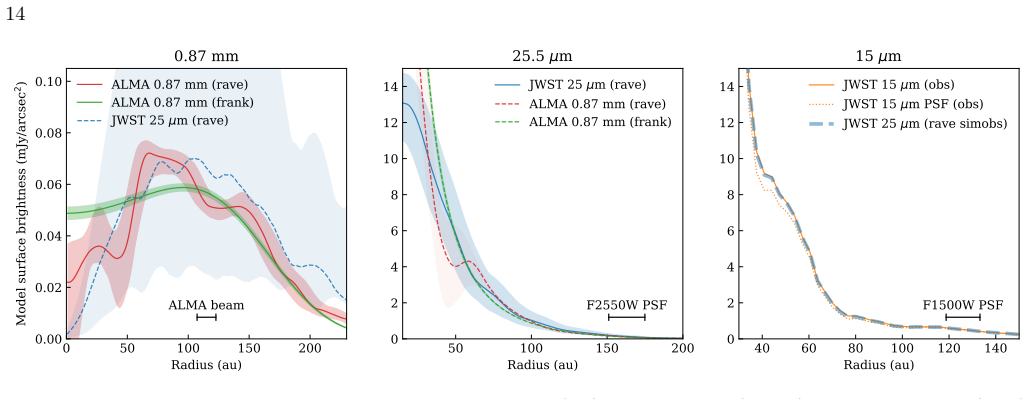
JWST/MIRI imaging at 15 and 25.5 μm reveals smooth and radially broad emission extending to a radius of at least 250 au at 25.5 μm. Combined with prior ALMA imaging, the mid-infrared radial profile suggests a radially broad steady-state collisional cascade with the same grain size distribution throughout the disk. This implies the system is populated by a radially broad planetesimal belt from tens of au or less to well over 200 au, rather than a narrow planetesimal belt from which the observed dust is displaced to appear broad.
What carries the argument
Radially broad steady-state collisional cascade maintaining the same grain size distribution at all radii, which accounts for the observed smooth mid-infrared brightness profile without requiring outward transport from a narrow belt.
If this is right
- The disk contains planetesimals distributed from inner regions outward to beyond 200 AU.
- The observed asymmetry corresponds to a disk eccentricity of roughly 0.03 that can be induced by a planet.
- No resolvable radial gap is expected from the proposed planetary companion.
- The breadth does not require recent dynamical stirring or separate dust populations to explain it.
Where Pith is reading between the lines
- Similar broad belts may exist undetected in other debris disks previously modeled as narrow rings with scattered dust.
- Additional infrared or submillimeter observations at varying resolutions could test whether grain properties stay constant across the full extent.
- The small eccentricity opens the possibility of detecting a low-mass planet at tens of AU through continued monitoring of the offset.
Load-bearing premise
The smooth radial brightness profile arises from one steady-state collisional cascade with uniform grain sizes at every radius rather than multiple components, recent events, or wavelength-dependent effects.
What would settle it
High-resolution multi-wavelength data that show grain sizes varying with radius or reveal distinct ringed structures at mid-infrared wavelengths would falsify the single uniform cascade interpretation.
Figures






read the original abstract
The A1V star $\gamma$ Oph, at a distance of 29.7 pc, is known from Spitzer imaging to host a debris disk with a large radial extent and from its spectral energy distribution to host inner warm dust. We imaged $\gamma$ Oph with JWST/MIRI at 15 and 25.5 $\mu$m, revealing smooth and radially broad emission that extends to a radius of at least 250 au at 25.5 $\mu$m. In contrast to JWST findings of an inner small-grain component with distinct ringed structures in Fomalhaut and Vega, the mid-infrared radial profile combined with prior ALMA imaging suggests a radially broad steady-state collisional cascade with the same grain size distribution throughout the disk. This further suggests that the system is populated by a radially broad planetesimal belt from tens of au or less to well over 200 au, rather than a narrow planetesimal belt from which the observed dust is displaced to appear broad. The disk is also found to be asymmetric, which could be modelled by a stellocentric offset corresponding to a small eccentricity of $\sim$0.03. Such a disk eccentricity could be induced by a mildly eccentric $<10\,M_\mathrm{Jup}$ giant planet outside 10 au, or a more eccentric companion up to stellar mass at a few au, without producing a resolvable radial gap in the disk.
Editorial analysis
A structured set of objections, weighed in public.
Referee Report
Summary. The paper presents new JWST/MIRI observations of the γ Ophiuchi debris disk at 15 and 25.5 μm, revealing smooth, radially broad mid-infrared emission extending to at least 250 au. Combined with existing ALMA millimeter imaging, the authors interpret the lack of substructure and the radial profile as evidence for a single steady-state collisional cascade with a spatially invariant grain size distribution n(a) ∝ a^{-q} from tens of au to beyond 200 au. This leads to the conclusion that the system hosts a radially broad planetesimal belt rather than a narrow source region with outward dust displacement. The disk is also found to be asymmetric and is modeled with a small eccentricity of ~0.03, potentially induced by a low-mass planet.
Significance. If the central interpretation holds, the result provides important evidence that some debris disks are populated by extended planetesimal belts rather than narrow rings with migrated dust, contrasting with the ringed inner components reported for Fomalhaut and Vega. The multi-wavelength comparison between JWST mid-IR and ALMA data is a clear strength, and the eccentricity modeling offers testable predictions for unseen companions. The work highlights JWST's ability to map smooth dust distributions at wavelengths sensitive to small grains.
major comments (2)
- [Discussion] The interpretation in the discussion that the smooth JWST radial brightness profiles, when combined with ALMA data, demonstrate a radially broad steady-state collisional cascade with uniform grain size distribution at all radii is not supported by quantitative forward modeling. No synthetic radial profiles are presented for the alternative hypothesis of a narrow planetesimal belt plus PR-drag or collisional migration, nor for a radially varying q(r) or wavelength-dependent optical depth effects. Without such comparisons, the smoothness alone does not yet exclude scenarios that could mimic breadth, which is load-bearing for the claim that the planetesimal belt itself is radially extended.
- [§3] §3 (Observations and Data Reduction): the manuscript does not provide sufficient detail on background subtraction, PSF modeling, or the quantitative fitting procedure used to extract the mid-IR surface-brightness profiles. These steps are essential to assess whether the reported smoothness and lack of ringed substructure are robust against instrumental or reduction artifacts, directly affecting the central claim that the profile indicates a single broad cascade.
minor comments (2)
- [Abstract] The abstract refers to 'prior ALMA imaging' without a specific citation; adding the reference to the ALMA data source would improve traceability.
- [Figures] Figure captions for the radial profiles should explicitly state the radial binning, uncertainty estimation method, and any masking applied to the asymmetric features.
Simulated Author's Rebuttal
We thank the referee for their constructive and detailed report, which has helped us improve the clarity and robustness of the manuscript. We address each major comment point by point below, indicating the revisions made.
read point-by-point responses
-
Referee: [Discussion] The interpretation in the discussion that the smooth JWST radial brightness profiles, when combined with ALMA data, demonstrate a radially broad steady-state collisional cascade with uniform grain size distribution at all radii is not supported by quantitative forward modeling. No synthetic radial profiles are presented for the alternative hypothesis of a narrow planetesimal belt plus PR-drag or collisional migration, nor for a radially varying q(r) or wavelength-dependent optical depth effects. Without such comparisons, the smoothness alone does not yet exclude scenarios that could mimic breadth, which is load-bearing for the claim that the planetesimal belt itself is radially extended.
Authors: We agree that the central claim would be strengthened by direct quantitative comparisons to alternative models. The original manuscript presented the interpretation based on the observed smoothness at mid-IR wavelengths combined with the ALMA millimeter data and the absence of ring-like substructure, arguing this is most consistent with a single broad collisional cascade. However, we acknowledge that explicit forward modeling of narrow-belt plus migration scenarios was not included. In the revised manuscript we have added a new paragraph in the discussion section that provides simple analytic estimates of the radial surface-brightness profiles expected under Poynting-Robertson drag and collisional migration from a narrow source. These estimates indicate that such models would produce a more centrally peaked distribution or steeper outer fall-off than observed, which is inconsistent with the smooth JWST profiles. We have also noted the limitations of these analytic approximations and stated that full numerical simulations remain beyond the present scope. We believe this addition addresses the concern while preserving the original conclusion as the most parsimonious interpretation of the multi-wavelength data. revision: partial
-
Referee: [§3] §3 (Observations and Data Reduction): the manuscript does not provide sufficient detail on background subtraction, PSF modeling, or the quantitative fitting procedure used to extract the mid-IR surface-brightness profiles. These steps are essential to assess whether the reported smoothness and lack of ringed substructure are robust against instrumental or reduction artifacts, directly affecting the central claim that the profile indicates a single broad cascade.
Authors: We thank the referee for highlighting the need for greater methodological transparency. In the revised version of the manuscript we have expanded §3 with additional subsections that now describe: (i) the background subtraction procedure, including the choice of off-source regions, any polynomial fitting applied, and checks for residual artifacts; (ii) the PSF modeling approach, specifying the reference star observations used, the scaling and subtraction method, and validation against the expected diffraction-limited core; and (iii) the quantitative fitting procedure for the surface-brightness profiles, including the functional form adopted, the fitting algorithm, the radial binning scheme, and how uncertainties were estimated from both photon noise and systematic residuals. These additions should enable readers to evaluate the robustness of the reported smoothness and lack of substructure. revision: yes
Circularity Check
No significant circularity; derivation self-contained against external data
full rationale
The paper's core interpretation—that the smooth JWST 15/25.5 μm radial profiles combined with prior ALMA imaging indicate a single radially broad steady-state collisional cascade with spatially invariant grain size distribution—rests on direct observational comparison rather than any quantity defined in terms of itself or a fitted parameter renamed as a prediction. The suggestion of a broad planetesimal belt follows from the observed extent and lack of substructure without forward-modeling loops or self-citation chains that bear the central load. External ALMA data and standard collisional cascade expectations provide independent benchmarks, rendering the argument non-circular.
Axiom & Free-Parameter Ledger
free parameters (1)
- disk eccentricity =
~0.03
axioms (1)
- domain assumption The observed mid-IR emission traces a steady-state collisional cascade with radially constant grain size distribution
Forward citations
Cited by 1 Pith paper
-
The multi-wavelength vertical structure of the archetypal $\beta$ Pictoris debris disk
The β Pictoris debris disk is on average 1.5 times thicker vertically in the mid-infrared than at millimeter wavelengths, with a relatively constant scale height across radius and warping consistent with secular pertu...
Reference graph
Works this paper leans on
-
[1]
Argyriou, I., Lage, C., Rieke, G. H., et al. 2023, A&A, 680, A96, doi: 10.1051/0004-6361/202346490 Astropy Collaboration, Price-Whelan, A. M., Lim, P. L., et al. 2022, ApJ, 935, 167, doi: 10.3847/1538-4357/ac7c74
-
[2]
Ballering, N. P., Su, K. Y. L., Rieke, G. H., & G´ asp´ ar, A. 2016, ApJ, 823, 108, doi: 10.3847/0004-637X/823/2/108
-
[3]
Bohren, C. F., & Huffman, D. R. 1983, Absorption and scattering of light by small particles (Wiley)
work page 1983
-
[4]
Burns, J. A., Lamy, P. L., & Soter, S. 1979, Icarus, 40, 1, doi: 10.1016/0019-1035(79)90050-2
-
[5]
2024,, 1.14.0 Zenodo, doi: 10.5281/zenodo.6984365
Bushouse, H., Eisenhamer, J., Dencheva, N., et al. 2025, JWST Calibration Pipeline, 1.18.0 Zenodo, doi: 10.5281/zenodo.6984365
-
[6]
2016, A&A, 589, A112, doi: 10.1051/0004-6361/201527484
Chelli, A., Duvert, G., Bourg` es, L., et al. 2016, A&A, 589, A112, doi: 10.1051/0004-6361/201527484
-
[7]
H., Mittal, T., Kuchner, M., et al
Chen, C. H., Mittal, T., Kuchner, M., et al. 2014, ApJS, 211, 25, doi: 10.1088/0067-0049/211/2/25
-
[8]
Cutri, R. M., Skrutskie, M. F., van Dyk, S., et al. 2003, 2MASS All Sky Catalog of point sources.,
work page 2003
-
[9]
Daley, C., Hughes, A. M., Carter, E. S., et al. 2019, ApJ, 875, 87, doi: 10.3847/1538-4357/ab1074
-
[10]
David, T. J., & Hillenbrand, L. A. 2015, ApJ, 804, 146, doi: 10.1088/0004-637X/804/2/146
-
[11]
Dohnanyi, J. S. 1969, J. Geophys. Res., 74, 2531, doi: 10.1029/JB074i010p02531
-
[12]
Eiroa, C., Marshall, J. P., Mora, A., et al. 2013, A&A, 555, A11, doi: 10.1051/0004-6361/201321050 ESA, ed. 1997, ESA Special Publication, Vol. 1200, The HIPPARCOS and TYCHO catalogues. Astrometric and photometric star catalogues derived from the ESA HIPPARCOS Space Astrometry Mission 18 0 50 100 150 200 250 300 350 400 Radius (au) 10 2 10 1 100 101 102 S...
-
[13]
Farhat, M. A., Sefilian, A. A., & Touma, J. R. 2023, MNRAS, 521, 2067, doi: 10.1093/mnras/stad316
-
[14]
Foreman-Mackey, D., Hogg, D. W., Lang, D., & Goodman, J. 2013, PASP, 125, 306, doi: 10.1086/670067
-
[15]
Friebe, M. F., Pearce, T. D., & L¨ ohne, T. 2022, MNRAS, 512, 4441, doi: 10.1093/mnras/stac664 Gaia Collaboration, Brown, A. G. A., Vallenari, A., et al. 2018, A&A, 616, A1, doi: 10.1051/0004-6361/201833051 G´ asp´ ar, A., Rieke, G. H., & Ballering, N. 2016, ApJ, 826, 171, doi: 10.3847/0004-637X/826/2/171 G´ asp´ ar, A., Su, K. Y. L., Rieke, G. H., et al....
-
[16]
Geiler, F., Krivov, A. V., Booth, M., & L¨ ohne, T. 2019, MNRAS, 483, 332, doi: 10.1093/mnras/sty3160
-
[17]
2026, A&A, 705, A196, doi: 10.1051/0004-6361/202556450
Han, Y., Mansell, E., Jennings, J., et al. 2026, A&A, 705, A196, doi: 10.1051/0004-6361/202556450
-
[18]
Han, Y., Wyatt, M. C., & Marino, S. 2025, MNRAS, doi: 10.1093/mnras/staf282
-
[19]
Han, Y., Wyatt, M. C., & Matr` a, L. 2022, MNRAS, 511, 4921, doi: 10.1093/mnras/stac373
-
[20]
2024, What causes warm dust interior to planetesimal belts?,, JWST Proposal
Han, Y., Wyatt, M., Carpenter, J., et al. 2024, What causes warm dust interior to planetesimal belts?,, JWST Proposal. Cycle 3, ID. #5709
work page 2024
-
[21]
Harris, C. R., Millman, K. J., van der Walt, S. J., et al. 2020, Nature, 585, 357–362, doi: 10.1038/s41586-020-2649-2
-
[22]
C., Schneider, G., Hollenbach, D., et al
Hines, D. C., Schneider, G., Hollenbach, D., et al. 2007, ApJL, 671, L165, doi: 10.1086/525016 Høg, E., Fabricius, C., Makarov, V. V., et al. 2000, A&A, 355, L27
-
[23]
Holland, W. S., Matthews, B. C., Kennedy, G. M., et al. 2017, MNRAS, 470, 3606, doi: 10.1093/mnras/stx1378
-
[24]
M., Duchˆ ene, G., & Matthews, B
Hughes, A. M., Duchˆ ene, G., & Matthews, B. C. 2018, ARAA, 56, 541, doi: 10.1146/annurev-astro-081817-052035
-
[25]
Hunter, J. D. 2007, Computing In Science & Engineering, 9, 90
work page 2007
-
[26]
O., Wende-von Berg, S., Dreizler, S., et al
Husser, T. O., Wende-von Berg, S., Dreizler, S., et al. 2013, A&A, 553, A6, doi: 10.1051/0004-6361/201219058 Imaz Blanco, A., Marino, S., Matr` a, L., et al. 2023, MNRAS, 522, 6150, doi: 10.1093/mnras/stad1221 IRSA, & SSC. 2020, Spitzer Enhanced Imaging Products,, NASA IPAC DataSet, IRSA433 doi: 10.26131/IRSA433
work page internal anchor Pith review doi:10.1051/0004-6361/201219058 2013
-
[27]
2010, A&A, 514, A1, doi: 10.1051/0004-6361/200913811
Ishihara, D., Onaka, T., Kataza, H., et al. 2010, A&A, 514, A1, doi: 10.1051/0004-6361/200913811
-
[28]
R., Pawellek, N., Zander, J., et al
Jankovic, M. R., Pawellek, N., Zander, J., et al. 2026, A&A, 705, A204, doi: 10.1051/0004-6361/202556637
-
[29]
Jankovic, M. R., Wyatt, M. C., & L¨ ohne, T. 2024, A&A, 691, A302, doi: 10.1051/0004-6361/202451080
-
[30]
Clarke, C. J. 2020, MNRAS, 495, 3209, doi: 10.1093/mnras/staa1365
-
[31]
Kennedy, G. M., & Wyatt, M. C. 2010, MNRAS, 405, 1253, doi: 10.1111/j.1365-2966.2010.16528.x 19
-
[32]
2022, A&A, 657, A7, doi: 10.1051/0004-6361/202142146
Kervella, P., Arenou, F., & Th´ evenin, F. 2022, A&A, 657, A7, doi: 10.1051/0004-6361/202142146
-
[33]
Krivov, A. V. 2010, Research in Astronomy and Astrophysics, 10, 383, doi: 10.1088/1674-4527/10/5/001
-
[34]
Krivov, A. V., & Wyatt, M. C. 2021, MNRAS, 500, 718, doi: 10.1093/mnras/staa2385
-
[35]
Lee, E. J., & Chiang, E. 2016, ApJ, 827, 125, doi: 10.3847/0004-637X/827/2/125
-
[36]
Li, A., & Greenberg, J. M. 1997, A&A, 323, 566
work page 1997
-
[37]
Lovell, J. B., Hales, A. S., Kennedy, G. M., et al. 2026, A&A, 705, A200, doi: 10.1051/0004-6361/202556568
-
[38]
Lovell, J. B., & Lynch, E. M. 2023, MNRAS, 525, L36, doi: 10.1093/mnrasl/slad083
-
[39]
Lovell, J. B., Marino, S., Wyatt, M. C., et al. 2021, MNRAS, 506, 1978, doi: 10.1093/mnras/stab1678
-
[40]
Lynch, E. M., & Lovell, J. B. 2022, MNRAS, 510, 2538, doi: 10.1093/mnras/stab3566
-
[41]
A., Matr` a, L., Kalas, P., et al
MacGregor, M. A., Matr` a, L., Kalas, P., et al. 2017, ApJ, 842, 8, doi: 10.3847/1538-4357/aa71ae
-
[42]
MacGregor, M. A., Weinberger, A. J., Nesvold, E. R., et al. 2019, ApJL, 877, L32, doi: 10.3847/2041-8213/ab21c2
-
[43]
1993, Nature, 365, 819, doi: 10.1038/365819a0
Malhotra, R. 1993, Nature, 365, 819, doi: 10.1038/365819a0
-
[44]
Mamajek, E. E. 2012, ApJL, 754, L20, doi: 10.1088/2041-8205/754/2/L20
-
[45]
2021, MNRAS, 503, 5100, doi: 10.1093/mnras/stab771
Marino, S. 2021, MNRAS, 503, 5100, doi: 10.1093/mnras/stab771
-
[46]
Marino, S., Matr` a, L., Hughes, A. M., et al. 2026, A&A, 705, A195, doi: 10.1051/0004-6361/202556489
-
[47]
2019, MNRAS, 484, 1257, doi: 10.1093/mnras/stz049
Marino, S., Yelverton, B., Booth, M., et al. 2019, MNRAS, 484, 1257, doi: 10.1093/mnras/stz049
-
[48]
Marino, S., Carpenter, J., Wyatt, M. C., et al. 2018, MNRAS, 479, 5423, doi: 10.1093/mnras/sty1790
-
[49]
2020, MNRAS, 498, 1319, doi: 10.1093/mnras/staa2386
Marino, S., Zurlo, A., Faramaz, V., et al. 2020, MNRAS, 498, 1319, doi: 10.1093/mnras/staa2386
-
[50]
2025a, MNRAS, doi: 10.1093/mnras/staf1990
Peimbert, A. 2025a, MNRAS, doi: 10.1093/mnras/staf1990
-
[51]
Marshall, J. P., Wang, L., Kennedy, G. M., Zeegers, S. T., & Scicluna, P. 2021, MNRAS, 501, 6168, doi: 10.1093/mnras/staa3917
-
[52]
P., Milli, J., Choquet, E., et al
Marshall, J. P., Milli, J., Choquet, E., et al. 2023, MNRAS, 521, 5940, doi: 10.1093/mnras/stad913
-
[53]
P., Hengst, S., Young, R., et al
Marshall, J. P., Hengst, S., Young, R., et al. 2025b, MNRAS, doi: 10.1093/mnras/staf2221 Matr` a, L., Wyatt, M. C., Wilner, D. J., et al. 2019, AJ, 157, 135, doi: 10.3847/1538-3881/ab06c0 Matr` a, L., Dent, W. R. F., Wilner, D. J., et al. 2020, ApJ, 898, 146, doi: 10.3847/1538-4357/aba0a4 Matr` a, L., Marino, S., Wilner, D. J., et al. 2025, A&A, 693, A151...
-
[54]
Mermilliod, J. C. 2006, VizieR Online Data Catalog: Homogeneous Means in the UBV System (Mermilliod 1991),, VizieR On-line Data Catalog: II/168. Originally published in: Institut d’Astronomie, Universite de Lausanne (1991)
work page 2006
-
[55]
Milli, J., Olofsson, J., Bonduelle, M., et al. 2026, A&A, 705, A199, doi: 10.1051/0004-6361/202556523 Mo´ or, A., K´ osp´ al,´A., ´Abrah´ am, P., et al. 2015, MNRAS, 447, 577, doi: 10.1093/mnras/stu2442
-
[56]
Morbidelli, A., Emel’yanenko, V. V., & Levison, H. F. 2004, MNRAS, 355, 935, doi: 10.1111/j.1365-2966.2004.08372.x
-
[57]
2015, ApJ, 799, 41, doi: 10.1088/0004-637X/799/1/41
Morrison, S., & Malhotra, R. 2015, ApJ, 799, 41, doi: 10.1088/0004-637X/799/1/41
-
[58]
Murray, C. D., & Dermott, S. F. 1999, Solar System Dynamics, doi: 10.1017/CBO9781139174817
-
[59]
Mustill, A. J., & Wyatt, M. C. 2012, MNRAS, 419, 3074, doi: 10.1111/j.1365-2966.2011.19948.x
-
[60]
Nederlander, A., Hughes, A. M., Fehr, A. J., et al. 2021, ApJ, 917, 5, doi: 10.3847/1538-4357/abdd32
-
[61]
2010, A&A, 518, A40, doi: 10.1051/0004-6361/201014444
Nilsson, R., Liseau, R., Brandeker, A., et al. 2010, A&A, 518, A40, doi: 10.1051/0004-6361/201014444
-
[62]
Olofsson, J., Th´ ebault, P., Kennedy, G. M., & Bayo, A. 2022, A&A, 664, A122, doi: 10.1051/0004-6361/202243794 Olofsson et al., J. submitted, A&A
-
[63]
Pan, M., & Schlichting, H. E. 2012, ApJ, 747, 113, doi: 10.1088/0004-637X/747/2/113
-
[64]
Pawellek, N., & Krivov, A. V. 2015, MNRAS, 454, 3207, doi: 10.1093/mnras/stv2142
-
[65]
Pawellek, N., Krivov, A. V., Marshall, J. P., et al. 2014, ApJ, 792, 65, doi: 10.1088/0004-637X/792/1/65
-
[66]
Pearce, T. D., & Wyatt, M. C. 2014, MNRAS, 443, 2541, doi: 10.1093/mnras/stu1302
-
[67]
Pearce, T. D., Krivov, A. V., Sefilian, A. A., et al. 2024, MNRAS, 527, 3876, doi: 10.1093/mnras/stad3462
-
[68]
Pilbratt, G. L., Riedinger, J. R., Passvogel, T., et al. 2010, A&A, 518, L1, doi: 10.1051/0004-6361/201014759
-
[69]
Plavchan, P., Jura, M., & Lipscy, S. J. 2005, ApJ, 631, 1161, doi: 10.1086/432568
-
[70]
Schneider, G., Grady, C. A., Hines, D. C., et al. 2014, AJ, 148, 59, doi: 10.1088/0004-6256/148/4/59
-
[71]
Sefilian, A. A. 2024, ApJ, 966, 140, doi: 10.3847/1538-4357/ad32d1
-
[72]
Sefilian, A. A., Kratter, K. M., Wyatt, M. C., et al. 2025, MNRAS, 543, 3123, doi: 10.1093/mnras/staf1555
-
[73]
Sefilian, A. A., Rafikov, R. R., & Wyatt, M. C. 2021, ApJ, 910, 13, doi: 10.3847/1538-4357/abda46
-
[74]
Sefilian, A. A., Rafikov, R. R., & Wyatt, M. C. 2023, ApJ, 954, 100, doi: 10.3847/1538-4357/ace68e 20
-
[75]
2016, MNRAS, 462, L116, doi: 10.1093/mnrasl/slw143
Shannon, A., Bonsor, A., Kral, Q., & Matthews, E. 2016, MNRAS, 462, L116, doi: 10.1093/mnrasl/slw143
-
[76]
2025, MNRAS, 539, 439, doi: 10.1093/mnras/staf494
Sommer, M., Wyatt, M., & Han, Y. 2025, MNRAS, 539, 439, doi: 10.1093/mnras/staf494
-
[77]
Stapelfeldt, K. R., Holmes, E. K., Chen, C., et al. 2004, ApJS, 154, 458, doi: 10.1086/423135
-
[78]
Strubbe, L. E., & Chiang, E. I. 2006, ApJ, 648, 652, doi: 10.1086/505736
-
[79]
Su, K. Y. L., Rieke, G. H., Stapelfeldt, K. R., et al. 2008, ApJL, 679, L125, doi: 10.1086/589508
-
[80]
Su, K. Y. L., Rieke, G. H., Misselt, K. A., et al. 2005, ApJ, 628, 487, doi: 10.1086/430819
discussion (0)
Sign in with ORCID, Apple, or X to comment. Anyone can read and Pith papers without signing in.