Electric-Switchable Chiral Magnons in PT-Symmetric Antiferromagnets
Pith reviewed 2026-05-25 07:32 UTC · model grok-4.3
The pith
An external electric field induces giant chiral splitting of magnons in PT-symmetric antiferromagnets that host a hidden dipole.
A machine-rendered reading of the paper's core claim, the machinery that carries it, and where it could break.
Core claim
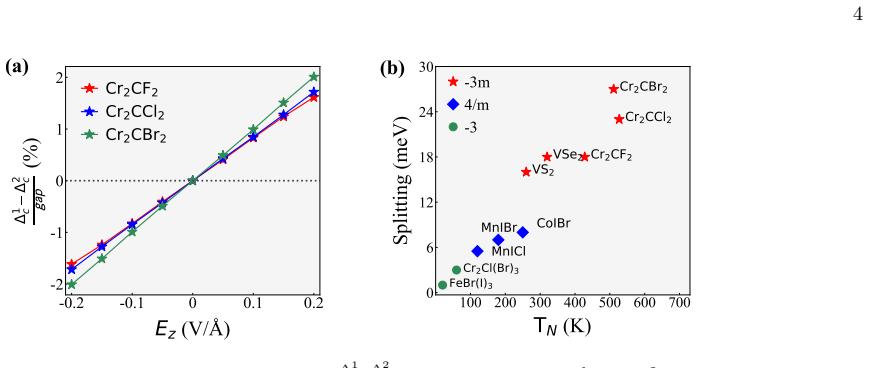
In PT-symmetric antiferromagnetic insulators that possess a hidden dipole moment coupled to the antiferromagnetic order, an external electric field breaks the magnon sublattice symmetry while preserving overall PT symmetry. This lifts the degeneracy of the magnon bands, producing chiral splittings up to 20 meV in Cr2CCl2 and Cr2CBr2 under 0.2 V/Å fields, equivalent to an effective magnetic field of 200 T, and permits electrically reversible switching of magnon-mediated spin currents.
What carries the argument
The hidden dipole coupled to the antiferromagnetic order, which permits an electric field to break magnon sublattice symmetry while preserving PT symmetry.
If this is right
- Magnon band splittings reach 20 meV under electric fields of 0.2 V/Å in the identified materials.
- The splitting magnitude corresponds to an effective magnetic field of 200 T.
- Electric control enables reversible switching of the direction of magnon-mediated spin currents.
- Group-theoretical analysis identifies the magnetic layer groups compatible with this behavior.
Where Pith is reading between the lines
- The same hidden-dipole mechanism could be searched for in other layered antiferromagnets that preserve PT symmetry.
- Integration of these materials into magnonic waveguides might allow purely electric routing of spin information.
- Inelastic neutron scattering under gate voltages could directly test the field-induced band splitting.
Load-bearing premise
The candidate materials host a hidden electric dipole that is coupled to the antiferromagnetic order in a manner allowing the field to differentiate the two magnon sublattices.
What would settle it
Measurement of zero or negligible magnon band splitting in Cr2CCl2 under an applied electric field of 0.2 V/Å would show the predicted chiral control does not occur.
Figures



read the original abstract
The magnons in antiferromagnetic insulators (AFIs) exhibit dual chirality, each carrying opposite spin angular momentum. However, in PT-symmetric AFIs, the magnon bands remain degenerate. In this work, we introduce a new class of PT-preserving AFIs in which the giant chiral splitting of magnons can be induced and controlled by an external electric field. Unlike conventional cases, such AFIs host a hidden dipole coupled to the antiferromagnetic order, which allows an external electric field to break the magnon sublattice symmetry and thereby largely lift the band degeneracy. Group theoretical analysis identifies the possible magnetic layer groups, while first-principles calculations and spin-wave theory reveal band splittings up to 20meV in Cr2CCl2 and Cr2CBr2 under the electric field of 0.2 V/{\AA}, corresponding to an effective magnetic field of 200T. In addition, the electrically controlled magnon chiral splitting enables reversible switching of magnon-mediated spin currents. These findings open a new route toward nonvolatile spintronics based on magnons.
Editorial analysis
A structured set of objections, weighed in public.
Referee Report
Summary. The manuscript introduces a class of PT-symmetric antiferromagnetic insulators (AFIs) possessing a hidden electric dipole locked to the antiferromagnetic order. Group-theoretical analysis identifies compatible magnetic layer groups; first-principles DFT and spin-wave calculations then show that an external electric field of 0.2 V/Å lifts the magnon degeneracy, producing chiral band splittings up to 20 meV (equivalent to an effective field of ~200 T) in Cr₂CCl₂ and Cr₂CBr₂. The electrically tunable splitting is further shown to enable reversible switching of magnon-mediated spin currents.
Significance. If the symmetry-allowed hidden-dipole mechanism and the reported splittings hold, the result would provide a concrete route to all-electric control of magnon chirality in PT-symmetric systems, with potential implications for magnon spintronics and nonvolatile devices. The combination of symmetry classification with explicit first-principles plus spin-wave verification constitutes a strength; the magnitude of the predicted splitting is noteworthy if the effective-field conversion is robust.
major comments (2)
- [group-theoretical analysis] The central mechanism rests on the existence of a PT-even but sublattice-odd dipole-Néel coupling that permits an external E-field to split magnon bands without violating overall PT symmetry. The group-theoretical section must explicitly list the allowed magnetic layer groups and the form of the invariant that couples the hidden dipole to the Néel vector; without this, it is impossible to confirm that the reported 20 meV splitting is symmetry-permitted rather than an artifact of the DFT electric-field implementation.
- [results / abstract] Abstract and results section: the conversion of the 20 meV magnon splitting into an “effective magnetic field of 200 T” is load-bearing for the claim of giant tunability. The manuscript must state the precise formula (including the magnon g-factor or spin stiffness used) and show that the same conversion applied to a conventional Zeeman term reproduces known benchmarks; otherwise the 200 T figure cannot be compared with literature values.
minor comments (2)
- [abstract / introduction] Notation for the hidden dipole moment should be defined once in the main text (e.g., as P_hidden or D) and used consistently; the abstract introduces the concept without a symbol.
- [figures] Figure captions for the spin-wave dispersion plots should include the electric-field direction relative to the layer normal and the k-path used, to allow direct comparison with the symmetry analysis.
Simulated Author's Rebuttal
We thank the referee for the positive evaluation of the work's significance and for the detailed, constructive comments. We address each major comment below and will incorporate the requested clarifications in a revised manuscript.
read point-by-point responses
-
Referee: The central mechanism rests on the existence of a PT-even but sublattice-odd dipole-Néel coupling that permits an external E-field to split magnon bands without violating overall PT symmetry. The group-theoretical section must explicitly list the allowed magnetic layer groups and the form of the invariant that couples the hidden dipole to the Néel vector; without this, it is impossible to confirm that the reported 20 meV splitting is symmetry-permitted rather than an artifact of the DFT electric-field implementation.
Authors: We agree that greater explicitness in the group-theoretical analysis will strengthen the manuscript. Although the original text states that the analysis identifies the compatible magnetic layer groups, we will revise the section to include an explicit enumeration (or table) of the allowed groups together with the derived form of the PT-even, sublattice-odd dipole-Néel invariant. This will directly demonstrate that the electric-field-induced magnon splitting is symmetry-permitted. revision: yes
-
Referee: Abstract and results section: the conversion of the 20 meV magnon splitting into an “effective magnetic field of 200 T” is load-bearing for the claim of giant tunability. The manuscript must state the precise formula (including the magnon g-factor or spin stiffness used) and show that the same conversion applied to a conventional Zeeman term reproduces known benchmarks; otherwise the 200 T figure cannot be compared with literature values.
Authors: We accept that the effective-field conversion requires a precise statement and validation. In the revised manuscript we will explicitly give the conversion formula (ΔE = g μ_B B_eff, with g obtained from the calculated spin stiffness) and apply the identical procedure to a conventional Zeeman term in a reference antiferromagnet, confirming that the resulting B_eff matches established literature values. revision: yes
Circularity Check
No circularity: derivation relies on independent group theory and first-principles calculations
full rationale
The paper presents its mechanism via group-theoretical analysis of magnetic layer groups that permit a hidden dipole coupled to AF order, followed by first-principles DFT and spin-wave theory computations on Cr2CCl2/Cr2CBr2. No quoted step defines a quantity in terms of itself, renames a fitted parameter as a prediction, or reduces the central splitting result to a self-citation chain or imported ansatz. The reported 20 meV splitting under 0.2 V/Å is presented as an output of those external methods rather than an input by construction. This is the normal non-circular case.
Axiom & Free-Parameter Ledger
axioms (2)
- domain assumption PT symmetry remains preserved while the electric field breaks magnon sublattice symmetry
- standard math Group-theoretical classification correctly identifies the magnetic layer groups that permit the hidden dipole
invented entities (1)
-
hidden dipole
no independent evidence
Reference graph
Works this paper leans on
-
[1]
A. V. Chumak, A. A. Serga, and B. Hillebrands, Magnon transistor for all-magnon data processing, Nat. Commun. 5, 4700 (2014)
work page 2014
-
[2]
A. V. Chumak, V. I. Vasyuchka, A. A. Serga, and B. Hillebrands, Magnon spintronics, Nat. Phys.11, 453 (2015)
work page 2015
-
[4]
S. D. Bader and S. S. P. Parkin, Spintronics, Annu. Rev. Condens. Matter Phys.1, 71 (2010)
work page 2010
- [5]
-
[6]
P. A. McClarty, Topological magnons: A review, Annu. Rev. Condens. Matter Phys.13, 171 (2022)
work page 2022
-
[7]
B. Lenk, H. Ulrichs, F. Garbs, and M. M¨ unzenberg, The building blocks of magnonics, Phys. Rep.507, 107 6 (2011)
work page 2011
-
[8]
X. Chen, Y. Liu, P. Liu, Y. Yu, J. Ren, J. Li, A. Zhang, and Q. Liu, Unconventional magnons in collinear mag- nets dictated by spin space groups, Nature640, 349 (2025)
work page 2025
-
[9]
L. Chen, J.-H. Chung, B. Gao, T. Chen, M. B. Stone, A. I. Kolesnikov, Q. Huang, and P. Dai, Topological spin excitations in honeycomb ferromagnet CrI 3, Phys. Rev. X8, 041028 (2018)
work page 2018
-
[10]
A. Mook, K. Plekhanov, J. Klinovaja, and D. Loss, Interaction-stabilized topological magnon insulator in ferromagnets, Phys. Rev. X11, 021061 (2021)
work page 2021
-
[11]
Y.-P. Wang, J. W. Rao, Y. Yang, P.-C. Xu, Y. S. Gui, B. M. Yao, J. Q. You, and C.-M. Hu, Nonreciprocity and unidirectional invisibility in cavity magnonics, Phys. Rev. Lett.123, 127202 (2019)
work page 2019
- [12]
- [13]
- [14]
-
[15]
V. A. Zyuzin and A. A. Kovalev, Magnon spin Nernst effect in antiferromagnets, Phys. Rev. Lett.117, 217203 (2016)
work page 2016
-
[16]
S. Qi, D. Chen, K. Chen, J. Liu, G. Chen, B. Luo, H. Cui, L. Jia, J. Li, M. Huang,et al., Giant electrically tunable magnon transport anisotropy in a van der Waals antifer- romagnetic insulator, Nat. Commun.14, 2526 (2023)
work page 2023
-
[17]
C. Liu, Y. Luo, D. Hong, S. S.-L. Zhang, H. Saglam, Y. Li, Y. Lin, B. Fisher, J. E. Pearson, J. S. Jiang, and et al., Electric field control of magnon spin currents in an antiferromagnetic insulator, Sci. Adv.7, 1669 (2021)
work page 2021
-
[18]
A. M. Kuzmenko, D. Szaller, T. Kain, V. Dziom, L. Wey- mann, A. Shuvaev, A. Pimenov, A. A. Mukhin, V. Y. Ivanov, I. A. Gudim, L. N. Bezmaternykh, and A. Pi- menov, Switching of magnons by electric and magnetic fields in multiferroic borates, Phys. Rev. Lett.120, 027203 (2018)
work page 2018
-
[19]
X. Wan, Q. Du, J. Lu, Z. Zhang, J. Ni, L. Zhang, Z. Jiang, and L. Bellaiche, Topological switching in bi- layer magnons via electrical control, Phys. Rev. B112, L100404 (2025)
work page 2025
-
[20]
A. R¨ uckriegel, A. Brataas, and R. A. Duine, Bulk and edge spin transport in topological magnon insulators, Phys. Rev. B97, 081106 (2018)
work page 2018
-
[21]
E. Parsonnet, L. Caretta, V. Nagarajan, H. Zhang, H. Taghinejad, P. Behera, X. Huang, P. Kavle, A. Fer- nandez, D. Nikonov, and et al., Nonvolatile electric field control of thermal magnons in the absence of an applied magnetic field, Phys. Rev. Lett.129, 087601 (2022)
work page 2022
- [22]
-
[23]
T. Jungwirth, X. Marti, P. Wadley, and J. Wunderlich, Antiferromagnetic spintronics, Nat. Nanotechnol.11, 231 (2016)
work page 2016
-
[24]
S. M. Rezende, A. Azevedo, and R. L. Rodr´ ıguez-Su´ arez, Introduction to antiferromagnetic magnons, J. Appl. Phys.126(2019)
work page 2019
-
[25]
O. Gomonay, V. Baltz, A. Brataas, and Y. Tserkovnyak, Antiferromagnetic spin textures and dynamics, Nat. Phys.14, 213 (2018)
work page 2018
-
[26]
R. R. Neumann, A. Mook, J. Henk, and I. Mertig, Ther- mal Hall effect of magnons in collinear antiferromagnetic insulators: Signatures of magnetic and topological phase transitions, Phys. Rev. Lett.128, 117201 (2022)
work page 2022
-
[27]
G. Gitgeatpong, Y. Zhao, P. Piyawongwatthana, Y. Qiu, L. W. Harriger, N. P. Butch, T. Sato, and K. Matan, Non- reciprocal magnons and symmetry-breaking in the non- centrosymmetric antiferromagnet, Phys. Rev. Lett.119, 047201 (2017)
work page 2017
-
[28]
T. J. Sato and K. Matan, Nonreciprocal magnons in non- centrosymmetric magnets, J. Phys. Soc. Jpn.88, 081007 (2019)
work page 2019
-
[29]
T. Matsumoto and S. Hayami, Nonreciprocal magnons due to symmetric anisotropic exchange interaction in honeycomb antiferromagnets, Phys. Rev. B101, 224419 (2020)
work page 2020
-
[30]
S. Hayami and T. Matsumoto, Essential model param- eters for nonreciprocal magnons in multisublattice sys- tems, Phys. Rev. B105, 014404 (2022)
work page 2022
-
[31]
L. ˇSmejkal, J. Sinova, and T. Jungwirth, Beyond conven- tional ferromagnetism and antiferromagnetism: A phase with nonrelativistic spin and crystal rotation symmetry, Phys. Rev. X12, 031042 (2022)
work page 2022
-
[32]
L. ˇSmejkal, J. Sinova, and T. Jungwirth, Emerging re- search landscape of altermagnetism, Phys. Rev. X12, 040501 (2022)
work page 2022
- [33]
-
[34]
Z. Xiao, J. Zhao, Y. Li, R. Shindou, and Z.-D. Song, Spin space groups: Full classification and applications, Phys. Rev. X14, 031037 (2024)
work page 2024
-
[35]
X. Chen, J. Ren, Y. Zhu, Y. Yu, A. Zhang, P. Liu, J. Li, Y. Liu, C. Li, and Q. Liu, Enumeration and representa- tion theory of spin space groups, Phys. Rev. X14, 031038 (2024)
work page 2024
- [36]
-
[37]
P. Liu, J. Li, J. Han, X. Wan, and Q. Liu, Spin-group symmetry in magnetic materials with negligible spin- orbit coupling, Phys. Rev. X12, 021016 (2022)
work page 2022
-
[38]
L. ˇSmejkal, A. Marmodoro, K.-H. Ahn, R. Gonz´ alez- Hern´ andez, I. Turek, S. Mankovsky, H. Ebert, S. W. D’Souza, O. ˇSipr, J. Sinova,et al., Chiral magnons in al- termagnetic RuO2, Phys. Rev. Lett.131, 256703 (2023)
work page 2023
-
[39]
K. Wu, J. Dong, M. Zhu, F. Zheng, and J. Zhang, Magnon splitting and magnon spin transport in alter- magnets, Chin. Phys. Lett. (2025)
work page 2025
-
[40]
Y.-F. Zhang, X.-S. Ni, K. Chen, and K. Cao, Chiral magnon splitting in altermagnetic CrSb from first prin- ciples, Phys. Rev. B111, 174451 (2025)
work page 2025
- [41]
-
[42]
Z. Liu, M. Ozeki, S. Asai, S. Itoh, and T. Masuda, Chiral split magnon in altermagnetic MnTe, Phys. Rev. Lett. 133, 156702 (2024)
work page 2024
-
[43]
V. C. Morano, Z. Maesen, S. E. Nikitin, J. Lass, D. G. Mazzone, and O. Zaharko, Absence of altermagnetic magnon band splitting in MnF 2, Phys. Rev. Lett.134, 7 226702 (2025)
work page 2025
-
[44]
Q. Sun, J. Guo, D. Wang, D. L. Abernathy, W. Tian, and C. Li, Observation of chiral magnon band splitting in altermagnetic hematite, Phys. Rev. Lett.135, 186703 (2025)
work page 2025
-
[45]
A. K. Singh, N. Heinsdorf, A. A. Mancilla, J. Bannies, A. Maity, A. I. Kolesnikov, M. Matsuda, M. B. Stone, M. Franz, J. Gaudet, and A. M. Hallas, Chiral spin- split magnons in the metallic altermagnet CrSb (2025), arXiv:2511.16086
work page internal anchor Pith review Pith/arXiv arXiv 2025
-
[46]
See Supplemental Material at http://link.aps.org/... which includes I. Additional details of DFT calculations; II. magnon transport theory; III. the finite temperature behavior of magnons; and IV. the symmetry analysis
-
[47]
Fiebig, Revival of the magnetoelectric effect, J
M. Fiebig, Revival of the magnetoelectric effect, J. Phys. D38, R123 (2005)
work page 2005
-
[48]
J. Ni, Z. Zhang, J. Lu, Q. Du, Z. Jiang, and L. Bel- laiche, Nonvolatile magnonics in bilayer magnetic insula- tors, Nano Lett.25, 1207 (2025)
work page 2025
-
[49]
Y. H. Shen, Y. Liu, and M. Luo, Electrical reversal of the magnon thermal Hall coefficient in a van der Waals bi- layer antiferromagnet, Phys. Rev. B110, 045423 (2024)
work page 2024
-
[50]
H. J. Zhao, X. Liu, Y. Wang, Y. Yang, L. Bellaiche, and Y. Ma, Zeeman effect in centrosymmetric antiferromag- netic semiconductors controlled by an electric field, Phys. Rev. Lett.129, 187602 (2022)
work page 2022
-
[51]
L. Tao, Q. Zhang, H. Li, H. J. Zhao, X. Wang, B. Song, E. Y. Tsymbal, and L. Bellaiche, Layer Hall detection of the N´ eel vector in centrosymmetric magnetoelectric antiferromagnets, Phys. Rev. Lett.133, 096803 (2024)
work page 2024
-
[52]
L. Yu, H. J. Zhao, L. Bellaiche, and Y. Ma, Electri- cally switchable nonrelativistic zeeman spin splittings in collinear antiferromagnets, Phys. Rev. Lett.135, 256704 (2025)
work page 2025
-
[53]
J. Ni, Y. Jin, Q. Du, and G. Chang, Magnon nonlinear Hall effect in two-dimensional antiferromagnetic insula- tors, Phys. Rev. B112, 054424 (2025)
work page 2025
-
[54]
Q. Du, Z. Zhang, J. Ni, Z. Jiang, and L. Bellaiche, Non- reciprocal magnons in layered antiferromagnets VPX 3 (X = S, Se, Te), Phys. Rev. B112, L100408 (2025)
work page 2025
- [55]
- [56]
-
[57]
J. Ni, X. Li, D. Amoroso, X. He, J. Feng, E. Kan, S. Pi- cozzi, and H. Xiang, Giant biquadratic exchange in 2d magnets and its role in stabilizing ferromagnetism of NiCl2 monolayers, Phys. Rev. Lett.127, 247204 (2021)
work page 2021
-
[58]
S. Chen, Z. Jian, and Z. Sun, Half-metallic ferro- magnetism and surface functionalization-induced metal- insulator transition in graphene-like two-dimensional Cr2C crystals, ACS Appl. Mater. Interfaces7, 17510 (2015)
work page 2015
- [59]
-
[60]
T. Holstein and H. Primakoff, Field dependence of the intrinsic domain magnetization of a ferromagnet, Phys. Rev.58, 1098 (1940)
work page 1940
-
[61]
N. N. Bogoljubov, V. V. Tolmachov, and D. ˇSirkov, A new method in the theory of superconductivity, Fortschr. Phys.6, 605 (1958)
work page 1958
-
[62]
Valatin, Comments on the theory of superconductivity, Il Nuovo Cimento (1955-1965)7, 843 (1958)
J. Valatin, Comments on the theory of superconductivity, Il Nuovo Cimento (1955-1965)7, 843 (1958)
work page 1955
-
[63]
K. Sourounis and A. Manchon, Impact of magnon in- teractions on transport in honeycomb antiferromagnets, Phys. Rev. B110, 054429 (2024)
work page 2024
-
[64]
R. Winkler,Spin-Orbit Coupling Effects in Two- Dimensional Electron and Hole Systems, Springer Tracts in Modern Physics (Springer, Berlin, Heidelberg, 2003)
work page 2003
-
[65]
Q. Cui, B. Zeng, P. Cui, T. Yu, and H. Yang, Efficient spin Seebeck and spin Nernst effects of magnons in alter- magnets, Phys. Rev. B108, L180401 (2023)
work page 2023
-
[66]
G. Poelchen, J. Hellwig, M. Peters, D. Y. Usachov, K. Kliemt, C. Laubschat, P. M. Echenique, E. V. Chulkov, C. Krellner, S. Parkin,et al., Long-lived spin waves in a metallic antiferromagnet, Nat. Commun.14, 5422 (2023)
work page 2023
discussion (0)
Sign in with ORCID, Apple, or X to comment. Anyone can read and Pith papers without signing in.