REVIEW 2 major objections 1 minor 52 references
Automated Road Crack Localization for Spatially Guided Highway Maintenance
T0 review · 2 major / 1 minor · reviewed 2026-05-16 · grok-4.3
Pith's one-line read Combining open aerial imagery with map data lets an AI model locate highway cracks accurately enough to create a useful national maintenance index.
desk verdict The paper gives a practical open-data pipeline for Swiss highway crack mapping with YOLOv11 but the F1 scores alone do not support the nationwide RHCD index. read the letter →
The pith
A machine-rendered reading of the paper's core claim, the machinery that carries it, and where it could break.
The reading
What carries the argument
The YOLOv11 object detector, fine-tuned on georeferenced airborne imagery using OpenStreetMap for highway alignment, which enables computation of the Relative Highway Crack Density index.
What would settle it
Independent ground-truth crack measurements from a representative sample of Swiss road segments that deviate substantially from the model's reported detection performance.
Extended reading notes
Core claim
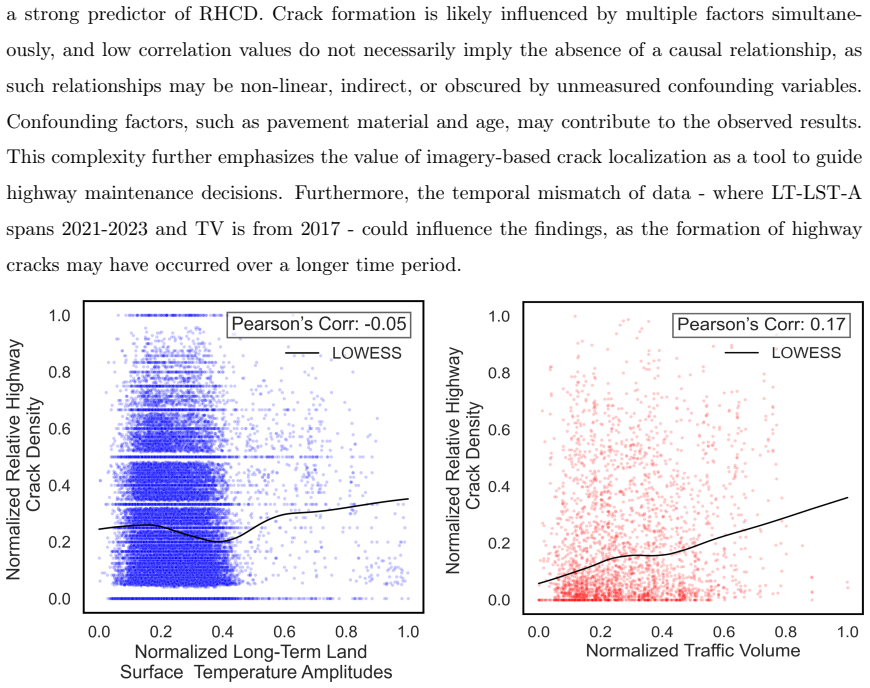
By fine-tuning YOLOv11 on airborne imagery aligned with OpenStreetMap data, the authors achieve F1-scores of 0.84 for crack detection and 0.97 for non-crack, and use this to compute a Swiss RHCD index that correlates weakly with land surface temperature amplitudes (r=-0.05) and traffic volume (r=0.17), demonstrating its value for guiding maintenance near urban areas and intersections.
Load-bearing premise
The YOLOv11 model trained on limited samples accurately detects cracks across all Swiss highways and varying conditions.
Editorial analysis
A structured set of objections, weighed in public.
Referee Report
Summary. The paper proposes a framework that combines airborne imagery and OpenStreetMap data to fine-tune YOLOv11 for localizing cracks on highways. It derives a Relative Highway Crack Density (RHCD) index for the Swiss network and reports weak correlations with long-term land surface temperature amplitudes (r = -0.05) and traffic volume (r = 0.17). The model achieves F1-scores of 0.84 for the crack class and 0.97 for the no-crack class, with elevated RHCD values near urban centers and intersections.
Significance. If the crack localization generalizes reliably, the work demonstrates a scalable use of open data for infrastructure monitoring that could reduce maintenance costs by prioritizing segments with high crack density. The weak correlations support the claim that RHCD captures information not already explained by temperature or traffic, adding a potentially useful index for public-sector planning.
major comments (2)
- [Abstract/Methods] Abstract and methods: The F1-scores of 0.84 (crack) and 0.97 (no-crack) are presented without any information on dataset size, train/val/test splits, geographic coverage of the imagery, imaging conditions, or cross-validation. This directly affects the central claim that the model supports a nationwide RHCD index for the entire Swiss highway network.
- [Results] Results section on RHCD correlations: The claim that RHCD provides added value for maintenance guidance rests on the assumption that the detected cracks are accurate across the full network; however, no evaluation on out-of-distribution data (different pavements, altitudes, lighting, or crack widths) is reported, leaving the extrapolation unsupported.
minor comments (1)
- [Abstract] The abstract states the model was fine-tuned but does not specify the YOLOv11 variant, learning rate, or other hyperparameters used.
Simulated Author's Rebuttal
We thank the referee for the constructive feedback, which highlights important aspects of transparency and generalizability. We have revised the manuscript to incorporate additional methodological details and to better contextualize the limitations of our claims regarding nationwide applicability.
read point-by-point responses
-
Referee: [Abstract/Methods] Abstract and methods: The F1-scores of 0.84 (crack) and 0.97 (no-crack) are presented without any information on dataset size, train/val/test splits, geographic coverage of the imagery, imaging conditions, or cross-validation. This directly affects the central claim that the model supports a nationwide RHCD index for the entire Swiss highway network.
Authors: We agree that these details are essential for evaluating the reported performance metrics. The revised manuscript expands the Methods section with a full description of the dataset (including total annotated images and sources), the train/validation/test split ratios, the geographic coverage of the airborne imagery across the Swiss highway network, imaging conditions such as resolution and acquisition parameters, and the cross-validation strategy employed. These additions directly support the reliability of the F1-scores and the derivation of the RHCD index. revision: yes
-
Referee: [Results] Results section on RHCD correlations: The claim that RHCD provides added value for maintenance guidance rests on the assumption that the detected cracks are accurate across the full network; however, no evaluation on out-of-distribution data (different pavements, altitudes, lighting, or crack widths) is reported, leaving the extrapolation unsupported.
Authors: We acknowledge that the absence of explicit out-of-distribution testing limits the strength of claims about full-network accuracy. The open datasets available for this study do not contain sufficient diversity to enable comprehensive OOD evaluation. In the revision, we have added a dedicated Limitations subsection that explicitly discusses this gap, includes qualitative observations on varied conditions where data permitted, and moderates the language around nationwide extrapolation. We also suggest directions for future work involving more diverse imagery. This constitutes a partial revision, as full OOD testing would require new data acquisition beyond the current open-data scope. revision: partial
- Comprehensive quantitative out-of-distribution evaluation, as the open datasets used lack the required diversity in pavements, altitudes, lighting, and crack characteristics.
Circularity Check
No circularity in derivation chain
full rationale
The paper fine-tunes YOLOv11 on airborne imagery and OSM data to localize cracks, derives the RHCD index directly from those model outputs, and reports its correlations with independent external variables (LT-LST-A and traffic volume). No load-bearing step reduces by construction to a fitted parameter, self-definition, or self-citation chain. F1 scores are standard held-out performance metrics; the index is a post-hoc aggregation compared to non-fitted external data. The derivation chain is self-contained against external benchmarks.
Assumptions & free parameters
free parameters (1)
- YOLOv11 fine-tuning hyperparameters
assumptions (1)
- domain assumption Airborne imagery combined with OSM data is sufficient for accurate crack localization
invented entities (1)
-
Relative Highway Crack Density (RHCD) index
Cite this review
Pith. "Pith review of Automated Road Crack Localization for Spatially Guided Highway Maintenance." pith.science (2026). https://pith.science/paper/2601.16737
@misc{pith2026260116737,
  author       = {Pith},
  title        = {Pith review of: Automated Road Crack Localization for Spatially Guided Highway Maintenance},
  year         = {2026},
  howpublished = {\url{https://pith.science/paper/2601.16737}},
  note         = {Machine review of arXiv:2601.16737}
}
abstract
Highway networks are crucial for economic prosperity. Climate change-induced temperature fluctuations are exacerbating stress on road pavements, resulting in elevated maintenance costs. This underscores the need for targeted and efficient maintenance strategies. This study investigates the potential of open-source data to guide highway infrastructure maintenance. The proposed framework integrates airborne imagery and OpenStreetMap (OSM) to fine-tune YOLOv11 for highway crack localization. To demonstrate the framework's real-world applicability, a Swiss Relative Highway Crack Density (RHCD) index was calculated to inform nationwide highway maintenance. The crack classification model achieved an F1-score of $0.84$ for the positive class (crack) and $0.97$ for the negative class (no crack). The Swiss RHCD index exhibited weak correlations with Long-term Land Surface Temperature Amplitudes (LT-LST-A) (Pearson's $r\ = -0.05$) and Traffic Volume (TV) (Pearson's $r\ = 0.17$), underlining the added value of this novel index for guiding maintenance over other data. Significantly high RHCD values were observed near urban centers and intersections, providing contextual validation for the predictions. These findings highlight the value of open-source data sharing to drive innovation, ultimately enabling more efficient solutions in the public sector.
Figures


Figures from the paper (4 more)


Lean theorems connected to this paper
-
IndisputableMonolith/Foundation/RealityFromDistinction.leanreality_from_one_distinction unclear?
unclearRelation between the paper passage and the cited Recognition theorem.
fine-tune YOLOv11 for highway crack localization... RHCD index... Pearson’s r = -0.05 and 0.17
What do these tags mean?
- matches
- The paper's claim is directly supported by a theorem in the formal canon.
- supports
- The theorem supports part of the paper's argument, but the paper may add assumptions or extra steps.
- extends
- The paper goes beyond the formal theorem; the theorem is a base layer rather than the whole result.
- uses
- The paper appears to rely on the theorem as machinery.
- contradicts
- The paper's claim conflicts with a theorem or certificate in the canon.
- unclear
- Pith found a possible connection, but the passage is too broad, indirect, or ambiguous to say the theorem truly supports the claim.
Reference graph
Works this paper leans on
-
[1]
R. Di Pietro, S. Raponi, M. Caprolu, S. Cresci, Critical infrastructure, in: R. Di Pietro, S. Raponi, M. Caprolu, S. Cresci (Eds.), New Dimensions of Information Warfare, Springer International Publishing, 2021, pp. 157–196. URL:https://doi.org/10.1007/ 978-3-030-60618-3_5. doi:10.1007/978-3-030-60618-3_5
-
[2]
L. Amador-Jimenez, C. J. W. and, Demonstrating a correlation between infrastructure and national development, International Journal of Sustainable Development & World Ecology 19 (2012) 197–202
work page 2012
-
[3]
P. H. Verburg, E. C. Ellis, A. Letourneau, A global assessment of market accessibility and market influence for global environmental change studies 6 (2011) 034019
work page 2011
-
[4]
Percoco, Highways, local economic structure and urban development 16 (2016) 1035–1054
M. Percoco, Highways, local economic structure and urban development 16 (2016) 1035–1054
work page 2016
-
[5]
A. Vijayakumar, M. N. Mahmood, A. Gurmu, I. Kamardeen, S. Alam, Social sustainability assessment of road infrastructure: a systematic literature review 58 (2024) 1039–1069
work page 2024
-
[6]
K. Fifer Bizjak, A. Dawson, I. Hoff, L. Makkonen, J. S. Ylhäisi, A. Carrera, The impact of climate change on the european road network 167 (2014) 281–295. Publisher: ICE Publishing
work page 2014
-
[7]
S. Sen, H. Li, L. Khazanovich, Effect of climate change and urban heat islands on the deteri- oration of concrete roads 16 (2022) 100736
work page 2022
-
[8]
Rioja, What is the value of infrastructure maintenance? a survey, in: G
F. Rioja, What is the value of infrastructure maintenance? a survey, in: G. K. Ingram, K. L. Brandt (Eds.), Infrastructure and Land Policies, Lincoln Institute of Land Policy, 2013, p. Chapter 13. Commentary by Waheed Uddin
work page 2013
Show all 52 references
-
[9]
Borghetti, G
F. Borghetti, G. Beretta, N. Bongiorno, M. De Padova, Road infrastructure maintenance: Operative method for interventions’ ranking 25 (2024) 101100
2024
-
[10]
A. V. Kumar, Pavement surface condition assessment: a-state-of-the-art research review and future perspective 9 (2024) 470. 18
2024
-
[11]
Saeed, M
N. Saeed, M. Dougherty, R. G. Nyberg, P. Rebreyend, D. Jomaa, A review of intelligent methods for unpaved roads condition assessment, in: 2020 15th IEEE Conference on Industrial Electronics and Applications (ICIEA), 2020, pp. 79–84. URL:https://ieeexplore.ieee. org/document/92...
2020 doi
-
[12]
Y. Liu, J. Yao, X. Lu, R. Xie, L. Li, DeepCrack: A deep hierarchical feature learning archi- tecture for crack segmentation 338 (2019) 139–153
2019
-
[13]
D. Arya, H. Maeda, S. K. Ghosh, D. Toshniwal, Y. Sekimoto, RDD2022: A multi-national image dataset for automatic road damage detection, 2022. URL:http://arxiv.org/abs/ 2209.08538. doi:10.48550/arXiv.2209.08538.arXiv:2209.08538 [cs]
2022 doi
-
[14]
D. Arya, H. Maeda, S. Kumar Ghosh, D. Toshniwal, H. Omata, T. Kashiyama, Y. Sekimoto, Global road damage detection: State-of-the-art solutions, in: 2020 IEEE International Con- ference on Big Data (Big Data), 2020, pp. 5533–5539. URL:https://ieeexplore.ieee.org/ document/93777...
2020 doi
-
[15]
Mandal, A
V. Mandal, A. R. Mussah, Y. Adu-Gyamfi, Deep learning frameworks for pavement distress classification: A comparative analysis, in: 2020 IEEE International Conference on Big Data (Big Data), 2020, pp. 5577–5583. URL:https://ieeexplore.ieee.org/document/9378047. doi:10.1109/BigD...
2020 doi
-
[16]
Zhang, Z
Y. Zhang, Z. Zuo, X. Xu, J. Wu, J. Zhu, H. Zhang, J. Wang, Y. Tian, Road damage detection using UAV images based on multi-level attention mechanism 144 (2022) 104613
2022
-
[17]
Zhong, J
J. Zhong, J. Zhu, J. Huyan, T. Ma, W. Zhang, Multi-scale feature fusion network for pixel-level pavement distress detection 141 (2022) 104436
2022
-
[18]
Samadzadegan, F
F. Samadzadegan, F. Dadrass Javan, F. Ashtari Mahini, M. Gholamshahi, F. Nex, Automatic road pavement distress recognition using deep learning networks from unmanned aerial imagery 8 (2024) 244. Number: 6 Publisher: Multidisciplinary Digital Publishing Institute
2024
-
[19]
D. Kang, S. S. Benipal, D. L. Gopal, Y.-J. Cha, Hybrid pixel-level concrete crack segmentation and quantification across complex backgrounds using deep learning 118 (2020) 103291. 19
2020
-
[20]
J.Zhong, J.Huyan, W.Zhang, H.Cheng, J.Zhang, Z.Tong, X.Jiang, B.Huang, Adeepergen- erative adversarial network for grooved cement concrete pavement crack detection 119 (2023) 105808
2023
-
[21]
Hacıefendioğlu, H
K. Hacıefendioğlu, H. B. Başağa, Concrete road crack detection using deep learning-based faster r-CNN method 46 (2022) 1621–1633
2022
-
[22]
A. M. Roy, J. Bhaduri, DenseSPH-YOLOv5: An automated damage detection model based on DenseNet and swin-transformer prediction head-enabled YOLOv5 with attention mechanism 56 (2023) 102007
2023
-
[23]
G. Yu, X. Zhou, An improved YOLOv5 crack detection method combined with a bottle- neck transformer 11 (2023) 2377. Number: 10 Publisher: Multidisciplinary Digital Publishing Institute
2023
-
[24]
F. Wan, C. Sun, H. He, G. Lei, L. Xu, T. Xiao, YOLO-LRDD: a lightweight method for road damage detection based on improved YOLOv5s 2022 (2022) 98
2022
-
[25]
J. Zeng, H. Zhong, YOLOv8-PD: an improved road damage detection algorithm based on YOLOv8n model 14 (2024) 12052. Publisher: Nature Publishing Group
2024
-
[26]
Y. Zhao, L. Zhou, X. Wang, F. Wang, G. Shi, Highway crack detection and classification using UAV remote sensing images based on CrackNet and CrackClassification 13 (2023) 7269. Number: 12 Publisher: Multidisciplinary Digital Publishing Institute
2023
-
[27]
M. Z. Bashar, C. Torres-Machi, Exploring the capabilities of optical satellite imagery in evaluating pavement condition (2022) 108–115. Publisher: American Society of Civil Engineers
2022
-
[28]
URL:https://www.swisstopo.admin.ch/de
swisstopo, 2024. URL:https://www.swisstopo.admin.ch/de
2024
-
[29]
URL:https://data.geo.admin.ch/
data.geo.admin.ch, 2024. URL:https://data.geo.admin.ch/
2024
-
[30]
URL:https://www.bfs.admin.ch/bfs/ en/home/statistics/mobility-transport/transport-infrastructure-vehicles/ network-length.html
Infrastructure and network length, 2024. URL:https://www.bfs.admin.ch/bfs/ en/home/statistics/mobility-transport/transport-infrastructure-vehicles/ network-length.html
2024
-
[31]
URL:https://download.geofabrik.de/europe/ switzerland.html
Geofabrik download server, 2024. URL:https://download.geofabrik.de/europe/ switzerland.html. 20
2024
-
[32]
URL:https://dashboard.ohsome.org/#backend=ohsomeApi
ohsome - dashboard, 2024. URL:https://dashboard.ohsome.org/#backend=ohsomeApi
2024
-
[33]
S. W. I. swissinfo.ch, Record-breaking traffic jams on swiss roads, 2024. URL:https://www. swissinfo.ch/eng/swiss-politics/record-breaking-traffic-jams-on-swiss-roads/ 80936609
2024
-
[34]
URL:https://data-explorer.oecd.org/vis?df[ds] =DisseminateFinalDMZ&df[id]=DSD_TRENDS@DF_TRENDS&df[ag]=OECD.ITF&dq=CHE.A
OECD data explorer, 2022. URL:https://data-explorer.oecd.org/vis?df[ds] =DisseminateFinalDMZ&df[id]=DSD_TRENDS@DF_TRENDS&df[ag]=OECD.ITF&dq=CHE.A. CONTAINER+FREIGHT+PASSENGER.PASKM.ROAD.ROAD.&lom=LASTNPERIODS&lo=5&to[TIME_ PERIOD]=false&vw=tb
2022
-
[35]
Road freight transported in switzerland 2008-2021 | statista,
2008
-
[36]
URL:https://www.statista.com/statistics/435544/ switzerland-tonne-kilometres-of-freight-transported-by-road/
-
[37]
URL:https://www.are.admin.ch/are/de/ home.html
Bundesamt für raumentwicklung ARE, 2024. URL:https://www.are.admin.ch/are/de/ home.html
2024
-
[38]
A. M. Fischer, K. M. Strassmann, M. Croci-Maspoli, A. M. Hama, R. Knutti, S. Kotlarski, C. Schär, C. Schnadt Poberaj, N. Ban, M. Bavay, U. Beyerle, D. N. Bresch, S. Brönnimann, P. Burlando, A. Casanueva, S. Fatichi, I. Feigenwinter, E. M. Fischer, M. Hirschi, M. A. Liniger, C....
2022
-
[39]
URL:https://www
Slippery roads warnings in switzerland - natural hazards portal, 2025. URL:https://www. natural-hazards.ch/home/current-natural-hazards/slippery-roads.html
2025
-
[40]
ge- ological survey, 2024
Landsat 8-9 collection 2 level 2 science product guide | u.s. ge- ological survey, 2024. URL:https://www.usgs.gov/media/files/ landsat-8-9-collection-2-level-2-science-product-guide
2024
-
[41]
Gorelick, M
N. Gorelick, M. Hancher, M. Dixon, S. Ilyushchenko, D. Thau, R. Moore, Google earth engine: Planetary-scale geospatial analysis for everyone 202 (2017) 18–27. 21
2017
-
[42]
Q. Weng, D. Lu, J. Schubring, Estimation of land surface temperature–vegetation abundance relationship for urban heat island studies 89 (2004) 467–483
2004
-
[43]
Wolhuter, Geometric Design of Roads Handbook, CRC Press, 2015
K. Wolhuter, Geometric Design of Roads Handbook, CRC Press, 2015. doi:10.1201/b18344
2015 doi
-
[44]
Casali, H
Y. Casali, H. R. Heinimann, A topological characterization of flooding impacts on the zurich road network 14 (2019) e0220338. Publisher: Public Library of Science
2019
-
[45]
F. R. O. FEDRO, Facts and figures 2023/2024, 2023. URL:https://www.astra.admin.ch/ astra/en/home/dokumentation/strassen-verkehr.html
2023
-
[46]
URL:https://www.astra.admin.ch/astra/ de/home/das-astra/kontakt/gebietseinheiten.html
The territorial units of the national roads, 2024. URL:https://www.astra.admin.ch/astra/ de/home/das-astra/kontakt/gebietseinheiten.html
2024
-
[47]
URL:https://www.efk.admin.ch/en/audit/ economic-efficiency-of-territorial-units-and-their-supervision-federal-roads-office/
Economic efficiency of territorial units and their super- vision, 2024. URL:https://www.efk.admin.ch/en/audit/ economic-efficiency-of-territorial-units-and-their-supervision-federal-roads-office/
2024
-
[48]
B. f. S. ASTRA, Unterhaltsplanung nationalstrassen, 2024. URL:https://www.astra. admin.ch/astra/de/home/themen/nationalstrassen/baustellen/wissenswertes/ unterhaltsplanung-nationalstrassen.html
2024
-
[49]
URL:https://concrete-ly
Operation and maintenance – swiss highways - concretely, 2024. URL:https://concrete-ly. com/en/operation-maintenance-swiss-highways/
2024
-
[50]
STRABAG switzerland goes all-digital with trimble on pilot swiss road reconstruction project,
-
[51]
URL:https://fieldtech.trimble.com/resources/construction-industry-2/ strabag-switzerland-goes-all-digital-with-trimble-on-pilot-swiss-road-reconstruction-project-2
-
[52]
URL:https://www.astra.admin.ch/ astra/de/home/fachleute/weitere-bereiche/fachanwendungen/kuba.html
KUBA - engineering structures and tunnels, 2025. URL:https://www.astra.admin.ch/ astra/de/home/fachleute/weitere-bereiche/fachanwendungen/kuba.html. 22
2025
Reviewed May 16, 2026 · model on record in the stance chip above.
Discussion (0). Continue with ORCID to comment.