Industrial Deposition of Wavelength-Shifting Films for Liquid Argon Photon Detection Systems
Pith reviewed 2026-05-16 11:22 UTC · model grok-4.3
The pith
An industrial physical vapor deposition process produces uniform p-terphenyl wavelength-shifting films on large substrates.
A machine-rendered reading of the paper's core claim, the machinery that carries it, and where it could break.
Core claim
The paper reports the successful realization of an industrial physical vapor deposition process for p-terphenyl coatings on large-area inorganic substrates, achieving edge-region thickness variation below 10 percent and emission spectra consistent with high-quality pTP reference samples, thereby establishing reproducibility, scalability, and reduced production time compared with laboratory methods.
What carries the argument
Physical vapor deposition adapted from OLED display manufacturing, which deposits uniform p-terphenyl layers on inorganic substrates despite organic-inorganic adhesion challenges.
If this is right
- Mass production of wavelength-shifting films becomes feasible for DUNE's approximately 2000 m² photon detection system.
- Coating production time is reduced significantly relative to laboratory-based deposition.
- Optical performance remains comparable to established pTP reference samples across large areas.
- A viable manufacturing pathway exists for high-performance coatings in future large-scale liquid argon experiments.
Where Pith is reading between the lines
- The same industrial deposition approach could be evaluated for alternative wavelength-shifting materials on similar substrates.
- Successful detector-level validation would lower the cost and timeline barriers for scaling neutrino observatories beyond DUNE.
- Process adaptations for non-flat or flexible substrates might support novel detector geometries in particle physics.
Load-bearing premise
Surface profilometry and visible emission spectra measurements are sufficient to confirm the films will efficiently convert 127 nm light in liquid argon.
What would settle it
Direct measurement of the wavelength conversion efficiency at 127 nm for the industrial films in a liquid argon environment, showing deviation from reference samples.
Figures



read the original abstract
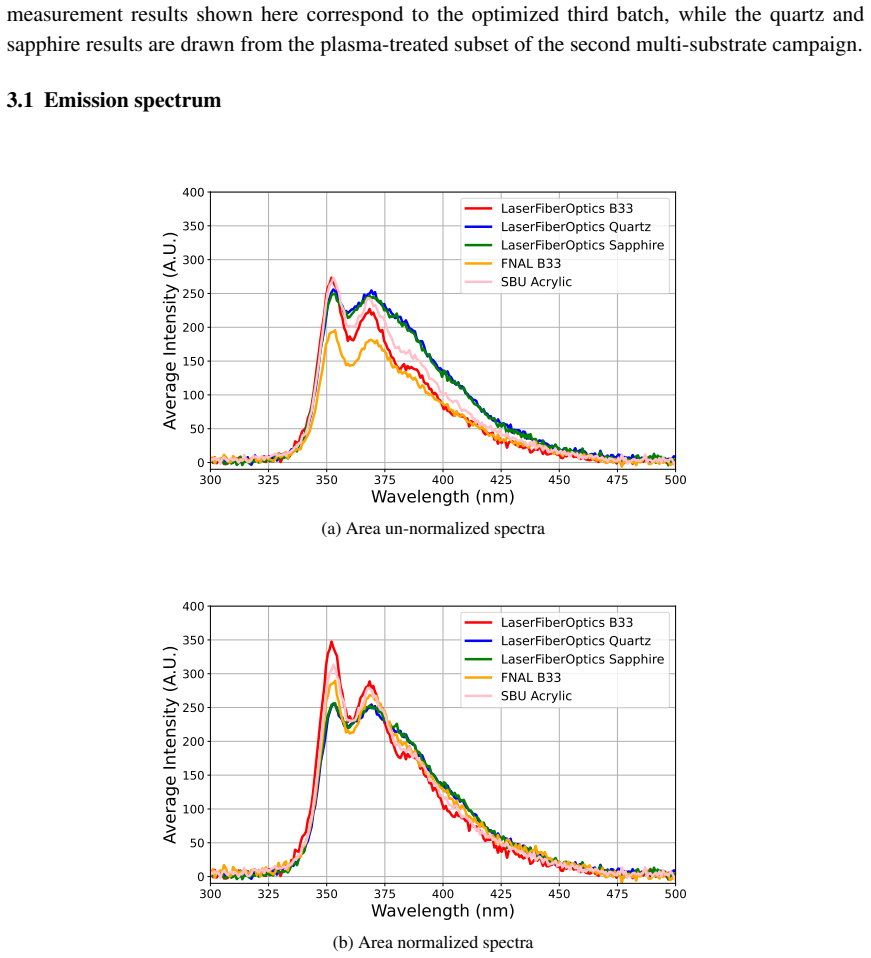
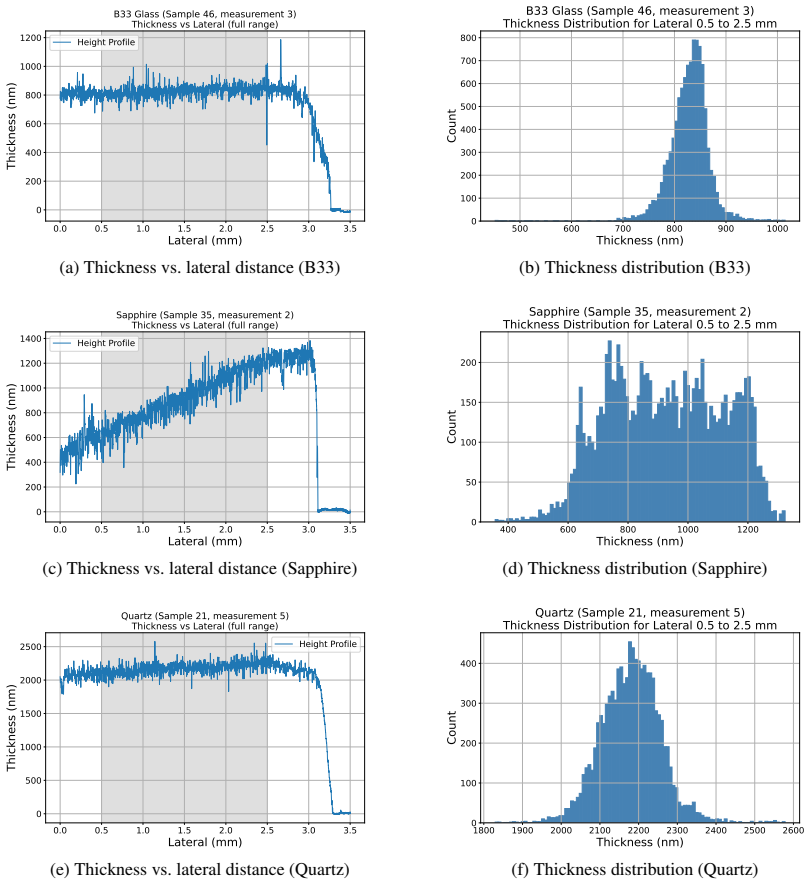
The Deep Underground Neutrino Experiment (DUNE) Phase-II Far Detector is considering an approximately 2000\,m$^2$ photon detection system to achieve a target mean light yield of 180\,PE/MeV. Meeting this requirement demands scalable, cost-effective, and high-quality wavelength-shifter (WLS) coatings capable of converting 127\,nm liquid-argon scintillation light into visible photons with controlled and reproducible optical performance. We report on the successful realization of an industrial physical vapor deposition (PVD) process for \textit{p}-terphenyl (pTP) coatings, adapted from vacuum deposition techniques developed for OLED display manufacturing, to produce uniform WLS layers on large-area inorganic substrates, a task traditionally challenged by adhesion and uniformity issues at organic--inorganic interfaces. Surface characterization by profilometry and spectroscopic measurements demonstrates edge-region thickness variation below 10\% and emission spectra consistent with high-quality pTP reference samples. The industrial process demonstrates reproducibility, scalability, and significantly reduced production time compared to laboratory-based methods, while maintaining optical characteristics consistent with established pTP reference samples. These results establish a viable pathway for mass production of high-performance pTP coatings for DUNE FD3 and future neutrino experiments, from a coating manufacturing and process standpoint. Detector-level performance validation, including quantitative VUV conversion efficiency measurements at 127\,nm, is identified as future work.
Editorial analysis
A structured set of objections, weighed in public.
Referee Report
Summary. The manuscript reports the successful adaptation of an industrial physical vapor deposition (PVD) process, drawn from OLED manufacturing, for producing uniform p-terphenyl (pTP) wavelength-shifting coatings on large-area inorganic substrates. Surface profilometry shows edge-region thickness variation below 10%, while spectroscopic measurements indicate emission spectra consistent with laboratory pTP reference samples. The work emphasizes process reproducibility, scalability to the ~2000 m² area needed for DUNE Phase-II, and substantially reduced production time relative to lab methods, while explicitly identifying quantitative VUV conversion efficiency at 127 nm and full detector validation as future work.
Significance. If the industrial process maintains the claimed uniformity and optical consistency at scale, it would provide a practical manufacturing route for the large photon detection system required to reach DUNE's target mean light yield of 180 PE/MeV. The approach leverages existing high-volume deposition infrastructure, which is a concrete strength for reproducibility and cost reduction in future neutrino experiments.
major comments (1)
- [Abstract] Abstract and Results: The claim that the coatings maintain 'optical characteristics consistent with established pTP reference samples' rests on visible-range emission spectra and profilometry; because quantitative VUV efficiency at 127 nm is deferred to future work, the direct link to liquid-argon scintillation performance (the load-bearing requirement for DUNE) is not yet demonstrated.
minor comments (2)
- [Figures] Figure captions should explicitly state the substrate dimensions and measurement locations used for the <10% edge-variation claim to allow readers to assess scalability.
- [Methods] The text would benefit from a brief table comparing key process parameters (deposition rate, temperature, chamber pressure) between the industrial PVD run and the laboratory reference process.
Simulated Author's Rebuttal
We thank the referee for the positive evaluation and constructive comment. We agree that the manuscript's claims about optical performance should be stated more precisely given the absence of quantitative VUV efficiency data, and we have revised the abstract accordingly.
read point-by-point responses
-
Referee: [Abstract] Abstract and Results: The claim that the coatings maintain 'optical characteristics consistent with established pTP reference samples' rests on visible-range emission spectra and profilometry; because quantitative VUV efficiency at 127 nm is deferred to future work, the direct link to liquid-argon scintillation performance (the load-bearing requirement for DUNE) is not yet demonstrated.
Authors: We agree that quantitative VUV conversion efficiency at 127 nm has not been measured and is correctly identified as future work. The present results demonstrate visible-range emission spectra matching laboratory pTP references together with edge thickness variation below 10% via profilometry. We have revised the abstract to replace the general phrase 'optical characteristics consistent with established pTP reference samples' with the more specific wording 'visible-range emission spectra consistent with high-quality pTP reference samples and surface uniformity below 10% thickness variation,' while retaining the explicit statement that detector-level VUV validation remains future work. This change clarifies the scope of the current measurements without implying a direct demonstration of LAr scintillation performance. revision: yes
Circularity Check
No significant circularity
full rationale
The manuscript is a purely experimental report on realizing an industrial PVD process for pTP coatings. It presents direct measurements of film thickness by profilometry and visible emission spectra, compared against reference samples, with no equations, fits, predictions, or self-referential definitions. The central claims concern process reproducibility, scalability, and reduced production time; quantitative VUV efficiency at 127 nm is explicitly deferred to future work. No load-bearing steps reduce to inputs by construction, self-citation chains, or ansatz smuggling. The work is self-contained against external benchmarks.
Axiom & Free-Parameter Ledger
free parameters (1)
- PVD process parameters
axioms (1)
- domain assumption Standard physical vapor deposition behavior applies to p-terphenyl on inorganic substrates
Reference graph
Works this paper leans on
-
[1]
Babak Abi et al. Deep Underground Neutrino Experiment (DUNE), Far Detector Technical Design Report, V olume I Introduction to DUNE.JINST, 15(08):T08008, 2020
work page 2020
-
[2]
Xuyang Ning et al. Self-compensating light calorimetry with liquid argon time projection chamber for gev neutrino physics.Phys. Rev. D, 111:032007, Feb 2025
work page 2025
-
[3]
Wei Shi et al. Physics prospects with mev neutrino-argon charged current interactions using enhanced photon detection in future lartpcs.Phys. Rev. D, 112:012019, Jul 2025
work page 2025
-
[4]
The dune far detector vertical drift technology
The DUNE collaboration. The dune far detector vertical drift technology. technical design report. Journal of Instrumentation, 19(08):T08004, aug 2024
work page 2024
-
[5]
A.A. Machado, E. Segreto, D. Warner, A. Fauth, B. Gelli, R. Máximo, A. Pissolatti, L. Paulucci, and F. Marinho. The x-arapuca: an improvement of the arapuca device.Journal of Instrumentation, 13(04):C04026, apr 2018. – 14 –
work page 2018
-
[6]
A. Abed Abud et al. Dune phase-ii: scientific opportunities, detector concepts, technological solutions.Journal of Instrumentation, 19(12):P12005, dec 2024
work page 2024
-
[7]
A. Falcone and Others. Cryogenic sipm arrays for the dune photon detection system.Nuclear Instruments and Methods in Physics Research Section A: Accelerators, Spectrometers, Detectors and Associated Equipment, 985:164648, 2021
work page 2021
-
[8]
U. Akgun et al. P-terphenyl deposited quartz plate calorimeter prototype. In2008 IEEE Nuclear Science Symposium Conference Record, pages 2228–2233, 2008
work page 2008
-
[9]
H. Kroha et al. Vacuum deposition of wavelength-shifting films for photon detectors.Nucl. Instrum. Meth. A, 483:287–294, 2001
work page 2001
-
[10]
E. Anassontzis et al. Techniques for tpb deposition and characterization.Nucl. Instrum. Meth. A, 479:439–445, 2002
work page 2002
-
[11]
C. Benson et al. Spin-coating of tpb wavelength-shifting films for liquid-argon detectors.JINST, 13:P04020, 2018
work page 2018
- [12]
-
[13]
K. Mavrokoridis. Development of wavelength shifters for the ardm argon dark matter detector. In Proceedings of Science (IDM2008), page 099, 2009
work page 2009
- [14]
- [15]
-
[16]
Thermo Fisher Scientific Inc. ptp safety material datasheet.https://www.fishersci.com/ store/msds?partNumber=AC137920250&productDescription=P-TERPHENYL+ 25GR&vendorId=VN00032119&countryCode=US&language=en. Accessed: 2025-10-24
work page 2025
-
[17]
U.S. Department of Defense (DoD). Military specification: Coating, single or multiple layer, interence: Durability requirements for. https://www.cevians.com/app/uploads/2021/01/MIL-C-48497A.pdf. Accessed: 2025-03-04
work page 2021
-
[18]
SCHOTT AG.Borosilicate Glass B33 Technical Data Sheet, 2020. Accessed: 2025-08-27
work page 2020
-
[19]
SCHOTT AG.SCHOTT Borosilicate Glass B33 – Properties and Applications, 2023. Accessed: 2025-08-27
work page 2023
-
[20]
I. H. Malitson. Interspecimen comparison of the refractive index of fused silica.Journal of the Optical Society of America, 55(10):1205–1209, 1965
work page 1965
-
[21]
KG.Fused Silica for Optical Applications – Technical Data Sheet,
Heraeus Quarzglas GmbH & Co. KG.Fused Silica for Optical Applications – Technical Data Sheet,
-
[22]
Accessed: 2025-08-27
work page 2025
- [23]
-
[24]
Crystran Ltd.Sapphire Optical Components – Technical Properties, 2022. Accessed: 2025-08-27
work page 2022
-
[25]
Characterization of electronic transitions in complex molecules.Discuss
Michael Kasha. Characterization of electronic transitions in complex molecules.Discuss. Faraday Soc., 9:14–19, 1950. – 15 –
work page 1950
discussion (0)
Sign in with ORCID, Apple, or X to comment. Anyone can read and Pith papers without signing in.