REVIEW 2 major objections 5 minor 2 cited by
Constraining reionization morphology and source properties with 21cm galaxy cross-correlation surveys
T0 review · 2 major / 5 minor · reviewed 2026-08-03 · deepseek-v4-flash
Pith's one-line read The paper claims that 21cm-galaxy cross-correlation measurements can tightly constrain the escape fraction and star formation efficiency of reionization-era galaxies, parameters that 21cm auto-power measurements leave almost completely dege
desk verdict A genuinely useful in-mock survey-optimization study showing cross-power can break degeneracies auto-power cannot, but the source-property constraints are for power-law model coefficients, not physical f_esc. read the letter →
The pith
A machine-rendered reading of the paper's core claim, the machinery that carries it, and where it could break.
The reading
What carries the argument
The central object is the 21cm–galaxy cross-power spectrum, the scale-dependent correlation between fluctuations in the 21cm brightness temperature and the galaxy overdensity field. Its characteristic anti-correlation at intermediate scales, zero-crossing at the typical ionized-bubble size, and positive correlation on small scales carry the source-bubble correlation that breaks degeneracies. The inference machinery is a conditional normalizing flow trained on thousands of forward-simulated, noise-realized power spectra, enabling likelihood-free posterior estimation without an explicit analytic likelihood.
What would settle it
Run the identical pipeline on forward simulations in which the escape fraction has a break or log-normal scatter around the power-law form; if the cross-power posteriors become biased or the claimed R² > 0.92 degrades, the central claim is simulation-specific. Alternatively, compare the inferred escape-fraction parameters with direct spectroscopically measured Lyman-continuum escape fractions at z ≈ 6–8; a systematic mismatch would falsify the recoverability claim.
Extended reading notes
Core claim
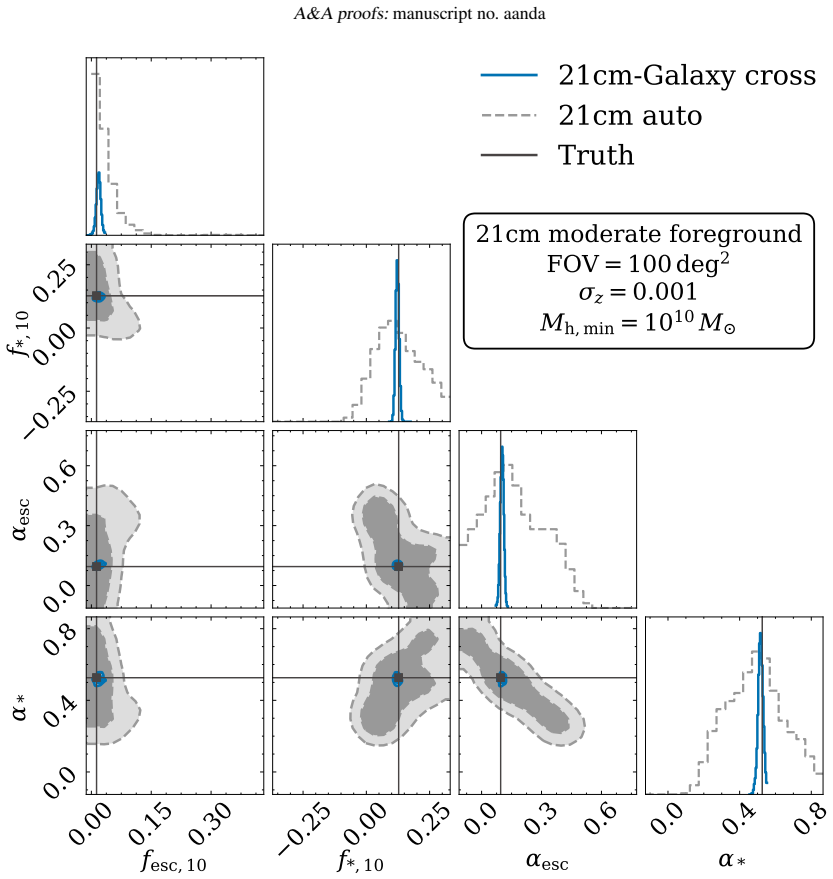
On the paper's own terms, the discovery is that the scale-dependent correlation between ionized bubbles and galaxies carries information about why and how efficiently galaxies ionized the universe—information the 21cm auto-power spectrum cannot supply. In simulation-based forecasts, cross-power spectra infer the normalization and mass slope of the escape fraction and star formation efficiency essentially without degeneracy, provided the galaxy survey has spectroscopic-quality redshifts and either reaches faint galaxies or is paired with aggressive foreground cleaning. The auto-power spectrum, by contrast, leaves these same parameters with more than 60% of the prior volume remaining, because
Load-bearing premise
The inference targets are the coefficients of power-law models for star formation efficiency and escape fraction versus halo mass, with halos treated as direct proxies for detectable galaxies; if real galaxies' detectability or ionizing output has a broken, scattered, or feedback-driven mass dependence, the recovered posteriors describe the toy model rather than physical escape fractions.
Editorial extensions
If this is right
- Cross-power measurements reduce posterior volumes for global reionization properties by 20–30% over auto-power alone, confirming genuinely complementary information.
- Spectroscopic-quality redshifts are a hard requirement; photometric-quality redshifts render cross-correlation measurements uninformative regardless of survey area or depth.
- Tight source-property constraints are achievable through either deep galaxy surveys reaching roughly 10^10 solar-mass halos under moderate foregrounds, or brighter galaxy surveys reaching 10^11 solar-mass halos combined with aggressive 21cm foreground cleaning.
- The escape fraction parameters and star formation efficiency parameters—normalizations and power-law slopes—are recoverable from cross-power with R² > 0.92 and posterior volumes below 12%, while remaining degenerate in auto-power.
- The mutual information gain from cross-power grows toward higher redshift and peaks at scales corresponding to ionized-bubble sizes, identifying where survey effort yields the most scientific return.
Reading between the lines
- If true, the result reframes survey design priorities: investment in spectroscopic redshift capability buys more science return than enlarging area, because photometric surveys add almost nothing to the cross-correlation measurement.
- A natural extension would be to apply the same inference pipeline to higher-order summaries, such as the bispectrum or Minkowski functionals, to test whether the cross-power advantage persists when morphology is summarized beyond the power spectrum.
- The finding that adding auto-power to cross-power actually dilutes source-property constraints at fixed network capacity suggests future multi-probe analyses should weight or architect observables explicitly rather than simply concatenating them.
- The assumptions of a perfect halo-galaxy correspondence and pure power-law mass scaling are the most likely places where real data could break the claim; a scatter, break, or feedback-driven turnover in the mass dependence would likely bias the recovered coefficients.
Editorial analysis
A structured set of objections, weighed in public.
Referee Report
Summary. The paper extends the EoRFlow simulation-based inference framework to 21cm-galaxy cross-power spectra. Using 21cmFASTv4 mocks at z=6–8 with power-law f_esc(M_h) and f_*(M_h), SKA-Low noise, and galaxy survey effects, the authors train conditional normalizing flows to infer x_HI(z) and ⟨1+δ_HI⟩(z), then study survey parameter dependence, mutual information gains, and constraints on four source parameters. They report that cross-power alone tightly constrains source parameters (R²>0.92, PV<12% at M_h,min=1e10 M⊙) while auto-power is uninformative (R²<0.47, PV>60%), and that optimistic foreground removal enables similar constraints at M_h,min=1e11 M⊙. Appendices compare 1D vs 2D power spectra and test the optimistic foreground scenario.
Significance. If the central claim holds, 21cm-galaxy cross-correlations become a qualitatively new probe of reionization sources: they would break degeneracies that 21cm auto-power alone leaves unresolved, while also providing foreground-robust morphology constraints. The paper has genuine strengths: public code for the cross-power uncertainty model and EoRFlow, held-out test sets, bootstrap error bars, and an honest appendix (Appendix A) showing that 1D spherical averaging outperforms 2D for the cross-power. The main caveat is that the headline source-property result is an in-mock demonstration for a specific power-law parameterization and a halo-mass threshold model; no out-of-family test is possible with the current setup. That limits the strength of the physical claim but does not invalidate the in-mock method.
major comments (2)
- [§4.4, Fig. 6; Eqs. (2)-(3)] The headline source-property constraints are in-mock results for the two-parameter power-law model of Eqs. (2)-(3). Training and test sets are drawn from the same 21cmFASTv4 family, so R²>0.92 and PV<12% demonstrate that the flow can invert this specific forward model, not that physical f_esc(M_h) and f_*(M_h) are constrained. If the real mass dependence contains scatter, a break, or feedback-driven turnover, the posteriors are projections onto toy-model coefficients and nominal credible intervals need not cover truth. The phrase 'fundamentally inaccessible to 21cm auto-power alone' (§4.4, Conclusions) is therefore too strong and should be reframed as 'within the 21cmFASTv4 power-law family', or supported by robustness tests with alternative parameterizations and stochastic scatter.
- [§2 (halo proxy)] The mock galaxy overdensity is constructed by a one-to-one halo selection at a fixed M_h,min threshold. There is no luminosity scatter, duty cycle, or selection function; the statement that line luminosity scales with halo mass is not implemented quantitatively. The cross-power amplitude and scale dependence, and therefore the inferred f_esc/f_* values, depend directly on this selection. A realistic galaxy sample with scatter could shift the cross-power and bias the inference. Since coverage checks use only test sets from the same halo-selection model, no in-mock test detects this. This limitation should be stated in Section 5 and, ideally, tested with occupancy-variation mocks.
minor comments (5)
- [Abstract vs Appendix C] The abstract states PV~19% for the optimistic-foreground M_h,min=1e11 case, but Appendix C reports R²>0.81 and PV between 11% and 15%, and Section 4.4 quotes PV<15%. This numerical inconsistency should be corrected.
- [Table 1] Table 1 lists 'log10 fesc,10 U[0.005,0.5]' and 'log10 f∗ U[0.005,0.5]', but the text and Fig. 6 axes suggest linear ranges for f_esc,10 and f_*,10. Please clarify whether these parameters are sampled in log or linear space and use f_*,10 consistently.
- [§4.1 and §4.4] R² and 'posterior volume' are not defined in the text. PV is computed as the standard deviation of posterior samples normalized by the prior standard deviation, which is a marginal-width ratio, not a multi-dimensional volume; the name is misleading. R² should state whether it uses posterior means or another point estimator.
- [§4.4] The cross+auto model degrades source constraints relative to cross alone (R² 0.89–0.92, PV 19–27%). The capacity-dilution explanation is plausible, but this is a caveat to the general statement that combining measurements improves constraints; the domain of the 20–30% PV-reduction claim in §4.1 should be made explicit.
- [§4.3] The mutual information estimates use the trained flow rather than the true posterior. The statement that 78% of bins show >100% fractional gain should be phrased as a property of the trained model, not an exact information decomposition of the data.
Circularity Check
No significant circularity: the inference targets are simulation inputs, not fitted outputs; the derivation chain is a forward-model inversion forecast.
full rationale
The paper's analysis is a simulation-based inference forecast, not a derivation that re-imports its conclusions. The forward model (21cmFASTv4) generates both the summary statistics (P21, P21,g) and the labels (x_HI, <1+delta_HI>, and the four power-law source parameters). EoRFlow is trained on one subset and evaluated on a disjoint held-out test set, with R^2 and posterior-volume metrics computed against known simulation inputs. Thus the 'predictions' are tests of invertibility of the forward model, not quantities fitted to the same data they are claimed to predict. The parameterization f_*(M_h) and f_esc(M_h) (Eqs. 2-3) is an input ansatz; the paper does not claim to derive it. The inferred source constraints are therefore conditional on this parametric family and on the halo-as-galaxy proxy, a model-dependence/correctness limitation rather than circularity. The only self-references (EoRFlow Pietschke et al. 2025; cross-power framework Hutter & Heneka 2025) point to public code and are not used as an unverified uniqueness theorem. One minor point: the abstract's PV~19% for the M_h,min=1e11 optimistic-foreground case differs from Appendix C's 11-15%; this is an internal inconsistency to correct, not a circular step. Overall, no step in the claimed chain equates a prediction to an input by construction.
Assumptions & free parameters
free parameters (4)
- log10 f_esc,10 prior =
U[0.005, 0.5]
- alpha_esc prior =
U[-0.8, 0.5]
- log10 f_*,10 prior =
U[0.005, 0.5]
- alpha_* prior =
U[-0.3, 0.9]
assumptions (6)
- domain assumption Saturated spin temperature T_S >> T_CMB at z=6-8, so deltaT_b = T_0 x_HI (1+delta) (Eq. 1)
- domain assumption Power-law parameterization of f_*(M_h) and f_esc(M_h) (Eqs. 2-3)
- domain assumption Halo mass is a direct proxy for galaxy detectability in emission-line surveys (Section 2)
- domain assumption Foreground wedge model: moderate = horizon + 0.1 Mpc^-1 buffer; optimistic = all modes down to primary-beam scale (App. C)
- ad hoc to paper Prior truncation: simulations with x_HI>0.7 or x_HI<0.2 across all z=6-8 are discarded (Section 2)
- domain assumption Fixed Planck-2018 cosmology (Omega_b=0.049, Omega_m=0.31, h=0.68)
Cite this review
Pith. "Pith review of Constraining reionization morphology and source properties with 21cm galaxy cross-correlation surveys." pith.science (2026). https://pith.science/paper/F6HBRIXG
@misc{pith2026260118627,
  author       = {Pith},
  title        = {Pith review of: Constraining reionization morphology and source properties with 21cm galaxy cross-correlation surveys},
  year         = {2026},
  howpublished = {\url{https://pith.science/paper/F6HBRIXG}},
  note         = {Machine review of arXiv:2601.18627}
}
abstract
Cross-correlations between 21cm observations and galaxy surveys provide a powerful probe of reionization by providing robustness against foreground contamination while linking ionization morphology to galaxies. We quantified the constraining power of 21cm galaxy cross-power spectra for inferring the neutral hydrogen fraction, $x_\mathrm{HI}(z),$ and mean overdensity, $\langle 1+\delta_\mathrm{HI} \rangle(z)$, exploring dependence on the field of view; redshift precision, $\sigma_z$; and minimum halo mass, $M_\mathrm{h,min}$. We employed our simulation-based inference framework EoRFlow for likelihood-free parameter estimation. Mock observations include thermal noise for 100h of SKA-Low with foreground avoidance and realistic galaxy-survey effects. For a fiducial survey ($\mathrm{FOV}=100\,\mathrm{deg}^2$, $\sigma_z=0.001$, $M_\mathrm{h,min}=10^{11}\mathrm{M}_\odot$), cross-power spectra yield unbiased constraints with posterior volumes (PVs) of $\sim$10% relative to priors. Cross-power measurements reduce the PV by 20-30% versus 21cm auto-power alone. With foreground avoidance, spectroscopic redshift precision is essential; photometric redshifts render cross-correlations uninformative. Notably, cross-power spectra constrain ionizing source properties, the escape fraction $f_\mathrm{esc,}$ and the star formation efficiency $f_*$, which remain degenerate in auto-power (PV >60%). Tight constraints require either deep surveys detecting faint galaxies ($M_\mathrm{h,min} \sim 10^{10}\mathrm{M}_\odot$) with moderate foregrounds (PV~11%) or conservative mass limits with optimistic foreground removal (PV~19%). 21cm galaxy cross-correlations enhance morphology constraints beyond auto-power while enabling previously inaccessible source property constraints. Realizing full potential requires precise redshifts and either faint galaxy detection limits or improved 21cm foreground cleaning.
Figures


Figures from the paper (3 more)


Forward citations
Cited by 2 Pith papers
-
Nearest Neighbour-Based Statistics for 21cm-Galaxy Cross-Correlations in the Epoch of Reionization
kNN CDF statistics detect 21cm-galaxy cross-correlations more effectively than two-point methods and distinguish reionization models at fixed ionized fraction even with noise and foregrounds.
-
A hidden reionization prior biases cosmological inference
No monotonic reionization history fits Planck τ, patchy kSZ from SPT/ACT, and Lyα endpoint; an early ionization phase at z≳12 relaxes ∑mν<0.39 eV and shifts σ8 via As-τ degeneracy.
Reference graph
Works this paper leans on
-
[1]
Abdurashidova, T. H. C. Z., Adams, T., Aguirre, J. E., et al. 2023, ApJ, 945, 124
2023
-
[2]
E., Alexander, P., et al
Abdurashidova, Z., Aguirre, J. E., Alexander, P., et al. 2022, ApJ, 924, 51
2022
-
[3]
E., Alexander, P., et al
Abdurashidova, Z., Aguirre, J. E., Alexander, P., et al. 2022, ApJ, 925, 221
2022
-
[4]
2024, MNRAS, 534, L30
Acharya, A., Mertens, F., Ciardi, B., et al. 2024, MNRAS, 534, L30
2024
-
[5]
Aghanim, N. et al. 2020, Astron. Astrophys., 641, A6, [Erratum: As- tron.Astrophys. 652, C4 (2021)]
2020
-
[6]
2019, MNRAS, 488, 4440
Alsing, J., Charnock, T., Feeney, S., & Wandelt, B. 2019, MNRAS, 488, 4440
2019
-
[7]
2024, in 29th ACM International Conference on Architectural Support for Programming Languages and Operating Systems, V olume 2 (ASPLOS ’24) (ACM)
Ansel, J., Yang, E., He, H., et al. 2024, in 29th ACM International Conference on Architectural Support for Programming Languages and Operating Systems, V olume 2 (ASPLOS ’24) (ACM)
2024
-
[8]
2019, ApJ, 874, 133
Beane, A., Villaescusa-Navarro, F., & Lidz, A. 2019, ApJ, 874, 133
2019
Show all 55 references
-
[9]
R., Mertens, F
Ceccotti, E., Offringa, A. R., Mertens, F. G., et al. 2025, First upper limits on the 21-cm signal power spectrum of neutral hydrogen atz=9.16 from the LOFAR 3C196 field
2025
-
[10]
K., Bianco, M., et al
Cerardi, N., Giri, S. K., Bianco, M., et al. 2025, arXiv e-prints, arXiv:2511.11568
2025 arXiv
-
[11]
K., Witte, S
Cole, A., Miller, B. K., Witte, S. J., et al. 2022, J. Cosmology Astropart. Phys., 2022, 004
2022
-
[12]
Cooper, N., Norregaard, C., Meriot, R., & Pritchard, J. R. 2025, arXiv e-prints, arXiv:2508.16329
2025 arXiv
-
[13]
Cover, T. M. & Thomas, J. A. 2006, Elements of Information Theory, 2nd edn. (Hoboken, NJ: Wiley-Interscience)
2006
-
[14]
E., Mesinger, A., & Murray, S
Davies, J. E., Mesinger, A., & Murray, S. G. 2025, A&A, 701, A236
2025
-
[15]
R., Parsons, A
DeBoer, D. R., Parsons, A. R., Aguirre, J. E., et al. 2017, Publications of the Astronomical Society of the Pacific, 129, 045001
2017
-
[16]
2019, Neural Spline Flows
Durkan, C., Bekasov, A., Murray, I., & Papamakarios, G. 2019, Neural Spline Flows
2019
-
[17]
Furlanetto, S. R. & Lidz, A. 2007, ApJ, 660, 1030
2007
-
[18]
R., Oh, S
Furlanetto, S. R., Oh, S. P., & Briggs, F. H. 2006, Phys. Rep., 433, 181
2006
-
[19]
E., & Mesinger, A
Gagnon-Hartman, S., Davies, J. E., & Mesinger, A. 2025, A&A, 699, A131
2025
-
[20]
2022, arXiv e-prints, arXiv:2206.14908
Greene, J., Bezanson, R., Ouchi, M., Silverman, J., & the PFS Galaxy Evolution Working Group. 2022, arXiv e-prints, arXiv:2206.14908
2022 arXiv
-
[21]
& Cooray, A
Heneka, C. & Cooray, A. 2021, MNRAS, 506, 1573
2021
-
[22]
2017, ApJ, 848, 52
Heneka, C., Cooray, A., & Feng, C. 2017, ApJ, 848, 52
2017
-
[23]
& Mesinger, A
Heneka, C. & Mesinger, A. 2020, MNRAS, 496, 581 HERA Collaboration, Abdurashidova, Z., Adams, T., et al. 2023, ApJ, 945, 124
2020
-
[24]
Hutter, A., Dayal, P., Müller, V ., & Trott, C. M. 2017, ApJ, 836, 176
2017
-
[25]
& Heneka, C
Hutter, A. & Heneka, C. 2025, arXiv e-prints, arXiv:2509.15906
2025
-
[26]
2018, MNRAS, 479, 2754 La Plante, P., Mirocha, J., Gorce, A., Lidz, A., & Parsons, A
Kubota, K., Yoshiura, S., Takahashi, K., et al. 2018, MNRAS, 479, 2754 La Plante, P., Mirocha, J., Gorce, A., Lidz, A., & Parsons, A. 2023, ApJ, 944, 59
2018
-
[27]
Lipman, Y ., Chen, R. T. Q., Ben-Hamu, H., Nickel, M., & Le, M. 2022, arXiv e-prints, arXiv:2210.02747
2022 arXiv
-
[28]
& Hutter, F
Loshchilov, I. & Hutter, F. 2019, Decoupled Weight Decay Regularization
2019
-
[29]
I., Brinchmann, J., et al
Mainieri, V ., Anderson, R. I., Brinchmann, J., et al. 2024, arXiv e-prints, arXiv:2403.05398
2024 arXiv
-
[30]
2020, The Messenger, 180, 24
Maiolino, R., Cirasuolo, M., Afonso, J., et al. 2020, The Messenger, 180, 24
2020
-
[31]
G., Mevius, M., Koopmans, L
Mertens, F. G., Mevius, M., Koopmans, L. V . E., et al. 2020, Monthly Notices of the Royal Astronomical Society, 493, 1662
2020
-
[32]
2011, Monthly No- tices of the Royal Astronomical Society, 411, 955, _eprint: https://academic.oup.com/mnras/article-pdf/411/2/955/4099991/mnras0411- 0955.pdf
Mesinger, A., Furlanetto, S., & Cen, R. 2011, Monthly No- tices of the Royal Astronomical Society, 411, 955, _eprint: https://academic.oup.com/mnras/article-pdf/411/2/955/4099991/mnras0411- 0955.pdf
2011
-
[33]
2024, MNRAS, 530, 3183
Moriwaki, K., Beane, A., & Lidz, A. 2024, MNRAS, 530, 3183
2024
-
[34]
G., Greig, B., Mesinger, A., et al
Murray, S. G., Greig, B., Mesinger, A., et al. 2020, Journal of Open Source Soft- ware, 5, 2582
2020
-
[35]
2025, SciPost Phys., 18, 155
Ore, A., Heneka, C., & Plehn, T. 2025, SciPost Phys., 18, 155
2025
-
[36]
Park, J., Kim, H.-S., Wyithe, J. S. B., & Lacey, C. G. 2014, MNRAS, 438, 2474
2014
-
[37]
2019, Monthly Notices of the Royal Astronomical Society, 484, 933–949
Park, J., Mesinger, A., Greig, B., & Gillet, N. 2019, Monthly Notices of the Royal Astronomical Society, 484, 933–949
2019
-
[38]
R., Backer, D
Parsons, A. R., Backer, D. C., Foster, G. S., et al. 2010, The Astronomical Jour- nal, 139, 1468
2010
-
[39]
Pietschke, Y ., Heneka, C., Schlenker, T., Ore, A., & Schosser, B. 2025, J. Cos- mology Astropart. Phys., 2025, 039
2025
-
[40]
C., Liu, A., Dillon, J
Pober, J. C., Liu, A., Dillon, J. S., et al. 2014, ApJ, 782, 66
2014
-
[41]
C., Parsons, A
Pober, J. C., Parsons, A. R., DeBoer, D. R., et al. 2013, The Astronomical Jour- nal, 145, 65
2013
-
[42]
D., Weniger, C., Acedo, E
Saxena, A., Meerburg, P. D., Weniger, C., Acedo, E. d. L., & Handley, W. 2024, RAS Techniques and Instruments, 3, 724
2024
-
[43]
2025, SciPost Phys
Schosser, B., Heneka, C., & Plehn, T. 2025, SciPost Phys. Core, 8, 037
2025
-
[44]
Schosser, B., Heneka, C., & Schäfer, B. M. 2025, arXiv e-prints, arXiv:2508.10094
2025 arXiv
-
[45]
2016, MNRAS, 459, 2741 The HERA Collaboration, Abdurashidova, Z., Adams, T., et al
Sobacchi, E., Mesinger, A., & Greig, B. 2016, MNRAS, 459, 2741 The HERA Collaboration, Abdurashidova, Z., Adams, T., et al. 2025, arXiv e- prints, arXiv:2511.21289
2016
-
[46]
J., Goeke, R., Bowman, J
Tingay, S. J., Goeke, R., Bowman, J. D., et al. 2013, PASA, 30, e007
2013
-
[47]
2023, arXiv e-prints, arXiv:2302.00482
Tong, A., Fatras, K., Malkin, N., et al. 2023, arXiv e-prints, arXiv:2302.00482
2023 arXiv
-
[48]
M., Jordan, C
Trott, C. M., Jordan, C. H., Midgley, S., et al. 2020, Monthly Notices of the Royal Astronomical Society, 493, 4711 van Haarlem, M. P., Wise, M. W., Gunst, A. W., et al. 2013, A&A, 556, A2
2020
-
[49]
2022, ApJS, 259, 61
Villaescusa-Navarro, F., Genel, S., Anglés-Alcázar, D., et al. 2022, ApJS, 259, 61
2022
-
[50]
2020, MNRAS, 492, 4952
Vrbanec, D., Ciardi, B., Jeli´c, V ., et al. 2020, MNRAS, 492, 4952
2020
-
[51]
2016, MNRAS, 457, 666
Vrbanec, D., Ciardi, B., Jeli´c, V ., et al. 2016, MNRAS, 457, 666
2016
-
[52]
2022, ApJ, 928, 1
Wang, Y ., Zhai, Z., Alavi, A., et al. 2022, ApJ, 928, 1
2022
-
[53]
H., Kulkarni, G., & Haehnelt, M
Weinberger, L. H., Kulkarni, G., & Haehnelt, M. G. 2020, MNRAS, 494, 703
2020
-
[54]
Yoshiura, S., Line, J. L. B., Kubota, K., Hasegawa, K., & Takahashi, K. 2018, MNRAS, 479, 2767
2018
-
[55]
optimistic foreground model
Yoshiura, S., Pindor, B., Line, J. L. B., et al. 2021, Monthly Notices of the Royal Astronomical Society, 505, 4775 Article number, page 12 of 15 Pietschke et al.: Constraining Reionization Morphology and Source Properties with 21cm-Galaxy Cross-Correlation Surveys Appendix A:...
2021
Reviewed August 3, 2026 · model on record in the stance chip above.
Discussion (0). Sign in to comment.