Recognition: 2 theorem links
· Lean TheoremImpact of Rastall gravity on hydrostatic mass of galaxy clusters
Pith reviewed 2026-05-16 10:37 UTC · model grok-4.3
The pith
Rastall gravity adjusts galaxy cluster hydrostatic masses to match baryonic and lensing observations at slopes near unity.
A machine-rendered reading of the paper's core claim, the machinery that carries it, and where it could break.
Core claim
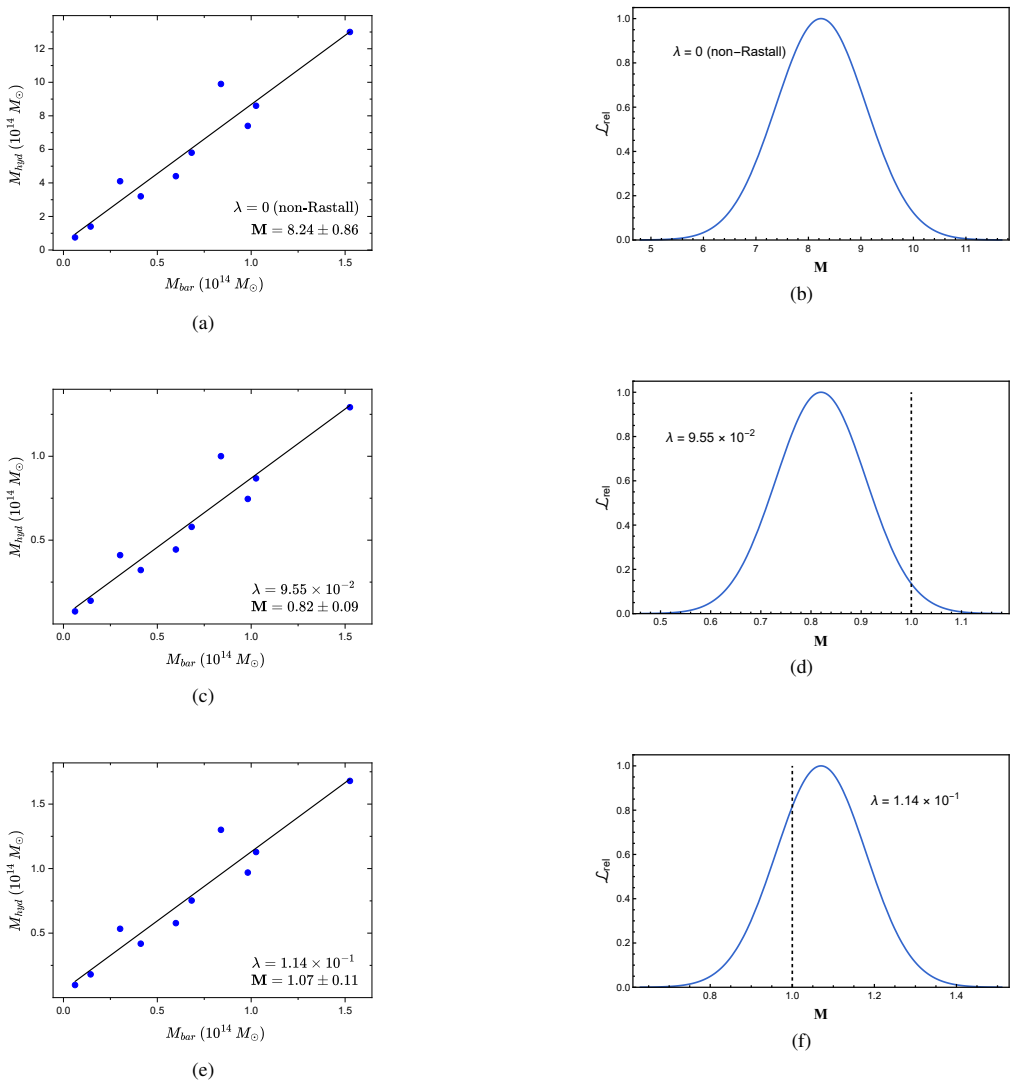
In Rastall gravity the hydrostatic equilibrium equation can be solved so that the resulting mass equals the baryonic mass (slope 1.07) when no dark matter is assumed, or equals the lensing mass (slope 0.99) when dark matter is retained, by constraining a single Rastall parameter on cluster data.
What carries the argument
The hydrostatic equilibrium equation adapted to Rastall gravity, in which the Rastall parameter rescales the effective source term that links matter density to spacetime curvature.
If this is right
- Without dark matter the Rastall hydrostatic mass and baryonic mass obey a linear relation with slope 1.07 ± 0.11.
- With dark matter the Rastall hydrostatic mass and lensing mass obey a linear relation with slope 0.99 ± 0.26.
- Goodness-of-fit statistics improve certain scaling relations yet do not place Rastall gravity ahead of every competing modified-gravity model.
Where Pith is reading between the lines
- Cluster-scale modifications of this kind could reduce the apparent need for dark matter in mass estimates.
- Repeating the analysis on larger, homogeneous cluster catalogs would test whether the Rastall parameter remains constant across different systems.
- The same rescaling might be applied to other virialized objects to check consistency beyond galaxy clusters.
Load-bearing premise
The standard form of hydrostatic equilibrium can be transplanted directly into Rastall gravity at cluster scales using one universal constant parameter.
What would settle it
A statistically significant departure of the fitted slope from unity across a large, independent sample of clusters, or a Rastall parameter that cannot be fixed to a single value by the same data, would falsify the central claim.
Figures

read the original abstract
Galaxy clusters are the largest virialized structures in the Universe and are predominantly dominated by dark matter. The hydrostatic mass and the mass obtained from gravitational lensing measurements generally differ, a discrepancy known as the hydrostatic mass bias. In this work, we derive the hydrostatic mass of galaxy clusters within the framework of Rastall gravity. We consider two scenarios: (i) the absence of dark matter and (ii) the presence of dark matter. In both cases, we constrain the Rastall parameter in the cluster-scale using observational data. In the first scenario, Rastall gravity effectively reduces the hydrostatic mass, bringing it closer to the observed baryonic mass. The best linear fit yields a slope $\mathbf{M}=1.07\pm0.11$, indicating a near one-to-one correspondence between the two masses. In the second scenario, Rastall gravity helps to alleviate the hydrostatic mass bias. The linear fit between the Rastall hydrostatic mass and the observed lensing mass results in a best-fit slope $\mathbf{M}=0.99\pm0.26$, which is very close to unity. We also calculate the goodness-of-fit for every fit. The statistical evaluations indicate that Rastall gravity provides a viable phenomenological framework that can improve certain aspects of the mass discrepancy problem at the level of scaling relations. However, it does not universally outperform other modified gravity model, when evaluated using standard goodness-of-fit criteria.
Editorial analysis
A structured set of objections, weighed in public.
Referee Report
Summary. The paper claims that Rastall gravity allows derivation of hydrostatic masses for galaxy clusters in two scenarios (no dark matter and with dark matter). By fitting the Rastall parameter to observational data, it reports linear relations with slopes 1.07±0.11 (hydrostatic vs. baryonic mass) and 0.99±0.26 (Rastall hydrostatic vs. lensing mass), indicating reduced mass bias at the scaling-relation level, though goodness-of-fit metrics show it does not universally outperform other modified-gravity models.
Significance. If the hydrostatic-equilibrium adaptation is rigorously derived, the work supplies a concrete phenomenological test of Rastall gravity at cluster scales, with explicit slopes, uncertainties, and fit statistics that quantify improvement in the no-DM case and bias alleviation in the DM case. It adds to the literature on modified-gravity alternatives to dark matter by providing falsifiable numerical predictions tied to existing cluster catalogs.
major comments (3)
- [Hydrostatic mass derivation (likely §3)] The hydrostatic equilibrium equation used for the Rastall case is introduced without an explicit derivation from the Rastall field equations for the metric ds² = −e^{2Φ}dt² + e^{2Λ}dr² + r²dΩ². The modified divergence of T_μν generally produces extra ∇R and λ-dependent terms in the effective gravitational acceleration for a perfect fluid; these must be shown to reduce to the adopted form or the reported mass reductions rest on an unverified assumption.
- [Parameter fitting and results (likely §4)] The Rastall parameter is constrained directly from the same cluster sample whose masses are then used to demonstrate the near-unity slopes. This procedure makes the reported goodness-of-fit improvements (e.g., slopes 1.07±0.11 and 0.99±0.26) at least partly tautological; an independent validation sample or cross-check against a held-out catalog is required to substantiate the claim of genuine improvement.
- [Methods and data (likely §2)] Data selection criteria, error propagation through the modified hydrostatic mass formula, and the precise observational catalogs (X-ray, lensing, etc.) are not described in sufficient detail. Without these, the quoted uncertainties and the conclusion that Rastall gravity “does not universally outperform other models” cannot be independently assessed.
minor comments (2)
- [Abstract] Abstract uses boldface for the slope symbols (M=1.07±0.11); replace with standard inline math for journal consistency.
- [Throughout] Ensure every equation is numbered and explicitly referenced in the text; several intermediate steps in the mass derivation appear unnumbered.
Simulated Author's Rebuttal
We thank the referee for their constructive and detailed report. We address each major comment below and outline the revisions planned for the manuscript.
read point-by-point responses
-
Referee: The hydrostatic equilibrium equation used for the Rastall case is introduced without an explicit derivation from the Rastall field equations for the metric ds² = −e^{2Φ}dt² + e^{2Λ}dr² + r²dΩ². The modified divergence of T_μν generally produces extra ∇R and λ-dependent terms in the effective gravitational acceleration for a perfect fluid; these must be shown to reduce to the adopted form or the reported mass reductions rest on an unverified assumption.
Authors: We appreciate the referee highlighting this point. The hydrostatic equilibrium equation in Rastall gravity was obtained from the modified field equations, but we agree that the step-by-step derivation was not shown explicitly in the manuscript. In the revised version, we will add a complete derivation starting from the Rastall field equations for the given metric, explicitly demonstrating how the additional ∇R and λ-dependent terms reduce to the adopted form of the hydrostatic mass. This will make the modifications fully transparent. revision: yes
-
Referee: The Rastall parameter is constrained directly from the same cluster sample whose masses are then used to demonstrate the near-unity slopes. This procedure makes the reported goodness-of-fit improvements (e.g., slopes 1.07±0.11 and 0.99±0.26) at least partly tautological; an independent validation sample or cross-check against a held-out catalog is required to substantiate the claim of genuine improvement.
Authors: We acknowledge that fitting the Rastall parameter on the same sample used to evaluate the slopes introduces a degree of circularity, as the parameter is chosen to optimize the mass alignment. This is a standard phenomenological approach when constraining a free parameter at cluster scales with available data, but it limits the strength of the claim for genuine improvement. No independent held-out catalog is available in the current study. In the revision, we will add an explicit discussion of this limitation, frame the results as a demonstration rather than definitive validation, and recommend future tests with separate datasets. revision: partial
-
Referee: Data selection criteria, error propagation through the modified hydrostatic mass formula, and the precise observational catalogs (X-ray, lensing, etc.) are not described in sufficient detail. Without these, the quoted uncertainties and the conclusion that Rastall gravity “does not universally outperform other models” cannot be independently assessed.
Authors: We thank the referee for noting the insufficient detail in the methods. The original manuscript referenced the data sources but omitted full specifications. In the revised version, we will expand the relevant section to include the precise data selection criteria, the specific X-ray and lensing catalogs used, and a clear account of error propagation through the modified hydrostatic mass formula. This will allow independent verification of the uncertainties and the comparative goodness-of-fit statements. revision: yes
- Requirement for an independent validation sample or held-out catalog to confirm the improvements, which is not available within the current dataset and analysis.
Circularity Check
Rastall parameter fitted to same cluster data produces near-unity mass slopes by construction
specific steps
-
fitted input called prediction
[Abstract]
"we constrain the Rastall parameter in the cluster-scale using observational data. In the first scenario, Rastall gravity effectively reduces the hydrostatic mass, bringing it closer to the observed baryonic mass. The best linear fit yields a slope M=1.07±0.11, indicating a near one-to-one correspondence between the two masses. In the second scenario, Rastall gravity helps to alleviate the hydrostatic mass bias. The linear fit between the Rastall hydrostatic mass and the observed lensing mass results in a best-fit slope M=0.99±0.26"
The Rastall parameter is tuned to the identical observational mass data whose discrepancy is then 'alleviated' by the adjusted hydrostatic masses; the reported slopes near unity are therefore the direct statistical outcome of that fit rather than an independent derivation or prediction.
full rationale
The paper constrains the single Rastall parameter λ directly to the hydrostatic vs. baryonic/lensing mass data, then reports linear fits with slopes 1.07±0.11 and 0.99±0.26 as evidence of improvement. This reduces the claimed alleviation of mass bias to a fitted-input-called-prediction step. The hydrostatic equilibrium adaptation itself is presented without an explicit derivation from the Rastall field equations for the spherical metric, but the central circularity is the parameter fit. No self-citation load-bearing or ansatz smuggling is evident in the provided text.
Axiom & Free-Parameter Ledger
free parameters (1)
- Rastall parameter =
fitted to data
axioms (2)
- domain assumption Hydrostatic equilibrium equation holds in Rastall gravity
- domain assumption Observational mass estimates are directly comparable
Lean theorems connected to this paper
-
IndisputableMonolith/Foundation/RealityFromDistinction.leanreality_from_one_distinction unclear?
unclearRelation between the paper passage and the cited Recognition theorem.
Rastall field equation G^μ_ν + κλ R δ^μ_ν = κ T^μ_ν with free λ fitted to yield slopes M≈1.07 and 0.99
-
IndisputableMonolith/Cost/FunctionalEquation.leanwashburn_uniqueness_aczel unclear?
unclearRelation between the paper passage and the cited Recognition theorem.
Newtonian-limit m(r) with extra κλ/(4κλ−1) terms (Eq. 35)
What do these tags mean?
- matches
- The paper's claim is directly supported by a theorem in the formal canon.
- supports
- The theorem supports part of the paper's argument, but the paper may add assumptions or extra steps.
- extends
- The paper goes beyond the formal theorem; the theorem is a base layer rather than the whole result.
- uses
- The paper appears to rely on the theorem as machinery.
- contradicts
- The paper's claim conflicts with a theorem or certificate in the canon.
- unclear
- Pith found a possible connection, but the passage is too broad, indirect, or ambiguous to say the theorem truly supports the claim.
Reference graph
Works this paper leans on
-
[1]
R. F. L. Holanda, J. S. Alcaniz, Astropart. Phys. 62 (2015) 134–138
work page 2015
-
[2]
A. V . Kravtsov, S. Borgani, Annu. Rev. Astron. Astrophys. 50 (2012) 353–409. arXiv:1205.5556 [astro-ph.CO]
work page internal anchor Pith review Pith/arXiv arXiv 2012
-
[3]
A. Mercurio, P. Rosati, A. Biviano, M. Annunziatella, M. Girardi, B. Sartoris, M. Nonino, M. Brescia, G. Ric- cio, C. Grillo, I. Balestra, G. B. Caminha, G. De Lucia, R. Gobat, S. Seitz, P. Tozzi, M. Scodeggio, E. Vanzella, G. Angora, P. Bergamini, S. Borgani, R. Demarco, M. Meneghetti, V . Strazzullo, L. Tortorelli, K. Umetsu, A. Fritz, D. Gruen, D. Kels...
work page 2021
- [4]
-
[5]
A. C. Fabian (Ed.), Clusters and Superclusters of Galax- ies, Springer, Dordrecht (1992), pp. 131–150
work page 1992
- [6]
-
[7]
C. L. Sarazin, Rev. Mod. Phys. 58 (1) (1986) 1–115
work page 1986
- [8]
-
[9]
G. M. V oit, Rev. Mod. Phys. 77 (2005) 207–258
work page 2005
-
[10]
S. W. Allen, A. E. Evrard, A. B. Mantz, Annu. Rev. As- tron. Astrophys. 49 (2011) 409–470
work page 2011
- [11]
-
[12]
H. Hoekstra, M. Bartelmann, H. Dahle, H. Israel, M. Limousin, M. Meneghetti, Space Sci. Rev. 177 (1–4) (2013) 75–118
work page 2013
- [13]
-
[14]
A. A. Vikhlinin, A. V . Kravtsov, M. L. Markevich, R. A. Sunyaev, E. M. Churazov, Phys. Usp. 57 (2014) 317–341
work page 2014
-
[15]
P. Li, Y . Tian, M. P. Júlio, M. S. Pawlowski, F. Lelli, S. S. McGaugh, J. M. Schombert, J. I. Read, P. C. Yu, C. M. Ko, Astron. Astrophys. 677 (2023) A24
work page 2023
- [16]
-
[17]
F. A. Pearce, S. T. Kay, D. J. Barnes, R. G. Bower, M. Schaller, Mon. Not. R. Astron. Soc. 491 (2) (2020) 1622– 1642
work page 2020
- [18]
- [19]
-
[20]
D. J. Turner, P. A. Giles, A. K. Romer, J. Pilling, T. K. Lingard, R. Wilkinson, M. Hilton, E. W. Upsdell, R. Al- Serkal, T. Cheng, R. Eappen, P. J. Rooney, S. Bhargava, C. A. Collins, J. Mayers, C. Miller, R. C. Nichol, M. Sahlén, P. T. P. Viana, Mon. Not. R. Astron. Soc. 37 (2) (2025) 1404–1429
work page 2025
-
[21]
J. Braspenning, J. Schaye, M. Schaller, R. Kugel, S. T. Kay, Mon. Not. R. Astron. Soc. 536 (4) (2025) 3784– 3802
work page 2025
- [22]
- [23]
- [24]
-
[25]
S. Andreon, M. A. Hurn, Mon. Not. R. Astron. Soc. 404 (4) (2010) 1922–1937
work page 2010
- [26]
- [27]
- [28]
-
[29]
M. Stepanov, L. Zadorozhna, V . Babur, O. Gugnin, B. Hnatyk, Universe 11(9) (2025) 316
work page 2025
-
[30]
P. W. Premadi, D. H. Nugroho, A. T. Jaelani, J. Math. Fund. Sci 53 (3) (2021) 428–450
work page 2021
- [31]
-
[32]
Modified Gravity and Cosmology
T. Clifton, P. G. Ferreira, A. Padilla, C. Skordis, Phys. Rep. 513 (2012) 1-189. arXiv:1106.2476 [astro-ph.CO]
work page internal anchor Pith review Pith/arXiv arXiv 2012
-
[33]
Observational Tests of Nonlocal Gravity: Galaxy Rotation Curves and Clusters of Galaxies
S. Rahvar, B. Mashhoon, Phys. Rev. D 89 (2014) 104011. arXiv:1401.4819 [astro-ph.GA]
work page internal anchor Pith review Pith/arXiv arXiv 2014
-
[34]
J. W. Moffat, S. Rahvar, Mon. Not. R. Astron. Soc. 441 (2014) 3724–3732. arXiv:1309.5077 [astro-ph.CO]. 12
work page internal anchor Pith review Pith/arXiv arXiv 2014
-
[35]
F. Apryandi, I. H. Belfaqih, A. Sulaksono, J. Phys. COnf. Ser. 2098 (2021) 012001
work page 2098
- [36]
-
[37]
A. M. Oliveira, H. E. S. Velten, J. C. Fabris, L. Casarini, Phys. Rev. D 92 (2015) 044020
work page 2015
-
[38]
M. F. A. R. Sakti, A. Suroso, A. Sulaksono, F. P. Zen, Phys. Dark Univ. 35 (2022) 100974
work page 2022
-
[39]
M. L. Pattersons, F. P. Zen, H. L. Prihadi, M. F. A. R. Sakti, Phys. Lett. B 868 (2025) 139636
work page 2025
-
[40]
Visser, Physics Letters B 782 (2018) 83–86
M. Visser, Physics Letters B 782 (2018) 83–86
work page 2018
- [41]
-
[42]
M. L. Pattersons, F. P. Zen, H. L. Prihadi, M. F. A. R. Sakti, G. Hikmawan, Int. J. Mod. Phys. D 34 (15) (2025) 2550074
work page 2025
-
[43]
F. M. da Silva, L. C. N. Santos, C. C. Barros Jr, Class. Quantum Grav. 38 (2021) 165011
work page 2021
-
[44]
P. Xi, Q. Hu, G. Zhuang, X. Li, Astrophys. Space Sci. 365 (2020) 163
work page 2020
- [45]
-
[46]
T. Tangphati, A. Banerjee, ˙I. Sakallı, A. Pradhan, Chin. J. Phys. 90 (2024) 422–433
work page 2024
-
[47]
A. Banerjee, A. Pradhan, ˙I. Sakallı, A. Dixit, Class. Quan- tum Grav. 42 (2025) 025008
work page 2025
-
[48]
I. G. Salako, D. R. Boko, G. F. Pomalegni, M. Z. Arouko, Theor. Math. Phys. 208 (2021), 1299–1316
work page 2021
-
[49]
A. Banerjee, T. Tangphati, S. Hansraj, A. Pradhan, Ann. Phys. 451 (2023) 169267
work page 2023
- [50]
- [51]
- [52]
-
[53]
Traversable asymptotically flat wormholes in Rastall gravity
H. Moradpour, N. Sadeghnezhad, S.H. Hendi, Can. J. Phys. 95 (12) (2017) 1257–1266. arXiv:1606.00846 [gr- qc]
work page internal anchor Pith review Pith/arXiv arXiv 2017
- [54]
- [55]
-
[56]
K. A. Bronnikov, V . A. G. Barcellos, L. P. de Carvalho, J. C. Fabris, Eur. Phys. J. C 81 (2021) 395
work page 2021
- [57]
- [58]
- [59]
-
[60]
Gaussian black holes in Rastall Gravity
E. Spallucci, A. Smailagic, Int. J. Mod. Phys. D 27 (02) (2018) 1850003. arXiv:1709.05795 [gr-qc]
work page internal anchor Pith review Pith/arXiv arXiv 2018
-
[61]
Black Hole Solutions in Rastall Theory
Y . Heydarzade, H. Moradpour, F. Darabi, Can. J. Phys. 95 (12) (2017) 1253–1256. arXiv:1610.03881 [gr-qc]
work page internal anchor Pith review Pith/arXiv arXiv 2017
-
[62]
D. C. Zou, M. Zhang, C. Wu, R. H. Yue, Adv. High En- ergy Phys. 2020 (2020) 4065254
work page 2020
- [63]
- [64]
- [65]
- [66]
-
[67]
R. Li, J. Wang, Z. Xu, X. Guo, Mon. Not. R. Astron. Soc. 486 (2) (2019) 2407–2411. arXiv:1903.08790 [astro- ph.GA]
work page internal anchor Pith review Pith/arXiv arXiv 2019
- [68]
- [69]
-
[70]
Y . Yusmantoro, F. P. Zen, M. L. Pattersons, Int. J. Mod. Phys. D 35 (03) (2026) 2550100. arXiv:2510.16061 [gr- qc]
-
[71]
P. Schneider, Extragalactic Astronomy and Cosmology: An Introduction (Second Edition), Springer, Heidelberg (2015), pp. 273–340
work page 2015
-
[72]
A. Vikhlinin, A. Kravtsov, W. Forman, C. Jones, M. Markevitch, S. S. Murray, L. Van Speybroeck, Astrophys. J. 640 (2) (2006) 691
work page 2006
-
[73]
Dos and don'ts of reduced chi-squared
R. Andrae, T. Schulze-Hartung, P. Melchior, arXiv:1012.3754 [astro-ph.IM]
work page internal anchor Pith review Pith/arXiv arXiv
-
[74]
Evidence for Non-Hydrostatic Gas from the Cluster X-ray to Lensing Mass Ratio
A. Mahdavi, H. Hoekstra, A. Babul, J. P. Henry, Mon. Not. R. Astron. Soc. 384 (4, 11) (2008) 1567–1574. arXiv:0710.4132 [astro-ph]
work page internal anchor Pith review Pith/arXiv arXiv 2008
- [75]
-
[76]
R. Herbonnet, C. Sifón, H. Hoekstra, Y . Bahé, R. F. J. van der Burg, J.-B. Melin, A. von der Linden, D. Sand, S. Kay, D. Barnes, Mon. Not. R. Astron. Soc. 497 (2020) 4684–4703. 13
work page 2020
-
[77]
A. Nagarajan, F. Pacaud, M. Sommer, M. Klein, K. Basu, F. Bertoldi, A. T. Lee, P. A. R. Ade, A. N. Bender, D. Ferrusca, N. W. Halverson, C. Horellou, B. R. Johnson, J. Kennedy, R. Kneissl, K. M. Menten, C. L. Reichardt, C. Tucker, B. Westbrook, Mon. Not. R. Astron. Soc. 488 (2019) 1728–1759. 14
work page 2019
discussion (0)
Sign in with ORCID, Apple, or X to comment. Anyone can read and Pith papers without signing in.