REVIEW 2 major objections 5 minor 111 references
Diffusion in quantum state preparation: From passive cooling to system-bath engineering
T0 review · 2 major / 5 minor · reviewed 2026-08-03 · deepseek-v4-flash
Pith's one-line read Both passive and engineered dissipative cooling of the SSH ground state take time quadratic in system size, with a unique dark state for the engineered protocol.
desk verdict Solid multi-method case for τ ∼ N² in number-conserving dissipative SSH preparation; the uniqueness proof in App. B is too sketchy for the weight it carries, but the scaling result stands. read the letter →
The pith
A machine-rendered reading of the paper's core claim, the machinery that carries it, and where it could break.
The reading
What carries the argument
The central object is the defect representation in terms of fermionic bond operators x_{j,±}=(c_{j,b}±c_{j+1,a})/√2, which diagonalize the SSH Hamiltonian into flat bands and turn the ground state into the dark state ∏j x†_{j,-}|0⟩. Excitations are x†_+ particles and x_- holes, and the jump operators of the engineered protocol move them leftward and recombine them. The argument is carried by two complementary reductions: a continuum reaction-diffusion equation for defect densities whose coefficients lack the destabilizing impact-ionization terms, and a classical random-walk model whose hitting time L²/4 gives the quadratic cooling time. A third piece is the jump sequence M = L²_{j_k'} ∏_i L¹
What would settle it
Find a second stationary state: exact diagonalization of the engineered Liouvillian at N=14 must show exactly one zero eigenvalue, and any additional eigenvalue that tends to zero as N grows—or a nonzero plateau in the late-time excited population prepared from the state |ι_n⟩—would falsify the uniqueness claim.
Extended reading notes
Core claim
The paper claims that cooling a dimerized SSH chain to its ground state by either thermal coupling or engineered dissipation is governed by the same diffusive mechanism. In both cases, the target state is a vacuum of particle-hole defects in the bond-operator basis, and cooling proceeds by locally hopping these defects and annihilating pairs when they meet; the annihilation rate is controlled by how long defects take to diffuse across the system. The paper argues that this diffusive bottleneck is unavoidable whenever total particle number is conserved, making τ=DN² with a protocol-dependent diffusion constant D, and that the engineered protocol has a smaller D than the thermal one. It furthe
Load-bearing premise
The uniqueness proof rests on the combinatorial claim that a minimal-distance particle-hole pair can always be transported to annihilation without another defect or Pauli exclusion blocking the path; if that claim fails, the engineered protocol could have additional steady states even though the quadratic cooling time would remain.
Editorial extensions
If this is right
- Particle-number-conserving dissipative preparation of this topological state cannot be accelerated beyond quadratic-in-size cooling times by choosing better local jump operators; only the prefactor (the diffusion constant) is protocol-dependent.
- The engineered protocol has a unique steady state, so the dark-state preparation approach is stable at all system sizes in this model, contradicting the impact-ionization instability predicted for related continuum models.
- Low-temperature thermal protocols come exponentially close to the ground state and share the same quadratic scaling as engineered dissipation, meaning cryostatic and engineered routes face the same fundamental diffusive bottleneck.
- The mean-field equations without impact-ionization terms imply that in the thermodynamic limit the defect densities decay diffusively with no residual plateau, a prediction testable in quantum-trajectory simulations.
- Because τ=DN², the engineered protocol's faster cooling is a quantitative prefactor advantage, not a change of scaling class.
Reading between the lines
- If the diffusive bottleneck is generic to number-conserving local dissipative dynamics, then any dissipative state-preparation protocol for fermionic symmetry-protected states will inherit quadratic (or worse) scaling, and the practical route to speedup lies in temporarily breaking or relaxing number conservation.
- The uniqueness proof's jump-sequence construction may generalize to other parent Hamiltonians whose ground states admit similar defect vacuums; a testable extension is to apply the same construction to other dimerized or topological band structures.
- The classical random-walk model suggests that the late-time dynamics is effectively single-particle even in a many-body system; one could test whether the full distribution of cooling times, not just its mean, matches the hitting-time statistics of the random walk.
- Since the engineered protocol is formulated with H=0, a direct experimental realization with optical or ionic platforms could probe the N² scaling by measuring the excited-population decay across two decades in time; observing a deviation at large N would point to finite-size corrections or a competing steady state.
Editorial analysis
A structured set of objections, weighed in public.
Referee Report
Summary. The paper studies two particle-number-conserving dissipative protocols for preparing the half-filled dimerized SSH ground state: a thermal protocol based on Davies/ULE master equations and an engineered protocol based on local jump operators. The authors report that in both cases the cooling time scales as τ ~ N^2, with N the number of lattice sites. This scaling is supported by exact diagonalization, quantum trajectories, truncated-Hilbert-space calculations, DMRG, a mean-field reaction-diffusion analysis, and a classical random-walk model. The paper further claims that the engineered protocol has a unique stable dark state, in contrast to recent claims of an impact-ionization instability in related dissipative topological systems.
Significance. If correct, the paper provides a concrete example in which particle-number conservation forces dissipative state preparation to be diffusive, with a quadratic rather than constant cooling time, and it challenges the FKPP impact-ionization instability scenario. The numerical evidence is strong: the parameter-free random-walk prediction τ = L^2/4 ≈ 0.0625N^2 is close to the numerical fit 0.057N^2, and the authors use several independent methods with overlapping system sizes. The mean-field equations are derived explicitly, and the data are made available. The main weakness is the analytical proof of uniqueness of the engineered steady state, which is not valid as written.
major comments (2)
- [Appendix B] The move-operator construction does not prove connectivity to the dark state. For a one-defect state |j;j> = x†_{j,+} x_{j,-}|◦>, the operator L2_j = L^-_{j,b} satisfies L2_j |j;j> = |j;j> - |◦> (up to normalization) and L2_j |◦> = 0. Thus the image of a same-site defect is not in the m-1 sector; the combination |j;j> - |◦> is an eigenvector of L2_j with eigenvalue 1, so repeated application of L2_j does not drain the m=1 component. The same failure occurs for an adjacent pair: L1_{j+1}|j+1;j> = |j;j> - |◦>, and then L2_j leaves the defect component invariant. Therefore the induction 'repeat until the dark subspace is reached' is unjustified, and the claimed analytical proof of uniqueness in Section VI collapses. Since the uniqueness/stability claim is a central advertised result and the principal analytical differentiator from the FKPP literature, this is load-bearing. The proof should
- [Section VI] The conclusion that the present results 'speak against the impact ionization scenario also on analytical grounds' relies on the invalid Appendix B proof and on mean-field equations that are specific to the authors' model. Even if the numerical data are convincing for finite systems up to N=60, they do not by themselves exclude a competing stationary state in the thermodynamic limit. The authors should clearly separate the finite-size numerical evidence from the (currently unsupported) rigorous uniqueness statement.
minor comments (5)
- [Eq. (13) and Sec. II A] The nonlinearity coefficient in Eq. (13) is denoted β, but β is also used for inverse temperature earlier in the paper. Rename one of them to avoid ambiguity.
- [Appendix B] The displayed formula for M is typographically garbled: 'M=L 2_{jk′} ik Y i=jk′ +1 L1_i' should be rewritten with explicit product limits and operator ordering.
- [Table I / Sec. III A 1] The DMRG calculations do not report the maximum bond dimension or the convergence criterion. The claim that DMRG results are verified to 2% would be easier to assess with this information.
- [Fig. 6] The exact-diagonalization data points in Fig. 6 are shown without error bars. Please state whether the errors are smaller than the symbol size.
- [Sec. V B 2] The generalized random-walk model initializes defect numbers with weights p_m ∝ dim H^(m). This ad hoc choice is not discussed; a brief justification or a sensitivity check would be helpful.
Circularity Check
No significant circularity: the quadratic cooling-time scaling is derived from the microscopic jump operators via an independent random-walk model, and the uniqueness claim rests on a general external theorem rather than on the paper's own fitted outputs.
full rationale
The central quantitative claim is the quadratic scaling tau ~ N^2. The random-walk model derives tau = L^2/4 from the engineered Lindblad operators' action on single particle-hole pairs: the jump frequency is obtained from ||psi(t)|| = exp(-kappa t), and the hitting-time calculation gives E[n] = L^2/2, so tau = L^2/4. This prefactor is not fitted to the numerical cooling times; the comparison in Fig. 7 is a genuine prediction (0.0625 N^2) versus the numerical fit (0.057 N^2). Similarly, the mean-field diffusion coefficient D_+ = kappa a^2/4 is obtained from the commutator equations (Eqs. E1-E4) and Wick's theorem, not from the target gap. The finite-size term |lambda_L| A is explicitly flagged as 'introduced for numerical comparisons' and is an input, not a predicted quantity; it does not by itself produce the N^2 scaling. The uniqueness/stability claim does invoke Theorem 2 of Ref. [41], whose author list overlaps with the present work. However, that theorem is a general, parameter-free statement about dark states and jump sequences, not a result that presupposes the model or the numerical outputs of this paper. Appendix B supplies the required jump-sequence construction; whether that construction is fully rigorous (e.g., the 'minimal distance' and Pauli-blocking lemma) is a correctness risk rather than a circularity risk. Thus I find no step in which a prediction reduces by construction to a fit or to a self-referential definition.
Assumptions & free parameters
free parameters (5)
- inverse temperature β =
10 (thermal protocol)
- thermal scaling prefactor c_th =
0.21
- engineered scaling prefactor c_eng =
0.057 (DMRG); random walk predicts 0.0625
- finite-size gap insertion λ_L =
not quoted; taken from Liouvillian spectrum
- spectral density shape J(ω;β) =
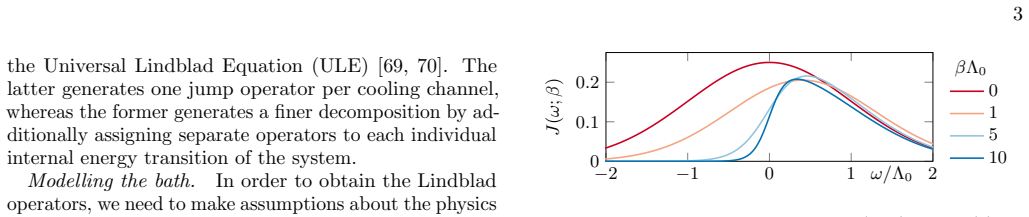
Gaussian with normalization 1/2+ln(1+βΛ0)
assumptions (7)
- standard math GKSL/Lindblad master equation is the correct open-system dynamics
- domain assumption Born-Markov approximation and local independent baths for the thermal protocol
- domain assumption KMS condition on the spectral density, Eq. (10)
- domain assumption Wick's theorem and Gaussianity at late times for the mean-field closure
- domain assumption Neglect of off-diagonal spatial correlations G(u,v), u≠v in the continuum limit
- standard math Theorem 2 of Ref. [41] as the uniqueness criterion
- domain assumption Finite-size scaling extrapolates to the thermodynamic limit
Cite this review
Pith. "Pith review of Diffusion in quantum state preparation: From passive cooling to system-bath engineering." pith.science (2026). https://pith.science/paper/UKCOMY37
@misc{pith2026260118894,
  author       = {Pith},
  title        = {Pith review of: Diffusion in quantum state preparation: From passive cooling to system-bath engineering},
  year         = {2026},
  howpublished = {\url{https://pith.science/paper/UKCOMY37}},
  note         = {Machine review of arXiv:2601.18894}
}
read the original abstract
We investigate and compare two particle number-conserving protocols for the preparation of a topologically nontrivial state. The first is derived from thermally coupling the system to a cold bath, while the second is based on engineered dissipation. We numerically study the time required to reach the target state as well as its robustness against physically important perturbations. Crucially, in both protocols, the cooling capability is limited by dissipatively induced diffusion processes. The resulting quadratic scaling of the cooling time with system size is also corroborated analytically using mean-field approximations and a purely classical random-walk model. Furthermore, we find that the engineered protocol admits a unique and stable dark state, which contributes to an ongoing discussion regarding the applicability of dissipative state preparation to many-body systems.
Figures


Figures from the paper (12 more)


Reference graph
Works this paper leans on
-
[1]
High-temperature regime As illustrated in Fig. 4, while the share of non- equilibrated particles ν in the steady state is the same for the Davies and ULE formulation, it is very heavily dependent on the choice of inverse temperature β. While the drop begins subexponentially, at β≳ 4 it becomes proportional to e−∆β, where ∆ is the difference between energy...
-
[2]
Low-temperature regime When setting β = 10 for the bath to allow the system to reach the ground state, by the KMS condition, almost only transitions decreasing the number of excitations are 7 (a) Davies equation, β = 10 0 0.2 0.4 data mean (b) ULE, β = 10 0 100 200 300 4000 0.2 0.4 t/κ excited population ν 1σ region 2σ region (c) Engineered dissipation Im...
-
[3]
Dependence of the cooling time τ on the number of sites N using site-switching system operators in Eq
On the concrete form of the thermal equation To verify that the diffusive behavior τ∝N 2 holds irrespective of our arbitrary choice of system operators, we implement a very asymmetric choice for the directionality 0 50 100 (a) Davies 0.21N 2 cooling timeτ ED Trajectories Ht;1 0 5 10 15 200 50 100 (b) ULE 0.21N 2 sitesN cooling timeτ Figure 6. Dependence o...
-
[4]
Thus, the exponential damping exp(−i ˜Ht) does not change the state but merely decreases its amplitude
Analytical Prediction of Cooling Rates The operators Aµ = L† µLµ (with µ enumerating all Lindblad operators) forming the terms of the effective Hamiltonian ˜H=− i 2 P µ Aµ are A+ j,γ ≡(L + j,γ)†L+ j,γ =κx † j,+(1−n j,γ)xj,+, A− j,γ ≡(L − j,γ)†L− j,γ =κx j,−nj,γx† j,−,(16) where γ = a, bthe wire index. Thus, the exponential damping exp(−i ˜Ht) does not cha...
-
[5]
Fur- thermore, it makes ad hoc assumptions about the initial spatial extend of the defect
Generalized Model While the above random walk model correctly captures the classical dynamics giving rise to the diffusive cooling, 11 it is restricted to only one defect living in H(1). Fur- thermore, it makes ad hoc assumptions about the initial spatial extend of the defect. In the following, we pro- vide a generalized model which relaxes these assumpti...
2004
-
[6]
R. P. Feynman, International Journal of Theoretical Physics21, 467 (1982)
1982
-
[7]
Lloyd, Science273, 1073 (1996)
S. Lloyd, Science273, 1073 (1996)
1996
-
[8]
T. D. Ladd, F. Jelezko, R. Laflamme, Y. Nakamura, C. Monroe, and J. L. O’Brien, Nature464, 45 (2010)
2010
Show all 111 references
-
[9]
Y. Kim, A. Eddins, S. Anand, K. X. Wei, E. van den Berg, S. Rosenblatt, H. Nayfeh, Y. Wu, M. Zaletel, K. Temme, and A. Kandala, Nature618, 500 (2023)
2023
-
[10]
Albash and D
T. Albash and D. A. Lidar, Rev. Mod. Phys.90, 015002 (2018)
2018
-
[11]
Danos, E
V. Danos, E. Kashefi, and P. Panangaden, J. ACM54, 8–es (2007)
2007
-
[12]
D. P. DiVincenzo, Fortschritte der Physik48, 771 (2000)
2000
-
[13]
J. I. Cirac and P. Zoller, Nature Physics8, 264 (2012)
2012
-
[14]
A. J. Daley, I. Bloch, C. Kokail, S. Flannigan, N. Pearson, M. Troyer, and P. Zoller, Nature607, 667 (2022)
2022
-
[15]
Kempe, A
J. Kempe, A. Kitaev, and O. Regev, SIAM Journal on Computing35, 1070 (2006)
2006
-
[16]
Aharonov, D
D. Aharonov, D. Gottesman, S. Irani, and J. Kempe, Communications in Mathematical Physics287, 41 (2009)
2009
-
[17]
Preskill, inFeynman Lectures on Computation(CRC Press, 2023) pp
J. Preskill, inFeynman Lectures on Computation(CRC Press, 2023) pp. 193–244
2023
-
[18]
Watrous, Quantum computational complexity, inEn- cyclopedia of Complexity and Systems Science, edited by R
J. Watrous, Quantum computational complexity, inEn- cyclopedia of Complexity and Systems Science, edited by R. A. Meyers (Springer New York, New York, NY, 2009) pp. 7174–7201
2009
-
[19]
Buluta and F
I. Buluta and F. Nori, Science326, 108 (2009)
2009
-
[20]
I. M. Georgescu, S. Ashhab, and F. Nori, Rev. Mod. Phys.86, 153 (2014)
2014
-
[21]
Altman, K
E. Altman, K. R. Brown, G. Carleo, L. D. Carr, E. Dem- ler, C. Chin, B. DeMarco, S. E. Economou, M. A. Eriks- son, K.-M. C. Fu, M. Greiner, K. R. Hazzard, R. G. Hulet, A. J. Koll´ ar, B. L. Lev, M. D. Lukin, R. Ma, X. Mi, S. Misra, C. Monroe, K. Murch, Z. Nazario, K.-K. Ni, A....
2021
-
[22]
Gross and I
C. Gross and I. Bloch, Science357, 995 (2017)
2017
-
[23]
Y. Guo, R. M. Kroeze, B. P. Marsh, S. Gopalakrishnan, J. Keeling, and B. L. Lev, Nature599, 211 (2021)
2021
-
[24]
V. D. Vaidya, Y. Guo, R. M. Kroeze, K. E. Ballantine, A. J. Koll´ ar, J. Keeling, and B. L. Lev, Phys. Rev. X8, 011002 (2018)
2018
-
[25]
Dreon, A
D. Dreon, A. Baumg¨ artner, X. Li, S. Hertlein, T. Esslinger, and T. Donner, Nature608, 494 (2022)
2022
-
[26]
Kongkhambut, J
P. Kongkhambut, J. Skulte, L. Mathey, J. G. Cosme, A. Hemmerich, and H. Keßler, Science377, 670 (2022)
2022
-
[27]
Landig, L
R. Landig, L. Hruby, N. Dogra, M. Landini, R. Mottl, T. Donner, and T. Esslinger, Nature532, 476 (2016)
2016
-
[28]
Klinder, H
J. Klinder, H. Keßler, M. R. Bakhtiari, M. Thorwart, and A. Hemmerich, Phys. Rev. Lett.115, 230403 (2015)
2015
-
[29]
Z. Wu, J. Fan, X. Zhang, J. Qi, and H. Wu, Phys. Rev. Lett.131, 243401 (2023)
2023
-
[30]
Zwettler, G
T. Zwettler, G. Del Pace, F. Marijanovic, S. Chattopad- hyay, T. B¨ uhler, C.-M. Halati, L. Skolc, L. Tolle, V. Hel- son, G. Bolognini, A. Fabre, S. Uchino, T. Giamarchi, E. Demler, and J. P. Brantut, Phys. Rev. X15, 021089 (2025)
2025
-
[31]
Periwal, E
A. Periwal, E. S. Cooper, P. Kunkel, J. F. Wienand, E. J. Davis, and M. Schleier-Smith, Nature600, 630 (2021)
2021
-
[32]
D. J. Young, A. Chu, E. Y. Song, D. Barberena, D. Well- nitz, Z. Niu, V. M. Sch¨ afer, R. J. Lewis-Swan, A. M. Rey, and J. K. Thompson, Nature625, 679 (2024)
2024
-
[33]
Sauerwein, F
N. Sauerwein, F. Orsi, P. Uhrich, S. Bandyopadhyay, F. Mattiotti, T. Cantat-Moltrecht, G. Pupillo, P. Hauke, and J.-P. Brantut, Nature Physics19, 1128 (2023)
2023
-
[34]
A. A. Houck, H. E. T¨ ureci, and J. Koch, Nature Physics 8, 292 (2012)
2012
-
[35]
Mazurenko, C
A. Mazurenko, C. S. Chiu, G. Ji, M. F. Parsons, M. Kan´ asz-Nagy, R. Schmidt, F. Grusdt, E. Demler, D. Greif, and M. Greiner, Nature545, 462 (2017)
2017
-
[36]
M¨ uller, S
T. M¨ uller, S. F¨ olling, A. Widera, and I. Bloch, Phys. Rev. Lett.99, 200405 (2007)
2007
-
[37]
Schindewolf, R
A. Schindewolf, R. Bause, X.-Y. Chen, M. Duda, T. Kar- man, I. Bloch, and X.-Y. Luo, Nature607, 677 (2022)
2022
-
[38]
Pagano, P
G. Pagano, P. W. Hess, H. B. Kaplan, W. L. Tan, P. Richerme, P. Becker, A. Kyprianidis, J. Zhang, E. Bir- ckelbaw, M. R. Hernandez, Y. Wu, and C. Monroe, Quantum Science and Technology4, 014004 (2018)
2018
-
[39]
Magnard, S
P. Magnard, S. Storz, P. Kurpiers, J. Sch¨ ar, F. Marxer, J. L¨ utolf, T. Walter, J.-C. Besse, M. Gabureac, K. Reuer, A. Akin, B. Royer, A. Blais, and A. Wallraff, Phys. Rev. Lett.125, 260502 (2020)
2020
-
[40]
Monroe, W
C. Monroe, W. C. Campbell, L.-M. Duan, Z.-X. Gong, A. V. Gorshkov, P. W. Hess, R. Islam, K. Kim, N. M. Linke, G. Pagano, P. Richerme, C. Senko, and N. Y. Yao, Rev. Mod. Phys.93, 025001 (2021)
2021
-
[41]
G¨ arttner, J
M. G¨ arttner, J. G. Bohnet, A. Safavi-Naini, M. L. Wall, J. J. Bollinger, and A. M. Rey, Nature Physics13, 781 (2017)
2017
-
[42]
Chang and J
H. Chang and J. Zhang, Chip2, 100054 (2023)
2023
-
[43]
Chen, H.-Y
C.-F. Chen, H.-Y. Huang, J. Preskill, and L. Zhou, Na- ture Physics21, 654 (2025)
2025
-
[44]
Diehl, A
S. Diehl, A. Micheli, A. Kantian, B. Kraus, H. P. B¨ uchler, and P. Zoller, Nature Physics4, 878 (2008)
2008
-
[45]
Verstraete, M
F. Verstraete, M. M. Wolf, and J. Ignacio Cirac, Nature Physics5, 633 (2009)
2009
-
[46]
Kraus, H
B. Kraus, H. P. B¨ uchler, S. Diehl, A. Kantian, A. Micheli, and P. Zoller, Phys. Rev. A78, 042307 (2008)
2008
-
[47]
M¨ uller, S
M. M¨ uller, S. Diehl, G. Pupillo, and P. Zoller, in Advances in Atomic, Molecular, and Optical Physics, Vol. 61, edited by P. Berman, E. Arimondo, and C. Lin (Academic Press, 2012) pp. 1–80
2012
-
[48]
P. M. Harrington, E. J. Mueller, and K. W. Murch, Nature Reviews Physics4, 660 (2022)
2022
-
[49]
Breuer and F
H.-P. Breuer and F. Petruccione,The Theory of Open Quantum Systems(Oxford University Press, 2007)
2007
-
[50]
A. J. Daley, Advances in Physics63, 77 (2014)
2014
-
[51]
Duan and G.-C
L.-M. Duan and G.-C. Guo, Phys. Rev. A57, 737 (1998)
1998
-
[52]
DiVincenzo and B
D. DiVincenzo and B. Terhal, Physics World11, 53 (1998)
1998
-
[53]
Gyongyosi and S
L. Gyongyosi and S. Imre, Computer Science Review31, 51 (2019)
2019
-
[54]
Daffer, K
S. Daffer, K. W´ odkiewicz, and J. K. McIver, Physical Review A - Atomic, Molecular, and Optical Physics67, 13 (2003)
2003
-
[55]
Zanardi, Phys
P. Zanardi, Phys. Rev. A57, 3276 (1998)
1998
-
[56]
Pichler, A
H. Pichler, A. J. Daley, and P. Zoller, Phys. Rev. A82, 063605 (2010). 14
2010
-
[57]
Griessner, A
A. Griessner, A. J. Daley, S. R. Clark, D. Jaksch, and P. Zoller, Phys. Rev. Lett.97, 220403 (2006)
2006
-
[58]
Griessner, A
A. Griessner, A. J. Daley, S. R. Clark, D. Jaksch, and P. Zoller, New Journal of Physics9, 44 (2007)
2007
-
[59]
Albash and D
T. Albash and D. A. Lidar, Phys. Rev. A91, 062320 (2015)
2015
-
[60]
J. F. Poyatos, J. I. Cirac, and P. Zoller, Phys. Rev. Lett. 77, 4728 (1996)
1996
-
[61]
Molpeceres, S
D. Molpeceres, S. Lu, J. I. Cirac, and B. Kraus, Phys. Rev. Res.7, 033162 (2025)
2025
-
[62]
Lloyd, A
J. Lloyd, A. A. Michailidis, X. Mi, V. Smelyanskiy, and D. A. Abanin, PRX Quantum6, 010361 (2025)
2025
-
[63]
X. Mi, A. A. Michailidis, S. Shabani, K. C. Miao, P. V. Klimov, J. Lloyd, E. Rosenberg, R. Acharya, I. Aleiner, T. I. Andersen, M. Ansmann, F. Arute, K. Arya, A. As- faw, J. Atalaya, J. C. Bardin, A. Bengtsson, G. Bortoli, A. Bourassa, J. Bovaird, L. Brill, M. Broughton, B. B....
2024
-
[64]
Tonielli, J
F. Tonielli, J. C. Budich, A. Altland, and S. Diehl, Phys. Rev. Lett.124, 240404 (2020)
2020
-
[65]
Z. Liu, E. J. Bergholtz, and J. C. Budich, Phys. Rev. Res.3, 043119 (2021)
2021
-
[66]
P. A. Nosov, D. S. Shapiro, M. Goldstein, and I. S. Burmistrov, Physical Review B107(2023)
2023
-
[67]
A. A. Lyublinskaya and I. S. Burmistrov, JETP Letters 118, 524–530 (2023)
2023
-
[68]
A. A. Lyublinskaya, P. A. Nosov, and I. S. Burmistrov, Physical Review B111(2025)
2025
-
[69]
O. I. Baburin and I. S. Burmistrov, Minimal veloc- ity of the travelling wave solutions in two coupled fkpp equations with the global conservation law (2025), arXiv:2509.14833 [cond-mat.stat-mech]
2025
-
[70]
M. S. Shustin, S. V. Aksenov, and I. S. Burmistrov, Dissipation-induced steady states in topological super- conductors: Mechanisms and design principles (2025), arXiv:2508.11242 [cond-mat.mes-hall]
2025 arXiv
-
[71]
Lindblad, Communications in Mathematical Physics 48, 119 (1976)
G. Lindblad, Communications in Mathematical Physics 48, 119 (1976)
1976
-
[72]
Gorini, A
V. Gorini, A. Kossakowski, and E. C. G. Sudarshan, Journal of Mathematical Physics17, 821 (1976)
1976
-
[73]
Shiraishi, M
K. Shiraishi, M. Nakagawa, T. Mori, and M. Ueda, Phys. Rev. B111, 184311 (2025)
2025
-
[74]
E. B. Davies, Communications in Mathematical Physics 39, 91 (1974)
1974
-
[75]
Nathan and M
F. Nathan and M. S. Rudner, Phys. Rev. B102, 115109 (2020)
2020
-
[76]
For the ULE, we then assume a diagonal spectral density function Jµν ∝δ µν
In the case of the Davies equation, this will render the power spectrum diagonal as γµν (ω) ∝δ µν . For the ULE, we then assume a diagonal spectral density function Jµν ∝δ µν
-
[77]
Mozgunov and D
E. Mozgunov and D. Lidar, Quantum4, 227 (2020)
2020
-
[78]
Davidovi´ c, Quantum4, 326 (2020)
D. Davidovi´ c, Quantum4, 326 (2020)
2020
-
[79]
D. D. Awschalom, L. C. Bassett, A. S. Dzurak, E. L. Hu, and J. R. Petta, Science339, 1174 (2013)
2013
-
[80]
Altland, M
A. Altland, M. Fleischhauer, and S. Diehl, Phys. Rev. X 11, 021037 (2021)
2021
-
[81]
P. A. Nosov, D. S. Shapiro, M. Goldstein, and I. S. Burmistrov, Phys. Rev. B107, 174312 (2023)
2023
-
[82]
Guo, Z.-T
Z. Guo, Z.-T. Xu, M. Li, L. You, and S. Yang, Variational matrix product state approach for non-hermitian system based on a companion hermitian hamiltonian (2022), arXiv:2210.14858 [quant-ph]
2022 arXiv
-
[83]
Zhong, W
P. Zhong, W. Pan, H. Lin, X. Wang, and S. Hu, Phys. Rev. Lett.135, 106502 (2025)
2025
-
[84]
Yamamoto, M
K. Yamamoto, M. Nakagawa, M. Tezuka, M. Ueda, and N. Kawakami, Phys. Rev. B105, 205125 (2022)
2022
-
[85]
G. Chen, F. Song, and J. L. Lado, Phys. Rev. Lett.130, 100401 (2023)
2023
-
[86]
Westhoff, M
P. Westhoff, M. Moroder, U. Schollw¨ ock, and S. Paeckel, A tensor network framework for lindbladian spectra and steady states (2025), arXiv:2509.07709 [quant-ph]
2025 arXiv
-
[87]
G. Chen, J. L. Lado, and F. Song, Phys. Rev. Res.6, 043182 (2024)
2024
-
[88]
Sander, M
A. Sander, M. Fr¨ ohlich, M. Eigel, J. Eisert, P. Gelß, M. Hinterm¨ uller, R. M. Milbradt, R. Wille, and C. B. Mendl, Large-scale stochastic simulation of open quan- tum systems (2025), arXiv:2501.17913 [quant-ph]
2025
-
[89]
Causer, M
L. Causer, M. C. Ba˜ nuls, and J. P. Garrahan, Phys. Rev. B111, L060303 (2025)
2025
-
[90]
Mascarenhas, H
E. Mascarenhas, H. Flayac, and V. Savona, Phys. Rev. A92, 022116 (2015)
2015
-
[91]
L¨ owdin (Academic Press, 1970) pp
P.-O. L¨ owdin (Academic Press, 1970) pp. 185–199
1970
-
[92]
Albert, Y
N. Albert, Y. Zhang, and H.-H. Tu, Truncated gaus- sian basis approach for simulating many-body dynamics (2025), arXiv:2410.04204 [cond-mat.str-el]
2025 arXiv
-
[93]
This follows from a counting argument noticing thatPL m=0 L m 2 = 2L L = N L = dimH
-
[94]
The jump operator matrix elements are provided in the Supplementary Material
-
[95]
Kamenev,Field Theory of Non-Equilibrium Systems (Cambridge University Press, 2011)
A. Kamenev,Field Theory of Non-Equilibrium Systems (Cambridge University Press, 2011)
2011
-
[96]
U. C. T¨ auber,Critical Dynamics: A Field Theory Ap- proach to Equilibrium and Non-Equilibrium Scaling Be- havior(Cambridge University Press, 2014). 15
2014
-
[97]
Calabrese and J
P. Calabrese and J. Cardy, Journal of Statistical Me- chanics: Theory and Experiment2005, P04010 (2005)
2005
-
[98]
ˇZnidariˇ c, Communications Physics3(2020)
M. ˇZnidariˇ c, Communications Physics3(2020)
2020
-
[99]
The full description of the system operators in this basis is provided in the Supplementary Material
-
[100]
Huang, X.-Q
Z.-M. Huang, X.-Q. Sun, and S. Diehl, Physical Review B106, 10.1103/physrevb.106.245204 (2022)
2022 doi
-
[101]
Mittal, T
R. Mittal, T. Zander, J. Lang, and S. Diehl, Fermion quantum criticality far from equilibrium (2025), arXiv:2507.14318 [cond-mat.stat-mech]
2025
-
[102]
Iemini, D
F. Iemini, D. Rossini, R. Fazio, S. Diehl, and L. Mazza, Physical Review B93(2016)
2016
-
[103]
Pokart, L
T. Pokart, L. K¨ onig, S. Diehl, and J. C. Budich, 10.5281/zenodo.18379558 (2026)
2026 doi
-
[105]
Fishman, S
M. Fishman, S. R. White, and E. M. Stoudenmire, Sci- Post Phys. Codebases , 4 (2022)
2022
-
[106]
Rackauckas and Q
C. Rackauckas and Q. Nie, The Journal of Open Research Software5(2017)
2017
-
[107]
Haegeman, Krylovkit (2025)
J. Haegeman, Krylovkit (2025)
2025
-
[108]
Verzani, Roots.jl: Root finding functions for julia, https://github.com/JuliaMath/Roots.jl(2020)
J. Verzani, Roots.jl: Root finding functions for julia, https://github.com/JuliaMath/Roots.jl(2020)
2020
-
[109]
C. R. Harris, K. J. Millman, S. J. van der Walt, R. Gom- mers, P. Virtanen, D. Cournapeau, E. Wieser, J. Taylor, S. Berg, N. J. Smith, R. Kern, M. Picus, S. Hoyer, M. H. van Kerkwijk, M. Brett, A. Haldane, J. F. del R ´ ıo, M. Wiebe, P. Peterson, P. G´ erard-Marchant, K. Shep-...
2020
-
[110]
Crucially, we find that they do not contain impact ionization terms, and thus do not corroborate the instability scenario
Linear Deviation from the Steady State Equations (E1) to (E4) can be formulated as field equations to allow for a comparison to previous literature [ 63]. Crucially, we find that they do not contain impact ionization terms, and thus do not corroborate the instability scenario....
-
[111]
[ 63] have been linked to the occurence of impact ionization
Measuring Impact Ionization The destabilizing terms ∝τ −1A in Ref. [ 63] have been linked to the occurence of impact ionization. This impact ionization and its implied instability of the ground state corresponds to a process in which an excitation ( x+) hops and thus excites a...
-
[112]
MEAN-FIELD MODEL OF THE ENGINEERED DISSIP A TION DYNAMICS
Comparing to Numerical Data Lastly, we compare the time evolution of the fields A and B to those obtained by implementing Eqs. (E13) and (E14). In Fig. 15 we show the results of this simulation (second column) against data (first column). While the time evolutions agree initia...
Reviewed August 3, 2026 · model on record in the stance chip above.
Discussion (0). Continue with ORCID to comment.