Recognition: 1 theorem link
· Lean TheoremProbing New Physics and CP Violation in ν_τ n to Λ_c τ^- (π^- ν_τ) and barν_τ p to Λ τ^+ (π^+ barν_τ)
Pith reviewed 2026-05-16 10:51 UTC · model grok-4.3
The pith
An azimuthal asymmetry in the pion from tau decays in specific neutrino processes signals CP-violating new physics.
A machine-rendered reading of the paper's core claim, the machinery that carries it, and where it could break.
Core claim
Complex Wilson coefficients in the effective low-energy extension induce transverse components in the tau polarization vector. These components generate a genuine CP-odd asymmetry in the azimuthal distribution of the pion emitted in the decay tau to pi nu, providing a smoking-gun observable for beyond-Standard-Model physics in the tau-neutrino scattering processes.
What carries the argument
Transverse components of the tau polarization vector induced by imaginary parts of the Wilson coefficients, which imprint a CP-odd azimuthal modulation onto the pion distribution in the tau rest frame.
If this is right
- The asymmetry constitutes a direct, background-free signature of CP violation that cannot arise in the Standard Model alone.
- Its observation would simultaneously constrain lepton-flavor-universality violation and new sources of CP violation.
- The same polarization-sensitive observable can be applied to other tau-production channels once sufficient event samples are available.
- Quantitative predictions depend on the form-factor extrapolation, so improved lattice calculations directly tighten the expected signal strength.
Where Pith is reading between the lines
- The method could be adapted to probe similar CP-odd effects in tau decays produced at electron-positron colliders or in heavy-ion collisions.
- If the asymmetry is confirmed, it would motivate dedicated analyses of tau polarization in existing and future neutrino detectors to extract the imaginary parts of specific Wilson coefficients.
- The observable links neutrino scattering data to broader tests of CP violation in the lepton sector, complementing electric-dipole-moment searches.
Load-bearing premise
The nucleon-hyperon transition form factors from lattice QCD remain reliable when extrapolated to the kinematics of tau production in these neutrino reactions.
What would settle it
A high-statistics measurement of the azimuthal pion distribution in tau-neutrino events that finds no asymmetry at the level predicted by the extrapolated form factors would rule out sizable complex Wilson coefficients in these channels.
Figures



read the original abstract
We study the processes $\nu_\tau n \to \Lambda_c \tau^- (\pi^- \nu_\tau)$ and $\bar\nu_\tau p \to \Lambda \tau^+ (\pi^+ \bar\nu_\tau)$, with particular emphasis on the pion energy and angular distributions, as a possible signal for lepton flavor universality violation, and in general of physics beyond the Standard Model (SM), as well as a sensitive probe of the $\tau$ polarization vector. We work within an effective low-energy extension of the SM with all dimension-six four-fermion operators. In this framework, complex Wilson coefficients which encode new physics can generate CP-violating contributions. We propose an observable that provides a genuine CP-odd signal due to its sensitivity to particular transverse components of the $\tau$ polarization vector. Namely, we show that the asymmetry in the azimuthal-angle distribution of the pion in the decay $\tau^\pm\to \pi^\pm \nu_\tau$ constitutes a smoking-gun prediction of such a beyond the SM scenario. We estimate the strength of this effect extrapolating nucleon-hyperon form factors recently obtained from lattice QCD calculations.
Editorial analysis
A structured set of objections, weighed in public.
Referee Report
Summary. The manuscript studies the processes ν_τ n → Λ_c τ⁻ (π⁻ ν_τ) and ν̄_τ p → Λ τ⁺ (π⁺ ν̄_τ) in an effective field theory with all dimension-six four-fermion operators. It focuses on pion energy and angular distributions in the subsequent τ decay as probes of lepton flavor universality violation and beyond-Standard-Model physics. Complex Wilson coefficients are shown to generate CP-violating effects through transverse components of the τ polarization vector. The authors propose the azimuthal asymmetry in the pion distribution as a genuine CP-odd observable and estimate its magnitude by extrapolating lattice QCD nucleon-hyperon transition form factors to the relevant kinematics.
Significance. If the central claims hold, the work identifies a clean CP-odd asymmetry that could serve as a distinctive signal for new physics in tau-neutrino interactions, complementing other lepton-sector probes. The incorporation of recent lattice QCD form factors is a strength that grounds the estimates in non-perturbative inputs rather than purely phenomenological parametrizations. The formal construction of the asymmetry from polarization interference terms provides a parameter-independent diagnostic of complex phases in the Wilson coefficients.
major comments (2)
- [§4] §4 (Form Factor Extrapolation): The extrapolation of lattice QCD nucleon-hyperon transition form factors from low Q² to the high-Q² regime (Q² ∼ m_τ²) of τ production is load-bearing for the predicted size of the CP-odd asymmetry. The manuscript provides no quantitative uncertainty band or comparison with alternative parametrizations, so the estimated strength of the effect cannot be reliably assessed.
- [§3.2] §3.2, Eq. (7): The hadronic matrix elements for the effective operators are parametrized by the form factors, but the paper does not show the explicit contraction that isolates the transverse polarization components P_x and P_y; without this step, it is unclear whether additional cancellations could suppress the azimuthal asymmetry in these specific channels.
minor comments (2)
- The effective operator basis should be explicitly matched to a standard convention (e.g., Warsaw basis) with a table listing the relevant Wilson coefficients for these processes.
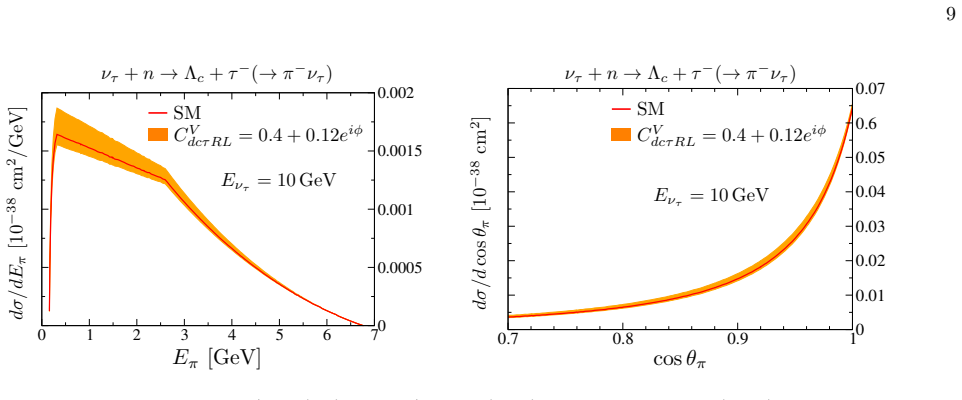
- Figure 2 and 3 captions should specify the benchmark values of the complex Wilson coefficients used for the plotted distributions.
Simulated Author's Rebuttal
We thank the referee for the careful reading of our manuscript and the constructive comments. We address each major comment below, indicating the revisions we will implement.
read point-by-point responses
-
Referee: §4 (Form Factor Extrapolation): The extrapolation of lattice QCD nucleon-hyperon transition form factors from low Q² to the high-Q² regime (Q² ∼ m_τ²) of τ production is load-bearing for the predicted size of the CP-odd asymmetry. The manuscript provides no quantitative uncertainty band or comparison with alternative parametrizations, so the estimated strength of the effect cannot be reliably assessed.
Authors: We agree that the absence of quantitative uncertainty estimates for the form-factor extrapolation limits the reliability of the predicted asymmetry magnitude. In the revised manuscript we will add a dedicated discussion of the extrapolation uncertainties, including comparisons with alternative parametrizations (e.g., dipole forms) and error bands on the numerical results for the CP-odd asymmetry. revision: yes
-
Referee: §3.2, Eq. (7): The hadronic matrix elements for the effective operators are parametrized by the form factors, but the paper does not show the explicit contraction that isolates the transverse polarization components P_x and P_y; without this step, it is unclear whether additional cancellations could suppress the azimuthal asymmetry in these specific channels.
Authors: We thank the referee for this observation. In the revised version we will insert the explicit contractions of the hadronic currents with the leptonic tensors that isolate P_x and P_y. These expressions will demonstrate that no unexpected cancellations suppress the azimuthal asymmetry in the channels under study. revision: yes
Circularity Check
No significant circularity; CP-odd asymmetry derived from EFT polarization using external lattice form factors
full rationale
The paper derives the proposed azimuthal pion asymmetry directly from the transverse components of the tau polarization vector, which arise when complex Wilson coefficients are present in the dimension-six effective operators. The hadronic matrix elements are parametrized by nucleon-hyperon transition form factors taken from independent lattice QCD calculations (with extrapolation to the relevant kinematics stated as an assumption). No equation or claim reduces by construction to a fitted parameter within the paper, no load-bearing self-citation is invoked for a uniqueness theorem, and no ansatz is smuggled via prior work by the same authors. The central prediction remains an independent consequence of the EFT setup once the external form factors are supplied.
Axiom & Free-Parameter Ledger
free parameters (1)
- Complex Wilson coefficients
axioms (2)
- domain assumption All beyond-Standard-Model effects at the relevant energies are described by dimension-six four-fermion operators
- domain assumption Nucleon-hyperon transition form factors obtained from lattice QCD remain valid after extrapolation to the τ-production kinematics
Lean theorems connected to this paper
-
IndisputableMonolith/Foundation/RealityFromDistinction.leanreality_from_one_distinction unclear?
unclearRelation between the paper passage and the cited Recognition theorem.
We work within an effective low-energy extension of the SM with all dimension-six four-fermion operators... the asymmetry in the azimuthal-angle distribution of the pion... constitutes a smoking-gun prediction
What do these tags mean?
- matches
- The paper's claim is directly supported by a theorem in the formal canon.
- supports
- The theorem supports part of the paper's argument, but the paper may add assumptions or extra steps.
- extends
- The paper goes beyond the formal theorem; the theorem is a base layer rather than the whole result.
- uses
- The paper appears to rely on the theorem as machinery.
- contradicts
- The paper's claim conflicts with a theorem or certificate in the canon.
- unclear
- Pith found a possible connection, but the passage is too broad, indirect, or ambiguous to say the theorem truly supports the claim.
Reference graph
Works this paper leans on
-
[1]
Lepton T ensor The tensor for the two neutrinos and the final pion is given by the product of lepton currents,L χab =l χal† χb, with lχa = 2G F fπV ∗ ud ¯uντ (⃗ pντ , L)/pπPL /k′ +m τ k′2 −m 2τ +i √ k′2 Γτ( √ k′2 ) Γa 1√ 2 Pχuντ (⃗k, χ),(A1) where Γa =γ µ, Iandσ µν, anduis a dimensionful Dirac spinor. We have employed the effectiveτ→πν τ vertex Lτ→πν τ =−...
-
[2]
Polarization vector We provide here the details of theτpolarization vector introduced in Eq. (13). In Ref. [29], it was shown that eN(ω, k·p) = 1 M2n X χ=L,R ρχχ X a,b W ab χ Lχab = 1 2 h − A(ω) +B(ω) p·k M2n − C(ω) (p·k) 2 M4n i ,(A9) Proceeding as in Ref. [35], the polarization four-vectorP µ reads P µ = 1 eN(ω, k·p) h pµ ⊥ Mn eNH1(ω, k·p) + qµ ⊥ Mn eNH...
-
[3]
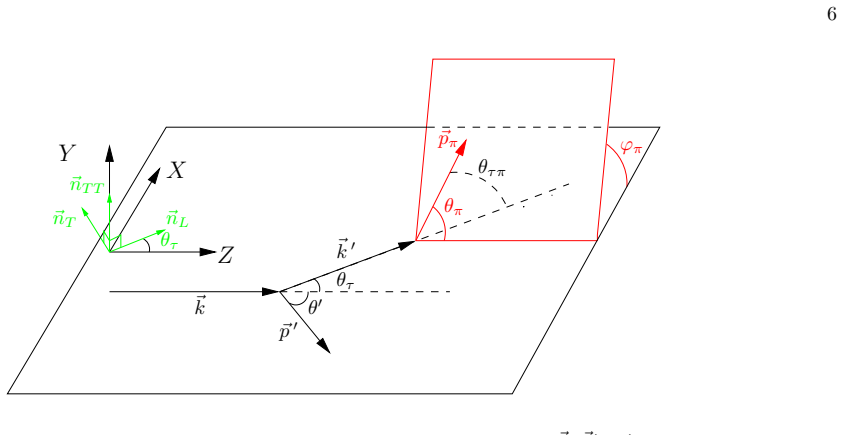
Phase-Space Integration Starting from Eq. (11) for the cross section, for each value of⃗ p ′ we can now take a rotationRaround theZaxis, defined by ⃗k, such that ˜p′ =Rp ′ = (E ′,−|⃗ p′|sinθ ′,0,|⃗ p′|cosθ ′). Equivalently, on an event-by-event basis, theY + axis is defined along⃗ p′ × ⃗k, while theX + axis lies along (⃗ p′ × ⃗k)× ⃗k, as shown in Fig. 1. ...
-
[4]
Banerjeeet al.(Heavy Flavor Averaging Group (HFLAV)), (2024), arXiv:2411.18639 [hep-ex]
S. Banerjeeet al.(Heavy Flavor Averaging Group (HFLAV)), (2024), arXiv:2411.18639 [hep-ex]
-
[5]
R. Aaijet al.(LHCb), Phys. Rev. Lett.120, 121801 (2018), arXiv:1711.05623 [hep-ex]
work page internal anchor Pith review Pith/arXiv arXiv 2018
-
[6]
A. Y. Anisimov, I. M. Narodetsky, C. Semay, and B. Silvestre-Brac, Phys. Lett.B452, 129 (1999), arXiv:hep-ph/9812514 [hep-ph]
work page internal anchor Pith review Pith/arXiv arXiv 1999
-
[7]
M. A. Ivanov, J. G. Korner, and P. Santorelli, Phys. Rev.D73, 054024 (2006), arXiv:hep-ph/0602050 [hep-ph]
work page internal anchor Pith review Pith/arXiv arXiv 2006
-
[8]
Study of exclusive semileptonic and nonleptonic decays of $B_c^-$ in a nonrelativistic quark model
E. Hern´ andez, J. Nieves, and J. Verde-Velasco, Phys. Rev. D74, 074008 (2006), arXiv:hep-ph/0607150
work page internal anchor Pith review Pith/arXiv arXiv 2006
-
[9]
Semileptonic $B_c$ decays and Charmonium distribution amplitude
T. Huang and F. Zuo, Eur. Phys. J.C51, 833 (2007), arXiv:hep-ph/0702147 [HEP-PH]
work page internal anchor Pith review Pith/arXiv arXiv 2007
-
[10]
Covariant Light-Front Approach for $B_c$ transition form factors
W. Wang, Y.-L. Shen, and C.-D. Lu, Phys. Rev.D79, 054012 (2009), arXiv:0811.3748 [hep-ph]
work page internal anchor Pith review Pith/arXiv arXiv 2009
-
[11]
Semileptonic decays $B_c\to(\eta_c,J/\Psi)l\nu$ in the perturbative QCD approach
W.-F. Wang, Y.-Y. Fan, and Z.-J. Xiao, Chin. Phys.C37, 093102 (2013), arXiv:1212.5903 [hep-ph]
work page internal anchor Pith review Pith/arXiv arXiv 2013
-
[12]
New Physics effect on $B_c \to J/\psi \tau\bar\nu$ in relation to the $R_{D^{(*)}}$ anomaly
R. Watanabe, Phys. Lett. B776, 5 (2018), arXiv:1709.08644 [hep-ph]
work page internal anchor Pith review Pith/arXiv arXiv 2018
-
[13]
A. Issadykov and M. A. Ivanov, Phys. Lett.B783, 178 (2018), arXiv:1804.00472 [hep-ph]
work page internal anchor Pith review Pith/arXiv arXiv 2018
-
[14]
C.-T. Tran, M. A. Ivanov, J. G. K¨ orner, and P. Santorelli, Phys. Rev.D97, 054014 (2018), arXiv:1801.06927 [hep-ph]
work page internal anchor Pith review Pith/arXiv arXiv 2018
- [15]
-
[16]
On lepton flavour universality in semileptonic $B_c \to \eta_c, J/\psi$ decays
D. Leljak, B. Melic, and M. Patra, JHEP05, 094 (2019), arXiv:1901.08368 [hep-ph]
work page internal anchor Pith review Pith/arXiv arXiv 2019
-
[17]
Lepton flavor universality violation in semileptonic tree level weak transitions
K. Azizi, Y. Sarac, and H. Sundu, Phys. Rev.D99, 113004 (2019), arXiv:1904.08267 [hep-ph]
work page internal anchor Pith review Pith/arXiv arXiv 2019
-
[18]
W. Wang and R. Zhu, Int. J. Mod. Phys. A34, 1950195 (2019), arXiv:1808.10830 [hep-ph]
-
[19]
Aaijet al.(LHCb), (2022), arXiv:2201.03497 [hep-ex]
R. Aaijet al.(LHCb), (2022), arXiv:2201.03497 [hep-ex]
-
[20]
F. U. Bernlochner, Z. Ligeti, D. J. Robinson, and W. L. Sutcliffe, Phys. Rev.D99, 055008 (2019), arXiv:1812.07593 [hep-ph]
work page internal anchor Pith review Pith/arXiv arXiv 2019
-
[21]
I. Adachiet al.(Belle-II), Phys. Rev. Lett.132, 211804 (2024), arXiv:2311.07248 [hep-ex]
- [22]
-
[23]
M. Rahimi and K. K. Vos, JHEP11, 007 (2022), arXiv:2207.03432 [hep-ph]
-
[24]
On the B to D* tau nu Sensitivity to New Physics
S. Fajfer, J. F. Kamenik, and I. Nisandzic, Phys. Rev.D85, 094025 (2012), arXiv:1203.2654 [hep-ph]
work page internal anchor Pith review Pith/arXiv arXiv 2012
-
[25]
An Investigation of D+--> tau+ nu
P. Rubinet al.(CLEO), Phys. Rev. D73, 112005 (2006), arXiv:hep-ex/0604043
work page internal anchor Pith review Pith/arXiv arXiv 2006
-
[26]
M. Ablikimet al.(BESIII), Phys. Rev. Lett.123, 211802 (2019), arXiv:1908.08877 [hep-ex]
-
[27]
R. Fleischer, R. Jaarsma, and G. Koole, Eur. Phys. J. C80, 153 (2020), arXiv:1912.08641 [hep-ph]
-
[28]
D. Beˇ cirevi´ c, F. Jaffredo, A. Pe˜ nuelas, and O. Sumensari, JHEP05, 175 (2021), arXiv:2012.09872 [hep-ph]
-
[29]
X. Leng, X.-L. Mu, Z.-T. Zou, and Y. Li, Chin. Phys. C45, 063107 (2021), arXiv:2011.01061 [hep-ph]
-
[30]
J. Fuentes-Martin, A. Greljo, J. Martin Camalich, and J. D. Ruiz-Alvarez, JHEP11, 080 (2020), arXiv:2003.12421 [hep-ph]
-
[31]
Y.-R. Kong, L.-F. Lai, X.-Q. Li, X.-S. Yan, Y.-D. Yang, and D.-H. Zheng, Phys. Rev. D108, 095036 (2023), arXiv:2307.07239 [hep-ph]
-
[32]
E. Hern´ andez, J. Nieves, and J. E. Sobczyk, Phys. Rev. D112, 053006 (2025), arXiv:2506.16774 [hep-ph]
- [33]
-
[34]
N. Penalva, E. Hern´ andez, and J. Nieves, JHEP10, 122 (2021), arXiv:2107.13406 [hep-ph]
-
[35]
N. Penalva, E. Hern´ andez, and J. Nieves, Phys. Rev. D101, 113004 (2020), arXiv:2004.08253 [hep-ph]
-
[36]
N. Penalva, E. Hern´ andez, and J. Nieves, Phys. Rev. D102, 096016 (2020), arXiv:2007.12590 [hep-ph]
- [37]
-
[38]
N. Penalva, E. Hern´ andez, and J. Nieves, JHEP06, 118 (2021), arXiv:2103.01857 [hep-ph]. 13 This is because of the factorh χ in the P χ=L,R of Eq. (D.2) of Ref. [31]. In addition, we can see in Eq. (D.1) of the same reference, that this distinctive sign (h χ) does not appear in the sum of left and right-handed contributions toA,BandC, which determine the...
-
[39]
N. Penalva, E. Hern´ andez, and J. Nieves, JHEP04, 026 (2022), arXiv:2201.05537 [hep-ph]
-
[40]
S. Bacchio and A. Konstantinou, (2025), arXiv:2507.09970 [hep-lat]
-
[41]
S. L. Mintz and M. A. Barnett, Nucl. Phys. A741, 149 (2004)
work page 2004
-
[42]
S. Meinel, Phys. Rev. D97, 034511 (2018), arXiv:1712.05783 [hep-lat]
-
[43]
E. Hern´ andez, J. Nieves, F. S´ anchez, and J. E. Sobczyk, Phys. Lett. B829, 137046 (2022), [Erratum: Phys. Lett. B836, 137612 (2023)], arXiv:2202.07539 [hep-ph]
discussion (0)
Sign in with ORCID, Apple, or X to comment. Anyone can read and Pith papers without signing in.