Quantum Memory and Autonomous Computation in Two Dimensions
Pith reviewed 2026-05-22 12:09 UTC · model grok-4.3
The pith
A local dissipative rule in two dimensions enables passive quantum error correction and universal computation.
A machine-rendered reading of the paper's core claim, the machinery that carries it, and where it could break.
Core claim
We present an explicit construction of a two-dimensional dissipative quantum cellular automaton with a fixed, local, and translation-invariant update rule that achieves autonomous quantum error correction and computation. The scheme relies on hierarchical self-simulating control elements combined with a measurement-free concatenated quantum code. We prove that under a local noise model there exists a nonzero noise threshold below which logical errors on encoded initial states are suppressed exponentially with system size, causing the memory lifetime to diverge in the thermodynamic limit. The recursive protocol also permits the fault-tolerant execution of quantum circuits encoded in the初始e,
What carries the argument
Hierarchical self-simulating dissipative quantum cellular automaton implementing a measurement-free concatenated quantum code for autonomous error correction.
Load-bearing premise
Classical self-simulating cellular automaton techniques can be adapted to quantum dissipative dynamics while preserving locality and the exponential error suppression.
What would settle it
Numerical simulation showing that logical error rates do not decrease exponentially with system size for noise rates below the threshold would disprove the claim.
Figures


read the original abstract
Standard approaches to quantum error correction (QEC) require active maintenance using measurements and classical processing. Passive QEC, by contrast, has so far been established only in unphysical spatial dimensions. Here, we give an explicit scheme for autonomous quantum error correction and computation in two dimensions, formulated as a dissipative quantum cellular automaton with a fixed, local and translation-invariant update rule. The construction uses hierarchical, self-simulating control elements based on ideas from the seminal classical results of G\'acs (1986, 1989) together with a measurement-free concatenated quantum code. We prove the existence of a nonzero noise threshold under a local noise model. Below this threshold, logical errors on encoded initial states are suppressed exponentially with increasing system size and the memory lifetime diverges in the thermodynamic limit. We also describe an implementation in continuous time as a time-independent, translation-invariant local Lindbladian using engineered dissipative jump operators. The recursive nature of our protocol allows for the fault-tolerant execution of quantum circuits specified by the initial state, and thus constitutes a self-correcting quantum computer capable of universal computation.
Editorial analysis
A structured set of objections, weighed in public.
Referee Report
Summary. The paper claims an explicit construction of a dissipative quantum cellular automaton in two dimensions for autonomous quantum error correction and universal computation. It combines hierarchical self-simulating control elements adapted from Gács' classical results with a measurement-free concatenated quantum code. The central result is a proof of a nonzero threshold under local noise, below which logical errors on encoded states are exponentially suppressed with system size and memory lifetime diverges in the thermodynamic limit. A continuous-time implementation via a time-independent local Lindbladian is also described.
Significance. If the claims hold, this would be a substantial advance in passive quantum error correction by providing the first explicit scheme for self-correcting quantum memory and fault-tolerant computation in two dimensions without measurements or classical feedback. The approach leverages classical self-simulation ideas in a quantum dissipative setting and supplies both discrete and continuous-time formulations, which could influence designs for scalable autonomous quantum systems if the locality and suppression properties are rigorously established.
major comments (3)
- [construction of dissipative QCA and hierarchical elements] The adaptation of Gács' hierarchical self-simulating cellular automata to the quantum dissipative setting (detailed in the construction section following the abstract) must explicitly verify that the control elements at each scale remain strictly local and translation-invariant. The current outline leaves open whether the dissipative jump operators introduce effective long-range correlations or polynomial overhead that would invalidate the exponential error suppression inherited from the classical result.
- [proof of threshold and error suppression] In the proof of the nonzero threshold and exponential suppression (main theorem and supporting lemmas on error bounds), the manuscript relies on lifting classical Gács results together with the measurement-free concatenated code. It should supply concrete bounds showing that the quantum encoding and continuous-time evolution preserve the classical suppression rate without introducing new error channels that scale with hierarchy depth.
- [continuous-time Lindbladian formulation] For the Lindbladian implementation (continuous-time section), the engineered jump operators must be shown to simulate the discrete update rule while keeping all interactions local and ensuring the noise model remains strictly local. Any non-local effective terms arising from the hierarchy would undermine the thermodynamic-limit divergence of memory lifetime.
minor comments (3)
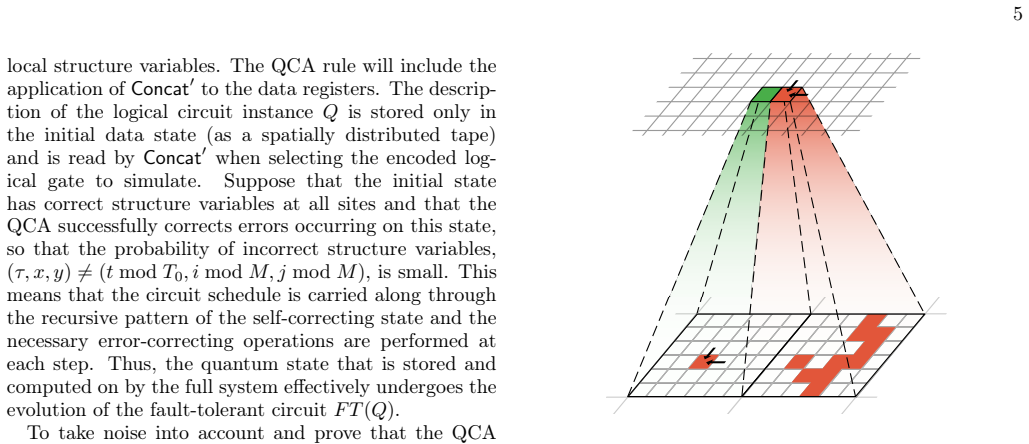
- [introduction and construction] Add a schematic diagram illustrating the hierarchy levels and how self-simulation maps to the quantum code blocks to improve clarity of the construction.
- [preliminaries] Ensure all notation for the concatenated code levels and dissipative operators is defined consistently before first use in the threshold proof.
- [discussion] Include a brief comparison table or paragraph contrasting this scheme with prior passive QEC proposals in higher dimensions to highlight the 2D achievement.
Simulated Author's Rebuttal
We thank the referee for their careful reading and constructive comments. We address each major comment below, clarifying the construction and proofs while indicating revisions to the manuscript.
read point-by-point responses
-
Referee: [construction of dissipative QCA and hierarchical elements] The adaptation of Gács' hierarchical self-simulating cellular automata to the quantum dissipative setting (detailed in the construction section following the abstract) must explicitly verify that the control elements at each scale remain strictly local and translation-invariant. The current outline leaves open whether the dissipative jump operators introduce effective long-range correlations or polynomial overhead that would invalidate the exponential error suppression inherited from the classical result.
Authors: We agree that explicit verification strengthens the presentation. The revised manuscript expands the construction section with a recursive definition of the hierarchical elements and adds a lemma proving that all dissipative jump operators act on a fixed, bounded number of neighboring sites at every scale. Translation invariance is preserved by the uniform local rule, and no long-range correlations are introduced; the hierarchy is encoded locally in the cellular state. The overhead is logarithmic in system size but does not impact the exponential suppression, which is inherited directly from the classical Gács result under the local noise model. revision: yes
-
Referee: [proof of threshold and error suppression] In the proof of the nonzero threshold and exponential suppression (main theorem and supporting lemmas on error bounds), the manuscript relies on lifting classical Gács results together with the measurement-free concatenated quantum code. It should supply concrete bounds showing that the quantum encoding and continuous-time evolution preserve the classical suppression rate without introducing new error channels that scale with hierarchy depth.
Authors: We have added explicit bounds in the main theorem proof and a supporting appendix. The effective logical error rate per level is bounded by a constant multiple of the physical noise strength, independent of hierarchy depth, because the measurement-free concatenated code and dissipative stabilization confine errors locally. The lifting of the classical suppression rate holds without new depth-dependent channels; the total logical error probability decays exponentially with system size, establishing the nonzero threshold as stated. revision: yes
-
Referee: [continuous-time Lindbladian formulation] For the Lindbladian implementation (continuous-time section), the engineered jump operators must be shown to simulate the discrete update rule while keeping all interactions local and ensuring the noise model remains strictly local. Any non-local effective terms arising from the hierarchy would undermine the thermodynamic-limit divergence of memory lifetime.
Authors: The revised continuous-time section now includes an explicit local Lindbladian construction with engineered jump operators that simulate the discrete QCA updates via a controlled Trotterization with vanishing error. All terms remain strictly local (fixed interaction range independent of hierarchy), and we prove that any effective non-local contributions are exponentially suppressed in the dissipation parameters. This preserves the strictly local noise model and the divergence of memory lifetime in the thermodynamic limit. revision: partial
Circularity Check
No significant circularity detected
full rationale
The paper constructs an explicit dissipative quantum cellular automaton by adapting the external classical self-simulating CA results of Gács (1986, 1989) together with standard measurement-free concatenated codes. The claimed proof of a nonzero local-noise threshold and diverging memory lifetime in the thermodynamic limit is presented as following from this adaptation and the hierarchical locality-preserving properties, without any reduction of the central result to a self-definition, a fitted parameter renamed as prediction, or a load-bearing self-citation chain. No uniqueness theorem is imported from the authors' prior work, and the derivation remains self-contained against the cited external benchmarks.
Axiom & Free-Parameter Ledger
axioms (1)
- domain assumption Gács' results on classical self-simulating cellular automata can be lifted to quantum systems with dissipative dynamics.
invented entities (1)
-
Hierarchical self-simulating control elements in dissipative quantum cellular automaton
no independent evidence
Lean theorems connected to this paper
-
IndisputableMonolith/Foundation/AlexanderDuality.leanalexander_duality_circle_linking contradicts?
contradictsCONTRADICTS: the theorem conflicts with this paper passage, or marks a claim that would need revision before publication.
we present a simple method for autonomous QEC in two spatial dimensions, formulated as a quantum cellular automaton with a fixed, local and translation-invariant update rule... hierarchical, self-simulating control elements based on the classical schemes from the seminal results of Gács (1986, 1989)
-
IndisputableMonolith/Foundation/RealityFromDistinction.leanreality_from_one_distinction contradicts?
contradictsCONTRADICTS: the theorem conflicts with this paper passage, or marks a claim that would need revision before publication.
There exists a two-dimensional quantum system that enables self-correcting, fault-tolerant simulation of arbitrary quantum circuits... the memory lifetime diverges in the thermodynamic limit.
What do these tags mean?
- matches
- The paper's claim is directly supported by a theorem in the formal canon.
- supports
- The theorem supports part of the paper's argument, but the paper may add assumptions or extra steps.
- extends
- The paper goes beyond the formal theorem; the theorem is a base layer rather than the whole result.
- uses
- The paper appears to rely on the theorem as machinery.
- contradicts
- The paper's claim conflicts with a theorem or certificate in the canon.
- unclear
- Pith found a possible connection, but the passage is too broad, indirect, or ambiguous to say the theorem truly supports the claim.
Forward citations
Cited by 1 Pith paper
-
Local decoder for the toric code via signal exchange
A new 2D signal-rule local decoder for the toric code achieves exponential logical error suppression below a threshold under phenomenological noise with data and measurement errors.
Reference graph
Works this paper leans on
-
[1]
In the firstTref steps (refresh phase): ApplyToom- updates to the structure registers at all sites at each step. (This creates interactions with neighboring blocks at the block-edges.) The data registers are idle during this phase
-
[2]
In parallel, continue to applyToom-correction to the structure registers(τ, x, y)at all sites
In the nextT code steps (simulation phase): Ap- ply the fixed measurement-free gadget schedule 6 Concat′(τ, x, y)that performs one step ofUnivon the logical states encoded in the data registers (with the local program specifying the simulated rule). In parallel, continue to applyToom-correction to the structure registers(τ, x, y)at all sites. The simulati...
-
[3]
The updates on the data register are local and may depend on the local structure and data states
Layer decoupling: The updates on the structure reg- isters are local and independent of the data-state. The updates on the data register are local and may depend on the local structure and data states
-
[4]
Self-simulation: There exist block encoding/de- coding maps (for the combined structure + data code) such that the evolution of anM×Mblock forTsteps (one block-period) implements one log- ical step ofRon the encoded higher-level cell
-
[5]
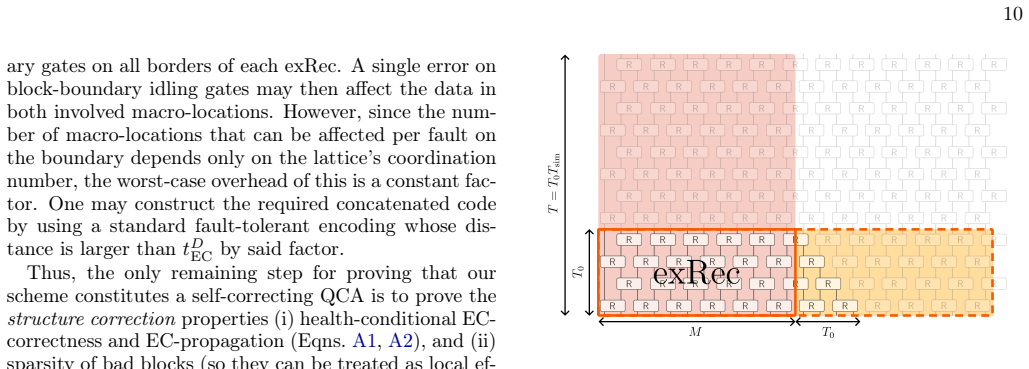
The macro- locations are partitioned into exRecs (= partial block-periods on levell)
Structure correction: A level-lstructure macro- location is one block-period on levell. The macro- locations are partitioned into exRecs (= partial block-periods on levell). There exists a notion of an exRec’s ‘influence neighborhood’ which speci- fies a finite set of exRecs surrounding it. Further, there exists a sequence of integer-labeled predicates ‘h...
-
[6]
Data correction: (i) (Fault-localization) The data faults induced by incorrect, and even unhealthy, structure-states are localized so that any structurally-good macro- location can include at most a constant number C·t S EC of incorrectly controlled data locations. (ii) (Fault-tolerance) Assuming the structure reg- isters are correct, the induced data evo...
-
[7]
A. G. Fowler, M. Mariantoni, J. M. Martinis, and A. N. Cleland, Surface codes: Towards practical large-scale quantum computation, Physical Review A86, 032324 (2012)
work page 2012
- [8]
-
[9]
Google Quantum AI and Collaborators, Quantum error correction below the surface code threshold, Nature638, 920 (2025)
work page 2025
- [10]
- [11]
-
[12]
S. Bravyi and B. Terhal, A no-go theorem for a two- dimensional self-correcting quantum memory based on stabilizer codes, New Journal of Physics11, 043029 (2009)
work page 2009
-
[13]
B. J. Brown, D. Loss, J. K. Pachos, C. N. Self, and J. R. Wootton, Quantum memories at finite temperature, Re- views of Modern Physics88, 045005 (2016)
work page 2016
-
[14]
J. Haah, Local stabilizer codes in three dimensions with- out string logical operators, Physical Review A83, 042330 (2011)
work page 2011
- [15]
-
[16]
B. Roberts, J. M. Koh, Y. Tan, and N. Y. Yao, Cored product codes for quantum self-correction in three di- mensions (2025), arXiv:2510.05479 [quant-ph]
-
[17]
J. W. Harrington,Analysis of Quantum Error-Correcting Codes: Symplectic Lattice Codes and Toric Codes, Ph.D. thesis, California Institute of Technology (2004)
work page 2004
-
[18]
L. F. Gray, A Reader’s Guide to Gacs’s “Positive Rates” Paper, Journal of Statistical Physics103, 1 (2001)
work page 2001
-
[19]
S. Balasubramanian, M. Davydova, and E. Lake, A local automaton for the 2D toric code (2025), arXiv:2412.19803 [quant-ph]
- [20]
-
[21]
F. Verstraete, M. M. Wolf, and J. Ignacio Cirac, Quan- tum computation and quantum-state engineering driven by dissipation, Nature Physics5, 633 (2009)
work page 2009
-
[22]
F. Pastawski, L. Clemente, and J. I. Cirac, Quantum memories based on engineered dissipation, Physical Re- view A83, 012304 (2011)
work page 2011
-
[23]
P. Gács, Reliable computation with cellular automata, Journal of Computer and System Sciences32, 15 (1986), also appears as an extended version in Journal of Statis- tical Physics103, 45 (2001)
work page 1986
-
[24]
Gács, Self-Correcting Two-Dimensional Arrays, Ad- vances in Computing Research5, 223 (1989)
P. Gács, Self-Correcting Two-Dimensional Arrays, Ad- vances in Computing Research5, 223 (1989)
work page 1989
-
[25]
Reversible quantum cellular automata
B. Schumacher and R. F. Werner, Reversible quantum cellular automata (2004), arXiv:quant-ph/0405174
work page internal anchor Pith review Pith/arXiv arXiv 2004
-
[26]
T. L. M. Guedes, D. Winter, and M. Müller, Quan- tum Cellular Automata for Quantum Error Correction and Density Classification, Physical Review Letters133, 150601 (2024)
work page 2024
-
[27]
Arrighi, An overview of quantum cellular automata, Natural Computing18, 885 (2019)
P. Arrighi, An overview of quantum cellular automata, Natural Computing18, 885 (2019). 15
work page 2019
-
[28]
D. Aharonov and M. Ben-Or, Fault-tolerant quantum computation with constant error, inProceedings of the Twenty-Ninth Annual ACM Symposium on Theory of Computing, STOC ’97 (1997) pp. 176–188, also appears as an extended version in SIAM Journal on Computing 38, 1207 (2008)
work page 1997
-
[29]
D.Gottesman,Fault-tolerantquantumcomputationwith local gates, Journal of Modern Optics47, 333 (2000)
work page 2000
- [30]
-
[31]
P.Aliferis, D.Gottesman,andJ.Preskill,Quantumaccu- racy threshold for concatenated distance-3 codes, Quan- tum Info. Comput.6, 97 (2006)
work page 2006
-
[32]
R. Trivedi, A. Franco Rubio, and J. I. Cirac, Quantum advantage and stability to errors in analogue quantum simulators, Nature Communications15, 6507 (2024)
work page 2024
-
[33]
N. Y. Yao, C. Nayak, L. Balents, and M. P. Zaletel, Classical discrete time crystals, Nature Physics16, 438 (2020)
work page 2020
-
[34]
A. L. Toom, Stable and attractive trajectories in mul- ticomponent systems, inMulticomponent Random Sys- tems, Advances in Probability, Vol. 6 (1980) pp. 549–575
work page 1980
-
[35]
Gottesman,Surviving as a Quantum Computer in a Classical World, Online Draft(2024)
D. Gottesman,Surviving as a Quantum Computer in a Classical World, Online Draft(2024)
work page 2024
-
[36]
K. G. H. Vollbrecht and J. I. Cirac, Reversible universal quantum computation within translation-invariant sys- tems, Physical Review A73, 012324 (2006)
work page 2006
-
[37]
D. J. Shepherd, T. Franz, and R. F. Werner, Universally Programmable Quantum Cellular Automaton, Physical Review Letters97, 020502 (2006)
work page 2006
-
[38]
K. G. H. Vollbrecht and J. I. Cirac, Quantum Simula- tors, Continuous-Time Automata, and Translationally Invariant Systems, Physical Review Letters100, 010501 (2008)
work page 2008
- [39]
-
[40]
B. M. Terhal and G. Burkard, Fault-tolerant quantum computation for local non-Markovian noise, Physical Re- view A71, 012336 (2005)
work page 2005
-
[41]
D. Aharonov, A. Kitaev, and J. Preskill, Fault-Tolerant Quantum Computation with Long-Range Correlated Noise, Physical Review Letters96, 050504 (2006)
work page 2006
-
[42]
Fault-Tolerant Postselected Quantum Computation: Schemes
E. Knill, Fault-Tolerant Postselected Quantum Compu- tation: Schemes (2004), arXiv:quant-ph/0402171
work page internal anchor Pith review Pith/arXiv arXiv 2004
-
[43]
S. Bravyi and A. Kitaev, Universal quantum computa- tion with ideal Clifford gates and noisy ancillas, Physical Review A71, 022316 (2005)
work page 2005
-
[44]
G. Korniss, M. A. Novotny, P. A. Rikvold, H. Guclu, and Z. Toroczkai, Going through Rough Times: From Non- Equilibrium Surface Growth to Algorithmic Scalability, MRS Online Proceedings Library700, 1010 (2011)
work page 2011
-
[45]
V. Kashyap, G. Styliaris, S. Mouradian, J. I. Cirac, and R. Trivedi, Accuracy Guarantees and Quantum Advan- tageinAnalogOpenQuantumSimulationwithandwith- out Noise, Physical Review X15, 021017 (2025)
work page 2025
-
[46]
T. Bergamaschi and C.-F. Chen, Quantum Spin Chains Thermalize at All Temperatures (2025), arXiv:2510.08533 [quant-ph]. 16 Appendix A: Review of the extended rectangle formalism We summarize here the extended rectangle formal- ism that was developed for establishing fault-tolerance of concatenated active error-correcting circuits [25, 29]. In Sec. IIIB we ...
discussion (0)
Sign in with ORCID, Apple, or X to comment. Anyone can read and Pith papers without signing in.