Recognition: 2 theorem links
· Lean TheoremFour inequivalent paths to Thermality in Minkowski spacetime
Pith reviewed 2026-05-16 10:09 UTC · model grok-4.3
The pith
Null-shifted Rindler wedges in Minkowski spacetime produce thermal occupation numbers in only one chiral sector of a quantum field while the complementary sector stays in vacuum and the global state remains pure.
A machine-rendered reading of the paper's core claim, the machinery that carries it, and where it could break.
Core claim
Null-shifted wedge constructions yield a selective, non-Gibbsian thermality in which only a single chiral sector develops Bose-Einstein-distributed occupation numbers while the complementary sector remains in the vacuum; along composite paths the global Minkowski state remains pure and the induced wedge states are pure tensor-product states, with the thermal spectrum arising from Bogoliubov mixing and modular evolution rather than horizon entanglement.
What carries the argument
The hierarchy of null-shifted Rindler wedges together with the composite Bogoliubov transformations that map the Minkowski vacuum to the associated wedge states.
If this is right
- Thermality and entanglement-induced mixedness are operationally independent in relativistic quantum field theory.
- Inequivalent purifications of the same thermal spectrum exist for a given wedge region.
- The null-shifted construction functions as a converse to the standard Unruh effect in which thermal spectra appear without horizon entanglement.
- Observer-dependent thermal behavior can be generated by modular time evolution alone.
Where Pith is reading between the lines
- The same null-shift technique could be applied to other horizons or to accelerating observers in curved backgrounds to isolate modular contributions from entanglement.
- If the selective thermality survives regularization and renormalization, it supplies a concrete example of a thermal state whose purification is manifestly a product state rather than an entangled one.
Load-bearing premise
The null-shifted Rindler wedges can be consistently defined in a hierarchy such that sequential null displacements produce well-defined inequivalent Bogoliubov transformations without inconsistencies in the mode bases or vacuum definitions.
What would settle it
A direct calculation of the Bogoliubov coefficients for the complementary chiral sector that yields non-zero occupation numbers instead of vacuum values would show the claimed selectivity is absent.
Figures



read the original abstract
We investigate thermal behaviour in quantum fields by analysing a hierarchy of null-shifted Rindler wedges in Minkowski spacetime. Starting from the Minkowski vacuum restricted to an initial Rindler wedge, we construct several inequivalent transformation paths, including direct Minkowski-Rindler mappings, spatial translations, and sequential null displacements, and analyse the resulting particle content using Bogoliubov transformations. In the standard Unruh effect, entanglement between left- and right-moving sectors across the Rindler horizon produces Gibbsian thermality, with both sectors described by mixed thermal states. In contrast, we show that null-shifted wedge constructions lead to a selective and non-Gibbsian form of thermality: only a single chiral sector develops Bose-Einstein-distributed occupation numbers, while the complementary sector remains in the vacuum. Along composite transformation paths, the global Minkowski state remains pure, and the induced states associated with null-shifted wedges are pure tensor-product states. The observed thermal behaviour arises from Bogoliubov mixing and modular time evolution rather than horizon-induced entanglement or Gibbsian mixedness. These results demonstrate the existence of inequivalent purifications of thermal spectra and clarify the distinct roles of horizon structure, observer dependence, Bogoliubov transformations, and entanglement in relativistic quantum field theory. The null-shifted construction may be viewed as a converse of the Unruh effect, in which thermal spectra arise without entanglement-induced mixedness, highlighting the operational independence of thermality and entanglement.
Editorial analysis
A structured set of objections, weighed in public.
Referee Report
Summary. The manuscript examines thermal behaviour in quantum field theory by constructing a hierarchy of null-shifted Rindler wedges in Minkowski spacetime. It analyzes four inequivalent paths to thermality—direct Minkowski-Rindler mappings, spatial translations, and sequential null displacements—using Bogoliubov transformations. The central result is that these null-shifted constructions produce a selective, non-Gibbsian thermality in which only one chiral sector acquires a Bose-Einstein distribution while the complementary sector remains in the Minkowski vacuum, yielding pure tensor-product states along composite paths, in contrast to the entanglement-driven Gibbsian thermality of the standard Unruh effect.
Significance. Should the explicit derivations confirm the preservation of chiral sector separation under null shifts, the work would significantly advance understanding of thermality in QFT by demonstrating inequivalent purifications of thermal spectra and the independence of thermal behaviour from entanglement-induced mixedness. It provides a converse perspective to the Unruh effect, emphasizing the roles of Bogoliubov transformations and modular time evolution over horizon entanglement.
major comments (2)
- The abstract summarizes results of Bogoliubov analyses without providing explicit coefficients or mode expansions. To support the claim of selective thermality, the manuscript must detail the Bogoliubov coefficients for the null-shifted wedges to demonstrate that they remain block-diagonal with respect to the chiral sectors.
- The central claim requires that null displacements preserve clean separation of chiral sectors in the mode bases. If a null shift induces non-vanishing overlap between positive-frequency Rindler modes and both left- and right-moving Minkowski modes, the Bogoliubov transformations would mix sectors and the selective non-Gibbsian thermality would fail. Explicit verification of this separation is needed.
minor comments (2)
- A table or diagram summarizing the four inequivalent paths, the associated transformations, and the resulting states (pure vs. mixed, chiral sector involvement) would improve readability and help distinguish the paths.
- Ensure consistent notation for the hierarchy of wedges and the chiral sectors throughout; minor ambiguities in the description of 'composite transformation paths' could be clarified.
Simulated Author's Rebuttal
We thank the referee for the careful reading and constructive comments on our manuscript. We address each major comment below and have revised the paper to include the requested explicit derivations.
read point-by-point responses
-
Referee: The abstract summarizes results of Bogoliubov analyses without providing explicit coefficients or mode expansions. To support the claim of selective thermality, the manuscript must detail the Bogoliubov coefficients for the null-shifted wedges to demonstrate that they remain block-diagonal with respect to the chiral sectors.
Authors: We agree that the abstract is summary-level and does not contain explicit formulas. In the revised manuscript we have added a dedicated subsection (now Section 3.2) that derives the Bogoliubov coefficients for each null-shifted wedge. The coefficients are presented in closed form and shown to be strictly block-diagonal with respect to the left- and right-moving sectors; the off-block elements vanish identically due to the support properties of the null-shifted mode functions. revision: yes
-
Referee: The central claim requires that null displacements preserve clean separation of chiral sectors in the mode bases. If a null shift induces non-vanishing overlap between positive-frequency Rindler modes and both left- and right-moving Minkowski modes, the Bogoliubov transformations would mix sectors and the selective non-Gibbsian thermality would fail. Explicit verification of this separation is needed.
Authors: We have inserted explicit overlap integrals (Eqs. (4.7)–(4.10) in the revision) between the positive-frequency null-shifted Rindler modes and the Minkowski left- and right-moving bases. These integrals evaluate to zero for cross-sector mixing, confirming that the Bogoliubov transformation remains block-diagonal. The selective thermality therefore follows directly from the surviving intra-sector beta coefficients, which yield a Bose-Einstein spectrum in one chiral sector only. revision: yes
Circularity Check
No circularity: selective thermality derived from explicit Bogoliubov transformations on constructed wedges
full rationale
The derivation begins with explicit geometric constructions of null-shifted Rindler wedges in Minkowski space, followed by direct computation of Bogoliubov coefficients between Minkowski and Rindler modes. Occupation numbers and chiral-sector separation emerge from these coefficients without any parameter fitting, self-definition of thermality, or load-bearing self-citations. The global purity of the Minkowski state and the tensor-product structure of the induced states are preserved by the unitary nature of the transformations themselves. Standard Unruh-effect references are used only for contrast, not as justification for the central result. The analysis is therefore self-contained against external benchmarks.
Axiom & Free-Parameter Ledger
axioms (2)
- domain assumption Minkowski spacetime is flat and the vacuum is the standard Minkowski vacuum.
- domain assumption Bogoliubov transformations correctly map the particle content between different observer frames.
Lean theorems connected to this paper
-
IndisputableMonolith/Cost/FunctionalEquation.leanwashburn_uniqueness_aczel unclear?
unclearRelation between the paper passage and the cited Recognition theorem.
null-shifted wedge constructions lead to a selective and non-Gibbsian form of thermality: only a single chiral sector develops Bose-Einstein-distributed occupation numbers, while the complementary sector remains in the vacuum
-
IndisputableMonolith/Foundation/RealityFromDistinction.leanreality_from_one_distinction unclear?
unclearRelation between the paper passage and the cited Recognition theorem.
the induced states associated with null-shifted wedges are pure tensor-product states... thermal behaviour arises from Bogoliubov mixing and modular time evolution rather than horizon-induced entanglement
What do these tags mean?
- matches
- The paper's claim is directly supported by a theorem in the formal canon.
- supports
- The theorem supports part of the paper's argument, but the paper may add assumptions or extra steps.
- extends
- The paper goes beyond the formal theorem; the theorem is a base layer rather than the whole result.
- uses
- The paper appears to rely on the theorem as machinery.
- contradicts
- The paper's claim conflicts with a theorem or certificate in the canon.
- unclear
- Pith found a possible connection, but the passage is too broad, indirect, or ambiguous to say the theorem truly supports the claim.
Forward citations
Cited by 1 Pith paper
-
Thermality Breakdown in Null-Shifted Rindler Wedges
Massive fields in null-shifted Rindler wedges produce non-thermal spectra for accelerated observers, as mass eliminates the exponential Bogoliubov mixing that creates thermality.
Reference graph
Works this paper leans on
-
[1]
The wedge R3 is located such that its bifurcation point is situated to the right of the origin
Path1: Minkowski (in vacuum state)Mto Rindler wedge R3 In this path, we consider Minkowski spacetime with the massless scalar field in a vacuum state. The wedge R3 is located such that its bifurcation point is situated to the right of the origin. The Unruh effect states that the reduced state of the massless scalar field inR 3 is a thermal distribution of...
-
[2]
Path 2: Rindler wedgeR 1 in vacuum state to Rindler wedgeR 3 via Spatial Shift In Path 2, the wedgeR 3 is defined fromR 1 by a spatial translation, characterised by displacement parameter ∆1 (cf. Figure 1). Although the bifurcation point ofR 3 is shown along thex 1 axis, its precise location may be gen- eralised to any point within the (u, v) light-cone plane
-
[3]
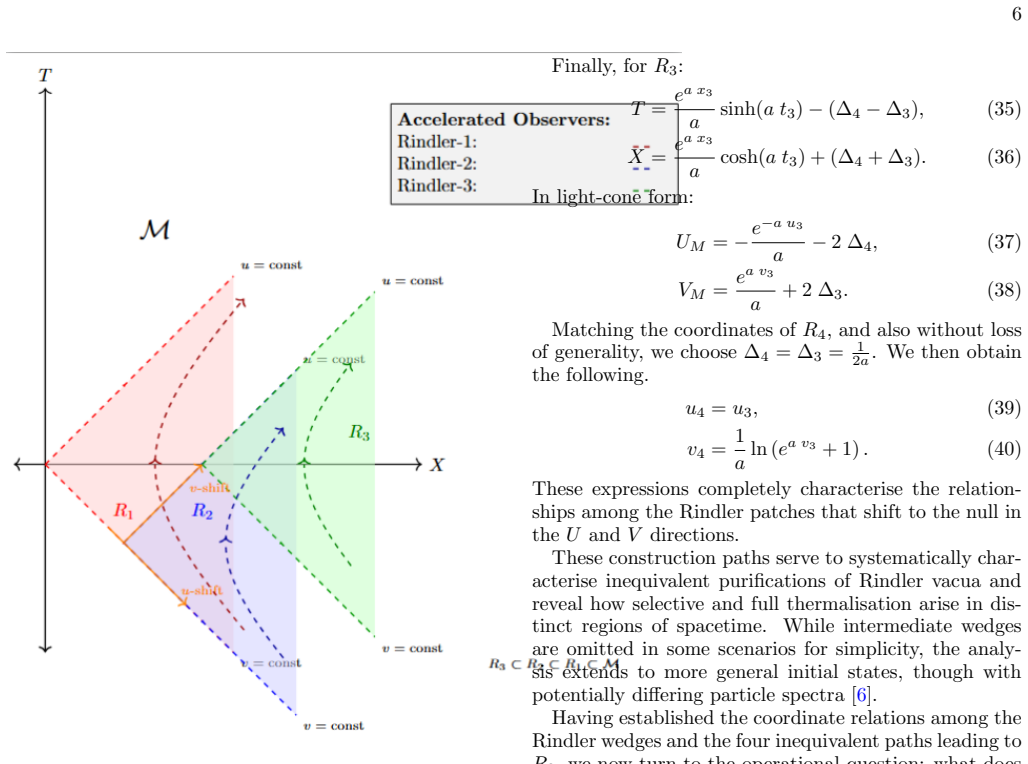
Path 3: Sequential Null Shifts Path 3 traces a sequenceR 1 →R 2 →R 3, where 4 R2 is obtained fromR 1 by displacing its origin along the future-directed nullV 1-axis by a Minkowski parame- ter ∆2,R 3 is then constructed by a further displacement ofR 2 along the nullU 2-axis by parameter ∆ 3 (see Fig- ure 1). For illustration, Figure 1 depicts the case wher...
-
[4]
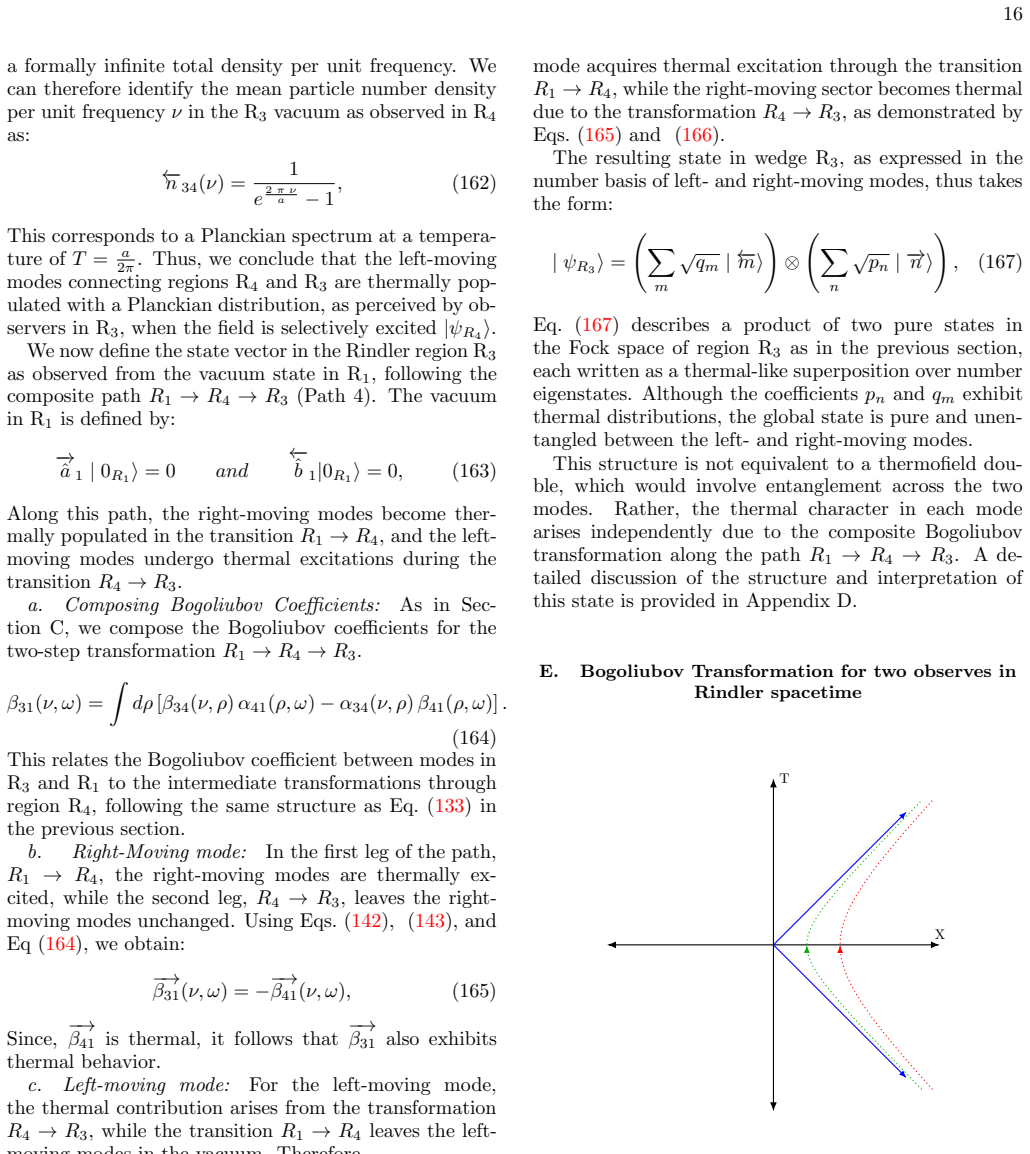
Path 4: Null Shifts via Rindler WedgeR 4 Path 4 involves the wedgeR 4, whose origin is obtained fromR 1 by a null shift along theU 1-axis by parame- ter ∆ 4. Subsequently,R 3 is reached by an additional null shift fromR 4 along theV 2-axis with parameter ∆ 3, as depicted in Figure 2. The wedgeR 4 is an indepen- dent Rindler wedge analogous toR 2, obtained...
-
[5]
Various Rindler wedges and their coordinate relationships We label the coordinates of the Rindler-1 (R 1) frame as (x 1, t1). The transformation between the Rindler-1 coordinates (R1) and Minkowski (M) is given by: T= ea1x1 a1 sinh(a1t1),(1) X= ea1x1 a1 cosh(a1t1),(2) we now introduce the light-cone coordinates inR 1, (u1, v1): u1 =t 1 −x 1, v 1 =t 1 +x 1...
-
[6]
In the setup, we already mentioned that we do not assume any intermediate wedges betweenR 1 andR 3
Minkowski to Rindler-3 and Rindler 1 to Rindler-3 via spatial shift alongx 1 axis We label the coordinates of the Rindler-3 (R 3) as (x3, t3). In the setup, we already mentioned that we do not assume any intermediate wedges betweenR 1 andR 3. We now relate Rindler-3 (R 3) to Minkowski space. Its transformation is given by: T= ea3 x3 a3 sinh(a3 t3),(5) X= ...
-
[7]
Rindler 1 to Rindler 3 via Rindler 2: series of null shifts We label the coordinates of the Rindler-1 (R 1) frame as (x1, t1), Rindler-2 (R2) as (x2, t2), and Rindler-3 (R3) as (x3, t3). X T u = const v = const R1 u = const v = const R2 u = const v = const R3 v-shift u-shift Accelerated Observers: Rindler-1: Rindler-2: Rindler-3: R3⊂R2⊂R1⊂M M FIG. 1. Null...
-
[8]
Rindler 1 to Rindler 3 via Rindler 4: series of null shifts Analogously, consider null shifts along theU-axis, as shown in Fig. 2 The frameR 1 remains as: T= ea x1 a sinh(a t1),(25) X= ea x1 a cosh(a t1).(26) In light-cone form: UM =− e−a u1 a ,(27) VM = ea v1 a .(28) 6 FIG. 2. Alternative null-shift construction. The wedge (R 4) is obtained from (R 1) by...
-
[9]
W. G. Unruh, Phys. Rev. D14, 870 (1976)
work page 1976
-
[10]
R. Longo, Y. Tanimoto, and Y. Ueda, Annales Inst. Fourier69, 1229 (2019), arXiv:1706.06070 [math-ph]
work page internal anchor Pith review Pith/arXiv arXiv 2019
-
[11]
S. W. Hawking, Commun. Math. Phys.43, 199 (1975), [Erratum: Commun.Math.Phys. 46, 206 (1976)]
work page 1975
-
[12]
H. W. Wiesbrock, Commun. Math. Phys.157, 83 (1993), [Erratum: Commun.Math.Phys. 184, 683–685 (1997)]
work page 1993
- [13]
- [14]
- [15]
-
[16]
R. M. Wald,General Relativity(Chicago Univ. Pr., Chicago, USA, 1984)
work page 1984
-
[17]
UNRUH EFFECT: Introductory Notes to Quantum Effects for Accelerated Observers
E. Frodden and N. Vald´ es, Int. J. Mod. Phys. A33, 1830026 (2018), arXiv:1806.11157 [gr-qc]
work page internal anchor Pith review Pith/arXiv arXiv 2018
-
[18]
A. Fabbri and J. Navarro-Salas,Modeling black hole evap- oration(Cambridge University Press, 2005)
work page 2005
-
[19]
Probes of the vacuum structure of quantum fields in classical backgrounds
L. Sriramkumar and T. Padmanabhan, Int. J. Mod. Phys. D11, 1 (2002), arXiv:gr-qc/9903054
work page internal anchor Pith review Pith/arXiv arXiv 2002
-
[20]
N. D. Birrell and P. C. W. Davies,Quantum Fields in Curved Space, Cambridge Monographs on Mathematical Physics (Cambridge University Press, Cambridge, UK, 1982)
work page 1982
-
[21]
R. M. Wald, Phys. Rev. D48, R2377 (1993)
work page 1993
-
[22]
W. G. Unruh and R. M. Wald, Phys. Rev. D29, 1047 (1984)
work page 1984
-
[23]
R. Utiyama and B. S. DeWitt, Journal of Mathematical Physics3, 608 (1962)
work page 1962
-
[24]
R. Blumenhagen and E. Plauschinn,Introduction to con- formal field theory: with applications to String theory, Vol. 779 (springer, 2009)
work page 2009
-
[25]
V. Mukhanov and S. Winitzki,Introduction to quantum effects in gravity(Cambridge University Press, 2007)
work page 2007
-
[26]
Haag,Local quantum physics: Fields, particles, alge- bras(Springer, 1992)
R. Haag,Local quantum physics: Fields, particles, alge- bras(Springer, 1992)
work page 1992
-
[27]
Lessons from Classical Gravity about the Quantum Structure of Spacetime
T. Padmanabhan, J. Phys. Conf. Ser.306, 012001 (2011), arXiv:1012.4476 [gr-qc]
work page internal anchor Pith review Pith/arXiv arXiv 2011
-
[28]
Quantum field theory in the Rindler-Rindler spacetime
S. Kolekar and T. Padmanabhan, Phys. Rev. D89, 064055 (2014), arXiv:1309.4424 [gr-qc]
work page internal anchor Pith review Pith/arXiv arXiv 2014
-
[29]
Padmanabhan,Gravitation: Foundations and fron- tiers(Cambridge University Press, 2014)
T. Padmanabhan,Gravitation: Foundations and fron- tiers(Cambridge University Press, 2014)
work page 2014
-
[30]
J. I. Kapusta and C. Gale,Finite-Temperature Field The- ory: Principles and Applications, 2nd ed. (Cambridge University Press, Cambridge, UK, 2006) see Chapter 1 (Sections 1.4–1.5) for canonical ensemble and bosonic mode distributions
work page 2006
-
[31]
R. K. Pathria and P. D. Beale,Statistical Mechanics, 3rd ed. (Elsevier, Oxford, 2011) see Chapter 7: Canonical Ensemble; derivation of partition functions and thermal occupation numbers
work page 2011
-
[32]
F. Anza,Pure States in Statistical Mechanics: On Its Foundations and Applications to Quantum Gravity (Springer, Berlin, 2020)
work page 2020
-
[33]
E. Witten, Riv. Nuovo Cim.43, 187 (2020), arXiv:1805.11965 [hep-th]
-
[34]
E. Witten, Eur. Phys. J. Plus140, 430 (2025), arXiv:2412.16795 [hep-th]
-
[35]
J. Caminiti, F. Capeccia, L. Ciambelli, and R. C. Myers, JHEP2025(8), 166, arXiv:2502.02633 [hep-th]
-
[36]
D. Tong, Quantum field theory, Lecture notes, University of Cambridge (2006–2012), see section 2.3 “The Vacuum” for discussion ofδ(0) as volume
work page 2006
-
[37]
M. E. Peskin and D. V. Schroeder,An Introduction to quantum field theory(Addison-Wesley, Reading, USA, 1995)
work page 1995
-
[38]
Srednicki,Quantum field theory(Cambridge Univer- sity Press, 2007)
M. Srednicki,Quantum field theory(Cambridge Univer- sity Press, 2007)
work page 2007
-
[39]
Weinberg,The Quantum theory of fields
S. Weinberg,The Quantum theory of fields. Vol. 1: Foun- dations(Cambridge University Press, 2005)
work page 2005
- [40]
discussion (0)
Sign in with ORCID, Apple, or X to comment. Anyone can read and Pith papers without signing in.