REVIEW 3 major objections 5 minor 1 cited by
Mapping dark matter in the Bullet Cluster using JWST imaging and spectroscopy
T0 review · 3 major / 5 minor · reviewed 2026-08-03 · deepseek-v4-flash
Pith's one-line read The Bullet Cluster's subcluster dark-matter halo lies 4 kpc from its brightest galaxy — a threefold tighter constraint than before — sharpening the key observational test of dark-matter self-interaction.
desk verdict A substantial step forward for Bullet Cluster lensing, with the 4 kpc DM–BCG offset still tied to the symmetric-halo assumption. read the letter →
The pith
A machine-rendered reading of the paper's core claim, the machinery that carries it, and where it could break.
The reading
What carries the argument
The load-bearing measurement is the displacement between the subcluster's dark-matter halo, modelled as a single smooth PIEMD profile (a pseudo-isothermal elliptical mass distribution with a core and an outer cutoff), and the subcluster's brightest galaxy. The paper isolates the effect of the new JWST data by re-optimising the identical parametric model with and without the newly added multiple-image systems: the offset tightens from 9+14−1 kpc to 4+4−2 kpc. Surrounding this are 135 spectroscopically confirmed multiple images from 27 background galaxies, a fixed X-ray gas map, roughly 219 cluster-member halos following luminosity scaling relations, and several group-scale halos fixed by clus
What would settle it
Re-fit the same 135-image catalogue with a free-form lensing method that allows arbitrary asymmetric mass distributions in the subcluster: if the recovered mass centroid shifts by substantially more than 4 kpc, or the best-fit density map shows substantial asymmetry around the brightest galaxy, then the measured alignment is an artefact of the assumed single symmetric halo rather than a physical constraint on dark-matter self-interaction.
Extended reading notes
Core claim
The paper claims that with 135 spectroscopically confirmed multiple images, the subcluster's single large-scale dark-matter halo is centred 4+4−2 kpc from BCG3, the subcluster's brightest galaxy — three times more precise than the 9+14−1 kpc recovered using only pre-JWST systems, and systematically lower. Because the expected separation between dark matter and galaxies in a merger scales with the self-interaction cross-section, this measurement sharpens the upper limit on that cross-section, provided the parametric model captures the true mass distribution. The authors also find that the main cluster's dark matter is a single elongated, double-peaked structure with elevated density between t
Load-bearing premise
The result assumes the subcluster's dark matter is one smooth, symmetric blob centred near the galaxy; if the true dark-matter distribution is lopsided or differently shaped by the merger, the measured 4-kpc offset is biased.
Editorial extensions
If this is right
- The 4+4−2 kpc subcluster dark-matter–galaxy offset is the tightest model-based measurement in the Bullet Cluster to date, directly feeding upper limits on the dark-matter self-interaction cross-section.
- With 27 spectroscopic systems (8 in the subcluster, where there was previously 1), the new model substantially reduces the systematic errors in mass profiles, magnifications, and multiple-image predictions that sparse redshift information caused in earlier models.
- The main cluster's dark-matter distribution is double-peaked and elongated along the axis connecting its two brightest galaxies, with elevated density between the peaks; adding group-scale substructures along the two merger axes improves the fit over models without them.
- Aperture masses agree across three independent lens models within roughly 60 kpc of the brightest cluster galaxies, establishing a robust scale at which the cluster's total enclosed mass is model-independent.
- The new spectroscopic redshifts reveal small but spatially coherent deviations from redshifts predicted by earlier models, showing where sparse spectroscopy had biased the mass reconstruction.
Reading between the lines
- The precision gain comes almost entirely from the sheer number of new multiple-image constraints rather than from the redshift information itself: re-optimising with new images but leaving redshifts free already sharpens the offset, while the new redshifts mainly pull the best-fit value from 7 kpc to 4 kpc. This suggests future gains on the displacement may come more from wider/deeper imaging than
- Because the quoted offset is small (4+4−2 kpc) and depends on a symmetric single-halo parametrisation, the measurement is best read as an upper envelope on possible dark-matter–galaxy separation rather than evidence for a large offset; a free-form lensing reconstruction on the same catalogue would test this directly.
- The paper's own prescription — re-running the same strong-lensing analysis on hydrodynamical simulations of Bullet-like mergers — is the decisive next step: only if simulations with a given self-interaction cross-section reproduce both the image positions and the recovered displacement can the offset be converted into a cross-section limit.
- The close agreement of aperture masses at 60 kpc across parametric and free-form models suggests that 60-kpc enclosed masses are a robust anchor for cluster mass calibration and magnification estimates, even where the detailed mass maps diverge.
Editorial analysis
A structured set of objections, weighed in public.
Referee Report
Summary. This paper presents an updated strong-lensing model of the Bullet Cluster (1E 0657-56) based on JWST NIRCam imaging and NIRSpec prism spectroscopy. The gold sample comprises 135 secure multiple images from 27 spectroscopically confirmed lensed galaxies, with redshifts spanning z = 0.9-6.7, roughly quadrupling the number of spectroscopic systems previously available. The lens model is built with Lenstool and includes four PIEMD large-scale halos, 213 cluster members with luminosity scaling relations, a fixed X-ray gas map, and seven group-scale substructures whose parameters are anchored to the B23 kinematic analysis. The headline result is that the subcluster dark-matter halo H3 aligns with the subcluster BCG BCG3 to within 4^{+4}_{-2} kpc, a threefold improvement in precision over a re-optimised version of the same parametrisation without the JWST systems. The paper also provides a catalogue of 199 multiple-image candidates, compares aperture masses with the R21 and C25 models, and shows that earlier models produce small but spatially coherent redshift-prediction offsets relative to the new NIRSpec redshifts.
Significance. If the subcluster DM-BCG offset measurement is robust, this is the tightest model-based constraint on the DM-galaxy displacement in the Bullet Cluster and is directly relevant to dark-matter self-interaction limits. The paper's empirical assets are substantial: 27 spectroscopic systems with uniform spatial coverage, an extensive and carefully graded multiple-image catalogue, explicit comparison against alternative parametrisations, and genuine out-of-sample redshift predictions from the pre-JWST R21 model. These are real strengths and go well beyond simply adding more image positions. However, the central displacement claim rests on a single, symmetric PIEMD component for the subcluster, and the paper itself acknowledges that this parametrisation cannot capture self-interaction-induced asymmetries. Because the threefold improvement is measured against the same parametrisation, it does not yet bound the dominant systematic uncertainty. The result is therefore promising but not yet at the level of a robust SIDM constraint.
major comments (3)
- [Section 5.1, Table 2, Table C.2] The central offset measurement is not assessed against the best-fitting model in Table 2. The constant-shear model has lower χ² (86 vs 101), lower BIC (250 vs 266), and lower Δrms (0.40" vs 0.43"), and only marginally lower log evidence. Because the authors favour the substructure model on physical grounds, the displacement should be reported for both models, or at minimum a sensitivity test should show how much H3-BCG3 changes when substructures are replaced by constant shear. Without this, the quoted 4^{+4}_{-2} kpc is conditional on one specific environmental parametrisation.
- [Section 4.4, Table 1] The mass estimates M^σ_200 and M^r_200 in Table 1 differ by up to an order of magnitude, yet the adopted average is used as a fixed parameter. The paper notes the uncertainties are 'not considered in our lens model'. This is a significant omission for a model that uses these substructures as a physically motivated replacement for constant shear, especially since the fiducial and constant-shear models produce different mass distributions in the inner region (Fig. 6). I would like to see the H3-BCG3 offset recomputed with substructure masses drawn from the full range of Table 1, or a clear argument why the offset is insensitive to these choices.
- [Section 5.1, Fig. 8] The claim of a threefold precision improvement is computed by re-optimising the same parametrisation without JWST systems. This tells us about the constraining power of the new data within that parametrisation, but not about the systematic error from the assumed functional form. Given the explicit caveat about symmetric halos, the paper should be explicit that the improvement is a precision gain conditional on the model family, not a reduction of the dominant model systematic. I would phrase the abstract and summary accordingly, or add an explicit systematic term to the quoted uncertainty.
minor comments (5)
- [Table A.1] The 'Class' column uses g, s, b but the text only defines 'gold', 'silver', 'bronze'. Please define the single-letter abbreviations in the table caption or the main text.
- [Section 4.5, Eq. (6)] The adopted positional uncertainty σp = 0.5" is justified, but the resulting χ²/DoF = 0.7 suggests that the uncertainties are conservative. This is fine for parameter estimation, but it means the quoted parameter uncertainties (e.g., the 4^{+4}_{-2} kpc offset) may be overestimated. A brief sentence noting that the offset uncertainty should not be interpreted as a pure statistical error would help.
- [Section 5.2] The discussion of the constant-shear model reports that it 'provides a better fit' while also stating it 'provides no increase in evidence'. The two statements are both shown in Table 2, but the text could be clearer that the evidence and BIC are in tension and which metric the authors regard as decisive.
- [Appendix B] For sources with asymmetrical uncertainties (e.g., K9a.1, N7, N11), the convention for reporting upper/lower errors is not defined. Please state whether these are 68% credible intervals from the redshift posterior.
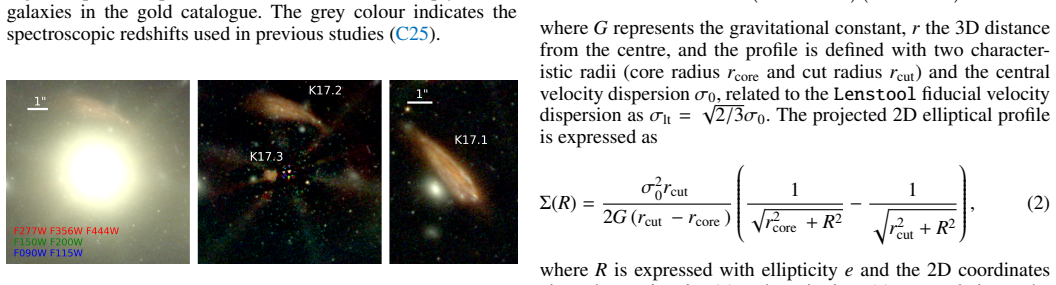
- [Figure 1] The figure legend and main text describe the colour coding of multiple images by grade, but the plot is dense and the squares/diamonds/circles/stars symbols are hard to distinguish at the printed size. A larger inset or a zoomed version would improve readability.
Circularity Check
No significant circularity: the lens-model displacement is a fitted parameter from independent JWST image/spectroscopic constraints, and the claimed improvement is a controlled re-optimization comparison, not a construction-level identity.
full rationale
The central result—the H3–BCG3 displacement of 4+4−2 kpc—is a free parameter of a Lenstool PIEMD model fitted to 135 multiply imaged positions with 27 spectroscopic system redshifts (Section 4.5, Eq. 6; Table C.2). It is an inference from data, not a quantity defined in terms of itself or fitted to a closely related output that is then called a prediction. The 'threefold improvement in precision' is obtained by re-optimizing the same parametrization on the pre-JWST subset and on the full JWST catalogue (Section 5.1); this is a legitimate controlled comparison of two fits, not a circular prediction. The redshift tests in Figure 9 are genuine out-of-sample checks for the R21 model: the paper explicitly distinguishes systems used to optimize R21 (diamonds) from JWST-discovered systems not used (squares). For C25, the paper notes that C25 included some of those systems as constraints, so no in-sample effect is hidden. The group-scale substructures are taken from the independent kinematic analysis B23, with masses from external velocity-dispersion/richness relations, and their addition is tested against a constant-shear alternative; this is independent input, not a self-referential construction. The cluster gas map originates from Chandra X-ray data (Bradač et al. 2006, Clowe et al. 2006) and is fixed; removing it changes the offset to 10.6 kpc, consistent with the fiducial value, so the central result does not rest on that self-citation. The paper's own Section 5.1 caveat—'Our simplified parametrisation, which assumes a symmetric large-scale halo, lacks the flexibility to capture self-interaction-induced asymmetries'—flags a genuine model-bias/systematics risk, as does the comparison with C25's 17.78 kpc weak-lensing-inclusive offset. These are external correctness concerns, not circularity: no load-bearing claim is reduced to its own input by definition, no fitted parameter is renamed as a prediction, and no uniqueness theorem or ansatz is imported from the authors' prior work. The derivation chain is self-contained against the new JWST data and against independent external benchmarks.
Assumptions & free parameters
free parameters (8)
- H1 PIEMD parameters =
x0=6.9", y0=7.1", e=0.69, θ=60°, σ_lt=586 km/s, r_core=12" (best-fit)
- H2 PIEMD parameters =
x0=39.6", y0=39.9", e=0.44, θ=71°, σ_lt=541 km/s, r_core=20" (best-fit)
- H3 PIEMD parameters =
x0=185.0", y0=49.7", e=0.49, θ=1°, σ_lt=683 km/s, r_core=11" (best-fit)
- H4 PIEMD parameters =
e=0.66, θ=28°, σ_lt=510 km/s, r_core=31" (best-fit)
- BCG1/BCG2/BCG3 velocity dispersions =
217, 213, 189 km/s (best-fit)
- G5, G9, G10 velocity dispersions =
160, 148, 133 km/s (best-fit)
- Scaling-relation normalizations =
σ_ref_lt=247 km/s, r_ref_cut=23" (best-fit)
- S1 and S7 velocity-dispersion normalizations =
300 km/s and 566 km/s (best-fit)
assumptions (7)
- domain assumption Mass distribution is a superposition of PIEMD halos with fixed r_cut=2 Mpc for large halos
- domain assumption Cluster members follow luminosity scaling relations with α=0.25, β_cut=0.5
- domain assumption Substructure positions and masses from B23 are correct
- domain assumption Chandra X-ray gas map is fixed and accurate to ~10%
- domain assumption Multiple-image identifications and NIRSpec redshifts are correct to Δz/(1+z)≈0.002
- ad hoc to paper Adopted position uncertainty σp=0.5″ is appropriate
- standard math Flat ΛCDM cosmology with Ωm=0.3, ΩΛ=0.7, H0=70 km/s/Mpc
Cite this review
Pith. "Pith review of Mapping dark matter in the Bullet Cluster using JWST imaging and spectroscopy." pith.science (2026). https://pith.science/paper/MHM64FD3
@misc{pith2026260122245,
  author       = {Pith},
  title        = {Pith review of: Mapping dark matter in the Bullet Cluster using JWST imaging and spectroscopy},
  year         = {2026},
  howpublished = {\url{https://pith.science/paper/MHM64FD3}},
  note         = {Machine review of arXiv:2601.22245}
}
abstract
We present an updated gravitational lens model of the Bullet cluster (1E 0657-56) by combining JWST NIRCam imaging and NIRSpec spectroscopy. Although previous lens models relied on many multiply imaged galaxies, only six systems had spectroscopic redshifts prior to this work. Our lens model is constrained by a catalogue of 135 secure multiple images from 27 background galaxies with spectroscopic redshifts, uniformly covering both subclusters and a wide redshift range of 0.9 - 6.7. We also provide a catalogue of 199 multiple image candidates. We modelled the cluster with Lenstool and incorporated several large-scale haloes, cluster members, the intracluster gas, and group-scale haloes surrounding the cluster core, motivated by spectroscopic studies of cluster member kinematics. We describe the main cluster component with a complex, elongated double-peaked distribution, and the subcluster with a single large-scale halo aligning closely with the brightest cluster galaxy ($4_{-2}^{+3}$ kpc). The uncertainty of the displacement has been improved threefold thanks to the addition of JWST systems. The addition of group-scale substructures, roughly following the two axes of cluster assembly, improves the fit to the multiple image positions and provides a physically motivated alternative to constant shear. Our lens model shows the closest agreement with previous studies in aperture mass profiles at $\sim60$ kpc from the brightest cluster galaxies (BCGs), but exhibits significant differences in the detailed mass distribution as a result of different lens-modelling strategies and adopted constraints. The differences are reflected in small but spatially coherent deviations between the new spectroscopic redshifts and redshifts predicted by earlier lens models.
Figures


Figures from the paper (6 more)


Forward citations
Cited by 1 Pith paper
-
A clear detection of proper motion confirms that the claimed $\mathbf{z\simeq32}$ galaxy candidate, "Capotauro'', is a Y-type brown dwarf
Capotauro, previously a candidate galaxy at z about 32, is confirmed as a Y-type brown dwarf near 730 pc by a 6.2 sigma proper motion measured over 3.5 years.
Reference graph
Works this paper leans on
-
[1]
Asada, Y ., Desprez, G., Willott, C. J., et al. 2025, ApJ, 983, L2 Barrena, R., Biviano, A., Ramella, M., Falco, E. E., & Seitz, S. 2002, A&A, 386, 816 Beauchesne, B., Clément, B., Hibon, P., et al. 2024, MNRAS, 527, 3246 Beauchesne, B., Clément, B., Richard, J., & Kneib, J.-P. 2021, MNRAS, 506, 2002 Benavides, J. A., Biviano, A., & Abadi, M. G. 2023, A&A...
arXiv 2025
-
[2024]
uncertainty, we compared the redshifts between different (secure) multiple images of a single system and between NIRSpec and MUSE redshifts from R21 where available. Based on the redshift scatter among 11 systems with several NIRSpec redshift measurements, we estimate the redshift uncertainty ∆z/(1+z)∼0.002, which we use for most NIRSpec redshifts in this...
2025
Reviewed August 3, 2026 · model on record in the stance chip above.
Discussion (0). Continue with ORCID to comment.