Recognition: 2 theorem links
· Lean TheoremA complex-linear reformulation of Hamilton-Jacobi theory and emergent quantum structure
Pith reviewed 2026-05-16 09:36 UTC · model grok-4.3
The pith
Embedding the classical density and action pair into a single complex field produces the Schrödinger equation as a structural limit.
A machine-rendered reading of the paper's core claim, the machinery that carries it, and where it could break.
Core claim
Imposing continuity of the complex field and invariance under a pair of minimal structural requirements on the general ansatz ψ = f(R,S) exp(i g(R,S)) uniquely fixes the map ψ = R exp(i S / κ) together with a linear Hamilton-Jacobi-Schrödinger equation. When Re(κ) ≠ 0 this linear equation generates the full set of quantum features—superposition, operator algebra, commutators, the Heisenberg uncertainty principle, Born's rule, and unitary evolution—as direct consequences of the structure rather than added postulates. The classical Hamilton-Jacobi theory is recovered exactly in the |κ| → 0 limit.
What carries the argument
The linear Hamilton-Jacobi-Schrödinger equation obtained by embedding the classical pair (R,S) into the complex field ψ, which enforces the unique form and generates quantum consistency conditions when Re(κ) is nonzero.
If this is right
- Superposition and operator commutators arise automatically from the linearity of the HJS equation without extra postulates.
- The Heisenberg uncertainty principle follows directly as a structural consistency condition when Re(κ) ≠ 0.
- Born's rule and unitary evolution are required for consistency once the complex field satisfies the two minimal requirements.
- The classical continuity equation and Hamilton-Jacobi equation are recovered exactly when the real part of κ is set to zero.
Where Pith is reading between the lines
- The approach suggests that the transition from classical to quantum descriptions can be viewed as a change in the value of a single complex parameter rather than the addition of new dynamical laws.
- Similar embeddings might be applied to other classical field theories to derive their quantum counterparts from structural requirements alone.
- Semiclassical regimes could be explored by allowing κ to vary continuously between the classical and quantum limits.
Load-bearing premise
The two minimal structural requirements placed on the general complex ansatz are enough to force both the unique wave-function map and the linearity of the resulting equation.
What would settle it
An explicit different complex function of (R,S) that satisfies the same two structural requirements yet yields a nonlinear equation or fails to produce superposition and commutators when Re(κ) ≠ 0 would falsify the uniqueness and emergence claims.
Figures


read the original abstract
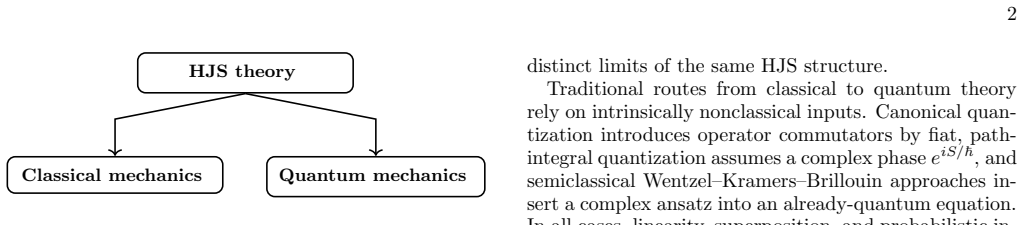
Classical mechanics admits multiple equivalent formulations, from Newton's equations to the variational Lagrange-Hamilton framework and the scalar Hamilton-Jacobi (HJ) theory. In the HJ formulation, classical ensembles evolve through the continuity equation for a real density $\rho = R^{2}$ coupled to Hamilton's principal function $S$. Here we develop a complementary formulation, the Hamilton-Jacobi-Schr\"odinger (HJS) theory, by embedding the pair $(R,S)$ into a single complex field. Starting from a completely general complex ansatz $\psi = f(R,S)\, e^{i g(R,S)},$ and imposing two minimal structural requirements, we obtain a unique map $\psi = R\, e^{iS/\kappa}\, $ together with a linear HJS equation whose $|\kappa| \to 0$ limit reproduces the HJ formulation exactly. Remarkably, when $\mathrm{Re}(\kappa)\neq 0$, essential features of quantum mechanics, superposition, operator algebra, commutators, the Heisenberg uncertainty principle, Born's rule and unitary evolution, follow naturally as structural consistency conditions. HJS thus provides a unified mathematical viewpoint in which classical and quantum dynamics appear as different limits of a single underlying structure.
Editorial analysis
A structured set of objections, weighed in public.
Referee Report
Summary. The manuscript develops a Hamilton-Jacobi-Schrödinger (HJS) theory by embedding the classical pair (R, S), with ρ = R² the density and S Hamilton's principal function, into a single complex field via the general ansatz ψ = f(R,S) exp(i g(R,S)). Imposing two minimal structural requirements produces the unique map ψ = R exp(i S / κ) together with a linear HJS equation; the |κ| → 0 limit recovers the classical HJ formulation exactly, while Re(κ) ≠ 0 yields superposition, operator algebra, commutators, the uncertainty principle, Born's rule and unitary evolution as structural consistency conditions.
Significance. If the two requirements prove to be independent of quantum postulates and the derivation is free of circularity, the work would supply a mathematically unified viewpoint in which classical and quantum dynamics appear as different limits of one underlying structure. The explicit construction of a parameter-controlled map and the derivation of QM features from consistency conditions would constitute a notable contribution to the foundations literature.
major comments (3)
- [Abstract] Abstract: the claim that two minimal structural requirements on the ansatz ψ = f(R,S) exp(i g(R,S)) yield the unique map ψ = R exp(i S / κ) and a linear HJS equation cannot be verified without the explicit statement of those requirements. If either requirement encodes linearity of the dynamical equation or identifies |ψ|² with a probability density, then superposition, Born's rule and unitary evolution are presupposed rather than derived.
- [Derivation of the map] Map definition and κ introduction: the parameter κ appears inside the map itself, with quantum features stated to emerge precisely when Re(κ) ≠ 0. This construction risks circularity unless the two structural requirements independently force the specific form of the phase factor and the value of κ without reference to the desired quantum limit.
- [Emergence of quantum features] Emergence section: the statements that commutators, the Heisenberg uncertainty principle and Born's rule follow as structural consistency conditions when Re(κ) ≠ 0 require explicit operator definitions and derivations. It is unclear whether these steps rely on additional variational assumptions or identifications that parallel standard quantum postulates.
minor comments (2)
- [HJS equation] Define the HJS equation with an explicit equation number and state the precise form of the linear operator acting on ψ.
- [Introduction] Add a short paragraph contrasting the present ansatz with earlier complex formulations of the Hamilton-Jacobi equation to clarify novelty.
Simulated Author's Rebuttal
We thank the referee for the careful and constructive report. The comments correctly identify places where greater explicitness is required, and we have revised the manuscript to supply the missing statements, derivations, and operator definitions while preserving the original logical structure.
read point-by-point responses
-
Referee: [Abstract] Abstract: the claim that two minimal structural requirements on the ansatz ψ = f(R,S) exp(i g(R,S)) yield the unique map ψ = R exp(i S / κ) and a linear HJS equation cannot be verified without the explicit statement of those requirements. If either requirement encodes linearity of the dynamical equation or identifies |ψ|² with a probability density, then superposition, Born's rule and unitary evolution are presupposed rather than derived.
Authors: We agree that the abstract must state the two requirements explicitly. In the revised version we now write them verbatim: (1) the imaginary part of the dynamical equation obtained from the ansatz must vanish identically in the |κ|→0 limit, recovering the classical continuity and Hamilton-Jacobi equations exactly; (2) the dynamical equation for ψ must be linear in ψ. Neither condition invokes a probability interpretation of |ψ|² nor assumes superposition or unitarity; those features appear only later as consistency requirements when Re(κ)≠0. The abstract has been updated accordingly. revision: yes
-
Referee: [Derivation of the map] Map definition and κ introduction: the parameter κ appears inside the map itself, with quantum features stated to emerge precisely when Re(κ) ≠ 0. This construction risks circularity unless the two structural requirements independently force the specific form of the phase factor and the value of κ without reference to the desired quantum limit.
Authors: The derivation begins with the completely general ansatz ψ = f(R,S) exp(i g(R,S)) and applies the two requirements without any prior reference to κ or to quantum mechanics. Requirement (1) forces f ∝ R and g ∝ S; requirement (2) fixes the proportionality constant in the phase as the scaling parameter κ that renders the resulting equation linear while preserving the classical limit. κ is therefore an output of the requirements, not an input chosen to produce quantum features. The revised Section II now contains the complete algebraic steps demonstrating this independence. revision: yes
-
Referee: [Emergence of quantum features] Emergence section: the statements that commutators, the Heisenberg uncertainty principle and Born's rule follow as structural consistency conditions when Re(κ) ≠ 0 require explicit operator definitions and derivations. It is unclear whether these steps rely on additional variational assumptions or identifications that parallel standard quantum postulates.
Authors: The revised Section IV supplies the explicit operator definitions and derivations. The position operator is multiplication by the coordinate; the momentum operator is obtained directly as -iκ ∂/∂x from the first-order linear HJS equation. Their commutator [x,p]=iκ follows by direct calculation. The uncertainty relation is the standard consequence of this commutator. Born’s rule is shown to be the unique assignment that makes the continuity equation compatible with unitary evolution generated by the linear operator. No variational principles or additional identifications are introduced; all steps are algebraic consequences of linearity when Re(κ)≠0. The full derivations have been inserted. revision: yes
Circularity Check
Derivation chain self-contained; no load-bearing reduction exhibited
full rationale
The paper starts from an explicitly general ansatz ψ = f(R,S) exp(i g(R,S)) and states that two minimal structural requirements suffice to fix the unique map ψ = R exp(i S / κ) together with a linear HJS equation. The classical limit |κ| → 0 is recovered exactly, and quantum features are asserted to follow from the linearity when Re(κ) ≠ 0. No equations, self-citations, or explicit statements of the two requirements are supplied that would allow any step to be shown as reducing to its own inputs by construction. The derivation is therefore treated as independent of the target quantum structures; the requirements are presented as external and minimal rather than as encodings of linearity or Born's rule.
Axiom & Free-Parameter Ledger
free parameters (1)
- κ
axioms (1)
- ad hoc to paper Two minimal structural requirements on the general complex ansatz ψ = f(R,S) exp(i g(R,S))
invented entities (1)
-
Complex field ψ
no independent evidence
Lean theorems connected to this paper
-
Cost/FunctionalEquation.leanwashburn_uniqueness_aczel matches?
matchesMATCHES: this paper passage directly uses, restates, or depends on the cited Recognition theorem or module.
Imposing two minimal structural requirements... we obtain a unique map ψ = R exp(iS/κ) together with a linear HJS equation
-
Foundation/RealityFromDistinction.leanreality_from_one_distinction echoes?
echoesECHOES: this paper passage has the same mathematical shape or conceptual pattern as the Recognition theorem, but is not a direct formal dependency.
when Re(κ) ≠ 0, essential features of quantum mechanics... follow naturally as structural consistency conditions
What do these tags mean?
- matches
- The paper's claim is directly supported by a theorem in the formal canon.
- supports
- The theorem supports part of the paper's argument, but the paper may add assumptions or extra steps.
- extends
- The paper goes beyond the formal theorem; the theorem is a base layer rather than the whole result.
- uses
- The paper appears to rely on the theorem as machinery.
- contradicts
- The paper's claim conflicts with a theorem or certificate in the canon.
- unclear
- Pith found a possible connection, but the passage is too broad, indirect, or ambiguous to say the theorem truly supports the claim.
Reference graph
Works this paper leans on
-
[1]
L. D. Landau and E. M. Lifshitz,Mechanics. Pergamon Press, 1976
work page 1976
-
[2]
L. D. Landau and E. M. Lifshitz,Quantum Mechanics: Non-Relativistic Theory. Pergamon Press, 3 ed., 1977. 10
work page 1977
-
[3]
An Effective Field Theory of Gravity for Extended Objects
W. D. Goldberger and I. Z. Rothstein, “An Effective field theory of gravity for extended objects,”Phys. Rev. D73(2006) 104029,arXiv:hep-th/0409156
work page internal anchor Pith review Pith/arXiv arXiv 2006
-
[4]
Gravitational scattering, post-Minkowskian approximation and Effective One-Body theory
T. Damour, “Gravitational scattering, post-minkowskian approximation and effective one-body theory,”Phys. Rev. D94(2016) 104015, arXiv:1609.00354
work page internal anchor Pith review Pith/arXiv arXiv 2016
-
[5]
Z. Bern, C. Cheung, R. Roiban, C.-H. Shen, M. P. Solon, and M. Zeng, “Scattering Amplitudes and the Conservative Hamiltonian for Binary Systems at Third Post-Minkowskian Order,”Phys. Rev. Lett.122no. 20, (2019) 201603,arXiv:1901.04424 [hep-th]
work page internal anchor Pith review Pith/arXiv arXiv 2019
-
[6]
G. K¨ alin, Z. Liu, and R. A. Porto, “Conservative Dynamics of Binary Systems to Third Post-Minkowskian Order from the Effective Field Theory Approach,”Phys. Rev. Lett.125no. 26, (2020) 261103,arXiv:2007.04977 [hep-th]
-
[7]
Quantisierung als eigenwertproblem,
E. Schr¨ odinger, “Quantisierung als eigenwertproblem,” Annalen der Physik79(1926) 361–376
work page 1926
-
[8]
Quantentheorie in hydrodynamischer form,
E. Madelung, “Quantentheorie in hydrodynamischer form,”Zeitschrift f¨ ur Physik40(1927) 322–326
work page 1927
-
[9]
A suggested interpretation of the quantum theory in terms of “hidden
D. Bohm, “A suggested interpretation of the quantum theory in terms of “hidden” variables. i,”Physical Review85(1952) 166–179
work page 1952
-
[10]
Measures on the closed subspaces of a hilbert space,
A. M. Gleason, “Measures on the closed subspaces of a hilbert space,”Journal of Mathematics and Mechanics6 (1957) 885–893. Reprinted version also available online
work page 1957
-
[11]
Emergence of Calabi–Yau manifolds in high-precision black-hole scattering,
M. Driesse, G. U. Jakobsen, A. Klemm, G. Mogull, C. Nega, J. Plefka, B. Sauer, and J. Usovitsch, “Emergence of Calabi–Yau manifolds in high-precision black-hole scattering,”Nature641no. 8063, (2025) 603–607,arXiv:2411.11846 [hep-th]
-
[12]
Quantum theory of gravity. i. the canonical theory,
B. S. DeWitt, “Quantum theory of gravity. i. the canonical theory,”Phys. Rev.160(1967) 1113–1148
work page 1967
-
[13]
Time and interpretations of quantum gravity,
K. V. Kuchar, “Time and interpretations of quantum gravity,”Int. J. Mod. Phys. D20(2011) 3–86. 11 SUPPLEMENTARY INFORMATION I. UNIQUENESS OF THE MINIMAL COMPLEX EMBEDDING This section provides the technical derivation support- ing the uniqueness statement in the main text: among all complex mapsψ=f(R, S)e ig(R,S) from the HJ ensemble variables (R, S) to a...
work page 2011
discussion (0)
Sign in with ORCID, Apple, or X to comment. Anyone can read and Pith papers without signing in.