REVIEW 5 major objections 4 minor 3 references
Synapse: Federated Tool Routing via Typed Compendium Artifacts
T0 review · 5 major / 4 minor · reviewed 2026-08-03 · deepseek-v4-flash
Pith's one-line read Federated tool routing can be built on typed, schema-validated compendiums rather than on weights or prompts, and a single compendium transfers across LLM families with about two points of accuracy loss.
desk verdict The abstract's headline cross-family transfer claim is not in the body; the typed compendium idea is worth a look, but the paper needs major revision before its central claims are supported. read the letter →
The pith
A machine-rendered reading of the paper's core claim, the machinery that carries it, and where it could break.
The reading
What carries the argument
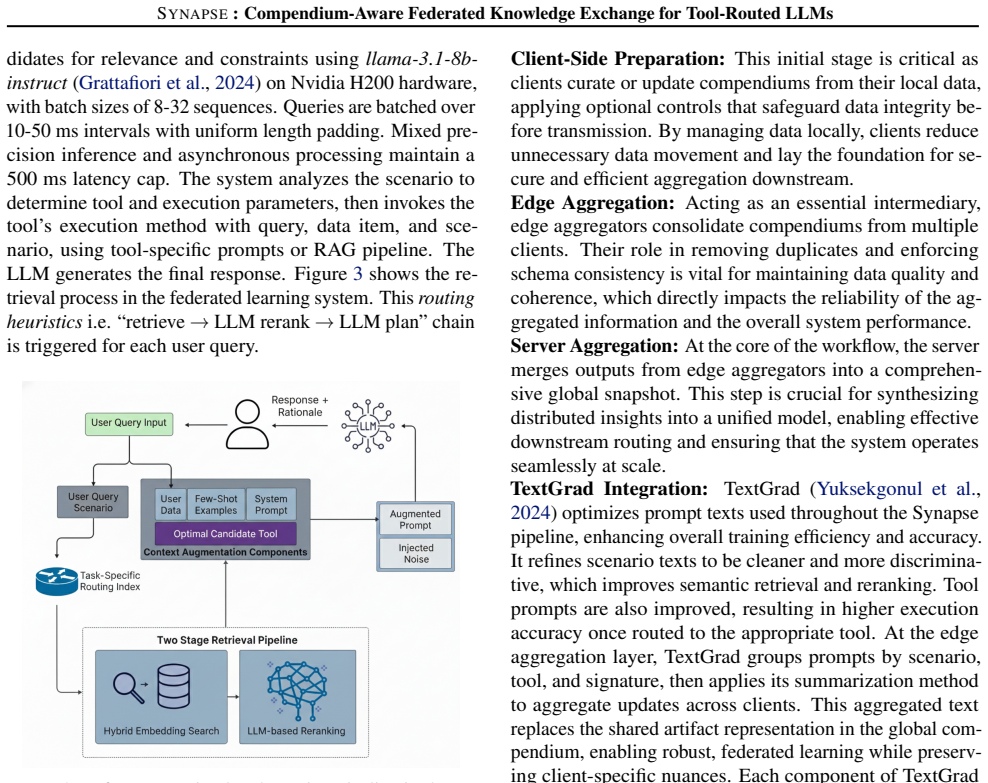
The central object is the compendium, a schema-validated JSON artifact whose fields—tool metadata, usage scenarios, precautions, prompt templates, and structured annex—are the units of federation. The typed merge operator performs field-wise conflict resolution during edge and central aggregation; per-field privacy operations, Laplace noise on numeric metadata and adaptive token masking on usage scenarios, are applied before sharing. Routing itself runs as a retrieve-then-rerank-then-plan pipeline, and the formal stability argument treats the routing operator as a contraction on a metric space of routing decisions, invoking Banach's fixed-point theorem to claim almost-sure convergence of too
What would settle it
Measure the routing operator's round-to-round Lipschitz constant on real client-update trajectories; if it reaches 1 on any distribution, the Banach fixed-point argument in Theorem A.2 cannot deliver almost-sure convergence. Alternatively, run the cross-family transfer experiment with an LLM family held out during federation; if the accuracy drop consistently exceeds the reported ~2 points, the portability claim is falsified.
Extended reading notes
Core claim
The paper's central claim is a change in the unit of exchange: instead of sharing model weights, prompts, or raw examples, clients share compendiums—typed JSON documents holding tool descriptions, usage scenarios, precautions, prompt templates, and a structured annex. Because the schema is explicit, operations like merging, privacy perturbation, and cross-model transfer can be defined field by field. A typed merge operator resolves conflicts per field, Laplace noise gives a formal differential-privacy guarantee on numeric metadata, and retrieval distortion and routing stability are characterized across five distributions, including one where the contraction premise used in the stability proo
Load-bearing premise
The formal convergence guarantee rests on the routing operator being a contraction (Lipschitz constant below 1), a premise the paper neither measures nor proves and that it concedes fails for one of its five test distributions.
Editorial extensions
If this is right
- Federated tool routing no longer requires clients to run the same LLM; frozen heterogeneous models can share a global routing artifact.
- Per-field privacy becomes operationally meaningful: numeric metadata receives formal differential privacy while textual scenarios get tunable masking, with masking affecting retrieval more than metadata noise.
- Communication during federation drops to kilobytes per client per round instead of gigabytes, enabling bandwidth-constrained deployments.
- Routing decisions stabilize under stationary conditions with fixed privacy noise, suggesting a federation can converge on tool selection without sharing gradients.
Reading between the lines
- Beyond the paper: if compendium transfer really holds across LLM families, the artifact could become a portable interchange format for tool knowledge, letting an organization build a routing compendium once and deploy it on whatever model it later adopts.
- Beyond the paper: the error analysis suggests retrieval quality is the main bottleneck; a direct extension would test whether replacing the embedding model alone recovers most of the accuracy lost under non-IID splits, independent of the federation protocol.
- Beyond the paper: the convergence result is shown for stationary client updates; under non-stationary or adversarial updates the paper's own experiments show oscillation, so a practical deployment would need drift detection—a testable extension rather than a claim of the paper.
- Beyond the paper: the DP guarantee covers numeric metadata, while text masking is heuristic; a sharper extension would compute an end-to-end privacy loss across the full pipeline, including the summarization step, and measure it against actual extraction attacks.
Editorial analysis
A structured set of objections, weighed in public.
Referee Report
Summary. The paper proposes SYNAPSE, a federated knowledge-exchange framework in which clients with frozen, heterogeneous LLMs share structured JSON 'compendiums' containing tool metadata, usage scenarios, precautions, prompt templates, and structured annexes, rather than model weights or raw prompts. Compendiums are aggregated hierarchically (client-edge-server), optionally refined with TextGrad prompt optimization, and used at inference for embedding retrieval plus LLM reranking to route queries to tools. The manuscript claims a typed merge operator, per-field differential privacy via Laplace noise and adaptive masking, routing-stability/convergence guarantees, communication superiority over weight sharing, and cross-LLM-family transfer. The body reports experiments on GSM8k and two BBH tasks, privacy/robustness analyses, and appendices containing theoretical claims and additional experiments.
Significance. If fully supported, the idea of typed compendium artifacts with per-field privacy, schema-aware merging, and cross-architecture transfer would be a useful contribution to federated LLM tool routing. The communication-cost comparison to fp32 weight sharing is in-principle favorable, and the paper provides an anonymous code URL and detailed appendices that aid reproducibility. However, the central cross-family transfer claim in the abstract is not present in the body, and the formal privacy and convergence theorems are either conditional on unproved assumptions or incomplete. The significance of the claimed results cannot be assessed until those gaps are addressed.
major comments (5)
- [Abstract vs. Appendix D] The abstract claims: 'A single compendium transfers across four LLM families (LLaMA 3.1-8B, LLaMA 3.2-3B, Mistral 7B, GPT-4o) with approximately 2 pt loss.' No experiment in the body or appendices reports such a transfer. Appendix D, Table 4 reports only prompt transfer from LLaMA 3.2-11B to LLaMA 3.2-3B on three tasks, with changes +0.03, +0.15, and -0.08; no Mistral 7B or GPT-4o compendium-transfer result appears, and no 2-pt-loss figure is given. Table 3 is a centralized-vs-federated comparison, not a cross-family transfer. Since the cross-architecture transfer claim is the stated advantage over weight-sharing federation, this is missing evidence for the paper's headline capability. The manuscript must either add the four-family experiment or substantially revise the abstract and conclusions to match the evidence.
- [Appendix A.2, Theorem A.2] Theorem A.2 assumes the routing operator R is a Lipschitz contraction with L<1 on a complete metric space of routing decisions. This is exactly the routing-stability property to be established; Banach's theorem then yields the conclusion without additional content. The manuscript does not measure, bound, or prove the contraction constant for the actual SYNAPSE routing operator, and the abstract itself concedes the premise fails for one of the five distributions. The stochastic component is dismissed as a martingale difference sequence with bounded variance, again without verification. As stated, the result is conditional and does not provide the claimed convergence guarantee. A valid argument needs either an explicit contraction estimate or a different mechanism (e.g., diminishing update magnitudes) with assumptions checked on the evaluated distributions.
- [Appendix A.3, Theorem A.3] The DP claim for artifact sharing is incomplete. The Laplace mechanism for numeric metadata is standard, but Theorem A.3 asserts that adaptive text masking 'modeled as randomized response or local differential privacy on tokens' satisfies epsilon-DP. The masking rule in Appendix A, p(w)=min(1, lambda*kappa(w)), depends on a per-token saliency score; no output alphabet or mechanism is specified, and the dependence of p on the token itself means the mask pattern can leak information about that token. Deterministic summarization/truncation is also not DP. The advanced composition formula is standard but cannot be applied until a per-round epsilon for the masking step is established. The theorem should either define a concrete mechanism with a proof, or be replaced by a claim limited to numeric metadata.
- [Appendix A.1, Theorem A.1] Theorem A.1's proof assumes the privacy transformation is an epsilon-DP randomized mapping and that epsilon-DP implies a bound on expected text distance delta_s(epsilon). Neither follows from differential privacy definitions; DP constrains output probabilities, not metric distance to the input. The proof also assumes the embedding is Lipschitz and that similarity deviations are Lipschitz in the embedding, with no constants estimated. Consequently the 'bounded embedding distortion' and 'conditional retrieval distortion' claims in the abstract are not established. If the intent is only an empirical distortion characterization, Figure 12 should be presented with error bars and a clear statement that no formal bound is proved.
- [Tables 1, 3, 4 and Fig. 7] The empirical evaluation is reported as point estimates without repeated-run uncertainty. Table 1 reports client-level spread and std. dev., but these measure client heterogeneity, not run-to-run variability. Tables 3 and 4 report single accuracies or deltas with no confidence intervals or significance tests. Figure 7's convergence trajectories are single examples with fixed/unfixed noise. Without repeated-seed experiments, claims such as 'performance comparable to centralized retrieval-only' and the transfer deltas in Table 4 cannot be assessed. Please provide repeated-run error bars or at least state the number of runs and the variance across runs.
minor comments (4)
- [Appendix E, Table 5] The Weight-Share row is internally inconsistent: the text says 64 GB per client per round, but the table's Avg. Bytes/Client/Round entries (564*10^9 and 864*10^9) do not match the totals or the text. Please reconcile the units and values.
- [Appendix A.4] The text contains an unexplained line 'Joy Maa Baglamukhi' after Figure 12, and an incomplete citation 'sum - uid (Chen et al., 2025)'. These appear to be editing artifacts and should be removed or clarified.
- [Section 4.2 and Appendix A.4] The acronym ALT is introduced as 'Adaptive Laplace Text Noise' in Appendix A.4, but the earlier text consistently calls the mechanism 'adaptive text masking'. Please standardize the terminology.
- [References] Several references have formatting issues, e.g., 'DworkCynthia & RothAaron' lacks a space, and the entry for 'sum-uid' is incomplete. Please run a reference-checking pass.
Circularity Check
No load-bearing circular derivation; formal stability/DP results are explicitly conditional and the empirical routing numbers are independent evidence.
full rationale
The central empirical claims are measured directly (Tables 1, 3-5 and Figures 4-9), not produced from fitted parameters renamed as predictions. The theoretical results are stated as conditionals: Theorem A.1 assumes a Lipschitz embedding and a bounded-perturbation model; Theorem A.2 explicitly assumes the routing operator is a contraction with L<1 and then invokes Banach's fixed-point theorem; Theorem A.3 applies standard Laplace/composition DP. The abstract itself calls these 'conditional retrieval distortion and routing-stability results' and even notes a distribution 'where the contraction premise fails,' so the paper does not present the contraction assumption as a derived fact. The self-citations to Chakraborty et al. (2025) are contextual ("inspired by" and survey framing) and are not load-bearing. The serious problem is evidentiary, not circular: the abstract's four-LLM-family transfer claim is not present in the body; Appendix D only reports LLaMA 3.2-11B to 3.2-3B prompt-transfer deltas on three tasks, and the 'adaptive masking modeled as randomized response' step in Theorem A.3 is an asserted modeling assumption. These are missing-evidence/proof-gap issues rather than reductions of outputs to inputs, so the circularity score remains low.
Assumptions & free parameters
free parameters (7)
- DP budget ε =
1.0 default; {0.5,1.0,2.0} tested
- masking strength λ =
{0.5,1.0,1.5}
- retrieval top-K =
5
- scenario summarization caps =
280-character sentences; Lmax/Smax
- TextGrad batch size / local steps / rounds =
3 / 3 / 3
- client counts and per-client examples =
3/5/8 clients; 60/50/30 examples
- BM25 k1/b =
1.5 / 0.75
assumptions (7)
- ad hoc to paper Routing operator R is a Lipschitz contraction with L<1 on a complete metric space.
- domain assumption Embedding function e(·) and similarity are Lipschitz continuous with constants L_e and L_sim.
- ad hoc to paper Adaptive token masking satisfies local differential privacy / randomized response.
- standard math Laplace mechanism with sensitivity Δm on numeric metadata.
- domain assumption Dataset labels determine ground-truth tools.
- domain assumption Clients are honest-but-curious; no Byzantine adversaries in the formal privacy model.
- standard math Advanced DP composition and Banach fixed-point theorem.
invented entities (3)
-
Compendium schema artifact
-
Typed merge operator with field-wise conflict resolution
-
Adaptive text masking (ALT)
Cite this review
Pith. "Pith review of Synapse: Federated Tool Routing via Typed Compendium Artifacts." pith.science (2026). https://pith.science/paper/HGZM3IZH
@misc{pith2026260200911,
  author       = {Pith},
  title        = {Pith review of: Synapse: Federated Tool Routing via Typed Compendium Artifacts},
  year         = {2026},
  howpublished = {\url{https://pith.science/paper/HGZM3IZH}},
  note         = {Machine review of arXiv:2602.00911}
}
read the original abstract
The unit of collaboration in federated learning determines what guarantees are even expressible. Flat units like weights, prompts, raw examples, carry no type signature on which privacy, conflict resolution, or cross-model transfer can dispatch as well-defined operations. We propose typed federated artifacts: schema validated objects whose declared field structure makes per field differential privacy, schema aware merging, and cross architectural transfer first-class operations rather than heuristic approximations. We instantiate this as SYNAPSE, a compendium for federated tool routing across clients with frozen, heterogeneous LLMs and no shared data or weights which is a setting flat units cannot handle without either leaking gradients or discarding structure. The compendium admits a typed merge operator with field wise conflict resolution, a formal DP guarantee on numeric metadata, and conditional retrieval distortion and routing-stability results empirically characterized on five distributions, including one where the contraction premise fails. A single compendium transfers across four LLM families (LLaMA 3.18B,LLaMA 3.2-3B, Mistral 7B, GPT 4o) with approximately 2 pt loss, a capability weight-sharing federation cannot provide without architectural matching.
Figures


Figures from the paper (8 more)


Reference graph
Works this paper leans on
-
[1]
R is Lipschitz continuous with constant L <1, i.e., a contraction: d(R(x),R(y))≤Ld(x, y),∀x, y∈ T
-
[2]
gpt-5.1", messages=[ {
Updates to ζ (r) g due to compendium aggregation are bounded and diminish over rounds, i.e., ∥ζ (r+1) g −ζ (r) g ∥ → 0. By Banach’s fixed-point theorem, any contraction mapping on a complete metric space admits a unique fixed point t∗ such that: R(t∗) =t ∗. The sequence {tr} generated by successive applications of Rconverges tot ∗: lim r→∞ tr =t ∗. Stocha...
2014
-
[388]
URL https://aclanthology.org/2025. findings-emnlp.388/. Chen, M., Jin, R., Deng, W., Chen, Y ., Huang, Z., Yu, H., and Li, X. Can Textual Gradient Work in Feder- ated Learning?, February 2025. URL http://arxiv. org/abs/2502.19980. arXiv:2502.19980 [cs]. Cobbe, K., Kosaraju, V ., Bavarian, M., Chen, M., Jun, H., Kaiser, L., Plappert, M., Tworek, J., Hilton...
arXiv 2025
Reviewed August 3, 2026 · model on record in the stance chip above.
Discussion (0). Continue with ORCID to comment.