REVIEW 3 major objections 4 minor 1 cited by
An infrared echo from a circumstellar disk in the hydrogen- and helium-poor SN 2024aecx
T0 review · 3 major / 4 minor · reviewed 2026-08-03 · deepseek-v4-flash
Pith's one-line read SN 2024aecx's late near-infrared glow is an infrared echo: light from the supernova peak re-radiated by pre-existing dust in a face-on circumstellar disk, making it the first such echo seen around a Type Ic supernova.
desk verdict The paper reports a genuinely new NIR excess in a Type Ic SN that looks like an IR echo from pre-existing CSM dust, and the data are strong — but the luminosity tuning and the equally good optically thick new-dust fit mean the central claim is not yet closed. read the letter →
The pith
A machine-rendered reading of the paper's core claim, the machinery that carries it, and where it could break.
The reading
What carries the argument
The load-bearing object is the infrared echo geometry: at each observing time, light from the SN peak that traveled an extra path length ct reaches a paraboloid of dust with the supernova at its focus, placing the echoing dust near distance c(t-t_peak). The authors combine single-temperature, optically thin dust fits with a 3D grid simulation of spherical, wind, shell, and thick-disk geometries; only the disk reproduces the observed temperature and mass evolution. They also use the equal-arrival-time volume to compute lower-limit optical depths and an analytic dust-heating relation (T_dust ∝ L_SN^1/2/r) to identify the echo's light source as the SN peak rather than shock cooling.
What would settle it
Watch SN 2024aecx between roughly 440 and 640 days post-explosion with radio, X-ray, and optical spectroscopy: the disk-echo model predicts the shock slamming into the disk's inner edge in that window, producing interaction signatures. If the supernova fades cleanly past about 700 days with no interaction, the inferred inner edge or the pre-existing-dust interpretation is wrong.
Extended reading notes
Core claim
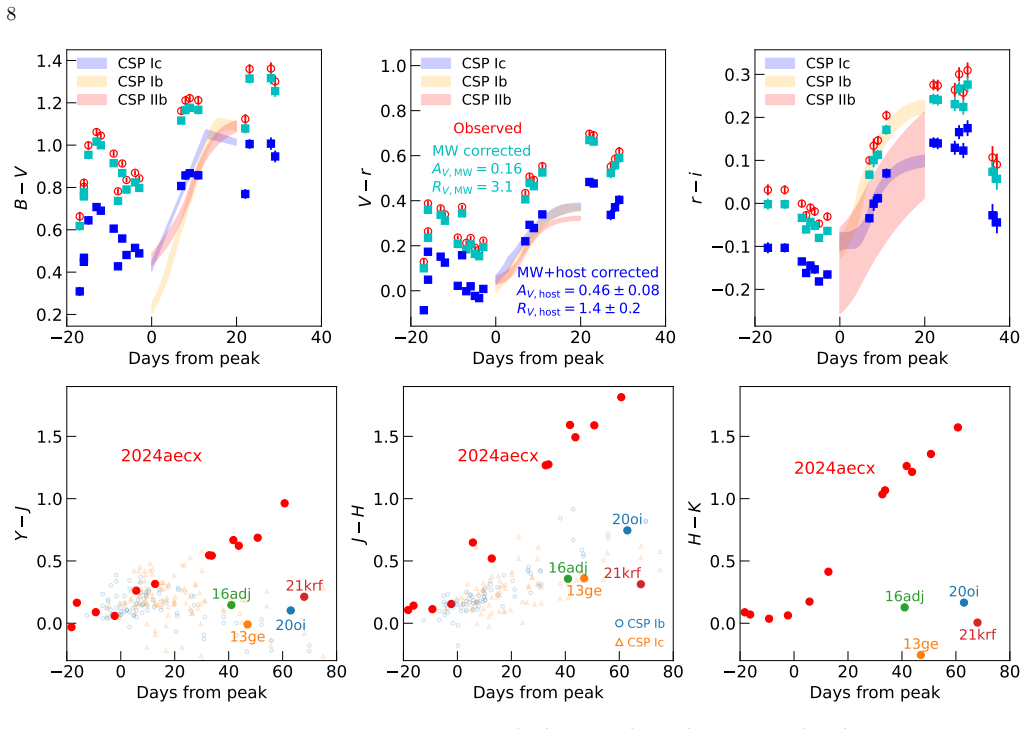
The central claim: the strong near-infrared excess that appears in SN 2024aecx 12–32 days past peak is thermal emission from pre-existing circumstellar dust, not newly formed ejecta dust. The dust is optically thin, about 10^-4 solar masses, with temperature declining from ~1130 to ~870 K, mass growing as (t-t_peak)^2, and luminosity roughly constant. The authors identify this as an infrared echo powered by the slowly evolving supernova peak, since powering it with the brief shock-cooling flash would require an implausibly dense, optically thick CSM. The single-temperature SED implies the echoing dust sits at roughly one distance per epoch, selecting a thick, nearly face-on disk with inner e
Load-bearing premise
The load-bearing premise is that the echo's light source has a luminosity near 1×10^42 erg/s; if the true peak luminosity is closer to the published 2.5×10^42 erg/s, the inferred dust distances grow and the preferred face-on disk geometry — along with the 440-day interaction prediction — shifts.
Editorial extensions
If this is right
- If the echo interpretation is correct, this is the first infrared echo from circumstellar dust reported for a Type Ic supernova, showing that at least some stripped-envelope progenitors shed mass close to explosion.
- The dusty disk's inner edge, ~5.7±2.6×10^16 cm, is similar to the CSM around the interacting SN 2014C, placing SN 2024aecx in a small class of stripped-envelope supernovae with close-in circumstellar material.
- The shock should reach the disk 440±200 days post-explosion; follow-up spectroscopy and imaging in that window will test the geometry and reveal whether the CSM is hydrogen-rich or hydrogen-poor.
- The implied mass-loss rate of about 10^-4 solar masses per year (for a 100 km/s wind) is lower than strongly interacting stripped-envelope supernovae, suggesting a weaker or different mass-loss channel shortly before death.
- The alternative optically thick scenario would require more than 10^-3 solar masses of dust formed within ~54 days of explosion, which the authors argue is implausible; thus the echo reading also constrains how fast supernova dust can form.
Reading between the lines
- Not in the paper, but if the echo picture holds, the same near-infrared monitoring strategy should find similar echoes in other stripped-envelope supernovae, turning a rare event into a census of late-stage mass loss.
- If the higher published peak luminosity (2.5×10^42 erg/s) is correct rather than the 1×10^42 erg/s adopted to match the dust temperatures, the inferred dust distances and disk inner edge grow, and the 440-day interaction date would come later; an independent bolometric light curve would discriminate.
- A face-on disk predicts little time-variable extinction of the supernova; if later spectra show reddening or broadened emission as the shock plows into the disk, the assumed geometry would need revision.
Editorial analysis
A structured set of objections, weighed in public.
Referee Report
Summary. The paper presents a dense NIR spectroscopic monitoring campaign of the Type Ic SN 2024aecx, covering -18 to +60 d from peak. A strong NIR excess appears between 12 and 32 d, while the optical colors remain normal. The authors fit the excess with single-temperature dust models, finding two equally good solutions: optically thin dust (temperature declining from ~1130 K to ~870 K; mass growing as roughly (t-t_peak)^2) and optically thick dust (hotter, with a mass lower limit of ~10^-3 M_sun). They argue that the optically thick scenario would require dust formation too early in the ejecta, and instead interpret the optically thin solution as an IR echo from pre-existing CSM dust heated by SN peak light. A simple 3D geometry simulation is used to argue that a thick, face-on disk with an inner edge around 5×10^16 cm best matches the evolution, and they predict the SN shock will interact with this CSM at 440±200 d after explosion.
Significance. If the echo interpretation is correct, this is the first reported IR echo from CSM dust around a Type Ic SN, providing rare observational leverage on the mass-loss history of a stripped-envelope progenitor. The observational dataset is a clear strength: 14 epochs, five instruments, consistent flux checks, and clean line-free continuum fits. The paper also makes a concrete, falsifiable prediction—shock interaction with the disk at ~440±200 d—which makes the claim testable with ongoing or scheduled follow-up. The main weaknesses are that the key interpretation is anchored to an adopted source luminosity that is not derived from the paper's own extinction analysis, and that the equally good optically thick/new-dust fit is not quantitatively excluded.
major comments (3)
- [§5.3.2, Fig. 10] The IR-echo model is anchored to an adopted echo source L_SN = 10^42 erg/s and T_SN = 7000 K, below the published peak (2.5×10^42 erg/s; Zou et al. 2026, Xi et al. 2025). The paper justifies this by suggesting the host extinction in those works is overestimated, but it never recomputes the bolometric peak with its own A_V,host = 0.46 ± 0.08, R_V = 1.4 ± 0.2. Because dust temperature scales roughly as L^(1/4) at fixed radius, the inner-disk radius, the optical-depth argument against shock cooling, and the predicted interaction epoch 440 ± 200 d all shift if L is higher. I request a recomputed peak luminosity and an explicit sensitivity analysis over L = 1–2.5 × 10^42 erg/s.
- [§5.3 vs. §4.4] Table 2 and Fig. 8 show that the optically thick and optically thin dust fits are equally good. The rejection of the optically thick scenario is based on the promptness of >10^-3 M_sun dust formation and the lack of strong interaction luminosity, but no quantitative dust-formation model is presented. The paper itself notes in §4.4 that the boxy Mg I line suggests a cold dense shell 'ripe for later dust formation', and it cites SN 2006jc as a hydrogen-poor interacting SN with prompt CDS dust. If prompt dust formation cannot be excluded, the unique echo/pre-existing-dust conclusion is not established. Please provide a quantitative upper limit on CDS dust mass for this SN, or soften the conclusion to a preferred scenario and state the degeneracy explicitly.
- [§5.3.2, Fig. 12] The geometry comparison is calibrated to the data in several ways: L_SN is chosen to match the temperature curve, η=0.35 is chosen as the smallest value for which the disk is optically thin, and the models are scaled to the third-epoch dust mass. Consequently, the good agreement of the disk model is partly by construction. To claim that a thick face-on disk 'best explains' the evolution, the authors should marginalize over or vary L, η, and the normalization and show the corresponding best fits for the sphere/wind/shell geometries. Otherwise the comparison is not a fair discrimination of CSM geometry. In addition, the text is internally inconsistent: it states that 'wind and disk models produce temperature and mass evolution that are more in tension with the data' and then immediately states that the thick disk temperature evolution is in good agreement.
minor comments (4)
- [Figure 4 caption vs. §3] The caption reports A_V,host = 0.39 ± 0.09 and R_V,host = 0.89 ± 0.16, while §3 gives A_V,host = 0.46 ± 0.08 and R_V,host = 1.4 ± 0.2. Please reconcile these values and state which set is used in the analysis.
- [§5.3 (near Fig. 10)] The phrase 'c(t−t peak/2' is missing a closing parenthesis and is ambiguous; it should read c(t−t_peak)/2. Similar notation should be checked in the caption of Fig. 10 and in the schematic of Fig. 11.
- [References] The surname 'Pyykkinen' in the reference list likely contains a typo; please verify the spelling against the original source.
- [§5.1, Table 2] For the optically thin fits, the reported radius column is a lower limit, but the table header just says 'r_BB'. Consider labeling it as a lower limit to avoid confusion with the blackbody radius of the optically thick case.
Circularity Check
Source luminosity and disk-model mass are tuned to the observed dust temperature/mass; the IR-echo claim retains an independent promptness argument, so circularity is partial.
-
fitted input called prediction
[Section 5.3.2, Figure 10 and the disk simulation]
"To better fit the observations, we set the temperature and luminosity of the source to 7000 K and 10^42 erg/s (see Figure 10), and compute the dust temperature for each cell."
The adopted source luminosity is the key input to the dust-temperature/distance relation (Eq. 2) and to the CSM-geometry simulation. The paper chooses L_SN = 10^42 erg/s, below the published peak of 2.5x10^42 erg/s, with the stated justification that this value 'is consistent with our observed temperature.' The observed T_dust is therefore used to select L_SN, after which the same observed T_dust is presented as being explained by the IR-echo model and used to favor the face-on disk and to scale the inferred dust distances/inner edge. The temperature match is thus partly by construction rather than an independent prediction.
-
fitted input called prediction
[Section 5.3.2, Figure 12]
"we scale the model so that the mass in the third epoch match the observation"
The disk simulation's absolute dust mass is normalized to the third-epoch observed dust mass. The paper then concludes that the thick disk 'can best explain the dust mass and temperature evolution.' The temperature comparison is physically meaningful, but the mass comparison is anchored to one fitted data point, so the model cannot independently reproduce the observed dust mass normalization. This is a standard model-normalization step rather than a complete circularity, but it is a second place where the 'explanation' depends on tuning the model to the data it is then said to explain.
full rationale
The central claim that the NIR excess is an IR echo from pre-existing CSM dust is not definitionally circular. The strongest independent evidence is the rapid onset of the excess between 12 and 32 days post-peak, together with the argument that an optically thick, newly formed dust shell would require an implausibly large dust mass at very early epochs, and the observed optical colors staying normal while the NIR becomes very red. These empirical arguments do not reduce to the model inputs. However, the quantitative echo interpretation contains two fitted inputs that are then presented as successful explanations: (1) the source luminosity/temperature for the echo is set to 7000 K and 10^42 erg/s specifically 'to better fit the observations,' even though the published bolometric peak is about 2.5x10^42 erg/s; and (2) the disk simulation is normalized to the third-epoch observed dust mass. Both choices weaken the predictive content of the geometry comparison, but they do not force the conclusion because the promptness and optically-thin/optically-thick arguments are independent of these tunings. The self-citations to Tinyanont et al. (2019, 2024, 2025) are used for reduction methods, spectral comparison, and the SN 2014C analogy; they are not load-bearing for the IR-echo conclusion. On balance, this is partial circularity through fitted inputs, not a derivation equivalent to its inputs by definition.
Assumptions & free parameters
free parameters (9)
- Dust temperature T_d (per epoch) =
1126.6–869.8 K (optically thin); 1583.9–1130.5 K (optically thick)
- Dust mass M_d (per epoch) =
0.66–2.6e-4 Msun (thin); >0.85–7.0e-3 Msun (thick)
- Blackbody radius r_BB (per epoch) =
>1.1–1.7e16 cm (thin); 0.62–1.2e16 cm (thick)
- Echo source luminosity L_SN =
1e42 erg/s (chosen; published peak 2.5e42 erg/s)
- Shock velocity v_shock =
15,000 km/s (arbitrary)
- Disk thickness parameter η =
0.35
- CSM outer radius R_out =
5e17 cm
- Gas-to-dust ratio =
100
- Host extinction A_V, R_V =
A_V = 0.46±0.08, R_V = 1.4±0.2
assumptions (7)
- standard math Dust emission formula F = M_d B_ν(T_d) κ_ν P_esc / d^2 (Eq. 1)
- standard math Dust temperature-radius relation from Fox et al. 2010 (Eq. 2)
- standard math IR echo equal-arrival-time paraboloid geometry (Dwek 1983)
- domain assumption Single-temperature, optically thin dust with 0.1 μm carbonaceous grains
- domain assumption Pre-existing dust in CSM rather than newly formed dust
- domain assumption Spherical symmetry for dust-density lower-limit calculation
- ad hoc to paper Disk geometry with η = 0.35 and face-on orientation
invented entities (1)
-
Thick face-on circumstellar dust disk
independent evidence
Cite this review
Pith. "Pith review of An infrared echo from a circumstellar disk in the hydrogen- and helium-poor SN 2024aecx." pith.science (2026). https://pith.science/paper/YUAEOT5Y
@misc{pith2026260202691,
  author       = {Pith},
  title        = {Pith review of: An infrared echo from a circumstellar disk in the hydrogen- and helium-poor SN 2024aecx},
  year         = {2026},
  howpublished = {\url{https://pith.science/paper/YUAEOT5Y}},
  note         = {Machine review of arXiv:2602.02691}
}
abstract
We present near-infrared (NIR) spectroscopy of the hydrogen- and helium-poor (Type Ic) supernova (SN) 2024aecx, which displays a strong NIR excess emerging 32 days post peak. SN 2024aecx is a peculiar SN Ic that exhibited luminous shock-cooling emission at early times, suggestive of close-in circumstellar medium (CSM), unexpected for this class of SNe. Its early NIR spectra are typical for a SN Ic but with strong C I absorption features. By $\sim$32 days post peak, the spectra show a strong NIR excess, while maintaining normal optical colors, unprecedented for SNe Ic. We find that the NIR excess is well fit with a single-temperature, optically thin dust model with declining temperature, increasing mass, and roughly constant luminosity over time. The NIR excess appears too promptly for dust to have formed in the SN ejecta, indicating an IR echo from pre-existing dust in the CSM. The IR echo is likely powered by the relatively slowly evolving SN peak light, and not the brief shock cooling emission, as the latter requires unrealistically high CSM densities to explain the observed dust mass. We consider different potential CSM geometries and find that a thick face-on disk with an inner edge of around $5\times 10^{16} \rm \ cm$ can best explain the dust mass and temperature evolution. In this scenario, the SN shock should start interacting with this CSM $440\pm200$ days post explosion. CSM around SN Ic is rare, and follow-up observations of SN 2024aecx will probe the mass-loss process responsible for removing hydrogen and helium from their progenitor star.
Figures


Figures from the paper (8 more)


Forward citations
Cited by 1 Pith paper
-
JWST observations of SN 2024abup: First Detection of CO in a broad-lined Type Ic Supernova and Constraints on r-process Nucleosynthesis
JWST spectra of SN 2024abup show CO, C, O, and Mg features plus possible dust emission, with no clear r-process signatures identified via SUMO modeling.
Reference graph
Works this paper leans on
-
[1]
J., Bostroem, K
Andrews, J., Sand, D. J., Bostroem, K. A., et al. 2024a, Transient Name Server Classification Report, 2024-4943, 1
2024
-
[2]
A., Sand, D
Andrews, J., Bostroem, K. A., Sand, D. J., et al. 2024b, Transient Name Server Classification Report, 2024-4974, 1
2024
-
[3]
Andrews, J. E., Clayton, G. C., Wesson, R., et al. 2011, AJ, 142, 45, doi: 10.1088/0004-6256/142/2/45 Astropy Collaboration, Robitaille, T. P., Tollerud, E. J., et al. 2013, A&A, 558, A33, doi: 10.1051/0004-6361/201322068 Astropy Collaboration, Price-Whelan, A. M., Sip˝ ocz, B. M., et al. 2018, AJ, 156, 123, doi: 10.3847/1538-3881/aabc4f
-
[4]
Balasubramanian, A., Corsi, A., Polisensky, E., Clarke, T. E., & Kassim, N. E. 2021, ApJ, 923, 32, doi: 10.3847/1538-4357/ac2154
-
[5]
Banerjee, D. P. K., Joshi, V., Evans, A., et al. 2018, MNRAS, 481, 806, doi: 10.1093/mnras/sty2255
-
[6]
Bode, M. F., & Evans, A. 1980, MNRAS, 193, 21P, doi: 10.1093/mnras/193.1.21P
-
[7]
2022, ApJ, 939, 105, doi: 10.3847/1538-4357/ac8b14
Brethauer, D., Margutti, R., Milisavljevic, D., et al. 2022, ApJ, 939, 105, doi: 10.3847/1538-4357/ac8b14
-
[8]
A., Chugai, N., Milisavljevic, D., & Fransson, C
Chandra, P., Chevalier, R. A., Chugai, N., Milisavljevic, D., & Fransson, C. 2020, ApJ, 902, 55, doi: 10.3847/1538-4357/abb460
Show all 102 references
-
[9]
W., Yang, S., Stevance, H
Chen, T. W., Yang, S., Stevance, H. F., et al. 2024, Transient Name Server AstroNote, 372, 1
2024
-
[10]
A., & Fransson, C
Chevalier, R. A., & Fransson, C. 1994, ApJ, 420, 268, doi: 10.1086/173557
1994 doi
-
[11]
2015, PASP, 127, 406, doi: 10.1086/680598
Chilingarian, I., Beletsky, Y., Moran, S., et al. 2015, PASP, 127, 406, doi: 10.1086/680598
2015 doi
-
[12]
N., & Chevalier, R
Chugai, N. N., & Chevalier, R. A. 2006, ApJ, 641, 1051, doi: 10.1086/500539
2006 doi
-
[13]
Crotts, A. P. S. 1988, ApJL, 333, L51, doi: 10.1086/185286
1988 doi
-
[14]
C., Vacca, W
Cushing, M. C., Vacca, W. D., & Rayner, J. T. 2004, PASP, 116, 362, doi: 10.1086/382907
2004 doi
-
[15]
Dessart, L., & Hillier, D. J. 2022, A&A, 660, L9, doi: 10.1051/0004-6361/202243372
2022 doi
- [16]
- [17]
-
[18]
Dwek, E., & Arendt, R. G. 2008, ApJ, 685, 976, doi: 10.1086/589988
2008 doi
-
[19]
G., et al
Dwek, E., Sarangi, A., Arendt, R. G., et al. 2021, ApJ, 917, 84, doi: 10.3847/1538-4357/ac09ea
2021 doi
-
[20]
G., et al
Eikenberry, S., Bandyopadhyay, R., Bennett, J. G., et al. 2012, in Society of Photo-Optical Instrumentation Engineers (SPIE) Conference Series, Vol. 8446, Ground-based and Airborne Instrumentation for Astronomy IV, ed. I. S. McLean, S. K. Ramsay, & H. Takami, 84460I, doi: 10.1...
2012 doi
-
[21]
S., Elston, R., Raines, S
Eikenberry, S. S., Elston, R., Raines, S. N., et al. 2004, in Society of Photo-Optical Instrumentation Engineers (SPIE) Conference Series, Vol. 5492, Ground-based Instrumentation for Astronomy, ed. A. F. M. Moorwood & M. Iye, 1196–1207, doi: 10.1117/12.549796
2004 doi
-
[22]
Crockett, R. M. 2013, MNRAS, 436, 774, doi: 10.1093/mnras/stt1612
2013 doi
-
[23]
H., Joyce, R
Elias, J. H., Joyce, R. R., Liang, M., et al. 2006, in Society of Photo-Optical Instrumentation Engineers (SPIE) Conference Series, Vol. 6269, Society of Photo-Optical Instrumentation Engineers (SPIE) Conference Series, ed. I. S. McLean & M. Iye, 62694C, doi: 10.1117/12.671817
2006 doi
-
[24]
2024, MNRAS, 529, L33, doi: 10.1093/mnrasl/slad195
Ferrari, L., Folatelli, G., Kuncarayakti, H., et al. 2024, MNRAS, 529, L33, doi: 10.1093/mnrasl/slad195
2024 doi
-
[25]
Filippenko, A. V. 1997, ARA&A, 35, 309, doi: 10.1146/annurev.astro.35.1.309
1997 doi
-
[26]
A., Fesen, R
Finn, R. A., Fesen, R. A., Darling, G. W., Thorstensen, J. R., & Worthey, G. S. 1995, AJ, 110, 300, doi: 10.1086/117519
1995 doi
-
[27]
Fitzpatrick, E. L. 1999, PASP, 111, 63, doi: 10.1086/316293 20
1999 doi
-
[28]
D., Chevalier, R
Fox, O. D., Chevalier, R. A., Dwek, E., et al. 2010, ApJ, 725, 1768, doi: 10.1088/0004-637X/725/2/1768
2010 doi
-
[30]
2014, Nature, 511, 326, doi: 10.1038/nature13558
Gall, C., Hjorth, J., Watson, D., et al. 2014, Nature, 511, 326, doi: 10.1038/nature13558
2014 doi
-
[31]
R., Meikle, W
Graham, J. R., Meikle, W. P. S., Selby, M. J., et al. 1983, Nature, 304, 709, doi: 10.1038/304709a0
1983 doi
-
[32]
2024, Transient Name Server Classification Report, 2024-4947, 1
Hinkle, J. 2024, Transient Name Server Classification Report, 2024-4947, 1
2024
-
[33]
D., Karamehmetoglu, E., et al
Holmbo, S., Stritzinger, M. D., Karamehmetoglu, E., et al. 2023, A&A, 675, A83, doi: 10.1051/0004-6361/202245334
2023 doi
-
[34]
J., Valenti, S., Kotak, R., et al
Hunter, D. J., Valenti, S., Kotak, R., et al. 2009, A&A, 508, 371, doi: 10.1051/0004-6361/200912896 Jacobson-Gal´ an, W. V., Dessart, L., Kilpatrick, C. D., et al. 2025, ApJL, 994, L14, doi: 10.3847/2041-8213/ae157a
2009 doi
-
[35]
2017, in Handbook of Supernovae, ed
Jerkstrand, A. 2017, in Handbook of Supernovae, ed. A. W. Alsabti & P. Murdin, 795, doi: 10.1007/978-3-319-21846-5 29
2017 doi
-
[36]
D., Foley, R
Kilpatrick, C. D., Foley, R. J., Drout, M. R., et al. 2018, MNRAS, 473, 4805, doi: 10.1093/mnras/stx2675
2018 doi
-
[37]
D., Drout, M
Kilpatrick, C. D., Drout, M. R., Auchettl, K., et al. 2021, MNRAS, 504, 2073, doi: 10.1093/mnras/stab838
2021 doi
-
[38]
Kotak, R., Meikle, W. P. S., Farrah, D., et al. 2009, ApJ, 704, 306, doi: 10.1088/0004-637X/704/1/306
2009 doi
-
[39]
2023, A&A, 678, A209, doi: 10.1051/0004-6361/202346526
Kuncarayakti, H., Sollerman, J., Izzo, L., et al. 2023, A&A, 678, A209, doi: 10.1051/0004-6361/202346526
2023 doi
-
[40]
2023, Research Notes of the American Astronomical Society, 7, 214, doi: 10.3847/2515-5172/ad0044
Labrie, K., Simpson, C., Cardenes, R., et al. 2023, Research Notes of the American Astronomical Society, 7, 214, doi: 10.3847/2515-5172/ad0044
2023 doi
-
[41]
J., Almaini, O., et al
Lawrence, A., Warren, S. J., Almaini, O., et al. 2007, MNRAS, 379, 1599, doi: 10.1111/j.1365-2966.2007.12040.x
2007
-
[42]
R., Walton, N
Lewis, J. R., Walton, N. A., Meikle, W. P. S., et al. 1994, MNRAS, 266, L27, doi: 10.1093/mnras/266.1.L27
1994 doi
-
[43]
2015, ApJ, 807, 35, doi: 10.1088/0004-637X/807/1/35
Maeda, K., Hattori, T., Milisavljevic, D., et al. 2015, ApJ, 807, 35, doi: 10.1088/0004-637X/807/1/35
2015 doi
-
[44]
2017, ApJ, 835, 140, doi: 10.3847/1538-4357/835/2/140
Margutti, R., Kamble, A., Milisavljevic, D., et al. 2017, ApJ, 835, 140, doi: 10.3847/1538-4357/835/2/140
2017 doi
- [45]
-
[46]
Mattila, S., Meikle, W. P. S., Lundqvist, P., et al. 2008, MNRAS, 389, 141, doi: 10.1111/j.1365-2966.2008.13516.x
2008
-
[47]
C., Filippenko, A
Mauerhan, J. C., Filippenko, A. V., Zheng, W., et al. 2018, MNRAS, 478, 5050, doi: 10.1093/mnras/sty1307
2018 doi
-
[48]
S., Steidel, C
McLean, I. S., Steidel, C. C., Epps, H. W., et al. 2012, in Proc. SPIE, Vol. 8446, Ground-based and Airborne Instrumentation for Astronomy IV, 84460J, doi: 10.1117/12.924794
2012 doi
-
[49]
2012, Publications of the Astronomical Society of the Pacific, 124, 1318, doi: 10.1086/669044
McLeod, B., Fabricant, D., Nystrom, G., et al. 2012, Publications of the Astronomical Society of the Pacific, 124, 1318, doi: 10.1086/669044
2012 doi
-
[50]
Meikle, W. P. S., Mattila, S., Gerardy, C. L., et al. 2006, ApJ, 649, 332, doi: 10.1086/506143
2006 doi
-
[51]
2015, ApJ, 815, 120, doi: 10.1088/0004-637X/815/2/120
Milisavljevic, D., Margutti, R., Kamble, A., et al. 2015, ApJ, 815, 120, doi: 10.1088/0004-637X/815/2/120
2015 doi
-
[52]
2024, ApJL, 965, L27, doi: 10.3847/2041-8213/ad324b P´ erez-Fournon, I., Aguado, D
Milisavljevic, D., Temim, T., De Looze, I., et al. 2024, ApJL, 965, L27, doi: 10.3847/2041-8213/ad324b P´ erez-Fournon, I., Aguado, D. S., Poidevin, F., et al. 2024, Transient Name Server AstroNote, 374, 1
2024 doi
-
[53]
M., Simon, J
Phillips, M. M., Simon, J. D., Morrell, N., et al. 2013, ApJ, 779, 38, doi: 10.1088/0004-637X/779/1/38
2013 doi
-
[54]
C., Vink´ o, J., et al
Pooley, D., Wheeler, J. C., Vink´ o, J., et al. 2019, ApJ, 883, 120, doi: 10.3847/1538-4357/ab3e36
2019 doi
-
[55]
X., & Bloom, J
Poznanski, D., Prochaska, J. X., & Bloom, J. S. 2012, MNRAS, 426, 1465, doi: 10.1111/j.1365-2966.2012.21796.x
2012
-
[56]
Pozzo, M., Meikle, W. P. S., Rayner, J. T., et al. 2006, MNRAS, 368, 1169, doi: 10.1111/j.1365-2966.2006.10204.x
2006
-
[57]
2020, The Journal of Open Source Software, 5, 2308, doi: 10.21105/joss.02308
Prochaska, J., Hennawi, J., Westfall, K., et al. 2020, The Journal of Open Source Software, 5, 2308, doi: 10.21105/joss.02308
2020 doi
-
[58]
X., Hennawi, J., Cooke, R., et al
Prochaska, J. X., Hennawi, J., Cooke, R., et al. 2020, pypeit/PypeIt: Release 1.0.0, v1.0.0, Zenodo Zenodo, doi: 10.5281/zenodo.3743493
2020 doi
-
[59]
2025, arXiv e-prints, arXiv:2512.11447, doi: 10.48550/arXiv.2512.11447
Pyykkinen, N., Nagao, T., Kuncarayakti, H., et al. 2025, arXiv e-prints, arXiv:2512.11447, doi: 10.48550/arXiv.2512.11447
2025 doi
-
[60]
M., Bregman, J., Witteborn, F
Rank, D. M., Bregman, J., Witteborn, F. C., et al. 1988, ApJL, 325, L1, doi: 10.1086/185096
1988 doi
-
[61]
P., Rho, J., Park, S., et al
Ravi, A. P., Rho, J., Park, S., et al. 2023, ApJ, 950, 14, doi: 10.3847/1538-4357/accddc
2023 doi
-
[62]
R., et al
Rho, J., Evans, A., Geballe, T. R., et al. 2021, ApJ, 908, 232, doi: 10.3847/1538-4357/abd850
2021 doi
-
[63]
Sarangi, A., & Slavin, J. D. 2022, ApJ, 933, 89, doi: 10.3847/1538-4357/ac713d
2022 doi
-
[64]
F., & Finkbeiner, D
Schlafly, E. F., & Finkbeiner, D. P. 2011, ApJ, 737, 103, doi: 10.1088/0004-637X/737/2/103
2011 doi
-
[65]
2024, A&A, 686, A129, doi: 10.1051/0004-6361/202348761
Sfaradi, I., Horesh, A., Sollerman, J., et al. 2024, A&A, 686, A129, doi: 10.1051/0004-6361/202348761
2024 doi
-
[66]
Y., Ashall, C., et al
Shahbandeh, M., Hsiao, E. Y., Ashall, C., et al. 2022, ApJ, 925, 175, doi: 10.3847/1538-4357/ac4030 21
2022 doi
-
[67]
2024, SN 2024aecx: A Gateway to Understanding Massive Star
Shahbandeh, M., Ashall, C., Baron, E., et al. 2024, SN 2024aecx: A Gateway to Understanding Massive Star
2024
-
[68]
D., Temim, T., et al
Shahbandeh, M., Fox, O. D., Temim, T., et al. 2025, ApJ, 985, 262, doi: 10.3847/1538-4357/adce77
2025 doi
-
[69]
M., et al
Shivvers, I., Mazzali, P., Silverman, J. M., et al. 2013, MNRAS, 436, 3614, doi: 10.1093/mnras/stt1839
2013 doi
-
[70]
2017, PASP, 129, 054201, doi: 10.1088/1538-3873/aa54a6
Shivvers, I., Modjaz, M., Zheng, W., et al. 2017, PASP, 129, 054201, doi: 10.1088/1538-3873/aa54a6
2017 doi
-
[71]
W., Smartt, S
Smith, K. W., Smartt, S. J., Young, D. R., et al. 2020, PASP, 132, 085002, doi: 10.1088/1538-3873/ab936e
2020 doi
-
[72]
2014, ARA&A, 52, 487, doi: 10.1146/annurev-astro-081913-040025
Smith, N. 2014, ARA&A, 52, 487, doi: 10.1146/annurev-astro-081913-040025
2014 doi
-
[73]
J., & Filippenko, A
Smith, N., Foley, R. J., & Filippenko, A. V. 2008, ApJ, 680, 568, doi: 10.1086/587860
2008 doi
-
[74]
V., & Chornock, R
Smith, N., Li, W., Filippenko, A. V., & Chornock, R. 2011, MNRAS, 412, 1522, doi: 10.1111/j.1365-2966.2011.17229.x
2011
-
[75]
2020, A&A, 643, A79, doi: 10.1051/0004-6361/202038960
Sollerman, J., Fransson, C., Barbarino, C., et al. 2020, A&A, 643, A79, doi: 10.1051/0004-6361/202038960
2020 doi
-
[76]
G., Tully, R
Sorce, J. G., Tully, R. B., Courtois, H. M., et al. 2014, MNRAS, 444, 527, doi: 10.1093/mnras/stu1450
2014 doi
-
[77]
M., Haynes, M
Springob, C. M., Haynes, M. P., Giovanelli, R., & Kent, B. R. 2005, ApJS, 160, 149, doi: 10.1086/431550
2005 doi
-
[78]
W., Young, D
Stevance, H., Smith, K. W., Young, D. R., et al. 2024, Transient Name Server AstroNote, 371, 1
2024
-
[79]
D., Anderson, J
Stritzinger, M. D., Anderson, J. P., Contreras, C., et al. 2018a, A&A, 609, A134, doi: 10.1051/0004-6361/201730842
-
[80]
D., Taddia, F., Burns, C
Stritzinger, M. D., Taddia, F., Burns, C. R., et al. 2018b, A&A, 609, A135, doi: 10.1051/0004-6361/201730843
-
[81]
D., Baron, E., Taddia, F., et al
Stritzinger, M. D., Baron, E., Taddia, F., et al. 2024, A&A, 686, A79, doi: 10.1051/0004-6361/202347883
2024 doi
-
[82]
Sugerman, B. E. K., Andrews, J. E., Barlow, M. J., et al. 2012, ApJ, 749, 170, doi: 10.1088/0004-637X/749/2/170
2012 doi
-
[83]
2020, A&A, 635, A39, doi: 10.1051/0004-6361/201936553
Tartaglia, L., Pastorello, A., Sollerman, J., et al. 2020, A&A, 635, A39, doi: 10.1051/0004-6361/201936553
2020 doi
-
[84]
2021, A&A, 650, A174, doi: 10.1051/0004-6361/202039068
Tartaglia, L., Sollerman, J., Barbarino, C., et al. 2021, A&A, 650, A174, doi: 10.1051/0004-6361/202039068
2021 doi
-
[85]
Teffs, J., Ertl, T., Mazzali, P., Hachinger, S., & Janka, H. T. 2020, MNRAS, 499, 730, doi: 10.1093/mnras/staa2549
2020 doi
-
[86]
P., Wheeler, J
Thomas, B. P., Wheeler, J. C., Dwarkadas, V. V., et al. 2022, ApJ, 930, 57, doi: 10.3847/1538-4357/ac5fa6
2022 doi
-
[87]
M., Kasliwal, M
Tinyanont, S., Lau, R. M., Kasliwal, M. M., et al. 2019, ApJ, 887, 75, doi: 10.3847/1538-4357/ab521b
2019 doi
-
[88]
J., Taggart, K., et al
Tinyanont, S., Foley, R. J., Taggart, K., et al. 2024, PASP, 136, 014201, doi: 10.1088/1538-3873/ad1b39
2024 doi
-
[89]
D., Shahbandeh, M., et al
Tinyanont, S., Fox, O. D., Shahbandeh, M., et al. 2025, ApJ, 985, 198, doi: 10.3847/1538-4357/adccc0
2025 doi
-
[90]
2024, Transient Name Server Discovery Report, 2024-4922, 1
Tonry, J., Denneau, L., Weiland, H., et al. 2024, Transient Name Server Discovery Report, 2024-4922, 1
2024
-
[91]
L., Denneau, L., Heinze, A
Tonry, J. L., Denneau, L., Heinze, A. N., et al. 2018, PASP, 130, 064505, doi: 10.1088/1538-3873/aabadf
2018 doi
-
[92]
D., Cushing, M
Vacca, W. D., Cushing, M. C., & Rayner, J. T. 2003, PASP, 115, 389, doi: 10.1086/346193
2003 doi
-
[93]
2008, ApJL, 673, L155, doi: 10.1086/527672
Valenti, S., Elias-Rosa, N., Taubenberger, S., et al. 2008, ApJL, 673, L155, doi: 10.1086/527672
2008 doi
-
[94]
E., Fesen, R
Weil, K. E., Fesen, R. A., Patnaude, D. J., & Milisavljevic, D. 2020, ApJ, 900, 11, doi: 10.3847/1538-4357/aba4b1
2020 doi
-
[95]
C., Henderson, C
Wilson, J. C., Henderson, C. P., Herter, T. L., et al. 2004, in Society of Photo-Optical Instrumentation Engineers (SPIE) Conference Series, Vol. 5492, Ground-based Instrumentation for Astronomy, ed. A. F. M. Moorwood & M. Iye, 1295–1305, doi: 10.1117/12.550925
2004 doi
-
[96]
Wright, E. L. 1980, ApJL, 242, L23, doi: 10.1086/183393
1980 doi
-
[97]
2025, arXiv e-prints, arXiv:2509.12343, doi: 10.48550/arXiv.2509.12343
Xi, Q., Sun, N.-C., Aguado, D., et al. 2025, arXiv e-prints, arXiv:2509.12343, doi: 10.48550/arXiv.2509.12343
2025 doi
-
[98]
2025, ApJL, 990, L44, doi: 10.3847/2041-8213/adfe5f
Yamanaka, M., & Nagayama, T. 2025, ApJL, 990, L44, doi: 10.3847/2041-8213/adfe5f
2025 doi
-
[99]
2017, ApJ, 840, 10, doi: 10.3847/1538-4357/aa6afe
Yoon, S.-C., Dessart, L., & Clocchiatti, A. 2017, ApJ, 840, 10, doi: 10.3847/1538-4357/aa6afe
2017 doi
-
[100]
D., Su, J., et al
Zapartas, E., Fox, O. D., Su, J., et al. 2025, MNRAS, doi: 10.1093/mnras/staf2208
2025 doi
-
[101]
2025, ApJ, 992, 9, doi: 10.3847/1538-4357/adf6b1
Zenati, Y., Wang, Q., Bobrick, A., et al. 2025, ApJ, 992, 9, doi: 10.3847/1538-4357/adf6b1
2025 doi
-
[102]
2025, ApJ, 978, 163, doi: 10.3847/1538-4357/ad9c76
Zhai, Q., Zhang, J., Lin, W., et al. 2025, ApJ, 978, 163, doi: 10.3847/1538-4357/ad9c76
2025 doi
-
[103]
S., et al
Zou, X., Kumar, B., Teja, R. S., et al. 2026, ApJ, 997, 77, doi: 10.3847/1538-4357/ae21dd
2026 doi
Reviewed August 3, 2026 · model on record in the stance chip above.
Discussion (0). Sign in to comment.