REVIEW 2 major objections 4 minor 73 references
Equilibrium measures for higher dimensional rotationally symmetric Riesz gases
T0 review · 2 major / 4 minor · reviewed 2026-08-03 · deepseek-v4-flash
Pith's one-line read For rotationally symmetric Riesz gases, this paper solves the reverse problem: starting from a prescribed equilibrium density on the unit ball, it constructs the confining potential that produces it, and verifies the full Euler–Lagrange con
desk verdict A solid inverse-construction paper for radially symmetric Riesz equilibrium measures; the main results are sound, and the only real gap is the half-space sufficiency for general d, which the authors explicitly leave as a conjecture. read the letter →
The pith
A machine-rendered reading of the paper's core claim, the machinery that carries it, and where it could break.
The reading
What carries the argument
The load-bearing object is Theorem 2.1's Euler–Lagrange machine: it reduces the soft-edge equilibrium problem to checking a single inequality (2.7) outside the unit ball, with the potential and the Robin constant expressed as coefficient series. The proof of the equality part relies on the Funk–Hecke formula to turn the d-dimensional Riesz potential into a one-dimensional integral and then on Lemma 3.3, a new identity between two 3F2 hypergeometric functions at unit argument (written as (2.12)), which cancels infinite sums and yields the closed forms.
What would settle it
Numerically evaluate G(x)−G(0) for d=2 and a fixed t>0; if the minimum over x≥0 is negative, Conjecture 2.8 is false and full boundary support does not occur for all a≥a_cri. Alternatively, find an admissible sequence satisfying (2.1)–(2.2) for which the inequality (2.7) fails for some |x|≥1—that would show the converse construction does not always yield a soft-edge equilibrium measure.
Extended reading notes
Core claim
The central claim is that for any admissible sequence {a_k} defining a radially symmetric probability density on the unit ball, the potential V(x) in (2.4) makes that density the equilibrium measure for the hard-wall model, and, provided inequality (2.7) holds for all |x|≥1, for the soft-edge model as well (Theorem 2.1). The paper proves the inequality for two concrete families: the power-type density with α = s−d/2+2m+1 and polynomial potentials (Theorem 2.4), and the purely power-type potential |x|^{2p} with the equilibrium density given by an explicit 2F1 function (Theorem 2.6). For the half-space Coulomb gas in dimension d+1, it derives the necessary condition a ≥ a_cri(d) for full bound
Load-bearing premise
For the half-space application, the claim that a ≥ a_cri is sufficient (not just necessary) depends on an unproved monotonicity of the function G(x) defined by (2.58)–(2.59), verified only in dimension 3; for general admissible densities, the whole construction requires checking the explicit inequality (2.7) outside the unit ball, which the paper does only for two families.
Editorial extensions
If this is right
- Explicit equilibrium densities for two new families of Riesz-gas potentials become available, enabling further study of fluctuations, edge behaviour, and microscopic structure.
- The hypergeometric identity (2.12) gives a reusable tool for evaluating Riesz potentials of radial measures, likely applicable to other exponents and dimensions.
- The half-space threshold a_cri(d) is computed exactly; in d=3 the full characterization is proved, pinning down the transition where the gas becomes confined to the boundary plane.
- The large-deviation rate for P[x_0 ≥ a] in (2.55) is explicit, showing the exponential cost of pushing the gas away from the wall in the Coulomb case.
- The framework converts the variational inequality into a checkable coefficient condition, so future work can test admissibility for other prescribed densities by verifying (2.7).
Reading between the lines
- Editorial inference: The construction likely extends to more general radial densities beyond the two displayed families; the paper leaves the inequality (2.7) as a condition to verify case-by-case, so the method is a template rather than a complete classification.
- Editorial inference: The 3F2 identity (2.12) may belong to a broader family of Thomae-type hypergeometric relations; if so, the construction could be automated to generate many more explicit equilibria.
- Editorial inference: For the half-space problem, numerically evaluating G(x)−G(0) in d=2 for various t would directly test Conjecture 2.8; if a counterexample appears, the boundary-support threshold may have a more subtle dimension dependence.
- Editorial inference: The energy formula (2.38) for power-type potentials connects to large-deviation asymptotics for partition functions; in the log-gas limit s→0 it recovers known weighted-energy values, suggesting the formula may seed further random-matrix applications.
Editorial analysis
A structured set of objections, weighed in public.
Referee Report
Summary. The paper develops a converse construction for rotationally symmetric Riesz gases on R^d with kernel |x-y|^{-s}, s in [d-2,d). Given a radial density on the unit ball written as a power series in |x|^2, it defines a radial potential V in (2.4) that makes the Euler-Lagrange equality hold identically on the support, and shows that µ is the equilibrium measure provided an inequality (2.7) holds outside the unit ball. The key technical ingredient is a hypergeometric identity (Lemma 3.3, equivalently (2.12)). Two explicit families are worked out: power-type equilibrium densities (1-|x|^2)^α with polynomial potentials for α = s-d/2+2m+1 (Theorem 2.4), and power-type potentials |x|^{2p} with an explicit 2F1 density (Theorem 2.6). For a half-space Coulomb gas in dimension d+1, the paper proves a necessary condition a ≥ a_cri(d) for full support on the boundary hyperplane (Theorem 2.7), with sufficiency proved only for d=3 in Appendix A and stated as Conjecture 2.8 for general d.
Significance. The inverse construction is novel and systematic: rather than fitting parameters, the density is prescribed and the potential is derived, with the Euler-Lagrange inequality checked independently. This is a genuine contribution to the sparse list of explicit Riesz equilibrium measures in higher dimensions. The hypergeometric identity (2.12) is of independent interest. The paper is also careful to distinguish proven results from conjectures, and the half-space threshold generalizes the known d=0,1 results. The lack of fitted parameters and the explicit, verifiable inequalities are notable strengths.
major comments (2)
- [Theorem 2.6 / §3.3, Eq. (2.37)] The proof verifies the Euler-Lagrange inequality (2.7) via Lemma 3.6, but it does not establish that the density in (2.37) is nonnegative on the unit ball. This is load-bearing: Theorem 2.1 applies only to admissible sequences (Definition 1), and the equilibrium measure is by definition a probability measure. Lemma 2.5 asserts a 'well defined non-negative density', but its proof only derives the potential (2.36). Please add a short argument proving positivity of (2.37) for all |x|≤1 (for example, via the integral representation used in Lemma 3.6 or the transformation 2F1(a,a-p;a+1-p;z)=(1-z)^{1-a}2F1(1-p,1;a+1-p;z)).
- [§2.4, Conjecture 2.8] The sufficiency of a ≥ a_cri(d) for full boundary support is proved only for d=0,1 and d=3 (Appendix A); for general d it remains an open conjecture. The paper is explicit about this, and Theorem 2.7(i) is correctly stated as a necessary condition. Nevertheless, the regime classification (iii) in Section 2.4 ('Fully effective hard wall') is conditional for d≠3. Please mark this consistently, e.g. by referring to Conjecture 2.8 directly in that bullet list, so that readers do not mistake the conditional classification for a proved theorem.
minor comments (4)
- [Definition 1] The sequence is denoted {a_n}_{n=1}^∞, but the series in (2.1)-(2.2) start at n=0; please fix the indexing.
- [Lemma 3.2 proof] In the derivation of the term II, the intermediate line contains 2F1(s/2, s/2; 1; u^2); the correct parameters from the quadratic transformation (3.10) are (s/2, (s-d+2)/2; d/2; u^2).
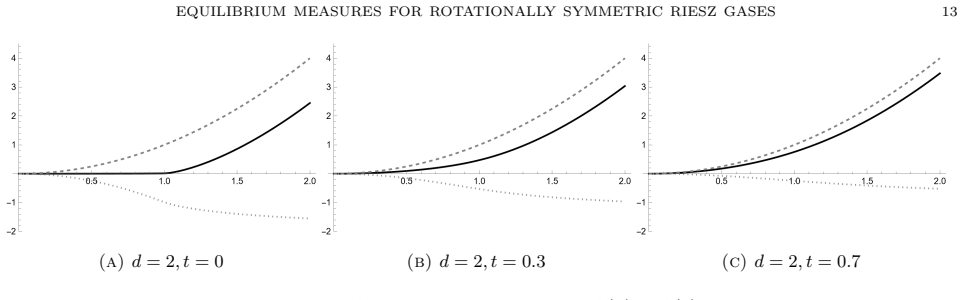
- [Remark 11 / Eqs. (2.58)-(2.59)] The notation G(x):=G(x)+x^2 uses the same symbol for two different functions, which is confusing. Please use distinct typographical conventions (e.g. G and mathfrak G).
- [Eq. (2.54), d=0] For d=0 the formula for µ_W on R^0 is degenerate; please explain the convention or exclude d=0 from that display and state the one-dimensional result separately.
Circularity Check
No significant circularity; the converse construction is genuine and the Euler-Lagrange inequalities are independently verified.
full rationale
The paper is an explicit inverse construction: it prescribes a radially symmetric density through the coefficients {a_k}, obtains the associated potential V(x) in (2.4) by direct evaluation of the Riesz potential (Proposition 3.4, Lemma 3.3), and then verifies the Euler-Lagrange inequality (2.7) for the two concrete families (Theorems 2.4 and 2.6). The equality part is satisfied by construction, which is the intended converse method, but the inequality part is an independent positivity check carried out in Lemmas 3.5 and 3.6. No parameter is fitted to data and no external quantity is renamed as a prediction. The central hypergeometric identity (Lemma 3.3) is proved in the paper itself, not imported from a self-citation. The self-citations that do appear — [3] in Remark 7 and [35] in the discussion of Conjecture 2.8 — are used for consistency checks and for known d=0,1 cases, respectively; they are not load-bearing for the main derivation. The half-space application has an explicitly open point: Conjecture 2.8, the sufficiency of a >= a_cri(d) for general d, is flagged as unproved except for d=3 (Appendix A) and the previously known d=0,1. That is a limitation of the application, not a circular step, because the necessary direction (Theorem 2.7(i)) is proven and the missing direction is openly identified rather than assumed. Overall, the derivation chain is self-contained and the central claims do not reduce to their inputs.
Assumptions & free parameters
assumptions (4)
- standard math Euler-Lagrange characterization of equilibrium measures via Frostman's theorem for 0<s<d (ref. [36, Thm 2])
- standard math Large deviation principle for Riesz gases of Leblé-Serfaty [60, Cor 1.1] used in (4.25)
- domain assumption Admissibility of the coefficient sequence {a_k}: convergence of series (2.1)-(2.2) and nonnegativity of the density
- ad hoc to paper Conjecture 2.8: G(x) ≥ G(0) for all x ≥ 0 in (2.58), equivalent to sufficiency of a ≥ a_cri, proved only for d=3 (Appendix A)
Cite this review
Pith. "Pith review of Equilibrium measures for higher dimensional rotationally symmetric Riesz gases." pith.science (2026). https://pith.science/paper/AERQ2FXU
@misc{pith2026260203047,
  author       = {Pith},
  title        = {Pith review of: Equilibrium measures for higher dimensional rotationally symmetric Riesz gases},
  year         = {2026},
  howpublished = {\url{https://pith.science/paper/AERQ2FXU}},
  note         = {Machine review of arXiv:2602.03047}
}
abstract
We study equilibrium measures for Riesz gases in dimension $d$ with pairwise interaction kernel $|x-y|^{-s}$, subject to radially symmetric external fields. We characterise broad classes of confining potentials for which the equilibrium measure is supported on the unit ball and admits an explicit density. Our main contribution is a converse construction: starting from a prescribed radially symmetric equilibrium density given as a power series in the squared radius, we determine the associated external potential and establish the corresponding Euler-Lagrange variational conditions. A key ingredient in the proof is an identity between two ${}_3F_2$ hypergeometric functions evaluated at unit argument, which is of independent interest. As applications, we identify the external potentials corresponding to equilibrium densities proportional to $(1-|x|^2)^\alpha$, $\alpha>-1$, and show that these potentials can be expressed in terms of Gauss hypergeometric functions ${}_2F_1$, reducing to polynomials for special values of $\alpha$. We also determine the equilibrium measure associated with purely power-type external potentials, often referred to as Freud or Mittag--Leffler potentials in the context of log gases, for which the equilibrium density admits an explicit ${}_2F_1$ representation. Furthermore, we apply our framework to a Coulomb gas in dimension $d+1$ confined by a harmonic potential to the half-space. We derive a necessary condition under which the equilibrium measure is fully supported on the boundary hyperplane of dimension $d$, with the induced density corresponding to that of a Riesz gas with exponent $s=d-1$.
Figures

Reference graph
Works this paper leans on
-
[1]
Adhikari,Hole probabilities forβ-ensembles and determinantal point processes in the complex plane, Electron
K. Adhikari,Hole probabilities forβ-ensembles and determinantal point processes in the complex plane, Electron. J. Probab. 23(2018), 1
2018
-
[2]
Adhikari and N
K. Adhikari and N. K. Reddy,Hole probabilities for finite and infinite Ginibre ensembles, Int. Math. Res. Not.2017(2017), 6694
2017
-
[3]
Agarwal, A
S. Agarwal, A. Dhar, M. Kulkarni, A. Kundu, S. N. Majumdar, D. Mukamel and G. Schehr,Harmonically confined particles with long-range repulsive interactions, Phys. Rev. Lett.123(2019), 100603
2019
-
[4]
Aizenman and P
M. Aizenman and P. A. Martin,Structure of Gibbs states of one dimensional Coulomb systems, Comm. Math. Phys.78 (1980), 99
1980
-
[5]
Ameur, C
Y. Ameur, C. Charlier, J. Cronvall and J. Lenells,Disk counting statistics near hard edges of random normal matrices: the multi-component regime, Adv. Math.441(2024), 109549
2024
-
[6]
Ameur, N.-G
Y. Ameur, N.-G. Kang and N. Makarov,Rescaling Ward identities in the random normal matrix model, Constr. Approx.50 (2019), 63
2019
-
[7]
Ameur, N.-G
Y. Ameur, N.-G. Kang, N. Makarov and A. Wennman,Scaling limits of random normalmatrix processes at singular boundary points, J. Funct. Anal.278(2020), 108340
2020
-
[8]
S. N. Armstrong, S. Serfaty and O. Zeitouni,Remarks on a constrained optimization problem for the Ginibre ensemble, Potential Anal.41(2014), 945958
2014
Show all 73 references
-
[9]
R. J. Baxter,Statistical mechanics of a one-dimensional Coulomb system with a uniform charge background, Proc. Camb. Phil. Soc.59(1963), 779
1963
-
[10]
Ben Arous, A
G. Ben Arous, A. Dembo and A. Guionnet,Aging of spherical spin glasses, Probab. Theory Relat. Fields120(2001), 1
2001
-
[11]
A. A. Berezin,The distribution of charges in classical electrostatics, Nature317(1985), 208
1985
-
[12]
Berezin,Functional central limit theorems for constrained Mittag-Leffler ensemble in hard edge scaling, Electron
S. Berezin,Functional central limit theorems for constrained Mittag-Leffler ensemble in hard edge scaling, Electron. J. Probab. 30(2025), 1
2025
-
[13]
J. M. Brown and A. Carrington,Rotational spectroscopy of diatomic molecules, Cambridge University Press, Cambridge (2003)
2003
-
[14]
Byun and P
S.-S. Byun and P. J. Forrester,Progress on the study of the Ginibre ensembles, KIAS Springer Ser. Math.3Springer, 2025, 221pp
2025
-
[15]
Byun and P
S.-S. Byun and P. J. Forrester,Electrostatic computations for statistical mechanics and random matrix applications, arXiv:2510.14334
-
[16]
Campa, Th
A. Campa, Th. Dauxois, D. Fanelli, S. Ruffo,Physics of long-range interacting systems, Oxford University Press, (Oxford), (2014)
2014
-
[17]
Castin,Basic theory tools for degenerate Fermi gases, in Proceedings of the International School of Physics Enrico Fermi, Vol
Y. Castin,Basic theory tools for degenerate Fermi gases, in Proceedings of the International School of Physics Enrico Fermi, Vol. 164: Ultra-cold Fermi Gases, edited by M. Inguscio, W. Ketterle, and C. Salomon, Varenna Summer School Enrico Fermi (IOS Press, Amsterdam, 2006)
2006
-
[18]
Chafa ¨ ı, E
D. Chafa ¨ ı, E. B. Saff and R. S. Womersley,On the solution of a Riesz equilibrium problem and integral identities for special functions, J. Math. Anal. Appl.515(2022), 126367
2022
-
[19]
Chafa ¨ ı, E
D. Chafa ¨ ı, E. B. Saff and R. S. Womersley,Threshold condensation to singular support for a Riesz equilibrium problem, Anal. Math. Phys.13(2023), 19
2023
-
[20]
Charles, B
L. Charles, B. Estienne,Entanglement entropy and Berezin–Toeplitz operators, Commun. Math. Phys.376(2020), 521
2020
-
[21]
Charlier,Asymptotics of determinants with a rotation-invariant weight and discontinuities along circles, Adv
C. Charlier,Asymptotics of determinants with a rotation-invariant weight and discontinuities along circles, Adv. Math.408 (2022), 108600
2022
-
[22]
Charlier,Hole probabilities and balayage of measures for planar Coulomb gases, arXiv:2311.15285
C. Charlier,Hole probabilities and balayage of measures for planar Coulomb gases, arXiv:2311.15285
-
[23]
Charlier,Large gap asymptotics on annuli in the random normal matrix model, Math
C. Charlier,Large gap asymptotics on annuli in the random normal matrix model, Math. Ann.388(2024), 3529
2024
-
[24]
Choquard, H
Ph. Choquard, H. Kunz, P. A. Martin, M. Navet,One- Dimensional Coulomb Systems, In: Bernasconi J., Schneider T. (eds) Physics in One Dimension, Springer Series in Solid-State Sciences, vol 23, (Springer Verlag, Berlin, Heidelberg, 1981), p. 335
1981
-
[25]
Choquard, B
Ph. Choquard, B. Piller and R. Rentsch,On the dielectric susceptibility of classical Coulomb systems II, J. Stat. Phys.46 (1987), 599
1987
-
[26]
Claeys, I
T. Claeys, I. Krasovsky and O. Minakov,Weak and strong confinement in the Freud random matrix ensemble and gap probabilities, Comm. Math. Phys.402(2023), 833. 30 SUNG-SOO BYUN, PETER J. FORRESTER, SATYA N. MAJUMDAR, AND GREGORY SCHEHR
2023
-
[27]
Claeys and A
T. Claeys and A. B. J. Kuijlaars,Universality in unitary random matrix ensembles when the soft edge meets the hard edge, Contemp. Math.458(2008), 265
2008
-
[28]
N. R. Cooper,Quantum Hall states of ultra cold atomic gases, inMany-Body physics with ultra cold gases, Les Houches (2010), Eds. C. Salomon, G. Shlyapnikov, L. F. Cugliandolo, (2010)
2010
-
[29]
F. D. Cunden, P. Facchi, M. Ligab` o and P. Vivo,Universality of the third-order phase transition in the constrained Coulomb gas, J. Stat. Mech. (2017), 053303
2017
-
[30]
F. D. Cunden, P. Facchi, M. Ligab` o, and P. Vivo,Third-order phase transition: random matrices and screened Coulomb gas with hard walls, J. Stat. Phys,175(2019), 1262
2019
-
[31]
Cronvall and A
J. Cronvall and A. Wennman,A direct approach to soft and hard edge universality for random normal matrices, arXiv:2511.18628
-
[32]
D. S. Dean and S. N. Majumdar,Large deviations of extreme eigenvalues of random matrices, Phys. Rev. Lett.97(2006), 160201
2006
-
[33]
D. S. Dean and S. N. Majumdar,Extreme value statistics of eigenvalues of Gaussian random matrices, Phys. Rev. E77 (2008), 041108
2008
-
[34]
D. S. Dean, P. Le Doussal, S. N. Majumdar and G. Schehr,Non-interacting fermions in a trap and random matrix theory, J. Phys. A52, (2019), 144006
2019
-
[35]
A. Dhar, A. Kundu, S. N. Majumdar, S. Sabhapandit and G. Schehr,Exact extremal statistics in the classical 1D Coulomb gas, Phys. Rev. Lett.119(2017), 060601
2017
-
[36]
Dragnev, R
P. Dragnev, R. Orive, E.B. Saff and F. Wielonsky, Riesz energy problems with external fields and related theory, Constr. Approx.57(2023), 1-43
2023
-
[37]
B. Dyda, A. Kuznetsov and M. Kwa´ snicki,Fractional Laplace operator and MeijerG-function, Constr. Approx.45(2017), 427
2017
-
[38]
Erd´ elyi, W
A. Erd´ elyi, W. Magnus, F. Oberhettinger, F.G. Tricomi, Higher Transcendental Functions, vols. I, II, Based in part on notes left by Harry Bateman, McGraw-Hill, 1953
1953
-
[39]
P. J. Forrester,Log-gases and random matrices, Princeton University Press, Princeton, NJ, 2010
2010
-
[40]
P. J. Forrester,Probability of all eigenvalues real for products of standard Gaussian matrices, J. Phys. A47(2014), 065202
2014
-
[41]
P. J. Forrester,Asymptotics of spacing distributions 50 years later, Random matrix theory, interacting particle systems and integrable systems, (ed. P. Deift and P. Forrester), MSRI Publications, 65 (2014), 199–222
2014
-
[42]
P. J. Forrester and B. Jancovici,Two-dimensional one-component plasma in a quadrupolar field, Int. J. Mod. Phys. A11 (1996), 941-949
1996
-
[43]
P. J. Forrester and N. S. Witte,Asymptotic forms for hard and soft edge generalβconditional gap probabilities, Nuclear Phys. B859, (2012), 321
2012
-
[44]
Frostman,Potentiel d’´ equilibre et capacite des ensembles avec quelques applications a la theorie des fonctions, Thesis, Meddel, Lunds Univ
O. Frostman,Potentiel d’´ equilibre et capacite des ensembles avec quelques applications a la theorie des fonctions, Thesis, Meddel, Lunds Univ. Mat. Sem.3(1935), 1
1935
-
[45]
T. S. Gutleb, J. A. Carrillo and S. Olver,Computing equilibrium measures with power law kernels, Math. Comput.91(2022), 2247
2022
-
[46]
T. S. Gutleb, J. A. Carrillo and S. Olver,Computation of power law equilibrium measures on balls of arbitrary dimension, Constr. Approx.58(2023), 75
2023
-
[47]
T. S. Gutlet and I. P. A. Papadopoulos,Explicit fractional Laplacians and Riesz potentials of classical functions, arXiv:2311.10896
-
[48]
D. P. Hardin, T. Lebl´ e, E. B. Saff and S. Serfaty,Large deviation principles for hypersingular Riesz gases, Constr. Approx. 48(2018), 61
2018
-
[49]
D. P. Hardin and E. B. Saff,Discretizing manifolds via minimum energy points, Not. Am. Math. Soc.51(2004), 1186
2004
-
[50]
D. P. Hardin and E. B. Saff,Minimal Riesz energy point configurations for rectifiabled-dimensional manifolds, Adv. Math. 193(2005), 174
2005
-
[51]
Jancovici, J
B. Jancovici, J. L. Lebowitz, G. Manificat,Large charge fluctuations in classical Coulomb systems, J. Stat. Phys.72(1993), 773
1993
-
[52]
Katzav and I
E. Katzav and I. P. Castillo,Large deviations of the smallest eigenvalue of the Wishart–Laguerre ensemble, Phys. Rev. E82 (2010), 040104
2010
-
[53]
Kethepalli, M
J. Kethepalli, M. Kulkarni, A. Kundu, S. N. Majumdar, D. Mukamel, G. Schehr,Harmonically confined long-ranged inter- acting gas in the presence of a hard wall, J. Stat. Mech., (2021), 103209
2021
-
[54]
Kethepalli, M
J. Kethepalli, M. Kulkarni, A. Kundu, S. N. Majumdar, D. Mukamel, G. Schehr,Edge fluctuations and third-order phase transition in harmonically confined long-range systems, J. Stat. Mech. (2022), 033203
2022
-
[55]
Krattenthaler and K
C. Krattenthaler and K. S. Rao,Automatic generation of hypergeometric identities by the beta integral method, J. Comput. Appl. Math.160, (2003), 159
2003
-
[56]
Krattenthaler†and T
C. Krattenthaler†and T. Rivoal,How can we escape Thomae’s relations?, J. Math. Soc. Japan58(2006), 183
2006
-
[57]
A. B. J. Kuijlaars and E. B. Saff,Asymptotics for minimal discrete energy on the sphere, Trans. Amer. Math. Soc.350 (1998), 523
1998
-
[58]
Lacroix-A-Chez-Toine, S
B. Lacroix-A-Chez-Toine, S. N. Majumdar, G. Schehr,Rotating trapped fermions in two dimensions and the complex Ginibre ensemble: Exact results for the entanglement entropy and number variance, Phys. Rev. A99(2019), 021602
2019
-
[59]
Le Doussal and G
P. Le Doussal and G. Schehr,Cumulants and large deviations for the linear statistics of the one-dimensional trapped Riesz gas, J. Stat. Phys.192(2025), 47. EQUILIBRIUM MEASURES FOR ROTATIONALLY SYMMETRIC RIESZ GASES 31
2025
-
[60]
Lebl´ e and S
T. Lebl´ e and S. Serfaty,Large deviation principle for empirical fields of log and Riesz gases, Invent. Math.210(2017), 645
2017
-
[61]
Lewin,Coulomb and Riesz gases: The known and the unknown, J
M. Lewin,Coulomb and Riesz gases: The known and the unknown, J. Math. Phys.63(2022), 061101
2022
-
[62]
Majumdar, C
S.N. Majumdar, C. Nadal, A. Scardicchio, P. Vivo,The Index Distribution of Gaussian Random Matrices, Phys. Rev. Lett., 103(2009), 220603
2009
-
[63]
S. N. Majumdar, C. Nadal, A. Scardicchio and P. Vivo,How many eigenvalues of a Gaussian random matrix are positive?, Phys. Rev. E83(2011), 041105
2011
-
[64]
S. N. Majumdar and G. Schehr,Top eigenvalue of a random matrix: Large deviations and third order phase transition, J. Stat. Mech. (2014), P01012
2014
-
[65]
S. N. Majumdar and M. Vergassola,Large deviations of the maximum eigenvalue for Wishart and Gaussian random matrices, Phys. Rev. Lett.102(2009), 060601
2009
-
[66]
M. L. Mehta,Random Matrices, Elsevier, (2004)
2004
-
[67]
Oblak, B
B. Oblak, B. Lapierre, P. Moosavi, J.-M. St´ ephan, B. Estienne,Anisotropic quantum Hall droplets, Phys. Rev. X14(2024), 011030
2024
-
[68]
F. W. J. Olver, D. W. Lozier, R. F. Boisvert, and C. W. Clark, eds.NIST Handbook of Mathematical Functions, Cambridge: Cambridge University Press, 2010
2010
-
[69]
H. M. Ramli, E. Katzav and I. P. Castillo,Spectral properties of the Jacobi ensembles via the Coulomb gas approach, J. Phys. A45(2012), 465005
2012
-
[70]
Riesz,Int´ egrales de Riemann-Liouville et potentiels, Acta Litt
M. Riesz,Int´ egrales de Riemann-Liouville et potentiels, Acta Litt. Sci. Szeged9(1938), 1
1938
-
[71]
E. B. Saff and V. Totik,Logarithmic Potentials with External Fields, Grundlehren der Mathematischen Wissenschaften, Springer-Verlag, Berlin, (1997)
1997
-
[72]
Serfaty,Lectures on Coulomb and Riesz Gases, arXiv:2407.21194
S. Serfaty,Lectures on Coulomb and Riesz Gases, arXiv:2407.21194
-
[73]
N. R. Smith, P. Le Doussal, S. N. Majumdar and G. Schehr,Counting statistics for noninteracting fermions in a rotating trap, Phys. Rev. A,105, (2022) 043315. Department of Mathematical Sciences and Research Institute of Mathematics, Seoul National University, Seoul 151-747, Re...
2022
Reviewed August 3, 2026 · model on record in the stance chip above.
Discussion (0). Continue with ORCID to comment.