Recognition: 2 theorem links
· Lean TheoremDisentangling baryon stopping and neutron skin effects in heavy-ion collisions
Pith reviewed 2026-05-16 07:16 UTC · model grok-4.3
The pith
The excess baryon-stopping parameter can be extracted from charge- and baryon-stopping ratios in Ru+Ru and Zr+Zr collisions.
A machine-rendered reading of the paper's core claim, the machinery that carries it, and where it could break.
Core claim
Using the statistical model, the excess baryon-stopping parameter gamma_B defined as (N_B / N_Q) times (Z/A) can be quantitatively extracted from forthcoming RHIC measurements of charge- and baryon-stopping ratios in Ru+Ru and Zr+Zr collisions at sqrt(s_NN) = 200 GeV. The approach generalizes to additional collision systems at RHIC and LHC energies, and an oxygen-baseline observable r^OX is introduced whose central-to-peripheral ratio exhibits strong and systematic sensitivity to the neutron-skin thickness of the target nucleus X.
What carries the argument
Statistical model treatment of net baryon (B) and net electric charge (Q) stopping, with the derived excess parameter gamma_B and the oxygen-baseline ratio observable r^OX.
Load-bearing premise
The statistical model accurately captures net baryon and charge stopping without significant contamination from dynamical or non-equilibrium effects that differ between the isobar systems.
What would settle it
Direct measurement of the charge- and baryon-stopping ratios in Ru+Ru and Zr+Zr collisions at RHIC that deviates from the statistical-model prediction for gamma_B, or a central-to-peripheral ratio of r^OX that shows no systematic dependence on neutron-skin thickness across target nuclei.
Figures


read the original abstract
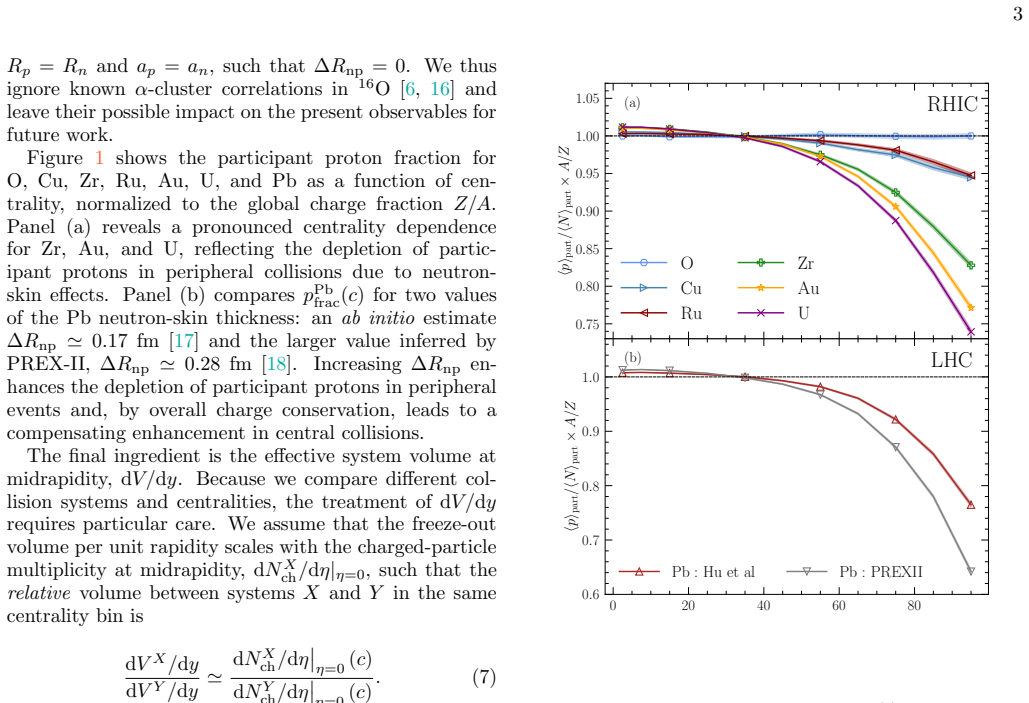
We analyse the net baryon (B) and net electric charge (Q) stopping in heavy-ion collisions using the statistical model. Focusing first on isobar collisions $\rm{Ru}+\rm{Ru}$ and $\rm{Zr}+\rm{Zr}$ at $\sqrt{s_{\rm NN}}=200$~GeV, we show that the excess baryon-stopping parameter $\gamma_B \equiv (N_B/N_Q)\,(Z/A)$ can be quantitatively extracted from forthcoming RHIC measurements of charge- and baryon-stopping ratios. We then generalize the approach to other collision systems at RHIC and LHC energies and introduce an oxygen-baseline observable, $r^{OX}$, whose central-to-peripheral ratio exhibits strong and systematic sensitivity to the neutron-skin thickness of the target nucleus $X$.
Editorial analysis
A structured set of objections, weighed in public.
Referee Report
Summary. The manuscript analyzes net baryon (B) and net electric charge (Q) stopping in heavy-ion collisions via the statistical model. For isobar collisions Ru+Ru and Zr+Zr at √s_NN=200 GeV, it defines an excess baryon-stopping parameter γ_B ≡ (N_B/N_Q)(Z/A) and claims this can be quantitatively extracted from forthcoming RHIC measurements of charge- and baryon-stopping ratios. The approach is then generalized to other RHIC and LHC systems, and an oxygen-baseline observable r^OX is introduced whose central-to-peripheral ratio is stated to exhibit strong sensitivity to the neutron-skin thickness of the target nucleus X.
Significance. If the extraction procedure and statistical-model assumptions hold, the work provides a controlled way to disentangle baryon-stopping dynamics from neutron-skin contributions using isobar pairs, which could yield new quantitative constraints on both heavy-ion transport and nuclear structure. The introduction of the r^OX observable for neutron-skin sensitivity is a potentially useful extension, though its robustness depends on the same model assumptions.
major comments (2)
- Abstract: the central claim that γ_B 'can be quantitatively extracted' from forthcoming RHIC measurements of stopping ratios is asserted without an explicit derivation, error-propagation formula, or validation against existing data or known limits, leaving the quantitative aspect of the claim unsupported in the given text.
- Statistical-model section (application to Ru+Ru vs. Zr+Zr): the extraction of γ_B assumes that statistical-model predictions for the net-baryon and net-charge stopping ratios differ between the isobars only through the controlled parameters γ_B and neutron-skin thickness after Z/A rescaling. No demonstration is provided that isobar-specific dynamical effects (rescattering, flow, or baryon-number transport) produce negligible or identical shifts, which is load-bearing for the quantitative extraction procedure.
minor comments (1)
- Notation for r^OX and the oxygen baseline should be defined explicitly with a formula or equation number on first use to improve clarity for readers unfamiliar with the observable.
Simulated Author's Rebuttal
We thank the referee for the detailed and constructive report. The comments highlight important points about the strength of our claims and the model assumptions. We have revised the manuscript to strengthen the presentation of the extraction procedure and to add explicit discussion of limitations.
read point-by-point responses
-
Referee: Abstract: the central claim that γ_B 'can be quantitatively extracted' from forthcoming RHIC measurements of stopping ratios is asserted without an explicit derivation, error-propagation formula, or validation against existing data or known limits, leaving the quantitative aspect of the claim unsupported in the given text.
Authors: We agree that the abstract statement would benefit from more support. In the revised manuscript we have added a concise derivation of the γ_B extraction formula (now shown explicitly in Sec. II) together with a first-order error-propagation expression that relates the uncertainty in the measured stopping ratios to the uncertainty in γ_B. We have also included a brief comparison to existing net-baryon and net-charge stopping data from Au+Au collisions at 200 GeV to illustrate consistency with known limits. These additions make the quantitative claim traceable within the text. revision: yes
-
Referee: Statistical-model section (application to Ru+Ru vs. Zr+Zr): the extraction of γ_B assumes that statistical-model predictions for the net-baryon and net-charge stopping ratios differ between the isobars only through the controlled parameters γ_B and neutron-skin thickness after Z/A rescaling. No demonstration is provided that isobar-specific dynamical effects (rescattering, flow, or baryon-number transport) produce negligible or identical shifts, which is load-bearing for the quantitative extraction procedure.
Authors: The referee correctly identifies a key assumption. The statistical model employed is by construction an effective description that absorbs average dynamical effects into the parameters γ_B and the neutron-skin thickness after the Z/A rescaling. We have added a new paragraph in Sec. III explicitly stating this model dependence and noting that isobar-specific differences in rescattering or flow are assumed to be small or to cancel in the ratio observables. While a full hydrodynamic or transport-model validation lies beyond the scope of the present work, we now cite existing studies that indicate such effects are sub-dominant for the integrated stopping ratios at RHIC energies. We therefore regard the assumption as reasonable within the stated framework but have made the limitation more transparent. revision: partial
Circularity Check
Minor self-definitional element in gamma_B extraction claim; overall derivation self-contained
specific steps
-
self definitional
[Abstract]
"the excess baryon-stopping parameter γ_B ≡ (N_B/N_Q) (Z/A) can be quantitatively extracted from forthcoming RHIC measurements of charge- and baryon-stopping ratios"
γ_B is defined as the scaled ratio (N_B/N_Q)*(Z/A), so claiming quantitative extraction from measurements of the charge- and baryon-stopping ratios reduces to computing the defined quantity by construction; the 'extraction' adds no independent derivation beyond the definition itself.
full rationale
The paper explicitly defines the excess baryon-stopping parameter directly from the measured ratios and states that it can be extracted from those same ratios via the statistical model framework for isobar systems. This creates a minor self-definitional aspect in the central claim, but the model is invoked as an external interpretive tool to disentangle neutron-skin contributions rather than deriving the parameter from itself. No fitted inputs renamed as predictions, load-bearing self-citations, uniqueness theorems, or ansatz smuggling are present. The approach relies on stated model assumptions without internal reduction to inputs by construction, making the derivation largely independent.
Axiom & Free-Parameter Ledger
axioms (1)
- domain assumption Statistical model accurately describes net baryon and charge stopping in the considered collision systems
Lean theorems connected to this paper
-
IndisputableMonolith/Cost/FunctionalEquation.leanwashburn_uniqueness_aczel unclear?
unclearRelation between the paper passage and the cited Recognition theorem.
We analyse the net baryon (B) and net electric charge (Q) stopping ... using the statistical model ... γ_B ≡ (N_B/N_Q)(Z/A)
-
IndisputableMonolith/Foundation/AlexanderDuality.leanalexander_duality_circle_linking unclear?
unclearRelation between the paper passage and the cited Recognition theorem.
participant proton fraction pX_frac(c) ... Woods–Saxon distributions ... neutron-skin thickness ΔR_np
What do these tags mean?
- matches
- The paper's claim is directly supported by a theorem in the formal canon.
- supports
- The theorem supports part of the paper's argument, but the paper may add assumptions or extra steps.
- extends
- The paper goes beyond the formal theorem; the theorem is a base layer rather than the whole result.
- uses
- The paper appears to rely on the theorem as machinery.
- contradicts
- The paper's claim conflicts with a theorem or certificate in the canon.
- unclear
- Pith found a possible connection, but the passage is too broad, indirect, or ambiguous to say the theorem truly supports the claim.
Reference graph
Works this paper leans on
- [1]
- [2]
-
[3]
D. Kharzeev, Phys. Lett. B378, 238 (1996), arXiv:nucl- th/9602027
-
[4]
V. Vovchenko and H. Stoecker, Comput. Phys. Commun. 244, 295 (2019), arXiv:1901.05249 [nucl-th]
- [5]
- [6]
-
[7]
C. Loizides, Phys. Rev. C113, 014914 (2026), arXiv:2507.05853 [nucl-th]
-
[8]
Rotation as an origin of high energy particle collisions
V. Vovchenko, M. I. Gorenstein, and H. Stoecker, Phys. Rev. C92, 054901 (2015), arXiv:1506.02638 [nucl-th]
work page internal anchor Pith review Pith/arXiv arXiv 2015
-
[9]
Decoding the phase structure of QCD via particle production at high energy
A. Andronic, P. Braun-Munzinger, K. Redlich, and J. Stachel, Nature561, 321 (2018), arXiv:1710.09425 [nucl-th]
work page internal anchor Pith review Pith/arXiv arXiv 2018
- [10]
- [11]
- [12]
-
[13]
C. Shen and S. Alzhrani, Phys. Rev. C102, 014909 (2020), arXiv:2003.05852 [nucl-th]
-
[14]
G. Giacalone, G. Nijs, and W. van der Schee, Phys. Rev. Lett.131, 202302 (2023), arXiv:2305.00015 [nucl-th]
- [15]
- [16]
-
[17]
B. Huet al., Nature Phys.18, 1196 (2022), arXiv:2112.01125 [nucl-th]. 12
-
[18]
D. Adhikariet al.(PREX), Phys. Rev. Lett.126, 172502 (2021), arXiv:2102.10767 [nucl-ex]
-
[19]
Hadron production in nuclear collisions at RHIC and high density QCD
D. Kharzeev and M. Nardi, Phys. Lett. B507, 121 (2001), arXiv:nucl-th/0012025
work page internal anchor Pith review Pith/arXiv arXiv 2001
-
[20]
L. Zhou and G. S. F. Stephans, Phys. Rev. C90, 014902 (2014), arXiv:1312.3656 [nucl-ex]
work page internal anchor Pith review Pith/arXiv arXiv 2014
-
[21]
H. De Vries, C. W. De Jager, and C. De Vries, Atom. Data Nucl. Data Tabl.36, 495 (1987)
work page 1987
- [22]
-
[23]
B. Schenke, C. Shen, and P. Tribedy, Phys. Rev. C102, 044905 (2020), arXiv:2005.14682 [nucl-th]
-
[24]
C. Zhang and J. Jia, Phys. Rev. Lett.128, 022301 (2022), arXiv:2109.01631 [nucl-th]
-
[25]
Nuclear ground-state masses and deformations: FRDM(2012)
P. M¨ oller, A. J. Sierk, T. Ichikawa, and H. Sagawa, Atom. Data Nucl. Data Tabl.109-110, 1 (2016), arXiv:1508.06294 [nucl-th]
work page internal anchor Pith review Pith/arXiv arXiv 2016
- [26]
- [27]
-
[28]
W. Ryssens, G. Giacalone, B. Schenke, and C. Shen, Phys. Rev. Lett.130, 212302 (2023), arXiv:2302.13617 [nucl-th]
-
[29]
C. E. Bemis, F. K. McGowan, J. L. C. Ford, W. T. Mil- ner, P. H. Stelson, and R. L. Robinson, Phys. Rev. C8, 1466 (1973)
work page 1973
- [30]
discussion (0)
Sign in with ORCID, Apple, or X to comment. Anyone can read and Pith papers without signing in.