Recognition: no theorem link
Analysis of the semileptonic decays Sigma_btoSigma_clbar{ν}_l, Xi'_btoXi'_clbar{ν}_l and Ω_btoΩ_clbar{ν}_l in QCD sum rules
Pith reviewed 2026-05-16 07:57 UTC · model grok-4.3
The pith
Three-point QCD sum rules calculations indicate that the semileptonic decay widths for Σ_b→Σ_c, Ξ'_b→Ξ'_c and Ω_b→Ω_c approximately satisfy SU(3) flavor symmetry.
A machine-rendered reading of the paper's core claim, the machinery that carries it, and where it could break.
Core claim
The electroweak transition form factors of Σ_b→Σ_c, Ξ'_b→Ξ'_c and Ω_b→Ω_c are analyzed within the framework of three-point QCD sum rules. In the phenomenological side, all possible couplings of interpolating current to hadronic states are considered, and the Dirac structure dependence on the form factors is systematically eliminated. In the QCD side, the calculation incorporates both the perturbative part and the contributions from vacuum condensates up to dimension 8. Using the obtained form factors, the partial widths of semileptonic decays Σ_b→Σ_c l ν̄_l, Ξ'_b→Ξ'_c l ν̄_l and Ω_b→Ω_c l ν̄_l are studied, showing approximate SU(3) flavor symmetry, with branching ratios for Ω_b→Ω_c l ν̄_l l
What carries the argument
Three-point QCD sum rules matching phenomenological hadronic couplings to QCD operator product expansion up to dimension eight for baryon transition form factors.
If this is right
- Decay widths approximately satisfy SU(3) flavor symmetry.
- Branching ratios for Ω_b→Ω_c l ν̄_l are provided for comparison.
- Lepton universality ratios are analyzed for new physics studies.
- Asymmetry parameters are calculated for the decay processes.
Where Pith is reading between the lines
- These predictions can be tested against future experimental data from heavy flavor factories.
- Deviations in the universality ratios could suggest new physics contributions.
- The same method may be extended to other semileptonic or nonleptonic decays of heavy baryons.
- Consistency checks with lattice QCD simulations would be valuable for validating the dimension-8 truncation.
Load-bearing premise
The operator product expansion up to dimension 8 sufficiently captures the relevant QCD dynamics without needing higher terms for convergence.
What would settle it
A measurement of the Ω_b→Ω_c e ν branching ratio that differs substantially from the QCD sum rules prediction would falsify the computed form factors and widths.
Figures





read the original abstract
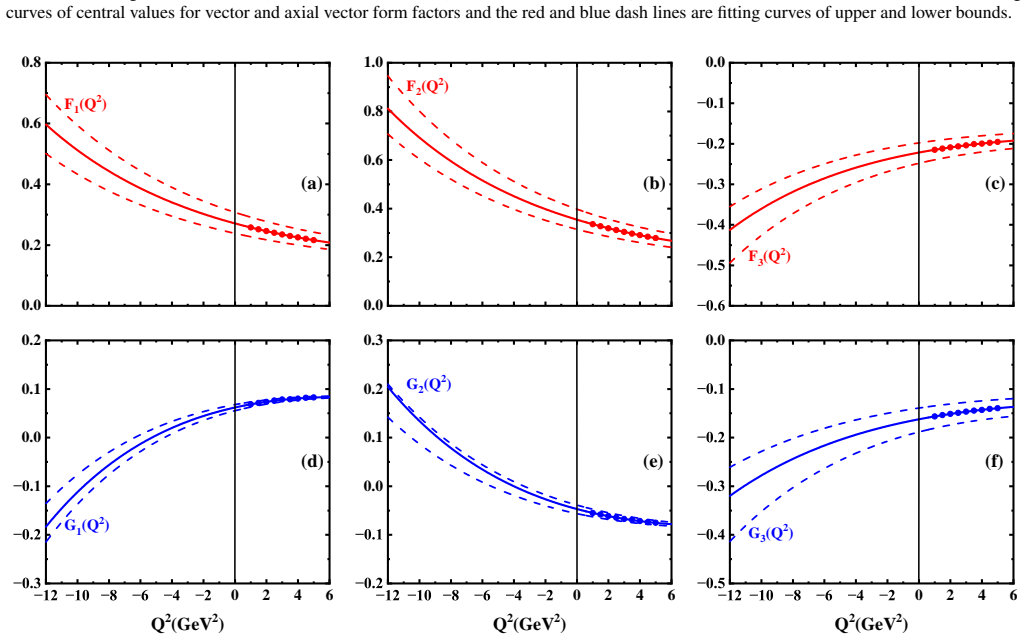
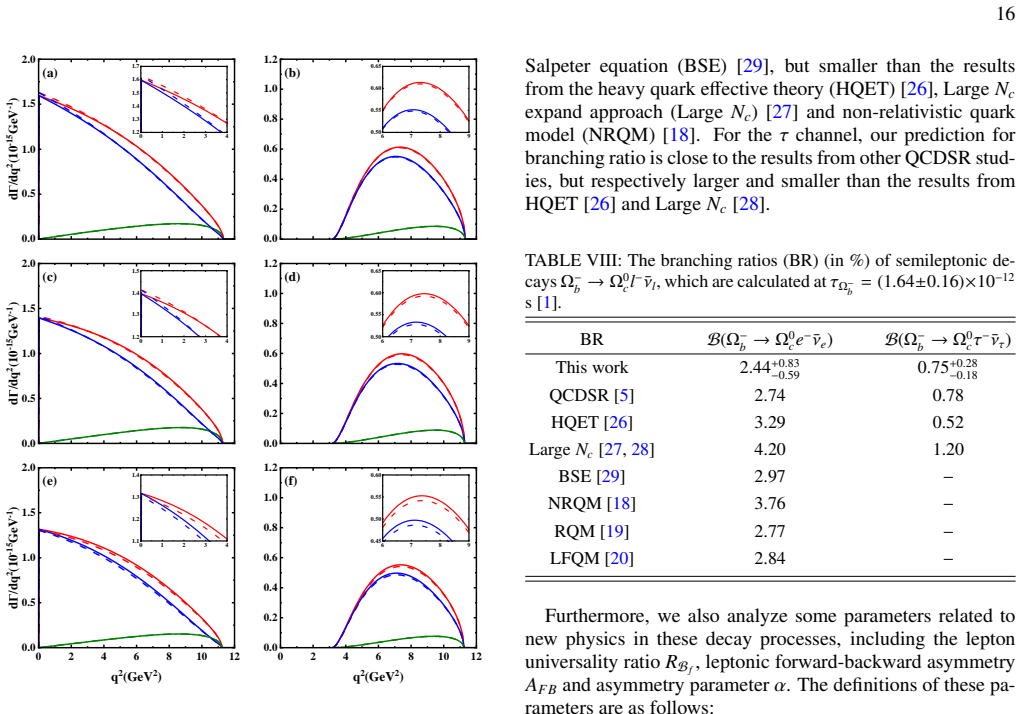
In this article, the electroweak transition form factors of $\Sigma_b\to\Sigma_c$, $\Xi'_b\to\Xi'_c$ and $\Omega_b\to\Omega_c$ are analyzed within the framework of three-point QCD sum rules. In phenomenological side, all possible couplings of interpolating current to hadronic states are considered, and the Dirac structure dependence on the form factors is systematically eliminated. In QCD side, our calculation incorporates both the perturbative part and the contributions from vacuum condensates up to dimension 8. This systematic inclusion of higher-dimensional terms accounts for a broader set of Feynman diagrams, thereby enhancing the comprehensiveness and reliability of the operator product expansion. Using the obtained form factors, we study the partial widths of semileptonic decays $\Sigma_b\to\Sigma_cl\bar{\nu}_l$, $\Xi'_b\to\Xi'_cl\bar{\nu}_l$ and $\Omega_b\to\Omega_cl\bar{\nu}_l$ ($l=e$, $\mu$ and $\tau$). The results indicate that these decay widths approximately satisfy SU(3) flavor symmetry. Next, we calculate the branching ratios for the decay process $\Omega_b\to\Omega_cl\bar{\nu}_l$ and compare them with the results from other collaborations. Furthermore, the lepton universality ratios and some asymmetry parameters of these decay processes are also analyzed, which provide information for the study of new physics. We hope that these results will serve as a useful reference for future theoretical and experimental studies of weak decays involving heavy flavor baryons.
Editorial analysis
A structured set of objections, weighed in public.
Referee Report
Summary. The manuscript computes the transition form factors for the semileptonic decays Σ_b → Σ_c l ν̄_l, Ξ'_b → Ξ'_c l ν̄_l and Ω_b → Ω_c l ν̄_l within three-point QCD sum rules. On the phenomenological side all possible interpolating-current couplings are retained and Dirac structures are projected out; on the QCD side the OPE includes the perturbative term plus vacuum condensates through dimension 8. The resulting form factors are used to evaluate the partial widths, which are reported to satisfy approximate SU(3) flavor symmetry. Branching ratios for Ω_b → Ω_c l ν̄_l are calculated and compared with other works; lepton-universality ratios and several asymmetry parameters are also presented.
Significance. If the extracted form factors are stable, the work supplies concrete predictions for branching fractions and a test of SU(3) breaking in heavy-baryon weak decays. These numbers can serve as benchmarks for lattice QCD and as targets for LHCb and Belle II measurements. The systematic treatment of all Dirac structures and the inclusion of dimension-8 operators are methodological strengths.
major comments (3)
- [§4] §4 (numerical analysis): The Borel windows M² and continuum thresholds s₀ are chosen separately for each channel to achieve stability, yet no table or figure quantifies the variation of the three decay widths (or their ratios) when M² and s₀ are shifted within the quoted ranges. Because the SU(3) equality is the central phenomenological claim, the absence of this sensitivity study leaves the result vulnerable to auxiliary-parameter dependence.
- [§3.2] §3.2 (OPE side): Although dimension-8 condensates are retained, the manuscript does not display the relative size of the dimension-6, -7 and -8 contributions evaluated at the working Borel mass for any channel. Without an explicit convergence check it is impossible to confirm that the higher-dimensional terms genuinely improve the reliability of the form-factor extraction.
- [Table 2] Table 2 (decay widths): The quoted uncertainties on the partial widths appear to reflect only the variation of input parameters (quark masses, condensates) and not the spread arising from the Borel and threshold choices. This underestimates the total theoretical error and weakens the comparison with other collaborations.
minor comments (2)
- [Abstract] Abstract: The statement that the widths 'approximately satisfy SU(3) flavor symmetry' is not accompanied by the numerical ratios or the size of the breaking; a single sentence quoting the largest deviation would improve clarity.
- [§5] §5 (branching ratios): A few inconsistencies in the labeling of form factors (f₁ versus f1) appear between the text and the tables; uniform notation would aid readability.
Simulated Author's Rebuttal
We thank the referee for the careful review and constructive suggestions. We address each of the major comments below and indicate the revisions that will be incorporated into the updated manuscript.
read point-by-point responses
-
Referee: [§4] §4 (numerical analysis): The Borel windows M² and continuum thresholds s₀ are chosen separately for each channel to achieve stability, yet no table or figure quantifies the variation of the three decay widths (or their ratios) when M² and s₀ are shifted within the quoted ranges. Because the SU(3) equality is the central phenomenological claim, the absence of this sensitivity study leaves the result vulnerable to auxiliary-parameter dependence.
Authors: We thank the referee for highlighting this important aspect of the analysis. The Borel windows and continuum thresholds were determined by requiring stability of the form factors and ensuring that the continuum contribution remains below 30% of the total. Within these windows, the form factors show only mild dependence on the auxiliary parameters, typically varying by less than 10%. Nevertheless, to provide a quantitative assessment of the sensitivity and to reinforce the reliability of the observed approximate SU(3) symmetry, we will add a new table in the revised version of section 4. This table will display the decay widths and their ratios for the central values as well as the upper and lower edges of the M² and s₀ ranges for each channel. We believe this addition will address the concern effectively. revision: yes
-
Referee: [§3.2] §3.2 (OPE side): Although dimension-8 condensates are retained, the manuscript does not display the relative size of the dimension-6, -7 and -8 contributions evaluated at the working Borel mass for any channel. Without an explicit convergence check it is impossible to confirm that the higher-dimensional terms genuinely improve the reliability of the form-factor extraction.
Authors: We agree that an explicit demonstration of the OPE convergence would strengthen the manuscript. In our calculation, the contributions from higher-dimensional operators are included to account for non-perturbative effects more comprehensively, and at the chosen Borel masses, these terms are numerically suppressed compared to lower-dimensional ones. To make this transparent, we will include a new table or figure in section 3.2 of the revised manuscript, showing the relative magnitudes of the dimension-6, dimension-7, and dimension-8 contributions to the form factors at the working Borel parameter for each decay channel. This will allow readers to verify the convergence of the expansion. revision: yes
-
Referee: [Table 2] Table 2 (decay widths): The quoted uncertainties on the partial widths appear to reflect only the variation of input parameters (quark masses, condensates) and not the spread arising from the Borel and threshold choices. This underestimates the total theoretical error and weakens the comparison with other collaborations.
Authors: We acknowledge that the error estimates in Table 2 currently account only for the uncertainties in the input parameters such as quark masses and condensates. The variations due to the Borel mass and continuum threshold, although small within the selected windows, should indeed be incorporated to provide a more conservative and complete theoretical uncertainty. In the revised manuscript, we will update Table 2 by including these auxiliary-parameter uncertainties, either by adding them in quadrature or by reporting them as separate contributions. This will result in slightly larger error bars but will make the comparison with other theoretical works more robust. revision: yes
Circularity Check
No significant circularity; standard QCD sum-rule extraction yields independent predictions for form factors and widths.
full rationale
The paper equates the phenomenological representation (with form factors) to the QCD OPE side (perturbative plus condensates up to dimension 8), applies Borel transformation, subtracts continuum, and extracts form factors after selecting M^2 and s0 for stability and OPE convergence. These auxiliary parameters are fixed by internal criteria (plateau behavior, condensate hierarchy) that do not incorporate the target decay widths or branching ratios. The computed widths, SU(3) pattern, and lepton-universality ratios are therefore genuine outputs of the sum rules rather than re-statements of the inputs. No self-citation chain, self-definitional loop, or fitted-parameter renaming is present in the derivation.
Axiom & Free-Parameter Ledger
free parameters (2)
- Borel parameter
- Continuum threshold
axioms (2)
- domain assumption Operator product expansion remains valid when truncated at dimension 8
- standard math Vacuum condensate values are known and universal
Reference graph
Works this paper leans on
-
[1]
αs(µ) αs(mc[b]) # 12 33−2N f , ms(µ)=m s(2GeV)
are introduced to reduce the Borel parameters in this work. Then, using the quark-hadron duality condition, we can establish a series of linear equa- tions about twenty-four scalar invariant amplitudes in both phenomenological and QCD sides. Finally, all form factors in Eq. (15) can be uniquely determined by solving these twenty- four linear equations. In...
work page 2024
- [2]
-
[3]
Z.-G. Wang, Phys. Lett. B685, 59 (2010), 0912.1648
work page internal anchor Pith review Pith/arXiv arXiv 2010
-
[4]
Analysis of the ${1/2^-}$ and ${3/2^-}$ heavy and doubly heavy baryon states with QCD sum rules
Z.-G. Wang, Eur. Phys. J. A47, 81 (2011), 1003.2838
work page internal anchor Pith review Pith/arXiv arXiv 2011
-
[5]
Z. Neishabouri and K. Azizi, Phys. Rev. D112, 054009 (2025), 2503.12390
-
[6]
Z. Neishabouri, K. Azizi, and H. R. Moshfegh, Phys. Rev. D 110, 014010 (2024), 2404.12654
- [7]
- [8]
-
[9]
Analysis of the semileptonic decays of $\Xi_{cc}$ and $\Omega_{cc}$ baryons in QCD sum rules
G.-L. Yu, Z.-G. Wang, J. Lu, B. Wu, P. Yang, and Z. Zhou (2026), 2601.06427
work page internal anchor Pith review Pith/arXiv arXiv 2026
-
[10]
Y .-M. Wang, M. J. Aslam, and C.-D. Lu, Eur. Phys. J. C59, 847 (2009), 0810.0609
work page internal anchor Pith review Pith/arXiv arXiv 2009
-
[11]
$\Lambda_b \to p, \Lambda$ transition form factors from QCD light-cone sum rules
Y .-M. Wang, Y .-L. Shen, and C.-D. Lu, Phys. Rev. D80, 074012 (2009), 0907.4008
work page internal anchor Pith review Pith/arXiv arXiv 2009
-
[12]
Form Factors and Strong Couplings of Heavy Baryons from QCD Light-Cone Sum Rules
A. Khodjamirian, C. Klein, T. Mannel, and Y . M. Wang, JHEP 09, 106 (2011), 1108.2971. 19 1 /s8722 /s48/s46/s490.00.10.20.30.40.50.6F1 (Q2 =1GeV2 ) Total Perturbative /s10216 g2 sGG /s10217 /s10216 qq /s102172 /s10216 qq /s10217/s10216 qg s /s963G q /s10217( a) /s8722 /s48/s46/s490.00.10.20.30.40.50.60.7F2 (Q2 =1GeV2 ) Total Perturbative /s10216 g2 sGG /s...
work page internal anchor Pith review Pith/arXiv arXiv 2011
-
[13]
Perturbative Corrections to $\Lambda_b \to \Lambda$ Form Factors from QCD Light-Cone Sum Rules
Y .-M. Wang and Y .-L. Shen, JHEP02, 179 (2016), 1511.09036
work page internal anchor Pith review Pith/arXiv arXiv 2016
-
[14]
T. M. Aliev, T. Barakat, and M. Savcı, Phys. Rev. D93, 056007 (2016), 1603.04762
work page internal anchor Pith review Pith/arXiv arXiv 2016
- [15]
-
[16]
Y .-J. Shi and Z.-X. Zhao, Phys. Rev. D110, 096015 (2024), 2407.07431
- [17]
- [18]
-
[19]
1/M Corrections to Baryonic Form Factors in the Quark Model
H.-Y . Cheng and B. Tseng, Phys. Rev. D53, 1457 (1996), [Er- ratum: Phys.Rev.D 55, 1697 (1997)], hep-ph/9502391
work page internal anchor Pith review Pith/arXiv arXiv 1996
- [20]
-
[21]
Weak Decays of Heavy Baryons in Light-Front Approach
Z.-X. Zhao, Chin. Phys. C42, 093101 (2018), 1803.02292
work page internal anchor Pith review Pith/arXiv arXiv 2018
- [22]
- [23]
- [24]
- [25]
- [26]
-
[27]
Q. P. Xu and A. N. Kamal, Phys. Rev. D47, 2849 (1993)
work page 1993
-
[28]
$\Omega_b$ semi-leptonic weak decays
M.-k. Du and C. Liu, Phys. Rev. D84, 056007 (2011), 1107.2535
work page internal anchor Pith review Pith/arXiv arXiv 2011
- [29]
-
[30]
M. A. Ivanov, J. G. Korner, V . E. Lyubovitskij, and A. G. Ruset- sky, Phys. Rev. D59, 074016 (1999), hep-ph/9809254
work page internal anchor Pith review Pith/arXiv arXiv 1999
- [31]
- [32]
-
[33]
W.-J. Wang, Y .-H. Zhou, L.-Y . Xiao, and X.-H. Zhong, Phys. Rev. D105, 074008 (2022), 2202.05426
-
[34]
Y .-H. Zhou, W.-J. Wang, L.-Y . Xiao, and X.-H. Zhong, Phys. Rev. D108, 094032 (2023), 2309.13906
- [35]
- [36]
-
[37]
A. Amiri and K. Azizi, Nucl. Phys. B1022, 117281 (2026), 2510.20937
-
[38]
R. Aaij et al. (LHCb), Phys. Rev. D96, 112005 (2017), 1709.01920
work page internal anchor Pith review Pith/arXiv arXiv 2017
-
[39]
Aaijet al.(LHCb), (2022), arXiv:2201.03497 [hep-ex]
R. Aaij et al. (LHCb), Phys. Rev. Lett.128, 191803 (2022), 2201.03497
-
[40]
T. Gutsche, M. A. Ivanov, J. G. K ¨orner, V . E. Lyubovitskij, and P. Santorelli, Phys. Rev. D90, 114033 (2014), [Erratum: Phys.Rev.D 94, 059902 (2016)], 1410.6043
work page internal anchor Pith review Pith/arXiv arXiv 2014
-
[41]
Z.-X. Zhao, R.-H. Li, Y .-L. Shen, Y .-J. Shi, and Y .-S. Yang, Eur. Phys. J. C80, 1181 (2020), 2010.07150
-
[42]
J. Zhang, X.-N. Jin, C.-W. Liu, and C.-Q. Geng, Phys. Rev. D 107, 033004 (2023), 2210.16825
-
[43]
R. N. Faustov and V . O. Galkin, Phys. Rev. D98, 093006 (2018), 1810.03388
work page internal anchor Pith review Pith/arXiv arXiv 2018
-
[44]
M. A. Shifman, A. I. Vainshtein, and V . I. Zakharov, Nucl. Phys. B147, 385 (1979)
work page 1979
-
[45]
M. A. Shifman, A. I. Vainshtein, and V . I. Zakharov, Nucl. Phys. B147, 448 (1979)
work page 1979
-
[46]
P. Colangelo and A. Khodjamirian, pp. 1495–1576 (2000), hep- ph/0010175
- [47]
- [48]
-
[49]
Z.-X. Zhao, X.-Y . Sun, F.-W. Zhang, Y .-P. Xing, and Y .-T. Yang, Phys. Rev. D108, 116008 (2023), 2103.09436
-
[50]
S.-Q. Zhang and C.-F. Qiao, Phys. Rev. D108, 074017 (2023), 2307.05019
- [51]
- [52]
- [53]
-
[54]
M. E. Bracco, M. Chiapparini, F. S. Navarra, and M. Nielsen, Prog. Part. Nucl. Phys.67, 1019 (2012), 1104.2864
work page internal anchor Pith review Pith/arXiv arXiv 2012
- [55]
- [56]
-
[57]
P. Pascual and R. Tarrach,QCD: RENORMALIZATION FOR THE PRACTITIONER, vol. 194 (1984)
work page 1984
-
[58]
L. J. Reinders, H. Rubinstein, and S. Yazaki, Phys. Rept.127, 1 (1985)
work page 1985
-
[59]
R. E. Cutkosky, J. Math. Phys.1, 429 (1960)
work page 1960
-
[60]
Gluon condensates and c, b quark masses from quarkonia ratios of moments
S. Narison, Phys. Lett. B693, 559 (2010), [Erratum: Phys.Lett.B 705, 544–544 (2011)], 1004.5333
work page internal anchor Pith review Pith/arXiv arXiv 2010
-
[61]
Gluon Condensates and m_{c,b} from QCD-Moments and their ratios to Order alpha_s^3 and <G^4>
S. Narison, Phys. Lett. B706, 412 (2012), 1105.2922
work page internal anchor Pith review Pith/arXiv arXiv 2012
-
[62]
Gluon Condensates and m_b(m_b) from QCD-Exponential Moments at Higher Orders
S. Narison, Phys. Lett. B707, 259 (2012), 1105.5070
work page internal anchor Pith review Pith/arXiv arXiv 2012
-
[63]
C. G. Boyd, B. Grinstein, and R. F. Lebed, Phys. Rev. Lett.74, 4603 (1995), hep-ph/9412324. 22
work page internal anchor Pith review Pith/arXiv arXiv 1995
- [64]
-
[65]
D. Jido, N. Kodama, and M. Oka, Phys. Rev. D54, 4532 (1996), hep-ph/9604280
work page internal anchor Pith review Pith/arXiv arXiv 1996
discussion (0)
Sign in with ORCID, Apple, or X to comment. Anyone can read and Pith papers without signing in.