REVIEW 2 major objections 5 minor 28 references
Photo-birefringent effects in crystalline AlGaAs mirror coatings
T0 review · 2 major / 5 minor · reviewed 2026-08-03 · deepseek-v4-flash
Pith's one-line read The paper claims one empirical curve—a logarithmic function of a single scaled variable combining LED intensity and squared intracavity power—describes photo-birefringence in crystalline AlGaAs coatings, and that LED illumination cancels po
desk verdict Careful experimental study with a genuinely useful LED-based noise-cancellation result; the two-photon/single-photon mechanism is constructed rather than independently tested. read the letter →
The pith
A machine-rendered reading of the paper's core claim, the machinery that carries it, and where it could break.
The reading
What carries the argument
The key object is the empirical line-splitting function Δ_biref(x) = Δ0 + Δs ln(x/xs + 1), with x = I_LED/I0(λ) + P_trans²/P0². I0(λ) is a wavelength-dependent normalization that equates an LED intensity with a squared intracavity power, and P0 = 1 µW. A two-mirror version adds local intensity ratios ρ and η for the far mirror. This function does the work of collapsing steady-state and transient observations onto one curve and provides the cancellation recipe: at fixed LED intensity, the derivative of birefringence with power can be tuned to oppose the photo-thermo-optic slope.
What would settle it
Measure the 1542 nm birefringence shift versus intracavity power over a wide range with no free normalization: the model requires a shift that is a function of P², so a robust linear term or any power-law exponent clearly different from 2 at low power would falsify the two-photon claim. A complementary check is a direct photocurrent or absorbed-power measurement at 1542 nm, which should show quadratic rather than linear intensity dependence.
Extended reading notes
Core claim
The central claim is that the light-induced modification of birefringence in GaAs/AlGaAs crystalline coatings is a carrier-driven process describable by one nonlinear function of a single variable. For 1542 nm intracavity light, whose photon energy is below the GaAs bandgap, the effective variable enters as power squared, suggesting an initial two-photon absorption; for LED light above the bandgap, it enters linearly, suggesting single-photon absorption. Both feed a common logarithmic response, modeled after the p-n junction diode equation, which fits steady-state line-splitting data and, with a two-mirror additive model, predicts response under combined illumination. The same variable, thro
Load-bearing premise
The load-bearing premise is that the scaling variable x is built on a per-wavelength fitted normalization I0(λ) chosen so that LED intensity and squared intracavity power are equivalent; if that normalization is arbitrary, the data collapse does not by itself prove the two-photon mechanism.
Editorial extensions
If this is right
- If the unified description is correct, the birefringence shift for any combination of intracavity power and external illumination is predictable from one calibrated logarithmic curve, so noise-cancellation operating points can be chosen without exhaustive measurement.
- Constant LED illumination lets a cavity run at roughly 4.5 times lower laser power while keeping the same cancellation quality, directly reducing power-fluctuation-induced frequency noise under constant fractional power stability.
- The model identifies the photo-birefringence response as carrier driven, implying that engineering carrier lifetime, dislocation density, or charge diffusion in the coating could suppress the effect at the source.
- The wavelength-dependent I0 values provide a quantitative target for testing the proposed absorption mechanism and for selecting coating materials less sensitive to above-bandgap stray light.
Reading between the lines
- Because I0(λ) is fitted per wavelength, the steady-state data collapse shows that one scaling can superimpose the curves, but it does not by itself prove two-photon absorption; confirmation would require a direct measurement of a quadratic power dependence at 1542 nm.
- A natural test: illuminate the coating simultaneously with two sub-bandgap wavelengths whose photon energies sum above the GaAs bandgap; if two-photon absorption drives the effect, the birefringence shift should show a cross-term proportional to the product of the two intensities.
- If the mechanism is electro-optic or photo-plastic, one would expect the I0(λ) values to track the absorption depth and carrier generation profile; measuring this correlation across wavelengths could distinguish carrier-generation models from thermal models.
- The cancellation method should transfer to cryogenic cavities, but the temperature dependence of the slow carrier relaxation means the LED operating point would need re-optimization.
Signed reviews
Editorial analysis
A structured set of objections, weighed in public.
Referee Report
Summary. This paper reports a room-temperature experimental study of photo-birefringent effects in crystalline GaAs/AlGaAs mirror coatings. The authors measure the frequency splitting between two polarization eigenmodes of a 1542-nm cavity as a function of intracavity power and of uniform LED illumination at 450, 535, 625, and 890 nm. They propose a unified empirical model in which the birefringence change is a universal function of x = I_LED/I0(λ) + P_trans^2/P0^2 (Eq. 1), with a Shockley-diode-like logarithmic response (Eq. 2). The 1542-nm data are fitted to this model, and I0 values are chosen per wavelength so that I_LED = I0 produces the same shift as P_trans = P0. The model is then used to predict the birefringence at combinations of intracavity power and LED intensity (Fig. 3) and to explain transient response scaling (Figs. 4–6). Finally, the authors demonstrate that adding 535-nm LED illumination allows cancellation of photo-thermo-optic and photo-birefringent frequency noise at 4.5× lower intracavity power, with residual sensitivity below 0.5 Hz/µW (Fig. 8).
Significance. If the empirical model is accepted, the paper provides a useful phenomenological description of a performance-limiting noise source in next-generation crystalline coatings and a practical mitigation scheme. The noise-cancellation demonstration is concrete and falsifiable. However, the mechanistic conclusion—two-photon absorption for below-bandgap 1542-nm light vs single-photon absorption for above-bandgap LEDs—is not independently established because Eq. (1) imposes the quadratic scaling and the I0(λ) normalizations are free. The paper is honest about this ('Without being able to derive the sensitivity coefficients from first principles'), but the abstract's 'suggests' overstates the evidence. The transient and two-mirror predictions are valuable, but they do not test the exponent.
major comments (2)
- [Sec. III, Eq. (1), Fig. 2] The unified variable x is constructed with P_trans^2 and with per-wavelength fitted I0(λ) chosen so that I_LED = I0 reproduces the same shift as P_trans = P0. Consequently, the collapse of the LED and 1542-nm data in Fig. 2 is a consequence of the normalization, not an independent test. Since Eq. (2) has free Δs and xs, a linear P_trans dependence with a suitably rescaled P0 would likely fit the same data over the observed range. To support the two-photon claim, please report a free-exponent fit of x = I_LED/I0 + (P_trans/P0)^n to the 1542-nm data, with confidence interval on n, and discuss whether the LED data rule out n ≠ 1. Without this, the abstract's 'suggests a primary two-photon process' is not supported by the evidence presented.
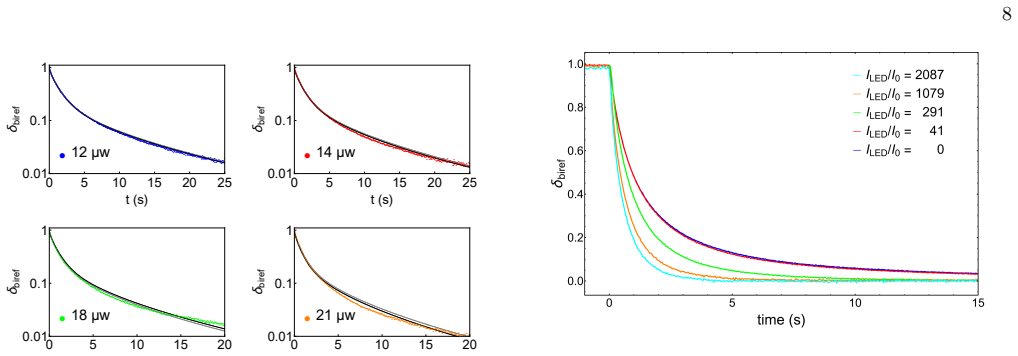
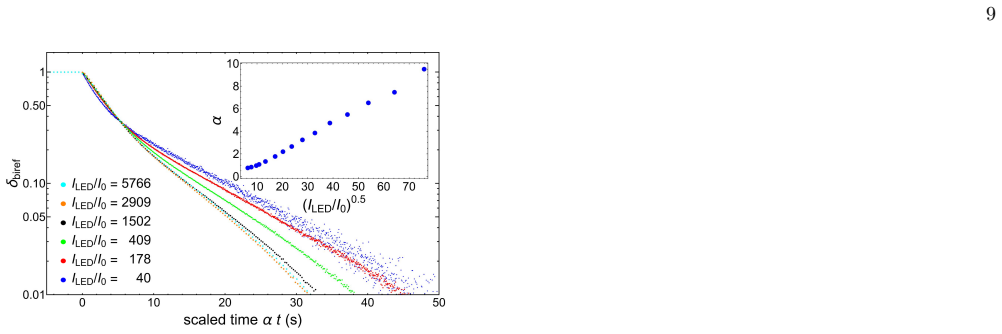
- [Sec. IV, Fig. 5 inset and Eq. (1)] The transient scaling factors α are plotted against √x, again relying on x being defined with P_trans^2. The transient data are measured independently of the steady-state fit and could provide a clean test of the exponent. Please fit α as a function of P_trans (at fixed LED intensity) and of I_LED (at fixed P_trans) with a free exponent and report the exponent; if α is actually linear in √x, this would validate the P^2 scaling. As it stands, the transient analysis only shows consistency with the assumed x.
minor comments (5)
- [Fig. 2 caption] The color assignments are confusing: red triangles are 625 nm data while the red curve is the 1542-nm fit. Use distinct line styles or a separate legend entry for the fit.
- [Sec. III, after Eq. (2)] Δ0_biref is called the 'dark value' but the fit value 104.26(1) kHz differs from the initial 104.280 kHz quoted in Sec. II. The discrepancy should be addressed or defined consistently.
- [Sec. IV, Eq. (6)] The stretched exponential term is written as A exp[-(αt/τ1)^β]; in the text the fit gives β = 0.510(1). Please state explicitly the normalization convention and the uncertainty on A and β.
- [Sec. VI, Fig. 8] The residual sensitivity '<0.5 Hz/µW' is stated for up to 10 s. Adding a quantified uncertainty or a shaded band on the residual trace would strengthen the claim.
- [Sec. III, Fig. 3 and Eq. (4)] The factor η = 5.6 is a free parameter and is 'unexpected' given the geometric divergence. A residual plot and confidence bounds for η, plus a discussion of how sensitively the Fig. 3 prediction depends on η, would clarify the model's predictive power.
Circularity Check
No significant circularity: the empirical normalization I0(λ) does not force the data collapse; the central mechanistic claim is presented as a hypothesis and supported by nontrivial shape and transient comparisons.
full rationale
The paper's unified variable x = I_LED/I0(λ) + P_trans^2/P0^2 embeds the assumed two-photon (quadratic in power) scaling for 1542 nm intracavity light and single-photon (linear in intensity) scaling for LED light, but this is explicitly presented as a hypothesis to be tested, not as a derived result. The per-wavelength coefficient I0(λ) is an empirical calibration chosen so that I_LED = I0 produces the same shift as P_trans = P0 = 1 µW; this fixes only one point per LED curve. The agreement of the full LED curves with the 1542 nm fit in Fig. 2 requires the slopes and curvature of the data to match over a wide range of intensities, which is not forced by that single-point normalization. The paper's own wording is appropriately hedged: it says the data 'suggests' a two-photon process and explicitly states 'Without being able to derive the sensitivity coefficients from first principles, we can achieve a good agreement by applying the LED wavelength-dependent coefficient I0.' That is an acknowledged empirical limitation, not a circular step. The transient analyses provide additional independent checks: Eq. 6 is fitted at one power and then only the time-scaling α is adjusted at other powers, and the inset of Fig. 5 tests whether α follows the same sqrt(x) scaling for both intracavity power and LED intensity. Self-citations to the group's earlier work [5,9,14] supply experimental context and preliminary observations, but the load-bearing evidence here is the new measurements and the shape comparisons, not an unverified self-citation chain. No step in the derivation reduces by construction to its own inputs.
Assumptions & free parameters
free parameters (9)
- I0(450 nm) =
14.3 µW/m^2
- I0(535 nm) =
3.4 µW/m^2
- I0(625 nm) =
5.7 µW/m^2
- I0(890 nm) =
2.9 µW/m^2
- Δ_s =
-193(7) Hz
- x_s =
56(10)
- η =
5.6(1)
- α slope and intercept =
0.102(1) per µW, -0.03(3)
- Transient fit parameters at 10 µW =
β=0.510(1), A=0.579(4), τ1=2.92(6) s, τ2=1.65(1) s
assumptions (4)
- ad hoc to paper Birefringence response follows the Shockley diode equation: Δ_biref(x)=Δ0 + Δ_s ln(x/x_s + 1).
- ad hoc to paper For 1542 nm intracavity light, the effective stimulus enters as P^2 (two-photon scaling).
- ad hoc to paper For LED light, the effective stimulus enters linearly as I_LED (single-photon scaling).
- domain assumption The birefringence modification is local and additive across both mirrors, with equal sensitivity per mirror up to scaling factors ρ, η.
Cite this review
Pith. "Pith review of Photo-birefringent effects in crystalline AlGaAs mirror coatings." pith.science (2026). https://pith.science/paper/UGZRV2O6
@misc{pith2026260204724,
  author       = {Pith},
  title        = {Pith review of: Photo-birefringent effects in crystalline AlGaAs mirror coatings},
  year         = {2026},
  howpublished = {\url{https://pith.science/paper/UGZRV2O6}},
  note         = {Machine review of arXiv:2602.04724}
}
abstract
High-reflective crystalline $GaAs/Al_{0.92}Ga_{0.08}As$ coatings show reduced Brownian noise compared to conventional dielectric coatings. However, several ultra stable laser systems observed additional noise sources that hinder the realization of the expected improvements in frequency stability. These additional noise sources are related to the birefringence of the coatings and its modification by intracavity light. The origin of the birefringence is not yet well understood and its modification via illumination remains unexplained. Here we present an extensive study on the steady-state and transient modification of the birefringence by intracavity light and by uniform illumination at various wavelengths using an optical cavity at room temperature. We find a unified description that suggests a primary two-photon process for photon energies below the bandgap of GaAs, or a single-photon process at higher energies. Adding external illumination allows to reduce noise induced by laser power fluctuations by balancing the photo-thermal-optic response of the mirrors and the photo-birefringent effect at a more favorable low intracavity power.
Figures


Figures from the paper (5 more)



Reference graph
Works this paper leans on
-
[1]
A. D. Ludlow, M. M. Boyd, J. Ye, E. Peik, and P. O. Schmidt, Optical atomic clocks, Rev. Mod. Phys.87, 637 (2015)
2015
-
[2]
G. M. Harry, H. Armandula, E. Black, D. R. M. Crooks, G. Cagnoli, J. Hough, P. Murray, S. Reid, S. Rowan, P. Sneddon, M. M. Fejer, R. Route, and S. D. Penn, Thermal noise from optical coatings in gravitational wave detectors, Appl. Opt.45, 1569 (2006)
2006
-
[3]
Granata, A
M. Granata, A. Amato, G. Cagnoli, M. Coulon, J. De- gallaix, D. Forest, L. Mereni, C. Michel, L. Pinard, B. Sassolas, and J. Teillon, Progress in the measure- ment and reduction of thermal noise in optical coatings for gravitational-wave detectors, Appl. Opt.59, A229 (2020)
2020
-
[4]
G. D. Cole, W. Zhang, B. J. Bjork, D. Follman, P. Heu, C. Deutsch, L. Sonderhouse, J. Robinson, C. Franz, A. Alexandrovski, M. Notcutt, O. H. Heckl, J. Ye, and M. Aspelmeyer, High-performance near- and mid- infrared crystalline coatings, Optica3, 647 (2016)
2016
-
[5]
J. Yu, S. H¨ afner, T. Legero, S. Herbers, D. Nicolodi, C. Y. Ma, F. Riehle, U. Sterr, D. Kedar, J. M. Robinson, E. Oelker, and J. Ye, Excess noise and photoinduced ef- fects in highly reflective crystalline mirror coatings, Phys. Rev. X13, 041002 (2023)
2023
-
[6]
Kedar, J
D. Kedar, J. Yu, E. Oelker, A. Staron, W. R. Milner, J. M. Robinson, T. Legero, F. Riehle, U. Sterr, and J. Ye, Frequency stability of cryogenic silicon cavities with semiconductor crystalline coatings, Optica10, 464 (2023)
2023
-
[7]
Kraus, S
B. Kraus, S. Herbers, C. Nauk, U. Sterr, C. Lisdat, and P. O. Schmidt, Ultra-stable transportable ultraviolet clock laser using cancellation between photo-thermal and photo-birefringence noise, Opt. Lett.50, 658 (2025)
2025
-
[8]
Zhu, X.-Y
X.-Q. Zhu, X.-Y. Cui, D.-Q. Kong, H.-W. Yu, X. Jiang, P. Xu, H.-N. Dai, Y.-A. Chen, and J.-W. Pan, Photo- birefringent effects of crystalline coatings in ultra-stable cavities, inFourteenth International Conference on Infor- mation Optics and Photonics (CIOP 2023), Vol. 12935, edited by Y. Yang, International Society for Optics and Photonics (SPIE, 2023) ...
2023
Show all 28 references
-
[9]
C. Y. Ma, J. Yu, T. Legero, S. Herbers, D. Nicolodi, M. Kempkes, F. Riehle, D. Kedar, J. M. Robinson, J. Ye, and U. Sterr, Ultrastable lasers: investigations of crys- talline mirrors and closed cycle cooling at 124 K, J. Phys.: Conf. Ser.2889, 012055 (2024)
2024
-
[10]
B. Wu, S. Goswami, S. Tanioka, and S. Ballmer, Birefrin- gence of AlGaAs/GaAs coatings under above-band-gap illumination, GR noise and photo-optic transfer function, arXiv:2512.00594 [physics.ins-det] (2025), lIGO Docu- ment P2500676-v2
2025 arXiv
-
[11]
H¨ afner, S
S. H¨ afner, S. Falke, C. Grebing, S. Vogt, T. Legero, M. Merimaa, C. Lisdat, and U. Sterr, 8×10 −17 fractional laser frequency instability with a long room-temperature cavity, Opt. Lett.40, 2112 (2015)
2015
-
[12]
G. D. Cole, S. Ballmer, G. Billingsley, S. B. Cata˜ no Lopez, M. Fejer, P. Fritschel, A. M. Gretarsson, G. M. Harry, D. Kedar, T. Legero, C. Makarem, S. D. Penn, D. Reitze, J. Steinlechner, U. Sterr, S. Tanioka, G. W. Truong, J. Ye, and J. Yu, Substrate-transferred GaAs/AlGaAs...
2023
-
[13]
Legero, T
T. Legero, T. Kessler, and U. Sterr, Tuning the thermal expansion properties of optical reference cavities with fused silica mirrors, J. Opt. Soc. Am. B27, 914 (2010)
2010
-
[14]
Kraus,A highly stable UV clock laser, Ph.D
B. Kraus,A highly stable UV clock laser, Ph.D. thesis, QUEST-Leibniz-Forschungsschule der Gottfried Wilhelm Leibniz Universit¨ at Hannover (2023)
2023
-
[15]
Yu,Cryogenic silicon Fabry-Perot resonator with Al0.92Ga0.08As/GaAs mirror coatings., Ph.D
J. Yu,Cryogenic silicon Fabry-Perot resonator with Al0.92Ga0.08As/GaAs mirror coatings., Ph.D. thesis, QUEST-Leibniz-Forschungsschule der Gottfried Wilhelm Leibniz Universit¨ at Hannover (2023)
2023
-
[16]
D. G. Matei, T. Legero, S. H¨ afner, C. Grebing, R. Weyrich, W. Zhang, L. Sonderhouse, J. M. Robinson, J. Ye, F. Riehle, and U. Sterr, 1.5µm lasers with sub-10 10 mHz linewidth, Phys. Rev. Lett.118, 263202 (2017)
2017
-
[17]
Adachi, Elastooptic and electrooptic effect, inPhysi- cal Properties of III-V Semiconductor Compounds(John Wiley & Sons, Ltd, 1992) Chap
S. Adachi, Elastooptic and electrooptic effect, inPhysi- cal Properties of III-V Semiconductor Compounds(John Wiley & Sons, Ltd, 1992) Chap. 9, pp. 193–222
1992
-
[18]
Koubaiti, J
S. Koubaiti, J. Couderc, C. Levade, and G. Vander- schaeve, Photoplastic effect and Vickers microhardness in III-V and II-VI semiconductor compounds, Mater. Sci. Eng. A234-236, 865 (1997)
1997
-
[19]
B. E. Mdivanyan and M. S. Shikhsaidov, Photostimu- lated enhancement of dislocation glide in gallium arsenide crystals, physica status solidi (a)107, 131 (1988)
1988
-
[20]
Winkler, L
G. Winkler, L. W. Perner, G.-W. Truong, G. Zhao, D. Bachmann, A. S. Mayer, J. Fellinger, D. Follman, P. Heu, C. Deutsch, D. M. Bailey, H. Peelaers, S. Pucheg- ger, A. J. Fleisher, G. D. Cole, and O. H. Heckl, Mid-infrared interference coatings with excess optical loss below 10...
2021 doi
-
[21]
Shockley, The theory of p-n junctions in semiconduc- tors and p-n junction transistors, Bell Sys
W. Shockley, The theory of p-n junctions in semiconduc- tors and p-n junction transistors, Bell Sys. Tech. J.28, 435 (1949)
1949
-
[22]
Ghosh, Slow relaxation of nonequilibrated photo- carriers in semiconductors, Phase Transitions77, 791 (2004)
S. Ghosh, Slow relaxation of nonequilibrated photo- carriers in semiconductors, Phase Transitions77, 791 (2004)
2004
-
[23]
D. E. Aspnes, S. M. Kelso, R. A. Logan, and R. Bhat, Optical properties of AlxGa1−xAs, J. Appl. Phys.60, 754 (1986)
1986
-
[24]
Farsi, M
A. Farsi, M. Siciliani de Cumis, F. Marino, and F. Marin, Photothermal and thermo-refractive effects in high re- flectivity mirrors at room and cryogenic temperature, J. Appl. Phys.111, 043101 (2012)
2012
-
[25]
Herbers,Transportable ultra-stable laser system with an instability down to10 −16, Ph.D
S. Herbers,Transportable ultra-stable laser system with an instability down to10 −16, Ph.D. thesis, QUEST- Leibniz-Forschungsschule der Gottfried Wilhelm Leibniz Universit¨ at Hannover (2021)
2021
-
[26]
De Rosa, L
M. De Rosa, L. Conti, M. Cerdonio, M. Pinard, and F. Marin, Experimental measurement of the dynamic photothermal effect in Fabry-Perot cavities for gravi- tational wave detectors, Phys. Rev. Lett.89, 237402 (2002)
2002
-
[27]
Zhu, X.-Y
X.-Q. Zhu, X.-Y. Cui, D.-Q. Kong, H.-W. Yu, X.-M. Zhai, M.-Y. Zheng, X.-P. Xie, Q. Zhang, X. Jiang, X.-B. Zhang, P. Xu, H.-N. Dai, Y.-A. Chen, and J.-W. Pan, An ultrastable 1397-nm laser stabilized by a crystalline- coated room-temperature cavity, Rev. Sci. Instrum.95, 083002 (2024)
2024
-
[28]
L. W. Perner, G. Winkler, G.-W. Truong, G. Zhao, D. Bachmann, A. S. Mayer, J. Fellinger, D. Follman, P. Heu, C. Deutsch, D. M. Bailey, H. Peelaers, S. Pucheg- ger, A. J. Fleisher, G. D. Cole, and O. H. Heckl, Mid- infrared interference coatings with excess optical loss be- low...
2024
Reviewed August 3, 2026 · model on record in the stance chip above.
Discussion (0). Continue with ORCID to comment.