Recognition: no theorem link
Detecting gravitational wave background with equivalent configurations in the network of space based optical lattice clocks
Pith reviewed 2026-05-16 07:11 UTC · model grok-4.3
The pith
Exchanging emitting and receiving ends of optical lattice clock links leaves the overlap reduction function modulus unchanged.
A machine-rendered reading of the paper's core claim, the machinery that carries it, and where it could break.
Core claim
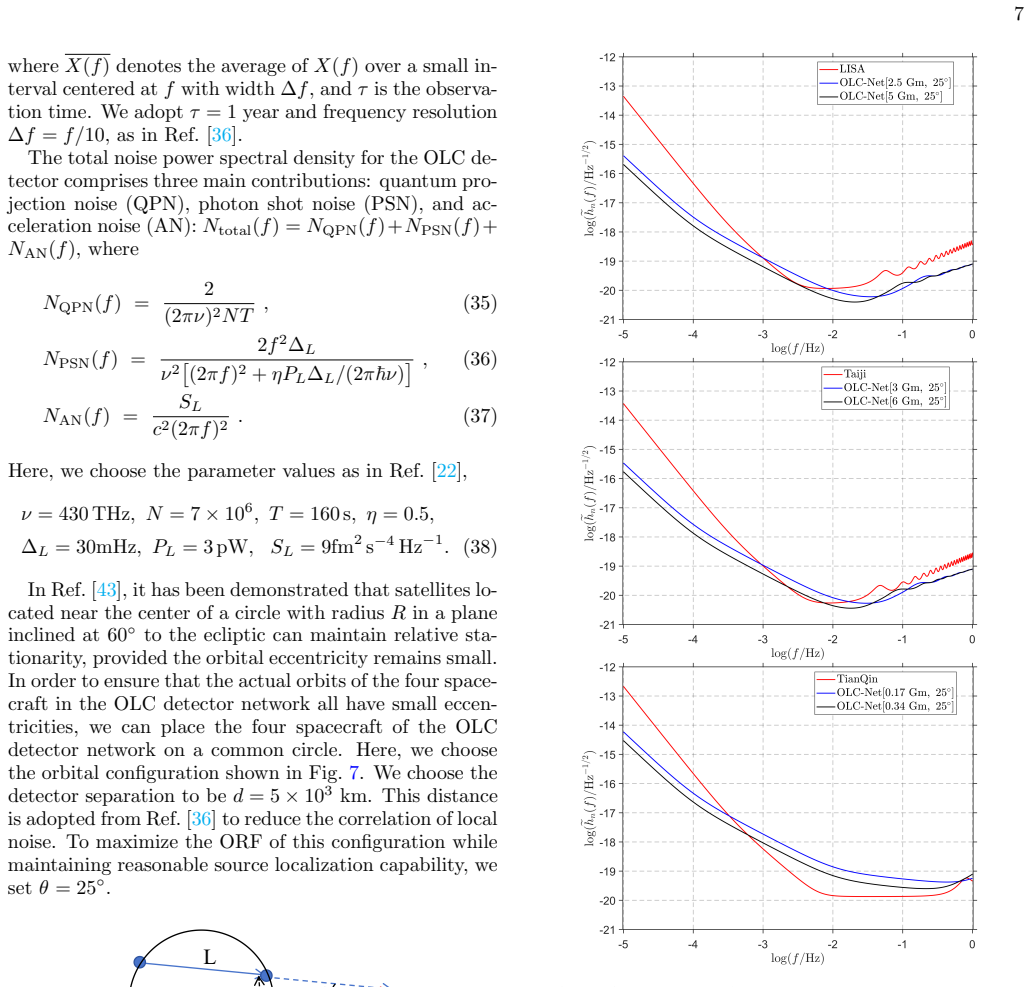
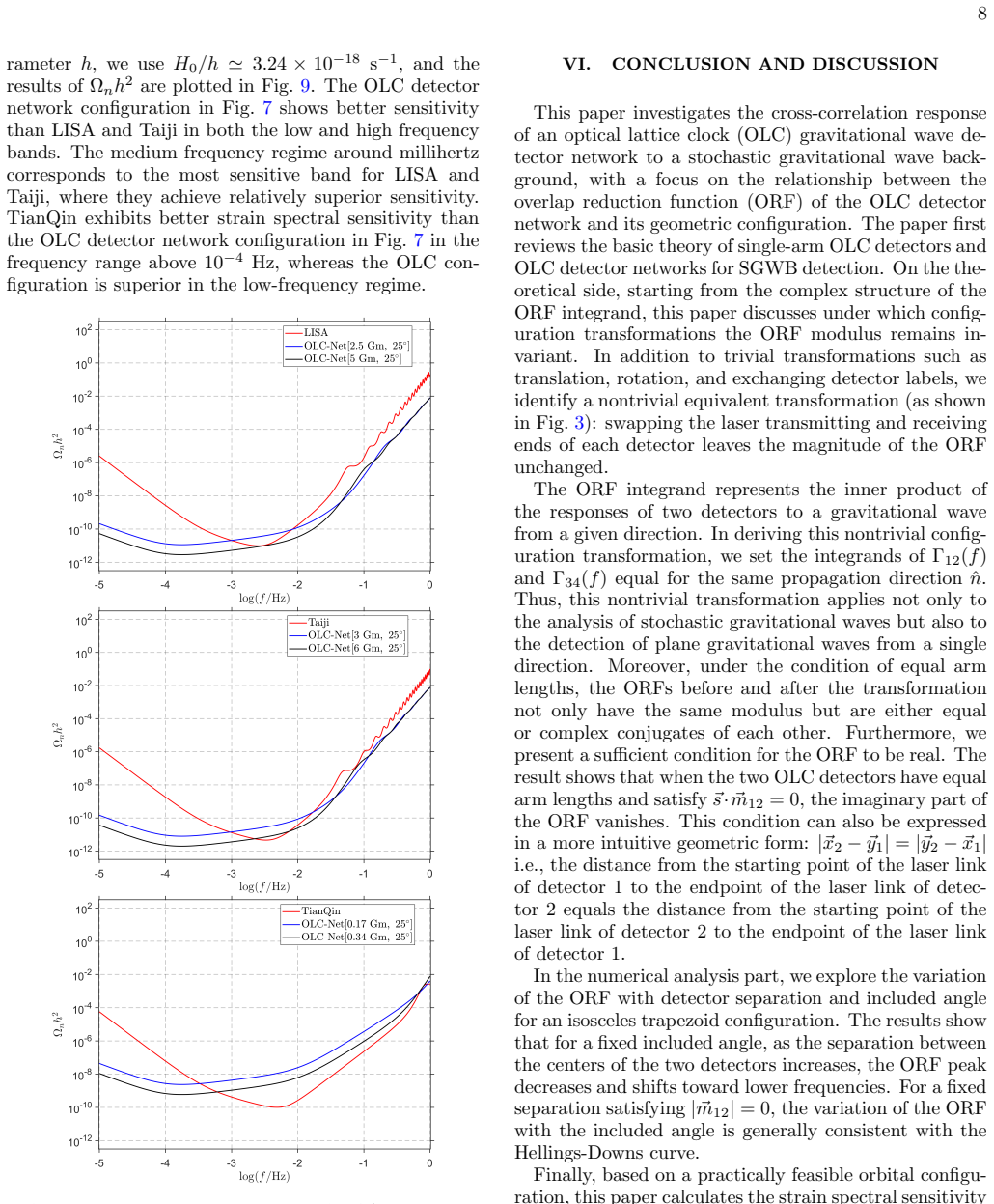
We identify an equivalent transformation in which the emitting and receiving ends of both OLC links are exchanged, while the modulus of the ORF remains invariant. We then numerically compare the ORFs of isosceles trapezoidal configurations with different separations and included angles. Based on these results, we design a feasible four-spacecraft orbital configuration and evaluate its strain sensitivity and noise energy-density spectrum in comparison with LISA, Taiji, and TianQin.
What carries the argument
The equivalent transformation that swaps the emitting and receiving ends of both optical lattice clock links while leaving the modulus of the overlap reduction function unchanged.
If this is right
- Configurations related by the end-exchange transformation produce identical detection capability for the stochastic gravitational wave background.
- Numerical evaluation shows that isosceles trapezoidal geometries with varying separations and included angles yield comparable overlap reduction functions.
- The four-spacecraft orbital design achieves strain sensitivity levels that can be directly compared with those of LISA, Taiji, and TianQin.
- The corresponding noise energy-density spectrum for the proposed network follows from the same preserved overlap reduction function.
Where Pith is reading between the lines
- Mission planners could select among equivalent geometries to satisfy secondary constraints such as propellant budgets or thermal stability without altering expected wave sensitivity.
- Repeated application of the transformation might generate larger networks whose collective overlap reduction function can be predicted without recomputing each pair.
- The same invariance could be checked when optical lattice clocks are combined with other detector technologies to test whether the modulus preservation extends across instrument types.
Load-bearing premise
The optical lattice clocks can be placed and maintained in the chosen orbital geometry with timing and position stability sufficient for the cross-correlation to reach the calculated strain sensitivity.
What would settle it
A high-precision measurement or simulation of the cross-correlation signal in the swapped-end configuration that yields a different overlap reduction function modulus than the analytic prediction would disprove the claimed invariance.
Figures


read the original abstract
This paper studies the use of optical lattice clock (OLC) detector networks for detecting the stochastic gravitational-wave background (SGWB). Starting from the cross-correlation formalism for two OLC detectors, we analyze how the detector geometry influences the overlap reduction function (ORF) and systematically search for configuration transformations that preserve the modulus of the ORF. We identify an equivalent transformation in which the emitting and receiving ends of both OLC links are exchanged, while the modulus of the ORF remains invariant. We then numerically compare the ORFs of isosceles trapezoidal configurations with different separations and included angles. Based on these results, we design a feasible four-spacecraft orbital configuration and evaluate its strain sensitivity and noise energy-density spectrum in comparison with LISA, Taiji, and TianQin.
Editorial analysis
A structured set of objections, weighed in public.
Referee Report
Summary. The manuscript analyzes optical lattice clock (OLC) networks for stochastic gravitational-wave background (SGWB) detection. It derives an equivalent transformation that exchanges the emitting and receiving ends of both OLC links while preserving the modulus of the overlap reduction function (ORF), performs numerical ORF comparisons for isosceles-trapezoid geometries with varying separations and angles, and proposes a specific four-spacecraft orbital configuration whose strain sensitivity and noise energy-density spectrum are compared to LISA, Taiji, and TianQin.
Significance. The analytical identification of the ORF-modulus-preserving link-end exchange and the subsequent numerical ORF comparisons constitute a clear geometric contribution. If the orbital-stability and timing-precision assumptions hold, the proposed configuration could supply a competitive alternative geometry for space-based SGWB searches, with the invariance property potentially simplifying network optimization.
major comments (2)
- [four-spacecraft orbital configuration] The four-spacecraft orbital configuration section proposes specific separations and included angles whose strain sensitivity h_c(f) is computed via the cross-correlation integral; however, no quantitative error budget or degradation analysis under realistic orbital perturbations is supplied, leaving the central sensitivity claims dependent on an unverified assumption of sufficient position and clock stability.
- [sensitivity evaluation] The sensitivity evaluation and noise energy-density spectrum comparisons rely on ideal overlap-reduction integrals without explicit noise models, full derivations of the integrals, or propagation of timing/position uncertainties, so the reported performance relative to LISA/Taiji/TianQin cannot be independently verified from the presented material.
minor comments (1)
- [abstract] The abstract would benefit from a brief quantitative statement of the ORF-modulus values obtained for the compared trapezoidal separations and angles.
Simulated Author's Rebuttal
We thank the referee for the detailed review and the recognition of the geometric insights in our work on OLC networks for SGWB detection. We provide point-by-point responses to the major comments and will update the manuscript to address the valid concerns raised.
read point-by-point responses
-
Referee: The four-spacecraft orbital configuration section proposes specific separations and included angles whose strain sensitivity h_c(f) is computed via the cross-correlation integral; however, no quantitative error budget or degradation analysis under realistic orbital perturbations is supplied, leaving the central sensitivity claims dependent on an unverified assumption of sufficient position and clock stability.
Authors: We concur that incorporating an error budget for orbital perturbations would enhance the robustness of our sensitivity claims. The current analysis assumes ideal orbital conditions to highlight the benefits of the equivalent configuration. In the revised manuscript, we will include a new subsection estimating the impact of small position and timing errors on the ORF modulus, using perturbative expansions, and compare to the stability levels achievable in proposed space missions. revision: yes
-
Referee: The sensitivity evaluation and noise energy-density spectrum comparisons rely on ideal overlap-reduction integrals without explicit noise models, full derivations of the integrals, or propagation of timing/position uncertainties, so the reported performance relative to LISA/Taiji/TianQin cannot be independently verified from the presented material.
Authors: The overlap reduction integrals follow the standard formalism detailed in the cited references (e.g., the cross-correlation for two detectors). We will add an appendix providing the explicit integral expressions and the assumptions on the noise power spectral densities used for the comparisons. For the propagation of uncertainties, we will add a qualitative discussion on how clock stability requirements translate to sensitivity degradation, while noting that a full Monte Carlo propagation is left for future work as it would require specific mission parameters. revision: partial
Circularity Check
No significant circularity; derivation self-contained from geometry and standard integrals
full rationale
The central claim identifies an equivalent transformation (exchanging emitting/receiving ends of OLC links) that leaves |ORF| invariant. This follows directly from the geometry of the links and the definition of the overlap reduction function via standard cross-correlation integrals, without reducing to a fitted parameter, self-definition, or load-bearing self-citation. Numerical comparisons of isosceles-trapezoid configurations and the four-spacecraft orbit proposal are presented as outputs of those integrals rather than inputs renamed as predictions. No uniqueness theorem or ansatz is smuggled via self-citation; the derivation chain remains independent of the target sensitivity results.
Axiom & Free-Parameter Ledger
free parameters (1)
- spacecraft separations and included angles
axioms (1)
- domain assumption Cross-correlation formalism for two-detector stochastic gravitational-wave searches
Reference graph
Works this paper leans on
-
[1]
B. P. Abbottet al.(LIGO Scientific, Virgo), Observation of Gravitational Waves from a Binary Black Hole Merger, Phys. Rev. Lett.116, 061102 (2016), arXiv:1602.03837 [gr-qc]
work page internal anchor Pith review Pith/arXiv arXiv 2016
-
[2]
B. P. Abbottet al.(LIGO Scientific, Virgo), GW170817: Observation of Gravitational Waves from a Binary Neu- tron Star Inspiral, Phys. Rev. Lett.119, 161101 (2017), arXiv:1710.05832 [gr-qc]
work page internal anchor Pith review Pith/arXiv arXiv 2017
-
[3]
B. P. Abbottet al.(LIGO Scientific, Virgo), Tests of general relativity with GW150914, Phys. Rev. Lett.116, 221101 (2016), [Erratum: Phys.Rev.Lett. 121, 129902 (2018)], arXiv:1602.03841 [gr-qc]
work page internal anchor Pith review Pith/arXiv arXiv 2016
-
[4]
Observation of Gravitational Waves from Two Neutron Star–Black Hole Coalescences,
R. Abbottet al.(LIGO Scientific, KAGRA, VIRGO), Observation of Gravitational Waves from Two Neutron Star–Black Hole Coalescences, Astrophys. J. Lett.915, L5 (2021), arXiv:2106.15163 [astro-ph.HE]
-
[5]
J. Aasiet al.(LIGO Scientific), Advanced LIGO, Class. Quant. Grav.32, 074001 (2015), arXiv:1411.4547 [gr-qc]
work page internal anchor Pith review Pith/arXiv arXiv 2015
-
[6]
Advanced Virgo: a 2nd generation interferometric gravitational wave detector
F. Acerneseet al.(VIRGO), Advanced Virgo: a second- generation interferometric gravitational wave detector, Class. Quant. Grav.32, 024001 (2015), arXiv:1408.3978 [gr-qc]
work page internal anchor Pith review Pith/arXiv arXiv 2015
-
[7]
K. Somiya (KAGRA), Detector configuration of KA- GRA: The Japanese cryogenic gravitational-wave de- tector, Class. Quant. Grav.29, 124007 (2012), arXiv:1111.7185 [gr-qc]
-
[8]
Punturoet al., The Einstein Telescope: A third- generation gravitational wave observatory, Class
M. Punturoet al., The Einstein Telescope: A third- generation gravitational wave observatory, Class. Quant. Grav.27, 194002 (2010)
work page 2010
-
[9]
P. A. Seoaneet al.(eLISA), The Gravitational Universe, ArXiv (2013), arXiv:1305.5720 [astro-ph.CO]
work page internal anchor Pith review Pith/arXiv arXiv 2013
-
[10]
W.-R. Hu and Y.-L. Wu, The Taiji Program in Space for gravitational wave physics and the nature of gravity, Natl. Sci. Rev.4, 685 (2017)
work page 2017
-
[11]
TianQin: a space-borne gravitational wave detector
J. Luoet al.(TianQin), TianQin: a space-borne gravi- tational wave detector, Class. Quant. Grav.33, 035010 (2016), arXiv:1512.02076 [astro-ph.IM]
work page internal anchor Pith review Pith/arXiv arXiv 2016
-
[12]
S. L. Detweiler, Pulsar timing measurements and the search for gravitational waves, Astrophys. J.234, 1100 (1979)
work page 1979
-
[13]
The Astrophysics of Nanohertz Gravitational Waves
S. Burke-Spolaoret al., The Astrophysics of Nanohertz Gravitational Waves, Astron. Astrophys. Rev.27, 5 (2019), arXiv:1811.08826 [astro-ph.HE]
work page internal anchor Pith review Pith/arXiv arXiv 2019
-
[14]
Z. Arzoumanianet al.(NANOGrav), The NANOGrav 12.5 yr Data Set: Search for an Isotropic Stochastic Gravitational-wave Background, Astrophys. J. Lett.905, L34 (2020), arXiv:2009.04496 [astro-ph.HE]
-
[15]
B. Goncharovet al., On the Evidence for a Common- spectrum Process in the Search for the Nanohertz Gravitational-wave Background with the Parkes Pul- sar Timing Array, Astrophys. J. Lett.917, L19 (2021), arXiv:2107.12112 [astro-ph.HE]
- [16]
-
[17]
J. Antoniadiset al., The International Pulsar Timing Ar- ray second data release: Search for an isotropic gravita- tional wave background, Mon. Not. Roy. Astron. Soc. 510, 4873 (2022), arXiv:2201.03980 [astro-ph.HE]
- [18]
-
[19]
INO: Interplanetary Network of Optical Lattice Clocks
T. Ebisuzaki, H. Katori, J. Makino, A. Noda, H. Shinkai, and T. Tamagawa, INO: Interplanetary Network of Op- tical Lattice Clocks, Int. J. Mod. Phys. D29, 1940002 (2019), arXiv:1809.10317 [astro-ph.IM]
work page internal anchor Pith review Pith/arXiv arXiv 2019
-
[20]
An atomic clock with $10^{-18}$ instability
N. Hinkley, J. A. Sherman, N. B. Phillips, M. Schioppo, N. D. Lemke, K. Beloy, M. Pizzocaro, C. W. Oates, and A. D. Ludlow, An Atomic Clock with 10–18 Instability, Science341, 1215 (2013), arXiv:1305.5869 [physics.atom- ph]
work page internal anchor Pith review Pith/arXiv arXiv 2013
-
[21]
B. J. Bloom, T. L. Nicholson, J. R. Williams, S. L. Campbell, M. Bishof, X. Zhang, W. Zhang, S. L. Brom- 11 ley, and J. Ye, An Optical Lattice Clock with Accuracy and Stability at the 10 −18 Level, Nature506, 71 (2014), arXiv:1309.1137 [physics.atom-ph]
work page internal anchor Pith review Pith/arXiv arXiv 2014
-
[22]
Gravitational wave detection with optical lattice atomic clocks
S. Kolkowitz, I. Pikovski, N. Langellier, M. D. Lukin, R. L. Walsworth, and J. Ye, Gravitational wave detec- tion with optical lattice atomic clocks, Phys. Rev. D94, 124043 (2016), arXiv:1606.01859 [physics.atom-ph]
work page internal anchor Pith review Pith/arXiv arXiv 2016
-
[23]
Stochastic Gravitational Wave Backgrounds
N. Christensen, Stochastic Gravitational Wave Back- grounds, Rept. Prog. Phys.82, 016903 (2019), arXiv:1811.08797 [gr-qc]
work page internal anchor Pith review Pith/arXiv arXiv 2019
-
[24]
Gravitational Wave Experiments and Early Universe Cosmology
M. Maggiore, Gravitational wave experiments and early universe cosmology, Phys. Rept.331, 283 (2000), arXiv:gr-qc/9909001
work page internal anchor Pith review Pith/arXiv arXiv 2000
-
[25]
Cosmological Backgrounds of Gravitational Waves
C. Caprini and D. G. Figueroa, Cosmological Back- grounds of Gravitational Waves, Class. Quant. Grav.35, 163001 (2018), arXiv:1801.04268 [astro-ph.CO]
work page internal anchor Pith review Pith/arXiv arXiv 2018
-
[26]
Gravitational wave bursts from cusps and kinks on cosmic strings
T. Damour and A. Vilenkin, Gravitational wave bursts from cusps and kinks on cosmic strings, Phys. Rev. D64, 064008 (2001), arXiv:gr-qc/0104026
work page internal anchor Pith review Pith/arXiv arXiv 2001
-
[27]
X. Siemens, V. Mandic, and J. Creighton, Gravitational wave stochastic background from cosmic (super)strings, Phys. Rev. Lett.98, 111101 (2007), arXiv:astro- ph/0610920
-
[28]
Witten, Cosmic Separation of Phases, Phys
E. Witten, Cosmic Separation of Phases, Phys. Rev. D 30, 272 (1984)
work page 1984
-
[29]
Gravitational Radiation from First-Order Phase Transitions
M. Kamionkowski, A. Kosowsky, and M. S. Turner, Grav- itational radiation from first order phase transitions, Phys. Rev. D49, 2837 (1994), arXiv:astro-ph/9310044
work page internal anchor Pith review Pith/arXiv arXiv 1994
-
[30]
V. F. Mukhanov, H. A. Feldman, and R. H. Branden- berger, Theory of cosmological perturbations. Part 1. Classical perturbations. Part 2. Quantum theory of per- turbations. Part 3. Extensions, Phys. Rept.215, 203 (1992)
work page 1992
- [31]
- [32]
-
[33]
S. R. Taylor and J. R. Gair, Cosmology with the lights off: standard sirens in the Einstein Telescope era, Phys. Rev. D86, 023502 (2012), arXiv:1204.6739 [astro-ph.CO]
work page internal anchor Pith review Pith/arXiv arXiv 2012
-
[34]
B. Allen and J. D. Romano, Detecting a stochastic background of gravitational radiation: Signal process- ing strategies and sensitivities, Phys. Rev. D59, 102001 (1999), arXiv:gr-qc/9710117
work page internal anchor Pith review Pith/arXiv arXiv 1999
-
[35]
Sensitivity curves for searches for gravitational-wave backgrounds
E. Thrane and J. D. Romano, Sensitivity curves for searches for gravitational-wave backgrounds, Phys. Rev. D88, 124032 (2013), arXiv:1310.5300 [astro-ph.IM]
work page internal anchor Pith review Pith/arXiv arXiv 2013
- [36]
- [37]
- [38]
-
[39]
R. w. Hellings and G. s. Downs, UPPER LIMITS ON THE ISOTROPIC GRAVITATIONAL RADIATION BACKGROUND FROM PULSAR TIMING ANALY- SIS, Astrophys. J. Lett.265, L39 (1983)
work page 1983
-
[40]
N. J. Cornish and S. L. Larson, Space missions to detect the cosmic gravitational wave background, Class. Quant. Grav.18, 3473 (2001), arXiv:gr-qc/0103075
work page internal anchor Pith review Pith/arXiv arXiv 2001
-
[41]
The construction and use of LISA sensitivity curves
T. Robson, N. J. Cornish, and C. Liu, The construction and use of LISA sensitivity curves, Class. Quant. Grav. 36, 105011 (2019), arXiv:1803.01944 [astro-ph.HE]
work page internal anchor Pith review Pith/arXiv arXiv 2019
-
[42]
Z. Luo, Y. Wang, Y. Wu, W. Hu, and G. Jin, The Taiji program: A concise overview, PTEP2021, 05A108 (2021)
work page 2021
-
[43]
S. V. Dhurandhar, K. Rajesh Nayak, S. Koshti, and J. Y. Vinet, Fundamentals of the LISA stable flight formation, Class. Quant. Grav.22, 481 (2005), arXiv:gr-qc/0410093
work page internal anchor Pith review Pith/arXiv arXiv 2005
-
[44]
H. Jiang, B. Xu, and Y.-L. Zhang, Artificial Precision Polarization Array: Sensitivity for the axion-like dark matter with clock satellites, (2025), arXiv:2511.04400 [astro-ph.CO]
work page internal anchor Pith review Pith/arXiv arXiv 2025
-
[45]
Y.-Y. Liu, J.-R. Zhang, M.-H. Du, H.-S. Liu, P. Xu, and Y.-L. Zhang, Detectability of axion-like dark mat- ter for different time-delay interferometry combinations in space-based gravitational wave detectors, (2025), arXiv:2511.15438 [gr-qc]
work page internal anchor Pith review Pith/arXiv arXiv 2025
discussion (0)
Sign in with ORCID, Apple, or X to comment. Anyone can read and Pith papers without signing in.